




















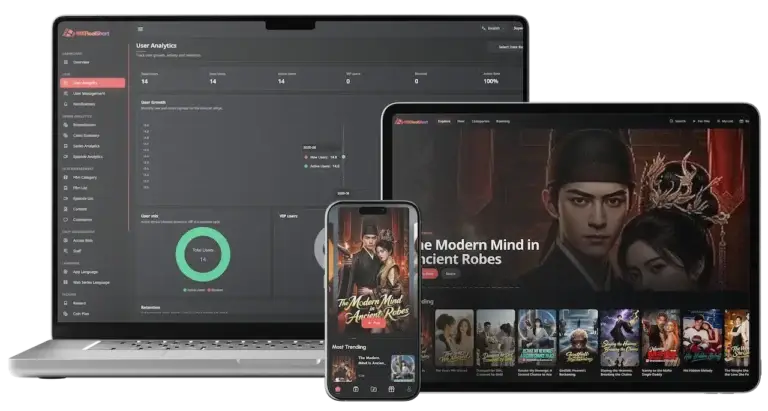
White Label Micro Drama App - Vertical Short-Drama OTT with Coin & VIP Monetization, Under Your Own Brand
A vertical short-drama platform delivered under your own name in six working days. Viewers watch a free opening window, then unlock what follows with coins, a rewarded ad, or an active VIP period. The catalog, the coin economy, the branded apps and the full source code are handed to you.
Three clients, one Express and MongoDB API. Coins and VIP are first-class entities rather than a paywall bolted onto a player, and the operator console reads the same ledger the wallet writes.
Go Live in 6 Days with Short DramaCoin UnlockVIP WindowsAd SupportedRTL ReadyWhite-Label
⚡ Platform at a Glance
6
Revenue Streams
coins, VIP windows, rewarded ads, episode pricing
2
Balances Per User
reward coins and purchased coins, spent in order
0
Card Data Stored
checkout is hosted, no card number reaches you
100%
Your Brand
no supplier name in the app, stores or admin
Launch a Short-Drama App as Your Own
Name, palette, catalog and coin pricing are operator settings, so the product reaches your market as your brand rather than as a licensed skin a viewer could recognise.
One API, Three Clients
Android, iOS and web share the same catalog, wallet and settings contracts, so a price change or a new title appears everywhere at once instead of three separate times.
🚀 Ready to launch your own short-drama platform?
Live in Action
Live Demo - Viewer App, Episode Store, Operator Console & Android Build
Skip the brochure. We hand over working logins to the running platform – viewer side and operator console – so you can watch an episode, hit the paywall, spend coins to pass it, then swing round to the console and resolve the report you just filed.
CONSUMER WEB APP
Viewer App - Watch & Unlock
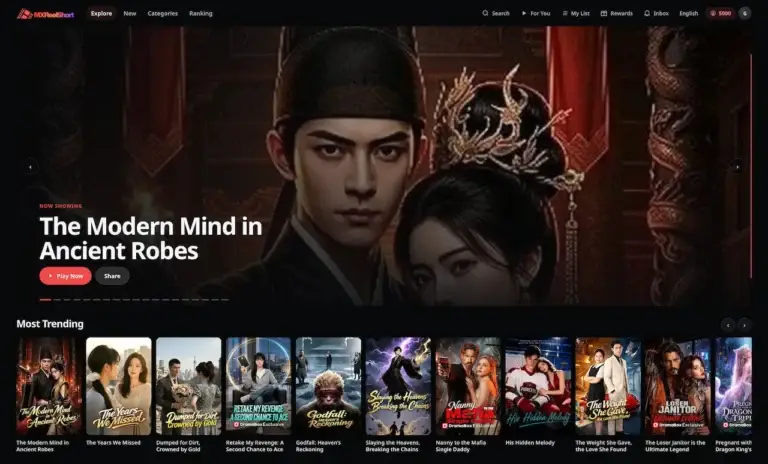
What a viewer sees: banner rails, trending, new releases, coming soon, For You trailers, search, and a vertical episode player carrying lock, comments, likes and subtitles.
-
Open the web app in your browser
-
Login with the demo credentials below
-
Explore: Rails, For You, Watch, Unlock
-
Try: webuser@demo.com | User_$321
STORE & REWARDS
Coins, VIP Plans & the Rewards Ladder
Where the money moves: coin packs with bonus coins, VIP plans by validity window, a seven day check-in ladder, ad reward tasks, social follow and email bonuses, and referral credit.
-
Open the web app in your browser
-
Login with the same credentials below
-
Explore: Store, Check-in, Rewards, Referral
-
Try: webuser@demo.com | User_$321
ADMIN CONSOLE
Cinema Operations & Governance
Running it day to day, from its own subdomain: overview analytics, film category and list, episode reorder, users and wallets, coin and VIP plans, reports, staff roles and settings.
-
Open the admin console in your browser
-
Login with the demo credentials below
-
Explore: Overview, Film List, Users, Settings
-
Try: admin@demo.com | Admin_$321 (view-only demo role)
ANDROID APP
Android Build - Your Brand, Your Store Listing
Shipped as Flutter: five tabs, episode-wise reels with a comment sheet, coin and ad unlock, wallet histories, rewards quests, and the same five locales as the web app.
-
Download the app to your Android device
-
Login with the viewer credentials below
-
Explore: Home, Reels, My List, Rewards
-
Try: webuser@demo.com | User_$321
Watch It Work
Micro Drama Platform Walkthrough: Catalog, Coin Unlock & Operator Console
Want a guided tour? Book a 30 minute call with our team and map your launch: catalog ingest, free episode window, coin pricing, VIP tiers, gateway selection and go-live sequencing.
Every Screen Mapped
Micro Drama App Flows - Viewer, Store, Operator & Mobile Screens
Roughly 202 registered API handlers, 60 on the client router and 142 on the admin router, backing a consumer web app, a Flutter store build and a Next.js operator console.


Follow a guest from a first free episode through a lock to a coin unlock, a buyer from coin pack to VIP window, and an operator from catalog upload through episode reorder to a resolved report.
Client Voices
Operator Reviews - Real Micro Drama Platforms, Real Results
Feedback from operators who launched short-drama platforms with Miracuves. Client identities withheld under NDA.
Proof in Production
Case Study - A White Label Micro Drama Deployment
A regional operator took this platform to market under its own name and its own catalog. Client identity withheld under NDA.
Confidential Deployment
Short-Drama OTT Platform
A regional short-drama service launched on this platform under its own brand, with coin unlock, VIP windows and a rewards ladder live from day one.
- Monetizing episode by episode without pushing viewers to a subscription wall
- Hebrew and Arabic right-to-left layout across web, app and console
- One catalog and one wallet shared by web, store app and operator console
- Launch a short-drama OTT without building a wallet and unlock engine from zero
- Give operators a cinema console instead of a raw database
- Run coin, VIP and ad unlock as three tenders at once
- Vertical episode player with subtitle track and continue watching
- Coin packs, VIP windows & a seven day rewards ladder
- Five locales with right-to-left layout
- Likes, episode comments, reports & My List
- One Express API behind nginx and PM2
"Coin unlock changed the economics. Viewers who would never buy a subscription still pay for the next episode."
The Basics
What Is a White Label Micro Drama App?
Vertical drama sells in ninety-second pieces, which makes the platform underneath it a paywall with a player attached. Categories, titles and numbered episodes sit on one side. A wallet that decides – free window, coins, rewarded ad, or an active VIP period – sits on the other. White label means both sides carry your name from the first frame, and the source code that runs them is handed to you.
Not a Video CMS
The unlock model is the value, not the file manager. Catalog lock, free window, per-user override rows and a typed ledger let one episode be sold three different ways without the wallet drifting.
Not a Rental Platform
Handover, not access: the source, the 33 model schema and the seed script are yours. No per-seat fee, no dependency on our roadmap, and a standard MongoDB underneath.
Honest About Readiness
Three things are stated up front rather than found later: web ad unlock is a simulated preview, passwords use Cryptr rather than bcrypt, and cash-out exists as data architecture only.
Built for Web, Android & API
What Does White Label Ownership Mean Here?
What carries your brand. The viewer app, the store listing and its icon, the episode player, the coin store, the transactional emails, the invoices, the VIP badge and the operator console all render your name and nothing else. There is no vendor watermark on the player, no attribution line in the footer, and no third-party name in the app store metadata a viewer reads before installing.
What you own outright. The full source code is handed over: the consumer web application, the Next.js operator console, the Express API with all 33 Mongoose models, the Flutter build and the seed catalog script. It deploys on your server, your domain, your merchant account and your own ad network IDs. Coin balances, viewer records, watch history and payout data sit in a database you hold, and you can read, export or migrate them without asking us.
What white label does not mean. It does not mean a hosted service with your logo swapped in. If a provider keeps the source code, controls the deployment, or takes a percentage of every coin pack sold, that is a SaaS licence wearing your brand. This is a handover: afterwards you can hire another team, fork the code, or run it untouched for five years without our permission. What it also does not include is the catalog. The platform ships empty, and licensing the episodes you publish is yours to arrange.
The hard part of short drama is not the player. It is pricing an episode rather than a subscription, keeping the wallet honest across three clients, and giving an operator somewhere to run the catalog and the economy without touching the database. Those are what this ships with.
-
Vertical episodes with a configurable free window
-
Coin, rewarded ad and VIP unlock on the same episode
-
Reward and purchased coin split with expiry
-
PayPlus hosted checkout with no card data stored
-
Five locales with right-to-left layout
Put plainly: the year of engineering that sits between an idea and a working coin-and-VIP drama service is already done, and it is handed over under your name. Three surfaces – a consumer web app, a Flutter store build and an operator console – already agree with each other. Underneath sit 33 Mongoose models on MongoDB, roughly 202 registered API handlers, a 24 module permission system, and five locales with right-to-left layout for Hebrew and Arabic.
Everything Included
Micro Drama Platform Features - Catalog, Unlock, Wallet, Rewards & Operations
Nothing on this list is a roadmap item. Every capability below runs in the live demo you can open above, and where something needs a third-party account or ships as a preview rather than a live integration, it says so against the feature instead of being quietly implied away.
Catalog & Content Types
Publishing runs straight from the console: categories, titles typed as movie or web series, and numbered episodes, with episode 0 reserved by convention as the trailer.
- Categories, titles and numbered episodes
- Movie and web series content types
- Episode 0 as the trailer convention
- Poster, banner and auto-animated hero toggles
Discovery Rails
Five rails carry the home screen - banner carousel, trending, new releases, coming soon and category - and coming soon titles are excluded from every other rail, so an unreleased title never leaks onto a shelf.
- Banner carousel, trending and new release rails
- Coming soon rail with an announce date
- Category rails grouped from the catalog
- Coming soon titles excluded from other rails
Search & My List
Matching runs on title and plot with an optional genre filter on both consumer surfaces. My List is held at series level, and continue watching stays on the client.
- Search on title and plot with an optional genre
- For You trailers grouped by title
- My List at the series level
- Continue watching stored on the client
Vertical Episode Player
Playback is sequential and carries a subtitle track, likes, episode comments capped at 400 characters, reports, share, and immersive fullscreen on the store build.
- Vertical episode player with sequential play
- Subtitle track from a stored VTT or SRT file
- Likes, episode comments capped at 400 characters
- Reports with operator-defined reasons
Three Ways to Unlock
The free window is set globally, coin unlock is priced per episode, and rewarded ad unlock carries a per-title daily cap, with auto-unlock available for the remainder of a title.
- Free episode window set from one setting
- Coin unlock priced per episode
- Rewarded ad unlock with a per-title daily cap
- Auto-unlock for the rest of a title
Coin Wallet with Expiry
Reward and purchased balances are tracked apart, spend draws reward first, promotional balances expire on a configurable window, and a typed ledger sits behind every movement.
- Reward coins and purchased coins tracked apart
- Spend draws reward coins first
- Promotional coins carry an expiry window
- Seven typed ledger codes for earn and spend
Coin Packs & VIP Plans
SKUs carry a bonus coin allowance and an offer price, sell through hosted checkout or a store billing flow, and land in a purchased balance that never expires.
- Coin packs with bonus coins and an offer price
- VIP plans by validity and validity type
- PayPlus hosted checkout with no card data stored
- Stripe, Razorpay, Flutterwave and Play switches
Rewards Ladder
Return visits are bought with inventory rather than cash: a seven day check-in with a streak, ad reward tasks under a daily cap, social follow and email bonuses, a login bonus, and a referral loop that credits the referrer.
- Seven day check-in ladder with a streak
- Ad reward tasks with a daily cap
- Social follow bonuses on your own channels
- Email bonus, login bonus and referral rewards
Operator Analytics
Everything reads live operational data: overview counts and charts, user analytics, monetization and the coins economy, and performance at both series and episode level.
- Overview, user, monetization and coins analytics
- Series and episode level analytics
- Order history for coin and VIP purchases
- Currency catalog with a default for checkout
Catalog Operations
Film category, film list and episode modules carry drag and drop reorder that renumbers and relocks as it goes, alongside subtitle upload and region chips for catalog targeting.
- Film category, film list and episode modules
- Drag and drop episode reorder with relocking
- Subtitle upload with language and format
- Region chips for catalog targeting
Staff Roles & Demo Operator
Permissions run 24 modules across list, create, edit and delete, with staff bound to named roles. The demo operator writes are refused by the server, not hidden by the interface.
- 24 permission modules across four actions
- Staff accounts bound to a named role
- Server-enforced view-only demo operator
- Block users, hide comments, resolve reports
Campaign Desk & Inbox
Templates, audience selection, scheduling and cancellation come with campaign stats, and every targeted user gets an in-app inbox row whether or not device push is configured.
- Campaign desk with templates and audiences
- Schedule, cancel and review campaign stats
- In-app inbox written for every targeted user
- Device push needs a Firebase project
Note for buyers: The software is complete on delivery; the accounts around it are yours to open. Payment gateways, AdMob, Firebase push, Resend mail and S3 or DigitalOcean storage all run on your own credentials. Web ad unlock is a simulated timed preview rather than a live ad network, with AdMob as the live path on the Flutter build. Live VIP checkout inside the store app is configuration required. Cash-out models exist in the schema, but the payout workflow is advanced setup.
How Operators Earn
Micro Drama Revenue Models - Coins, VIP, Ads & Licensing
Revenue arrives from four directions at once here, and each is modelled as its own lever, so raising one does not quietly damage another.
Coin Pack Sales
Coin SKUs with bonus coins and an offer price, purchased through hosted checkout or a store billing flow, credited to a purchased balance that never expires.
VIP Subscription Windows
Pricing is by validity and validity type. An active plan writes an entitlement window onto the user record, and every locked episode opens for as long as that window runs.
Rewarded Ad Inventory
Ads act as a third tender: a viewer without coins watches a rewarded unit to open episodes, under a per-title daily cap the operator sets.
Per-Episode Pricing
Price lives on the episode itself, so a season finale can cost more than an opener, and the free window can be tightened or loosened without shipping a release.
Rewards as Retention
Coins, not cash, pay for the seven day ladder, the social bonuses and the referral credits. Return visits get bought with inventory the operator already controls.
White-Label Licensing
Every identity-bearing setting is runtime configuration - branding, locales, currency, plans and reward tables - so the same deployment can be licensed onward to another operator under their own name.
Coin packs and VIP are the two that actually move the numbers, because they are aimed at two different people: the viewer who spends at midnight to find out how it ends, and the one who has decided this is now a habit.
Run It Without a Dev Team
Operator Console - Catalog, Economy, Staff & Settings
The operator console runs on its own subdomain with a one hour session, 24 permission modules across four actions, and a demo role whose writes are refused by the server rather than merely hidden by the interface.
Admin Console Sections
Overview
Date bounded counts with user and revenue charts plus a paid revenue trend, reading live operational data rather than a warehouse.
User Management
Paginated users with search and country filter, profile and history views, wallet inspection, a block toggle and a balance adjustment.
Monetization & Coins
Paid revenue monitoring, series revenue breakdown, top revenue episodes, and coin economy analytics tied to the ledger codes.
Film Category & List
Genre buckets plus titles with poster, banner, type, trending, coming soon, auto-animate and active toggles, and region chips for targeting.
Episode List & Reorder
Episodes with image, video, duration, coin price and lock, drag and drop reorder that renumbers and relocks, and a subtitle upload dialogue.
Comments & Reports
Paginated comments with a hide action, plus a report queue with operator-defined reasons and a solved state that notifies the reporter.
Coin & VIP Plans
SKU creation with coins, bonus coins, price, offer price and a store product key, plus VIP plans by validity, with order history for both.
Rewards, Four Tabs
Ad coin reward, daily coin reward across seven days, login and social rewards with follow URLs, and the referral reward amount.
Access Roles & Staff
Named roles carrying module and action grants, staff accounts bound to a role, and a sidebar that hides what a role does not include.
- General settings with policy links and store links
- Storage as local, AWS S3 or DigitalOcean Spaces
- Payment switches and keys per gateway
- AdMob unit IDs for Android and iOS
Settings & Campaigns
General, storage, payment, ads, language, currency and profile tabs, alongside the notification campaign desk with scheduling and stats.
- Language flags across five locales
- App language JSON editing for client copy
- Currency catalog with a default for checkout
- Report reasons shown in the client report sheet
Need deeper governance? Today staff permissions are enforced in the admin shell; pushing that enforcement down to every API route is a scoped customization. The documentation also names a persistent audit collection, a health endpoint, request rate limiting and a CORS allow-list. Tell us which of those your review board requires and we will scope it before deployment.
Transparent Pricing
How Much Does a White Label Micro Drama App Cost in 2026?
Deployment starts at $3,399 for a launch-ready platform in your own branding, with the source code handed over. What moves the number is catalog size, which payment gateway clears you, ad network setup, the storage and CDN tier your episode library needs, and whether the store build ships alongside the web app.
Not sure which option
is right for you?
Talk to us - we'll understand your goals, timeline, and budget, and point you to exactly what you need. No upselling, just honest advice.
The Full Package
What's Included - Full Source Code, Branded Apps & Deployment
Delivery here is a handover, not access. You receive the application source, the schema behind it, and the documentation a technical buyer will ask to see. Ownership transfers in full: no runtime licence, no per-seat fee, no revenue share, and no dependency on what we choose to build next.
Full Source Code
Four codebases transfer: the consumer web application, the Next.js 14 operator console, the Express API and the Flutter store build. Modify, rebrand and redeploy them without licence conditions.
- Consumer web application on Vite and React
- Operator console on Next.js 14
- Express API with Mongoose models
- Flutter application for iOS and Android
33 Model Schema
Six domains are modelled on MongoDB - identity, catalog, engagement, messaging, commerce and configuration - with a seed script and indexes placed on the paths the player and the ledger actually hit.
- 33 Mongoose models on MongoDB
- Seed catalog script with demo titles
- Indexes on the catalog and ledger hot paths
- Unique compound keys on the unlock rows
Consumer Web App
Ships with rails, search, For You trailers, the vertical player carrying subtitles and comments, My List, the store, rewards, inbox, profile and the legal CMS routes.
- Vertical episode player with subtitle track
- Rails, search, For You trailers and My List
- Store, rewards ladder and referral
- Legal CMS pages and a language picker
Flutter Store App
Five tabs, episode-wise reels, coin and ad unlock, wallet histories, rewards quests, five locales, referral, and native screenshot restriction on the device.
- Five locales with right-to-left layout
- App language JSON editing in the console
- Series language catalog kept separate
- Default locale set from settings
Operator Console
Overview and analytics sit alongside catalog and episode modules, users and wallets, plans and orders, reports, staff roles, campaigns and the settings tabs.
- Coin and VIP plan modules with order history
- PayPlus hosted checkout plus four more switches
- Reward tables across four operator tabs
- Currency catalog driving checkout display
Payments & Wallet
PayPlus hosted checkout leads, with four further gateway switches behind it, plus coin and VIP plans, a typed ledger, and reward coin expiry handled in the wallet helpers.
- 24 permission modules across four actions
- Server-enforced view-only demo operator
- Block, comment hide and report queue
- Campaign desk with an in-app inbox
Upload & Storage
Storage is a switch across local disk, AWS S3 and DigitalOcean Spaces. Magic-byte inspection sits in front of it and discards renamed executables, archives and PDFs.
- Storage switch across local, S3 and Spaces
- Magic-byte inspection on every upload
- Midnight crons resetting the ad counters
- Minute cron dispatching due campaigns
Technical Documentation
Seven documents ship: entity relationship, schema reference, the complete API collection, a developer handbook, a security handbook, the VAPT posture, and the PRD with feature catalogue.
- Entity relationship and schema references
- Complete API collection across both routers
- Developer and security handbook
- VAPT posture, PRD and feature catalogue
Want to see it running first? Use the viewer or operator login above, or book a walkthrough where we take you through a locked episode, a coin unlock, a VIP window and a resolved report, modelled against your own catalog rather than ours.
Know Your Buyer
Who Is This White Label Micro Drama Platform Built For?
This fits operators who hold or license vertical drama and want to charge for it episode by episode instead of asking every viewer for a monthly commitment.
Short-Drama Studios
Regional OTT Operators
Content Licensors
App Publishers
Media Brands & Networks
White-Label Drama Networks
Renting a distribution channel means the channel keeps the viewer relationship, the payment rail and the behavioural data. Owning the platform inverts all three. If you are licensing short-form drama, converting casual watchers into payers without asking for a monthly commitment, or running one catalog across a web app and a store build, the argument for owning the layer is plain: it is the only part of the business that does not expire when a content deal does.
Where It Fits
Micro Drama Use Cases - Studios, Regional OTT, Licensors & Publishers
Which part leads changes with the operator; the codebase does not. A studio leads with catalog and episode pricing, a regional service with locales and the payment rail, a licensor with reporting. All three are configuration, and none of them is a fork you then have to maintain.
Studios with Owned Catalog
Run an owned catalog of vertical series with episode level coin pricing, a free window you can move from a settings screen, and analytics that show which titles and which episodes actually convert.
Regional OTT Services
Launch a market focused service with five locales, right-to-left layout for Hebrew and Arabic, a currency catalog, and a hosted payment rail suited to the region you are selling into.
Content Licensors
Distribute licensed drama with catalog management, per-title region targeting, order history and series analytics you can put in front of a rights holder without exporting collections by hand.
App Publishers
Ship a store presence where the Flutter build, the web companion and the operator console share one API, so entitlements never differ between what a reviewer sees and what a customer gets.
Media Brands & Networks
Extend a media brand into short vertical drama with runtime branding, legal CMS pages, staff roles scoped by module, and a demo operator you can hand to a partner safely.
White-Label Drama Networks
Operate several branded services where each is its own database, domain pair and store binary, which is the single-tenant model this platform is built around.
One platform, many configurations. Every use case above runs on the same 33 model schema and the same three clients. The catalog, the free window, the coin prices, the locales and the gateway all change. The codebase does not.
Market Timing
Why Launch a Short-Drama Platform in 2026?
Asking for a monthly subscription loses the buyer who has not decided anything yet. Selling one episode at a time does not. Vertical drama reaches a viewer subscription streaming never converts: the person who will not sign up for a month will still spend on the next three episodes at midnight.
Micro-Payments Beat Subscriptions
Intent is highest at the cliffhanger, and a coin unlock collects it there. A subscription asks for a decision about next month; a coin asks about the next four minutes.
Three Tenders, One Episode
One lock, three keys. A viewer with no money, some money, or an established habit each has a route through it, and every route pays the operator something.
Vertical Is the Format
The content is shot and watched vertically, so the platform is built that way rather than adapted into it - vertical episodes, trailer conventions and reels-style discovery throughout.
Catalog Economics Are Measurable
Which title converts, and which episode is where viewers stop paying, both show up in series and episode analytics. That is the feedback loop deciding what you license next.
RTL Markets Are Underserved
Right-to-left layout for Hebrew and Arabic runs across web, app and console as built behaviour rather than a retrofit, and that is precisely what disqualifies most alternatives.
Buy-Versus-Build Is Settled
From scratch, an equivalent is most of a year of work across catalog, wallet, unlock, store apps and console. This deployment is live on your server in under six days.
Platform by the Numbers
The year goes into this layer, not into the player. A wallet with two balance types, an unlock decision with four inputs, a rewards ladder and an operator console are each unglamorous, each mandatory, and each slow to get right the first time.
Under the Hood
Micro Drama Tech Stack - Node.js, Express, MongoDB, React & Flutter
Behind the player, three things have to hold: a wallet that cannot drift, an unlock decision made identically on every client, and a console that stays usable as the catalog grows past a few hundred titles. Here is how each one is built.
Consumer Web Application
Vite · React · React Router
- Static single page application on the apex domain
- Rails, search, For You trailers, watch, store, rewards and profile
- Locale provider spanning five languages with RTL
- Continue watching kept in browser storage
Operator Console
Next.js 14 · Redux · ApexCharts
- Pages router, running on its own subdomain
- Overview and revenue charts rendered client side
- Sidebar filtered by whichever role signed in
- The same five locale packs as the consumer surfaces
One API for Three Clients
Node.js · Express · Mongoose
- Client router and admin router on one service
- Around 202 handlers registered across the two
- Shared secret gate on client calls, one hour console session
- Start and limit pagination on every list endpoint
Catalog, Wallet & Ledger
MongoDB · 33 Models
- Categories, titles and numbered episodes carrying lock and coin price
- Reward and purchased balances behind a typed seven code ledger
- Unique compound keys on every per-user unlock row
- Indexes on active titles, release date and ledger timelines
Store Application
Flutter · GetX · iOS and Android
- Five tabs, episode-wise reels and a comment sheet
- Coin, rewarded ad and auto-unlock paths
- Wallet histories, rewards quests and referral
- Native screenshot restriction with immersive fullscreen
Edge, Storage & Jobs
nginx · PM2 · node-cron
- Reverse proxy denying .env and .git
- Storage switch across local disk, AWS S3 and DigitalOcean Spaces
- Magic-byte inspection discarding disguised uploads
- Midnight ad counter reset and a minute campaign dispatcher
Note for Tech Buyers: what you are getting is a request and response JSON API – no WebSocket module, no Redis queue, no transcoding pipeline. The platform plays the URLs you store, which makes a CDN, a bitrate ladder or DRM deployment choices rather than shipped modules. Payment gateways, AdMob, Firebase push, Resend mail and object storage each run on your own account. The documentation also publishes its own hardening list: password hashing currently uses reversible encryption rather than a slow hash, request rate limiting is not bundled, CORS defaults open, the client settings payload is unscoped, and staff permissions are enforced in the console rather than on every route. Those are closed with you at deployment.
End to End
How a Micro Drama Platform Works - Discover, Watch, Unlock & Convert
From the outside this looks like a player with a paywall in front of it. Underneath it is a tightly sequenced catalog, entitlement and wallet pipeline. What follows is the path a viewer actually takes, from a first rail to a paid unlock to a return visit.
Viewer Journey, From First Rail to Paid Unlock
Enter and Discover
A viewer arrives with no account required. Guest entry creates a durable identity so rails, My List and rewards all work before any payment instrument exists.
- Guest entry, or email and password on both surfaces
- Banner carousel, trending, new releases and coming soon
- Search across title and plot with an optional genre
- For You trailers grouped by title
Watch the Free Window
The opening episodes play without friction. How many is a single operator setting, which is the lever most worth testing in the first weeks.
- Free episode window applied at read time
- Episode 0 reserved as the trailer
- Subtitle track attached when a file is stored
- Continue watching remembered on the client
Hit the Lock
At the edge of the free window the episode is locked. The player offers every route that opens it rather than a single paywall.
- Catalog lock and coin price sit on the episode
- VIP window opens it with no further action
- Coins, or a rewarded ad, both presented
- Auto-unlock offered for the rest of the title
Unlock and Spend
Whichever route the viewer takes writes the same per-user unlock row, so the entitlement is identical however it was earned.
- Coin spend draws reward coins before purchased
- Rewarded ad unlock capped per title per day
- Per-user unlock rows keyed uniquely to the episode
- Every movement written to the typed ledger
Buy Coins or VIP
When the wallet empties, the store presents two genuinely different products: a coin pack for the impulse, a VIP window for the habit.
- Coin packs with bonus coins and an offer price
- VIP plans priced by validity window
- PayPlus hosted checkout, no card data stored
- Purchase credited and recorded in order history
Come Back Tomorrow
Retention is bought with coins rather than cash. The ladder, the bonuses and the referral loop all pay in inventory the operator controls.
- Seven day check-in ladder with a streak
- Ad reward tasks under a daily cap
- Social follow and email bonuses claimed once
- Referral credits the referrer on signup
Visual Flow Diagram
Discover → Watch Free → Hit Lock → Unlock → Buy Coins → Return
How It's Built
Micro Drama Platform Architecture & Backend Flow
One API, Three Clients
The same catalog, wallet and settings contracts serve web, Flutter and console. That is what stops a web demo and a store build from disagreeing about what a viewer owns.
Unlock Computed, Not Stored Twice
Four facts decide access at read time: the catalog lock, the free window, the VIP entitlement and the per-user row. No second entitlement service exists to drift out of step.
Wallet as Two Balances
Two fields, one displayed total. Spend always draws reward coins first, so promotional inventory can expire without ever touching money the viewer actually paid.
Typed Ledger Behind Everything
Every movement carries one of seven codes - check-in, ads, login, referral, purchase, unlock and auto-unlock - which is what lets the console report an economy rather than a balance.
Single Tenant by Design
Each operator gets one database, one settings document, one domain pair and one store binary. There is no tenant discriminator anywhere, so catalog and wallet isolation is absolute.
Scheduled Work in Process
Two jobs run inside the API process rather than needing a queue service: one at midnight resetting ad counters, one every minute dispatching due campaigns.
Performance Targets
Built to Scale - Indexed Catalog, Static Web & Growth Headroom
Nothing exotic ships here, deliberately. A static consumer web build, a single Express process under a process manager, a Next.js console, and MongoDB carrying indexes on the paths the player and the ledger genuinely hit.
Catalog Reads Under Rail Load
Rails and search are where the read load lands, so the catalog is indexed on visibility and release date instead of falling back to collection scans.
The read path rests on:
- Indexes covering active titles and release date
- Start and limit pagination on every list endpoint
- Coming soon titles excluded from the other rail queries
- Region matching folded into the same query clause
Unlock Lookups That Stay Cheap
Every episode view has to answer one question – does this viewer already own this episode – so the rows are keyed to answer it in a single hit.
The unlock model provides:
- Unique compound key across viewer and episode
- Unique compound key across viewer and title for auto-unlock
- Catalog lock and free window resolved without a join
- VIP entitlement read straight from the viewer document
A Wallet That Reconciles
A coin economy is only credible while any balance can be explained, so nothing moves by silent field update – every movement writes a typed ledger row.
The wallet model keeps:
- Reward and purchased balances held apart
- Seven typed codes spanning earn and spend
- Expiry applied ahead of any credit or spend
- Purchase snapshots retained on the viewer record
Media Off the Application Host
Episode bytes have no business passing through the API process, which is why storage is a switch rather than an assumption.
The storage model offers:
- Local disk, AWS S3 or DigitalOcean Spaces, one active at a time
- Magic-byte inspection before any file is accepted
- Static consumer web served directly by the proxy
- A CDN in front of the bucket as a deployment choice
Static Consumer Web
The viewer application is a static build served by the proxy, so browsing and playback never occupy the API process.
Indexed Hot Paths
Visibility, release date, ledger timelines and unlock lookups are all indexed, which keeps the busiest queries cheap as the catalog grows.
Storage as a Switch
Local disk, AWS S3 or DigitalOcean Spaces, exclusive and operator selected, with a CDN in front of the bucket as a deployment choice.
Process Model
A process manager sits behind the proxy running both the API and the console, so adding capacity is an instance decision rather than an architectural one.
Upload Safety Built In
Magic-byte inspection reads the first bytes of every upload and discards executables, archives, PDFs and markup before the controller runs.
Named Scaling Additions
Rate limiting, a CORS allow-list, a health endpoint and a log drain are documented as additions, each scoped rather than implied.
Built for Customization & Long-Term Growth
Every operator eventually needs something specific to their catalog or their market, and that is the real test of whether owning the code was worth anything.
Here it is ordinary work: a new gateway is a switch, keys and a route; a new locale is a flag and a translation pack. Node.js, Express, MongoDB, React and Flutter are stacks you can hire for anywhere, so you are never tied to the team that built it.
Note for founders and operators: Launch lean and grow the same deployment. What changes with volume is process count behind the proxy, a CDN in front of object storage, and read capacity on the database. The architecture underneath does not move. Rate limiting, a CORS allow-list and a health endpoint are named additions rather than rewrites.
Built to Be Audited
Platform Security - OWASP-Mapped and Candidly Documented
A dedicated VAPT reference maps the posture against the OWASP Top 10. The unusual part is the candour: the present column lists only controls that are actually shipped, and everything else sits in a labelled hardening backlog rather than being blurred into the same table.
Password Storage, Stated Plainly
Rate Limiting Is Not Bundled
CORS Defaults Open
Client Settings Payload
Staff Permissions Scope
Payment Proof Beyond Hosted
No Card Data Stored
The card is taken on the processor side by PayPlus hosted pages, so no card number is written to MongoDB on that path. It is the strongest single control in the stack.
Magic-Byte Upload Inspection
Uploads are read at the byte level before the controller runs, and only image, video and subtitle families pass. A renamed executable, archive, PDF or markup file is discarded.
Server-Enforced Demo Role
Browsing is unrestricted for the demo operator; writing is refused at the server rather than concealed by the interface. That distinction is what makes handing a live console to a prospect safe.
Session and Access Gates
Console sessions expire after an hour. Consumer calls pass a shared client gate, and moderation covers viewer blocking, comment hiding and a report queue carrying a resolved state.
Edge and Device Controls
Proxy rules returning not found for sensitive paths such as .env and .git, plus native screenshot restriction on the store build.
A Named Hardening Backlog
Five items sit in the scheduled column and are never presented as shipped: password hashing, rate limiting, a CORS allow-list, client settings scoping and staff API enforcement.
A clean looking table would be easy to produce and worth considerably less. What is built here is real: hosted checkout so no card number reaches the database, magic-byte upload inspection that discards a renamed executable, a demo operator whose writes the server refuses, proxy rules hiding sensitive paths, and native screenshot restriction. The gaps are stated with the same plainness, and we close them with you at deployment.
Go Further
Add-Ons - Hardening, Ads, Cash-Out & Enterprise
The platform is complete and demonstrable on the day it ships. What follows are the modules operators most often add afterwards, usually because a third-party account is involved, or because scale, a security review or a procurement process demands it.
Production Security Hardening
Named in the VAPT reference and closed at deployment: password hashing, request rate limiting, a CORS allow-list, scoped client settings, and moving the card gateway secret off the store build.
Live Ad Network
Today the web ad unlock is a simulated timed preview. The live path is AdMob on the store build with your own unit IDs; real ads on the web surface are an extension.
Processor Payment Proof
Hosted checkout is complete as shipped. Store billing and card gateways record purchases on client attestation, so receipt verification and callback signature checks are scoped work.
Cash-Out and Payouts
The schema already carries withdrawal method and request models, with minimum thresholds in settings. The consumer flow, the operator payout desk and bank rails are advanced setup.
CDN, Transcoding and DRM
Whatever URL you store is what the platform plays. A bitrate ladder, a CDN with signed URLs and DRM are deployment choices or extensions rather than modules that ship in the box.
Push Notifications
No external service is needed for the campaign desk or the in-app inbox. Device push is the exception: it needs a Firebase project and valid device tokens before an OS will deliver it.
Audit Trail and Health Probe
Request logging ships as standard. An immutable audit collection for operator actions and a health endpoint for a load balancer are both available as additions.
Staff Enforcement on the API
Today roles gate the console. Pushing the same module and action rules onto every API route is the extension procurement reviews ask for most often.
Building in Short-Form Video? We Have the Whole Market Covered.
Short-form video splits into distinct businesses, and each has its own platform on this list. If your roadmap runs past vertical drama, these are the immediate neighbours.
TikTok Clone
Short-video platform with an algorithmic feed, creator tools, live streaming and virtual gifting.
Netflix Clone
OTT streaming platform with subscription billing, multi-device sync and content licensing workflows.
YouTube Clone
Long-form video platform with channels, monetization, subscriptions and watch-time analytics.
ReelShort Clone
The same short-drama platform presented as a brand-led build, with the coin, ad and VIP economics framed for a single-market launch.
The Commercial Case
Marketability, Revenue Potential & Business Prospects
The unit economics of this format are unusually kind to an operator. Episodes run minutes rather than hours, production costs a fraction of long-form, and the coin model collects from viewers who would never have signed a subscription in the first place.
Three Revenue Lines
Coin packs, VIP windows and rewarded ads reach three different buyers, so revenue does not rest on converting everyone to the same product.
Pricing Is a Setting
Three numbers are yours to move from a settings screen - the free window, the coin price per episode and the ad caps - which turns pricing into a weekly experiment rather than a scheduled release.
Low Operating Headcount
Catalog, economy, moderation and staff all live in one console, which is why a small team can run a large catalog without exporting collections or writing queries.
Exit Optionality
The codebase and the schema are yours on a standard MongoDB. There is no proprietary format to unwind and no vendor to renegotiate with.
The usual sequence: a modest catalog, a free window of three to five episodes, and coin packs selling through one hosted gateway. Coins become collectible the moment the first locked episode goes live, normally within a day of publishing. VIP tends to arrive once repeat viewing is evident, and rewarded ads once the store build is published and an ad account exists. None of the three is a build – all are already in the schema, so turning them on is configuration.
Not through software. Defensibility in this category is catalog and habit. A viewer holding a coin balance, a My List and a check-in streak does not drift away casually, and a licensor renews wherever the reporting is credible. What the platform contributes is making both true inside the first month: the wallet gives the viewer a reason to come back, and series and episode analytics give the licensor numbers nobody assembled by hand. Owning the deployment adds the part that lasts longest – the catalog relationship and the payment rail are yours, not a platform’s.
Example Revenue Scenarios
In this category the wallet is the business, which is the entire commercial case for owning the platform rather than renting one. Pricing, the free window and the reward ladder are the three levers that move revenue, and all three belong to whoever controls the software.
Single Catalog
Titles Live
Coin packs carry early revenue.
A studio or licensor proving the model on catalog it already owns, tuning episode pricing and the free window weekly while VIP stays dormant until the audience justifies switching it on.
Regional Service
Titles Live
Coins and VIP both active, ads filling the gap.
A market focused operator where the rewards ladder is what drives return visits, and rewarded ads monetize the large share of viewers who will never spend cash.
Multi-Brand Network
Titles Live
VIP dominates, with coins capturing impulse spend.
Several branded services running as separate deployments, where the console and the analytics are the reason a small team can operate more catalog than its headcount would normally allow.
Why Miracuves
Miracuves vs Other White Label Micro Drama Vendors
There are many ways to get a short-drama platform: generic scripts, freelancers, agencies, or owning the infrastructure.
Why Founders Choose Miracuves
Built for Coin Unlock
What you are buying is the wallet, the ledger and the four input unlock decision. A generic video script hands you a player and a subscription toggle and leaves the economy for you to invent.
One API, No Drift
Shared contracts across web, store app and console mean what a viewer owns is identical everywhere. Running two backends, one for the web demo and one for the real app, is the usual failure.
RTL Across All Three
All three surfaces handle Hebrew and Arabic right-to-left layout: the consumer web app, the store build and the operator console. None of them had it bolted on afterwards.
Full Source Code Ownership
The complete web, console, API and Flutter codebase is yours to modify and deploy. No per-seat fee, no provider who can change terms on you.
Documented to Enterprise Standard
The documentation set - entity relationship, schema, API collection, developer and security handbooks, VAPT posture - is written to survive a procurement review, not to accompany a demo.
Honest Readiness Language
Its own gaps are printed in the documentation: reversible password encryption, no bundled rate limiting, an unscoped settings payload and a simulated web ad preview. Nothing surfaces after purchase that was not disclosed before it.
Compare & Discover Why Clients Choose Us as
#1 Ready-Made Clone Solution Partner
| Criteria | Miracuves White Label Platform | Generic Clone Script | Custom Dev Agency |
|---|---|---|---|
| Time to Launch | 6 days (Production) | Unknown / DIY | 6-9+ months |
| Source-Code Ownership | ✔ Full | Often limited / encrypted | Usually yes |
| Feature Depth (micro drama) | High (catalog, coin unlock & VIP windows) | Basic (catalog & feed only) | Depends on budget |
| Security & Compliance | Strong (ISO mindset, GDPR-ready) | Minimal | Varies widely |
| Scalability & Performance | Cloud & CDN-optimized | Rarely considered | Depends on architecture |
| Monetization Options | Multiple (ads, gifts, subs) | Limited / needs custom work | Custom (more time & cost) |
| Admin & Analytics | Full-fledged dashboard | Very basic or missing | Custom build (extra cost) |
| Cost vs Speed vs Quality | Balanced | Cheap but risky | High cost, slow |
| Ongoing Support & Updates | Available with clear plans | Usually none | Depends on contract |
Not every route to a short-drama platform survives its first paying viewer. Here is where we differ.
Industries
Industries We Serve
Anyone selling access to episodic short-form drama is running the same shape of business, and the platform is built around that shape rather than around one operator’s catalog. Studios holding their own titles price per episode and read the analytics that show exactly where viewers stop paying. Regional OTT services lean on the five shipped locales, right-to-left layout and a local payment rail. Content licensors need catalog management and reporting a rights holder will accept without argument. App publishers ship a Flutter build and a web companion against a single API. Media brands extend into vertical drama under their own branding and legal pages. White-label networks run several services as separate deployments off one codebase. Advertising-led operators treat rewarded ads as a third tender alongside coins and VIP. Education and training publishers reuse the same lock-and-unlock spine for episodic course content.
- 🎬 Short-Drama Studios
- 📺 Regional OTT Services
- 📜 Content Licensors
- 📱 App Publishers
- 🏢 Media Brands & Networks
- 🌍 MENA & RTL Markets
- 💰 Ad-Led Operators
- 🎥 Vertical Video Producers
- 🎞️ Film & Series Distributors
- 🎓 Episodic Learning
- 🚀 White-Label Networks
- 🛠️ Agencies & Builders
Everything here is wallet-first, because on this format the economics are the product and the catalog is the variable. Any episodic library loads in, priced per episode where the business calls for it, and ships entirely under your own brand.
Changelog
Micro Drama Platform Release Log - Version History & Updates
| Version | Date | <span style="color: rgb(6, 6, 8); font-family: Montserrat, sans-serif; font-size: 13px; font-style: normal; font-variant-ligatures: normal; font-variant-caps: normal; font-weight: 700; text-align: left; white-space-collapse: collapse; background-color: rgb(255, 255, 255);">What's New</span> |
|---|---|---|
| v2026.1 | Aug 2026 | Initial release. Short-drama OTT with coin, ad and VIP unlock, rewards ladder, hosted checkout, five RTL locales and a 24 module console. |
Blog & Resources
Micro Drama Apps - Latest Insights & Guides
Stay updated with the latest trends, guides and case studies on short-drama streaming, coin monetization and vertical video platforms.
Key Takeaways AI personalization in short-drama platforms helps viewers discover relevant episodes by using watch…
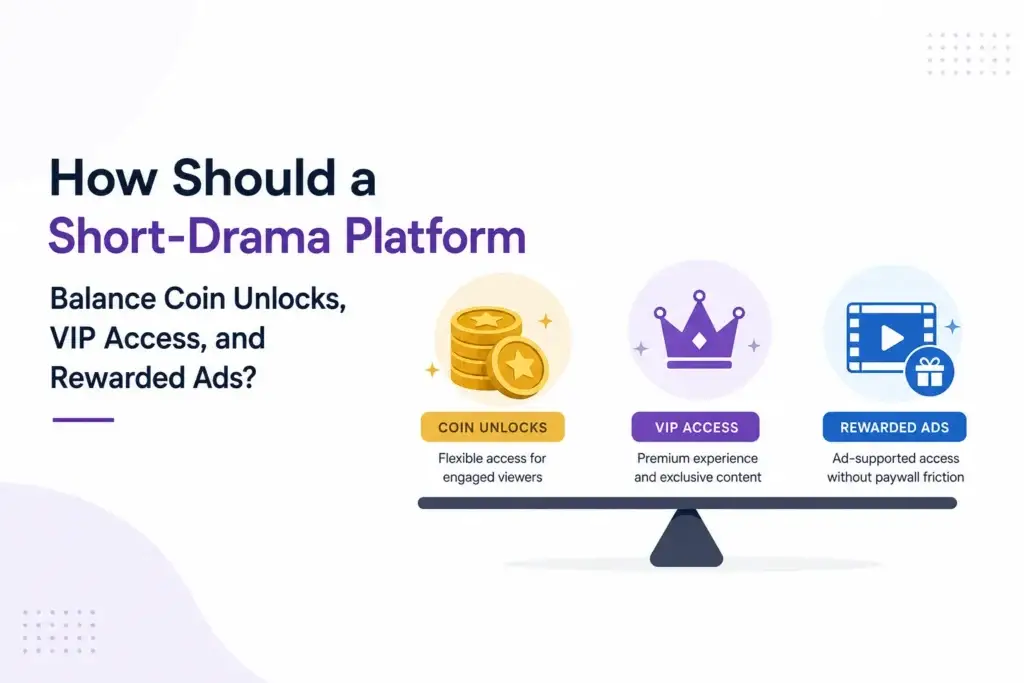
How Should a Short-Drama Platform Balance Coin Unlocks, VIP Access, and Rewarded Ads?
Last Updated on August 31, 2026 by sakshi Key Takeaways Coin unlocks monetize emotionally engaged…
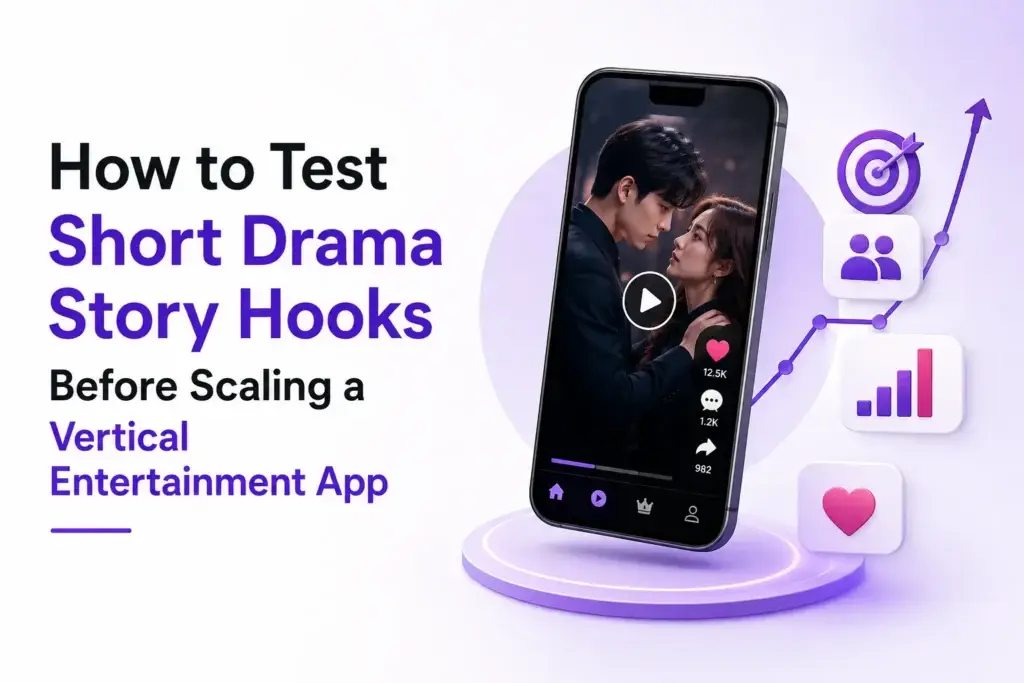
How to Test Short Drama Story Hooks Before Scaling a Vertical Entertainment App
Last Updated on August 18, 2026 by samruddhi kadam Key Takeaways Short drama story hook…
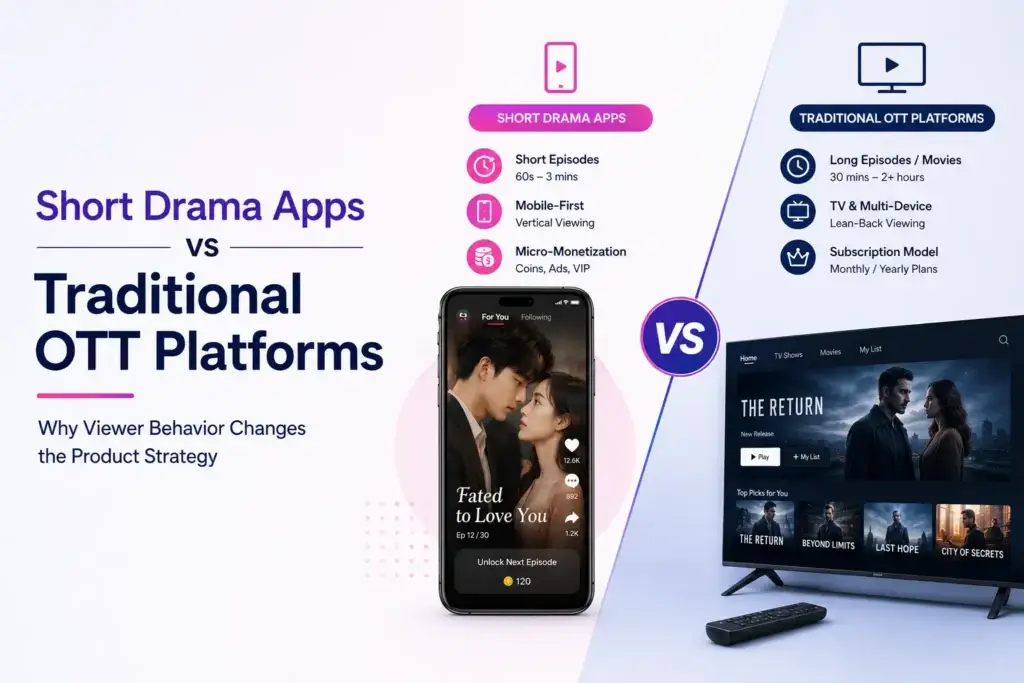
Short Drama Apps vs Traditional OTT Platforms: Why Viewer Behavior Changes the Product Strategy
Last Updated on August 19, 2026 by Yash Narayan Key Takeaways Short drama apps and…
FAQ
White Label Micro Drama FAQ - Pricing, Unlock, Payments & Deployment
The questions operators ask before signing, answered without hedging.
A packaged vertical-drama streaming platform that ships under your name instead of ours. You get categories, titles and numbered episodes, a full-screen vertical player, a free-episode window, and coin, reward or VIP unlock beyond it, plus a wallet, a rewards ladder and an operator console. Nothing a viewer sees – the interface, the store listing, the emails – carries a vendor name, because the source code is handed over and deployed on infrastructure you hold.
Yes. Vertical short-form drama is a format rather than anyone’s property, and the commerce patterns behind it – a free opening window, coin unlock, VIP tiers, a check-in streak – are used across the whole category. What you must own is the content. Every episode you publish needs a licence you can produce or a production you commissioned. The platform ships with no catalog attached: the seed script creates structure, not titles.
The platform starts at $3,399 for a launch-ready deployment under your own brand, with the full source code handed over. Scope moves that figure: catalog size, which payment gateway you clear, whether the store build goes out alongside the web app, ad network setup, and the storage and CDN tier your episode library needs. Content licensing and production sit outside this price and are usually the larger line in year one.
Six working days on our side. Because the platform is already built, the work is rebranding it and deploying it to your server. What actually stretches a calendar is what comes from you: brand assets, hosting access, the catalog and episode files, and a merchant account for whichever gateway you switch on.
Four facts are read the moment a viewer opens an episode: is it locked in the catalog, does its number sit inside the free window, is there an active VIP window on the account, and does a per-user unlock row already exist. Coins, a rewarded ad and auto-unlock all write that same row, so the entitlement is identical no matter how it was earned.
Purchased coins come from a coin pack and never expire. Reward coins come from the ladder, ads, referrals and bonuses, and carry an expiry window. Spending always draws the reward balance first, so promotional inventory is consumed before money the viewer actually paid, and the two roll into a single displayed total.
Everything a viewer or an app store reviewer can see. The logo and colour system across the web app, the store build and the operator console; the app name, icon, splash screen and store listing copy; the sender name and templates on transactional email; the coin pack and VIP plan names; the legal pages, which point at your entity rather than ours; and the receipts your payment gateway issues. Inside the codebase, package identifiers and bundle IDs are set to your namespace before the store build is compiled. What does not change is the engineering underneath – the unlock logic, the wallet ledger, the rewards ladder and the analytics – because that is the part you are actually buying.
PayPlus hosted checkout leads, and it is the strongest option from a compliance angle because the card is taken on the processor side and no card number reaches your database. Stripe, Razorpay, Flutterwave and Google Play switches ship alongside it. Each runs on your own merchant account, and for the store and card gateways, processor-side purchase verification is scheduled work rather than shipped behaviour.
On the store build, yes – AdMob with your own unit IDs, which is an integration step at deployment. On the web surface the ad unlock is a simulated timed preview rather than a live ad network, so it demonstrates the flow without earning anything. We say so plainly here because it is exactly the kind of thing that otherwise surprises a buyer in week two.
Five: English, Hebrew, Hindi, Arabic and Spanish, with right-to-left layout for Hebrew and Arabic across the consumer web app, the store build and the operator console. An app language editor in the console lets you change client copy without a rebuild. Be aware that some later Hindi, Arabic and Spanish web strings fall back to English, so completing that copy is a configuration task at launch.
Not as shipped. The withdrawal method and request models exist in the schema, with minimum thresholds in settings, so the wallet architecture supports the idea. The consumer flow, the operator payout desk and the bank rails are advanced setup. We describe it as architecture that can support cash-out, never as a live payout product.
Yes, in full: the consumer web application, the Next.js 14 operator console, the Express API with all 33 Mongoose models, the seed catalog script, and the Flutter store build for iOS and Android. Ownership transfers with them – modify, rebrand and extend without licence conditions.
A dedicated VAPT reference maps the platform against the OWASP Top 10, and it is deliberately candid. Shipped controls: hosted checkout with no card data stored, magic-byte upload inspection, a server-enforced view-only demo operator, proxy rules hiding sensitive paths, and native screenshot restriction. The same document prints the backlog: password hashing currently uses reversible encryption rather than a slow hash, request rate limiting is not bundled, CORS defaults open, the client settings payload is unscoped, and staff permissions are enforced in the console rather than on every route. Those are closed with you at deployment.
Let's turn your idea into
a live platform.
Get a free consultation, a clear timeline, and honest answers. We'd rather earn your trust than rush a sale.
Miracuves is an independent software development company. We are not affiliated with, connected to, sponsored by, or endorsed by ReelShort, DramaBox, or any other short-drama service.
“White label micro drama app” describes a category of product, not any one company. Brand names appear elsewhere on this site only to describe the kind of platform being built and the terms buyers search for.
The entire design and codebase is built by our own team. The product contains no code, design, graphics, or content originating from any third-party short-drama website or application.
No episodes, titles or artwork are supplied with the platform. Licensing the catalog you publish is your responsibility. All third-party names and marks are the property of their respective owners.