

Key Takeaways
What You’ll Learn
- Startups choose Rappi clones for faster launch because core delivery workflows are already built.
- A Rappi clone supports multiple services like food, grocery, courier, pharmacy, and local delivery.
- Custom development takes more time because every app, dashboard, payment flow, and tracking system starts from scratch.
- Clone apps reduce early product risk by giving founders a tested foundation to customize.
- The main lesson for founders is to spend more time on growth, not rebuilding basic delivery infrastructure.
Stats That Matter
- The article compares clone vs custom development for startups building Rappi-style delivery platforms.
- Core modules include customer app, delivery partner app, vendor app, and admin panel.
- Important workflows include ordering, payments, dispatch, tracking, vendor management, and admin control.
- Growth tools include analytics, churn alerts, coupon testing, and retention-focused dashboards.
- The page highlights 6-day deployment as a faster route for launching a Rappi-style app.
Real Insights
- Speed matters in quick commerce because early launches help startups test cities faster.
- Saved development effort can go into growth like restaurant onboarding, local partnerships, and promotions.
- White-label flexibility helps startups customize branding, UI, services, and regional workflows.
- Admin control becomes critical for managing users, orders, payments, vendors, drivers, and support.
- For founders, build a Rappi clone app around multi-service delivery, real-time tracking, vendor tools, payments, analytics, and scalable city-by-city growth.
Everyone loves a good David-versus-Goliath story, especially founders staring at enormous to-do lists and shrinking burn rates every morning.
A decade ago, Colombian upstart Rappi crashed a delivery market dominated by global giants and regional incumbents, turning the Spanish verb rappear — “to hustle” — into a lifestyle choice.
If you are building a delivery startup in 2026, you would want that same lightning-in-a-bottle momentum. But you probably do not want to spend two years and a VC war chest rebuilding the same logistics plumbing that Rappi already proved.
That is why many startups now choose a Rappi clone over custom development. It gives founders a faster foundation for delivery, multi-service ordering, vendor management, payments, dispatch, tracking, and admin control, without starting every core workflow from zero.
I’ve been in a few late-night strategy huddles where someone slams the whiteboard and yells, “Let’s just clone the darn thing!” That knee-jerk can feel reckless—until you realize that 90-day launch windows beat 18-month rewrites, every single time. Today we’ll unpack why savvy founders skip custom dev and ride a Rappi Clone straight to product-market-fit (PMF) land.
Spoiler alert: Miracuves has helped more than 50 growth-stage teams do exactly that without drowning in code debt or ballooning costs. If you’re curious how, keep reading—because the same shortcut might save your runway, too.
What Exactly Is a Rappi Clone?
Think of it as a blueprint of the original Rappi app — including all the essential modules like:
- User App: For customers to browse, order, track deliveries, and pay.
- Delivery Partner App: For drivers to receive delivery requests, navigate, and manage tasks.
- Merchant/Vendor App: For restaurants, grocery stores, or pharmacies to manage listings and orders.
- Admin Panel: A central dashboard to oversee and manage the platform (users, orders, payments, etc.)
The clone is white-label, which means you can rebrand, customize features, and even change the UI/UX to match your niche or regional needs.
How Does It Work?
Here’s a simplified flow of how the Rappi Clone functions in real-world usage:
- User Registration/Login
Users sign up using email, phone, or social accounts. - Browse & Order
They browse nearby restaurants, stores, or services based on GPS location and place an order. - Real-Time Tracking
The user can track the delivery agent’s movement on the map after order confirmation. - Payment & Reviews
Payments can be made via cards, wallets, or COD (if enabled). Users can also rate services post-delivery.
Read More : What is Rappi App and How Does It Work?
Market Timing: Catch the Quick-Commerce Wave, Don’t Chase It
Rappi’s co-founder recently hinted the company could file for an IPO within a year—while admitting they’re already profitable across nine countries. That’s your flashing neon sign: quick commerce in Latin America hasn’t peaked yet, but the window to join the leaderboard is closing fast.
Why a clone helps:
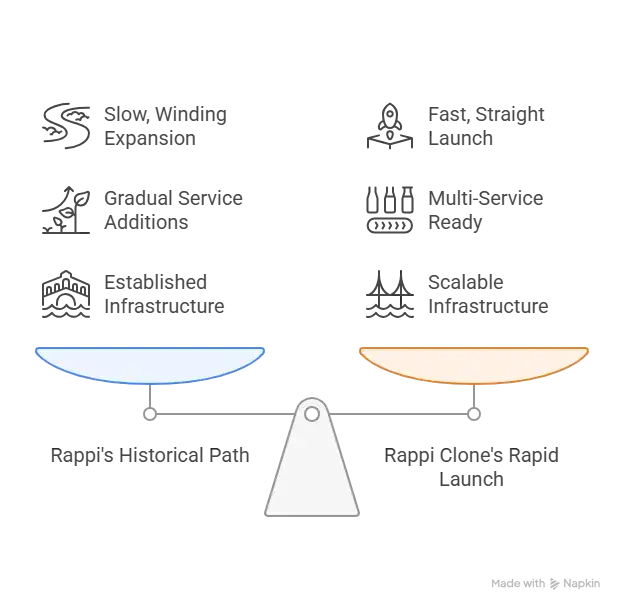
- A pre-built engine lets you soft-launch in weeks, capturing first-mover buzz in secondary cities Rappi hasn’t saturated.
- You can funnel savings into hyper-local partnerships—think bodegas, pharmacies, dark kitchens—rather than burning cash on ground-up architecture.
Cost Advantage: VC Dollars Belong in Growth, Not Re-Coding Basics
- Custom delivery app development can quickly become expensive because every core system has to be built from scratch.
- Founders need to invest in logistics workflows, route optimization, driver tracking, customer apps, vendor panels, payment systems, and admin dashboards.
- Each feature adds more development time, testing effort, and technical risk before the product even reaches real users.
- A Miracuves-built solution helps reduce that pressure by giving startups a ready foundation for launch.
- Instead of spending months building basic delivery infrastructure, founders can focus on customer acquisition, restaurant onboarding, promo campaigns, and city-by-city growth.
- This is why many startups prefer a faster Rappi-style platform approach over fully custom development.
Read More : Best Rappi Clone Scripts in 2025: Features & Pricing Compared
Data-Driven Growth Loops—No Guesswork Required
Rappi remains one of LatAm’s strongest delivery players, with a major footprint across cities, restaurants, and stores.
But in markets like Colombia and Argentina, competition is intense.
The real takeaway: acquisition is costly, but retention decides who wins.
Miracuves’ clone ships with:
- Cohort analytics dashboard (mixpanel-style)
- Predictive churn alerts
- Coupon A/B testing harness
Translation: You tweak promos based on live funnel data, not gut feels.
Total Ownership, Zero “Vendor Lock-In” Anxiety
Yes, clone = template, but the codebase is 100 % yours. Want to bolt on drone deliveries or an AI-powered componer (recommendation engine)? Fork it. Miracuves delivers clean, commented code—minus messy third-party shackles.
Storytime: A Peruvian founder customized our Rappi clone to integrate electric scooter fleets, slashing last-mile costs 18 %. He calls it “Rappi con ruedas verdes.” That mod shipped in four sprints because he wasn’t reverse-engineering proprietary SDKs.
Brand, Not Backend, Becomes Your Moat
Consumers remember quirky mascot llamas, witty push copy, and lightning-fast refunds—not which queue system you deployed. A clone frees design and marketing to craft those sticky brand moments:
- Haha micro-copy when drivers hit traffic (“Our rider’s stuck behind a telenovela-worthy jam. Hang tight!”)
- AR filters that paste hot-sauce halos over delivered tacos
- Local holiday promo badges (¡Feliz Día del Niño!)
Spend time making hearts race, not debugging WebSocket handshakes.
Conclusion :
Speed wins markets, and clones are often the fastest vehicle in town. While competitors are still planning basic delivery flows, you can already be onboarding restaurants, testing retention loops, improving customer experience, and exploring new revenue channels.
But speed only matters when the foundation is strong. A clone should not just copy the surface of a successful app; it should give you a faster launch path with room to customize, scale, and compete in your own market. With the right technology, admin control, payment flow, delivery logic, and user experience, a delivery clone can become more than a shortcut. It can become the base for a real, revenue-ready business.
The brands that move early get more time to learn, improve, and win customer trust. That is why a well-built Rappi-style platform is not just about launching faster. It is about reaching the market sooner, adapting smarter, and building momentum before competitors catch up.
At Miracuves, we help innovators launch high-performance app clones that are fast, scalable, and monetization-ready. Ready to turn your idea into reality? Let’s build together.
FAQs
How customizable is a clone?
Think Lego, not super-glue. You can reskin, add modules, or even rewrite entire services without breaking the foundation.
Will investors frown on “clone tech”?
VCs fund risk-adjusted growth. If a clone shrinks time-to-revenue, most investors applaud the pragmatism—and ask how fast you’ll scale.
What about unique features Rappi doesn’t have?
A solid clone surfaces clean APIs, so layering innovations—voice ordering, drone drops, BNPL—is straightforward.
Is compliance really “set-and-forget”?
Regulations shift, but the base passes current PCI-DSS and GDPR audits. Miracuves ships update patches whenever rules change—no extra dev sprint needed.
How do clones affect ongoing maintenance costs?
Shared, battle-tested code reduces bug-hunt hours. Clients report 30–40 % lower monthly DevOps spend versus scratch-built stacks.
Can I migrate off the clone later?
Absolutely. You own the repo. If you outgrow it, treat the clone as MVP scaffolding and gradually refactor micro-services—at your pace, on your budget.
Related Articles :
Miracuves is an independent software development company. We are not affiliated with, connected to, sponsored by, or endorsed by any company or product named in this article.
Terms such as “X Clone” are used descriptively. It is how the software industry refers to building a platform with functionality comparable to a known service, and how clients search for it.
The entire design and codebase of our products is built by our own team. Our products contain no code, design, graphics, or content originating from any third-party website or applications.
All third-party names and marks referenced in this article are the property of their respective owners, referenced solely to identify the services discussed.