Key Takeaways
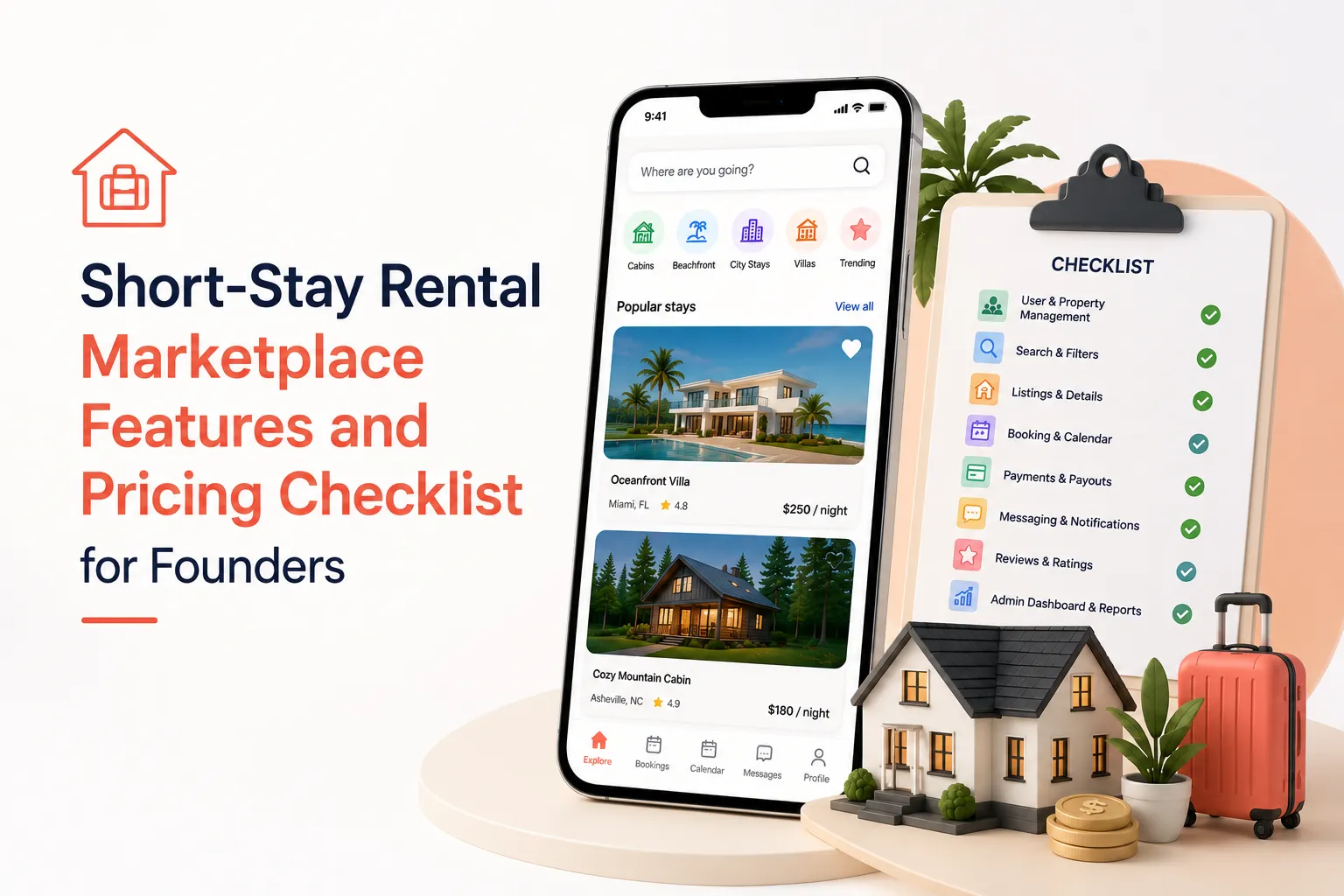
- A short-stay rental marketplace needs property listings, smart search, availability calendars, booking workflows, secure payments, host payouts, reviews, messaging, and admin controls.
- Marketplace pricing depends on feature depth, web and mobile scope, payment and map integrations, host tools, automation, customization, security, and scalability requirements.
- Founders should prioritize booking-critical features first, then expand into dynamic pricing, loyalty, advanced analytics, channel integrations, and automation after validating demand.
Feature & Pricing Signals
- Core features should cover host onboarding, listing management, location search, filters, calendars, instant booking, cancellations, payments, payouts, reviews, and notifications.
- Development cost can increase with native mobile apps, real-time synchronization, dynamic pricing, identity verification, multi-currency support, tax logic, APIs, and third-party integrations.
- Admin dashboards should manage users, properties, bookings, commissions, refunds, disputes, payouts, promotions, reports, permissions, and marketplace analytics.
Founder Checklist Insights
- Founders should define the rental niche, target geography, commission model, host requirements, payment flow, cancellation policy, and MVP scope before estimating development cost.
- A modular short-stay rental platform can control early development complexity while leaving room for future features such as loyalty, subscriptions, automation, and advanced host tools.
- Miracuves develops customizable short-stay rental marketplaces with listings, booking engines, calendars, payments, payouts, host management, analytics, integrations, and admin controls.
Building a short-stay rental marketplace is not only about launching a website where guests can book rooms, apartments, villas, or unique stays. The real challenge is building a system where hosts can manage availability, guests can trust listings, payments move safely, and the platform operator can control operations without depending on developers for every small change.
For founders, the biggest mistake is comparing platforms only by feature count. A long list of features does not automatically mean the product is ready for real bookings. What matters is whether the core flows work together: listing creation, search, availability, booking rules, payment collection, host payouts, reviews, disputes, and admin control.
This checklist will help you understand what a short-stay rental marketplace needs, what affects pricing, which features should come first, and when a ready-made foundation may be a smarter path than building from zero.
What Is a Short-Stay Rental Marketplace?
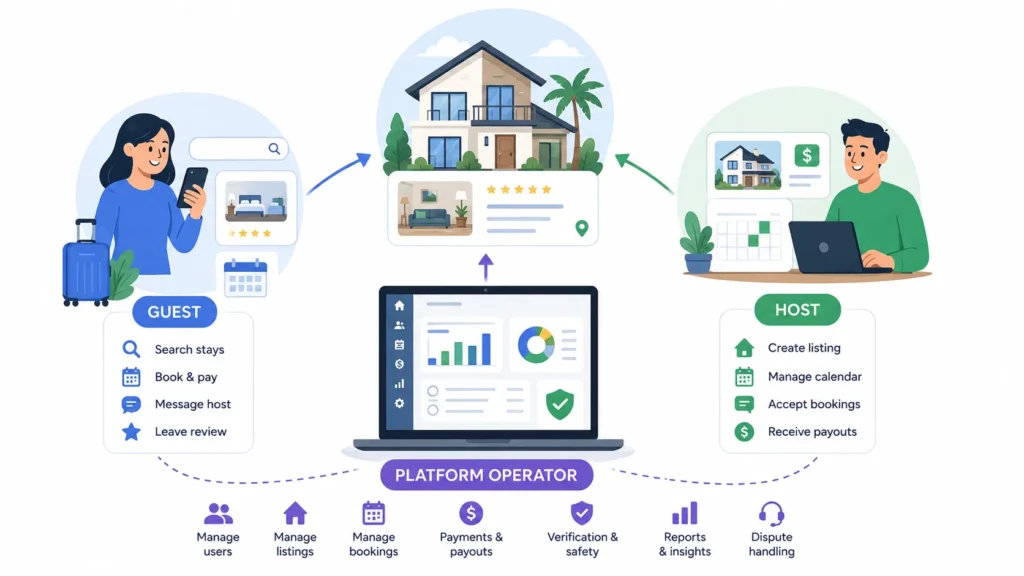
A short-stay rental marketplace connects guests with property owners, hosts, or professional property managers who offer temporary stays. The platform does not own every property. Instead, it creates the digital system where listings are published, searched, booked, paid for, reviewed, and managed.
This model usually includes three major user groups:
Guests search for stays, compare listings, check dates, make bookings, complete payments, message hosts, and leave reviews.
Hosts create listings, upload photos, manage calendars, set pricing, accept bookings, communicate with guests, and receive payouts.
Platform operators manage users, listings, bookings, commissions, disputes, payments, content, verification, and reports from the admin dashboard.
The business only works when all three sides operate smoothly. A beautiful guest interface will not help if hosts cannot control availability. A strong booking page will not matter if the admin team cannot resolve disputes. A payment flow is incomplete if host payouts are not clearly tracked.
Why Founders Need a Feature and Pricing Checklist Before Building
Many founders begin with the question, “How much will it cost?” That is understandable, but it is not the best first question.
A better question is: “Which features are essential for my marketplace to handle real bookings safely and reliably?”
The answer depends on your business model. A city-focused homestay marketplace may need multilingual listings and local payment methods. A villa rental business may care more about seasonal pricing, security deposits, and calendar blocking. A boutique hospitality marketplace may need verified hosts, premium listing placement, and stronger content moderation.
Pricing becomes clearer when the scope is clearer. Without a checklist, founders often overbuild advanced modules while underinvesting in the booking, availability, host, and admin flows that decide whether the platform can operate.
Core Guest Features Every Short-Stay Rental Marketplace Should Include
Guest features should make discovery, trust, and booking simple. The guest does not care how complex the backend is. They care whether they can find a suitable stay, understand the price, trust the listing, and book without friction.
Search and Location-Based Discovery
Search is the first conversion layer. Guests should be able to search by destination, dates, number of guests, price range, property type, and amenities.
Location-based filters are especially useful when travelers are comparing neighborhoods, nearby attractions, business districts, event venues, or local transport access. Map-based browsing can also help users understand distance and convenience before booking.
Listing Detail Pages
A listing page should explain the stay clearly before the guest reaches checkout. Important elements include photos, title, description, amenities, sleeping capacity, rules, cancellation policy, location, host information, reviews, and available dates.
The goal is to reduce uncertainty. If guests have too many unanswered questions, they may leave the platform or message the host before booking, which slows conversion.
Date Availability and Booking Flow
The booking flow should show whether selected dates are available, what the total price includes, and what happens after payment. Founders should decide whether their platform supports instant booking, request-to-book, or both.
Instant booking is faster for guests, but request-based booking gives hosts more control. Some marketplaces may need both options depending on property type, host preference, or local operating style.
Secure Payment Checkout
Payment checkout should be simple, transparent, and connected to the booking lifecycle. The platform should clearly show nightly charges, cleaning fees, service fees, taxes where applicable, discounts, and the final payable amount.
A guest should not feel surprised at checkout. Hidden or unclear charges can reduce trust and increase abandoned bookings.
Guest Account and Booking History
Guests should be able to view upcoming bookings, past stays, messages, payment status, cancellation details, and support requests. This reduces support load and gives users confidence that the platform is organized.
Host Features That Decide Marketplace Supply Quality
Short-stay marketplaces depend heavily on supply. If hosts cannot manage their properties easily, they may stop listing or move to other channels. That is why host-side features are not secondary. They are central to marketplace growth.
Host Onboarding
Host onboarding should make it easy to create an account, add property details, upload images, define stay rules, and submit listings for review if admin approval is required.
A guided onboarding flow helps reduce incomplete listings. It also helps the platform maintain listing quality from the beginning.
Property and Room-Level Listing Management
Some hosts list a full property. Others list private rooms, multiple units, or several spaces under one property. The platform should support the listing structure that matches the business model.
Room-level or unit-level control becomes important when one property has multiple bookable spaces. Without this, the platform may risk calendar confusion or double booking.
Calendar and Availability Control
Hosts need a clear calendar where they can block dates, update availability, manage upcoming bookings, and avoid conflicts. Availability is one of the most important technical layers in a rental marketplace because the platform must prevent two guests from booking the same stay for the same dates.
Calendar control should be simple enough for individual hosts but strong enough for professional operators managing multiple listings.
Pricing Rules
Pricing is rarely fixed in short-stay rentals. Hosts may need weekday pricing, weekend pricing, seasonal pricing, special event pricing, length-of-stay discounts, cleaning fees, extra guest charges, and cancellation rules.
For founders, this matters because pricing flexibility directly affects host adoption. If hosts cannot price their inventory properly, they may not trust the platform with their best listings.
Host Earnings and Payout Tracking
Hosts should be able to see confirmed bookings, pending payouts, completed payouts, commission deductions, cancellation adjustments, and payout history.
A transparent payout dashboard reduces support queries and builds host trust. It also helps operators manage payment disputes with clearer records.
Founders who want a deeper module-level breakdown can review the full host tools, pricing, and payout controls available in a short-stay rental marketplace setup.
Admin Features Founders Should Not Ignore
The admin dashboard is where the business is actually controlled. Founders sometimes focus too much on guest-facing screens and underestimate the importance of backend operations.
A strong admin panel should help the platform operator manage growth, risk, disputes, pricing rules, users, content, and financial workflows.
User and Role Management
The admin should be able to manage guests, hosts, support users, finance users, content moderators, and internal team roles. Role-based access is important because not every team member should have access to payments, reports, or sensitive user information.
Listing Approval and Moderation
Before listings go live, the platform may need approval controls. Admins should be able to review property images, descriptions, rules, pricing, location accuracy, and suspicious content.
This protects the marketplace from low-quality or misleading listings.
Booking and Cancellation Management
The admin panel should show booking status, cancellation requests, refund status, host responses, guest issues, and dispute records.
This is critical once real users start transacting. Without admin booking control, even small operational issues can become support-heavy.
Commission and Revenue Settings
The platform operator should be able to define commission logic, service fees, host plans, featured listing fees, or other monetization rules. These settings should be manageable without requiring code changes for every update.
If revenue planning is part of your launch strategy, the host revenue and marketplace fee models page explains how commissions, service fees, host plans, featured listings, and payout logic can work together.
Reports and Analytics
Founders need visibility into bookings, revenue, active hosts, popular locations, cancellation rates, payout status, and user growth.
Good analytics help founders understand whether the issue is demand, supply, pricing, trust, or conversion.
Miracuves Microblogging App Solution Cost and Tech Stack
Miracuves Pricing for a Microblogging App developed in JavaScript For $3,099 USD (One-Time Price) in just 6 days
Get a fully developed, deployment-ready microblogging platform built for founders launching community networks, creator platforms, niche social apps, professional discussion networks, and real-time content-sharing products. Built on a modern JavaScript foundation, this complete package includes everything you need to launch and scale:
Core Workflows: User registration, profile creation, short-form post publishing, follows, likes, replies, reposts, hashtags, mentions, media attachments, search, personalized feeds, and notifications.
Built-in Revenue Logic: Premium subscriptions, promoted posts, sponsored content, creator monetization, paid communities, advertising placements, verification plans, and platform service fees.
Management Hub: Centralized admin dashboard, user management, post moderation, report handling, hashtag controls, content visibility settings, role-based permissions, monetization tracking, and platform analytics.
Launch-Ready: Fully prepared for your custom branding, configuration, user onboarding, moderation rules, notification setup, monetization options, community categories, and immediate market entry.
Why Is Microblogging App Development More Affordable?
Most microblogging platforms become expensive when businesses choose fully custom development from scratch. Building separate workflows for users, feeds, posting, replies, follows, media sharing, notifications, moderation, search, monetization, and admin controls can significantly increase cost, timeline, and technical complexity.
We took a smarter, more practical approach:
You Aren’t Paying for Ground-Up Development: Our microblogging platform engine is already developed, tested, and ready to deploy. You skip the inflated cost and long development cycles normally associated with building a social networking product from scratch.
The Power of JavaScript: We built this solution on a modern JavaScript architecture that supports interactive feeds, fast user engagement, scalable social workflows, API-driven integrations, and smooth administrative operations.
You get a launch-ready microblogging platform with practical publishing, engagement, moderation, monetization, and community management features, source code access, and faster deployment without the high custom development price tag.
Note: This cost is for the solution, re-branding, deployment, and source code only.
What Actually Drives the Cost of a Short-Stay Rental Marketplace?
The cost of building a short-stay rental marketplace depends on scope. A simple listing and booking platform costs less than a multi-region marketplace with advanced pricing, complex payouts, calendar integrations, custom dashboards, mobile apps, and multilingual support.
For a clearer breakdown of what affects scope, modules, customization, and launch pricing, read this guide on short-stay marketplace development cost before finalizing your budget.
Founders should not treat cost as a single number. It is better to understand the cost drivers.
Platform Type
A web-only platform usually costs less than a full web, iOS, and Android ecosystem. However, mobile apps may be useful if your users expect on-the-go booking, host management, or instant notifications.
Feature Depth
Basic search, listings, booking, and payments are one level of complexity. Advanced modules such as dynamic pricing, channel calendar syncing, wallet systems, multi-language support, coupons, loyalty features, and advanced reporting increase development scope.
Booking Logic
Short-stay booking is more complex than simple ecommerce checkout. The system must consider dates, availability, rules, cancellation policies, payment status, host approval, refunds, and payout timing.
The more flexible your booking logic, the more planning and testing it needs.
Payment and Payout Setup
Payment gateways, service fees, host payouts, refund workflows, wallet logic, tax handling, and multi-currency support can affect cost. These systems must be reliable because payment confusion damages trust quickly.
Admin Dashboard Complexity
A lightweight admin panel may only manage users and listings. A stronger admin panel may include booking control, revenue reports, dispute handling, payout review, permission-based roles, support tools, promotional controls, and content moderation.
For a marketplace business, admin depth is not optional for long-term operations.
Custom Branding and UX
Branding is more than a logo. It includes interface design, listing layout, booking flow, email templates, notifications, host dashboards, and overall user experience. Custom UX can improve differentiation but also adds design and development work.
Integrations
Third-party integrations may include maps, payment gateways, SMS, email, analytics, identity verification, tax tools, customer support, cloud storage, and calendar sync. Each integration adds setup, testing, and maintenance requirements.
Practical Pricing Checklist for Founders
Before asking for a quote, define these points clearly:
- What property types will the platform support?
- Will hosts list full properties, rooms, units, villas, cabins, shared spaces, or multiple stay categories?
- Will bookings be instant, request-based, or both?
- Do hosts need seasonal pricing, weekend pricing, cleaning fees, discounts, or extra guest charges?
- Which payment gateways and payout methods are required?
- Do you need web only, mobile apps, or both?
- Will the platform support one city, one country, or multiple regions?
- Do you need multilingual support?
- Do you need identity verification, host approval, or document checks?
- What admin roles are required for your internal team?
- Do you need custom design or a faster white-label launch?
These answers help convert a vague idea into a realistic scope.
Founder Decision Signals
Speed
If you need to test a rental market quickly, a ready-made marketplace foundation can reduce the time spent building basic guest, host, booking, and admin flows from zero.
Cost
Cost increases when booking rules, payment flows, custom dashboards, integrations, and mobile apps become more complex. Start with the flows needed for real transactions.
Scalability
A platform should be planned around listings, bookings, availability, payouts, and admin workflows that can support growth without constant rebuilds.
Market Fit
The first version should validate whether guests book and hosts stay active. Advanced features should support that learning, not distract from it.
Ready-Made vs Custom Development: Which Makes Sense?
There are usually three routes founders consider.
A custom build gives maximum flexibility, but it usually requires more time, budget, planning, testing, and technical oversight. It makes sense when the business model has unique workflows that cannot be handled by an existing foundation.
A SaaS or no-code marketplace builder can help with quick validation, but it may limit source-code ownership, deeper customization, backend control, and long-term differentiation.
A ready-made white-label marketplace foundation sits between the two. It gives founders a faster launch path while still allowing branding, customization, admin control, and source-code ownership when provided by the development partner.
For many founders, the best decision is not “custom or nothing.” The better question is: “Which route gets my marketplace into the market with enough control to validate, learn, and grow?”
Before choosing a build route, founders should also know how to evaluate the right development partner for booking logic, calendar accuracy, payment workflows, admin control, source-code ownership, and post-launch flexibility.
Security and Trust Features to Include From the Start
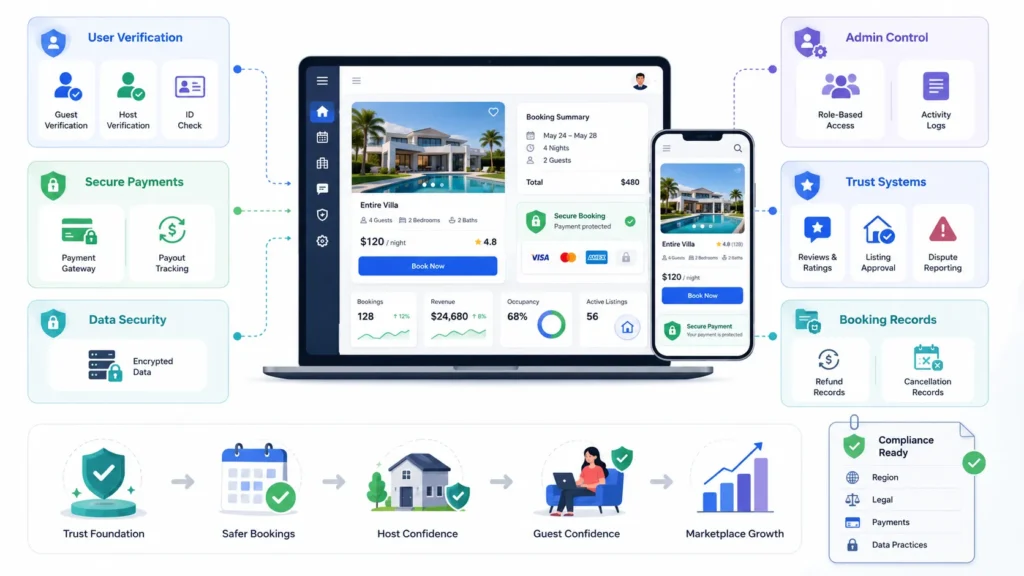
Trust is central to short-stay rental marketplaces because users are dealing with personal spaces, payments, identity, travel plans, and real-world access.
Important trust and safety features include:
- User verification for guests and hosts.
- Secure payment gateway integration.
- Encrypted data transfer and storage.
- Role-based admin access.
- Review and rating systems.
- Abuse reporting and dispute workflows.
- Activity logs for sensitive admin actions.
- Listing moderation and approval controls.
- Refund and cancellation records.
Security should not be treated as a future upgrade. Even if the first version is focused, it should still have the right trust foundation.
Final compliance depends on operating region, legal review, data practices, payment providers, and the marketplace model. Founders should treat compliance readiness as part of platform planning, not a one-time checkbox.
Common Mistakes Founders Should Avoid
Choosing Features Before Choosing the Marketplace Model
A founder building for vacation homes may need different tools from a founder building for city apartments, boutique stays, student housing, or long-weekend rentals. The model should guide the feature list.
Underestimating Host Operations
Many founders design the guest journey first. That is natural, but hosts create the supply. If host onboarding, calendars, pricing, and payouts are weak, the marketplace may struggle even with a polished guest app.
Treating Pricing as Only Development Cost
Development cost is only one part of the budget. Founders should also plan for hosting, payment fees, support, moderation, marketing, legal review, maintenance, and future enhancements.
Ignoring Admin Controls
Without a strong admin dashboard, every issue becomes manual. Booking disputes, payout questions, listing quality, user complaints, and refunds all need backend visibility.
Overbuilding Before Validation
Advanced features are useful only when the core marketplace works. Start with the flows required to list, search, book, pay, manage, review, and support users.
How Miracuves Supports Short-Stay Rental Marketplace Founders
Miracuves helps founders launch marketplace products faster with ready-made, white-label, source-code-owned app foundations that can be customized around the business model.
For founders evaluating short-stay rental marketplace development, the goal is not to copy an existing platform blindly. The goal is to start with a proven rental marketplace structure and adapt it to your target geography, host type, property category, pricing model, payment flow, and brand positioning.
If you are ready to move from feature planning to launch evaluation, review the Miracuves short-stay rental marketplace solution to explore demo access, host workflows, admin control, deployment details, and pricing.
That page should be used as the next-step commercial page for demo, features, deployment details, pricing, and solution-specific discussion.
Final Thoughts
A short-stay rental marketplace succeeds when the product supports real marketplace operations. Guests need smooth discovery and booking. Hosts need reliable listing, calendar, pricing, and payout tools. Platform operators need admin control, reporting, moderation, and payment visibility.
The smartest founders do not compare platforms by feature count alone. They compare by how well each feature supports bookings, trust, host retention, monetization, and operational control.
Use this checklist before choosing your development path. Once your feature scope is clear, the next step is to compare build options, understand customization needs, and choose a launch path that gives your marketplace enough speed and control to validate demand. For founders who want to move from planning to launch with a ready-made, source-code-owned foundation, Miracuves can help build a short-stay rental marketplace with branded design, admin control, host workflows, and faster deployment.
FAQs
What features are most important in a short-stay rental marketplace?
The most important features are property listings, location-based search, availability calendars, booking flow, secure payments, host dashboards, payout tracking, reviews, admin controls, and dispute management. These features support the full transaction lifecycle from discovery to post-stay review.
What affects the cost of a rental marketplace platform?
Cost depends on platform type, feature depth, booking rules, payment gateways, payout workflows, admin dashboard complexity, mobile app requirements, design customization, integrations, security needs, and launch scope.
Should founders build custom or use a ready-made marketplace foundation?
Custom development makes sense when the business requires highly unique workflows. A ready-made white-label foundation can be better when founders want to launch faster, reduce initial build complexity, and customize around a proven marketplace structure.
Why is the host dashboard so important?
The host dashboard controls marketplace supply. Hosts need tools to create listings, manage availability, update pricing, respond to bookings, track earnings, and request payouts. Weak host tools can limit growth even if the guest app looks good.
Do short-stay rental marketplaces need mobile apps?
Mobile apps are useful when guests and hosts need frequent access, instant notifications, booking updates, or on-the-go management. Some founders can start with a responsive web platform and add mobile apps later depending on user behavior and market expectations.
What security features should a rental marketplace include?
A rental marketplace should include secure payment integration, encrypted data transfer, role-based admin access, user verification, moderation tools, activity logs, abuse reporting, review systems, and dispute workflows.
How can a founder avoid overbuilding the first version?
Start with the flows required for real transactions: listing, search, availability, booking, payment, host management, admin control, and support. Add advanced features only when they support validated user behavior or revenue opportunities.
Miracuves is an independent software development company. We are not affiliated with, connected to, sponsored by, or endorsed by any company or product named in this article.
Terms such as “X Clone” are used descriptively. It is how the software industry refers to building a platform with functionality comparable to a known service, and how clients search for it.
The entire design and codebase of our products is built by our own team. Our products contain no code, design, graphics, or content originating from any third-party website or applications.
All third-party names and marks referenced in this article are the property of their respective owners, referenced solely to identify the services discussed.