

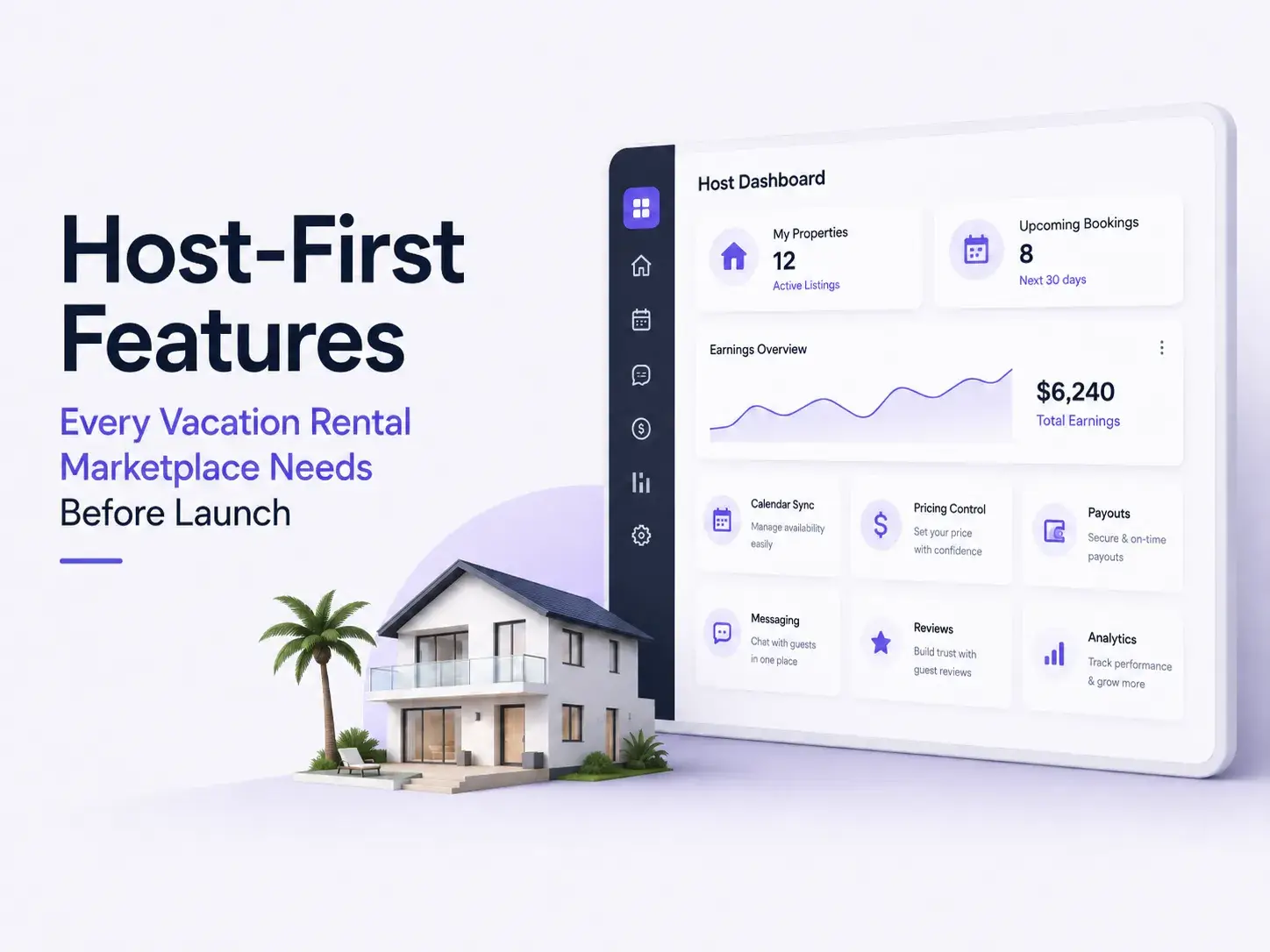
A vacation rental marketplace does not become valuable just because guests can search and book stays. The real foundation is host supply.
If hosts do not trust the platform, they will not list their properties. If listing creation feels difficult, they will abandon the process. If calendars are inaccurate, guests will face failed bookings. If payouts are unclear, hosts will leave after the first few reservations.
That is why founders planning a vacation rental marketplace solution should think host-first before they think guest-first.
Guests create demand, but hosts create inventory. Without active hosts, the platform has nothing to sell. A strong rental marketplace needs features that help property owners list faster, manage availability, control pricing, communicate clearly, receive payments, and stay confident that the platform protects their interests.
This guide breaks down the host-first features every vacation rental marketplace should consider before launch, especially if you want to build a scalable, monetization-ready platform instead of a basic booking website.
Key Takeaways
- Vacation rental marketplace features should be planned around host supply, not only guest booking convenience.
- Hosts need simple onboarding, listing control, calendar accuracy, pricing flexibility, payout transparency, and trust tools before launch.
- Admin controls matter because marketplace operators need visibility into listings, bookings, disputes, commissions, and host performance.
- A host-first platform can improve inventory quality, reduce booking conflicts, and create stronger marketplace reliability.
- Miracuves helps founders move faster with ready-made, white-label rental marketplace solutions that can be customized for branding, operations, and monetization.
Why Vacation Rental Marketplaces Should Start With Host Experience
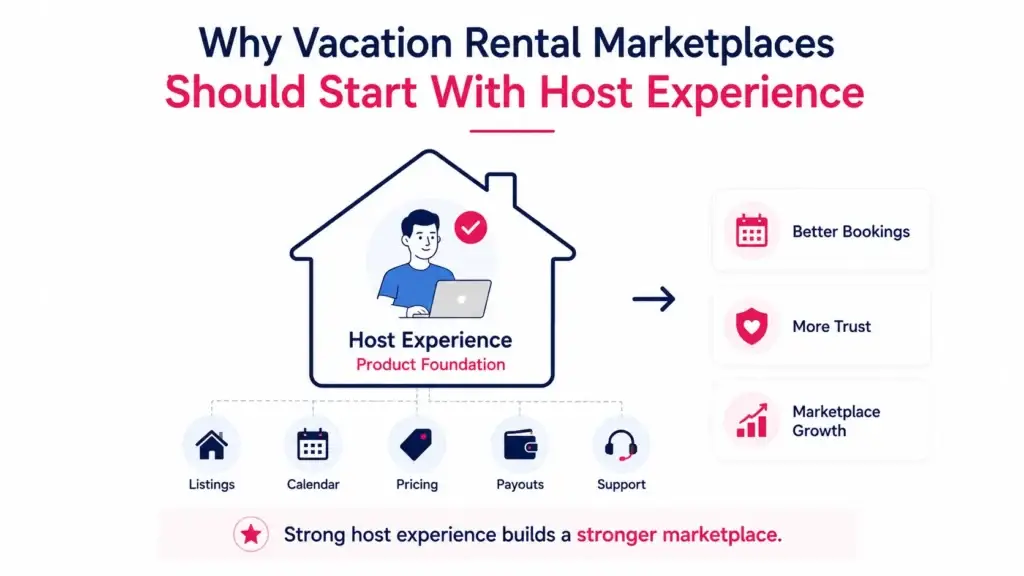
Many founders start by designing the guest journey first: search, filters, location maps, booking dates, payment, and reviews. These are important, but they only work when the host side is already strong.
A guest cannot book a property that has no complete listing. A payment flow cannot fix an outdated calendar. A good map experience cannot compensate for missing availability. A beautiful mobile interface cannot build trust if hosts do not understand how payouts, cancellations, and booking rules work.
That is why the host experience should be treated as the product foundation.
A host-first marketplace answers practical questions early:
- Can a host create a complete listing without support?
- Can the platform check listing quality before publishing?
- Can hosts control availability and prevent accidental bookings?
- Can hosts adjust prices for weekends, seasons, events, and demand?
- Can hosts understand earnings before and after platform commission?
- Can admins verify hosts and resolve disputes?
- Can the marketplace scale without manually managing every booking?
For founders, this matters because host supply is usually harder to build than guest demand. A guest may visit once and leave. A good host can bring repeat inventory, repeat bookings, referrals, and long-term marketplace value.
1. Simple Host Onboarding That Reduces Drop-Off
Host onboarding should be short enough to complete, but structured enough to protect marketplace quality.
A weak onboarding flow asks for basic profile details and then allows anyone to publish a property. That may help the platform look full early, but it can create long-term problems: poor listings, incomplete property details, low trust, and more admin cleanup later.
A stronger host onboarding flow should include:
- Host profile creation
- Email or phone verification
- Identity or business verification where relevant
- Property ownership or management declaration
- Payment and payout setup
- Location confirmation
- Basic house rules
- Agreement to platform policies
The goal is not to make onboarding difficult. The goal is to collect the information needed to protect guests, hosts, and the marketplace operator.
For early-stage founders, this is also a supply-quality filter. If a host cannot complete basic onboarding, they may not be ready to manage real bookings on your platform.
2. Listing Creation Tools That Help Hosts Publish Better Properties
Listings are the storefront of a vacation rental marketplace. A poor listing can reduce bookings even if the property itself is good.
Hosts need guided listing creation, not a blank form.
A strong listing flow should help hosts add:
- Property title
- Property type
- Room or unit details
- Number of guests allowed
- Bedrooms, beds, and bathrooms
- Amenities
- House rules
- Check-in and check-out information
- Location and nearby highlights
- High-quality images
- Cancellation policy
- Base price and seasonal pricing
- Availability calendar
The platform should also guide hosts with completion indicators. For example, a listing may be marked as incomplete until the host adds enough photos, pricing, availability, and rules.
This matters because listing quality directly affects guest confidence. A property with missing details creates uncertainty. Uncertainty slows bookings.
For founders, listing quality is not just a design issue. It affects conversion, support load, refund risk, and marketplace reputation.
3. Listing Approval Workflow for Marketplace Quality Control
Founders often want listings to go live instantly because it makes the platform feel active. But a fully open listing system can create quality problems.
A listing approval workflow gives the marketplace operator control before properties appear publicly.
The admin should be able to:
- Review new listings
- Approve or reject listings
- Request changes from hosts
- Check images and descriptions
- Review property location accuracy
- Flag duplicate or suspicious listings
- Disable listings that violate platform rules
This feature becomes especially important if your marketplace operates in a local tourism market, premium rental niche, city apartment segment, villa market, student stay segment, or managed apartment category.
Approval workflows help maintain trust. They also protect the platform from low-quality inventory that may damage guest confidence.
4. Calendar and Availability Management to Prevent Booking Conflicts
Calendar accuracy is one of the most important host-side features in any rental booking platform.
If availability is wrong, everything else breaks.
Guests may book dates that are already unavailable. Hosts may reject confirmed requests. Admins may deal with refunds, complaints, or reputation damage. The platform may look unreliable even when the issue started with one outdated calendar.
Hosts should be able to:
- Open and block dates
- Set unavailable periods
- Manage check-in and check-out rules
- Add minimum and maximum stay rules
- View upcoming bookings
- Update availability quickly
- Prevent overlapping reservations
- Sync availability where third-party calendar integration is used
For founders, calendar logic should not be treated as a minor feature. It is part of the marketplace trust layer.
A vacation rental marketplace does not need hundreds of advanced features before launch, but it does need reliable availability control.
5. Flexible Pricing Controls for Hosts
Hosts need pricing flexibility because vacation rental demand changes constantly.
A flat price may work for a simple launch, but it can quickly become limiting. Weekend demand, holidays, local events, seasonal tourism, long stays, early bookings, and last-minute discounts all affect pricing.
A host-first platform should support pricing controls such as:
- Base nightly price
- Weekend pricing
- Seasonal pricing
- Special date pricing
- Length-of-stay discounts
- Cleaning fee
- Extra guest charges
- Refundable deposits where relevant
- Minimum stay pricing rules
- Platform commission visibility
The founder benefit is clear: better pricing tools can help hosts earn more and stay active.
When hosts feel they can manage revenue inside your marketplace, they have fewer reasons to move bookings elsewhere. Pricing control is not only a feature. It is a host retention mechanism.
6. Booking Request and Instant Confirmation Options
Not every host wants the same booking model.
Some hosts prefer instant confirmation because it reduces manual work and improves booking speed. Others prefer manual approval because they want to review guest details before accepting a stay.
A scalable vacation rental marketplace should support both models:
| Booking Mode | Best For | Host Benefit | Marketplace Impact |
|---|---|---|---|
| Instant confirmation | Professional hosts, managed properties, high-availability listings | Saves time and increases booking speed | Improves conversion and reduces delay |
| Request-based booking | New hosts, premium stays, private homes, sensitive inventory | Gives hosts more control | Builds host confidence during early adoption |
| Hybrid rules | Hosts with different property types | Allows flexible booking logic | Supports more listing categories |
Founders should not force one model too early. A host-first marketplace gives hosts enough control while still encouraging reliable booking behavior.
7. Host Dashboard for Daily Operations
A host dashboard is where property owners manage their business inside the platform.
It should not be limited to “view listing” and “see bookings.” Hosts need a working control center.
A useful host dashboard should include:
- Active listings
- Pending listings
- Booking requests
- Confirmed bookings
- Calendar view
- Earnings summary
- Payout status
- Guest messages
- Reviews and ratings
- Cancellation history
- Listing performance
- Account settings
For professional hosts or property managers, this dashboard becomes even more important. They may manage multiple properties, different pricing rules, housekeeping coordination, and repeat guest communication.
For founders, the dashboard reduces operational dependency. If hosts can manage more actions themselves, the admin team does not have to intervene in every small update.
Host-First Feature Checklist for Vacation Rental Marketplaces
| Feature | Business Value | Founder Impact |
|---|---|---|
| Host onboarding | Improves supply quality and trust | Reduces weak or incomplete host accounts |
| Guided listing creation | Helps hosts publish stronger property pages | Improves guest confidence and booking readiness |
| Calendar management | Prevents double bookings and availability errors | Reduces refunds, disputes, and support tickets |
| Flexible pricing | Allows hosts to respond to demand changes | Supports better monetization and host retention |
| Payout tracking | Builds host confidence in platform earnings | Reduces payout-related support pressure |
| Listing approval | Protects marketplace quality | Gives admins control before inventory goes public |
| Reviews and ratings | Creates accountability for hosts and guests | Strengthens long-term trust signals |
8. Secure Host and Guest Messaging
Messaging helps reduce booking uncertainty.
Guests often want to ask about check-in time, parking, pets, neighborhood safety, work-friendly spaces, family suitability, or local transportation before booking. Hosts need a controlled way to respond without moving the conversation outside the platform.
A built-in messaging system should support:
- Guest-to-host messages
- Booking-specific conversation threads
- Admin visibility where needed
- Notification alerts
- Attachment support where appropriate
- Spam and abuse controls
- Message history for dispute review
This is important because off-platform communication can create risk. Guests may be asked to pay outside the marketplace. Hosts may bypass platform rules. Disputes may become harder to resolve.
A secure messaging layer keeps communication transparent and helps the platform operator maintain control.
9. Payout Transparency for Host Trust
Hosts care deeply about when and how they get paid.
If payout logic is unclear, the platform loses trust quickly. Even if the guest experience is smooth, hosts will not stay active if they cannot understand earnings, deductions, commissions, pending payouts, and completed transfers.
A host-first platform should give hosts visibility into:
- Booking amount
- Platform commission
- Taxes or fees where applicable
- Cleaning fees or add-ons
- Security deposit status where relevant
- Pending payout
- Completed payout
- Failed payout
- Refund or cancellation adjustment
- Payout schedule
For founders, payout transparency is a retention feature. It reduces support conversations and shows hosts that the marketplace is professionally managed.
Miracuves can help founders build rental marketplace workflows where host earnings, commission logic, booking records, and admin controls work together instead of being managed through disconnected tools.
10. Reviews, Ratings, and Host Reputation Signals
Trust is a two-sided problem.
Guests need to trust hosts. Hosts also need to trust guests.
A strong vacation rental marketplace should include review and rating features that help both sides make better decisions. At a basic level, this includes guest reviews of properties. A stronger system can also include host reviews of guests, rating breakdowns, review moderation, and admin controls.
Useful review features include:
- Guest reviews after completed stays
- Host ratings
- Guest ratings where relevant
- Review moderation
- Reporting inappropriate reviews
- Verified-stay labels
- Response option for hosts
- Rating summaries on listing pages
Founders should treat reviews as marketplace infrastructure, not decoration. Reviews influence booking confidence, listing ranking, host behavior, and guest expectations.
11. Cancellation and Refund Policy Controls
Travel plans change. Guests cancel. Hosts cancel. Weather, health issues, operational conflicts, and payment failures can all affect bookings.
Without clear cancellation policy controls, every cancellation becomes a manual dispute.
Hosts should be able to select or configure approved cancellation policy types, while admins should control the framework.
A practical setup may include:
- Flexible cancellation
- Moderate cancellation
- Strict cancellation
- Admin-defined cancellation rules
- Refund percentage logic
- Cancellation window settings
- Host cancellation tracking
- Guest refund visibility
- Admin override for special cases
For founders, the key is not to create complex rules from day one. The key is to avoid ambiguity. Clear cancellation rules reduce confusion and protect both marketplace trust and admin time.
12. Admin Controls for Host Management
Even though this article is host-first, the admin panel is the control layer behind the host experience.
A marketplace operator needs visibility into what hosts are doing, where problems appear, which listings perform well, and which accounts create risk.
Admin controls should include:
- Host account management
- Host verification status
- Listing approval
- Listing suspension
- Booking monitoring
- Commission settings
- Payout review
- Refund handling
- Dispute management
- Review moderation
- Reported listing review
- Host performance analytics
- Role-based access for internal teams
This matters because founders cannot scale a marketplace manually. As supply grows, the admin layer decides whether the business can manage quality without depending on developers for every operational change.
A ready-made rental marketplace foundation from Miracuves can help founders start with these operational layers already planned, then customize workflows based on the target market, property types, and monetization model.
Founder Decision Signals
Speed
If you need to validate a travel or rental marketplace quickly, prioritize features that let hosts onboard, publish listings, manage calendars, and receive bookings without manual admin support.
Cost
Building every host, guest, booking, payment, and admin module from zero can increase cost and delay. A ready-made foundation can be more cost-efficient when the core marketplace logic already fits your model.
Scalability
Scalability is not only about servers. It also depends on whether hosts can manage listings, availability, pricing, cancellations, and payouts without constant platform intervention.
Market Fit
A host-first platform helps founders test whether property owners will list, manage, and continue using the platform before spending heavily on guest acquisition.
13. Property Rules, Guest Limits, and Stay Conditions
Hosts need control over who can book, how the property can be used, and what guests should know before arrival.
This includes practical rules such as:
- Maximum guest count
- Pet policy
- Smoking rules
- Party rules
- Quiet hours
- Check-in instructions
- Check-out instructions
- Parking availability
- Child-friendly or accessibility notes
- Extra guest charges
Clear house rules reduce misunderstandings. They also help guests self-select before booking.
From a marketplace perspective, this improves booking quality. A guest who understands the property rules before payment is less likely to cancel, complain, or create disputes later.
14. Host Notifications and Booking Alerts
A host may miss a booking request if the platform depends only on dashboard login.
That is why notifications matter.
Hosts should receive alerts for:
- New booking requests
- Confirmed bookings
- Guest messages
- Cancellation requests
- Payment updates
- Payout updates
- Review reminders
- Listing approval status
- Calendar conflict warnings
- Admin messages
Notification channels may include email, SMS, push notifications, or in-app alerts depending on the product scope.
For founders, notifications are part of marketplace reliability. They help hosts respond faster and reduce booking delays.
15. Host Analytics and Performance Insights
Hosts are more likely to stay active when they understand performance.
A simple analytics layer can show whether a listing is getting views, bookings, inquiries, reviews, and repeat interest. More advanced platforms may add occupancy trends, seasonal performance, revenue summaries, and pricing suggestions.
Useful host analytics include:
- Listing views
- Inquiry count
- Booking conversion
- Occupancy rate
- Revenue summary
- Average rating
- Cancellation rate
- Response time
- Repeat guest activity
- Top-performing listings
For founders, host analytics can also identify supply-side problems. If many listings get views but few bookings, the issue may be pricing, photos, trust signals, or availability. If hosts receive messages but do not respond, notification logic or host education may need improvement.
Analytics should help both the host and the operator make better decisions.
16. Mobile-Ready Host Experience
Many hosts manage properties while moving between locations, guests, housekeeping teams, maintenance tasks, or other jobs.
A mobile-ready host experience is therefore essential.
Hosts should be able to:
- Respond to messages
- Accept or reject booking requests
- Update availability
- Edit pricing
- View payout status
- Check booking details
- Update listing details
- Receive alerts
- Manage reviews
The host interface does not need to be overloaded. It needs to be fast, clear, and usable during real operations.
For founders, mobile readiness improves host responsiveness. Faster responses can improve guest confidence and booking completion.
17. Trust and Safety Features for Hosts and Guests
Trust is one of the hardest parts of building a rental marketplace.
Guests need confidence that the property is real. Hosts need confidence that guests are legitimate. The platform operator needs controls to reduce fraud, disputes, abuse, and unsafe behavior.
Important trust and safety features include:
- Host verification
- Guest verification
- Secure payment gateway integration
- Booking history
- Review moderation
- Abuse reporting
- Dispute management
- Admin approval controls
- Activity logs
- Role-based dashboards
- Privacy-conscious data handling
Security should not be treated as a marketing add-on. It should be built into the marketplace foundation because identity, payments, records, and disputes directly affect trust.
Final compliance and legal requirements depend on the target market, operating model, payment providers, data policies, and legal review.
18. Monetization Features That Do Not Frustrate Hosts
Vacation rental marketplaces usually monetize through a combination of platform commission, service fees, listing plans, promotional placements, or add-on services.
However, monetization must be transparent.
If hosts do not understand platform deductions, they may feel the marketplace is unfair. If guests see surprise fees late in checkout, conversion may drop.
A founder-friendly monetization setup should include:
| Monetization Model | How It Works | Why It Matters |
| Booking commission | Platform earns a percentage or flat fee per successful booking | Works well when transaction volume grows |
| Host subscription plans | Hosts pay for listing access or higher listing limits | Creates recurring revenue potential |
| Featured listings | Hosts pay for better visibility | Useful when supply grows and competition increases |
| Guest service fee | Guest pays a platform service charge | Can support platform operations if shown clearly |
| Add-on services | Cleaning, insurance, local support, photography, or concierge services | Creates extra revenue opportunities in niche markets |
The platform should make fees visible in the right places: before booking, inside host earnings, and in admin reporting.
19. What Founders Should Prioritize Before Launch
A founder does not need every possible feature in the first version. But the first version should include the features that protect the core marketplace loop.
The core loop is simple:
Host lists property → guest discovers listing → guest books → payment is processed → host confirms stay → guest completes stay → payout is released → review is added.
To protect this loop, prioritize:
- Host onboarding
- Listing creation
- Listing approval
- Calendar management
- Booking flow
- Secure payments
- Host dashboard
- Guest-host messaging
- Payout visibility
- Reviews
- Admin controls
- Cancellation logic
Advanced features such as AI recommendations, dynamic pricing engines, loyalty programs, complex multi-property automation, and deep analytics can come later if the platform has validated supply and demand.
The smarter first move is not to build the biggest platform. It is to build the most reliable host-to-booking foundation.
Mistakes Founders Should Avoid
Building guest search before fixing host supply
A beautiful guest interface will not convert if listings are incomplete, calendars are inaccurate, or hosts are slow to respond. Host readiness should come before advanced discovery features.
Launching without payout transparency
Hosts need to know how earnings, deductions, refunds, and payout timing work. Unclear payout logic can damage trust quickly.
Skipping listing approval
Allowing every listing to go live without review may create quality problems, duplicate listings, inaccurate property details, and avoidable disputes.
Adding too many advanced features too early
Founders should first protect the booking loop. AI, loyalty, advanced ranking, and complex automation are useful later, but they cannot replace reliable onboarding, calendars, payments, and admin control.
Read more: Short-Stay Rental App Security Guide: How to Protect Guests, Hosts, Payments, and Bookings
Ready-Made vs Custom Development for a Host-First Rental Marketplace
Founders usually face two build paths.
One path is custom development from zero. This gives maximum control but requires more planning, development, testing, and iteration before the platform is launch-ready.
The other path is starting with a ready-made rental marketplace foundation and customizing it for brand, workflows, integrations, pricing logic, and market needs.
| Build Path | Best For | Strength | Risk |
| Custom development from zero | Unique business models with highly specific workflows | Full flexibility from day one | Higher cost, longer timeline, more testing required |
| Ready-made rental marketplace foundation | Founders who need core host, guest, booking, payment, and admin flows faster | Faster validation and lower setup complexity | Must be customized carefully to avoid generic positioning |
| Hybrid approach | Founders who want a ready foundation with custom modules | Balanced speed and flexibility | Requires clear scope control |
For many founders, the practical question is not “which path is perfect?” It is “which path helps us test host supply and guest booking demand faster without losing control?”
Miracuves helps founders evaluate this decision by mapping the required host workflows, booking logic, admin controls, branding needs, and monetization model before development begins.
Final Thoughts: Build the Host Foundation Before Scaling Guest Demand
A vacation rental marketplace should not be judged only by how attractive the guest search page looks. The stronger question is whether hosts can actually use the platform to manage real inventory, pricing, availability, bookings, communication, reviews, and payouts.
If hosts struggle, the marketplace struggles.
A host-first feature strategy helps founders build a stronger foundation before spending heavily on acquisition. It improves supply quality, reduces booking errors, strengthens trust, and gives the admin team better control over operations.
The best marketplace is not the one with the longest feature list. It is the one where hosts can list confidently, guests can book reliably, and the operator can manage growth without chaos.
For founders planning a short-stay or vacation rental marketplace, Miracuves can help turn that foundation into a white-label, source-code-owned platform aligned with your launch goals, business model, and operational requirements.
FAQs
What are the most important features for a vacation rental marketplace?
The most important features include host onboarding, property listing creation, availability calendar, booking flow, secure payments, guest-host messaging, payout tracking, reviews, cancellation policies, and admin controls. Founders should prioritize the features that protect the full booking journey before adding advanced discovery or automation features.
Why should founders focus on host features before guest features?
Hosts create the inventory that guests book. If hosts cannot publish listings, manage calendars, control pricing, communicate with guests, or receive payouts clearly, the guest experience will eventually fail. A host-first approach helps founders build supply quality before scaling demand.
What should a host dashboard include?
A host dashboard should include listing management, booking requests, calendar controls, pricing tools, guest messages, earnings summary, payout status, reviews, cancellation history, and account settings. For professional hosts, performance analytics and multi-property management can also be useful.
How does calendar management help a rental marketplace?
Calendar management helps prevent double bookings, unavailable-date errors, rejected reservations, refund issues, and guest frustration. It is one of the core trust features in a rental booking platform because every booking depends on accurate availability.
What monetization models work for vacation rental marketplaces?
Common monetization models include booking commission, guest service fees, host subscription plans, featured listings, promotional placements, and add-on services. The right model depends on the marketplace niche, property type, region, and host acquisition strategy.
Do rental marketplaces need listing approval before launch?
Listing approval is strongly recommended when quality, trust, and safety matter. It allows the platform operator to review property details, images, location, host information, and policy compliance before listings go public.
Should founders build a vacation rental marketplace from zero?
Building from zero can make sense for highly custom business models. However, many founders can validate faster by starting with a ready-made rental marketplace foundation and customizing host flows, booking logic, branding, integrations, and monetization rules.
How can Miracuves help with vacation rental marketplace development?
Miracuves helps founders build white-label rental marketplace platforms with host tools, guest booking flows, admin control, payment workflows, source-code ownership, and faster deployment. The platform can be customized based on the founder’s target market, property model, branding, and business requirements.
Miracuves is an independent software development company. We are not affiliated with, connected to, sponsored by, or endorsed by any company or product named in this article.
Terms such as “X Clone” are used descriptively. It is how the software industry refers to building a platform with functionality comparable to a known service, and how clients search for it.
The entire design and codebase of our products is built by our own team. Our products contain no code, design, graphics, or content originating from any third-party website or applications.
All third-party names and marks referenced in this article are the property of their respective owners, referenced solely to identify the services discussed.