


Key Takeaways
- Multi-Vendor Ecommerce Marketplace Business Model should connect sellers, buyers, commissions, fulfillment, refunds, payouts, and admin control inside one operating system.
- Commission is usually the simplest first revenue stream, while subscriptions, featured listings, delivery margins, and seller services can be added later.
- One buyer order may need to split across multiple sellers, with separate stock updates, commissions, delivery states, refunds, and payouts.
- Seller trust depends on clear wallet balances, deductions, pending payouts, refund adjustments, and settlement history.
- The marketplace operator needs configurable control over seller approval, catalog quality, commissions, fulfillment, returns, disputes, and payout rules.
Business Model Signals
- Start with commission when seller demand is still developing and recurring seller fees may create unnecessary friction.
- Use seller subscriptions when the platform has enough buyer demand and tools to justify recurring access fees.
- Featured listings and sponsored placements become more valuable after marketplace traffic and product discovery are strong.
- Fulfillment strategy should influence commission, delivery fees, seller responsibilities, refunds, and customer-service workflows.
- Category-specific operations matter because fashion, grocery, electronics, handmade goods, pharmacy, and B2B marketplaces require different controls.
Real Insights
- A marketplace is not a single-store checkout with extra vendors; order splitting and seller-level settlement must be designed from the beginning.
- Operational efficiency directly affects profitability through stock accuracy, delivery coordination, refund handling, seller quality, and payout transparency.
- Hard-coded commission rules become restrictive as the platform introduces category, seller, promotion, and subscription-specific pricing.
- Catalog moderation is a trust function because weak listings from one seller can damage the reputation of the entire marketplace.
- The strongest flow is: onboard seller → approve catalog → attract buyer → split multi-seller order → calculate commission → fulfill each seller line → manage returns or refunds → update wallet ledger → settle seller payout → report through admin.
A Multi-Vendor Ecommerce Marketplace looks simple from the buyer’s side.
The customer searches for a product, adds it to the cart, checks out, tracks delivery, and leaves a review. But behind that smooth experience, the platform is managing multiple sellers, product catalogs, commissions, stock updates, delivery rules, refunds, seller payouts, customer support, and admin controls.
That is what makes the marketplace business model powerful, but also complex.
Unlike a single-brand online store, the platform operator does not own every product or handle every seller relationship manually. Instead, the platform connects buyers with many independent sellers and earns through commissions, vendor plans, featured placements, delivery margins, ads, subscriptions, or value-added services.
For startups, the key question is not only how the marketplace earns revenue. The bigger question is how sellers, buyers, commissions, and operations stay connected in one system without breaking trust.
This guide explains the business model of a multi-seller ecommerce marketplace Multi-Vendor Ecommerce Marketplace Business Model from a founder’s perspective.
What Is a Multi-Vendor Ecommerce Marketplace?
A multi-vendor ecommerce marketplace is an online platform where multiple independent sellers list products and buyers purchase from them through one shared shopping experience.
If you are still mapping the broader launch journey, this ecommerce marketplace launch guide explains how marketplace planning, features, development, and business setup connect before scaling seller operations.
The platform operator owns the marketplace infrastructure. Sellers manage product listings, pricing, stock, and fulfillment responsibilities based on platform rules. Buyers get one storefront, one checkout experience, and one support journey.
The model usually includes three core participants:
- Buyers who browse, compare, purchase, review, and return products.
- Sellers who list products, manage stock, fulfill orders, and receive payouts.
- Marketplace operator who manages rules, payments, commissions, disputes, catalog quality, delivery logic, and platform growth.
The platform becomes valuable when it reduces friction for both sides. Buyers get more choice. Sellers get access to demand. The operator earns by creating trust, discovery, transaction flow, and operational control.
Why the Business Model Is More Than Commission
Many founders assume the marketplace business model is simple: take a percentage from every sale.
Commission is important, but it is only one layer.
A strong marketplace model may include:
- Commission on every successful order
- Monthly or yearly seller subscription plans
- Featured product placements
- Sponsored seller listings
- Delivery fee margin
- Packaging or fulfillment service fees
- Buyer membership plans
- Seller onboarding fees
- Premium analytics for sellers
- Cross-border service charges
- Wallet or payout-cycle advantages
- White-label or franchise licensing for regional operators
The stronger decision is not to activate every revenue stream immediately. The stronger decision is to choose the right first revenue layer based on the category, seller maturity, buyer demand, and fulfillment model.
For early marketplaces, commission is usually easiest to explain. Once seller demand grows, subscriptions, ads, featured placements, and value-added services become easier to introduce.
How Sellers Fit Into the Marketplace Model
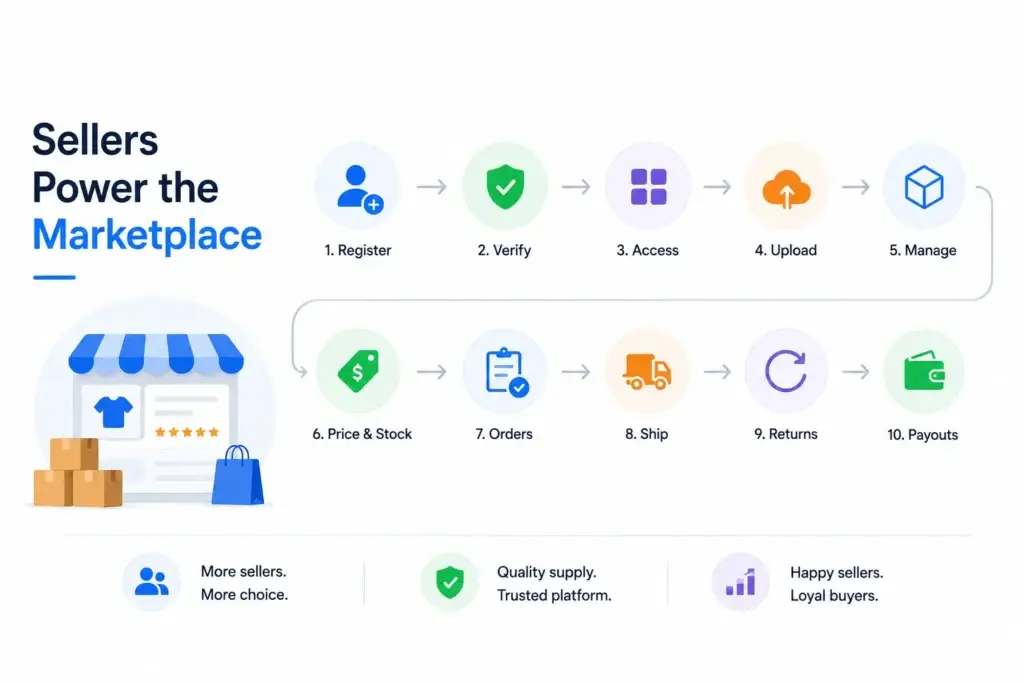
Sellers are the supply side of the marketplace.
Without enough relevant sellers, buyers have no reason to return. But onboarding every seller without quality control can damage trust.
A seller workflow should include:
- Seller registration
- Business verification where relevant
- Product category access
- Catalog upload
- SKU and variant management
- Price and stock control
- Order acceptance
- Packaging and handover
- Return and refund participation
- Wallet and payout visibility
- Performance reports
- Review and rating management
- Support and dispute handling
The seller panel should not feel like an afterthought. It is where the marketplace supply engine operates every day.
If sellers cannot upload products easily, manage stock accurately, understand commissions, track payouts, or respond to orders quickly, the buyer experience will suffer.
How Buyers Fit Into the Marketplace Model
Buyers do not care how complex the seller network is.
They expect a simple experience:
- Search for products
- Compare options
- Check price, delivery, reviews, and return policy
- Add items to cart
- Pay securely
- Track order status
- Receive products on time
- Request return or refund if needed
- Contact support without confusion
This creates an important marketplace challenge.
Buyer discovery can also improve when the platform understands browsing history, product behavior, and purchase patterns. This guide on a personalized product recommendation engine explains how recommendation logic can support product discovery in ecommerce marketplaces.
One buyer order may include products from multiple sellers. The platform must split that order internally while still showing the buyer a clean checkout and order-tracking experience.
For example, a buyer may purchase a phone case from Seller A, headphones from Seller B, and a charger from Seller C in one cart. The buyer sees one checkout, but the backend must route three seller order lines, apply three stock updates, calculate commissions separately, and manage fulfillment status for each seller.
This is why a multi-vendor ecommerce marketplace needs strong order logic, not just a beautiful storefront.
The Marketplace Operator’s Role
The operator is the control layer of the business.
The operator decides:
- Who can sell
- Which categories are open
- What commission applies
- How seller plans work
- Which products need approval
- How returns are handled
- Which payment methods are available
- How delivery is assigned
- When sellers are paid
- How disputes are resolved
- Which listings receive promotional visibility
- What data sellers can see
- Which regions or languages are supported
A marketplace can fail when the operator has weak controls.
If sellers list poor-quality products, buyers lose trust. If payouts are unclear, sellers leave. If refunds are messy, support costs rise. If commissions are inconsistent, finance teams struggle to reconcile revenue.
The operator dashboard is where the business model becomes manageable.
Core Revenue Streams in a Multi-Vendor Ecommerce Marketplace
A scalable marketplace should have revenue options that can grow with the business.
Revenue Streams for a Multi-Vendor Ecommerce Marketplace
| Revenue Stream | How It Works | Best Time to Use | Founder Impact |
|---|---|---|---|
| Sales Commission | The platform takes a percentage or fixed fee from each completed order. | Best as the first monetization layer because it aligns platform earnings with seller sales. | Easy to explain, easy to scale, and directly connected to transaction growth. |
| Seller Subscription Plans | Sellers pay monthly or yearly for access to selling tools, category access, analytics, or higher listing limits. | Useful once the platform has enough demand to justify recurring seller fees. | Creates predictable revenue beyond order volume. |
| Featured Listings | Sellers pay to promote products in search, category pages, home sections, or campaign slots. | Works after buyer traffic becomes meaningful. | Adds advertising revenue without changing the checkout model. |
| Delivery Margin | The platform charges delivery fees and may retain margin after carrier or delivery partner cost. | Useful when the operator controls or coordinates logistics. | Turns fulfillment into a revenue and retention lever. |
| Seller Services | The platform charges for catalog support, product photography, packaging, fulfillment, or premium onboarding. | Useful when sellers need operational help to perform well. | Improves seller quality while adding service revenue. |
| Buyer Membership | Buyers pay for benefits such as free delivery, priority deals, loyalty rewards, or exclusive access. | Works when repeat purchase frequency is high. | Builds retention and predictable buyer-side revenue. |
The right revenue mix depends on the marketplace category. Grocery, fashion, electronics, handmade goods, pharmacy, wholesale, and local retail do not behave the same way.
A founder should start with the revenue stream that creates the least friction while the marketplace is building trust.
How Commission Logic Should Work
Commission is the most common revenue stream in a multi-vendor marketplace.
But the calculation should be more flexible than a single fixed percentage.
A good commission engine should support:
- Category-wise commission
- Seller-wise commission
- Product-level commission exceptions
- Promotional commission discounts
- Subscription-based commission tiers
- Delivery fee separation
- Tax separation
- Refund reversal
- Partial refund adjustment
- Wallet entries for seller and operator
- Commission reports by seller, category, and order
For example, electronics may have different margin expectations than fashion. New sellers may receive a lower introductory commission. Premium sellers may pay a monthly plan and receive reduced transaction commission.
The platform should make these rules configurable from the admin dashboard.
Hard-coded commission logic becomes a problem when the business starts negotiating with different seller groups.
Order Splitting: The Hidden Engine Behind Marketplace Operations
Order splitting is where many marketplace builds become complicated.
A buyer may place one order, but the platform may need to split it across several sellers. Each seller has their own products, stock, packaging, delivery timeline, cancellation rules, return handling, and payout amount.
The backend must decide:
- Which seller owns each item
- Which stock should be reduced
- Which seller receives the order line
- Which delivery rule applies
- Which commission applies
- Which tax rules apply
- Which seller wallet is credited
- What happens if one seller cancels
- What happens if one item is returned
- How the buyer sees the final order status
This is why a marketplace cannot be treated like a normal ecommerce store with extra vendors added later.
The order architecture needs to be multi-vendor from the beginning.
Seller Payouts and Wallet Logic
Seller trust depends heavily on payout transparency.
A seller should be able to understand:
- Total order value
- Platform commission
- Delivery charge handling
- Tax or fee deductions
- Refund adjustments
- Wallet balance
- Pending payout
- Available payout
- Payout status
- Payout schedule
- Failed payout reason
- Past settlement history
A strong marketplace uses wallet or ledger logic to keep every transaction traceable.
For example, when an order is completed, the platform may credit the seller wallet after deducting commission. If the buyer returns the product, the platform should reverse the relevant seller credit and commission entry based on refund rules.
Without clean wallet logic, sellers may lose confidence and support teams may spend too much time answering payout questions.
Fulfillment Models: Seller-Led, Platform-Led, or Hybrid
Fulfillment decides how the product reaches the buyer.
A marketplace can use different delivery models:
| Fulfillment Model | How It Works | Best For |
|---|---|---|
| Seller-Led Fulfillment | Sellers pack and ship their own orders. | Early marketplaces, niche sellers, low operational control models |
| Platform-Led Fulfillment | The marketplace manages delivery through its own fleet or partners. | Operators that want stronger control over delivery experience |
| Hybrid Fulfillment | Some sellers self-ship while others use platform logistics. | Marketplaces with mixed categories, regions, or seller maturity |
| Pickup / Local Delivery | Orders are fulfilled from nearby stores or local sellers. | Hyperlocal retail, grocery, pharmacy, essentials, and city marketplaces |
| Warehouse-Assisted Fulfillment | Sellers store selected inventory in a marketplace-managed warehouse. | High-volume categories and standardized delivery promises |
Fulfillment affects commission, delivery fees, refunds, customer experience, and seller performance.
A founder should not decide the revenue model separately from fulfillment. If the platform controls delivery, it may justify delivery margin, service fees, or premium seller plans. If sellers handle their own fulfillment, the platform needs stronger seller performance tracking and buyer communication.
Returns, Refunds, and Disputes
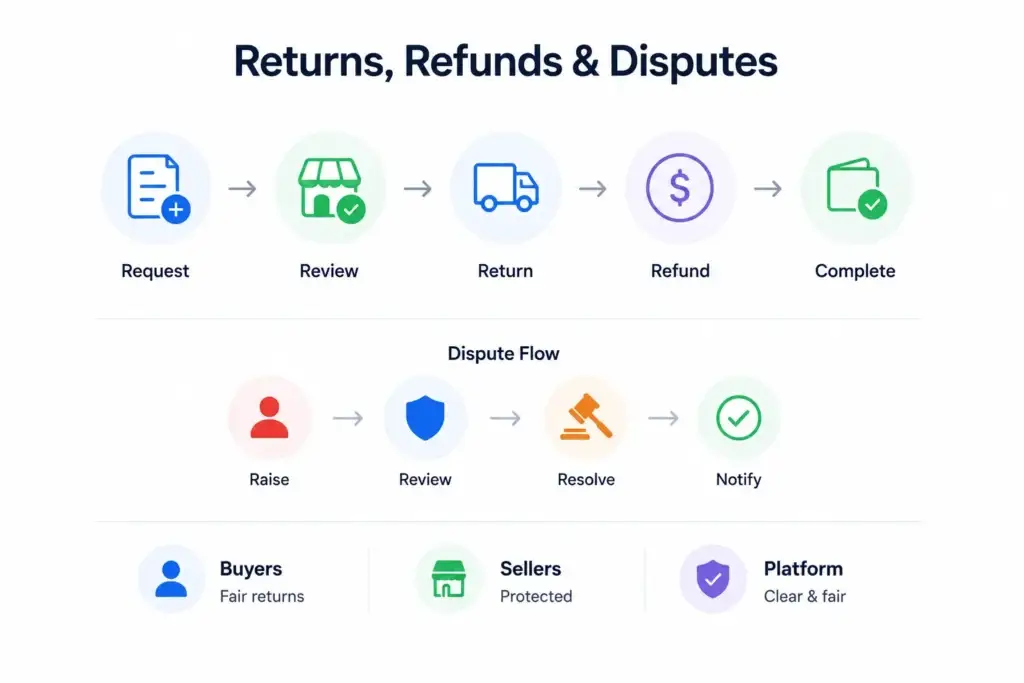
Returns are more complicated in a multi-vendor marketplace than in a single-seller store.
A buyer may return one item from a multi-seller order. One seller may approve the return while another does not. A refund may need to reverse commission, delivery fees, seller wallet credit, coupon use, and loyalty points.
The platform should define:
- Return eligibility by category
- Seller-specific return rules
- Buyer refund method
- Partial refund logic
- Refund approval workflow
- Product pickup or return shipping flow
- Commission reversal rules
- Seller penalty rules
- Dispute escalation
- Admin override
- Refund timeline visibility
This protects all parties.
Buyers need confidence that returns are fair. Sellers need protection against misuse. The operator needs records to resolve disputes without guessing.
Seller Quality, Catalog Control, and Trust
A marketplace grows when buyers trust the products and sellers.
Seller quality control should include:
- Seller approval workflow
- Product approval queue
- Category permissions
- Image and description standards
- Brand verification where relevant
- Restricted product rules
- Review moderation
- Seller ratings
- Complaint tracking
- Return-rate monitoring
- Cancellation-rate monitoring
- Late shipment tracking
- Policy violation warnings
- Seller suspension controls
Catalog quality is especially important because one weak seller can damage the platform’s reputation.
The operator should be able to pause a seller, hide a product, restrict a category, or require review before products go live.
For founders who want to understand how catalog, checkout, seller tools, delivery, payouts, and admin workflows connect inside a commerce product, Miracuves provides a multi-vendor marketplace feature breakdown that explains the product modules behind the business model.
Founder Decision Signals for Marketplace Business Model Design
Supply
If you already have seller relationships, the marketplace can move faster because the supply side is not starting from zero.
Trust
If buyers need confidence before purchasing, seller verification, reviews, refunds, and catalog moderation should be part of the launch plan.
Operations
If one order can involve multiple sellers, the platform needs strong order splitting, fulfillment, wallet, and refund logic from the beginning.
Revenue
If seller demand is still early, start with commission before adding subscriptions, advertising, and premium seller tools.
Marketplace Business Model by Category
Every category changes the operating model.
A fashion marketplace needs size, color, variant, return, and image quality workflows. Grocery needs fast inventory movement, substitutions, delivery zones, and freshness expectations. Electronics needs warranty, fraud control, and high-value order verification. Handmade marketplaces need seller storytelling, customization, and trust signals.
| Category | Business Model Priority | Operational Risk |
|---|---|---|
| Fashion | Product discovery, variants, returns, seller branding | High return rates and inconsistent sizing |
| Grocery | Fast delivery, stock accuracy, local seller coverage | Inventory freshness and delivery timing |
| Electronics | Trust, warranty, high-value order handling | Fraud, fake products, and refund disputes |
| Handmade Goods | Seller identity, uniqueness, storytelling | Quality consistency and delivery predictability |
| Pharmacy / Wellness | Catalog control, approved sellers, delivery reliability | Restricted products and regional rules |
| B2B / Wholesale | Bulk pricing, seller verification, repeat orders | Credit terms, negotiation, and fulfillment complexity |
The marketplace business model should be built around the category’s actual operating pressure.
Do not copy a general marketplace structure blindly if your category needs deeper controls.
Admin Dashboard: Where the Marketplace Becomes Controllable
The admin dashboard is the operator’s command center.
It should help manage:
- Buyers
- Sellers
- Product categories
- Product approvals
- Seller documents
- Orders
- Split order status
- Delivery assignments
- Commission rules
- Seller plans
- Wallets
- Payout requests
- Returns
- Refunds
- Coupons
- Featured listings
- Reviews
- Disputes
- Reports
- Tax settings
- Payment gateways
- Languages and currencies
- Staff roles and permissions
Without a strong admin panel, the founder becomes dependent on developers for every small operational change.
A marketplace must be adjustable. Commission rules, category access, featured placement, payout schedules, seller restrictions, delivery zones, and refund policies may change as the business learns from the market.
How Operations Connect to Profitability
A marketplace does not become profitable only by increasing GMV.
Profitability depends on how efficiently the platform handles sellers, buyers, orders, commissions, delivery, returns, and support.
Operational problems can quietly reduce margins.
For example:
- Poor seller onboarding reduces catalog quality.
- Weak stock sync causes cancellations.
- Bad delivery coordination increases refund pressure.
- Unclear commissions create seller disputes.
- Slow payouts reduce seller retention.
- Weak return rules increase support load.
- Poor catalog moderation damages buyer trust.
- Manual settlement creates finance errors.
A founder should treat operations as part of the business model, not a separate back-office issue.
The platform earns more sustainably when the system reduces manual work and keeps each transaction traceable.
For a deeper revenue-side view, review Miracuves’ ecommerce marketplace business model guide, which explains how commissions, vendor plans, delivery margin, placement, wallet float, and white-label models can connect around one order ledger.
Common Mistakes Founders Should Avoid
Starting With Too Many Revenue Streams
Commission, subscriptions, ads, delivery margin, buyer memberships, and seller services can work together, but adding all of them too early may slow seller adoption.
Using Single-Store Checkout Logic
A marketplace needs split orders, seller-specific stock, commission rules, delivery handling, refund logic, and wallet settlement. A single-seller checkout foundation will struggle as the platform grows.
Ignoring Seller Payout Transparency
Sellers need to understand what they earned, what was deducted, what is pending, and when payout will happen. Confusing payout records damage seller trust.
Treating Catalog Moderation as Optional
If poor listings, fake products, weak images, or misleading descriptions go live, buyer trust drops. Product quality control should be built into the seller workflow.
Where a Ready-Made Marketplace Foundation Helps
Building a Multi-Vendor Ecommerce Marketplace from zero requires more than product pages and checkout.
The platform needs buyer workflows, seller panels, catalog management, SKU-level inventory, order splitting, commission logic, wallets, delivery coordination, refunds, payout cycles, admin controls, reporting, and marketplace rules.
Startups that need implementation support can evaluate Miracuves as a multi-vendor marketplace development partner for seller onboarding, catalog control, checkout, commission logic, delivery workflows, and admin operations.
A ready-made foundation can help when the founder already understands the category, seller network, or target market and wants to validate faster.
Miracuves offers a ready-made multi-vendor ecommerce platform for founders who want buyer, seller, delivery, and operator workflows under one branded marketplace foundation. This article focuses on business-model design, while the solution page remains the commercial destination for product evaluation.
If budgeting is the next step, review these ecommerce marketplace development cost factors to understand how modules, integrations, delivery logic, source-code ownership, and launch scope affect planning.
Startups that need implementation support can also evaluate Miracuves as a multi-vendor marketplace development partner for seller onboarding, catalog control, checkout, commission logic, delivery workflows, and admin operations.
For broader marketplace routes, explore Miracuves’ ecommerce app solutions and white-label marketplace software.
Final Thoughts: A Marketplace Business Model Works Only When Operations Connect
A Multi-Vendor Ecommerce Marketplace is not just a website where many sellers upload products.
It is a connected operating model.
Sellers need clear onboarding, catalog tools, order management, and payout visibility. Buyers need simple discovery, checkout, delivery, returns, and support. The operator needs commission control, refund logic, seller quality rules, wallet records, fulfillment visibility, and admin reporting.
The business model works when every transaction can move cleanly from product discovery to payment, seller fulfillment, commission calculation, delivery, refund handling, and final payout.
For founders, the strongest decision is to design the marketplace around operations before scaling traffic. Demand can bring users in, but operational clarity keeps sellers, buyers, and revenue connected for the long term.
FAQs
What is a Multi-Vendor Ecommerce Marketplace?
A Multi-Vendor Ecommerce Marketplace is an online platform where multiple independent sellers list products and buyers purchase through one shared storefront, checkout, and support experience. The marketplace operator manages rules, commissions, payments, delivery logic, refunds, and seller controls.
How does a multi-vendor marketplace make money?
A multi-vendor marketplace can earn through sales commissions, seller subscription plans, featured listings, sponsored products, delivery margins, buyer memberships, seller services, and value-added tools such as analytics or fulfillment support.
Why is commission important in a marketplace business model?
Commission is important because it connects platform revenue directly to successful transactions. The platform earns when sellers sell, making it one of the easiest monetization models to explain during early marketplace growth.
What is order splitting in a multi-vendor ecommerce marketplace?
Order splitting happens when a buyer places one order that includes products from multiple sellers. The backend separates the order by seller, updates stock, applies commissions, manages delivery status, and handles seller-specific payouts.
Why do sellers need wallet and payout visibility?
Sellers need to see order value, platform commission, deductions, refunds, pending balance, available payout, payout schedule, and past settlement history. Transparent payouts help build seller trust.
What should an admin dashboard include for a marketplace?
A marketplace admin dashboard should include buyer management, seller approval, product moderation, category control, orders, commissions, wallets, payouts, delivery settings, returns, refunds, disputes, coupons, reviews, reports, and staff permissions.
Should startups start with commission or seller subscriptions?
Many startups should begin with commission because it creates less upfront friction for sellers. Seller subscriptions usually work better once the marketplace has buyer demand, seller traction, and enough value to justify recurring fees.
Can Miracuves help build a multi-vendor ecommerce marketplace?
Yes. Miracuves helps founders launch ready-made and white-label marketplace platforms with buyer workflows, seller panels, catalog tools, checkout, commission logic, delivery coordination, admin dashboards, source-code ownership, and faster deployment support.
Miracuves is an independent software development company. We are not affiliated with, connected to, sponsored by, or endorsed by any company or product named in this article.
Terms such as “X Clone” are used descriptively. It is how the software industry refers to building a platform with functionality comparable to a known service, and how clients search for it.
The entire design and codebase of our products is built by our own team. Our products contain no code, design, graphics, or content originating from any third-party website or applications.
All third-party names and marks referenced in this article are the property of their respective owners, referenced solely to identify the services discussed.