


Key Takeaways
- An astrology portal platform business model uses free tools and content to attract users before introducing relevant paid services.
- Free kundali, horoscopes, panchang, compatibility checks, tarot, numerology, and educational content help establish initial trust.
- Paid opportunities can include detailed reports, AI readings, consultations, subscriptions, remedies, commerce, and promoted practitioner profiles.
- The platform should guide users from general curiosity toward personalized insights, deeper interpretation, and suitable paid actions.
- A diversified model reduces dependence on consultations, advertising, or any other single source of revenue.
Business Model Signals
- Connect every free tool to a natural paid step, such as a detailed report, personalized reading, subscription, or consultation.
- Start with paid reports when the portal is content-led, then add consultations when demand for human guidance becomes clear.
- Use AI for instant explanations, report previews, guided questions, and after-hours engagement rather than replacing practitioners completely.
- Introduce remedies, puja services, gemstones, courses, and related commerce only when recommendations are relevant and transparent.
- Track free-tool usage, report purchases, consultation bookings, subscription renewals, wallet activity, and repeat engagement.
Real Insights
- Free astrology tools are structured acquisition and trust-building channels—not simply giveaways.
- Pushing users toward payment before demonstrating value can reduce trust and weaken conversion.
- Launching too many revenue streams together can create operational complexity and an unclear customer journey.
- Admin control over pricing, reports, AI limits, commissions, promotions, content, and payouts is essential for testing the business model.
- Miracuves develops white-label, source-code-owned astrology portal platforms with free tools, reports, AI readings, consultations, monetization workflows, admin control, and six-day delivery where the standard scope applies.
Free astrology tools attract attention. Paid services build the business.
That is the core logic behind a strong astrology portal platform business model.
A visitor may arrive for a free kundali, daily horoscope, compatibility check, panchang, muhurta finder, tarot reading, numerology insight, or astrology article. At that point, they may not be ready to speak with an astrologer or buy a detailed report. They are simply curious, uncertain, or looking for quick clarity.
The founder’s job is not to force payment too early.
The smarter model is to use free tools and content as the trust layer, then guide users toward paid reports, AI-powered readings, consultations, remedies, memberships, and personalized services when the timing feels natural.
That is what separates a basic astrology website from a monetization-ready astrology platform.
For founders, the opportunity is not only in astrology demand. It is in building a product journey where free discovery, personalized insight, and paid action connect cleanly.
What Is an Astrology Portal Platform Business Model?
An astrology portal platform business model is a content-led and tool-led monetization system where users enter through free astrology experiences and later convert into paid services.
Unlike a consultation-only marketplace, an astrology portal does not depend entirely on users booking a live astrologer session. It can create value through a wider funnel:
- Free horoscope and kundali tools
- Astrology articles and spiritual content
- Compatibility and matchmaking reports
- Daily, weekly, monthly, and yearly predictions
- AI astrology guidance
- Paid downloadable reports
- Live astrologer consultations
- Remedy, gemstone, puja, or ritual commerce
- Memberships and premium access
- Sponsored placements and content partnerships
This model works because astrology demand is often question-driven.
A user may ask:
“Is this a good time for marriage?”
“Why is my career stuck?”
“Are we compatible?”
“What does my birth chart say?”
“Should I consult someone?”
“What remedy should I follow?”
A good portal does not treat these as isolated visits. It turns each question into a product journey.
Why Free Astrology Tools Are the Front Door of the Business
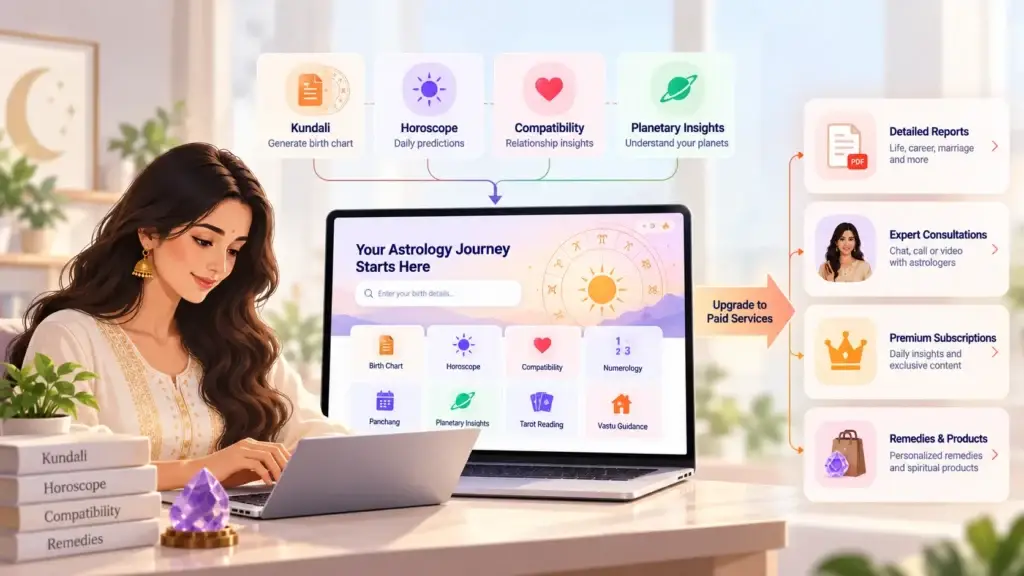
Free tools are not just traffic magnets. They are the trust-building layer of the platform.
When a user generates a kundali, checks horoscope predictions, reads a planetary interpretation, or tests compatibility, they are giving the platform a chance to prove usefulness before asking for money.
That matters because astrology is a trust-sensitive category.
Users may hesitate to pay immediately, especially if they do not know the brand, astrologer, report quality, or prediction style. Free tools reduce that hesitation by giving users a first experience without risk.
For founders, free tools can support three business goals:
- Organic acquisition through searchable astrology queries.
- User profiling through birth details, zodiac signs, interests, and repeated tool usage.
- Paid conversion through relevant upgrade paths after the user receives a basic result.
The mistake many founders make is treating free tools as giveaways.
A stronger approach is to treat them as structured entry points into deeper services.
For example, a free kundali can lead to a paid detailed life report. A compatibility result can lead to a marriage matching report. A daily horoscope can lead to a subscription. A planetary weakness explanation can lead to a remedy consultation or product recommendation.
The business model begins when free utility connects to paid relevance.
The Core Funnel: From Free Visit to Paid Service
A strong astrology portal platform usually follows a layered funnel.
| Funnel Stage | User Intent | Platform Experience | Monetization Opportunity |
|---|---|---|---|
| Discovery | “I need a quick answer.” | Blog, horoscope, kundali, panchang, tarot, numerology | Ads, retargeting, email capture |
| Personalization | “This should apply to me.” | Birth details, zodiac profile, compatibility inputs | Paid reports, saved profiles |
| Interpretation | “What does this mean?” | AI explanation, detailed report preview, content recommendations | Premium report, AI reading |
| Human Guidance | “I need deeper clarity.” | Chat, call, video, scheduled consultation | Consultation fee, platform commission |
| Action | “What should I do next?” | Remedies, puja, gemstones, courses, rituals | Marketplace revenue, affiliate revenue, direct commerce |
| Retention | “I want ongoing guidance.” | Daily alerts, subscriptions, saved charts, member access | Memberships, repeat wallet usage |
This is why the business model should not be planned as one revenue stream.
A portal can monetize at different points depending on user readiness.
Some users will never book a consultation but may buy reports. Some users may not buy products but may return daily for horoscope content. Some may start with AI guidance and later speak with a human astrologer. Some may subscribe for ongoing spiritual or predictive content.
The strongest model gives each user a relevant next step instead of forcing everyone into the same paid path.
Revenue Streams in an Astrology Portal Platform
An astrology portal can combine several revenue streams. Founders should not activate all of them at once. The right sequence depends on traffic, audience trust, practitioner supply, content depth, and operational capacity.
1. Paid Astrology Reports
Paid reports are often the cleanest first monetization layer for a content-led astrology portal.
They work because the user has already shown intent by entering birth details, checking a chart, or exploring a life question. A free result can show the basic interpretation, while the paid report offers depth.
Paid report examples include:
- Detailed kundali report
- Marriage compatibility report
- Career prediction report
- Yearly horoscope report
- Health astrology report
- Child astrology report
- Dosha analysis report
- Numerology report
- Transit report
- Personalized remedy report
For founders, paid reports are attractive because they can be delivered digitally, priced in tiers, and sold without needing every purchase to involve a live astrologer.
The key is not to hide all value behind payment. The free version should be useful enough to build trust, while the paid version should clearly offer more depth, structure, personalization, or downloadable value.
2. AI Astrology Readings
AI readings can help astrology portals serve users who want instant answers but are not ready for a live consultation.
This can include:
- AI horoscope explanations
- Tarot interpretations
- Numerology summaries
- Personalized question answering
- Birth-chart explanations
- Compatibility analysis
- Remedy suggestions
- Daily guidance prompts
The business logic is simple: AI can provide fast, scalable engagement, while human astrologers can handle deeper, emotional, or complex conversations.
Founders should be careful with positioning. AI should not be presented as a replacement for every human consultation. It is better positioned as instant guidance, first-level interpretation, or a bridge toward deeper paid services.
A practical monetization model may include free limited AI responses, paid question packs, wallet-based AI readings, subscription access, or AI-generated premium reports.
3. Live Astrology Consultations
Consultations are one of the strongest paid layers because users often want conversation, reassurance, and contextual interpretation.
A consultation model can include:
- Per-minute chat
- Voice calls
- Video calls
- Scheduled appointments
- Live sessions
- Specialist categories such as career, marriage, finance, health, vastu, tarot, or numerology
The platform may earn through commission, service fees, subscription access, or featured astrologer placement.
However, consultation revenue adds operational complexity. The platform needs astrologer onboarding, verification, availability management, pricing rules, wallet deduction, refunds, ratings, reviews, dispute handling, and payout workflows.
That is why consultation should be added with clear controls, not as a loose add-on.
A portal that already has traffic from free tools and content can introduce consultations more naturally because users are already arriving with specific questions.
4. Remedy, Puja, Gemstone, and Spiritual Commerce
Astrology often leads to recommended action.
If a user learns about a dosha, planetary weakness, compatibility concern, or auspicious timing issue, they may want remedies, rituals, gemstones, yantras, mantras, puja bookings, or spiritual products.
This creates a content-to-commerce opportunity.
The platform can monetize through:
- Direct product sales
- Vendor marketplace commissions
- Puja or ritual booking fees
- Affiliate partnerships
- Practitioner-recommended remedies
- Paid remedy reports
- Bundled consultation plus remedy packages
This layer should be handled carefully because trust matters. Product recommendations must feel helpful and transparent, not manipulative. Clear descriptions, refund rules, vendor verification, and support workflows are important for long-term credibility.
5. Subscriptions and Memberships
Subscriptions work when the platform gives users a reason to return repeatedly.
Possible subscription benefits include:
- Ad-free horoscope experience
- Premium daily or weekly guidance
- Monthly personalized reports
- Saved birth charts
- Family profile management
- Priority consultation access
- Exclusive webinars
- Discounted paid reports
- Limited AI readings
- Member-only spiritual content
Subscriptions should not be added just because recurring revenue sounds attractive. They work only when users receive ongoing value.
A founder should ask:
“Why would someone pay again next month?”
If the answer is not clear, subscriptions should wait until the portal has stronger retention signals.
6. Advertising and Sponsored Content
Astrology portals with high content traffic can monetize through ads and sponsorships.
This may include:
- Display ads
- Sponsored horoscope sections
- Festival campaigns
- Brand partnerships
- Spiritual product promotions
- Wellness, gifting, jewelry, or lifestyle partnerships
Advertising can be useful, but founders should avoid letting ads damage trust or user experience. Too many ads around sensitive personal predictions can make the platform feel low-quality.
Ads work best when they are contextual, limited, and secondary to the main product experience.
7. Featured Listings and Practitioner Promotions
If the platform includes astrologers, tarot readers, numerologists, vastu experts, or spiritual advisors, there may be a supply-side revenue opportunity.
Practitioners may pay for:
- Featured profile placement
- Category boosting
- Sponsored live sessions
- Higher visibility in search
- Promotional campaigns
- Training or certification access
This model should be introduced only after the platform has meaningful user demand. Practitioners will pay for visibility only when visibility can produce measurable business value.
Founder Decision Signals: Which Revenue Stream Should Come First?
Start With Reports
If your portal is content-led and already has free tools, paid reports are usually easier to launch than a full practitioner marketplace.
Add Consultations When Demand Is Clear
If users repeatedly ask for human guidance, live chat, voice, or video consultations can become the next paid layer.
Use AI for Scale
AI readings can support instant answers, report previews, and after-hours engagement before users move to deeper paid services.
Introduce Commerce Carefully
Remedies, puja, and spiritual products can monetize intent, but only when recommendations feel trustworthy and transparent.
Free Tools That Can Support Paid Conversion
Free tools should not be chosen randomly. Each free tool should connect to a monetization path.
| Free Tool or Content Type | User Question | Natural Paid Step |
|---|---|---|
| Free kundali generator | “What does my birth chart say?” | Detailed kundali PDF, AI chart reading, astrologer consultation |
| Guna milan / matching | “Are we compatible?” | Marriage report, relationship consultation, family matching package |
| Daily horoscope | “What should I expect today?” | Premium horoscope subscription, personalized alerts |
| Panchang | “What is auspicious today?” | Muhurta report, puja booking, festival content |
| Muhurta finder | “When should I do this?” | Detailed timing report, astrologer validation |
| Tarot reading | “What is the answer to my question?” | Paid tarot spread, live tarot consultation |
| Numerology calculator | “What does my number mean?” | Numerology report, name correction consultation |
| Vastu content | “What should I fix at home?” | Vastu consultation, remedy guide |
| Astrology blog | “I want to understand this topic.” | Related report, subscription, consultation |
The best portals make this transition feel useful.
For example, after a free compatibility score, the platform should not immediately push a generic consultation pop-up. It should explain what the score means, what is missing from the free version, and why a deeper report may help.
That is the difference between monetization and interruption.
The Role of Content in Astrology Portal Monetization
Content is not just a blog section. In an astrology portal, content is part of the product.
Content can attract search traffic, educate users, build trust, support free-tool usage, and create internal paths toward paid services.
Useful content categories include:
- Zodiac sign guides
- Daily, weekly, monthly, and yearly horoscopes
- Festival explainers
- Planetary transit updates
- Compatibility guides
- Kundali education
- Marriage astrology content
- Career astrology articles
- Numerology and tarot explainers
- Remedy and puja guides
- Regional astrology content
For founders, the content strategy should answer one question:
“What should the user do after reading this?”
If the article explains manglik dosha, the next step could be a dosha report or consultation. If the article explains career astrology, the next step could be a personalized career report. If the article explains festival rituals, the next step could be a puja booking or reminder.
Content becomes commercially useful when it is connected to a relevant product path.
Admin Controls That Decide Whether the Business Model Works
An astrology portal business model is not only about frontend features. The admin layer decides whether the founder can actually run the business.
Important admin controls include:
- Free and paid tool toggles
- Report pricing
- AI reading pricing
- Consultation pricing
- Wallet recharge settings
- Practitioner onboarding and approval
- Commission rules
- Payout management
- Refund handling
- Blog and CMS management
- Horoscope publishing workflows
- Promo code management
- User analytics
- Revenue reporting
- Support and dispute workflows
- Role-based access for team members
Without admin control, every pricing change, offer, content update, or monetization experiment becomes a developer dependency.
That slows down the business.
Founders should treat admin flexibility as part of the revenue model, not just a backend feature.
Why the Free-to-Paid Boundary Matters
The most important decision in an astrology portal is where the free experience ends and the paid experience begins.
If too much is free, users may consume value without converting.
If too little is free, users may leave before trusting the platform.
The right boundary depends on the type of service:
| Product Layer | What Can Be Free | What Can Be Paid |
|---|---|---|
| Kundali | Basic chart and short summary | Full PDF, deeper interpretation, remedies |
| Horoscope | General sign-based prediction | Personalized prediction based on birth details |
| Compatibility | Basic score | Detailed relationship report |
| AI reading | Limited free questions | Paid question packs or subscription |
| Consultation | Astrologer discovery | Chat, call, video, appointment |
| Remedies | Educational content | Personalized remedy report, puja, product |
| Content | Informational articles | Premium guides, courses, memberships |
This boundary should remain adjustable. A founder may start with more free access to build traffic, then introduce paid tiers once trust and repeat usage improve.
Common Mistakes Founders Should Avoid
Copying a Popular Astrology Platform Without Understanding the Funnel
The goal is not to copy screens. The goal is to understand how free discovery, personal insight, paid reports, consultations, and repeat engagement connect as one business system.
Adding Too Many Revenue Streams on Day One
Reports, consultations, AI readings, subscriptions, remedies, and ads can all work, but launching everything together can create operational confusion. Start with the revenue layer that matches your audience readiness.
Forcing Consultation Too Early
A content-led portal may need free tools and paid reports before it needs a large astrologer network. Consultation should be added when user demand justifies practitioner onboarding and payout operations.
Ignoring Admin Pricing Controls
If your team cannot update report pricing, AI question limits, consultation fees, offers, and content flows from the admin panel, your monetization experiments will move too slowly.
Ready-Made vs Custom Astrology Portal Development
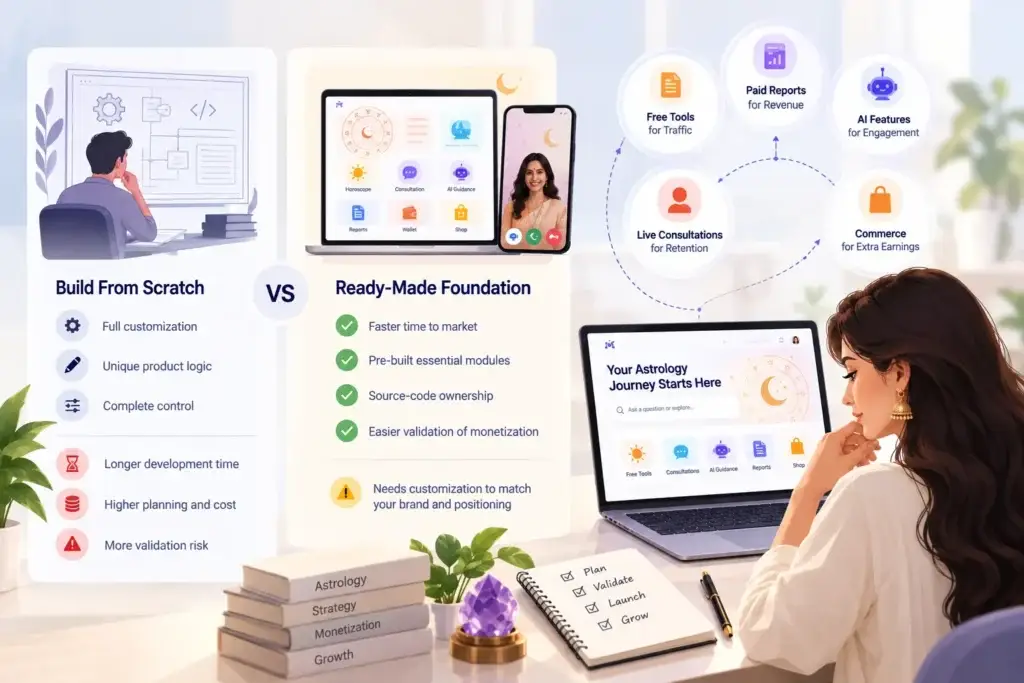
Founders usually have two routes: build everything from scratch or start with a ready-made foundation.
| Build Route | Best For | Strength | Risk |
|---|---|---|---|
| Custom development from zero | Highly unique product logic or enterprise-grade custom workflows | Full control over every detail | Longer timeline, higher planning burden, more validation risk |
| Ready-made astrology portal foundation | Founders who want free tools, reports, content, AI, consultation, and admin workflows faster | Faster launch, existing product structure, source-code ownership when provided | Requires careful customization to avoid generic positioning |
| Basic website plus plugins | Small content sites testing traffic | Lower initial complexity | Limited monetization control, weak app experience, harder scaling |
| Consultation-only marketplace | Practitioner-led astrology brands | Direct transaction model | Needs strong astrologer supply and operational management from day one |
For many founders, the smarter path is not choosing the longest build. It is choosing the path that helps them validate the business model faster without losing control over branding, pricing, content, and paid services.
A ready-made astrology portal platform can be useful when the founder already knows the target niche, language, region, monetization priority, and launch plan.
Miracuves helps founders launch white-label astrology portal platforms with the product foundation needed to connect free tools, content, paid reports, AI readings, practitioner workflows, admin control, and monetization logic.
This matters because the business model depends on more than a homepage and a calculator. Founders need the ability to decide what stays free, what becomes paid, how reports are priced, how users move into consultation, how practitioners are managed, and how the platform grows over time.
With Miracuves, founders can structure the platform around important business layers such as:
- Free astrology tools such as kundali generation, horoscope pages, compatibility checks, panchang, muhurat, tarot, or numerology flows that help attract users organically.
- Paid report journeys where free insights can lead users toward detailed kundali reports, marriage compatibility reports, yearly predictions, or personalized astrology PDFs.
- AI-powered astrology interactions that can support instant readings, guided questions, personalized explanations, and scalable user engagement.
- Practitioner workflows for managing astrologer profiles, availability, consultations, pricing, reviews, and payout logic.
- Admin control for managing users, content, reports, tool visibility, pricing, commissions, promo codes, and platform settings.
- Monetization flexibility across paid reports, wallet-based readings, consultations, subscriptions, remedy commerce, featured listings, and content-driven upgrades.
- Brand customization so the astrology portal can reflect the founder’s niche, audience, language, region, and positioning instead of looking like a generic platform.
- Source-code ownership for teams that want long-term control over customization, integrations, scaling, and future product decisions.
For teams evaluating a launch-ready foundation, the Miracuves ready-made astrology portal platform shows how a free-tool-first astrology business can be structured with branded deployment, source-code ownership, admin control, and paid service layers.
Final Thoughts: The Business Model Is the Journey From Curiosity to Paid Clarity
An astrology portal platform succeeds when it understands user psychology.
People do not always arrive ready to pay. Many arrive with curiosity, uncertainty, or one personal question. Free tools and content help the platform earn attention and trust. Paid services convert that trust into deeper value.
The business model is not just “consultations” or “reports” or “ads.”
It is the full journey:
Free discovery → personal insight → deeper interpretation → paid action → repeat engagement.
Founders who design that journey carefully can build astrology platforms that are more useful, more monetization-ready, and easier to scale.
The strongest opportunity is not in copying a known platform feature by feature. It is in building a portal where free tools, content, reports, AI, consultations, remedies, and admin control work together as one business system.
FAQs
What is an astrology portal platform business model?
An astrology portal platform business model uses free astrology tools, horoscope content, birth-chart features, and educational resources to attract users, then monetizes through paid reports, consultations, AI readings, remedies, subscriptions, ads, or spiritual commerce.
How do free astrology tools help generate revenue?
Free tools attract users and help them experience value before paying. A free kundali, compatibility check, panchang, horoscope, or numerology tool can lead naturally to paid reports, deeper interpretations, AI readings, or live consultations.
What are the main revenue streams for an astrology portal?
Common revenue streams include paid kundali reports, premium horoscope subscriptions, AI astrology readings, live astrologer consultations, remedy commerce, puja bookings, gemstones, sponsored content, ads, and practitioner profile promotions.
Should an astrology portal start with consultations or paid reports?
It depends on the business model. A content-led portal may start with free tools and paid reports first, then add consultations once users show demand for human guidance. A practitioner-led marketplace may prioritize consultations earlier.
Can AI astrology features be monetized?
Yes. AI astrology features can be monetized through paid questions, subscription access, report generation, wallet-based readings, or premium interpretation flows. AI works best when positioned as instant guidance rather than a complete replacement for human astrologers.
Why is content important for astrology portal monetization?
Content brings organic traffic, educates users, builds trust, and creates natural paths toward paid services. Articles about kundali, zodiac signs, compatibility, transits, remedies, and festivals can support relevant report, consultation, or subscription offers.
What admin features are important for an astrology portal business?
Important admin features include pricing control, report management, AI question limits, wallet settings, practitioner approval, commission rules, payout management, CMS publishing, horoscope management, promo codes, analytics, and user support workflows.
How can founders avoid keyword cannibalization when writing astrology blogs?
Founders should keep solution pages focused on commercial keywords such as platform, clone, demo, pricing, and development. Blogs should target supporting informational topics such as business model, monetization, free-tool funnel, paid reports, and astrology portal strategy, then link naturally to the solution page as the next step.
Miracuves is an independent software development company. We are not affiliated with, connected to, sponsored by, or endorsed by any company or product named in this article.
Terms such as “X Clone” are used descriptively. It is how the software industry refers to building a platform with functionality comparable to a known service, and how clients search for it.
The entire design and codebase of our products is built by our own team. Our products contain no code, design, graphics, or content originating from any third-party website or applications.
All third-party names and marks referenced in this article are the property of their respective owners, referenced solely to identify the services discussed.



