
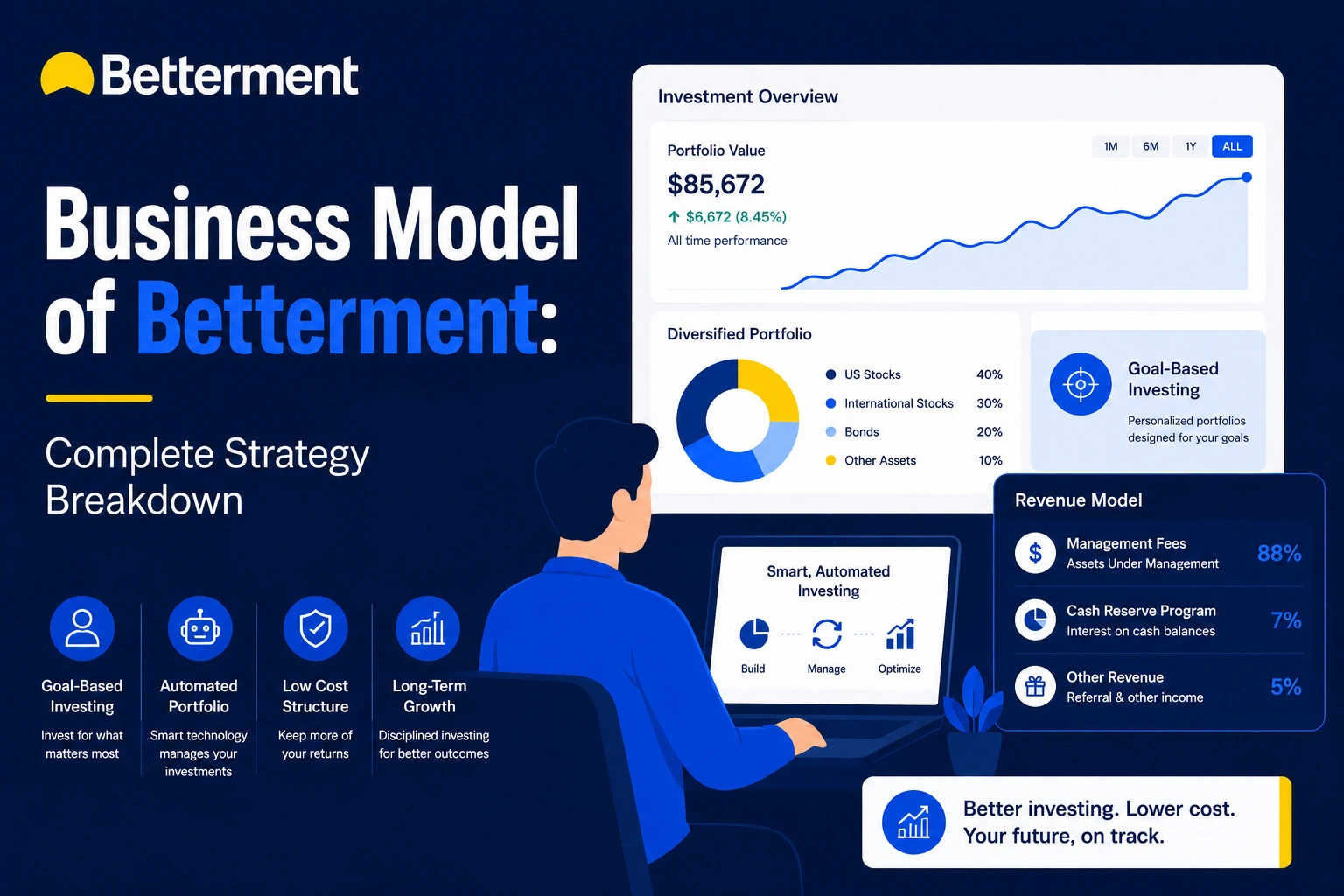
The business model of Betterment has quietly reshaped modern wealth management by proving that smart investing doesn’t need salespeople, high fees, or complex products. From a Y Combinator–backed fintech startup, Betterment scaled into one of the world’s largest independent robo-advisors, managing tens of billions of dollars in assets. By automating disciplined, goal-based investing, it challenged a legacy industry built on 1–2% fees and high entry barriers.
Founded in 2008 during the global financial crisis, Betterment launched when trust in traditional financial institutions was deeply shaken. Instead of market timing or commission-driven advice, it focused on evidence-based investing, radical transparency, and automation over human bias. By 2026, Betterment has evolved beyond a robo-advisor into a full digital wealth platform spanning investing, retirement, cash management, and B2B infrastructure.
For entrepreneurs, Betterment is a masterclass in building a durable platform. Its predictable recurring revenue, strong regulatory moat, and education-led trust show how software, behavioral economics, and compliance can compound into long-term value.
How the Betterment Business Model Works
Betterment operates on a digital wealth management platform model — blending automation, behavioral finance, and low-cost portfolio management into a single, scalable system.
At its core, Betterment replaces traditional financial advisors with software-driven decision-making, while still offering optional human guidance when needed. This hybrid structure allows it to serve millions of users efficiently without sacrificing trust.
Let’s break down the framework.
Type of Business Model
Betterment uses a Hybrid Fintech Platform Model, combining:
- Robo-advisory (core engine)
- Subscription-style AUM pricing
- B2B SaaS infrastructure (Betterment for Advisors & Work)
Value Proposition by User Segment
1. Individual Investors (B2C)
What they get:
- Automated, diversified portfolios using ETFs
- Goal-based investing (retirement, safety net, major purchases)
- Automatic rebalancing and tax-loss harvesting
- Transparent, low fees with no hidden commissions
Why it resonates:
- Removes emotional decision-making
- No minimums for entry-level plans
- “Set it and forget it” investing psychology
2. High-Net-Worth & Premium Users
What they get:
- Human financial advisors on demand
- Advanced tax strategies
- Customized portfolios
This tier increases ARPU without changing the core product.
3. Advisors & Employers (B2B)
What they get:
- White-labeled or co-branded investing infrastructure
- Compliance-ready tools
- Scalable client management systems
This turns Betterment into financial operating system, not just an app.
Key Stakeholders in the Ecosystem
Betterment’s ecosystem stays balanced through clearly defined roles:
- Users: Provide assets (AUM) — the core revenue driver
- ETF Providers: Supply low-cost investment vehicles
- Custodians & Banks: Secure asset storage and transactions
- Regulators: Ensure compliance (SEC, FINRA, etc.)
- Advisors (optional): Add human value without bloating costs
Each stakeholder benefits as the platform scales — a classic platform alignment strategy.
How the Model Evolved Over Time
Betterment didn’t start as a full-suite wealth platform.
Evolution timeline:
- 2008–2012: Pure robo-advisor for retail investors
- 2013–2016: Added tax-loss harvesting & retirement tools
- 2017–2020: Introduced human advice tiers and cash accounts
- 2021–2024: Expanded B2B offerings (Advisors, Work)
- 2025–2026: Focus on profitability, retention, and enterprise fintech services
This phased evolution reduced risk while compounding trust.
Why Betterment’s Model Works in 2026
Several macro trends make this model especially powerful today:
- Rising distrust of commission-based financial advice
- Younger investors preferring digital-first platforms
- Increased comfort with algorithmic decision-making
- Pressure on fees across financial services
- Regulatory clarity around robo-advisors
Read more : What is Betterment App and How Does It Work?
Target Market & Customer Segmentation Strategy
Betterment’s growth isn’t driven by everyone — it’s driven by the right investors at the right life moments. Its segmentation strategy is behavioral, not just demographic, which is why retention stays high even during market volatility.
Primary Customer Segments
1. Mass-Affluent Digital Investors (Core Segment)
Profile:
- Age: 25–45
- Digitally native, skeptical of traditional finance
- Long-term wealth builders (retirement, home, family)
Why they stay:
- Automated discipline removes emotional investing
- Simple UX replaces financial jargon
- Trust built through education and transparency
This segment fuels the majority of Betterment’s AUM growth.
2. First-Time & Passive Investors
Profile:
- New to investing
- Low initial capital
- Fear of making “wrong” decisions
Betterment’s hook:
- No account minimums
- Guided onboarding and goal-based setup
- “Investing without thinking about investing”
This segment is critical for long-term LTV, even if early balances are small.
3. High-Net-Worth & Premium Clients
Profile:
- Higher balances
- Tax sensitivity
- Time-poor professionals
Retention levers:
- Human advisor access
- Advanced tax strategies
- Personalized portfolios
This segment boosts average revenue per user without altering the core platform.
4. B2B Clients (Advisors & Employers)
Profile:
- Independent RIAs
- Mid-sized employers offering financial wellness
- Institutions needing compliant fintech infrastructure
These clients bring:
- Stable, contract-based revenue
- Large AUM inflows in fewer accounts
- Lower churn compared to B2C users
Customer Journey: From Discovery to Retention
1. Discovery
- Content marketing (financial education, blogs, calculators)
- SEO around investing basics
- Employer benefit discovery (for Work accounts)
- Word-of-mouth referrals
2. Conversion
- Seamless onboarding
- Risk tolerance and goal assessment
- Instant portfolio allocation
3. Retention & Expansion
- Automated rebalancing
- Proactive nudges (tax savings, goal progress)
- Cross-selling cash management and advice tiers
This journey is engineered to reduce decision fatigue, not increase engagement noise.
Revenue Streams and Monetization Design
Betterment’s monetization is one of the cleanest examples of “recurring revenue done right” in fintech.
Instead of making money through:
- trading fees
- hidden spreads
- commissions
- or product kickbacks
Betterment earns primarily through a percentage-based platform fee on Assets Under Management (AUM) — a model designed to scale as customers grow wealth.
Betterment’s Core Revenue Logic
Betterment’s revenue grows when:
- users deposit more
- users stay longer
- portfolios appreciate over time
That means the company is structurally incentivized to align with customer outcomes — which is why trust is easier to build compared to traditional finance.
Primary Revenue Stream
This is Betterment’s core business.
How it works:
- Betterment charges an annual fee based on total assets managed
- Fee is deducted monthly (quietly, automatically)
- The platform manages portfolios via ETFs
Typical pricing structure (2026 market standard):
- Digital plan: ~0.25% annually
- Premium/hybrid tiers: ~0.40%+ depending on advice access
Why it’s powerful:
- Predictable recurring revenue
- Compounding effect over time
- High gross margins due to automation
Growth trajectory:
Betterment doesn’t need to “sell” more — it needs to:
- keep users investing
- keep them calm in downturns
- expand into retirement + cash + advice tiers
That’s why retention is more valuable than virality.
Secondary Revenue Streams
2. Subscription / Advice Upsells
Betterment monetizes premium users through:
- access to human advisors
- financial planning sessions
- retirement strategy optimization
This creates a “hybrid advisory” layer where:
- software handles 90%
- humans handle the high-trust moments
This is a high-margin upsell because Betterment doesn’t staff like a traditional advisory firm.
3. Betterment for Work (Employer Revenue)
Betterment earns from employers through:
- financial wellness programs
- retirement plan services
- employee investing benefits
B2B monetization is attractive because:
- CAC is lower per dollar of AUM
- AUM inflow is larger
- churn is dramatically lower
4. Betterment for Advisors (Platform Infrastructure)
Betterment monetizes advisors by offering:
- custody + portfolio automation
- rebalancing tools
- reporting dashboards
- compliant client workflows
Operational Model & Key Activities
Behind Betterment’s calm, minimal interface is a highly disciplined operational engine. The company’s real advantage isn’t just smart portfolios — it’s how efficiently those portfolios are delivered at scale under strict regulation.
This is where fintech either breaks… or becomes durable.
Core Operations (Day-to-Day Execution)
1. Platform & Portfolio Management
- Algorithm-driven asset allocation
- Continuous portfolio rebalancing
- Automated tax-loss harvesting
- Cash allocation and sweep logic
Once built, these systems scale almost infinitely with minimal marginal cost.
2. Technology Infrastructure
- Cloud-native architecture
- API-first systems for B2B and partner integrations
- Real-time data pipelines for market monitoring
- High-availability and disaster recovery systems
Tech reliability is non-negotiable — downtime equals lost trust.
3. Compliance & Risk Management
- SEC and FINRA compliance workflows
- Automated reporting and audit trails
- Data security and privacy enforcement
- Risk modeling and portfolio safeguards
Unlike many startups, compliance is not a cost center — it’s a competitive moat.
4. Customer Support & Advisory Services
- Tiered support models
- Human advisors reserved for high-impact interactions
- Education-driven support (guides > calls)
This keeps support costs low while preserving customer confidence.
5. Marketing & Brand Operations
- Education-first content strategy
- SEO and long-form financial guides
- Employer onboarding programs
- Performance marketing with strict CAC:LTV thresholds
Betterment avoids hype-driven growth in favor of credibility.
Why This Operational Model Scales
- High upfront build cost, low marginal cost
- Software replaces repetitive human labor
- Compliance embedded into workflows
- Same core engine serves multiple revenue lines (B2C + B2B)
Strategic Partnerships & Ecosystem Development
Betterment’s platform looks simple on the surface, but underneath it operates as a carefully orchestrated financial ecosystem. Instead of building everything in-house, Betterment partners strategically to move faster, stay compliant, and deepen its moat.
This partnership-first mindset is a major reason it scaled sustainably.
Betterment’s Collaboration Philosophy
Betterment partners where:
- scale matters more than ownership
- regulation is complex
- trust is already established
Rather than competing with every financial institution, it integrates with them — positioning itself as the intelligent layer on top of traditional finance.
Key Partnership Types
1. Technology & API Partners
These partners power Betterment’s infrastructure:
- Market data providers
- Cloud infrastructure vendors
- Security and identity verification platforms
- Tax optimization and reporting tools
Why it matters:
- Faster feature development
- Enterprise-grade reliability
- Reduced internal engineering burden
2. Custodial, Banking & Payment Partners
Betterment does not directly custody assets.
Instead, it partners with:
- Regulated custodians
- FDIC-insured banks
- Clearing and settlement providers
Benefits:
- Regulatory compliance
- Customer trust
- Reduced balance-sheet risk
This “asset-light” approach keeps the business scalable.
3. ETF & Asset Management Partners
Betterment builds portfolios using:
- Low-cost ETFs
- Passive investment vehicles
- Broad market exposure products
This allows Betterment to:
- Avoid conflicts of interest
- Maintain fee transparency
- Focus on allocation and automation, not fund manufacturing
4. Employer & Institutional Partners
For Betterment for Work:
- Employers integrate Betterment into benefits packages
- Institutions use Betterment as investing infrastructure
This creates:
- Built-in distribution
- Large AUM inflows
- High retention
5. Regulatory & Expansion Alliances
Betterment actively collaborates with:
- Regulators
- Industry associations
- Compliance consultants
Instead of treating regulation as friction, it treats it as part of the ecosystem design.
Ecosystem Strategy: Why It’s So Defensible
Betterment’s ecosystem creates powerful network effects:
- More users → more AUM
- More AUM → better negotiating power
- Better partnerships → better products
Better products → higher trust
Read more : Best Betterment Clone Scripts 2026 for Automated Investing Platforms
Growth Strategy & Scaling Mechanisms
Betterment’s growth story isn’t about explosive virality. It’s about compounding trust, compounding assets, and compounding time. That makes its scaling strategy especially valuable for founders building long-term platforms.
Core Growth Engines
1. Organic Growth via Trust & Education
Betterment invests heavily in:
- Financial education content
- Long-form guides and calculators
- Transparent market communication during downturns
Why this works:
- Finance decisions are trust-heavy
- Educational content compounds SEO value
- Users who understand the “why” are less likely to churn
This is slow growth — but incredibly durable.
2. Referral Loops & Social Proof
Betterment benefits from:
- Peer recommendations
- Family financial planning referrals
- Employer-driven adoption
Referrals are powerful because:
- People discuss investing only with trusted circles
- Referrals convert with higher AUM
- CAC is dramatically lower
3. Paid Acquisition (Used Selectively)
Unlike consumer apps, Betterment treats paid ads cautiously.
- Strict CAC:LTV ratio enforcement
- Focus on high-intent keywords (retirement, long-term investing)
- Retargeting instead of broad awareness
Growth is measured in AUM quality, not user volume.
4. Product-Led Expansion
Betterment scales by expanding within the customer:
- Cash management
- Retirement accounts
- Human advice tiers
- Tax optimization tools
This increases:
- Retention
- ARPU
- Platform dependency
One user, multiple financial needs.
5. B2B Distribution Channels
Betterment for Work and Advisors unlock:
- Large account inflows
- Predictable revenue contracts
- Embedded growth through institutions
This reduces reliance on volatile consumer acquisition.
Geographic Expansion Model
Betterment is cautious with international expansion because:
- financial regulation is highly local
- compliance cost is high
- trust takes time
Instead of rapid global rollout, Betterment prioritizes:
- depth over breadth
- profitability over reach
- infrastructure readiness
Competitive Strategy & Market Defense
Betterment operates in one of the most competitive industries on earth: wealth management — where legacy giants, banks, and fast-moving fintechs all fight for the same thing:
By 2026, the robo-advisor market is crowded, fee-compressed, and increasingly commoditized. So Betterment’s real edge isn’t “automation” anymore.
It’s how the company defends:
- customer trust
- customer retention
- and ecosystem control
Core Competitive Advantages
1. Trust as a Product
Betterment’s biggest advantage is that it’s perceived as:
- rational
- transparent
- conflict-free
Unlike many financial apps, Betterment doesn’t rely on:
- payment-for-order-flow
- trading gamification
- hype investing
This matters because in 2026:
- users are more skeptical
- regulators are stricter
- trust is scarcer
Trust becomes a moat.
2. Switching Barriers (Quiet but Strong)
Betterment creates switching costs through:
- automated recurring deposits
- multiple goals tied to the platform
- tax-optimized portfolios
- retirement accounts and employer-linked plans
Once a user has:
- 3–5 goals
- automated contributions
- and tax history
…leaving becomes annoying and psychologically risky.
3. Data-Driven Personalization
Betterment’s personalization is not “social feed AI.”
It’s high-value personalization like:
- risk tolerance adjustments
- retirement projections
- tax impact forecasts
- goal probability scoring
This makes the platform feel like a long-term financial partner — not a tool.
4. Platform Depth vs Feature Breadth
Many competitors chase flashy features:
- crypto trading
- meme stocks
- social investing
Betterment wins by going deeper on:
- retirement outcomes
- tax efficiency
- long-term allocation
- behavioral nudges
It doesn’t compete on excitement.
It competes on results.
5. Compliance Strength as a Competitive Weapon
In 2026, compliance isn’t optional — it’s a growth filter.
Betterment benefits from:
- mature SEC-grade operations
- audit-ready systems
- trusted custody partnerships
- established governance
New entrants struggle to match this without huge investment.
Market Defense Tactics
1. Handling New Entrants & Pricing Wars
Robo-advisors often compete by dropping fees.
Betterment’s defense:
- hold pricing steady
- justify value via tax tools + advice access
- increase retention through better outcomes
Instead of racing to the bottom, it increases perceived ROI.
2. Strategic Feature Rollouts
Betterment avoids rushing new features.
It times releases around:
- market shifts (interest rates, volatility)
- user needs (retirement seasons, tax year)
- regulatory clarity
This creates stability and reduces risk of public failures.
3. B2B Expansion to Protect Market Share
Betterment’s move into:
- Betterment for Advisors
- Betterment for Work
…is a market defense strategy.
Because B2B relationships:
- reduce churn
- bring large AUM flows
- embed Betterment in institutional distribution
It’s harder to displace.
4. Strategic Partnerships & Consolidation Moves
Betterment strengthens defense through:
- custody and banking alliances
- employer distribution partners
- advisor ecosystems
In fintech, partnerships aren’t just growth — they are territory control.
Lessons for Entrepreneurs & Implementation
Betterment’s journey offers one of the clearest blueprints for building a trust-first, recurring-revenue platform — especially in regulated, high-stakes industries like fintech, healthtech, and B2B SaaS.
Let’s translate insight into action.
What Really Made Betterment Successful
1. Outcome-Based Monetization
Betterment didn’t charge for:
- trades
- advice sessions
- features
It charged for results over time.
When your revenue grows with your customer’s success, alignment becomes a growth engine.
2. Automation as the Core, Humans as the Edge
Betterment automated:
- asset allocation
- rebalancing
- tax optimization
Humans were added only where:
- trust peaks
- complexity spikes
- emotions rise
This kept margins high and service quality consistent.
3. Discipline Over Hype
While competitors chased trends, Betterment stayed boring — deliberately.
That “boring” consistency built:
- credibility during market crashes
- loyalty over decades
- brand trust regulators respect
4. Platform Thinking from Day One
Betterment wasn’t just an app — it was infrastructure.
This made it easy to:
- expand into B2B
- add new products
- reuse the same engine for multiple audiences
Replicable Principles for Startups
Entrepreneurs can apply Betterment’s model by focusing on:
- Recurring revenue tied to customer outcomes
- Long-term retention over short-term growth
- Education-led acquisition
- Modular, scalable architecture
- Compliance-aware product design
These principles work far beyond fintech.
Common Mistakes to Avoid
Founders trying to copy Betterment often fail by:
- adding human advisors too early
- underestimating compliance costs
- chasing viral growth instead of retention
- over-customizing before proving scale
- monetizing transactions instead of trust
Betterment earned the right to expand — it didn’t rush it.
Implementation & Investment Priorities
Phase 1: Foundation
- Regulatory research
- Core automation engine
- Basic portfolio logic
- MVP compliance layer
Phase 2: Trust & Retention
- Goal-based UX
- Education content
- Behavioral nudges
- Early partnerships
Phase 3: Monetization & Scale
- Tiered pricing
- B2B offerings
- Advanced analytics
- Expansion channels
Ready to implement Betterment’s proven business model for your market?
Miracuves builds scalable platforms with tested business models and growth mechanisms.
We’ve helped entrepreneurs launch profitable fintech and digital platforms.
Get your free business model consultation today.
To put this into practice, our ready-made multi-asset investing platform starts at $9,099 and is delivered in 6 days. It is not a copy of Betterment. Automated portfolio allocation and rebalancing are custom work, and investment advisory licences are arranged by you.
Conclusion
Betterment’s business model proves a powerful truth about modern platform companies:
Sustainable growth isn’t built on excitement — it’s built on execution, trust, and time.
In an era where many apps chase attention, Betterment chose something harder: discipline. By aligning its revenue with user outcomes, embedding compliance into its technology, and designing for decades instead of quarters, it created a business that compounds quietly but relentlessly.
What makes Betterment especially relevant in 2026 is not its robo-advisory roots — it’s its platform maturity. It shows that when automation, behavioral design, and regulation work together, software can outperform traditional institutions without becoming reckless.
The future of platform economies will belong to companies that remove friction, reduce cognitive load, and monetize long-term value — not short-term behavior.
Betterment didn’t just change how people invest.
FAQs
What type of business model does Betterment use?
Betterment uses a hybrid fintech platform model that combines robo-advisory services, recurring AUM-based fees, and B2B wealth management infrastructure. It serves both individual investors and institutions using the same core technology.
How does Betterment’s business model create value?
Betterment creates value by automating long-term investing, reducing human bias, and offering low-cost, diversified portfolios. Its software-driven approach delivers consistent outcomes with minimal friction.
What are Betterment’s key success factors?
Betterment’s success comes from trust-first design, transparent pricing, automation at scale, and strong regulatory compliance. High retention and long investment horizons drive compounding growth.
How does Betterment make money?
Betterment earns primarily through a small annual percentage fee on assets under management (AUM). Additional revenue comes from premium advisory services, employer plans, and cash management products.
How scalable is Betterment’s business model?
The model is highly scalable because portfolio management is automated and costs don’t rise linearly with users. Revenue grows as user assets grow over time.
What are the biggest challenges in Betterment’s model?
Major challenges include regulatory complexity, fee competition, market volatility, and customer acquisition costs. Betterment mitigates these through compliance-first design and long-term retention strategies.
How can entrepreneurs adapt Betterment’s model to their region?
Founders can localize the model by targeting niche investor segments, partnering with regulated custodians, and embedding compliance early. Education-led trust building is critical for adoption.
What are alternatives to Betterment’s business model?
Alternatives include subscription-based financial planning apps, trading-driven platforms, bank-led wealth services, and advisor marketplaces. Each model trades off scale, trust, and monetization differently.
How has Betterment’s business model evolved over time?
Betterment evolved from a pure robo-advisor into a full digital wealth platform by adding cash management, retirement tools, human advice, and B2B services, improving revenue stability and scale.
Related Article :
- What is Wealthfront and How Does It Work?
- What is Robinhood App and How Does It Work?
- Best N26 Clone Scripts 2026 for Digital Banking Startups
- Best Monzo Clone Scripts 2026: Build a Digital Banking App That Scales Globally
- Best Starling Bank Clone Scripts 2026 : Build a Digital Bank That Scales in the Real World
Miracuves is an independent software development company. We are not affiliated with, connected to, sponsored by, or endorsed by any company or product named in this article.
Terms such as “X Clone” are used descriptively. It is how the software industry refers to building a platform with functionality comparable to a known service, and how clients search for it.
The entire design and codebase of our products is built by our own team. Our products contain no code, design, graphics, or content originating from any third-party website or applications.
All third-party names and marks referenced in this article are the property of their respective owners, referenced solely to identify the services discussed.