


Breaking news changes user behavior instantly. A quiet platform can become the center of attention within minutes when a political update, celebrity announcement, market crash, sports result, public safety alert, entertainment controversy, or major global event starts spreading. People do not visit a real-time microblogging platform casually during these moments. They arrive with urgency. They refresh timelines, search hashtags, post reactions, follow accounts, report misinformation, open direct messages, watch media, and expect every update to appear almost immediately.
For founders, this is the moment that reveals whether a platform is truly ready. A real-time public conversation product may look polished during normal usage, but breaking news stress-tests everything at once: the feed, composer, notifications, database, moderation layer, media handling, admin dashboard, search experience, and trust systems. The challenge is not only handling more users. The challenge is handling unpredictable behavior from millions of users at the same time.
That is why building a real-time microblogging platform is not just about creating posts, replies, likes, reposts, and profiles. The product must be prepared for sudden attention. When a major story breaks, speed matters, but uncontrolled speed creates risk. The platform has to stay fast without spreading abuse, misinformation, impersonation, spam, duplicate content, or broken notifications. This is where architecture, moderation, admin control, and operational planning become business-critical.
Key Takeaways
- Breaking news traffic surges expose whether a real-time microblogging platform is truly scalable or only functional under normal load.
- The biggest pressure points are feed reads, post writes, search activity, media loading, notifications, moderation queues, and admin decision-making.
- Founders should prepare for traffic spikes before launch because viral attention rarely gives teams time to rebuild core infrastructure.
- Trust systems such as verification, reporting, account status controls, and audit trails become more important when millions of users are reacting at once.
- A launch-ready platform foundation can help founders test real-time public conversation faster without building every workflow from zero.
Why Breaking News Creates a Different Kind of Platform Load
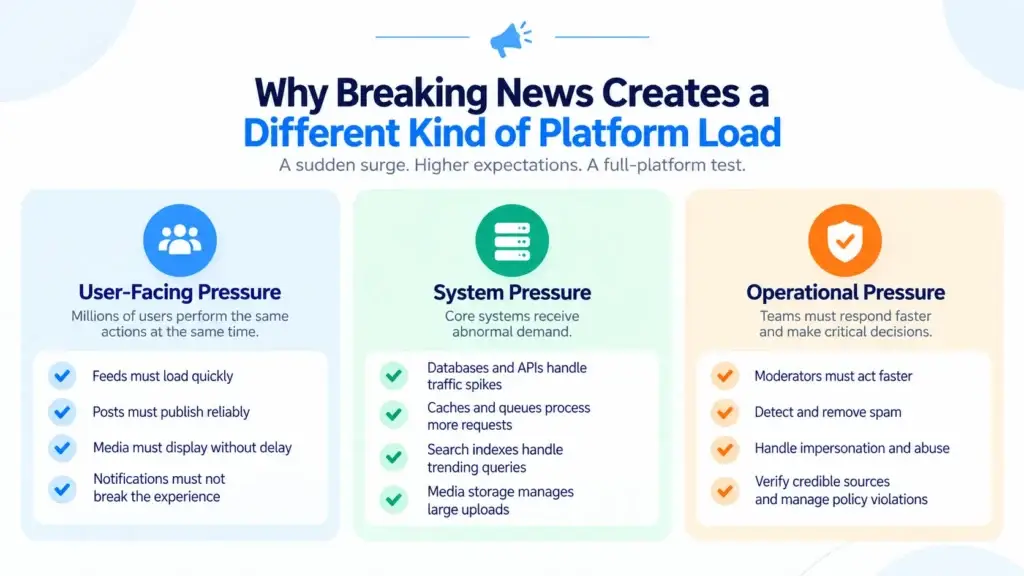
Normal social platform traffic is relatively predictable. Users open the app, scroll, post, message, and leave. Even if daily active users are growing, the platform can usually forecast usage patterns based on time zones, audience behavior, campaigns, and content habits.
Breaking news behaves differently. It compresses demand into a short window. Thousands or millions of users may perform the same actions repeatedly within minutes. They refresh timelines faster than usual. They open the same trending post. They search the same phrase. They upload screenshots and videos. They follow verified sources. They argue in replies. They report posts. They send links to friends. They expect the platform to feel live.
This creates pressure across three layers at the same time:
- User-facing pressure: feeds must load quickly, posts must publish reliably, media must display, and notifications must not collapse the experience.
- System pressure: databases, APIs, caches, queues, search indexes, media storage, and authentication systems receive abnormal demand.
- Operational pressure: moderators, admins, and platform operators must make faster decisions about spam, impersonation, abuse, verified sources, and policy violations.
For a founder, the key lesson is simple: breaking news does not test one feature. It tests the entire platform ecosystem.
The First Surge: Everyone Opens the Feed at Once
The first visible pressure point is usually the feed. When news breaks, users do not wait patiently for algorithmic discovery. They open the app because they expect the timeline to explain what is happening now. The feed becomes the front door, the search engine, the reaction layer, and the credibility layer all at once.
A weak feed architecture can fail in several ways. It may load slowly, repeat the same posts, show outdated content, lose newly published posts, or create inconsistent experiences across web and mobile. A real-time microblogging platform needs a feed system that can handle high read volume without recalculating everything from scratch for every user request.
During breaking news, the platform has to make practical choices:
- Should the feed prioritize recency, relevance, trusted accounts, or engagement?
- Should newly published posts appear instantly or after lightweight ranking checks?
- Should users see a “new posts available” prompt instead of constant automatic refresh?
- Should trending content be separated from the main timeline to reduce feed pressure?
- Should certain media-heavy posts be lazy-loaded to protect performance?
These are not only technical decisions. They affect user trust. If users feel the platform is slow during a major event, they may leave. If they feel the platform is fast but chaotic, they may also leave. The ideal experience balances speed, stability, and clarity.
Posting Volume Spikes: The Composer Becomes a High-Risk Feature
Most users think of the composer as a simple box where people write posts. In a breaking news moment, the composer becomes a high-risk system. It handles text, hashtags, images, video, audio, polls, mentions, links, quote posts, threads, and replies. Every submission creates database writes, notification events, media processing, timeline updates, moderation signals, and engagement records.
If the composer is not built carefully, the platform may create duplicate posts, fail uploads, lose drafts, accept abusive content without flagging, or allow spam accounts to flood the feed. Rate limiting, validation, media checks, and account-status controls become important because posting is the main action attackers and spam networks will abuse during high-visibility events.
A scalable composer flow should be designed around three priorities:
- Reliability: users should know whether their post was published, queued, rejected, or delayed.
- Safety: the system should detect obvious spam patterns, suspicious automation, abusive terms, or high-frequency posting behavior.
- Consistency: posts should appear correctly across profile pages, feeds, replies, notifications, search results, and mobile views.
This is where founders often underestimate complexity. Building a post box is easy. Building a post box that remains reliable when millions of people react to the same event is the real challenge.
Search and Hashtags Become Temporary Navigation Systems
During breaking news, users search differently. They do not search broad topics; they search specific names, phrases, locations, quotes, abbreviations, hashtags, and developing claims. Search becomes a live navigation system for the event.
This puts pressure on indexing. New posts have to become searchable quickly. Hashtag pages must update. Trending topics must detect velocity without being manipulated easily. Search results should not overload the database with expensive queries every time users type the same phrase.
The platform should prepare for:
- Fast indexing of new posts and public profiles
- Trend detection based on velocity, not only total volume
- Spam-resistant hashtag discovery
- Search result caching for repeated high-demand queries
- Safe handling of sensitive or harmful terms
- Clear separation between live updates, top posts, and account results
For founders, the search layer is important because it shapes how users discover authority during uncertainty. If search results are slow, polluted, or outdated, users lose confidence in the platform exactly when attention is highest.
Notifications Can Help Engagement or Break the Experience
Notifications are powerful during live events. Users want to know when a post is replied to, when a creator publishes an update, when a followed account goes active, when a thread continues, or when a direct message arrives. But notifications can also become a performance problem.
When millions of users interact with the same accounts and posts, notification volume can explode. If every like, reply, repost, mention, follow, and message creates immediate push activity, the platform may overwhelm users and infrastructure at the same time. The result can be delayed alerts, duplicate notifications, battery drain, increased costs, or user frustration.
A stronger notification strategy uses rules instead of sending everything instantly. For example, the platform may group similar actions, delay low-priority notifications, prioritize direct messages and mentions, suppress noisy engagement alerts, and create digest-style updates for high-volume posts.
The goal is not to notify users about everything. The goal is to notify users about what matters without turning a live event into noise.
Moderation Pressure Increases Faster Than Traffic
Breaking news does not only increase legitimate conversation. It also increases impersonation, spam, harassment, misinformation, graphic media, copied content, scams, coordinated reporting, and abusive replies. A platform that can handle traffic but cannot handle moderation risk is still not ready for real-time public conversation.
Moderation pressure often grows faster than normal traffic because high-attention events attract people who want to influence, disrupt, or exploit the conversation. Reports arrive quickly. Users flag posts. Public figures or creators may be impersonated. New accounts may flood hashtags. Older posts may resurface without context. Screenshots may be posted as evidence even when they are misleading.
A platform needs both tooling and human decision-making. Automated rules can detect obvious spam, repeated content, suspicious posting velocity, or banned terms. Human moderators still need queues, context, account history, escalation paths, and proportional resolution actions. The operator should be able to hide, unhide, delete, suspend, ban, review appeals, and document decisions.
This is why admin design matters. If moderators only have a simple delete button, every decision becomes too blunt. If they have structured workflows, the platform can respond proportionately and create a record of why action was taken.
What Breaks During a Breaking News Traffic Surge?
| Platform Layer | What Can Go Wrong | What Founders Should Prepare |
|---|---|---|
| Feed and Timeline | Slow loading, stale content, repeated posts, inconsistent web and mobile views | Cached reads, cursor pagination, ranking rules, timeline refresh controls, consistent API behavior |
| Composer and Posting | Duplicate posts, failed uploads, spam floods, unsafe media, broken threads | Validation, rate limits, media handling, account status checks, clear publish states |
| Search and Hashtags | Outdated search results, manipulated trends, expensive repeated queries | Fast indexing, trend velocity logic, search caching, spam-resistant hashtag systems |
| Notifications | Duplicate alerts, delayed delivery, noisy user experience, rising infrastructure load | Priority rules, grouping, throttling, digest logic, channel-level notification controls |
| Moderation | Report queue overload, impersonation, abuse, misinformation, inconsistent decisions | Report queues, action history, audit logs, appeal workflows, role-based admin controls |
| Admin Operations | Operators cannot see what is happening quickly enough to act | Dashboards, member search, account status tools, activity analytics, escalation workflows |
Verified Accounts Become Critical During Uncertainty
During breaking news, users look for accounts they can trust. They want updates from official organizations, journalists, creators, public figures, subject experts, local witnesses, and known community voices. This makes account verification more than a badge. It becomes a trust signal that affects how users interpret information.
A platform with weak verification controls can become vulnerable to impersonation. Fake accounts can copy profile photos, names, bios, and posting styles. During a fast-moving event, users may not have time to inspect every account carefully. If impersonation spreads before moderators can respond, the platform’s credibility suffers.
For founders, verification should not be treated as a decorative profile feature. It should be connected to a review process, account record, admin decision, and audit trail. Operators should know who granted verification, why it was granted, when it changed, and whether the account still qualifies.
This is also where a public conversation platform can create commercial value. Verified communities, paid professional accounts, creator tiers, institutional accounts, and expert-led spaces can all become part of a membership strategy. But that only works if verification is trusted by users and controllable by the operator.
Database Design Decides Whether the Platform Feels Live
Real-time microblogging platforms create heavy database activity. A single breaking news post can trigger reads from thousands of timelines, writes from replies, updates from reposts, counters from engagement, records from reports, notifications from mentions, and search indexing events.
The platform should avoid expensive operations that recalculate large datasets during every request. If the system tries to count, sort, filter, and join too much information at read time, the experience slows down when traffic rises. This is why many social platforms use denormalized counters, cached timelines, cursor pagination, indexed queries, and background processing.
Founders do not need to become database engineers, but they should understand the business impact of database design. Poor data modeling increases cost, slows the feed, creates inconsistent user experiences, and makes it harder to moderate or analyze platform behavior. Strong data modeling makes the platform easier to operate, scale, and improve after launch.
The right question is not “Can users post?” The stronger question is “Can users post, search, reply, report, refresh, and receive notifications while everyone else is doing the same thing?”
Media Loading Can Become the Hidden Bottleneck
Breaking news is visual. Users upload screenshots, short clips, audio snippets, documents, memes, charts, and live-location visuals. These files make the event easier to understand, but they also increase platform load. Media-heavy posts require upload handling, storage, processing, compression, delivery, previews, and sometimes moderation review.
If media handling is weak, the platform may publish text quickly but fail to display images or videos. Users may retry uploads multiple times, which creates even more pressure. Slow media can make the entire platform feel broken even when the core feed is still working.
A more resilient approach separates media processing from the core posting experience. The post can be accepted, media can be processed in the background, and the user can receive a clear state if the media is pending, failed, or ready. For high-volume events, this prevents media handling from blocking every other action.
Direct Messages and Private Sharing Also Surge
Public posts get most of the attention, but direct messages often surge during breaking news. Users send links, ask friends whether an update is true, share posts privately, coordinate responses, or continue arguments away from the public timeline.
This matters because messaging has different expectations from public posting. Users expect message delivery, read receipts, typing indicators, reactions, media attachments, and conversation history to remain stable. If private messaging breaks during a major event, the platform loses a major engagement loop.
For founders, private conversation features should be treated as part of the real-time platform load, not as an optional extra. Even when the main product is public conversation, private sharing can increase retention and bring users back into the public feed.
The Admin Dashboard Becomes the Control Room
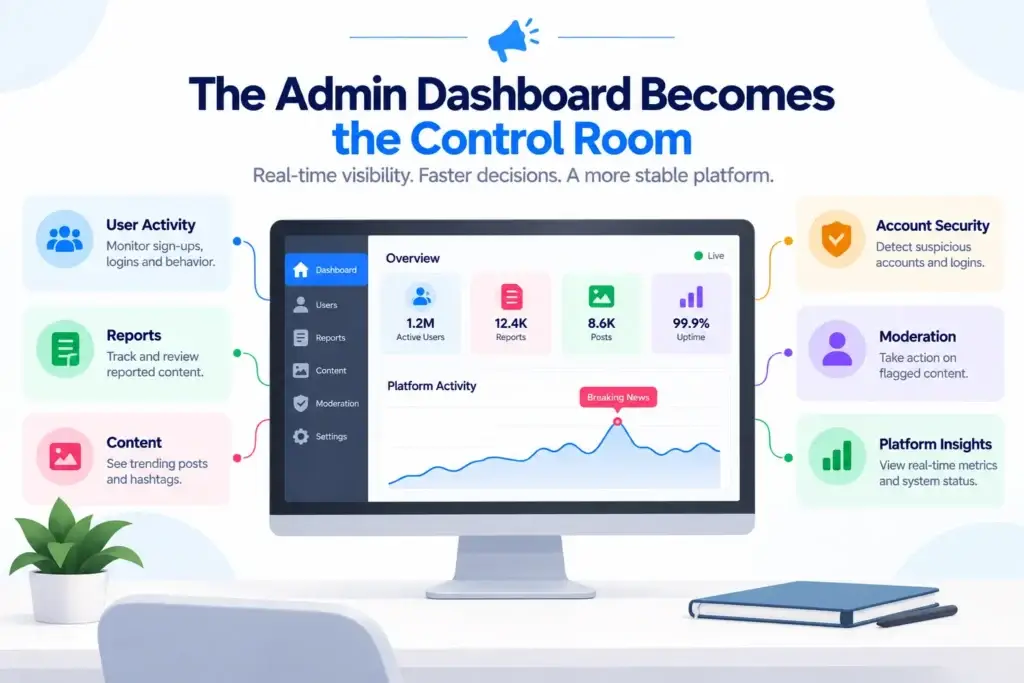
When a platform is small, founders may think of the admin dashboard as a backend convenience. During breaking news, the dashboard becomes the control room. Operators need to see member activity, reports, account status, flagged content, suspicious sign-ins, moderation actions, verification requests, and platform growth signals.
If the admin dashboard is weak, the team is forced to guess. They may not know which accounts are driving traffic, which posts are being reported, which hashtags are being abused, which users are facing login issues, or which moderator took a specific action.
A useful dashboard should help operators answer questions quickly:
- Which posts or accounts are causing unusual activity?
- Which reports need urgent review?
- Which accounts are newly created and posting aggressively?
- Which verified accounts are being impersonated?
- Which moderation actions were taken, by whom, and why?
- Which platform areas are seeing the most pressure?
These controls are not only technical features. They protect the business. A real-time platform that cannot be governed during a surge can lose user trust even if its servers stay online.
Founder Decision Signals: Is Your Platform Ready for a Surge?
Founder Decision Signals
Speed
If your team needs months to add basic feed, moderation, messaging, and admin controls, the platform may miss the market window. Speed matters most when the product category is already proven and the founder needs to validate a niche, community, or geography faster.
Control
If pricing, verification, account status, moderation, or source code remain outside the operator’s control, the business model can become dependent on the vendor instead of the founder’s strategy.
Reliability
If the feed works only during light usage, the product is not ready for real-time public conversation. Surge readiness requires stable posting, reads, search, notifications, reports, and admin action history.
Trust
If users cannot tell which accounts are credible, which actions were taken, or why content was removed, the platform becomes harder to govern during high-attention moments.
Why Surge Readiness Matters Before Your Platform Is Big
Many founders assume surge readiness is a problem for large platforms only. In reality, smaller platforms may face bigger risk because they have less operational margin. A niche community, creator-led network, local news platform, professional discussion app, or interest-based microblogging product can become visible quickly if the right event pulls users in.
The first high-attention moment often shapes user perception. If the platform stays fast, useful, and trustworthy, users may return. If it crashes, spreads spam, delays posts, or fails to moderate obvious abuse, users may decide the platform is not ready.
This does not mean every founder should overbuild for massive scale on day one. Overbuilding can waste budget and delay launch. The smarter approach is to build a foundation that can handle realistic early growth, protect critical workflows, and make future scaling decisions easier. Founders should know which parts are ready now, which parts need configuration, and which parts should be upgraded as usage grows.
How a Ready-Made Foundation Helps Founders Move Faster
When founders build a real-time social product from zero, much of the timeline goes into work users may never consciously notice: feed behavior, account relationships, admin tooling, posting rules, report queues, message flows, entitlement logic, profile settings, notification handling, and source-code structure. These systems are essential, but they can slow down market validation.
A ready-made foundation can shorten that path when the founder’s goal is to test a public conversation concept faster. Instead of spending months proving that profiles, feeds, posting, messaging, reports, verification, and admin workflows can exist, the team can focus on positioning, niche strategy, moderation rules, monetization choices, onboarding, community building, and product differentiation.
For founders planning a branded public conversation product, Miracuves offers a launch-ready public conversation platform that can be customized for specific business goals. Its 6-day delivery timeline is especially useful when the founder wants to validate demand quickly instead of waiting through a long first build cycle.
The key is not to copy a large platform blindly. The stronger decision is to start with a proven product foundation, adjust the business logic for your audience, and prepare the operational layer before traffic spikes expose weak points.
What Founders Should Check Before Launching a Real-Time Microblogging Platform
Before launching, founders should evaluate the platform through the lens of a sudden news event. Even if the product is intended for a niche community, the same stress patterns apply: people arrive quickly, interact heavily, and expect the platform to behave like a live system.
Use this checklist before going live:
- Feed readiness: Can timelines load quickly when many users refresh at once?
- Posting reliability: Can users publish text, media, replies, and threads without duplicate or failed states?
- Search readiness: Can new content become discoverable without expensive repeated queries?
- Notification control: Can the platform group, throttle, or prioritize alerts during high activity?
- Moderation workflows: Can reports be reviewed with clear actions and recorded reasons?
- Verification process: Can operators review, approve, revoke, and document verified accounts?
- Account controls: Can admins suspend, ban, restore, or restrict accounts with an audit trail?
- Media handling: Can images, video, and audio be processed without blocking core posting?
- Admin visibility: Can operators see activity, reports, sign-ins, and growth signals quickly?
- Source ownership: Can the business modify the product as its audience and rules evolve?
If you are evaluating platform feature readiness, focus less on how many screens exist and more on how consistently the account, feed, moderation, and admin layers work together. A platform with fewer but stronger operational controls is often more launch-ready than a platform with many disconnected features.
Mistakes Founders Should Avoid During Surge Planning
Mistakes Founders Should Avoid
Thinking a feed is the whole product
A feed is only one part of a real-time microblogging platform. The business also needs posting rules, moderation, search, notifications, admin control, verification, account status workflows, and analytics.
Leaving moderation until after launch
Moderation becomes harder once users are already active. Founders should define report flows, resolution actions, appeal logic, and admin permissions before the first major traffic event.
Ignoring notification pressure
Notifications can improve retention, but during breaking news they can also create noise and system load. Prioritization and grouping should be planned early.
Building without source-code flexibility
Real-time platforms evolve quickly. Founders need the ability to adjust feeds, policies, monetization, verification, and integrations as the audience changes.
When Should a Founder Choose a Ready-Made Route Instead of Building From Zero?
A from-scratch build can make sense when the product requires a completely new interaction model, unusual compliance needs, highly specialized infrastructure, or deep technical differentiation. But many real-time microblogging ideas do not fail because the founder could not imagine a unique feed. They fail because the team spends too long building standard workflows before testing whether the target audience will actually use the product.
A ready-made route is worth considering when the founder already knows the product category, wants faster validation, needs branded deployment, wants source-code ownership, and does not want to rebuild common social workflows from zero. In that case, the practical advantage is speed. The founder can spend more effort on audience, trust, moderation policy, creator onboarding, and business positioning.
Miracuves helps founders shorten this early execution path with ready-made, white-label social platform foundations and a 6-day delivery timeline where the selected scope matches the existing build. For teams comparing build approaches, it is useful to evaluate the build partner by asking how they handle feed consistency, account control, verification, report queues, audit logs, and ownership after deployment.
Final Thoughts: Breaking News Reveals the Real Platform
Breaking news is one of the clearest tests of a real-time microblogging platform. It reveals whether the feed is stable, whether posting is reliable, whether moderation can keep up, whether notifications are useful, whether search can surface live information, and whether operators have enough control to manage trust during uncertainty.
For founders, the lesson is not to overbuild endlessly before launch. The lesson is to prepare the right foundation. A real-time public conversation product should be able to handle traffic spikes, protect user trust, and give operators the tools to act quickly. Without that foundation, a viral moment can become a failure. With it, the same moment can become proof that the platform is ready for attention.
The strongest platforms are not only the ones that can publish posts. They are the ones that can stay useful, fast, and governable when everyone arrives at once.
FAQs
What happens when breaking news causes a traffic surge on a microblogging platform?
When breaking news causes a traffic surge, users refresh feeds, publish posts, search hashtags, upload media, send messages, follow accounts, and report content at unusually high speed. This puts pressure on feeds, APIs, databases, search indexing, notifications, moderation queues, and admin dashboards.
Why do real-time feeds slow down during breaking news?
Real-time feeds slow down when too many users request fresh content at the same time and the platform has to process large volumes of reads, writes, ranking signals, media previews, and engagement updates. Strong caching, indexed queries, cursor pagination, and refresh controls help reduce this pressure.
How can a microblogging platform manage notifications during a live event?
A microblogging platform can manage notifications during a live event by grouping similar alerts, prioritizing mentions and direct messages, throttling low-priority engagement alerts, delaying noisy updates, and using digest-style summaries for high-volume posts.
Why is moderation harder during breaking news?
Moderation becomes harder during breaking news because traffic increases quickly and the platform may see more impersonation, spam, abusive replies, misinformation, repeated content, coordinated reporting, and unsafe media. Operators need structured report queues, resolution actions, account controls, and audit logs.
What should founders check before launching a real-time microblogging platform?
Founders should check feed performance, posting reliability, search readiness, notification control, moderation workflows, verification processes, account status tools, media handling, admin visibility, and source-code ownership before launching a real-time microblogging platform.
Can a ready-made platform handle breaking news traffic from day one?
A ready-made platform can provide a faster and stronger starting foundation, but surge readiness still depends on final configuration, hosting setup, traffic expectations, moderation policy, integrations, and scaling decisions. Founders should review realistic launch targets before opening the platform to a large audience.
Why does source-code ownership matter for a real-time social platform?
Source-code ownership matters because real-time social platforms change quickly. Founders may need to adjust feed logic, moderation rules, verification workflows, monetization models, notification behavior, or integrations as user behavior evolves.
Miracuves is an independent software development company. We are not affiliated with, connected to, sponsored by, or endorsed by any company or product named in this article.
Terms such as “X Clone” are used descriptively. It is how the software industry refers to building a platform with functionality comparable to a known service, and how clients search for it.
The entire design and codebase of our products is built by our own team. Our products contain no code, design, graphics, or content originating from any third-party website or applications.
All third-party names and marks referenced in this article are the property of their respective owners, referenced solely to identify the services discussed.