


Key Takeaways
- Online Retail Marketplace Security should protect buyer accounts, seller access, payments, order data, APIs, admin permissions, refunds, and payouts from the beginning.
- Buyer security should cover login, password recovery, sessions, sensitive account changes, wallet activity, refunds, and support interactions.
- Seller dashboards need stronger access controls because compromised accounts can affect listings, inventory, refunds, and payout details.
- Payment protection must include secure gateway integration, webhook validation, refund controls, transaction logs, and seller payout reconciliation.
- Role-based permissions, audit logs, approval workflows, and suspicious-activity monitoring help reduce both external attacks and internal misuse.
Security Signals
- Buyer, seller, support, delivery, finance, and admin roles should only access the data needed for their responsibilities.
- Sensitive seller changes such as payout-account updates should require verification, alerts, and admin review.
- API authorization must be enforced at the backend so users cannot access another account’s orders, refunds, addresses, or financial data.
- Fraud monitoring should watch for suspicious logins, fake accounts, unusual refunds, promo abuse, payout changes, and abnormal listing activity.
- Cash, wallets, refunds, and settlements need clear transaction histories showing why money moved, who triggered it, and which order it belongs to.
Real Insights
- Marketplace security is not only a checkout problem; weak recovery flows, seller access, APIs, admin permissions, and payout controls can create equally serious risks.
- Sellers should receive enough buyer information to fulfil an order, but not unnecessary customer history, payment data, or unrelated marketplace records.
- Shared admin logins weaken accountability because the platform cannot reliably trace who changed refunds, payouts, products, or seller accounts.
- Security becomes harder and more expensive to retrofit after launch because roles, APIs, payment flows, and operational permissions are already deeply connected.
- The strongest security flow is: authenticate users → assign role-based permissions → verify sensitive actions → protect transactions and data → monitor suspicious behavior → route high-risk events for review → maintain audit trails across every critical action.
An Online Retail Marketplace does not only manage products and orders. It manages trust.
Buyers trust the platform with their personal details, addresses, saved preferences, payment journeys, and order history. Sellers trust the platform with store access, catalog control, payout information, inventory records, and customer fulfilment data. The marketplace operator must protect both sides while keeping checkout, delivery, refunds, and admin operations smooth.
For founders, security should not be treated as a feature added near launch. It should be part of the product foundation. A retail marketplace with weak security can face account abuse, fake orders, payout manipulation, seller disputes, payment fraud, data exposure, and operational downtime.
This guide explains the core security areas every founder should plan before launching or scaling an online retail marketplace.
Why Security Matters More in an Online Retail Marketplace
A single-brand ecommerce store has one merchant, one catalog owner, and one operational team. A marketplace has buyers, sellers, delivery partners, support teams, admins, payment providers, logistics integrations, and sometimes external seller tools.
That increases the attack surface.
A security issue in a marketplace may affect:
- Buyer accounts
- Seller dashboards
- Product listings
- Checkout flows
- Payment transactions
- Refund requests
- Seller payouts
- Order histories
- Delivery addresses
- Admin permissions
- API integrations
- Promotional campaigns
- Support records
The risk is not only technical. It is operational. If a seller account is compromised, product prices can be changed. If payout details are altered, money can be redirected. If buyer data is overexposed, trust is damaged. If admin access is too broad, internal mistakes can become platform-wide incidents.
That is why marketplace security must be designed around roles, permissions, transaction integrity, data minimization, monitoring, and accountability.
1. Buyer Account Security: Protecting Login, Identity, and Order History
Buyer accounts are attractive targets because they may contain addresses, order history, saved preferences, loyalty points, wallet balances, coupons, and payment-related workflows.
A secure Online Retail Marketplace should protect buyer accounts through:
- Strong password rules
- Multi-factor authentication where relevant
- OTP verification for sensitive actions
- Secure password reset flows
- Login attempt limits
- Device and location-based risk checks
- Session timeout controls
- Email or mobile alerts for account changes
- Protection against credential stuffing
- Secure storage of authentication tokens
Password reset is especially important. Many account takeovers happen not because checkout is weak, but because recovery flows are poorly designed. Founders should ensure that a reset link, OTP, or recovery request cannot be abused to gain access to another buyer’s account.
Founder Insight
Do not only secure checkout. Secure the full buyer journey: registration, login, password recovery, address changes, wallet usage, refund requests, and support interactions.
2. Seller Access Security: Protecting Vendor Dashboards and Store Control
Seller accounts carry business risk. A compromised seller dashboard can affect product listings, prices, inventory, order fulfilment, refund responses, and payout details.
Seller access should be more tightly controlled than normal buyer access because sellers can influence marketplace operations.
Important seller security controls include:
- Seller verification during onboarding
- Role-based access for seller teams
- Admin approval for sensitive seller changes
- Payout account change verification
- Product listing activity logs
- Bulk upload monitoring
- Restricted access to buyer contact data
- Seller session controls
- Suspicious login alerts
- Permission-based dashboards
- Approval workflows for high-risk categories
For example, a seller staff member may need access to order fulfilment but not payout settings. A catalog manager may need product upload permissions but not refund approval. A finance user may need settlement visibility but not product-editing access.
This is where role-based access control becomes practical. It helps sellers operate efficiently without giving every user full store control.
3. Payment Security: Protecting Checkout, Refunds, and Settlement Flows
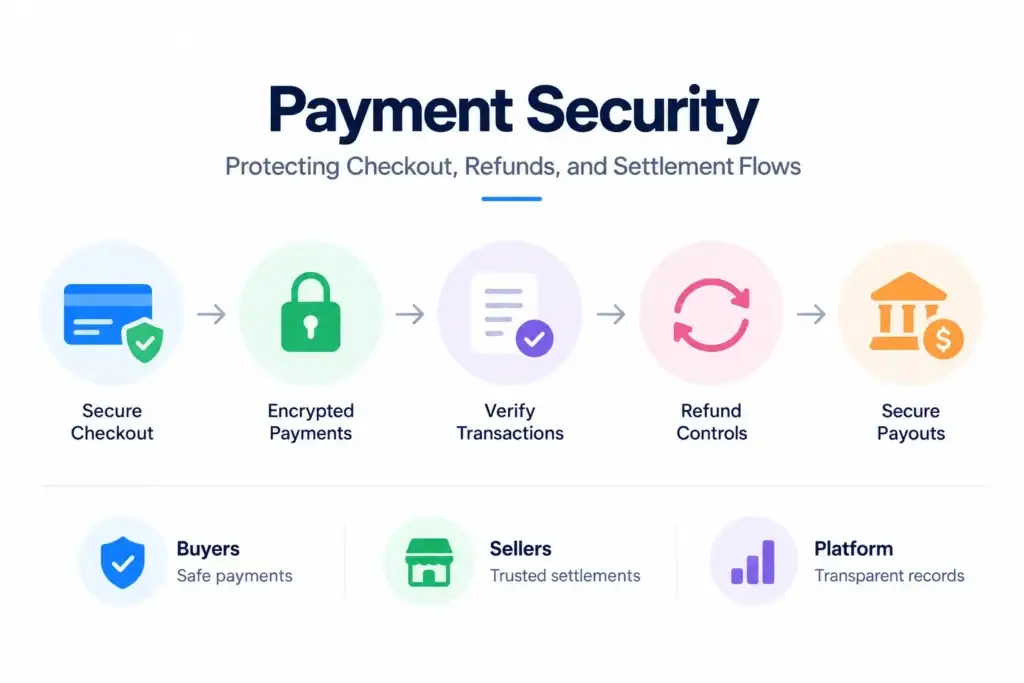
Payment security is one of the most sensitive layers of any retail marketplace.
The platform should not treat payment protection as only a gateway issue. Even when payments are handled through trusted providers, the marketplace still needs secure checkout logic, transaction records, refund controls, and settlement workflows.
Important payment security layers include:
- Secure payment gateway integration
- Tokenized payments where available
- Encrypted data transfer
- Avoiding storage of unnecessary card data
- Transaction status verification
- Webhook signature validation
- Refund approval workflows
- Failed payment handling
- Duplicate payment checks
- Chargeback and dispute records
- Seller payout reconciliation
- Admin logs for payment actions
Payment workflows should be designed so the platform can answer basic questions clearly:
- Was the payment successful?
- Which seller received the order?
- Was commission deducted correctly?
- Was the refund full or partial?
- Was the seller payout adjusted?
- Was the transaction manually changed by an admin?
- Is there an audit trail?
If payment and refund records are unclear, the marketplace becomes vulnerable to disputes, fraud, and operational confusion.
4. Order Data Security: Protecting Buyer, Seller, and Fulfilment Information
Order data is more sensitive than many founders realize.
An order record may include buyer name, mobile number, delivery address, product details, seller details, payment status, delivery timeline, refund information, support messages, and fulfilment notes.
Marketplace operators should protect order data by applying least-privilege access. That means each role should see only the data needed to complete its task.
For example:
| User Role | Data Needed | Data to Restrict |
|---|---|---|
| Buyer | Own order history, payment status, delivery updates, refund status | Other buyers’ data, seller payout data, internal notes |
| Seller | Orders linked to their own products, fulfilment details, refund requests | Other sellers’ orders, full marketplace revenue data |
| Delivery Partner | Pickup and delivery details required for fulfilment | Payment methods, seller financial data, unrelated customer history |
| Support Agent | Relevant support ticket and order issue details | Payout credentials, unnecessary personal data |
| Admin | Permission-based access based on role and responsibility | Full access should be limited and logged |
Order data protection is not only about preventing external attacks. It also reduces internal misuse, accidental exposure, and unnecessary data sharing.
5. Admin Dashboard Security: Protecting the Marketplace Control Layer
The admin dashboard is the most powerful part of the marketplace.
Admins may control sellers, buyers, products, categories, commissions, payouts, refunds, coupons, banners, tax settings, delivery zones, support tickets, and reports. If admin permissions are weak, a small mistake can affect the entire platform.
An Online Retail Marketplace should include:
- Role-based admin access
- Separate roles for operations, finance, support, catalog, marketing, and super admin
- Multi-factor authentication for admin users
- Activity logs for sensitive actions
- Approval workflows for payout and refund changes
- Access review process
- IP or device restrictions where needed
- Strong password and session policies
- Admin action alerts
- Backup admin recovery process
Admin access should never be shared through one common login. Shared admin accounts make it difficult to trace who changed a payout, approved a refund, deleted a product, or modified a seller account.
6. API Security for Mobile Apps, Seller Tools, and Integrations
Modern marketplaces rely heavily on APIs. Buyer apps, seller apps, admin dashboards, payment gateways, logistics providers, analytics tools, and notification systems all communicate through APIs.
This makes API security a major part of marketplace protection.
Founders should plan for:
- Strong API authentication
- Authorization checks on every object and function
- Secure token handling
- Rate limiting
- Webhook validation
- Input validation
- API version management
- Protection against excessive data exposure
- Restricted partner API scopes
- Logging and monitoring
- Safe third-party integration practices
API authorization is especially important in marketplaces. A seller should never be able to access another seller’s orders by changing an ID in a request. A buyer should never be able to view another buyer’s refund or address details. A support user should not be able to trigger payout actions through hidden API calls.
Security must be enforced at the backend, not only hidden in the user interface.
7. Fraud Prevention for Buyers, Sellers, Promotions, and Orders
Marketplace fraud can happen from multiple directions.
A buyer may use stolen credentials. A fake seller may upload suspicious products. A user may abuse promotions through multiple accounts. A bad actor may create fake orders to manipulate ratings. A compromised seller account may attempt payout fraud.
Fraud prevention should cover:
- Suspicious login monitoring
- Fake account detection
- Promo abuse detection
- Multiple account signals
- High-risk order alerts
- Payout change review
- Unusual refund activity
- Abnormal bulk product uploads
- Review manipulation signals
- Seller quality monitoring
- Chargeback tracking
- Manual review queues
The goal is not to block every unusual action automatically. The goal is to detect risk early and route sensitive cases to admin review.
8. Seller Data Access: How Much Buyer Information Should Vendors See?
This is one of the most important security decisions in a retail marketplace.
Sellers need enough information to fulfil orders. But they do not need unlimited access to buyer profiles, browsing behavior, payment details, or unrelated order history.
A practical seller data policy should define:
- Which buyer details sellers can see
- When sellers can see delivery information
- Whether contact details are masked
- How long order data remains visible
- Whether seller teams can export order data
- Whether buyer communication happens inside the platform
- How seller access changes after order completion
- What happens when a seller is suspended
Founders should think about seller access from the beginning. If sellers can export too much customer data, the marketplace may lose control over privacy, support quality, and buyer relationships.
9. Security for Cash, Wallets, Refunds, and Payouts
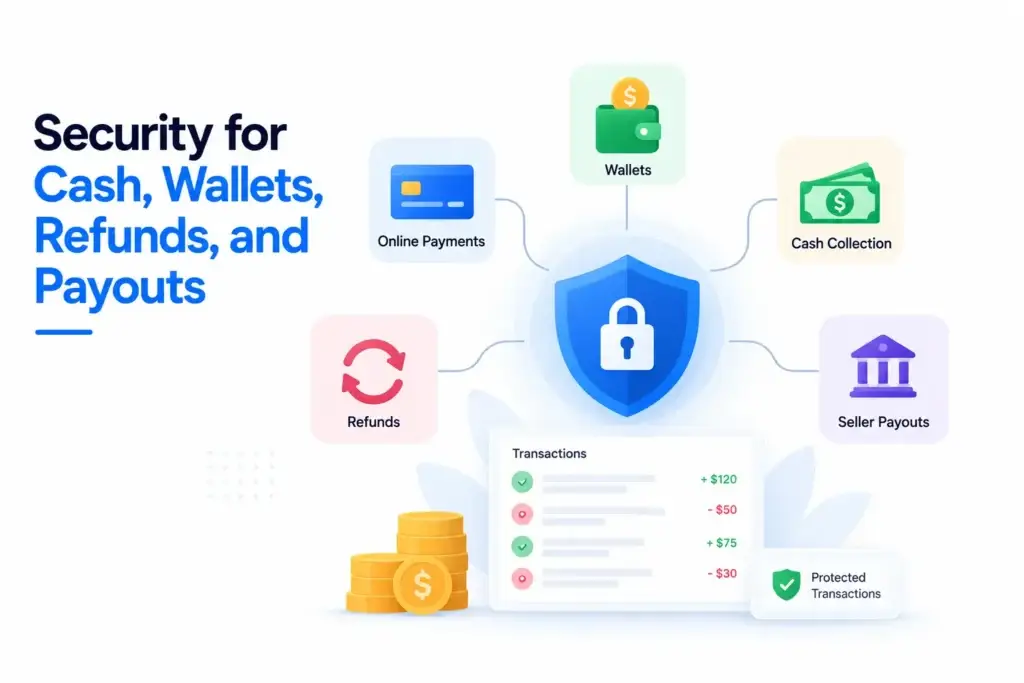
Many online retail marketplaces support mixed payment behavior, including online payments, wallets, cash collection, credits, and seller settlements.
Each flow needs clear controls.
Important safeguards include:
- Wallet transaction history
- Seller payout approval
- Withdrawal request verification
- Cash collection logs
- Delivery proof checks
- Refund status tracking
- Partial refund controls
- Settlement statements
- Reserve handling for returns
- Daily reconciliation reports
- Finance admin permissions
- Audit logs for manual adjustments
A strong marketplace does not only record that money moved. It records why money moved, who triggered it, which order it belongs to, and whether a reversal or dispute exists.
Marketplace Security Checklist for Founders
Security Planning Checklist for Online Retail Marketplaces
| Security Area | What to Protect | Founder Decision |
|---|---|---|
| Buyer Accounts | Login, password reset, sessions, addresses, order history. | Use strong authentication, secure recovery, and suspicious login monitoring. |
| Seller Access | Vendor dashboards, product listings, payout details, store settings. | Use seller verification, role-based permissions, and payout-change approval. |
| Payments | Checkout, gateway callbacks, refunds, failed payments, transaction records. | Use secure gateway integrations, tokenized flows, webhook validation, and audit logs. |
| Order Data | Buyer details, seller fulfilment data, delivery address, support records. | Limit data visibility by role and avoid unnecessary data exposure. |
| Admin Control | Commissions, payouts, refunds, products, sellers, reports, settings. | Separate admin roles and log sensitive actions. |
| APIs | Mobile apps, seller tools, logistics, payment callbacks, third-party services. | Enforce backend authorization, rate limits, safe tokens, and scoped integrations. |
| Fraud Monitoring | Fake accounts, promo abuse, fake orders, suspicious refunds, payout fraud. | Create risk alerts and manual review queues for sensitive activity. |
Security decisions should be planned alongside the core platform modules. Buyer accounts, seller dashboards, product listings, cart flows, payments, refunds, delivery updates, and admin controls all need the right feature foundation. This retail marketplace feature checklist can help founders review the essential modules before launch.
Founder Decision Signals
Speed
If you need to launch quickly, do not skip security planning. Prioritize secure login, seller verification, payment gateway integration, admin roles, and order-data permissions from day one.
Cost
Security cost depends on authentication depth, payment integrations, fraud controls, compliance workflows, admin permissions, logging, and post-launch monitoring needs.
Scalability
As sellers, products, and orders grow, weak access control becomes harder to fix. Build permission rules and audit trails before marketplace operations become complex.
Trust
Buyers and sellers stay longer when account changes, payments, refunds, payouts, and order records are transparent and traceable.
Before finalizing the security scope, founders should also consider how authentication, payment gateway integration, fraud monitoring, admin roles, audit logs, and seller access controls can affect the build effort. For a budget-focused view, review these retail marketplace development cost factors.
How Security Connects With Marketplace Features and Business Model
Security decisions affect marketplace features directly.
If sellers can manage products, the platform needs access control and activity logs. If buyers can request refunds, the platform needs refund-state tracking and approval workflows. If delivery partners collect cash, the platform needs proof of delivery, cash ledger records, and settlement reconciliation. If admins manage commissions, the platform needs finance-level permissions and audit logs.
Founders planning feature scope can review this online retail marketplace feature set to understand how seller workflows, catalog management, delivery operations, payments, and admin control connect.
Security also affects monetization. Commission, seller subscriptions, delivery margins, featured placement, and wallet flows all need transparent records. Founders comparing revenue logic can review this retail marketplace business model breakdown before finalizing commercial rules.
Common Security Mistakes Founders Should Avoid
Using one admin login for the whole team
Shared admin access makes it difficult to identify who changed products, approved refunds, modified seller data, or adjusted payout settings.
Giving sellers too much buyer data
Sellers need fulfilment information, not unlimited buyer history. Restricting buyer data reduces privacy risk and protects the marketplace relationship.
Ignoring payout-change risk
Payout account changes should require verification and admin review because compromised seller accounts can redirect funds.
Treating payment security as only a gateway problem
Gateways help process payments, but the marketplace still needs secure order records, refund workflows, webhook validation, transaction logs, and settlement controls.
Adding security after launch
Security added late is usually harder and more expensive to fix because user roles, APIs, order flows, and admin permissions may already be deeply connected.
How Miracuves Helps Founders Build Secure Retail Marketplace Platforms
Miracuves helps founders launch ready-made and white-label marketplace platforms with source-code ownership, custom branding, seller workflows, buyer journeys, admin dashboards, payment integrations, and operational control.
For founders, the goal is not only to launch a storefront. The goal is to create a marketplace foundation that can protect users, sellers, payments, order records, and admin actions as the business grows.
Businesses that want a faster route to market can explore Miracuves’ launch-ready retail marketplace foundation for multi-vendor commerce, seller operations, catalog management, checkout, delivery, and admin workflows.
Founders comparing broader commerce categories can also explore white-label ecommerce app solutions and white-label marketplace software for branded marketplace execution with vendor and admin control.
Final Thoughts
An Online Retail Marketplace is only as strong as the trust system behind it. Buyers need secure accounts and protected order data. Sellers need controlled access, clear payout records, and safe dashboard permissions. Admins need visibility, logs, and approval workflows. Payment flows need traceability from checkout to refund to settlement.
Once the marketplace foundation is secure, founders should also plan how to attract buyers, onboard sellers, build trust, and increase repeat orders. This online retail marketplace growth strategy explains how marketing, seller acquisition, customer retention, and marketplace positioning can support post-launch traction.
Security is not one checkbox. It is a set of product, operational, and technical decisions that protect the marketplace as it grows.
Founders who plan security early can reduce avoidable risk, improve seller trust, protect buyer data, and build a stronger foundation for long-term marketplace operations.
Choosing the right technology partner matters when security, payments, seller access, and order data are part of the platform foundation. Founders can review how to select an ecommerce marketplace development partner based on source-code ownership, customization flexibility, admin control, and long-term platform scalability.
FAQs
Why is security important for an Online Retail Marketplace?
Security is important because an Online Retail Marketplace handles buyer accounts, seller dashboards, payments, refunds, order records, delivery information, and admin controls. Weak security can lead to account abuse, payment fraud, data exposure, and operational disputes.
How can online retail platforms protect buyer accounts?
Buyer accounts can be protected with strong authentication, secure password reset flows, OTP verification for sensitive actions, session controls, login attempt limits, suspicious activity alerts, and privacy-conscious data handling.
What security controls should seller dashboards include?
Seller dashboards should include seller verification, role-based access, payout-change verification, catalog activity logs, restricted buyer-data access, suspicious login alerts, and admin approval for sensitive changes.
How should marketplace payment security be handled?
Marketplace payment security should use secure payment gateway integrations, tokenized payments where available, encrypted transfer, webhook validation, transaction logs, refund controls, chargeback records, and payout reconciliation.
What order data should sellers be able to access?
Sellers should only access order data needed for fulfilment, such as relevant product, delivery, and order status details. They should not receive unnecessary buyer history, unrelated customer data, payment details, or platform-wide financial information.
Why is admin dashboard security critical?
The admin dashboard controls sellers, buyers, products, payments, refunds, commissions, reports, and platform settings. Weak admin security can expose the entire marketplace to errors, fraud, or unauthorized changes.
What is role-based access control in marketplace security?
Role-based access control gives users permissions based on their responsibility. For example, a support agent may view order issues but not payout settings, while a finance admin may review settlements without editing product listings.
How can founders reduce marketplace fraud?
Founders can reduce fraud by monitoring suspicious logins, fake accounts, promo abuse, unusual refunds, payout changes, bulk listing changes, fake reviews, chargebacks, and high-risk order patterns.
Miracuves is an independent software development company. We are not affiliated with, connected to, sponsored by, or endorsed by any company or product named in this article.
Terms such as “X Clone” are used descriptively. It is how the software industry refers to building a platform with functionality comparable to a known service, and how clients search for it.
The entire design and codebase of our products is built by our own team. Our products contain no code, design, graphics, or content originating from any third-party website or applications.
All third-party names and marks referenced in this article are the property of their respective owners, referenced solely to identify the services discussed.



