Key Takeaways
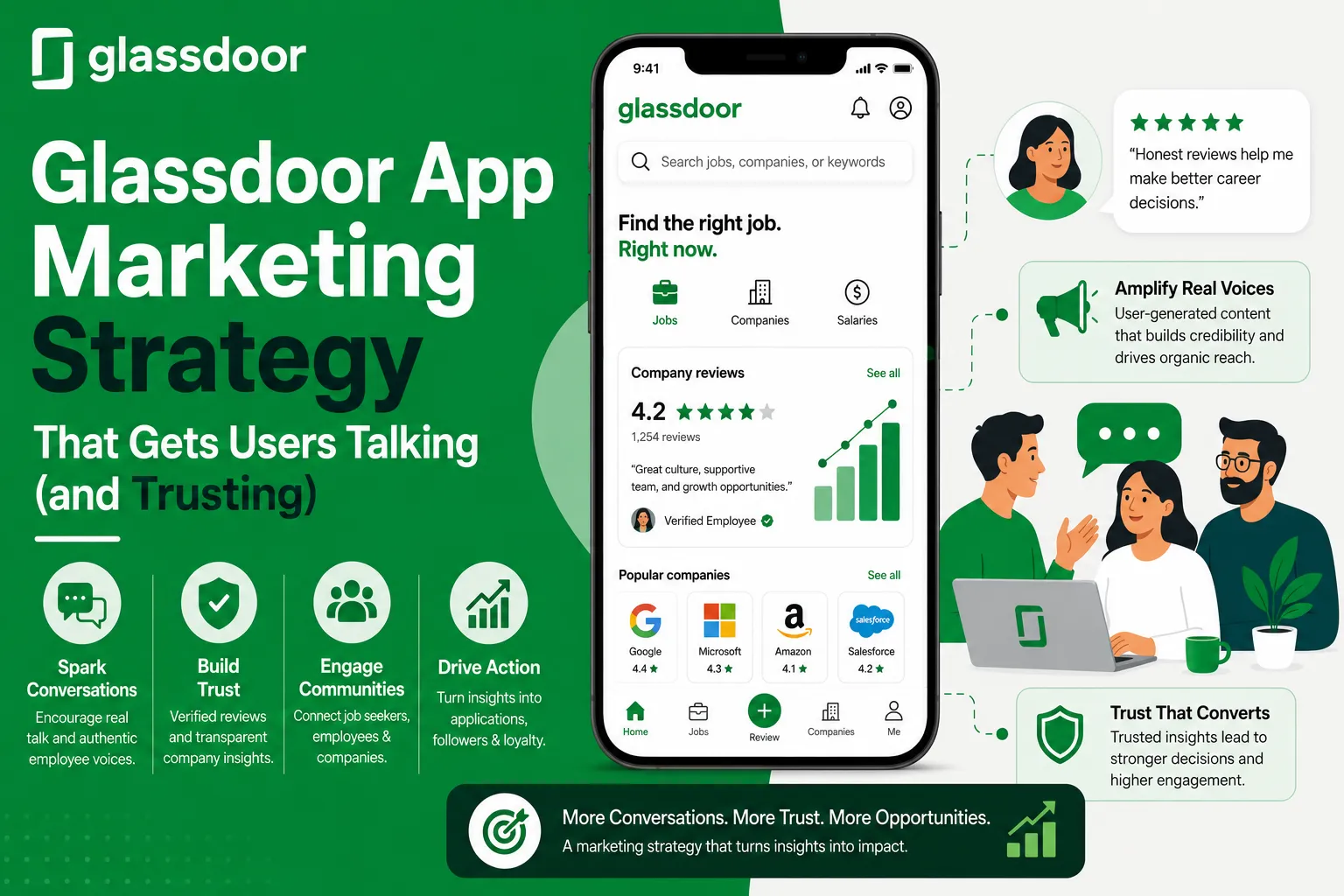
- Glassdoor built growth through user-generated reviews.
- Trust became its biggest marketing advantage.
- SEO drives long-term organic traffic.
- Transparency attracts both users and employers.
- Community content creates powerful network effects.
Growth Signals
- Reviews and ratings generate valuable content.
- Give-to-get models encourage contributions.
- Emotional messaging increases engagement.
- Email campaigns improve retention.
- Employer branding creates additional revenue streams.
Real Insights
- People search for workplace truth, not job listings.
- UGC can become a scalable marketing engine.
- Trust-based products often grow through community contributions.
- Two-sided marketplaces need balanced incentives.
- A Glassdoor clone succeeds when reviews become the core product.
If you’ve ever rage-quit a job or fantasized about exposing your toxic boss, odds are Glassdoor was your go-to therapy. But Glassdoor isn’t just a digital watercooler; it’s a brilliant business built on radical transparency and smart, sticky marketing.
It’s where job seekers don’t just look at paychecks, but at culture, values, leadership ratings, employee reviews, interview experiences, and salary insights before they even open LinkedIn. For entrepreneurs, this creates a strong opportunity to build a Glassdoor clone that connects job seekers, employees, and employers through workplace transparency, review-driven trust, and data-backed hiring decisions.
For startup founders and app creators, the lesson is loud and clear: trust is a product, and how you market that trust is what makes or breaks your platform. Glassdoor didn’t just gather reviews—it made them central to its flywheel, turning users into contributors and companies into content.
If you’re dreaming of building your own glassdoor alternative or career app (or something that thrives on user-generated insights), Miracuves can help you replicate—and even improve—this model.
The Inside Story: Glassdoor’s App Marketing Engine
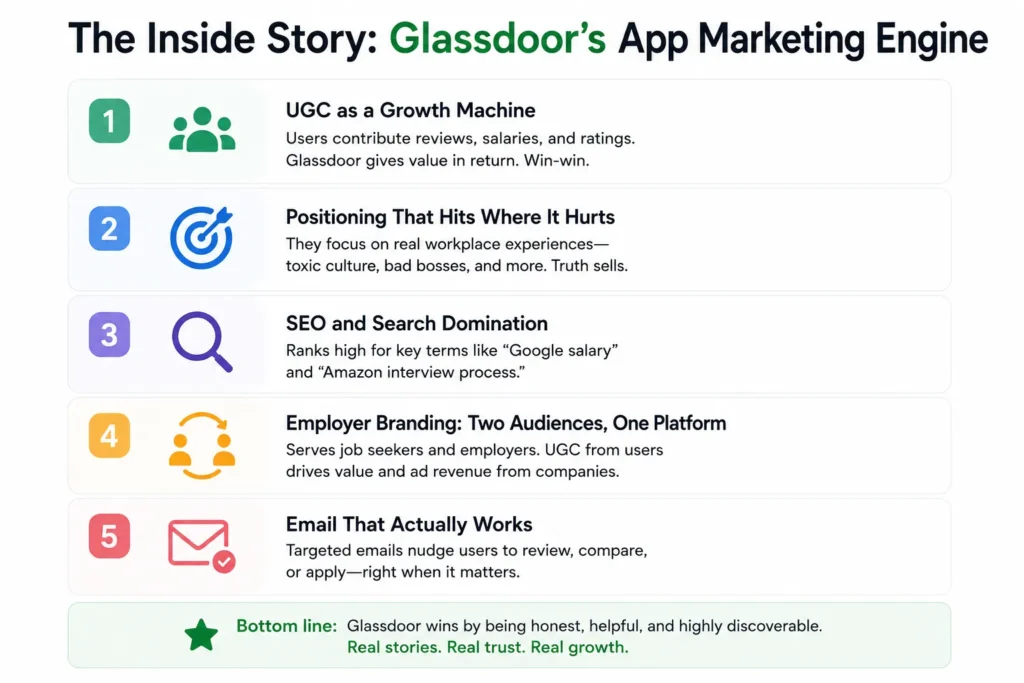
1. UGC as a Growth Machine
Glassdoor’s biggest flex? It turns users into marketers. Every salary disclosure, every CEO rating, every anonymous gripe adds value to the platform. That’s not just content—that’s marketing that scales without ads.
And how do they get it? By giving first. Users get salary estimates, interview prep insights, and real job listings—in exchange for sharing one piece of info. It’s a classic give-to-get growth loop.
2. Positioning That Hits Where It Hurts (In a Good Way)
Glassdoor doesn’t talk about jobs. It talks about what jobs feel like—and that’s powerful. Their messaging focuses on toxic culture, bad bosses, and ghosting horror stories. It’s not “find a job,” it’s “find the truth.”
They turned emotional pain points into a product hook. That’s content-market fit at its best.
3. SEO and Search Domination
Type “Google salary,” “Amazon interview process,” or “working at Tesla,” and guess who ranks top 3? That’s right—Glassdoor. Their SEO game is elite, driven by massive content volume, long-tail keywords, and strategic schema markup.
4. Employer Branding: Marketing to Two Audiences at Once
Their marketing isn’t flashy—it’s findable. That’s what keeps the downloads rolling.
CB Insights on Glassdoor’s SEO-driven growth
Here’s where it gets really smart. Glassdoor markets both to job seekers and employers. Companies pay to improve their profile, add responses, and showcase culture. That ad revenue? Fueled by the same UGC job seekers contribute.
It’s B2C and B2B in one app—without splitting their message.
5. Email That Actually Works
Glassdoor sends targeted emails that do more than just “remind.” They nudge users to write reviews, check salary comparisons, or apply with one click. And it’s all contextual—based on your last search or rating.
Their CRM? A content marketing channel in disguise.
Lessons for Startups & Founders
1. Don’t Sell Jobs—Sell Insight
Glassdoor wins because it positions itself as a decision-support tool, not a listing engine. Market your app as an insider’s lens, not just a noticeboard.
2. Make Reviews the Hero
User reviews aren’t just social proof—they’re the content. Structure your app and messaging so that every review unlocks more value for future users.
3. Gamify Contributions
Offer badges, thank-you emails, and even anonymous shoutouts to make contributing fun. Glassdoor rewards contributors with early access to company data—a small gesture that drives huge retention.
4. Nail the Two-Sided Market
Just like Uber balances riders and drivers, you need to balance job seekers and employers. Design your app flows so both sides feel valued and empowered.
5. Use Emotional Marketing (Responsibly)
It’s okay to lean into frustration, confusion, or career anxiety—but do it ethically. Show that your platform helps users overcome these feelings, not just amplify them.
Build Your Own Glassdoor Clone with Miracuves
Conclusion
Glassdoor didn’t just market a product; it marketed perspective. By putting radical transparency, employee voices, salary insights, company reviews, and workplace stories at the center of its strategy, it built a platform that changed how people evaluate careers. For entrepreneurs, the lesson is clear: a Glassdoor-style platform succeeds when it gives users the confidence to make better decisions before applying, hiring, or accepting an offer.
A strong Glassdoor clone should do more than collect reviews. It should build trust through verified content, simple search, employer profiles, anonymous feedback, salary data, interview experiences, and smart moderation. When transparency becomes the product experience, the platform becomes sticky, scalable, and valuable for both job seekers and employers.
At Miracuves, we help innovators launch high-performance app clones that are fast, scalable, and monetization-ready. Ready to turn your idea into reality? Let’s build together.
FAQs
How does Glassdoor get so many user reviews?
They incentivize reviews by unlocking full platform features only after a user contributes. It’s a “give to access” model that works.
How does Glassdoor get so many user reviews?
Tons of long-tail content (company names, roles, salaries), consistent schema markup, and authority on job-related topics.
Is Glassdoor a job board or a review platform?
Both! But it positions itself as a career insight tool, which is what makes its marketing feel more human and helpful.
How does it monetize?
Glassdoor earns through employer branding subscriptions, sponsored jobs, and targeted ads—all backed by UGC credibility.
Can a startup replicate this model?
Yes—with a smart UX flow, two-sided incentives, and a review-first mentality. It’s ideal for niche industries too.
Why choose Miracuves to build a Glassdoor-style app?
Because we bring deep clone development expertise, fast delivery, and smart UX practices—so your app is ready to grow from Day 1.
Related Article:
Miracuves is an independent software development company. We are not affiliated with, connected to, sponsored by, or endorsed by any company or product named in this article.
Terms such as “X Clone” are used descriptively. It is how the software industry refers to building a platform with functionality comparable to a known service, and how clients search for it.
The entire design and codebase of our products is built by our own team. Our products contain no code, design, graphics, or content originating from any third-party website or applications.
All third-party names and marks referenced in this article are the property of their respective owners, referenced solely to identify the services discussed.