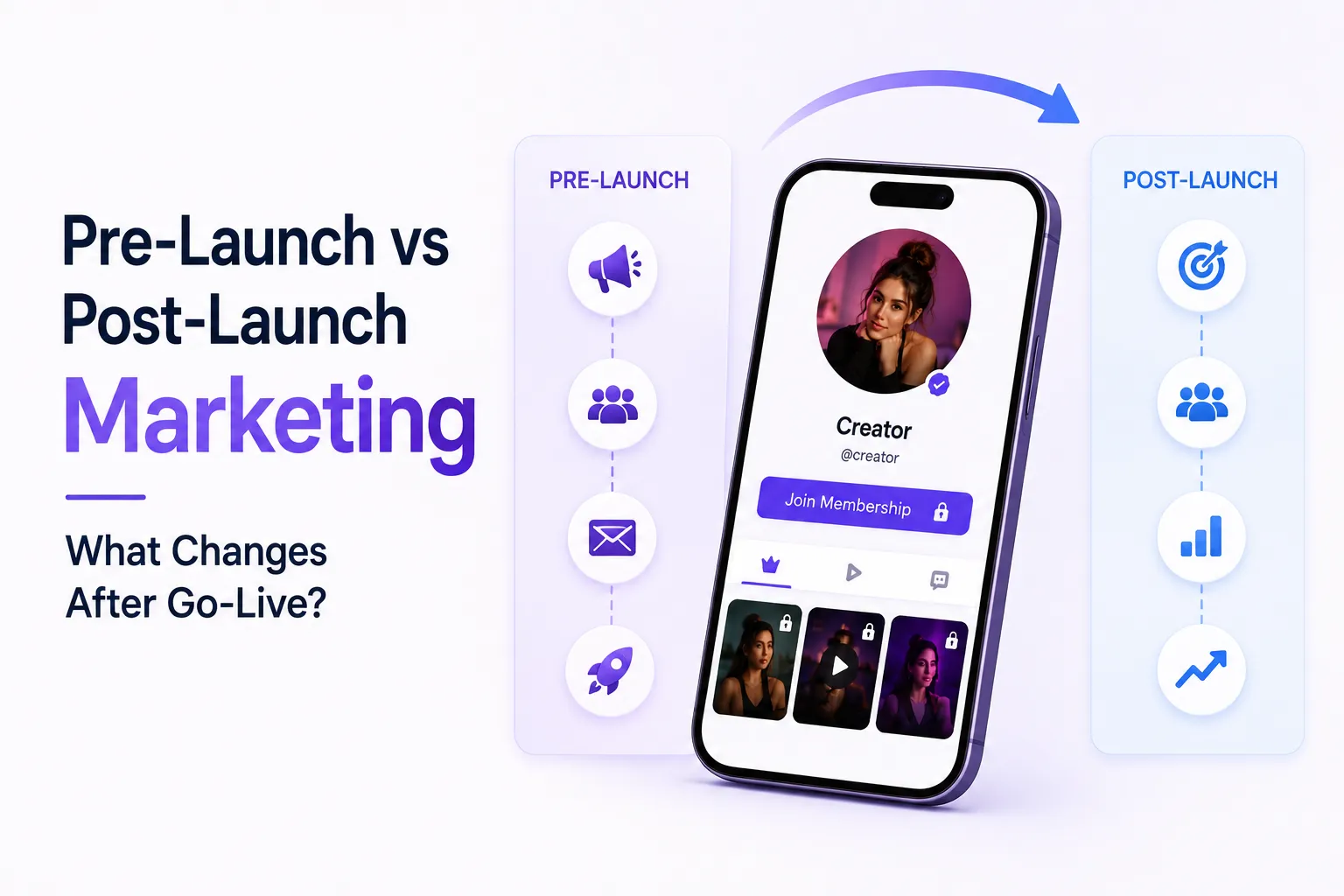
Key Takeaways
- Creator Membership Platform Marketing Strategy should change from building belief before launch to driving activation, paid conversion, retention, referrals, and repeat engagement after go-live.
- Pre-launch marketing should focus on niche positioning, creator recruitment, creator waitlists, trust-building, landing pages, and launch-day content readiness.
- Post-launch marketing should focus on creator activation, fan onboarding, subscriptions, PPV purchases, lifecycle campaigns, referrals, and churn reduction.
- Creators should usually be recruited before large fan acquisition campaigns so users do not arrive to empty profiles or weak content supply.
- Marketing performance should shift from measuring interest before launch to measuring real behavior such as activation, conversion, retention, creator posting frequency, and repeat purchases.
Marketing Signals
- Pre-launch creator cohorts should include active, niche-relevant creators who publish consistently and are willing to invite their existing audiences.
- Launch-day readiness should include complete creator profiles, previews, paid posts, membership tiers, onboarding emails, payout guidance, and support documentation.
- Free followers can be converted through subscriber-only previews, PPV drops, creator messages, upgrade prompts, limited offers, and personalized recommendations.
- Lifecycle campaigns should differ for new fans, free followers, paid members, inactive creators, PPV buyers, and churned subscribers.
- Referral programs should reward actions that create real platform value, such as active creators, subscriptions, paid content purchases, and repeat engagement.
Real Insights
- Pre-launch marketing is about readiness and belief, while post-launch marketing is about proof and user behavior.
- A strong pre-launch campaign can still fail if creators do not publish enough content or the platform launches without clear membership value.
- Post-launch growth becomes more data-driven because founders can see where creators, fans, subscribers, and buyers drop out of the funnel.
- Retention is not only a marketing issue; creator consistency, payout trust, content rhythm, product usability, and support also influence churn.
- The strongest marketing path is: define niche → recruit creators → prepare launch supply → activate users → convert free fans → retain members → build referrals → optimize from real behavior.
Launching a Creator Membership Platform is not only a product release. It is a two-sided market launch where creators need confidence, fans need a reason to join, and the platform operator needs enough early activity to prove the model.
The mistake many founders make is treating pre-launch and post-launch marketing as the same campaign.
Before launch, the platform has limited proof. Your job is to create belief, build creator supply, validate the niche, prepare the audience, and make sure the product does not go live silently.
After launch, the platform has real user behavior. Your job shifts to onboarding, retention, paid conversions, creator activity, referrals, lifecycle messaging, and product optimization.
That shift matters because a Creator Membership Platform Marketing Strategy is not driven by downloads alone. It grows when creators publish consistently, fans subscribe or unlock premium content, payments work smoothly, users return, and the admin team learns from actual platform activity.
Miracuves helps founders build ready-made and white-label creator economy platforms with source-code ownership, branded design, admin control, creator dashboards, paid access workflows, and faster deployment. But even with a strong product foundation, marketing must be planned differently before and after go-live.
Why Marketing Changes After a Creator Membership Platform Goes Live
Before go-live, your marketing is based on promise.
You are telling creators what the platform will help them do, what kind of fans they can reach, how they may earn, and why your product is worth trying. Fans are also being introduced to the platform concept before they can fully experience it.
After go-live, your marketing is based on proof.
Now users can sign up, browse creators, follow profiles, subscribe to tiers, unlock paid content, send messages, make payments, request support, and decide whether to return.
That means your marketing changes from:
| Stage | Main Question | Marketing Goal |
|---|---|---|
| Pre-launch | Will creators and fans care? | Build awareness, trust, supply, and launch demand |
| Launch window | Will users take the first action? | Convert waitlist, activate creators, drive first payments |
| Post-launch | Will users return and spend again? | Improve retention, paid conversion, creator activity, and referrals |
For founders, this is the most important mindset shift: pre-launch is about readiness, while post-launch is about behavior.
Pre-Launch Marketing: Build the Market Before the Product Opens
Pre-launch marketing should not be treated as hype alone. Hype without creator supply creates disappointment. Hype without trust creates hesitation. Hype without a clear niche creates weak signups.
The goal before launch is to prepare the market so that go-live has real momentum.
A strong pre-launch strategy should answer:
- Who is the platform for?
- Which creator category will join first?
- Why should creators trust this platform?
- What type of fans will be targeted?
- What content will be ready on launch day?
- What paid offers will fans see first?
- What will creators earn from?
- What does the platform stand for?
- What makes this product different from generic subscription tools?
If these answers are unclear, paid ads and social teasers may only create low-quality traffic.
Step 1: Define the Creator Niche Before Promotion
A generic Creator Membership Platform is difficult to market because creators already have many options. Your positioning needs to answer one sharp question:
Why would a creator bring their audience here instead of staying on their current channels?
The niche could be fitness creators, educators, fan communities, regional influencers, musicians, digital coaches, entertainment creators, premium communities, lifestyle creators, or creator agencies.
Clear niche positioning helps with:
- Landing page copy
- Creator outreach
- Waitlist qualification
- Content moderation planning
- Payment policy planning
- Creator onboarding
- Referral messaging
- Social media targeting
- Feature prioritization
A founder should not start by saying, “This platform is for all creators.” A better starting point is, “This platform is for a specific creator category with a specific monetization problem.”
Founders comparing creator-led business categories can also explore influencer platform solutions to understand how creator discovery, fan engagement, paid interactions, and membership models work across different niches.
That clarity makes marketing sharper and product decisions easier.
Step 2: Build a Creator Waitlist Before Fan Acquisition
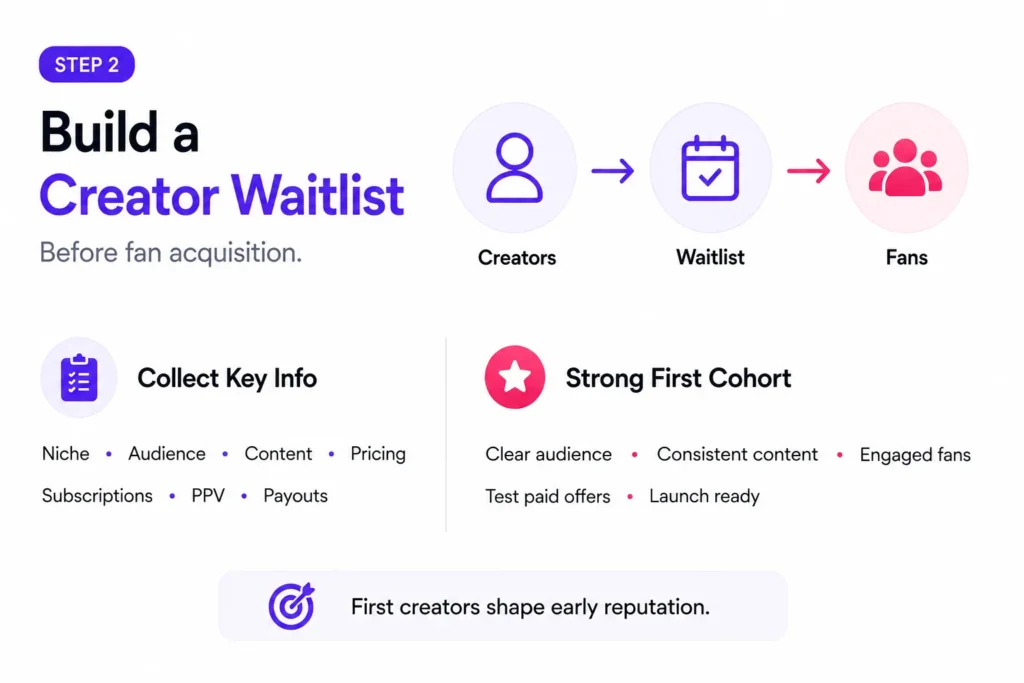
A creator membership product needs supply before demand can convert.
If fans arrive and see empty profiles, inactive creators, or weak content previews, they may leave and not return. That is why creators should usually be recruited before large fan acquisition campaigns begin.
A useful creator waitlist should collect more than name and email. It should help the founder understand:
- Creator niche
- Audience size
- Main social channels
- Content type
- Existing monetization method
- Expected pricing
- Interest in subscriptions
- Interest in PPV content
- Interest in paid messaging
- Payout preferences
- Content safety requirements
- Launch readiness
This data helps founders decide which creators are most valuable for the first launch cohort.
What Makes a Strong Pre-Launch Creator Cohort?
A strong first cohort does not need to include the biggest creators in the market. It needs creators who are active, niche-relevant, willing to publish consistently, and ready to invite fans.
The best early creators usually have:
- Clear audience identity
- Consistent content habits
- Strong fan engagement
- Willingness to test paid offers
- Trust in the platform’s rules
- Clear understanding of what they will publish after launch
The first creator group shapes the platform’s early reputation. Choose carefully.
Step 3: Create a Founder-Led Trust Narrative
Creator platforms require trust before users share content, payment details, identity information, or audience access.
Pre-launch content should explain what the platform stands for. It should not only say, “Coming soon.” It should explain why creators and fans should believe in the product.
Your trust narrative may cover:
- Creator earning flexibility
- Transparent commission rules
- Payment and payout clarity
- Privacy-conscious data handling
- Creator verification
- Age-gating where applicable
- Content moderation
- Abuse reporting
- Admin review workflows
- Community guidelines
- Brand positioning
This matters because creator membership businesses are sensitive. Creators want to know if they will be paid fairly. Fans want to know if payments are secure. Platform operators need to show that the business is serious, not experimental.
Step 4: Build a Landing Page That Captures Two Audiences
A Creator Membership Platform has at least two audiences: creators and fans.
Trying to serve both with one vague landing page can weaken conversion. A better pre-launch setup may include:
| Landing Page Type | Purpose | CTA |
| Creator landing page | Recruit creators before launch | Apply as a creator |
| Fan waitlist page | Collect early fan demand | Join early access |
| Investor/partner page | Explain market and business model | Request platform deck or contact |
| Niche campaign page | Target a specific creator category | Join the launch cohort |
The creator page should explain earning tools, content control, payout clarity, audience growth, and launch benefits.
The fan page should explain creator discovery, membership value, exclusive content, early access, and why the platform is worth joining.
A single “join waitlist” button is usually not enough. Each audience needs a different reason to care.
Step 5: Prepare Launch-Day Content Before Go-Live
A platform should not open with empty profiles.
Before launch, founders should prepare creator profiles, preview content, first paid posts, membership tier names, introductory offers, onboarding emails, and support flows.
Launch-day readiness may include:
- Verified creator profiles
- Public preview posts
- First subscriber-only posts
- PPV content examples
- Membership tier descriptions
- Creator intro videos
- Category pages
- Featured creator placements
- Welcome email sequence
- Fan onboarding screens
- Creator payout instructions
- Support documentation
- Community rules
If your launch strategy depends on premium videos, creator feeds, locked media, or visual content drops, video content platform solutions can help you plan media workflows before go-live.
This preparation helps users understand the platform immediately. If the first visit feels unfinished, marketing spend becomes less effective.
Step 6: Choose Pre-Launch Channels Based on Trust, Not Noise
Not every marketing channel fits every creator membership business.
For pre-launch, the best channels are usually the ones that build trust and creator relationships.
Useful pre-launch channels include:
- Creator outreach
- Private creator communities
- Niche Discord or Telegram groups
- LinkedIn founder content
- X/Twitter conversations
- Short-form educational videos
- Email waitlists
- Landing page SEO
- Creator referral campaigns
- Invite-only beta access
- Partner newsletters
- Founder-led behind-the-scenes content
Pre-launch marketing should feel intentional. The goal is not to reach everyone. The goal is to reach the right creators and early fans before the product opens.
What Changes During the Launch Window?
The launch window is the bridge between promise and real usage.
During this phase, the founder’s goal is to convert waitlist interest into first actions.
The launch window should focus on:
- Getting creators to publish
- Getting fans to sign up
- Driving first follows
- Converting first subscribers
- Encouraging first PPV unlocks
- Testing paid messages
- Tracking onboarding friction
- Responding to support issues quickly
- Collecting early testimonials where appropriate
- Fixing product gaps fast
Launch messaging should become more direct than pre-launch messaging.
Before launch, you may say: “A new creator membership experience is coming.”
During launch, you should say: “Join this creator, unlock this offer, claim early access, subscribe today, or explore the first creator drops.”
The CTA becomes action-based because the product is now live.
Post-Launch Marketing: Convert Attention Into Retention
Post-launch marketing begins when real users can take real actions.
The main question changes from:
Will people care?
to:
Will people return, pay, post, interact, and invite others?
This is where many creator membership startups struggle. They build excitement before launch, then stop marketing once the app is live. That is a mistake.
After go-live, marketing should become more data-driven and behavior-focused.
Post-launch marketing should focus on:
- Creator activation
- Fan onboarding
- Subscription conversion
- PPV purchases
- Paid messaging usage
- Creator posting frequency
- Content discovery
- User retention
- Referral loops
- Win-back campaigns
- Churn reduction
- Platform trust
- Support communication
- Feature education
A clear creator membership business model helps founders connect subscriptions, paid content, creator payouts, platform commissions, refunds, and repeat fan purchases after launch.
Post-launch growth depends less on announcement content and more on lifecycle communication.
Step 1 After Launch: Activate Creators Quickly
Creators are not fully activated when they sign up. They are activated when they publish, price, promote, and earn.
Post-launch creator activation should help creators:
- Complete profiles
- Publish first free preview
- Publish first paid post
- Set membership tiers
- Invite fans from social channels
- Enable paid messaging
- Understand payout rules
- Track earnings
- Review content performance
- Keep a posting schedule
Founder mistake: assuming creators know what to do after signup.
Most creators need prompts, templates, reminders, content ideas, and earning education. The platform should guide creators toward actions that create fan value.
Step 2 After Launch: Improve Fan Onboarding
Fans should understand the platform quickly.
A weak fan onboarding experience may cause users to leave before subscribing. They may not understand how to find creators, what free following means, what membership tiers include, how paid content works, or how payments are handled.
Fan onboarding should explain:
- How to browse creators
- How to follow creators
- What membership tiers include
- How premium content unlocks work
- How paid messaging works
- How tips or wallet payments work
- How to manage subscriptions
- Where to find purchased content
- How to report issues
- How to contact support
The easier the first session feels, the more likely users are to return.
Step 3 After Launch: Track the Right Marketing Metrics
Post-launch marketing should be measured differently from pre-launch marketing.
Pre-launch metrics show interest. Post-launch metrics show behavior.
| Marketing Stage | Useful Metrics | What They Reveal |
| Pre-launch | Waitlist signups, creator applications, email open rates, landing page conversion, niche interest | Whether the market cares |
| Launch window | Creator activation, fan signups, first subscriptions, first purchases, first paid messages | Whether users take action |
| Post-launch | Retention, churn, repeat purchases, creator posting frequency, referral usage, revenue per active fan | Whether the platform has staying power |
A founder should not judge the platform only by total signups. A creator membership business needs active creators and paying fans, not just accounts.
Step 4 After Launch: Turn Free Users Into Paid Members
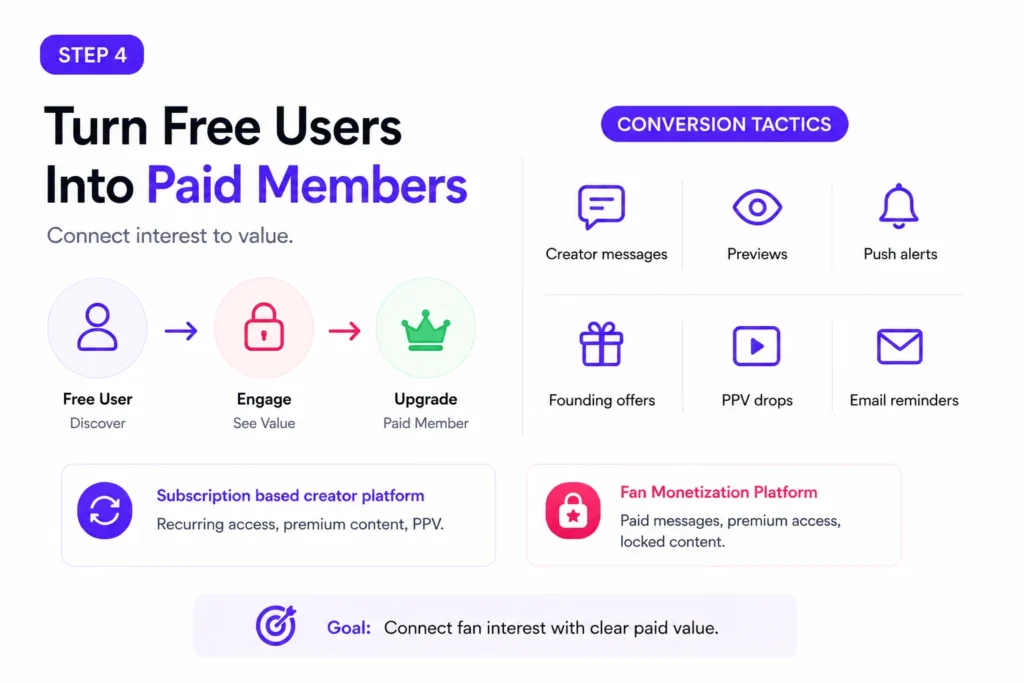
Free access is useful, but only if it supports paid conversion.
Post-launch marketing should help free users understand why membership is worth paying for.
Useful conversion tactics include:
- Creator-led upgrade messages
- Subscriber-only previews
- Limited-time founding member tiers
- PPV content drops
- Email reminders for locked content
- Push notifications for new creator posts
- Creator welcome videos
- Personalized creator recommendations
- Discounted first-month offers where appropriate
- Bundled access for selected creators
- Upgrade prompts after repeated free engagement
A subscription based creator platform can help founders turn free followers into paying members through recurring access, premium content, PPV unlocks, and creator-fan engagement.
If your post-launch strategy depends heavily on paid messages, premium fan access, locked content, and creator-led monetization, reviewing a Fan Monetization Platform can help you understand how these workflows connect.
The goal is not to pressure users. The goal is to connect fan interest with clear paid value.
Step 5 After Launch: Use Lifecycle Campaigns
Lifecycle campaigns are messages triggered by user behavior.
They are important because different users need different prompts.
A new fan needs onboarding.
An inactive fan needs reactivation.
A paying member needs retention.
A creator with no posts needs publishing prompts.
A creator with high engagement needs monetization suggestions.
A churned subscriber needs a win-back reason.
Lifecycle campaigns may include:
| User Segment | Campaign Goal | Example Message Theme |
| New creator | Complete setup | “Publish your first premium post” |
| Inactive creator | Restart activity | “Your fans are waiting for your next drop” |
| New fan | Explore platform | “Follow your first creator” |
| Free follower | Convert to paid | “Unlock subscriber-only content” |
| Paid member | Retain | “New content added to your membership” |
| PPV buyer | Repeat purchase | “New exclusive unlock available” |
| Churned subscriber | Win back | “See what you missed this week” |
Lifecycle marketing is where post-launch growth becomes more precise.
Step 6 After Launch: Build Referral Loops
Referral campaigns are especially useful for creator membership products because creators already have communities.
Referral loops can work in different ways:
- Creators invite fans and earn higher visibility
- Fans invite friends and receive credits
- Creators invite other creators and receive platform rewards
- Agencies invite creator rosters
- Premium members receive early access to creator drops
- Top referrers get platform badges or perks
The key is to reward behavior that strengthens the platform.
A referral program should not only create signups. It should encourage actions that lead to creator activity, fan subscriptions, paid content purchases, or repeat engagement.
Step 7 After Launch: Reduce Churn With Creator Consistency
Fan churn often happens when users stop seeing value.
A fan may cancel because the creator is inactive, content is repetitive, membership benefits are unclear, payment reminders feel sudden, or the user does not understand what they are getting next.
To reduce churn, founders should support creator consistency.
This may include:
- Posting calendars
- Creator content prompts
- Drop reminders
- Subscriber-only content schedules
- Analytics for creators
- Fan feedback tools
- Renewal reminders
- Membership benefit reminders
- Re-engagement emails
- Churn surveys
- Creator education guides
Retention is not only a marketing problem. It is a creator success problem.
Pre-Launch vs Post-Launch Marketing Comparison
Pre-Launch vs Post-Launch Marketing for a Creator Membership Platform
| Area | Pre-Launch Focus | Post-Launch Focus |
|---|---|---|
| Main Goal | Build belief, creator supply, and early demand | Convert attention into repeat usage and paid behavior |
| Creator Strategy | Recruit launch cohort and explain earning value | Activate creators, improve posting frequency, and support earnings |
| Fan Strategy | Build waitlist and tease upcoming access | Guide fans to follow, subscribe, unlock, message, and return |
| Content Strategy | Founder story, niche positioning, previews, and creator teasers | Creator drops, upgrade prompts, retention content, and lifecycle campaigns |
| Trust Strategy | Explain platform rules, payouts, privacy, and moderation | Show reliable operations, support, creator activity, and user safety |
| Metrics | Waitlist signups, creator applications, landing page conversion | Activation, subscription conversion, retention, churn, repeat purchases |
| Founder Question | Can we create enough belief before launch? | Can we turn belief into repeat platform value? |
Founder Decision Signals Before and After Go-Live
Before Launch
If creators are not clear on why they should join, pause broad fan acquisition and sharpen niche positioning, payout messaging, and creator onboarding.
Launch Window
If signups are happening but subscriptions are weak, review creator profile quality, tier value, free previews, and paid content visibility.
After Launch
If users join but do not return, focus on lifecycle campaigns, creator activity, content drops, recommendations, and retention messaging.
Scaling Stage
If the platform is growing but operations feel messy, improve admin control, moderation queues, payout workflows, analytics, and support systems.
Ready-Made vs Custom Development for Creator Membership Platform Launches
Marketing and development are connected.
If the product foundation takes too long to build, pre-launch momentum can fade. If the product launches too early without core workflows, post-launch marketing may expose gaps in onboarding, payments, creator tools, or admin control.
Founders usually compare three options:
| Development Route | Best For | Founder Tradeoff |
| Custom development | Highly unique creator products with unusual workflows | More flexibility, but longer planning, build, testing, and go-to-market coordination |
| Ready-made foundation | Founders who need creator profiles, memberships, paid content, payments, and admin control faster | Faster validation, but customization should match niche and brand strategy |
| Hybrid approach | Founders who want a proven core with selected custom modules | Balanced option when differentiation matters but speed is still important |
For founders planning a creator subscription business, Miracuves offers a launch-ready creator membership solution that can be customized around discovery, subscription tiers, premium content access, creator dashboards, wallet workflows, moderation, and admin operations.
Common Marketing Mistakes Founders Should Avoid
Driving Fan Traffic Before Creator Supply Is Ready
If users arrive before creators have profiles, previews, membership tiers, and paid content ready, the first impression becomes weak.
Using Generic “Coming Soon” Messaging
Pre-launch content should explain the creator advantage, niche value, payout clarity, and fan experience. Generic teasers do not create enough trust.
Stopping Marketing After Go-Live
Launch day is not the end of marketing. After launch, the focus should move to onboarding, activation, retention, referrals, and paid conversion.
Tracking Signups but Ignoring Behavior
Total signups can look good while creator activity, subscription conversion, and retention remain weak. Post-launch marketing needs behavior-level metrics.
What Product Features Support Better Marketing?
Marketing performs better when the product supports the promise.
If the landing page promises creator discovery, the platform should have search, categories, tags, and profile visibility. If the marketing promises creator earnings, the creator dashboard should show subscriptions, paid content, wallet balance, and payout status. If the campaign promises safety, the admin panel should support moderation, reports, verification, and policy workflows.
Marketing Promise vs Product Requirement
| Marketing Promise | Product Feature Needed | Why It Matters |
|---|---|---|
| Creators can get discovered | Search, categories, tags, featured creators, explore feed | Turns discovery messaging into real platform value |
| Fans can access premium content | Membership tiers, locked posts, PPV unlocks, access rules | Supports paid conversion and recurring revenue |
| Creators can earn confidently | Wallet, payout records, commission visibility, withdrawal workflows | Builds creator trust after launch |
| Fans can interact directly | Messaging, paid replies, locked media in chat, reporting controls | Creates engagement and additional monetization |
| The platform is professionally managed | Admin dashboard, reports, moderation queues, analytics, staff permissions | Helps operators manage scale and user trust |
Founders who need a deeper checklist can review the essential creator membership platform features required to support discovery, subscriptions, paid content, messaging, wallets, payouts, moderation, and admin control.
How Miracuves Helps Founders Align Product and Marketing
Miracuves helps founders build ready-made and white-label creator economy platforms with source-code ownership, custom branding, admin dashboards, creator monetization workflows, secure payment gateway integration, discovery features, membership tiers, paid content modules, and faster deployment.
This matters because marketing only works when the product can support the promise. A founder cannot confidently promote creator earnings without payout workflows. They cannot promote discovery without profile visibility and categories. They cannot promote paid access without subscription and content-unlock logic.
For broader planning, founders can also explore Miracuves’ creator platform development services and platform solutions when comparing creator-led business models, audience acquisition, and monetization workflows.
Final Thoughts: Pre-Launch Creates Belief, Post-Launch Creates Proof
The difference between pre-launch and post-launch marketing is simple.
Pre-launch asks:
Can we create enough belief for creators and fans to care?
Post-launch asks:
Can we turn that belief into repeat usage, paid engagement, creator earnings, and platform trust?
A strong pre-launch campaign without post-launch retention becomes temporary hype. A strong product without pre-launch demand becomes a quiet release. The better founder decision is to plan both together.
For a Creator Membership Platform, that means recruiting creators before launch, preparing fans before go-live, activating users immediately after release, and using post-launch data to improve onboarding, subscriptions, paid content, referrals, and retention.
Miracuves helps founders align product readiness and marketing execution with white-label flexibility, source-code ownership, admin control, and monetization-ready creator platform workflows.
FAQs
What is pre-launch marketing for a Creator Membership Platform?
Pre-launch marketing is the strategy used before the platform goes live. It focuses on niche positioning, creator waitlists, landing pages, trust-building, creator outreach, teaser content, and launch-day readiness.
What is post-launch marketing for a Creator Membership Platform?
Post-launch marketing begins after users can access the platform. It focuses on creator activation, fan onboarding, subscriptions, paid content unlocks, referrals, lifecycle campaigns, retention, and churn reduction.
Should founders attract creators or fans first?
Most founders should recruit creators first because creators provide the content supply that fans pay for. Once creator profiles, previews, and membership tiers are ready, fan acquisition becomes more meaningful.
What changes after a creator membership platform goes live?
After go-live, marketing shifts from awareness to behavior. Founders need to track onboarding, creator activity, subscriptions, paid content purchases, messages, retention, referrals, and support issues.
What metrics matter before launch?
Important pre-launch metrics include creator applications, waitlist signups, landing page conversion, email engagement, creator outreach response rate, niche interest, and launch cohort readiness.
What metrics matter after launch?
Important post-launch metrics include creator activation, fan signups, subscription conversion, PPV purchases, paid message usage, repeat visits, churn, referrals, and revenue per active fan.
How can founders reduce churn after launching a creator membership platform?
Founders can reduce churn by improving onboarding, supporting creator consistency, sending content-drop reminders, explaining membership value, using lifecycle campaigns, collecting cancellation feedback, and improving paid-content discovery.
Can Miracuves help launch a Creator Membership Platform?
Yes. Miracuves helps founders build ready-made and white-label creator platforms with source-code ownership, branded design, admin dashboards, creator monetization workflows, premium content access, and faster deployment.
Miracuves is an independent software development company. We are not affiliated with, connected to, sponsored by, or endorsed by any company or product named in this article.
Terms such as “X Clone” are used descriptively. It is how the software industry refers to building a platform with functionality comparable to a known service, and how clients search for it.
The entire design and codebase of our products is built by our own team. Our products contain no code, design, graphics, or content originating from any third-party website or applications.
All third-party names and marks referenced in this article are the property of their respective owners, referenced solely to identify the services discussed.