
Key Takeaways
What You’ll Learn
- Building a Skype clone fails when founders focus only on features — real success depends on call quality, scalability, and reliability.
- Poor real-time infrastructure causes lag, dropped calls, and weak user experience, which can quickly reduce retention.
- Ignoring security and privacy is a major mistake because users share sensitive conversations, files, and personal details.
- Weak admin controls make platform management harder, especially when handling users, reports, misuse, and technical issues.
- A Skype-like app needs strong planning from the start across architecture, performance, security, and growth strategy.
Stats That Matter
- Real-time communication apps are highly performance-sensitive, where even small delays can damage user trust.
- Video and voice calling require stronger backend systems than basic chat apps due to continuous media streaming.
- Security gaps increase platform risk, especially around account access, file sharing, and private conversations.
- Scalability mistakes become costly later when user traffic, call volume, and server load increase.
Real Insights
- The biggest mistake is underestimating real-time complexity, because calling apps need more than simple UI screens.
- Call quality should be treated as a core product feature, not just a technical backend task.
- Security must be included before launch, not fixed after users start reporting privacy concerns.
- Testing under real user conditions is essential to identify lag, crashes, server pressure, and device compatibility issues.
- A successful Skype clone avoids shortcuts in architecture, privacy, and performance because trust depends on every call experience.
Ever had a great idea over a midnight pizza—like, “Let’s build the next Skype, but better!”? You’re not alone. With the boom in remote work, hybrid teams, and digital nomad culture, the hunger for video calling apps is real. Zoom took off during lockdowns. Discord’s now a business tool. And Skype? Well, it still sets the benchmark for startups eyeing the real-time communication space.
But building a Skype clone isn’t just about tossing in a few lines of WebRTC and adding a shiny interface. It’s a battleground of choices—some clever, some downright fatal. I’ve seen early-stage teams pour months (and dollars) into features no one uses, only to fizzle out when scalability bites back. Worse? The “we’ll figure out monetization later” mindset is still alive and kicking.
If you’re thinking of launching your own VoIP or video conferencing platform, buckle up. This blog walks you through the top 5 deadly mistakes that can derail your journey. We’ll also unpack what not to do and how Miracuves can help you stay on track while building your monetization-ready Skype alternative.
1. Underestimating Real-Time Infrastructure Complexity
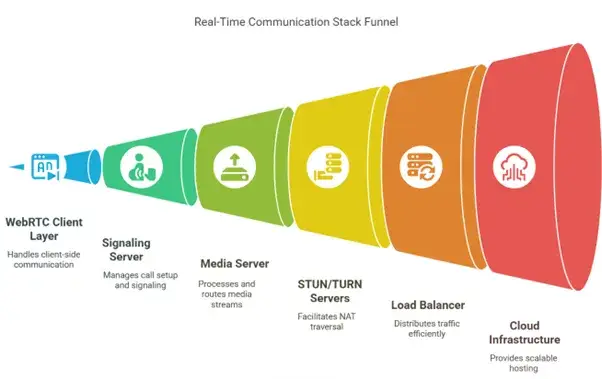
On the surface, video calling looks simple. But underneath? It’s a messy playground of codecs, latency buffers, and NAT traversal techniques. Think of it like building a Formula 1 engine—precision matters.
Mistake in Action:
Many startups opt for basic peer-to-peer setups assuming they’ll scale later. But as concurrent users grow, so do issues: lag spikes, echo chambers, and dropped connections become the norm.
What to Do Instead:
- Use media servers like Kurento or Janus from Day 1.
- Leverage STUN/TURN for NAT handling.
- Opt for cloud-native architectures with horizontal scaling in mind.
2. Cloning Without Innovating
Let’s face it—no one wants a pixel-perfect copy of Skype anymore. That’s like launching a “new Facebook” in 2026. Users crave something fresh—maybe Snapchat-style filters in video calls or Discord-inspired community rooms.
Mistake in Action:
Startups spend months duplicating Skype’s interface and feature list instead of carving a niche.
What to Do Instead:
- Identify micro-trends (e.g., AI noise cancellation, emoji reactions).
- Offer localization features (multi-language, regional servers).
- Target underserved markets like remote therapists or virtual classrooms.
3. Ignoring Cross-Platform Optimization
Your users don’t care about your codebase—they just want things to work. Seamlessly. Whether they’re on an iPhone 15, mid-range Android, or Chrome on Linux.
Mistake in Action:
Teams prioritize desktop apps and treat mobile as an afterthought, leading to glitchy performance and poor onboarding.
What to Do Instead:
- Build with Flutter or React Native for shared logic.
- Use progressive web apps (PWAs) for browser users.
- Test on low-bandwidth connections. Think 3G speeds, not your office Wi-Fi.
4. Neglecting Security & Privacy from the Start
Video calls aren’t just casual chatter. They’re used for interviews, therapy, legal advice—stuff that’s confidential. If your app’s leaking data or doesn’t encrypt calls end-to-end, it’s a ticking PR bomb.
Mistake in Action:
Security is added late in the build cycle. As a result, basic vulnerabilities go unchecked.
What to Do Instead:
- Enable E2E encryption using DTLS-SRTP.
- Comply with GDPR and HIPAA if targeting Europe or healthcare.
- Offer privacy-first features like temporary meeting links or auto-deletion of call history.
5. Monetization Comes as an Afterthought
You’ve got a shiny app. A few users. Then you look around and realize—how exactly are we making money again?
Mistake in Action:
Monetization is treated like the cherry on top, instead of part of the recipe.
What to Do Instead:
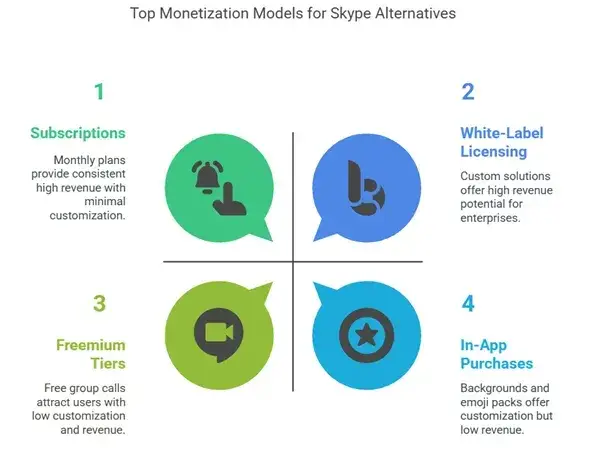
Design your monetization early. Options include:
- Freemium model with paid premium rooms
- Subscription plans for HD/Group calls
- White-label versions for businesses
- In-app purchases for filters, backgrounds, stickers
Conclusion
Startup teams building Skype clones often get tripped up by the same avoidable pitfalls—technical shortcuts, copycat designs, poor UX decisions, or a complete lack of monetization strategy. But you? You’re smarter now. You know where most go wrong, and better yet, how to avoid it.
From real-time architecture to cross-platform fluency, every piece of your app should scream quality and innovation. And in a space crowded with alternatives like Zoom, Google Meet, and FaceTime, that’s the only way to break through.
At Miracuves, we help innovators launch high-performance app clones that are fast, scalable, and monetization-ready. Ready to turn your idea into reality? Let’s build together.
FAQs
1. How much does it cost to build a Skype clone?
With Miracuves, you don’t need to spend $25,000 to $100,000 on development. You can launch a fully developed Bumble-like app for just $2,799 (one-time cost), delivered in 6 days, with a ready-made, scalable platform built for quick go-to-market.
2. Can I use open-source technologies like WebRTC?
Absolutely. WebRTC is the backbone of most modern video calling apps. We help you scale it securely and efficiently.
3. Is it legal to create a Skype alternative?
Yes! As long as you don’t copy proprietary code or brand assets. Functional cloning is totally fair game.
4. How can I ensure low latency for calls?
Use media servers, adaptive bitrate streaming, and edge CDNs to deliver smooth video quality.
5. Do I need separate apps for iOS and Android?
Not anymore. With React Native or Flutter, we build cross-platform apps with shared codebases.
Related Articles :
Miracuves is an independent software development company. We are not affiliated with, connected to, sponsored by, or endorsed by any company or product named in this article.
Terms such as “X Clone” are used descriptively. It is how the software industry refers to building a platform with functionality comparable to a known service, and how clients search for it.
The entire design and codebase of our products is built by our own team. Our products contain no code, design, graphics, or content originating from any third-party website or applications.
All third-party names and marks referenced in this article are the property of their respective owners, referenced solely to identify the services discussed.