
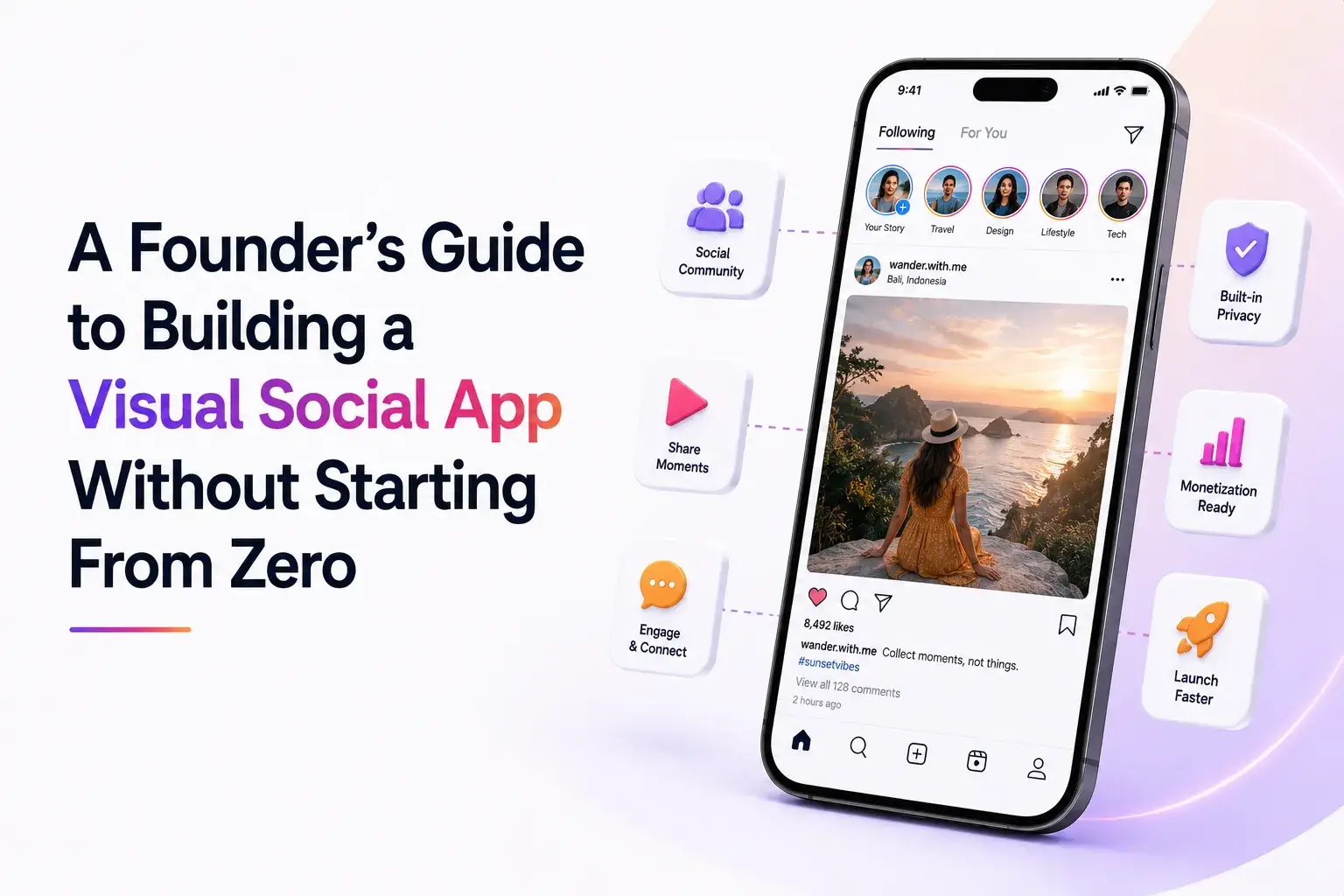
Building a visual social app sounds exciting until the feature list starts growing.
At first, the idea may look simple: users create profiles, upload photos or short videos, follow others, react to content, and send messages. But once you look deeper, the product needs feed logic, media storage, compression, creator tools, recommendations, notifications, moderation, reporting, analytics, monetization, admin control, and scalable backend workflows.
That is where many founders lose time.
The real decision is not whether a visual social app can be built. It can. The stronger question is whether every standard module should be built from zero before the idea is tested in the market.
For founders, startups, agencies, and brands, a ready-made foundation can reduce avoidable development work while still leaving room for branding, custom workflows, monetization models, and market-specific differentiation. Miracuves helps founders approach this decision with a practical product lens: build what makes your platform unique, but do not waste months rebuilding the common infrastructure every visual social platform already needs.
Key Takeaways
- A visual social app needs more than content posting. It needs onboarding, feeds, discovery, creator tools, moderation, messaging, analytics, and admin control.
- Founders should separate standard platform features from the unique product experience that creates differentiation.
- Building every module from zero can delay market validation, increase technical risk, and postpone monetization testing.
- A ready-made or white-label foundation can help founders launch faster while still customising branding, workflows, and business logic.
- Miracuves helps founders move from idea to launch faster with source-code-owned, ready-made, and white-label app solutions.
Why Founders Should Not Build Every Standard Social Feature From Zero
A founder’s early energy should go into product positioning, audience focus, creator acquisition, monetization strategy, and retention design. But many teams spend the first several months rebuilding standard features that do not create real market advantage.
For example, user signup, profile creation, media upload, likes, comments, follows, notifications, reports, and admin controls are necessary. But they are rarely the reason users choose one platform over another.
The real advantage usually comes from:
- A sharper niche.
- A better creator experience.
- Stronger community identity.
- A smoother publishing workflow.
- Better discovery for a specific audience.
- Monetization that fits creator behavior.
- Safer moderation and platform control.
- A brand experience users trust.
This is why “starting from zero” can become expensive in hidden ways. It does not only increase development time. It delays the moment when users can interact with the product, creators can test content formats, and founders can see whether the market actually responds.
A practical founder should ask:
Which features are standard infrastructure, and which features make our product meaningfully different?
That question is the foundation of smarter visual social app development.
What a Visual Social App Really Needs Before Launch
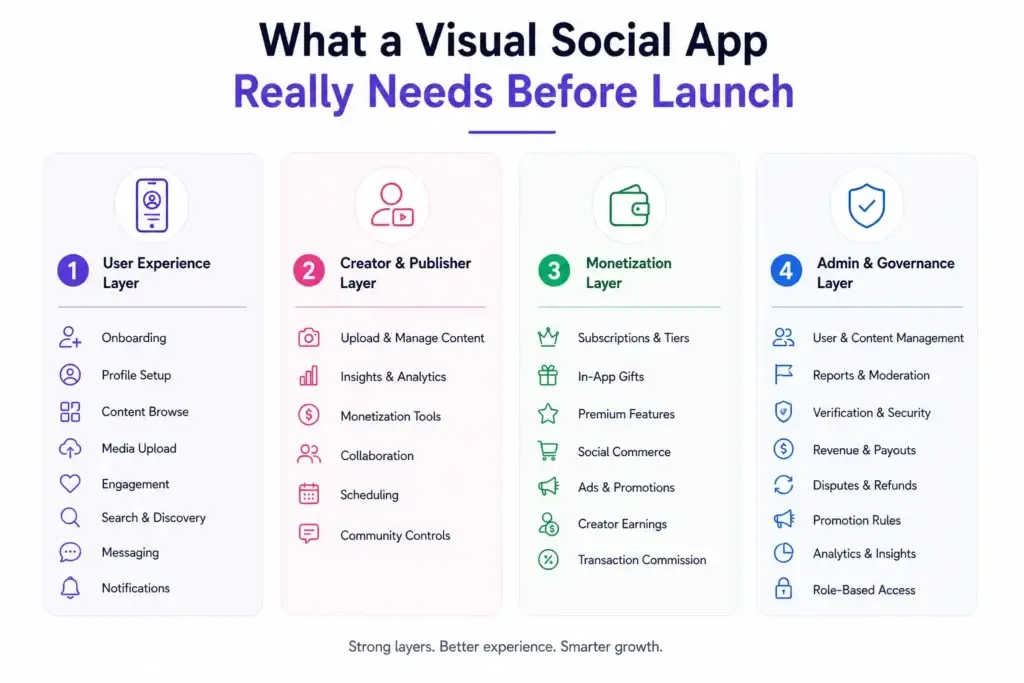
A visual social app is not just one screen. It is an ecosystem of connected product layers.
The user sees posts, videos, profiles, stories, comments, likes, follows, and messages. The creator sees publishing tools, audience activity, insights, and monetization opportunities. The operator sees users, content, reports, revenue, disputes, ads, verification, and system activity.
A launch-ready visual social product should be planned across four major layers.
1. User Experience Layer
This is the visible side of the app. It includes onboarding, profile setup, content browsing, media upload, engagement actions, search, discovery, messaging, and notifications.
The user experience should reduce friction. A new user should quickly understand what to do, who to follow, what to watch, what to post, and why to return.
2. Creator and Publisher Layer
A visual platform depends on supply. If creators do not publish consistently, the feed becomes empty or repetitive.
Creators may need:
- Photo and video upload.
- Drafts and previews.
- Caption and hashtag support.
- Profile customization.
- Follower insights.
- Post performance data.
- Monetization tools.
- Collaboration options.
- Content scheduling.
- Comment and community controls.
For founders, creator tools are not “extra features.” They are the supply engine of the platform.
3. Monetization Layer
Revenue should not be added as an afterthought. Even if a founder does not monetize on day one, the product architecture should support future monetization.
Common options include:
- Sponsored content.
- Paid creator tiers.
- In-app gifts.
- Premium profile features.
- Social commerce.
- Brand promotions.
- Ad placements.
- Subscription communities.
- Platform commission on transactions.
The right monetization model depends on the audience. A creator-led app may prioritize subscriptions and gifts. A D2C brand community may prioritize shoppable content. A local community app may prioritize promoted posts or premium business profiles.
4. Admin and Governance Layer
This is the part users rarely see, but founders depend on it every day.
A visual social app should give the operator control over:
- Users.
- Posts.
- Comments.
- Reports.
- Banned content.
- Creator accounts.
- Verification requests.
- Revenue activity.
- Refunds or disputes.
- Promotion rules.
- Notifications.
- Analytics.
- Role-based team access.
Without admin control, every moderation issue, user complaint, content dispute, or revenue adjustment becomes a developer dependency.
Core Visual Social App Layers and Founder Impact
| Platform Layer | What It Includes | Founder Impact |
|---|---|---|
| User flows | Signup, profiles, feed, search, posting, reactions, messaging, and notifications. | Defines whether users understand the app quickly and return after the first session. |
| Content engine | Media upload, storage, compression, publishing, captions, hashtags, and visibility rules. | Controls the quality and speed of the content experience. |
| Creator tools | Publishing controls, insights, follower management, monetization, and collaboration workflows. | Helps attract and retain creators who keep the platform active. |
| Discovery logic | Feeds, categories, search, recommendations, trending content, and interest signals. | Helps users find value before the platform depends only on existing follower networks. |
| Safety and moderation | Reports, blocking, content review, abuse controls, comment moderation, and policy workflows. | Protects user trust, creator safety, and advertiser confidence. |
| Admin dashboard | User control, content control, promotions, monetization, analytics, refunds, and audit activity. | Allows the operator to manage the platform without relying on developers for every issue. |
How the User Journey Works in a Visual Social App
A visual social app succeeds when the user journey creates a repeat loop.
The journey usually begins with onboarding. The platform must help new users select interests, follow accounts, discover content, and understand what type of community they have joined.
After onboarding, users move into content consumption. They scroll through feeds, view photos or short videos, open creator profiles, react to posts, save content, follow accounts, and send content privately.
Then the platform must create reasons to return. Notifications, new content, creator updates, comments, replies, messages, and recommendations all help bring users back.
A practical journey may look like this:
- User signs up.
- User selects interests or follows recommended accounts.
- User lands on a relevant feed.
- User engages with posts, videos, or creator profiles.
- The system learns from behavior.
- The user receives notifications or recommendations.
- The user returns and engages again.
- Over time, the user may publish, follow creators, buy, subscribe, or invite others.
For founders, this matters because the first version of the app should not be designed around a long feature wishlist. It should be designed around the core loop that makes users return.
The Feed Is Not Just a Screen. It Is the Retention Engine
Many founders think of the feed as a list of posts. In reality, the feed is where retention is won or lost.
A weak feed feels empty, slow, repetitive, irrelevant, or unsafe. A strong feed gives users a reason to keep browsing, react, follow, save, share, and return.
A feed system needs decisions around:
- Followed content versus recommended content.
- Chronological order versus ranked content.
- New creator discovery.
- Content freshness.
- Content quality signals.
- Relevance signals.
- Moderation filters.
- Sponsored or promoted content.
- Loading speed.
- Media format support.
For an early platform, a simple feed may be enough. But as content volume grows, founders need stronger discovery logic. Users should not have to search manually for every valuable post. The platform should help them find creators, topics, communities, products, or trends that match their interests.
This is also where media infrastructure matters. A visual social app with slow loading, broken uploads, poor compression, or unreliable playback will struggle even if the interface looks polished.
For deeper technical planning, editors can internally link to a supporting guide on video streaming infrastructure where relevant.
Choosing the Right Content Formats Before Launch
Not every visual social app needs every content format immediately.
A founder may want posts, stories, short videos, live streaming, private messaging, groups, shoppable tags, creator subscriptions, and brand promotions from day one. But adding too many formats early can create complexity before the business has clear user behavior.
The better approach is to choose content formats based on the audience.
A fashion community may need photos, short videos, creator profiles, product tags, and social commerce. A fitness creator app may need short videos, progress posts, private groups, live sessions, and subscriptions. A local creator platform may need location-based discovery, profiles, messaging, and promoted posts. A private community may need posts, stories, direct messaging, member approvals, and strong privacy controls.
Use this simple decision rule:
| Audience Type | Strong Starting Formats | Why It Works |
|---|---|---|
| Creator community | Short videos, profiles, creator insights, monetization tools | Creators need reach, feedback, and earning pathways. |
| D2C brand community | Posts, product tags, creator content, shoppable collections | Content can guide product discovery and repeat purchase. |
| Local visual network | Profiles, location tags, feed, search, messaging | Discovery depends on relevance and nearby activity. |
| Private interest community | Posts, stories, groups, member controls, DMs | Trust and repeat engagement matter more than viral reach. |
| Media or publisher platform | Visual posts, short videos, topic feeds, notifications | Fresh content and audience return behavior are the priority. |
The goal is not to launch with everything. The goal is to launch with the right content loop.
Ready-Made Foundation vs Building From Zero
A from-zero build gives full flexibility, but it also increases planning, development, testing, integration, and QA work. It may be the right path when the product requires a highly unusual interaction model, proprietary algorithm, custom compliance workflow, or deep enterprise integration.
A ready-made foundation makes more sense when the core platform pattern is already clear and the founder needs to move faster.
That does not mean the product becomes generic. The foundation handles standard app logic, while the founder customizes the brand, audience, feature priorities, monetization model, visual identity, and growth strategy.
| Build Approach | Best For | Founder Advantage | Tradeoff |
| Build from zero | Highly unique product models or unusual technical workflows | Maximum flexibility from the first line of code | Longer timeline, higher planning load, delayed validation |
| Ready-made foundation | Founders who need standard social app modules faster | Faster launch, lower development waste, quicker user testing | Requires smart customization to avoid a generic experience |
| Hybrid approach | Teams that want speed plus selected custom modules | Standard flows launch faster while unique features are added strategically | Needs clear scope discipline |
| No-code or lightweight prototype | Early concept testing or investor demos | Fastest way to show an idea visually | Limited scalability, ownership, and backend control |
For most founders, the question is not “custom or ready-made?” The better question is:
Which parts of the product must be custom to create advantage, and which parts only need to work reliably?
That distinction can save months.
Founder Decision Signals
Speed
If market timing matters, a ready-made foundation can help you test user behavior faster instead of waiting for every standard module to be built from zero.
Cost
Cost depends on features, integrations, branding, platform scope, and customization depth. The strongest approach is to reduce unnecessary rebuild work while investing in real differentiation.
Scalability
A visual social app needs backend planning for media, feeds, storage, notifications, moderation, and analytics. Scalability should be part of the foundation, not an afterthought.
Market Fit
A faster launch helps founders test audience focus, creator supply, engagement loops, monetization, and retention before committing to deeper custom development.
Monetization Should Be Planned Before the App Becomes Popular
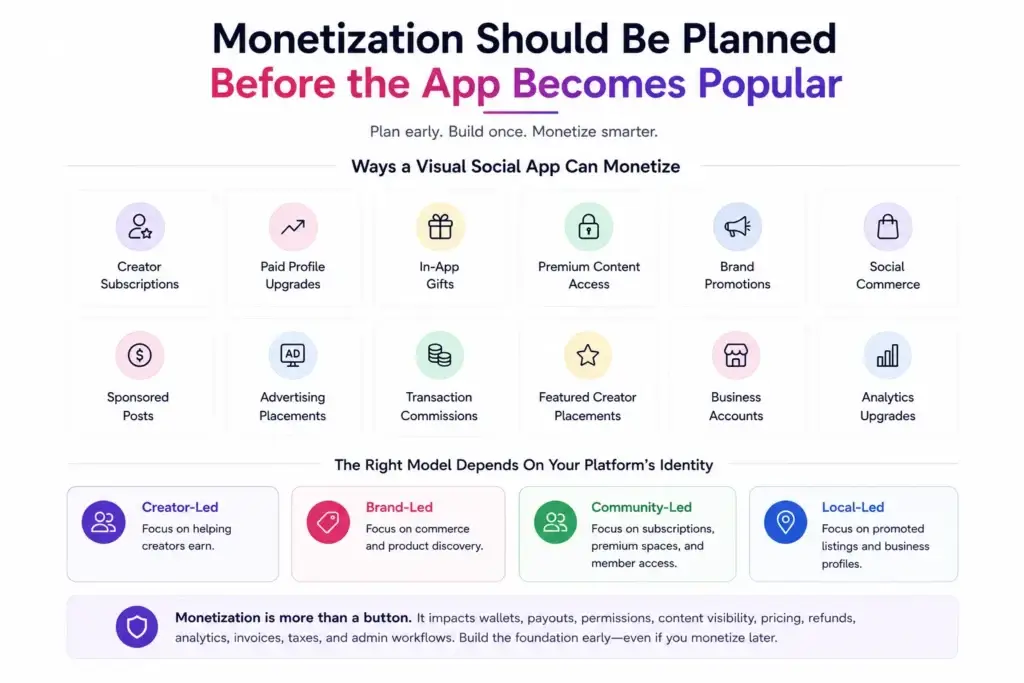
Many founders delay monetization planning because they want to focus on growth first. That sounds reasonable, but the technical foundation still needs to support future revenue models.
A visual social app may monetize through:
- Creator subscriptions.
- Paid profile upgrades.
- In-app gifts.
- Premium content access.
- Brand promotions.
- Social commerce.
- Sponsored posts.
- Advertising placements.
- Transaction commissions.
- Featured creator placements.
- Business accounts.
- Analytics upgrades.
The right model depends on the platform’s identity.
If the app is creator-led, the monetization layer should help creators earn. If the app is brand-led, commerce and product discovery may matter more. If the app is community-led, subscriptions, premium spaces, and member access may be stronger. If the app is local, promoted listings and business profiles may be more practical.
The mistake is treating monetization as a button that can be added later. Monetization touches wallets, payouts, permissions, content visibility, pricing rules, refunds, analytics, invoices, taxes, and admin workflows.
That is why monetization-ready architecture matters even when revenue starts later.
Safety, Moderation, and Trust Are Product Features
User-generated content platforms need safety from the beginning.
A founder may focus on feeds, uploads, and creator tools, but the platform also needs controls for harmful content, spam, fake accounts, abuse, copyright complaints, inappropriate comments, impersonation, and payment-related disputes.
A practical safety layer may include:
- User reporting.
- Post reporting.
- Comment moderation.
- Account blocking.
- Creator verification.
- Manual review queues.
- Automated abuse signals.
- Admin action logs.
- Role-based team access.
- Content visibility controls.
- Community guideline enforcement.
- Appeal or dispute workflows.
Trust affects retention. Users return when they feel safe. Creators publish more when they feel protected. Brands spend more when the environment is controlled. Operators scale better when moderation workflows are visible inside the dashboard.
Security should also be treated as a foundation. Encrypted data transfer, secure payment gateway integration, role-based access control, audit logs, and privacy-conscious data handling are important for protecting the product as it grows.
Admin Control Separates a Demo From a Real Platform
A visual social app can look impressive in a demo but become difficult to operate after launch if the admin layer is weak.
The operator should be able to answer questions such as:
- Which users are growing fastest?
- Which content is being reported?
- Which creators are monetizing?
- Which posts are promoted?
- Which payments need review?
- Which accounts are suspicious?
- Which content should be removed or restored?
- Which team member changed a setting?
- Which notifications are driving return visits?
Without this visibility, the founder becomes dependent on developers for routine operations. That slows the business and creates friction as the platform grows.
A strong admin dashboard should support user management, content control, moderation, promotion control, revenue visibility, reporting, team roles, and audit trails.
This is one of the strongest reasons to avoid rebuilding every layer from zero without a clear operations plan.
When a Ready-Made Visual Social App Foundation Makes Sense
A ready-made foundation makes sense when the founder already understands the platform pattern and wants to test the market faster.
It is useful when the startup needs:
- User accounts and profiles.
- Feed-based content discovery.
- Photo and short-video publishing.
- Creator profiles.
- Likes, comments, saves, and shares.
- Private messaging.
- Notifications.
- Search and discovery.
- Admin dashboard.
- Content moderation.
- Monetization options.
- White-label branding.
- Source-code ownership.
- Room for future customization.
This approach does not remove strategy. Founders still need positioning, audience selection, community rules, launch campaigns, creator onboarding, moderation policies, pricing logic, and growth planning.
But it can reduce the time spent rebuilding standard app infrastructure.
Miracuves helps founders build source-code-owned, white-label visual social app foundations with branding, admin control, monetization-ready workflows, and scalable product logic. The goal is not to copy a popular platform blindly. The goal is to launch a product foundation that can be shaped around a specific audience, market, and business model.
Mistakes Founders Should Avoid
Building Too Many Content Formats at Once
Photos, short videos, stories, live sessions, messaging, groups, and commerce all add complexity. Start with the formats that support your strongest user behavior.
Treating the Feed as a Simple Post List
The feed is the retention engine. It needs relevance, freshness, speed, safety, and discovery logic to keep users engaged.
Ignoring Creator Incentives
If creators do not see growth, feedback, visibility, or earning potential, the platform may struggle to maintain content supply.
Adding Monetization Too Late
Revenue models affect payments, permissions, wallets, analytics, refunds, and admin workflows. Even if revenue starts later, the architecture should be planned early.
Launching Without Strong Admin Control
Without admin dashboards, moderation queues, reporting tools, role-based access, and audit logs, the founder loses operational visibility as soon as real users arrive.
How Miracuves Helps Founders Avoid Starting From Zero
Miracuves helps founders, startups, agencies, and businesses launch digital products faster using ready-made, white-label, source-code-owned app solutions and custom app development services.
For a visual social app, Miracuves can help with:
- White-label app setup.
- Source-code-owned product foundation.
- Custom branding.
- User and creator workflows.
- Feed-based content experiences.
- Media upload and publishing logic.
- Messaging workflows.
- Content moderation.
- Admin dashboards.
- Monetization planning.
- Social commerce workflows.
- Notification systems.
- Security and access control.
- Post-launch customization.
This approach is most useful when a founder wants to validate the market without spending the early stage rebuilding every standard social platform module.
A ready-made solutions gives the business a faster starting point. Customization gives the platform its own identity.
Final Thoughts: Build Faster, But Build With Control
A visual social app does not succeed because it has the longest feature list. It succeeds when the product connects the right audience with the right content experience, creator incentives, discovery logic, monetization model, and operating controls.
Founders should not rush blindly. But they should also avoid spending months rebuilding standard infrastructure before testing whether the market wants the product.
The smarter path is to separate what is standard from what is strategic.
Build the differentiation carefully. Use a reliable foundation for the parts users already expect. Keep admin control, safety, monetization, and scalability in the plan from the beginning.
That is how founders avoid starting from zero without losing ownership, flexibility, or product direction.
FAQs
What is a visual social app?
A visual social app is a platform where users create, share, discover, and interact with visual content such as photos, short videos, creator posts, stories, product content, or community updates. It usually includes profiles, feeds, engagement actions, messaging, notifications, and discovery tools.
How do visual social apps make money?
Visual social apps can make money through ads, sponsored posts, creator subscriptions, in-app gifts, premium accounts, social commerce, paid promotions, brand partnerships, platform commissions, and business profile upgrades. The right model depends on the audience and content behavior.
Should founders build a visual social app from zero?
Building from zero makes sense when the product needs a highly unique interaction model or deep custom architecture. A ready-made foundation may be more practical when the founder needs standard social app workflows, faster validation, source-code ownership, branding control, and room for customization.
What features should a visual social app include at launch?
A focused first version should include onboarding, profiles, content publishing, feed browsing, likes, comments, follows, search, notifications, basic messaging, reporting, moderation, and admin control. Advanced features such as live streaming, complex recommendations, and deep monetization can be added based on the business model.
Why is admin control important in a social app?
Admin control helps the platform operator manage users, content, reports, moderation, promotions, revenue, refunds, team roles, and analytics. Without admin control, routine operational issues become developer tasks, which slows the business after launch.
What is the benefit of a white-label visual social app?
A white-label visual social app gives founders a ready-made foundation that can be branded and customized for their business. It can reduce time spent rebuilding standard modules while allowing the founder to focus on audience, growth, monetization, and differentiation.
How can founders avoid building a generic social platform?
Founders should choose a niche, define the strongest content loop, plan creator incentives, build relevant discovery, add safety controls, and customize the experience around a clear audience. The foundation can be standard, but the positioning and experience should be specific.
Miracuves is an independent software development company. We are not affiliated with, connected to, sponsored by, or endorsed by any company or product named in this article.
Terms such as “X Clone” are used descriptively. It is how the software industry refers to building a platform with functionality comparable to a known service, and how clients search for it.
The entire design and codebase of our products is built by our own team. Our products contain no code, design, graphics, or content originating from any third-party website or applications.
All third-party names and marks referenced in this article are the property of their respective owners, referenced solely to identify the services discussed.