
Key Takeaways
- A restaurant discovery and delivery platform depends on listings, search, ordering, payments and delivery systems working together as one connected architecture.
- Restaurant data such as menus, availability, pricing, operating hours and delivery zones directly influences what customers can discover and order.
- Search and ordering systems should exchange real-time information so customers do not reach unavailable restaurants or menu items.
- A modular architecture allows each major service to scale independently while maintaining a consistent customer experience.
Listings, Search and Orders
- Restaurant listings should store structured information about cuisines, menu items, prices, ratings, fulfilment options and service areas.
- Search should combine keywords with filters such as location, cuisine, rating, price and estimated delivery time.
- Before checkout, the system should validate menu availability, pricing, delivery eligibility and restaurant operating status.
- Order management should track every stage from cart creation and restaurant acceptance to preparation and final fulfilment.
Payments and Delivery Insights
- Payment workflows should connect transactions with unique order states to prevent duplicate charges and inconsistent order records.
- Delivery assignment should consider restaurant location, customer address, partner availability and order preparation time.
- Real-time status updates should connect restaurant preparation, pickup, navigation and customer tracking throughout the delivery journey.
- Operational monitoring should highlight payment failures, delayed orders and delivery exceptions so teams can respond quickly.
A restaurant delivery platform can look deceptively simple from the customer side. A user enters an address, searches for food, chooses a restaurant, adds dishes to a cart, pays, and waits for the order to arrive. Behind those few screens, however, several systems need to exchange accurate information at exactly the right time.
Restaurant availability affects search results. Menu availability affects the cart. The delivery address influences restaurant visibility and delivery charges. Payment confirmation affects whether an order should reach the kitchen. Preparation status affects dispatch timing. Rider availability affects estimated delivery time. A cancellation can affect payments, commissions, restaurant earnings, and customer refunds simultaneously.
That interconnected workflow is what makes restaurant discovery platform architecture important. The objective is not simply to create restaurant listings or add delivery tracking to an ordering interface. The architecture needs to connect discovery, transactions, fulfilment, and administration without allowing those layers to drift apart.
For founders evaluating a restaurant marketplace, understanding these connections is useful before choosing technology, integrations, or a ready-made platform. A visually polished customer application cannot compensate for weak order-state management, inaccurate restaurant availability, payment mismatches, or unreliable dispatch.
For founders evaluating the complete ecosystem, the relationship between customer discovery, restaurant operations, ordering, payments, and last-mile fulfilment is easier to understand when viewed as one connected marketplace. The underlying restaurant discovery and delivery platform workflow shows how these participants and transaction stages interact before deeper architectural decisions are made.
Restaurant Discovery Is the First Layer of the Delivery Architecture
Restaurant discovery is often treated as a frontend design problem: display nearby restaurants, provide a search bar, and add a few filters. In practice, discovery is a backend decision system.
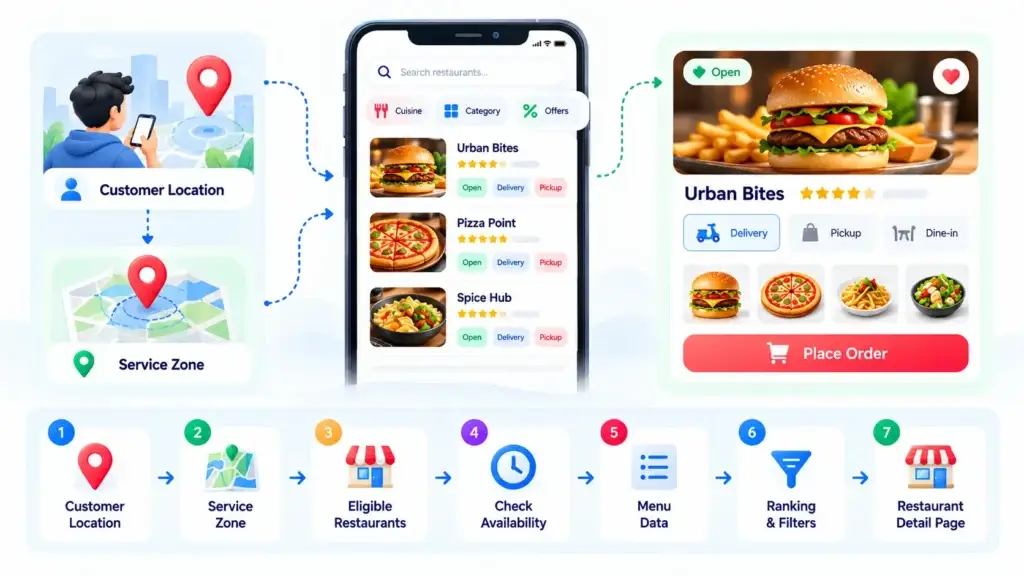
When a customer opens the platform, the system first needs context. Where is the customer located? Which service zone contains that address? Which restaurants serve that zone? Are those restaurants currently open? Are they accepting orders? Are the relevant menu items available? Does the restaurant support delivery, pickup, dine-in ordering, or multiple fulfilment modes?
Only after those questions are resolved should ranking and presentation begin.
This means a restaurant appearing in search results should ideally represent an orderable option, not simply a database record matching the user’s query. Miracuves’ current food-delivery platform material follows this principle by describing discovery around restaurants that serve the customer’s address, combined with cuisine, dish, category, offer, and delivery-related filtering.
A practical discovery flow can therefore be thought of as:
Customer location → service zone → eligible restaurants → availability → searchable menu data → ranking and filters → restaurant detail page
The quality of each step affects conversion further down the funnel.
How Restaurant Listings Should Be Structured
A restaurant listing is more than a restaurant name, photograph, and rating. It represents a collection of operational data that determines where, when, and how that restaurant can participate in the marketplace.
The listing layer may contain restaurant identity and branding information, cuisine categories, operating hours, service areas, fulfilment methods, menu relationships, delivery settings, promotions, ratings, availability status, and administrative approval information.
Some information changes infrequently. Other information can change several times during a single day.
A restaurant may remain active in the marketplace while temporarily stopping orders. A kitchen may be open while a particular dish is unavailable. A branch may serve one neighbourhood but not another. Delivery availability can also differ from pickup availability.
The data model should distinguish these conditions instead of compressing everything into a single active/inactive flag.
| Listing Data | What It Controls | Why It Matters |
|---|---|---|
| Restaurant profile | Identity and customer presentation | Creates the primary discovery record |
| Cuisine and categories | Browse and search classification | Helps customers narrow choices |
| Operating hours | Time-based availability | Prevents orders outside service hours |
| Service zones | Geographic eligibility | Controls where the restaurant appears |
| Menu | Orderable products | Connects discovery to transactions |
| Item availability | Real-time ordering eligibility | Reduces failed orders |
| Fulfilment modes | Delivery, pickup or other supported modes | Changes checkout logic |
| Offers | Promotional visibility | Supports acquisition and conversion |
| Ratings and reviews | Discovery and trust signals | Helps customers evaluate options |
This structure becomes particularly important when one business operates several branches. The brand may be shared, while menus, prices, opening hours, inventory, delivery radius, and preparation times differ by location.
Search Architecture Must Understand Restaurants and Food
Restaurant search becomes significantly more useful when it understands multiple entity types rather than matching only restaurant names.
A customer might search for a cuisine, a specific dish, a restaurant category, a dietary preference, or an offer. The search layer therefore needs relationships between restaurant data and menu data.
A search for “pizza,” for example, may need to return restaurants categorized around pizza as well as restaurants that happen to sell pizza despite belonging to broader cuisine categories.
Filters add another layer. Customers may want to narrow results according to rating, estimated delivery time, pricing, offers, cuisine, distance, or other marketplace-specific criteria. But filters should operate after geographic and operational eligibility has been established. There is little value in ranking an attractive restaurant highly if it cannot deliver to the customer’s address.
For early or moderately sized marketplaces, a well-designed database search with appropriate indexing may be sufficient. More sophisticated search infrastructure becomes relevant as catalogue size, query volume, ranking requirements, personalization, typo tolerance, and geographic complexity increase. Architecture should leave room for that evolution without forcing unnecessary infrastructure into the first release.
Menu Architecture Connects Discovery With Checkout
Menus sit between discovery and transactions, which makes their data model unusually important.
A customer does not simply order a “menu item.” They may select a base item, size, variation, optional or required add-ons, quantity, special instructions, and promotional pricing. The restaurant may simultaneously change stock availability or pricing.
The platform therefore needs a structured relationship between restaurants, menu categories, items, variations, add-ons, pricing, availability, and the eventual order line.
A critical architectural principle is that an existing order should preserve what the customer actually purchased. If a restaurant changes a dish price tomorrow, yesterday’s transaction should not suddenly reflect the new price.
The order record should therefore capture the transaction-relevant information needed for historical accuracy instead of depending entirely on the restaurant’s current menu record.
That distinction becomes valuable during refunds, customer support investigations, restaurant settlement, tax reporting, and dispute resolution.
The Cart Is Where Several Architecture Layers Meet
The cart looks simple in the interface but is one of the first places where business rules collide.
When customers add items, the platform may need to validate restaurant identity, item availability, selected variations, minimum-order rules, delivery location, promotions, taxes, fees, and supported fulfilment methods.
Before payment, important information should be checked again.
A customer can spend several minutes browsing after adding an item. During that time, a restaurant might close, an item might become unavailable, a promotion might expire, or pricing might change. Checkout should not blindly trust stale cart data.
This is why robust ordering architecture revalidates important conditions at transaction time.
Order Management Should Be Designed as a State Machine
An order is not a single event. It is a lifecycle.
A simplistic system might store only “pending,” “accepted,” and “completed.” A real delivery operation usually needs greater precision because several actors interact with the same transaction.
Useful states can represent events such as:
- order created and awaiting payment confirmation;
- payment authorized or confirmed;
- restaurant notified;
- restaurant accepted or rejected;
- preparation started;
- delivery assignment pending;
- delivery partner assigned;
- ready for pickup;
- picked up;
- in transit;
- delivered;
- cancelled or failed;
- refund pending or completed.
These do not necessarily need to be exposed to customers using identical terminology. Internally, however, precise states make automation and exception handling much easier.
For example, a cancellation before restaurant acceptance has different operational consequences from a cancellation after preparation begins. A failed payment requires different recovery from an accepted order that cannot find a delivery partner.
This is why order-state architecture should be designed around actual business operations rather than simply around the progress bar shown to customers.
Payment Architecture Should Follow the Order Without Becoming the Order
One common design mistake is treating payment status and order status as the same thing.
They are related, but they represent different realities.
A payment may fail while an order record already exists. A gateway may confirm payment after a delayed callback. A customer may receive a partial refund without the complete order being cancelled. Cash-based orders can be operationally valid before money has been collected electronically.
The platform should therefore maintain clear payment records connected to the order rather than trying to encode every financial event inside one order-status field.
Payment architecture may need to account for the customer charge, platform commission, delivery fee, discounts, taxes where applicable, restaurant earnings, tips, refunds, adjustments, and eventual payouts.
Security should also be built into this layer rather than treated as an afterthought. Secure gateway integrations, encrypted data transfer, authentication controls, permission-based administrative access, activity records, and careful handling of payment references help create a safer operational foundation. These controls form part of the wider food delivery platform security architecture, where API protection, user access, payment workflows, application security, and operational safeguards need to work together. Final payment and regulatory requirements will still depend on the target jurisdiction, payment provider, integrations, and operating model.
Restaurant Operations Need Their Own Control Layer
The customer interface receives most of the design attention, but the restaurant side determines whether orders can actually be fulfilled.
Restaurants need practical control over menus, availability, opening hours, incoming orders, preparation status, pricing, and relevant earnings information. Depending on the business model, restaurant operators may also require promotion management, branch controls, analytics, or integration with external systems.
The most important consideration is synchronization.
If a restaurant marks an item unavailable, that change should reach customer discovery and checkout quickly enough to prevent avoidable cancellations. If the restaurant adjusts preparation time, the information may affect delivery assignment and customer ETA. If an order is rejected, payment and refund workflows may need to respond.
Restaurant operations are therefore not a separate dashboard bolted onto the marketplace. They are part of the same transactional architecture.
Delivery Architecture Starts Before a Rider Is Assigned
Delivery is frequently described as “assign the nearest rider and show GPS tracking.” Real fulfilment involves more context.
The platform needs to know the pickup location, delivery destination, restaurant preparation status, eligible delivery partners, service zone, delivery partner availability, current workload, and potentially cash-handling or vehicle constraints.
Assigning the geographically closest delivery partner is not always the most efficient choice. If the food will take another twenty minutes to prepare, sending someone immediately can create idle time at the restaurant. Assigning too late can leave a completed meal waiting for pickup.
Dispatch therefore needs to coordinate supply availability with kitchen readiness.
How much of this fulfilment layer the platform controls is ultimately a business-strategy decision as much as a technical one. Different food delivery marketplace strategies can place different levels of responsibility on restaurant operations, delivery coordination, customer acquisition, logistics, and monetization, which in turn changes what the underlying platform needs to support.
A useful high-level flow is:
Order accepted → preparation estimate → eligible delivery partners identified → assignment → pickup → live delivery updates → handover → completion
This coordination becomes more difficult as order density increases. Miracuves’ existing operational analysis similarly emphasizes that scaling food delivery is fundamentally a coordination problem across restaurants, delivery partners, pricing, fulfilment, and operational systems rather than simply a traffic problem.
Location and Delivery Zones Should Influence the Entire Platform
Geography is not merely a map feature.
Delivery zones can determine which restaurants customers see, which delivery fees apply, which delivery partners qualify for an assignment, how promotions work, which admin teams manage operations, and whether an address is serviceable at all.
For that reason, service-zone logic should be treated as part of the platform’s operating model.
A founder may initially launch within a small geographic area, but the data structure should consider what happens when the business adds another neighbourhood, city, or operational region. Hardcoding every geographic rule into application logic can make expansion unnecessarily difficult.
Configurable service zones provide considerably more flexibility.
Live Tracking Is Really an Event-Coordination Problem
A moving marker on a map is only the visible part of live tracking.
The underlying architecture must receive location updates, associate them with the correct active delivery, control update frequency, make relevant data available to the customer, and avoid exposing information that should remain private.
At the same time, order events need to remain synchronized. Customers should know when the restaurant accepts an order, when preparation begins, when pickup occurs, and when the delivery is approaching.
Push notifications and real-time connections can improve this experience, but they should not become the sole record of what happened. Important order events should remain persisted so support teams and administrators can reconstruct the transaction later.
Admin Architecture Is the Control Plane of the Marketplace
The admin dashboard is not simply an analytics screen. It is the platform operator’s control layer.
Administrators may need to manage restaurants, customers, delivery partners, listings, categories, service zones, commissions, promotions, disputes, refunds, approvals, payments, content, and operational exceptions.
That makes permission design important as the organization grows. A support employee may need access to orders without being allowed to modify commission settings. A regional operator may need access only to a particular market. Finance personnel may require settlement information without having full marketplace configuration privileges.
Role-based access, activity logs, and permission-based dashboards can reduce unnecessary administrative risk while making accountability clearer.
For founders comparing implementation options, the depth of this control layer deserves as much attention as the customer application’s design.
How the Complete Architecture Connects
The easiest way to understand the system is to follow one transaction across its dependencies.
| Stage | Core Systems Involved | Key Architecture Question |
|---|---|---|
| Discover | Location, listings, search, availability | Can this customer actually order from this restaurant? |
| Browse | Menu, pricing, availability | Is the information current and orderable? |
| Cart | Menu, promotions, fees, location | Are all transaction conditions still valid? |
| Checkout | Orders, payments, pricing | Can the transaction be created safely and consistently? |
| Restaurant acceptance | Orders, restaurant operations | Can the kitchen fulfil it? |
| Preparation | Restaurant status, ETA logic | When should delivery coordination begin? |
| Dispatch | Location, rider availability, zones | Who should fulfil the delivery? |
| Pickup and tracking | Order events, GPS, notifications | Can every party see the appropriate current state? |
| Completion | Delivery confirmation, payments | Has fulfilment actually finished? |
| Settlement | Commission, earnings, adjustments | Does the financial record match the transaction? |
| Support | Logs, orders, payments, admin | Can the operator reconstruct what happened? |
The important architectural idea is not that every function requires its own complex service. It is that every important business event needs a clear owner and predictable relationships with the systems affected by it.
Those architectural relationships eventually become customer-facing and operational capabilities across restaurant discovery, menu management, ordering, payments, delivery coordination, tracking, and administration. Mapping the architecture against the required restaurant delivery platform features helps founders identify which capabilities belong in the customer experience, restaurant workflow, delivery operations, and platform control layer before finalizing the product scope.
What Should Be Synchronous and What Can Run in the Background?
Not every task needs to block the customer’s request.
Checkout validation and order creation generally need immediate responses because the customer is waiting for confirmation. Other operations can often run asynchronously through queues or background workers.
Notifications, email receipts, analytics events, certain search-index updates, scheduled settlement operations, and other non-blocking jobs are examples where background processing can prevent secondary tasks from slowing the main transaction.
Payment callbacks deserve particular care. External providers can retry webhook events, so the backend should be designed to handle repeated notifications safely rather than assuming every external event arrives exactly once.
As the marketplace scales, this distinction between immediate transactional work and asynchronous background work becomes increasingly important.
How Should a Restaurant Delivery Platform Scale?
Scaling should begin with the actual workload rather than fashionable infrastructure.
Restaurant discovery is typically read-heavy: many customers browse without placing an order. Orders generate more durable transaction data. Delivery introduces frequent location updates. Notifications can create sudden bursts of background activity. Settlement requires accuracy and safe retry behavior.
These workloads have different characteristics.
Caching frequently accessed discovery information can reduce database load. Proper indexes improve restaurant and menu search. Queues can move secondary work away from checkout requests. Object storage can handle media separately from transactional data. Monitoring can identify slow queries, failed jobs, payment errors, or abnormal order-state transitions.
Miracuves’ current platform architecture similarly separates the concerns around discovery, order growth, dispatch concurrency, and payout execution rather than treating scaling as one generic server-capacity problem.
The founder-level lesson is straightforward: architecture should scale around business bottlenecks, not merely around user counts.
Common Architecture Mistakes Founders Should Avoid
Treating Discovery as a Static Restaurant Directory
Discovery should understand location, operating hours, menu availability, serviceability, and fulfilment rules. Otherwise, customers repeatedly reach restaurants or dishes they cannot actually order.
Using One Status for Multiple Business Events
Order, payment, restaurant preparation, delivery, cancellation, and refund states should not be compressed into one vague workflow. Clear states make automation, customer support, reconciliation, and failure recovery substantially easier.
Designing the Customer App Before Restaurant Operations
An attractive discovery experience creates little value if restaurants cannot keep menus current, manage availability, process orders, or communicate preparation progress reliably.
Adding Dispatch as a Separate Feature Later
Delivery interacts with preparation time, zones, order status, customer location, payment methods, and fulfilment confirmation. It should be considered part of the transactional architecture from the beginning when the business controls delivery.
Ignoring Historical Transaction Data
Orders should preserve the prices, discounts, commissions, and relevant item information associated with the original transaction. Historical records should not change because a restaurant edits its current menu.
Architecture Decisions Founders Should Make Before Development
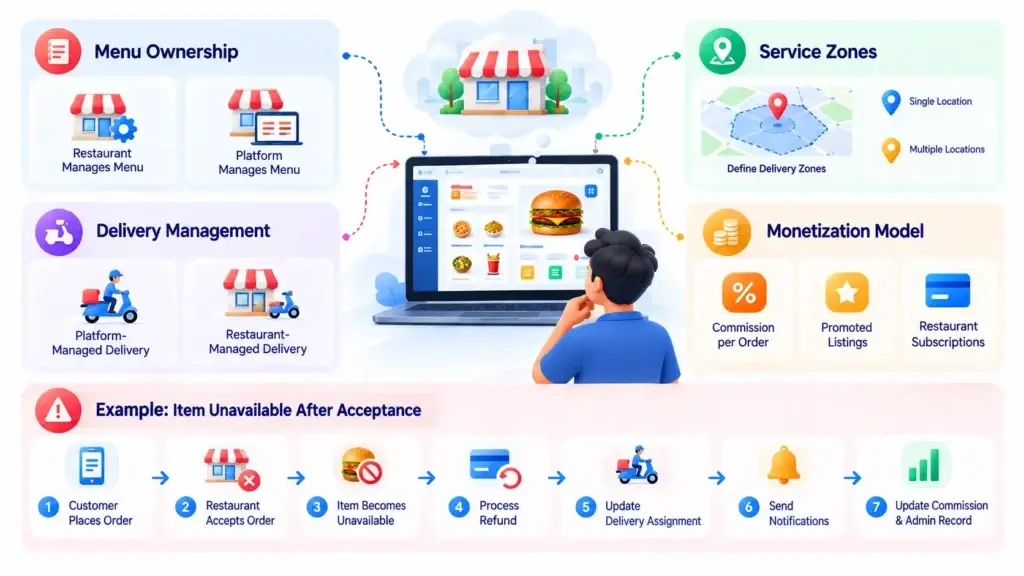
Technology selection matters, but several business decisions should come first.
Founders should establish whether restaurants control their own menus, how service zones work, whether delivery is platform-managed or restaurant-managed, what happens when a restaurant rejects an order, when a delivery partner should be assigned, which party can cancel at each stage, how refunds work, how commissions are calculated, and what administrators can override.
The monetization model also influences architecture because every revenue stream creates its own data and operational requirements. Restaurant commissions require transaction-level commission records, promoted listings influence discovery and ranking logic, restaurant subscriptions require account and entitlement controls, and delivery-fee margins depend on pricing and fulfilment records. Defining the restaurant marketplace business model early helps ensure that commissions, paid visibility, subscriptions, delivery revenue, and other monetization mechanisms are supported by the platform architecture rather than added awkwardly after launch.
The business model and architecture therefore cannot be designed independently.
A useful test is to take one difficult transaction—a paid order where an item becomes unavailable after restaurant acceptance—and ask the team to explain exactly what happens to the customer, restaurant, payment, delivery assignment, refund, commission, notifications, and admin record.
If those answers are unclear, the architecture probably needs more work.
Ready-Made Architecture vs Building Every Layer From Zero
Understanding restaurant marketplace architecture does not automatically mean a business should engineer every subsystem from scratch.
A highly specialized operation with unusual fulfilment rules, proprietary infrastructure, or extensive integration requirements may justify substantial custom development. Other founders primarily need established restaurant, customer, delivery, payment, and administrative workflows that can be configured around their market.
The decision should therefore be based on where the business actually needs differentiation.
That decision also changes the economics of development. Building search, restaurant management, menu logic, checkout, payment workflows, dispatch, tracking, and administrative controls independently creates a different cost structure from customizing an existing product foundation. Evaluating the food delivery platform development cost alongside architecture requirements can help founders separate essential customization from standard marketplace functionality that does not need to be engineered again.
If the differentiator is a unique discovery model, specialized restaurant category, local fulfilment strategy, new monetization approach, or underserved geographic market, spending months recreating basic menu, cart, order, payment, dispatch, and admin foundations may provide limited strategic value.
For businesses evaluating that route, Miracuves provides a ready-made restaurant discovery and delivery platform that can be branded and customized rather than building every foundational workflow again. This is a natural point to explore the dedicated solution page for product-level details, demos, deliverables, and commercial scope.
Eligible ready-made Miracuves deployments can follow a 6-day launch path, with source-code ownership and white-label customization available depending on the selected solution and final scope. The current dedicated solution page advertises a 6-day go-live proposition, while Miracuves’ broader delivery offering also publishes 6-working-day deployment for its ready-made delivery products.
The architectural question remains more important than speed alone: does the foundation correctly connect discovery, transactions, restaurant operations, fulfilment, financial records, and administration for the intended business model?
The implementation partner should be evaluated against those same architectural requirements. When choosing a food delivery development company, founders should examine source-code ownership, customization boundaries, backend control, integration flexibility, deployment responsibilities, scalability, and post-launch support rather than judging the product only by its customer-facing screens.
Founder Decision Signals
Discovery Complexity
If the marketplace will support many restaurants, branches, cuisines, menus, offers, and service zones, define search and listing relationships before polishing the home screen.
Operational Control
If your team will manage commissions, restaurant approvals, delivery areas, disputes, refunds, promotions, and fulfilment exceptions, the admin layer should be treated as core architecture.
Delivery Ownership
If the platform controls the delivery network, dispatch, rider status, preparation timing, tracking, and completion events must be connected directly to the order lifecycle.
Launch Strategy
If your differentiation lies in the market or operating model rather than basic ordering technology, evaluate whether a source-code-owned, configurable foundation can reduce avoidable development work.
How Miracuves Can Support the Architecture-to-Launch Transition
Architecture planning answers the question “How should the system work?” Product selection answers a different question: “How much of that foundation should we build ourselves?”
Miracuves helps founders bridge those decisions with food-delivery platforms that can include connected customer, restaurant, delivery-partner, and administrative workflows. Its broader food-delivery development offering describes restaurant/menu management, ordering, payment configuration, dispatch, tracking, commissions, and operational administration as parts of the same platform architecture.
For founders who have already defined their discovery model, delivery geography, restaurant strategy, monetization rules, and operational requirements, a ready-made foundation can shift effort away from rebuilding standard marketplace plumbing and toward the parts of the business that create actual differentiation.
Final Thoughts: Design the Transaction, Not Just the Screens
A restaurant discovery and delivery platform is not simply a collection of restaurant cards followed by checkout and a tracking map. It is a connected operating system in which discovery determines what can be ordered, menus determine what can enter the cart, payment events determine transaction state, restaurants determine fulfilment readiness, delivery systems move the order, and administrative controls keep the entire marketplace manageable.
That is why the strongest architecture starts with business events and relationships rather than screens alone.
Founders should be able to explain what happens from the moment a customer enters an address until the final transaction is completed and reconciled. They should also know what happens when that ideal flow breaks: when a payment callback is delayed, a restaurant rejects an order, a dish becomes unavailable, no delivery partner accepts the job, or a customer requires a refund.
When those paths are designed clearly, technology becomes much easier to evaluate. A custom build may be appropriate when the operating model requires substantial proprietary logic. When the core model follows established restaurant discovery and delivery workflows, a configurable ready-made foundation can provide a faster route to market while leaving development effort available for genuine differentiation.
FAQs
What is restaurant discovery platform architecture?
Restaurant discovery platform architecture is the technical and operational structure connecting restaurant listings, location data, menus, search, filters, ordering, payments, restaurant operations, delivery, and administrative controls. Its purpose is to make sure information discovered by customers remains consistent with what can actually be ordered and fulfilled.
How does location-based restaurant discovery work?
The platform first determines the customer’s location or delivery address and maps it against supported service areas. It can then identify eligible restaurants before applying availability, cuisine, menu, ranking, offer, or other search logic. This prevents customers from discovering restaurants that cannot serve their address.
What should a restaurant listing system include?
A useful listing system can include restaurant identity, branch information, cuisine categories, operating hours, service areas, fulfilment options, menu relationships, ratings, promotions, and availability. The exact data structure depends on the platform’s business and fulfilment model.
Why should payment status and order status be separated?
They describe different events. A payment can fail, remain pending, succeed late, or be partially refunded while the order follows its own operational lifecycle. Separating them makes reconciliation, exception handling, refunds, and customer support more reliable.
How does restaurant delivery dispatch fit into the order architecture?
Dispatch connects an accepted order with an eligible delivery partner based on factors such as service area, availability, pickup location, delivery destination, and restaurant preparation progress. The resulting assignment and pickup events should then update the wider order lifecycle.
Does a restaurant delivery marketplace need separate customer, restaurant, and delivery interfaces?
Usually, each participant requires different capabilities. Customers discover and purchase, restaurants manage menus and fulfil orders, delivery partners handle pickup and delivery, while administrators oversee the complete marketplace. These interfaces can share a common backend while applying role-specific permissions and workflows.
Should founders build a restaurant marketplace from scratch?
That depends on the business model and required differentiation. Highly specialized operational logic may justify extensive custom development. When the business primarily needs established restaurant discovery, ordering, payment, dispatch, and administration workflows, a configurable ready-made foundation may reduce development effort and launch time.
How quickly can Miracuves deploy a ready-made restaurant delivery platform?
Miracuves currently advertises a 6-day launch for its relevant ready-made solution, subject to the selected scope and customization requirements. Custom requirements, external approvals, payment-provider onboarding, or app-store processes can affect the broader go-live schedule.
Miracuves is an independent software development company. We are not affiliated with, connected to, sponsored by, or endorsed by any company or product named in this article.
Terms such as “X Clone” are used descriptively. It is how the software industry refers to building a platform with functionality comparable to a known service, and how clients search for it.
The entire design and codebase of our products is built by our own team. Our products contain no code, design, graphics, or content originating from any third-party website or applications.
All third-party names and marks referenced in this article are the property of their respective owners, referenced solely to identify the services discussed.