


Key Takeaways
- A Subscription-Based Platform Monetization strategy can combine memberships, PPV content, paid messaging, live access, tips, virtual gifts, premium tools, and platform commissions.
- Recurring subscriptions provide predictable revenue, while one-time purchases and paid interactions allow creators and operators to monetize different levels of fan demand.
- Multi-stream revenue works best when pricing, content access, creator earnings, subscriber value, payment flows, and platform fees remain clear and connected.
Revenue Stream Signals
- Membership tiers can generate recurring revenue through monthly or annual plans that unlock exclusive feeds, premium content, communities, and subscriber benefits.
- PPV posts, locked videos, paid messages, live sessions, tips, virtual gifts, bundles, and personalized interactions can generate additional transaction-based revenue.
- Platform operators can earn through creator commissions, transaction fees, payout charges, premium creator tools, promoted visibility, advertising, and other value-added services.
Monetization Strategy Insights
- Operators should track subscription conversion, renewal rate, PPV purchases, paid-message activity, live-session spending, creator earnings, revenue per subscriber, and churn.
- A balanced monetization model should give free users room to discover value while giving paying subscribers clear reasons to upgrade, purchase premium content, and remain active.
- Miracuves develops customizable subscription-based platforms with memberships, PPV content, paid messaging, live access, tipping, virtual gifts, creator payouts, revenue analytics, and admin controls.
Subscription-based platform monetization should not depend on monthly memberships alone. A monthly plan can create recurring revenue, but stronger creator platforms usually need multiple earning paths: premium content unlocks, tips, paid messages, live sessions, wallet spending, product sales, platform commissions, promotional placements, and advanced creator tools.
This matters because not every fan wants to pay the same way. Some subscribers prefer monthly access. Some pay only for special content. Some spend during live sessions. Some tip creators directly. Some buy products, bundles, calls, or one-time experiences.
For founders, the goal is not just to add more payment buttons. The goal is to design a revenue system where creators can earn in different ways, subscribers feel they are getting value, and the platform owner can manage commissions, payouts, access rules, reports, and growth from one controlled backend.
This guide explains the most important monetization options for a subscription-based platform and how founders can use multi-stream revenue planning to build a stronger creator economy product.
Why One Revenue Stream Is Not Enough
A subscription platform may start with monthly plans, but monthly access alone can limit earning potential.
Creators have different audience types. Some fans want ongoing access. Some want one exclusive post. Some want private interaction. Some want live access. Some want custom content. Some want to support a creator through tips. Some want products, services, or premium bundles.
When the platform supports only one payment model, it forces every creator and every fan into the same revenue path. That can reduce conversion, limit fan spending, and make creator earnings less flexible.
A multi-stream revenue model helps solve this problem by giving creators and platform owners more ways to monetize different types of demand.
Core Revenue Streams in a Subscription-Based Platform
A strong monetization system combines recurring revenue, one-time purchases, interaction-based revenue, platform-level fees, and creator business tools.
| Revenue Stream | How It Works | Who Benefits |
|---|---|---|
| Monthly Memberships | Fans pay recurring fees to access creator content, communities, or premium updates. | Creators and platform owners |
| Pay-Per-View Content | Fans pay once to unlock selected posts, videos, files, or premium bundles. | Creators and highly engaged fans |
| Paid Messaging | Creators charge for replies, private media, custom requests, or premium inbox access. | Creators and fans seeking direct interaction |
| Tips and Virtual Gifts | Fans send support directly through wallet balance, tips, gifts, or live-session spending. | Creators and loyal fan communities |
| Live Access | Fans pay for live sessions, paid calls, private streams, events, workshops, or consultations. | Creators, coaches, performers, and educators |
| Creator Shop | Creators sell digital products, physical products, services, bundles, courses, or premium offers. | Creators with products or services |
| Platform Commission | The platform takes a configurable percentage from creator earnings, purchases, or transactions. | Platform owner |
| Featured Placements | Creators pay or qualify for promotional visibility across search, homepage, categories, or campaigns. | Creators and platform owner |
| Premium Creator Tools | Creators pay for advanced analytics, automation, fan lists, scheduling, promotion, or business tools. | Advanced creators and platform owner |
The right revenue mix depends on the platform’s niche, creator category, subscriber behavior, content type, payment provider approval, moderation needs, and growth stage.
Monthly Memberships for Recurring Revenue
Monthly memberships are the foundation of many subscription-based platforms. They give creators recurring income and give fans ongoing access to exclusive content or community benefits.
Membership plans may include:
- Free follower access
- Basic paid access
- Premium content access
- VIP membership
- Annual access
- Category-based access
- Creator-specific plans
- Community-only plans
- Early access tiers
The biggest benefit of subscriptions is predictable revenue. Creators can forecast income more easily, and platform owners can track recurring revenue, active subscribers, cancellations, plan upgrades, and retention.
However, subscriptions work only when users have a reason to keep renewing. That means creators need regular content, engagement tools, fan updates, exclusive drops, and clear value in each tier.
Founders planning monetization should also review the Subscription-Based Platform business model to understand how subscriptions, PPV content, tips, paid messaging, wallet flows, and platform commissions work together.
Pay-Per-View Content for Premium Unlocks
Pay-per-view content gives creators a way to monetize high-value content separately from regular memberships.
This works well for:
- Premium videos
- Exclusive photos
- Private posts
- Locked media
- Downloadable files
- Behind-the-scenes content
- Personalized content
- Event recordings
- Tutorials
- Limited bundles
- Special releases
PPV monetization is useful because not every fan wants a higher monthly plan. Some fans may prefer to pay once for one piece of content. Others may already subscribe but still want premium extras.
For creators, PPV unlocks can increase average revenue per fan. For platform owners, PPV transactions can create additional commission opportunities.
The important backend requirement is access control. Once a fan pays, the system must unlock the right content, track the transaction, record creator earnings, and prevent unpaid access.
Paid Messaging and Custom Requests
Direct communication is one of the strongest monetization layers in a creator platform. Fans often pay for access, but they may spend more when they can interact personally with creators.
Paid messaging may include:
- Paid replies
- Locked media messages
- Custom content requests
- Priority inbox access
- Creator message bundles
- Mass message campaigns
- Scheduled creator messages
- Fan list targeting
- Premium DM access
- Message-based PPV unlocks
This revenue stream works because it combines monetization with relationship-building. A fan may subscribe for content, but private interaction can increase loyalty and repeat spending.
Founders should plan paid messaging carefully. The platform needs clear pricing, content rules, reporting tools, moderation options, message history, transaction records, and creator controls.
Tips, Gifts, and Wallet-Based Spending
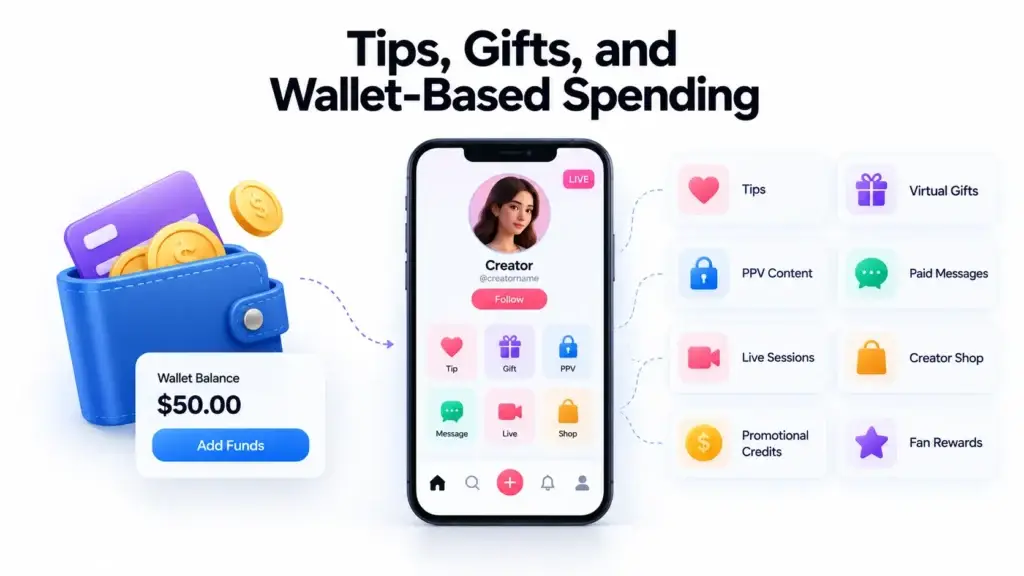
Tips and virtual gifts let fans support creators without buying a new subscription or unlocking a specific post. This creates low-friction revenue moments.
A wallet system can make this easier. Fans add balance once and then spend across the platform on tips, gifts, PPV content, paid messages, creator shops, live sessions, or calls.
Wallet-based spending can support:
- Faster repeat purchases
- Better transaction tracking
- Promotional credits
- Fan rewards
- Gift campaigns
- Creator earnings records
- Payout visibility
- Reduced checkout friction
For founders, wallet payments also create better operational visibility. Admins can track top-ups, spending, commissions, refunds, chargebacks, and payout requests from one system.
Live Sessions, Paid Calls, and Real-Time Access
Live monetization adds urgency and personal interaction. Instead of only publishing static content, creators can charge for real-time experiences.
This can include:
- Paid live streams
- Private live sessions
- Paid audio calls
- Paid video calls
- Group events
- Coaching sessions
- Workshops
- Virtual meetups
- Performance events
- Limited-seat sessions
Live access works well for creators, coaches, educators, performers, consultants, fitness instructors, and premium communities.
However, real-time monetization requires more than a live button. The platform needs session scheduling, access rules, payment validation, creator availability, reminders, moderation, session history, refunds, and reporting.
Creator Shops and Product-Based Revenue
A subscription-based platform can also support product sales. This helps creators monetize their audience beyond content access.
Creator shops may include:
- Digital downloads
- Courses
- Templates
- Merchandise
- Physical products
- Paid services
- Event tickets
- Premium bundles
- Limited offers
- Coupons
- Membership add-ons
This revenue stream is useful when creators already have a strong audience and want to sell products or services directly inside the platform.
For founders, commerce adds complexity. The platform may need inventory logic, product pages, order records, delivery rules, refunds, tax handling, support workflows, and seller controls.
Platform Commission and Revenue Share
Platform commission is one of the most important founder-side monetization models. The platform earns a percentage from creator transactions.
Commission can apply to:
- Membership revenue
- PPV unlocks
- Tips
- Gifts
- Paid messages
- Live sessions
- Calls
- Product sales
- Campaigns
- Featured placements
The challenge is balance. If commission is too high, creators may leave or avoid promoting the platform. If commission is too low, the business may not cover payment processing, infrastructure, support, moderation, marketing, and development costs.
A practical commission model should consider:
- Creator acquisition cost
- Payment gateway fees
- Refund and dispute rates
- Payout costs
- Infrastructure costs
- Support workload
- Platform marketing
- Content moderation needs
- Competitive creator expectations
- Long-term margin goals
The best commission structure supports both platform sustainability and creator motivation.
Featured Creators, Promotions, and Paid Visibility
As the platform grows, discovery becomes valuable. Creators want attention, and platform owners need ways to organize visibility fairly.
Paid or curated promotional tools can include:
- Featured creator placements
- Homepage promotion
- Category promotion
- Search boosts
- Sponsored profile visibility
- Launch campaigns
- Seasonal campaigns
- Discount campaigns
- Referral campaigns
- Creator spotlight sections
Promotional monetization should be handled carefully. If the platform becomes too pay-to-win, smaller creators may lose motivation. A better model combines paid visibility, performance-based discovery, editorial curation, and quality signals.
Premium Tools for Serious Creators
Advanced creators may pay for tools that help them grow faster and manage fans better.
Premium creator tools can include:
- Advanced analytics
- Fan segmentation
- Custom lists
- Scheduled messages
- Bulk messaging
- Campaign tracking
- Automated offers
- Referral tools
- Creator vaults
- Content calendars
- Performance insights
- Priority support
- Agency access
- Team permissions
This model works best once the platform has creators who treat their presence as a business. These creators need more than posting and payments. They need growth, workflow, reporting, and automation tools.
Ads and Brand Partnerships
Ads can be useful in some subscription-based platforms, but they should be added carefully. Too many ads can hurt the premium experience.
Ads may work better when the platform has:
- Free users
- Public creator discovery pages
- Brand-safe categories
- High traffic
- Strong audience segmentation
- Clear reporting
- Creator-approved placements
- Sponsor-friendly content rules
Brand partnerships may also create revenue through sponsored campaigns, creator collaborations, event sponsorships, and category-specific promotions.
For early-stage platforms, ads should usually be secondary. Creator earnings and subscriber value should come first.
Revenue Streams by Platform Maturity
Not every monetization feature belongs on day one. Founders should launch with the revenue streams that match their audience and creator category, then expand once usage data proves demand.
| Platform Stage | Best Revenue Streams | Founder Focus |
|---|---|---|
| Launch Stage | Memberships, PPV unlocks, tips, wallet payments, platform commission | Validate creator demand, payment flow, subscriber access, and payout trust |
| Growth Stage | Paid messaging, live sessions, calls, bundles, coupons, featured creators | Increase engagement, repeat spending, and creator earnings |
| Scale Stage | Creator shops, premium creator tools, agency accounts, campaigns, brand partnerships | Expand revenue depth and improve creator business workflows |
| Advanced Stage | Automation, AI engagement tools, advanced analytics, enterprise creator packages, custom monetization modules | Improve efficiency, personalization, and high-value creator retention |
Payment and Payout Trust: The Hidden Monetization Layer
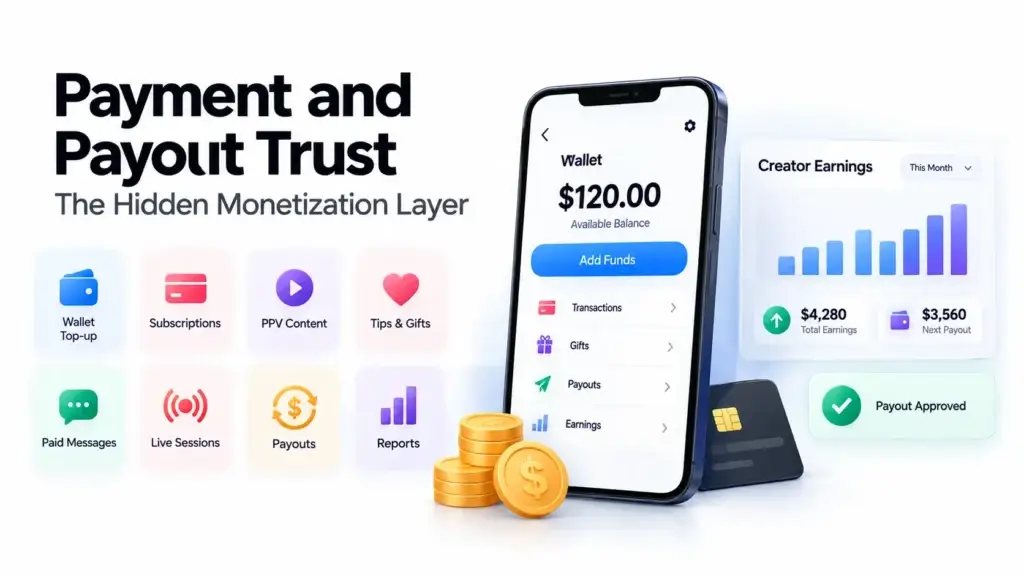
Creators may join a platform for monetization features, but they stay when payments are reliable.
A strong payment and payout system should support:
- Wallet top-ups
- Subscription payments
- PPV purchases
- Tips and gifts
- Paid message transactions
- Live session payments
- Refund records
- Creator earning records
- Platform commission tracking
- Payout requests
- Payout approvals
- Payment gateway status
- Failed payment handling
- Transaction history
- Admin reporting
If creators cannot understand their earnings or trust the payout process, they may stop using the platform. If subscribers experience payment confusion, they may cancel or contact support repeatedly.
Payment clarity is not just a finance feature. It is a retention feature.
Analytics That Help Improve Revenue
Monetization improves when creators and platform owners understand what is working.
Creator analytics may include:
- Subscriber growth
- Membership revenue
- PPV conversion
- Tip volume
- Paid message revenue
- Live session revenue
- Fan activity
- Churn signals
- Best-performing content
- Average revenue per fan
- Payout status
- Campaign performance
Platform analytics may include:
- Total transaction volume
- Platform commission
- Active subscribers
- Creator retention
- New creator activation
- Failed payments
- Refunds
- Wallet top-ups
- Feature usage
- Category-level revenue
- Highest-performing creators
- Support load
- Moderation signals
These insights help founders decide what to promote, what to improve, and which monetization features deserve more investment.
Founder Decision Signals Before Choosing Revenue Streams
Audience Spending Behavior
If fans prefer recurring access, memberships should lead. If they prefer occasional premium purchases, PPV content, bundles, tips, and paid messages may perform better.
Creator Category
Coaches, educators, performers, influencers, artists, and consultants may need different monetization mixes based on content format and fan expectations.
Payment Complexity
If the platform supports subscriptions, wallets, tips, PPV, paid calls, refunds, and payouts, payment workflows must be planned before launch.
Creator Retention
If creators need long-term income growth, provide analytics, fan lists, scheduling, premium offers, payout clarity, and promotional tools.
What Features Are Needed for Multi-Stream Monetization?
A subscription-based platform needs strong backend control to manage multiple earning paths. Without the right systems, revenue streams become confusing for creators, fans, and admins.
For a deeper feature breakdown, review the Subscription-Based Platform features page before finalizing your launch scope.
Important monetization features include:
- Membership tier management
- PPV content unlocks
- Wallet top-ups
- Tips and virtual gifts
- Paid messaging
- Live session payments
- Paid audio and video calls
- Creator shop
- Coupons and promotions
- Platform commission settings
- Payment gateway integration
- Payout request workflows
- Refund and dispute visibility
- Creator earnings dashboard
- Fan transaction history
- Admin revenue reporting
- Moderation and compliance controls
You can also review this guide on subscription-based platform features to understand which creator, subscriber, payment, engagement, and admin features matter beyond monthly memberships.
Common Monetization Mistakes Founders Should Avoid
1. Treating Subscriptions as the Entire Revenue Model
Monthly memberships are useful, but stronger platforms also need PPV content, tips, paid messages, live access, wallets, creator shops, and premium offers.
2. Adding Too Many Revenue Streams Too Early
More monetization options do not always mean more revenue. Launch with the streams that match your creator category and add advanced tools after usage data is clear.
3. Ignoring Creator Payout Trust
Creators need clear earnings, transparent fees, payout status, transaction records, and reliable settlement workflows to stay active on the platform.
4. Setting Commission Without Cost Planning
Platform commission should account for payment processing, refunds, infrastructure, support, moderation, marketing, and future development costs.
5. Separating Monetization From Engagement
Fans spend more when they stay engaged. Messaging, live sessions, content drops, recommendations, notifications, and creator updates all support monetization.
Custom Build vs Ready-Made Monetization Foundation
Founders can build a subscription-based platform from scratch, use a ready-made foundation, or choose a hybrid path.
A custom build gives maximum control, but it requires more planning around payments, wallets, creator dashboards, payout records, moderation, analytics, mobile apps, web access, admin tools, and integrations.
A ready-made foundation can be more practical when the founder wants to validate the model faster and avoid rebuilding standard creator monetization workflows from zero.
If budget planning is your next step, this subscription platform development cost guide can help connect revenue streams, integrations, and customization scope with pricing.
Founders comparing build partners can also review this guide on choosing the right Subscription Platform development partner before deciding between custom development, ready-made deployment, or a hybrid approach.
If you want to understand how monetization connects with backend workflows, this guide on subscription-based platform architecture explains the development side in more detail.
How Miracuves Helps Founders Launch Monetization-Ready Platforms Faster
Miracuves helps founders, agencies, creator businesses, and media operators launch ready-made and white-label creator monetization platforms with subscriptions, PPV content, wallet payments, paid messages, tips, gifts, live streaming, audio/video calls, creator shop, analytics, moderation, admin governance, and source-code ownership.
This matters because multi-stream monetization depends on connected workflows. A fan subscription should connect with access rules. A PPV unlock should connect with transaction records. A creator payout should connect with commission logic. A live session should connect with payment validation and session history.
Founders evaluating a faster launch path can review the creator monetization platform foundation from Miracuves to understand how subscription access, PPV monetization, wallet flows, live engagement, admin control, and creator tools can work together.
Where the ready-made scope fits the requirement, Miracuves can support a 6-day launch path with white-label rebranding, deployment support, app publishing support, and source-code ownership.
Founders exploring broader creator, influencer, fan engagement, and entertainment products can also review Miracuves’ influencer platform solutions.
Final Thoughts
Subscription-based platform monetization is strongest when revenue does not depend on one monthly plan alone.
Monthly memberships create predictable income. PPV content adds premium unlocks. Paid messaging monetizes direct interaction. Tips and gifts encourage fan support. Live sessions create urgency. Creator shops expand commerce. Platform commissions create operator revenue. Premium tools help serious creators grow.
For founders, the real goal is not just to add more revenue streams. It is to connect those revenue streams with creator trust, subscriber value, payment reliability, payout clarity, analytics, moderation, and admin control.
A platform that helps creators earn in multiple ways is more likely to retain creators. A platform that gives fans multiple reasons to spend is more likely to grow revenue. A platform that gives operators clear control is easier to scale.
As creator monetization keeps evolving, founders should also study the future of creator-led platforms to understand where subscriptions, communities, direct engagement, and premium content models are moving next.
FAQs
What is subscription-based platform monetization?
Subscription-based platform monetization is the process of generating revenue from recurring memberships and additional earning streams such as PPV content, tips, paid messages, live access, wallet payments, creator shops, commissions, and premium tools.
Are monthly memberships enough for creator platforms?
Monthly memberships can create recurring revenue, but they are usually not enough by themselves. Stronger creator platforms often add PPV content, tips, paid messaging, live sessions, creator shops, and wallet-based spending.
How does pay-per-view content help creators earn more?
Pay-per-view content lets creators charge fans once to unlock premium posts, videos, files, bundles, or private media. It helps creators monetize highly engaged fans without forcing every user into a higher subscription tier.
Why are wallet payments useful in subscription platforms?
Wallet payments reduce checkout friction. Fans can add balance once and spend across subscriptions, PPV content, tips, gifts, paid messages, live sessions, calls, and creator shop purchases.
How do platform owners make money from creator platforms?
Platform owners can earn through commissions, transaction fees, featured placements, premium creator tools, advertising, brand partnerships, enterprise creator packages, and revenue share from multiple creator transactions.
What monetization features should launch first?
Most platforms should start with memberships, PPV unlocks, tips, wallet payments, platform commission, creator earnings records, payout workflows, and admin reporting. Advanced tools can be added after user behavior becomes clear.
Why is payout trust important for creator monetization?
Creators need clear earnings, transparent transaction records, reliable payout status, and predictable settlement workflows. If creators do not trust the payment system, they may stop using the platform.
Can Miracuves help launch a multi-stream creator monetization platform?
Yes. Miracuves helps founders launch ready-made and white-label creator monetization platforms with subscriptions, PPV content, wallet payments, paid messaging, live engagement, creator dashboards, moderation, analytics, admin control, branding, and source-code ownership.
Miracuves is an independent software development company. We are not affiliated with, connected to, sponsored by, or endorsed by any company or product named in this article.
Terms such as “X Clone” are used descriptively. It is how the software industry refers to building a platform with functionality comparable to a known service, and how clients search for it.
The entire design and codebase of our products is built by our own team. Our products contain no code, design, graphics, or content originating from any third-party website or applications.
All third-party names and marks referenced in this article are the property of their respective owners, referenced solely to identify the services discussed.



