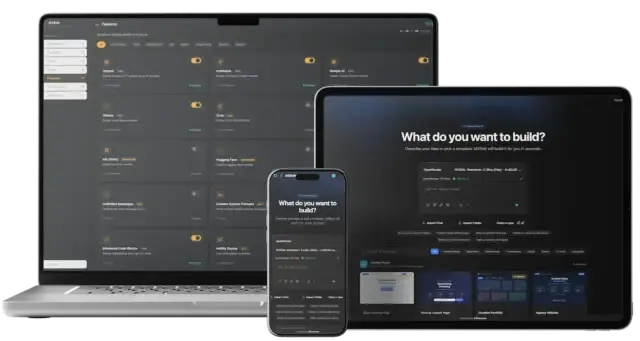
Prypco Clone Development Cost: $6,999 for Eleven Product Lines
Two numbers decide this budget and most quotes blur them into one. The first is the software, priced once: a fractional property platform carrying eleven product lines, a 46-suite operator console and a native mobile client for iOS and Android. The second is the readiness work between a running deployment and a platform fit to take public money, sized by your processor, your identity vendor, your approval chain and your licence. This page keeps the two apart, because a blended figure is how a launch date slips.
Get a Scoped Quote →See FeaturesWhat a Prypco-Style Platform Costs Each Way
Five routes to the same shop window, and what each one leaves you actually holding.
| Route | What you pay | What you end up holding |
|---|---|---|
| Generic fractional-property script | A small one-time fee | One product line. A listings page, a pledge form, and a spreadsheet standing in for the ownership register |
| Licensed platform on subscription | Setup, then a share of your book for as long as you operate | A tenancy. The register, the investor data and the pricing power stay with the vendor, and the bill grows with your success |
| Miracuves ready-made | $6,999, once | Eleven product lines, the 46-suite console, the native mobile client and the full source, branded and deployed in six working days |
| Agency or contract build | A programme priced by the engineer-month across one to two years | A bespoke platform that reaches the operator console and the mobile app last, if the budget survives long enough to reach them at all |
| In-house team | Salaries across four hard-to-hire profiles, for years rather than months | Your own platform, plus the permanent cost of the people who understand the ledger and cannot be replaced quickly |
Ours is the third row. The honest comparison at $6,999 is not another script. It is the salary bill for a senior team writing a fractional investment engine, a double-entry ledger, an append-only register, KYC orchestration, four payment integrations, a secondary marketplace, exit windows and voting, a distribution engine, a 46-suite console, a 60-screen native app, CRM, tokenisation and the gold, mortgage, visa and wills modules from an empty repository. The platform documentation's own buy-versus-build table puts that at 64 to 121 engineer-months.
What the Price Includes
The complete build behind MXPropstake, its documentation, and deployment under your brand. Not a core module with the rest behind a second quote.
Full source ownership, no per-investor fee and no share of your fee revenue. What the price does not include is the readiness work below, and we would rather itemise it than average it into a headline figure.
What Moves the Number
The price buys the software. It does not buy readiness to take public money. These are the items between the two, and the first three are not optional in any deployment that intends to open.
Permissions bound to your approval chain
A thirty-role permission matrix exists in the build. Production means every admin account carries an assigned role rather than legacy full access, the matrix verified against your real approval plan, maker-checker thresholds set where funds and chain operations move, and multi-factor enforced on admin accounts. This is what turns a console into something an auditor accepts.
Your processor, verified against your own secret
The payment webhook secret ships as a sandbox placeholder and must be rotated before anything real touches it. Going live means your provider contracted, keys configured against the payments abstraction, a live signed test webhook sent, and both the settlement transaction and the replay no-op confirmed by observation. Webhook edge cases are where money goes missing.
Identity provider wiring and evidence
Your KYC provider token, level name and webhook secret set, the production webhook URL registered in the vendor dashboard, one test applicant verified end to end, and a retention policy for the evidence it produces. The route fails closed before the secret is in place, which is correct and still surprises teams meeting it in launch week.
Sanctions and PEP screening, not included
Stated plainly, because the alternative is a nasty discovery: screening is not in the build and is not implied anywhere. Contracting a provider, wiring results into the screening flow inside the KYC case, defining how a match is handled and staffing the queue is defined work, and most regulators expect it before you operate.
Single node until Redis
The rate limiter and the WebAuthn challenge store are in-process today. One node is fine and documented as such. Scaling past one means moving both to Redis at the documented swap points, alongside centralised logging, alerting on webhook signature failures and reconciliation drift, and a restore drill actually run rather than written down.
Products, locales and store release
Eleven product lines ship and you may not want all eleven open on day one. Each is a feature flag plus the legal position behind it, and gold, mortgage, visa and wills carry jurisdiction configuration of their own. Eight locales ship; a ninth is translation plus layout verification everywhere. App store signing, listings and review sit outside the six days.
Custody sits outside too: the local vault is not production custody, the repository's own mainnet checklist says so, and moving issuer keys to a managed provider is a contract and a key ceremony, not a setting. So does the legal setup: jurisdiction, SPV formation per property, and your licence. Every readiness item is quoted in writing before work starts.
The Six-Day Path to Live
What happens in the six working days, and the gate that decides when you may actually open. App store approval runs on the stores' clock, not ours.
Fix the product set and the gate
Which of the eleven product lines you open with and which stay flagged off, which locales you offer, which jurisdiction the first SPVs sit in, and a written agreement on which readiness items must close before any investor sees the platform. Provider contracts and the licence conversation start today, because they set the real date.
Brand every surface, including the app
Name, logo, colours and domain across the investor web app, the native mobile client, the operator console, the agent portal and the certificate and statement print surfaces. Design tokens sit in one shared package, so a rebrand propagates rather than being retyped per screen, and right-to-left layout is checked rather than assumed.
Deploy on your infrastructure
Your servers and PostgreSQL with the Prisma migrations applied, object storage for due-diligence documents and verification evidence, email and push credentials, and your payment and identity provider accounts connected in whichever mode you start in. The deployment is an isolated sibling: your database, your providers, your jurisdiction profile, not a tenancy on ours.
Configure the economics and the roles
Fee schedules across the ten fee types and nine rails, minimum tickets, investor classes, marketplace rules, lock-in and exit window defaults, agent commission tiers and advance caps, feature flags per product line, and the thirty-role catalogue mapped to your real approval chain. That mapping is configuration and sits inside these six days; enforcing it at route level is the readiness item above, quoted separately.
Walkthrough and training
Your team runs a property from pipeline through underwriting and committee to a live offering, an investor from verification through subscription to a certificate, a distribution batch to settlement, and a marketplace trade that moves the register, all on seeded test data with the audit trail open beside it. Then the same journeys on the phone, because the app is where most of your investors will live.
Before any real money
Permissions enforced against your approval chain, the payment secret rotated and a live signed webhook verified end to end, the identity provider wired with evidence retention, screening contracted and connected, the rate limiter and WebAuthn store on Redis if you run more than one node, custody arranged if the token layer goes past sandbox, and your own penetration test if you want one. Your licence runs in parallel on its own timeline and is the item most likely to decide your opening date.
Six days is a branded deployment, configured and walked through. It is not a licence, not a hardened production environment, and it does not include app store review. Any vendor who lets you conflate the four is selling you a date you cannot keep.
Regional Development Rates, and What We Publish Instead
We do not print an hourly rate card, because we cannot source one honestly and an invented range dressed as market data is worse than none. The unit that does travel between regions is effort, so that is what the table gives you.
| Workstream | Senior-team effort | Where the estimate goes wrong | In the Prypco Clone |
|---|---|---|---|
| Fractional investment engine: orders, allocations, share classes, SPVs, certificates | 6 - 10 engineer-months | Financial-correctness risk, where every bug is somebody's money | Included |
| Double-entry ledger and append-only ownership register | 4 - 8 engineer-months | Audit findings if built naively, and a rewrite is near impossible after launch | Included |
| KYC orchestration and case management | 3 - 6 engineer-months plus vendor work | Compliance exposure while the review queue is improvised | Included, behind a provider abstraction |
| Payments across cards, bank, local rails and crypto, with the webhook driving allocation and certificate in one transaction | 4 - 8 engineer-months | Webhook edge cases are where money goes missing quietly | Included, four providers |
| Secondary marketplace: listings, offers, trades, settlement | 4 - 6 engineer-months | Liquidity mechanics are product design, not code alone | Included |
| Exit windows and property sale voting | 2 - 4 engineer-months | Governance edge cases nobody specifies until one occurs | Included |
| Rental distribution engine: batches, lines, receipts, reinvest plans | 3 - 5 engineer-months | Per-share correctness across expenses and fees | Included |
| Native mobile client, iOS and Android, 60+ screens | 8 - 14 engineer-months | Two platforms, store cycles, push and biometrics. Estimated late and built later, because a web demo hides its absence | Included, same production API |
| Operator console, 46 suites and five role dashboards | 12 - 24 engineer-months | The largest single row, and usually the part that is never finished at all | Included, on day one |
| CRM, investor relations, campaigns, announcements, knowledge base | 4 - 8 engineer-months | Fragmentation and reconciliation drift if bought separately | Included |
| Blockchain tokenisation: XRPL tokens, NFToken certificates, dual-control signing queue, indexer | 4 - 8 engineer-months | Key management and chain operations risk | Included, against a sandbox |
| Fractional gold: orders, price ticks, spreads | 2 - 4 engineer-months plus vendor | Pricing-feed reliability under live spreads | Included as mx Mint |
| Mortgage, golden visa, wills and services modules | 6 - 12 engineer-months combined | Legal and jurisdiction configuration, per market | Included as mx Mortgage, mx Golden Visa, mx Will and mx Real Estate services |
| Eight languages with full right-to-left support | 2 - 4 engineer-months | Right-to-left quality assurance is routinely underestimated | Included |
Why there is no from-scratch currency total here
Any single figure would be an assumption about your market, your team and your specification presented as a fact. Add the fourteen ranges above and a competent senior team is looking at 64 to 121 engineer-months, roughly five to ten engineer-years, before anyone has sourced a building. Multiply that by whatever a senior engineer-month costs where you hire, and the arithmetic is yours rather than ours. Two rows deserve naming, because in-house plans habitually understate them: the 46-suite console at 12 to 24 engineer-months, and the 60-screen native client at 8 to 14. A build starts at the investment engine and reaches both last, if ever, which is why so many operators spend year one on spreadsheets with a web-only product in front of investors.
The effort ranges above are the platform documentation's own buy-versus-build figures for a competent senior team, published qualitatively and deliberately not in currency because salaries vary by market. They are an estimate of work, not a quote and not a market statistic.
Why the Price Is Fixed, Not “Starting At”
Four commitments, stated plainly
One price, not an opening bid. $6,999 buys all eleven product lines, the 46-suite console, the native mobile client and the full source. Not a core module with gold, mortgage, visa, wills, the agent network and the admin console each behind their own quote. A price that only covers the demo is how a budget doubles between proposal and kickoff.
The readiness work is itemised, never averaged in. Its size is set by you: which processor and identity vendor you use, how your approval chain works, whether you need more than one node, whether tokenisation goes past sandbox. Averaging it would overcharge the simple deployments and under-scope the hard ones. Quoting one blended number and letting you discover the gate later is the version of this page we refuse to write.
No per-investor fee and no share of your fees. Ten fee types across nine rails are yours to configure and yours to keep: management and performance, the transaction lifecycle, exit and early-exit fees, marketplace listing and transaction fees, the gold spread, agent channel economics and the referral economy. We are not a party to any transaction and cannot see your schedules.
We cannot sell you permission to operate. No software vendor can. The platform is not authorised, licensed or regulated in any jurisdiction, it holds no client money, and it is the system of record a regulated operator needs rather than a regulated entity itself. Jurisdiction selection, SPV formation, your AML policy and your licence or exemption stay with you and your counsel.
Also never included, and better read here than found later: a compliance certificate, an uptime guarantee, custody of investor funds, sanctions and PEP screening, or any claim that the base build is production-ready the day it lands. Those depend on your audits, your hosting, your banking and the readiness gate above.
Hidden Costs Most Quotes Leave Out
None of these are paid to us, and across a first year several are larger than the platform price. They belong in the plan from week one, not the first invoice.
Licensing, counsel and SPV formation
Your authorisation or exemption, the legal structure of the vehicle holding each property, the subscription agreement, and counsel in every jurisdiction you open. Eleven product lines means more legal surface, not less: mortgage introduction, golden visa facilitation and wills each carry their own position. Often the largest line in year one.
Identity verification and screening, per check
Identity vendors charge per verification and screening vendors per check or per monitored subject. Screening is not in the build, so that contract is a new line rather than a configuration change. Budget a manual review rate too: documents from several countries produce more edge cases than a single-market platform plans for.
Payments, payouts and banking
Processor fees on subscriptions, payout costs on every distribution run and withdrawal, and whatever your bank charges a capital-raising entity. Corporate banking for this kind of business routinely takes longer to arrange than a launch plan assumes, and it is worth starting before the software does.
Custody, if you take tokenisation live
The token layer ships against a deterministic sandbox and the local vault is explicitly not production custody. A real network means a managed custody contract, a split-trust key ceremony, a funded issuer account, redundant endpoints and an authorisation and freeze policy you can defend. That is a project with a vendor, not a toggle in admin.
Audit, reporting and the legal content
Independent audit, usually recurring once you are licensed, plus whatever periodic reporting your regulator expects. The legal pages in the content system ship as placeholder copy that counsel must replace, and a prospectus workstream per vehicle is ordinary cost. The register and audit search make this cheaper to satisfy, not free.
Hosting, storage, observability and people
Application hosting, PostgreSQL, object storage for documents and verification evidence, backups with a tested restore, and a log sink with alerting. Then the cost no platform removes: the people answering an investor who wants to know why a distribution settled at the figure it did, in whichever of your eight languages they asked in.
Owning the software removes the fee that grows with your register, and the breadth removes the vendor stack you would otherwise assemble around it. What remains is the ordinary cost of running a capital-raising business, listed here so you can plan for it rather than meet it.
A number means nothing without the team behind it
The questions worth asking any vendor selling fractional property software, the answers that should end the conversation, and what you own at the end of it.
Frequently Asked Questions
How much does a Prypco clone cost to build?
Why is the readiness work quoted separately instead of included?
Do the mobile app and the admin console cost extra?
Is a subscription platform cheaper than buying?
What are the recurring costs after launch?
Does the price include a licence or any regulatory approval?
One price for the software, one scope for the readiness gate
Tell us which of the eleven product lines you are opening with, which processor and identity vendor you intend to use, whether tokenisation goes past sandbox, and where your licence conversation stands. We will quote both, in writing, before you commit to either.
Explore the Prypco Clone
Five pages on this product. You are on Development Cost.
Development Cost
The fixed price and what moves it.
$6,999 for the software. The readiness gate quoted, not buried.
Eleven product lines, a 46-suite operator console and a native client for both stores, on your own infrastructure, with the source yours and none of your fee revenue ours.
Talk to Us →Miracuves is an independent software development company. We are not affiliated with, connected to, sponsored by, or endorsed by Prypco.
“Prypco Clone” is used descriptively. It is how the software industry refers to building a platform with functionality similar to Prypco, and how clients search for it.
The entire design and codebase is built by our own team. The product contains no code, design, graphics, or content originating from the Prypco website or applications.
Prypco and all other third-party names and marks are the property of their respective owners, referenced here solely to describe the category of software offered.