
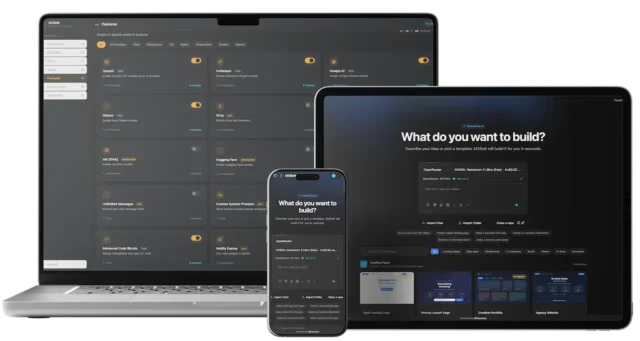
White Label AI App Builder Features: Prompt, Preview, Deploy
A user types what they need, a model you chose writes the whole project, the browser tab installs and previews it, and one click ships it. Around that loop sit plans, per-model credits, a console for keys and prices, and the source code, which you keep. This page walks through each capability by who uses it, and sets the platform beside renting a builder or buying a bare script.
Request a Live Demo →See PricingFeature Set by Role
This is the platform underneath our AI app builder clones, and it serves three kinds of people from one PostgreSQL database: the person building an app, the paying team, and you as the operator. The demo gives you four logins, one for each tier: free, pro, enterprise and admin.
The Builder
Someone with an idea and a browser. They write a description and get software they can run on the spot.
- One plain-English brief becomes a full multi-file project: frontend, routes, config and manifests
- A real Node.js environment boots inside their tab in three to five seconds
- Saved files reach the preview in under half a second
- A CodeMirror 6 editor shows each AI edit as a diff to accept or reject
- A working terminal, and a failed command can go straight back to the AI
- Starter projects in eight categories, curated by you
Paying Teams on Pro and Enterprise
What a subscription buys, and how the platform counts what each account uses.
- Four providers on Free, all twenty-two on Pro and Enterprise
- Prompt enhancement, custom system prompts and MCP tools on paid plans
- Operator keys added by the Express proxy, never sent to the browser
- Every spend priced from real token counts and logged in a ledger
- Enterprise: metering off, longer context, branding, custom agents and API access
- Shipping to GitHub, GitLab, Vercel, Netlify, Cloudflare Pages or a ZIP
You, the Operator
A separate admin console where the business is configured live, with no developer and no redeploy.
- Add, rotate or disable the keys for any of the 22 providers
- Place any model on any plan with its own input and output rate
- Cap tokens per request by plan and model
- Search users, change their tier, adjust credits with a reason, suspend accounts
- 45+ flags in eight categories, checked on the server
- Templates, categories, covers and plan access managed in one place
The commercial point of this split is simple. Because you decide which models each plan can reach and what every token costs on that plan, the shape of your pricing is a setting you change in the console, not a ticket for an engineer.
Rented AI Builder Platform vs One-Time Script vs Miracuves Platform
There are three common routes to an AI app builder carrying your brand. Here is where each one tends to hold up and where it usually starts to cost you.
| What decides it | Miracuves platform | Rented or hosted platform | One-time script |
|---|---|---|---|
| Who holds the source | You, in full | The vendor; you get a workspace with your logo | Frequently encrypted or restricted |
| How you pay | $3,699 once, with no per-prompt or per-seat fee to us | A monthly reseller plan, often charged per seat | A one-time fee, usually low |
| Where it runs | Your servers, with generated code executing in each user's browser | The vendor's servers | Your server, with preview infrastructure seldom planned for |
| Model choice | 22 providers plus 365+ OpenRouter models, on your own provider accounts | Whatever models the vendor picks | Often one provider wired in |
| How you charge | Plans, per-model credits, seats and enterprise accounts | Inside the limits of the vendor's plan | Few options, extra work needed |
| Operator controls | Keys, prices, plans, users and 45+ flags, changed live | Usually only what the plan exposes | Thin or absent |
| Security evidence | A VAPT report and security handbook, no certificate claimed | Whatever the vendor chooses to publish | Little or none |
| If you stop paying | Nothing changes; the code is yours | The workspace usually goes dark | Nothing changes |
| Desktop and mobile | Electron desktop builds for macOS, Windows and Linux; no mobile app | Typically a browser workspace | Rarely included |
| Time to go live | 6 days to deploy | Quick, on the vendor's terms | Unclear, mostly do-it-yourself |
A rented plan can make sense for a test with no budget for hosting. Once you want your own margins, models and data, the money side of the decision is set out on the Development Cost page, including the running costs you carry yourself.
The Technology Behind the Features
The workspace is a server-rendered Remix 2.15 app on React 18.3 with UnoCSS, beside an xterm.js terminal. Anything that touches the database goes through an Express 5.2 proxy that holds sessions, rate limits, credit metering and your provider keys; anything that touches the AI pipeline runs on a Cloudflare workerd runtime using the Vercel AI SDK, with a 45-second stream timeout and two retries. PostgreSQL holds six tables, reached only through parameterized queries with no ORM. StackBlitz WebContainers give each user a full Node.js environment in the browser, which is why previews cost your servers nothing. One licensing point to plan for: StackBlitz licenses WebContainers commercially, so production use in a for-profit product needs a license from StackBlitz, which you obtain directly. Generation itself runs through LLM provider accounts you open and pay for, under each provider's terms; Miracuves has no model of its own.
From Signup to a Shipped App
Identity, generation, execution and metering happen in a fixed order. The part most buyers do not expect is where the heavy work lands: in the user's browser rather than on your cloud bill.
An account with a balance from day one
Email, username and password are validated at the API boundary, the password is stored as a bcrypt hash, and a 256-bit session token is saved only as its SHA-256 hash. The free tier and a welcome credit balance are applied before the workbench even loads.
A template that already runs
The user starts blank or picks one of 30+ starters across eight categories, each with its own generation prompt. The chosen template fills the browser runtime with a complete project tree, so the first session opens on something that works.
The prompt reaches the model
Chat history, file state and model settings travel together. On qualifying plans the proxy adds your provider key on the server, and workerd calls the selected model, streaming text and action commands back.
The browser does the running
File writes, shell commands and package installs execute inside the WebContainer. The preview refreshes as files arrive, so the infrastructure you pay for does not grow with the amount of code your users run.
Refinement, priced on real usage
Follow-up prompts keep every project file in view, and a failing terminal command can be handed back to the AI. Each call is priced from its true input and output token counts, checked against the balance on the server and appended to the ledger.
Out the door
The finished app goes to Vercel, Netlify, GitHub, GitLab or Cloudflare Pages, with the framework detected across ten options and the live URL shown in the workbench, or it downloads as a ZIP at any time.
Every Feature Earns Its Place
Below, each capability is paired with the reason an operator needs it, which is a more useful test than whether it appears on a checklist.
| Capability | What it does | Why an operator wants it |
|---|---|---|
| In-browser execution | Installs, builds and previews run on the user's machine | Your servers carry an AI relay and some database rows per user, not a sandbox per session, so cost does not climb with every active builder |
| Per-model credit rates | Input and output rates for each model on each plan | A low-cost open model and a frontier model can share a plan at fair prices, so neither one quietly pays for the other |
| Metering from actual tokens | Cost is worked out from real counts after each call | Your margin on shared provider keys sits in that number; pricing on guesses gives it away |
| Operator-held provider keys | You buy capacity from providers and resell it as credits | The gap between your API bill and your credit price is a revenue line you set yourself |
| Bring-your-own-key | Users on any plan can enter their own provider keys | Free users can work on their own accounts, so they add little to your provider spend |
| Plan-gated models and templates | Each tier reaches only the models, starters and features you allow | Paid plans differ in capability, not only in credit volume, which gives buyers a reason to upgrade |
| Append-only ledger | Every grant, spend and adjustment recorded with a reason and the new balance | When a customer questions a charge, the record answers it |
| Promotional credit grants | Admins issue credit blocks for trials, onboarding or win-backs | Support can rescue an account in the moment, and each grant stays traceable |
| Six ways out | Five hosting and git destinations plus a ZIP download | People commit more work to a tool they can leave, and that confidence is what keeps them |
What Is Not Included in the Base Package
The workspace, the metering and the console are complete and ready to demo. These are the edges of the fixed price: licenses and accounts that are yours to hold, configuration that happens on your server, and modules quoted as add-ons.
- A model of our ownThere is none. Generation runs through LLM provider accounts you open and pay for, under those providers' terms, and you buy the capacity you meter out. The platform routes, prices and records that usage; it does not supply it.
- The in-browser runtime licenseStackBlitz licenses WebContainers commercially. Production use in a for-profit product needs a license from StackBlitz, which you obtain directly; it is not part of our fee.
- Payment processingUsage is priced and metered, but nothing takes a card and there is no checkout. Stripe or a similar provider is connected at deployment with your merchant account and webhook signature verification.
- A mobile appNone ships. The product is browser-first with Electron desktop builds for macOS, Windows and Linux. Native iOS or Android apps for monitoring and reviewing projects are custom development.
- Hardening set on your serverContent-Security-Policy and HSTS are off by default, demo accounts need switching off, and encryption at rest for the database and stored keys is a documented step. We configure these at rollout because the right values depend on your domains and hosting.
- Single sign-on and two-factorSAML or OIDC sign-on and TOTP two-factor can be added. Neither is enabled, and the assessment lists two-factor as a planned control.
- Audit trail and data retentionA dedicated audit datastore for admin actions, and automated retention, export and deletion, are recommended in the docs and built on request.
- Shared rate limitingLimits live in an in-memory map that clears on restart, which suits a single instance. A Redis-backed limiter is the documented step before running several.
- Team collaborationLive co-editing, shared team workspaces and project version history are roadmap items, available as custom scope. One installation runs one operator brand.
Deciding who should supply your AI app builder?
The questions to put to any vendor, including who licenses the in-browser runtime, plus our delivery steps and a real enterprise deployment, are on the Provider page.
Frequently Asked Questions
Which LLM providers can my users choose from?
Where does the generated code run, and does that need a license?
How are provider API keys protected?
Can I change plans, prices and model access after launch?
Does the platform collect payments from my users?
Is there a mobile app?
Explore the White Label AI App Builder
Build an app as a user, then price it as the operator
Four demo logins, one per tier. Prompt a project into life in the free workspace, then open the admin console and change which models a plan can reach and what each token costs.
Miracuves is an independent software development company. We are not affiliated with, connected to, sponsored by, or endorsed by Bolt.new, StackBlitz or any other AI app builder or code generation service.
“White label AI app builder” describes a category of product, not any one company. Brand names appear elsewhere on this site only to describe the kind of platform being built and the terms buyers search for.
We supply software, not rights to any AI model or runtime. Opening and paying for LLM provider accounts and staying within their terms, obtaining the commercial license StackBlitz requires for production use of WebContainers, your terms of service for the code your users generate, privacy notices and payment processing are your responsibility. We do not advise on any of it.
The entire design and codebase is built by our own team. The product contains no code, design, graphics, or content originating from any third-party AI app builder website or application. All third-party names and marks belong to their respective owners.