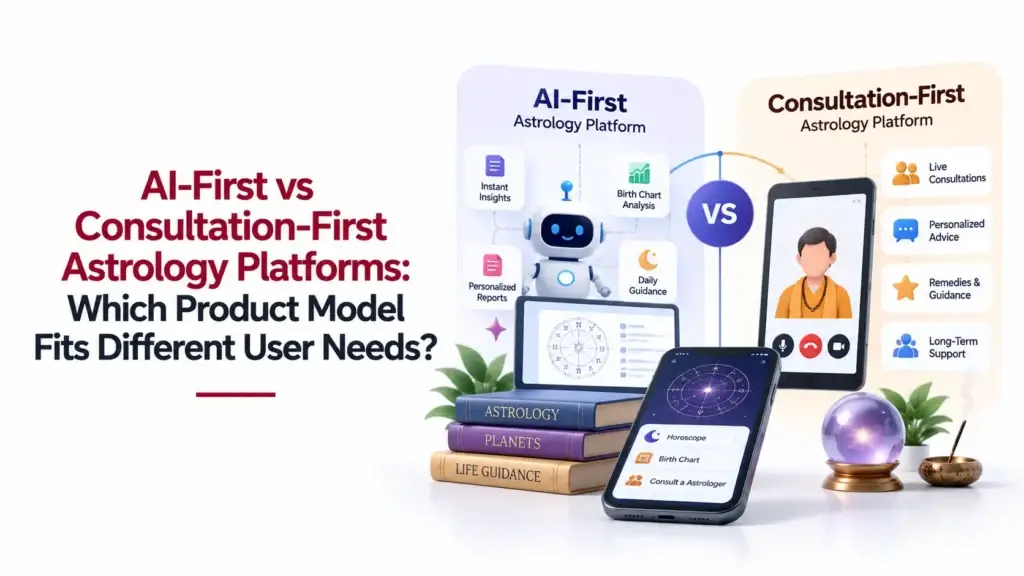
Astrology consultation platforms are no longer simple horoscope websites. They operate as digital service marketplaces where users pay for instant access to astrologers, tarot readers, numerologists, vastu experts, spiritual advisors, reports, live sessions, AI-assisted tools, and remedy-based services.
For founders, the real opportunity is not just adding chat and call features. The business becomes stronger when every user action connects to a clear monetization flow. A paid chat session, a wallet recharge, a video consultation, an AI-generated reading, a kundli report, a puja booking, or a spiritual product purchase should all move through a controlled revenue system.
That is why understanding the revenue model matters before building the product. If the platform does not meter sessions properly, manage wallet balances accurately, split astrologer commissions fairly, control refunds, and track repeat usage, revenue can leak even when user demand is strong.
This guide explains how astrology consultation platform generate revenue from paid sessions, prepaid wallets, AI tools, reports, spiritual services, subscriptions, promotions, and marketplace operations. It is written for founders who want to understand the business logic behind a scalable astrology app before choosing the right product foundation.
Key Takeaways
- Astrology consultation platforms generate revenue through paid chat, voice calls, video sessions, live sessions, reports, AI tools, wallets, subscriptions, promotions, and spiritual services.
- The prepaid wallet is the center of the revenue flow because it reduces payment friction and allows multiple services to spend from one balance.
- Per-minute billing works only when session timers, low-balance alerts, auto-deductions, refunds, and transaction history are handled accurately.
- AI tools can become monetization layers when they are positioned as guided digital utilities, not as replacements for expert consultations.
- Revenue growth depends on trust, astrologer quality, repeat usage, admin controls, payout accuracy, and clear service packaging.
Why Revenue Design Matters in Astrology Consultation Platforms
An astrology consultation platform looks simple from the outside. A user opens the app, selects an expert, starts a chat or call, and pays for the session. Behind that simple experience, however, there are several revenue-sensitive systems working together.
The platform must know whether the user has enough balance, whether the astrologer is available, what the per-minute rate is, how long the session lasted, whether any free minutes or coupons apply, how much commission the platform keeps, how much the astrologer earns, and whether the transaction should be shown inside the admin dashboard.
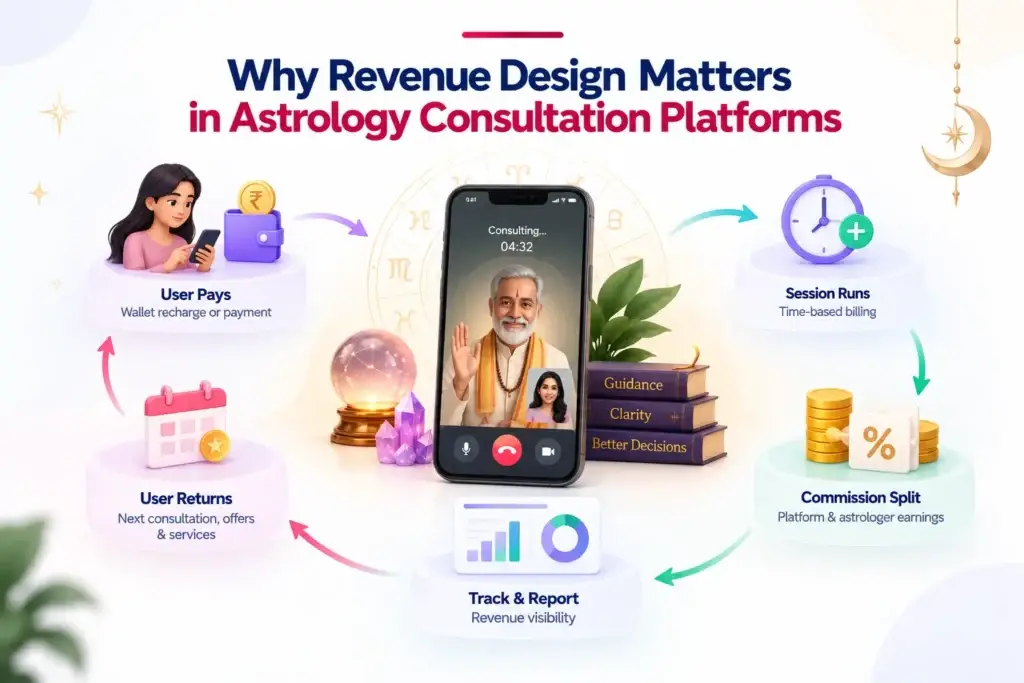
This is where many first-time founders underestimate the product. They think revenue comes from adding a payment gateway. In reality, the revenue comes from the complete commercial loop: discovery, wallet recharge, session start, timer-based deduction, commission split, payout, reporting, refund logic, and retention offer.
A strong astrology consultation platform should answer three business questions clearly:
- How does the user pay before or during the service?
- How does the platform track and protect revenue from each interaction?
- How does the app bring the user back for the next consultation, report, service, or purchase?
When these answers are built into the product from the beginning, the platform is easier to scale. When they are added later, founders often face billing disputes, manual payout work, refund confusion, and unclear revenue reporting.
The Core Revenue Loop: From Discovery to Repeat Purchase
Most astrology consultation platforms follow a repeatable revenue loop. The user enters through free or low-friction discovery, builds trust with astrologer profiles or tools, adds wallet balance, starts a paid interaction, receives value, and then returns through reminders, offers, reports, or follow-up consultations.
The loop usually looks like this:
- The user discovers astrologers, live sessions, daily horoscopes, kundli tools, or service categories.
- The user checks expertise, language, ratings, availability, consultation price, and service format.
- The app encourages wallet recharge through a clear entry offer, minimum balance requirement, or package.
- The user starts a paid chat, voice call, video session, report purchase, AI reading, or service booking.
- The platform deducts balance based on duration, item price, package type, or selected service.
- The astrologer or service provider receives an earning entry based on platform rules.
- The admin dashboard records the transaction, commission, refund status, payout status, and user activity.
- The platform brings the user back through follow-up offers, reminders, reports, subscriptions, or personalized recommendations.
This loop is important because the platform is not selling only astrology content. It is selling access, confidence, convenience, personalization, and repeat guidance. Users may return for career decisions, relationship concerns, marriage compatibility, finance questions, business timing, health-related spiritual guidance, festival rituals, or daily life uncertainty.
The strongest platforms do not depend on one revenue stream. They create multiple monetization layers around the same trust relationship.
Revenue Stream 1: Paid Chat Consultations
Paid chat consultation is usually one of the easiest entry points for users. It feels private, quick, and less intimidating than a voice or video call. A user can ask a question, share birth details, continue at their own pace, and stop when the balance or need ends.
For founders, chat consultation is valuable because it can generate frequent small transactions. Many users may not be ready to pay for a long premium session on the first visit, but they may be willing to try a short chat if the cost is visible and the experience feels smooth.
The monetization logic is usually based on a per-minute rate. Each astrologer can have a different rate depending on expertise, popularity, language, demand, and profile quality. The platform earns by keeping a commission from each paid session while the astrologer receives the remaining share according to the payout rules.
A good paid-chat revenue flow should include:
- Astrologer-wise per-minute pricing
- Minimum wallet balance check before session start
- Live session timer
- Auto-deduction during the session
- Low-balance warning before session interruption
- Auto-end logic when balance is insufficient
- Chat history and transaction record
- Refund or dispute workflow when needed
The business risk is simple: if the chat session continues without accurate wallet deduction, the platform may lose revenue. If deduction happens incorrectly, users may lose trust. That is why billing accuracy matters as much as the chat interface.
Revenue Stream 2: Voice Call Consultations
Voice consultations create a more personal experience than text chat. Users who want faster answers, emotional reassurance, or detailed explanations may prefer speaking directly with an astrologer. This format can support higher rates because the interaction feels more immediate and human.
From a revenue perspective, voice calls work well when the app connects call status, wallet balance, astrologer availability, and session billing in real time. The platform should know when the call was requested, accepted, started, paused, dropped, ended, or rejected. Each event affects the billing record.
Voice consultation monetization should not rely only on the call provider. The business layer should stay under the platform’s control. The system needs to decide when billing begins, what happens when a call fails, whether the user gets charged for a dropped call, and how the astrologer’s earning is calculated.
Important voice-call revenue controls include:
- Call request and acceptance tracking
- Per-minute rate mapping
- Wallet balance validation before the call starts
- Billing start and end timestamps
- Dropped-call handling
- Missed-call or rejected-call logic
- Commission calculation
- Call history inside the user, astrologer, and admin panels
When voice calls are stable, they can improve trust and retention. When calls fail or billing feels unclear, users may blame the platform even if the astrologer was not at fault. That is why voice monetization should be designed as both a technical flow and a trust flow.
Revenue Stream 3: Video Consultations as a Premium Session Format
Video consultation can become a premium revenue layer for users who want a more direct and personal interaction. It works especially well for detailed sessions such as kundli discussion, marriage compatibility, career direction, spiritual coaching, vastu review, or high-value advisory sessions.
Video sessions usually require stronger infrastructure than chat. The platform must handle live media quality, session timing, device permissions, call signaling, bandwidth issues, balance deductions, and user support if the session fails. Because of this complexity, video consultation should be introduced with clear pricing and strong operational rules.
Founders can monetize video sessions in different ways:
- Higher per-minute pricing than chat or voice
- Fixed-price premium appointments
- Specialist consultation packages
- Scheduled sessions with top-rated experts
- Follow-up video bundles for recurring users
- Private spiritual guidance or coaching sessions
The key is to avoid treating video as just another button in the app. Video consultation affects pricing, support, refund policies, expert availability, and infrastructure cost. It should be positioned as a premium experience with clear value and reliable delivery.
For deeper technical planning around live consultation events, the supporting guide on real-time WebSockets in astrology consultation apps can help founders understand why chat, calls, wallet updates, and session timers need strong real-time coordination.
Revenue Stream 4: Wallet Recharge and Prepaid Balance
The wallet is one of the most important revenue systems in an astrology consultation platform. Instead of asking users to complete a payment every time they start a session, the platform encourages them to add balance first and then spend that balance across services.
This improves the user experience because sessions can begin faster. It also improves monetization because prepaid balance creates a stronger commitment than casual browsing. Once a user has money inside the wallet, they are more likely to try a consultation, buy a report, join a live session, unlock an AI reading, or purchase a service.
A wallet-based model also gives founders more control over offers. They can create recharge bonuses, first-session credits, festival campaigns, referral rewards, loyalty balance, and discounted consultation bundles without changing the core payment flow.
A strong wallet system should support:
- Recharge through selected payment gateways
- Minimum balance rules before paid sessions
- Wallet ledger for every credit and debit
- Refund entries and adjustment entries
- Low-balance alerts during live sessions
- Recharge packages and bonus balance
- Coupon or referral credit
- Separate user and astrologer wallet views
- Admin-level transaction monitoring
The wallet also supports cross-service monetization. A user may recharge for a chat consultation but later spend the same balance on a report, live question, AI tool, or remedy recommendation. This is how the platform moves from a single-use consultation app to a broader spiritual services ecosystem.
Revenue Stream 5: Astrologer Commissions and Payout Rules
Astrologer commission is the marketplace layer of the revenue model. The user pays for a session, the platform keeps a percentage or fixed share, and the astrologer receives the remaining earning. This seems simple, but it becomes more complex when there are different consultation types, rates, offers, free minutes, refunds, taxes, and payout schedules.
Founders should avoid managing commissions manually. Manual payout tracking may work for a small test group, but it becomes risky when the platform has many astrologers, multiple services, failed sessions, support disputes, and high transaction volume.
The commission system should define:
- Default platform commission
- Astrologer-specific commission rules
- Service-wise commission variation
- Free-session handling
- Refund impact on astrologer earnings
- Payout eligibility and minimum withdrawal threshold
- Admin approval flow for withdrawals
- Transaction-wise earning reports
The goal is to keep astrologers motivated while protecting platform margins. If payouts are delayed, unclear, or disputed often, good astrologers may leave. If commissions are too low or offers are not controlled, the platform may struggle to cover acquisition, technology, support, and operations.
This is why founders should think of commission rules as product infrastructure, not just finance settings.
Revenue Stream 6: AI Astrology Tools and Automated Readings
AI tools are becoming a useful monetization layer for astrology consultation platforms. They can help users get instant guidance, structured reports, compatibility summaries, daily insights, question-based interpretations, or first-level explanations before speaking to an expert.
However, AI should be positioned carefully. In a trust-based category like astrology and spiritual consultation, AI tools should support the user journey rather than replace expert-led consultations completely. The stronger approach is to use AI as a low-friction entry product, a personalization layer, or a follow-up assistant.
AI tools can generate revenue through:
- Paid instant readings
- AI-generated compatibility summaries
- Personalized daily or weekly guidance
- Question-based paid predictions
- Premium report summaries
- AI-assisted kundli explanations
- Subscription access to unlimited or limited AI usage
- Wallet-metered microtransactions for each AI request
The best business use of AI is to reduce the gap between free browsing and paid consultation. For example, a user may first try a low-cost AI reading, then upgrade to a human astrologer for deeper interpretation. Another user may buy an automated report and then book a call to understand it better.
From an admin perspective, AI monetization needs clear controls. The platform should define what is free, what is paid, how many requests are included in a subscription, whether wallet balance is deducted before each request, and how AI history is stored or displayed to the user.
Revenue Stream 7: Paid Kundli Reports, Matchmaking Reports, and Digital Products
Not every user wants to start with a live consultation. Some users prefer a structured report they can read privately. This makes paid reports a strong digital product revenue stream for astrology platforms.
Paid reports can include kundli analysis, matchmaking, numerology, career guidance, yearly predictions, relationship compatibility, business timing, gemstone suggestions, or personalized spiritual recommendations. These products can be sold as one-time purchases, bundled with consultations, included in premium subscriptions, or offered as upsells after a free tool.
The business value of reports is that they create monetization without requiring every transaction to consume astrologer time. Once report templates, rules, and delivery flows are configured, the platform can sell them repeatedly. Human review or expert add-ons can be used for premium versions.
Report monetization works best when the platform offers different levels:
| Report Type | Revenue Logic | Founder Impact |
|---|---|---|
| Free Basic Report | Used as an acquisition tool | Brings users into the funnel without asking for payment immediately |
| Paid Detailed Report | One-time digital product purchase | Creates revenue from users who may not book live sessions |
| Expert-Reviewed Report | Higher-priced report with human review | Combines automation with expert trust |
| Report + Consultation Bundle | Packaged offer | Increases average order value and encourages deeper engagement |
| Subscription Report Access | Recurring plan | Improves retention and predictable repeat revenue |
The key is to connect reports to the rest of the platform. A report should not be a dead-end download. It should lead users toward expert explanation, follow-up chat, recommended services, or related spiritual products when relevant.
Revenue Stream 8: Live Astrology Sessions and Paid Audience Interaction
Live astrology sessions allow one expert to engage many users at the same time. This creates a different revenue pattern from private consultation. Instead of monetizing only one-to-one time, the platform can monetize group attention.
Live sessions can be free to watch and paid to interact, or they can be premium sessions unlocked through wallet balance, subscription access, ticket purchase, or special event passes.
Common live-session monetization options include:
- Paid questions during a live session
- Priority answer fees
- Virtual gifts
- Premium live room access
- Festival-based or event-based sessions
- Expert-led group workshops
- Replay access for paid users
- Subscription-only live events
Live sessions are also useful for astrologer discovery. Users can watch an expert’s communication style before booking a private consultation. This can improve conversion because the user gets trust signals before spending on one-to-one guidance.
For founders, live monetization should be designed with moderation, payment clarity, and session rules. The platform should clearly show what users are paying for, how paid questions are queued, whether answers are guaranteed, and what happens if the live session ends before a paid interaction is completed.
Revenue Stream 9: Spiritual Services, Puja Bookings, and Remedy-Based Commerce
Astrology consultation platforms can grow beyond chat and call revenue by adding spiritual services and remedy-based commerce. Once users trust the platform for guidance, they may also be interested in puja bookings, gemstone recommendations, ritual services, vastu consultation, numerology services, tarot sessions, meditation guidance, or personalized remedies.
This creates a broader marketplace model. The platform is no longer only connecting users with astrologers. It is helping users move from advice to action.
Spiritual service monetization can include:
- Puja booking fees
- Service commission from ritual providers
- Paid remedy recommendations
- Gemstone and spiritual product sales
- Personalized consultation packages
- Festival-specific service bundles
- Premium delivery or fulfillment fees
- Expert-led service verification charges
The important thing is to protect trust. Users should clearly understand what is a consultation, what is a product, what is a service, who fulfills it, what the price includes, and how support or refunds work. In spiritual commerce, unclear claims or poor fulfillment can damage the entire platform’s reputation.
Founders should start with services that are operationally manageable. A platform may begin with consultations and reports, then expand into puja bookings, remedy products, and regional service categories after it has enough user trust and admin control.
Revenue Stream 10: Subscriptions, Bundles, and Repeat-User Offers
Recurring users are important for astrology consultation platforms because many users return for different life questions over time. A person who first asks about career may later return for relationship guidance, marriage compatibility, business timing, relocation, health-related spiritual advice, or family concerns.
Subscriptions and bundles help convert occasional users into repeat customers. Instead of making every transaction feel separate, the platform can offer prepaid packages that create a reason to come back.
Useful repeat-revenue models include:
- Monthly consultation credit plans
- Discounted chat-minute bundles
- Premium astrologer access plans
- Report bundles
- Live-session membership
- Festival consultation packs
- AI reading subscriptions
- Wallet recharge bonus campaigns
- Loyalty rewards for repeat users
The founder decision is not simply whether to add subscriptions. The real question is what users are subscribing to. A subscription should offer clear value: access, savings, convenience, premium experts, exclusive sessions, or bundled guidance. If the subscription is vague, users may not renew.
Repeat-user offers should also be controlled carefully. Heavy discounting may increase transaction volume but reduce margins. A healthier model uses targeted offers based on user behavior, such as reactivation credits, first-call upgrades, report bundles after consultation, or bonus balance on recharge.
Founder Decision Signals
Speed
If the revenue model depends on chat, calls, wallets, reports, and services, founders should avoid building every billing workflow manually from zero. A ready-made foundation can shorten the path to market validation.
Margin Control
Revenue is not only about session volume. Commission rates, offers, refunds, payment charges, support cost, and payout rules decide whether the model stays profitable as usage grows.
Trust
Users share personal questions, birth details, payment information, and private consultation history. Transparent billing, verified experts, clear records, and secure access controls are part of revenue protection.
Expansion
The strongest platforms can expand from paid sessions into AI tools, reports, live events, services, subscriptions, and commerce without rebuilding the core wallet and admin logic.
How Wallets Connect Multiple Revenue Streams
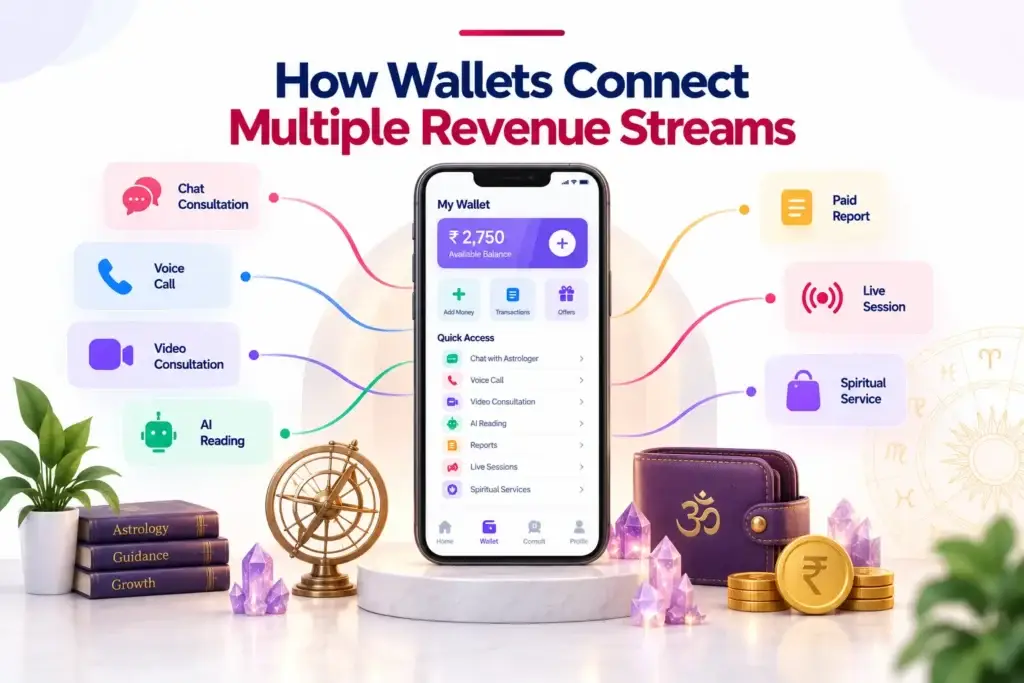
The wallet is not just a payment feature. It is the commercial control layer of the platform. It connects consultations, AI tools, reports, live sessions, services, promotions, refunds, and transaction history into one measurable system.
Without a wallet, each service may require a separate payment event. That can create friction. Users may drop off before completing payment, especially for small purchases such as a short chat, paid question, AI reading, or report unlock.
With a prepaid wallet, the platform can support smaller and faster transactions. The user recharges once and spends across multiple services. This makes it easier to monetize micro-actions, not only large bookings.
| Wallet Use Case | How It Generates Revenue | Business Benefit |
|---|---|---|
| Chat Consultation | Balance is deducted per minute | Supports quick entry-level paid sessions |
| Voice Call | Wallet is checked before call start and deducted during the session | Reduces unpaid call risk |
| Video Consultation | Premium rates can be charged through wallet balance | Creates higher-value consultation revenue |
| AI Reading | Each request or package can consume wallet credits | Monetizes instant digital guidance |
| Paid Report | User unlocks downloadable or viewable report using wallet balance | Creates digital product revenue |
| Live Session | Users pay for questions, gifts, priority access, or event entry | Scales one expert to many users |
| Spiritual Service | Wallet can be used for bookings, products, or remedy packages | Expands revenue beyond consultation |
The wallet also gives the admin team better visibility. Instead of checking payments across disconnected systems, admins can review credits, debits, refunds, commissions, failed transactions, bonus balance, and user spending behavior from one place.
Admin Controls That Protect Revenue
Revenue protection depends on admin control. A founder may design strong monetization ideas, but without the right admin dashboard, the team cannot operate them properly.
The admin panel should allow the platform operator to manage rates, astrologer commissions, wallet packages, coupons, recharge offers, report pricing, AI tool pricing, service categories, refunds, disputes, payouts, and revenue analytics.
Important admin-side revenue controls include:
- User wallet transaction history
- Astrologer earnings and withdrawal dashboard
- Commission settings
- Service-wise pricing control
- Coupon and recharge bonus management
- Refund and dispute records
- Failed payment monitoring
- Session history and duration logs
- Report purchase tracking
- AI tool usage tracking
- Live session revenue reports
- Revenue by user, astrologer, service, and time period
This is where founders should connect monetization strategy with platform operations. It is not enough to know that chat consultation can generate revenue. The admin must also know which astrologers generate repeat users, which services create refunds, which offers improve retention, and which categories produce strong wallet spending.
For founders comparing product requirements, the astrology consultation platform features page can help map revenue ideas to wallet, call, AI, admin, and service-control modules.
Cost Layers Founders Should Consider Before Scaling Revenue
A revenue model is incomplete without understanding the cost side. Astrology consultation platforms may earn from multiple services, but they also carry operating costs. If these costs are not planned early, growth can create margin pressure.
Common cost layers include:
- Astrologer payouts
- Payment gateway charges
- Voice and video infrastructure
- Chat and real-time communication systems
- Cloud hosting and storage
- Customer support
- Refunds and failed payment handling
- Marketing and user acquisition
- Expert verification
- Security monitoring
- AI provider usage
- Report generation and delivery logic
- Operational team costs
Founders should not treat every revenue stream as equally attractive. A paid report may have different cost behavior from a video consultation. An AI reading may require provider usage cost. A live video session may need stronger infrastructure. A puja booking may involve fulfillment, support, and vendor coordination.
The right question is not “How many revenue streams can we add?” The better question is “Which revenue streams can we operate reliably, profitably, and with enough user trust?”
For budget planning, founders can review the development cost breakdown for an astrology consultation platform to understand how feature scope, integrations, launch requirements, and customization affect the build decision.
How AI Tools Should Support Human Consultation Revenue
AI can improve the revenue model when it is connected to the consultation journey. The mistake is treating AI as a separate feature that sits away from the main platform. The better approach is to use AI to increase engagement, reduce hesitation, and guide users toward deeper paid services.
For example, a user may ask an AI tool for a basic reading. After receiving the result, the app can suggest a paid expert consultation for deeper interpretation. Another user may generate a compatibility summary and then buy a detailed matchmaking report. A third user may use daily AI guidance as part of a subscription plan.
AI can support revenue in four practical ways:
- Entry monetization: Low-cost paid readings for users who are not ready for live consultation.
- Upsell path: AI output leads users toward expert explanation, reports, or service bookings.
- Retention: Daily or weekly AI insights bring users back into the app.
- Personalization: AI can recommend relevant consultation categories, reports, or services based on user interest.
However, AI monetization should include clear user expectations. The platform should avoid overpromising outcomes. It should explain what the tool provides, how it uses the user’s input, whether a human expert is involved, and how the user can get deeper guidance if needed.
Trust, Safety, and Billing Transparency Are Revenue Features
Astrology apps deal with personal questions, private conversations, birth details, payments, and emotional decision-making. Because of this, trust is directly connected to revenue. Users are more likely to recharge, consult again, and buy additional services when they feel the platform is clear, safe, and professionally operated.
Revenue trust depends on:
- Verified expert profiles
- Clear pricing before session start
- Visible wallet balance
- Low-balance alerts
- Transparent deduction history
- Refund and dispute workflows
- Secure payment gateway integration
- Role-based admin access
- Privacy-conscious data handling
- Moderation for content, reviews, and abuse reports
If users do not understand why balance was deducted, they may stop trusting the app. If astrologers do not understand how earnings are calculated, they may leave the platform. If admins cannot investigate disputes, support costs increase. These are not only support problems. They are revenue problems.
For a deeper risk view, founders can read the guide on safe launch planning for white-label astrology apps, especially when handling user data, payment flows, private chats, and admin access controls.
Revenue Features vs. Business Value
Founders should not add monetization features only because they sound attractive. Each feature should have a clear business purpose. Some features improve acquisition, some improve conversion, some improve retention, and some protect revenue from leakage.
| Revenue Feature | Business Value | Founder Impact |
|---|---|---|
| Free astrology tools | Attract organic and referral users | Builds top-of-funnel demand before paid conversion |
| Wallet recharge | Creates prepaid spending intent | Reduces repeated payment friction |
| Per-minute billing | Monetizes live expert time | Turns sessions into measurable revenue events |
| Commission management | Controls platform earnings | Protects margins while keeping experts active |
| Paid reports | Adds digital product revenue | Monetizes users who prefer written guidance |
| AI tools | Creates instant low-friction monetization | Bridges free users toward deeper paid journeys |
| Live sessions | Scales expert attention | Improves engagement and expert discovery |
| Subscriptions | Encourages repeat usage | Improves retention and predictable purchase behavior |
| Service bookings | Expands beyond consultation | Builds a broader spiritual services marketplace |
| Admin revenue analytics | Improves operating decisions | Helps track what is working and what is leaking revenue |
Mistakes Founders Should Avoid in Astrology Platform Monetization
Mistakes Founders Should Avoid
Building Consultation Without Wallet Logic
Paid sessions need balance checks, deductions, low-balance alerts, refunds, and transaction history. Without wallet logic, the platform may face disputes and unpaid usage.
Adding Too Many Revenue Streams Too Early
Reports, AI tools, services, subscriptions, and live sessions are useful, but launching everything at once can create operational complexity. Start with the strongest revenue loop, then expand.
Ignoring Astrologer Payout Experience
Astrologers need transparent earnings, withdrawal rules, payout history, and fair commission visibility. Poor payout experience can weaken supply quality.
Using Discounts Without Margin Control
Free first chat, coupons, bonus balance, and referral rewards can improve conversion, but they should be tracked carefully so promotions do not damage margins.
Treating Security as a Later Upgrade
Private chats, payment data, personal details, and admin controls should be protected from the beginning. Trust failures can directly reduce recharge rates and repeat usage.
What Founders Should Validate Before Launch
Before launching an astrology consultation platform, founders should validate the business model at a practical level. The goal is not to copy every feature from a large platform. The goal is to understand which revenue streams fit the target market, language, geography, expert supply, pricing expectations, and operating capacity.
Founders should answer these questions before development:
- Will the platform begin with chat, call, video, reports, AI tools, services, or a combination?
- What will be free, and what will be paid?
- Will users recharge a wallet before every session?
- What minimum balance should be required for each consultation type?
- How will astrologer pricing be controlled?
- What commission model will the platform use?
- How will failed sessions, refunds, and disputes be handled?
- Which revenue streams are realistic for the first launch version?
- Which features can wait until user behavior is clearer?
- What admin reports are needed to understand revenue performance?
This validation prevents founders from overbuilding. A platform can start with a focused monetization loop such as wallet recharge, paid chat, voice calls, basic reports, and admin commission tracking. After traction improves, the founder can expand into video, live sessions, AI tools, subscriptions, puja bookings, and spiritual commerce.
For founders who want to move faster, Miracuves offers a launch-ready astrotalk clone foundation that can support paid consultations, wallet billing, admin controls, expert management, and monetization workflows while still allowing customization for a specific market.
How Miracuves Helps Founders Launch Revenue-Ready Astrology Platforms
Building an astrology consultation platform from zero can take time because the product is not only a user app. It also needs expert workflows, wallet logic, real-time sessions, payment integration, reports, service categories, admin controls, payout tracking, and support workflows.
Miracuves helps founders launch faster with ready-made and white-label app foundations designed around practical business use cases. For astrology consultation platforms, this means founders can start with the core revenue flows already planned: paid sessions, wallet recharge, per-minute billing, expert management, commission tracking, admin control, and scalable customization.
The advantage is speed and clarity. Instead of spending months defining every basic module from scratch, founders can focus on market positioning, expert onboarding, pricing strategy, service packaging, brand experience, and growth. Where relevant, Miracuves can support 6-day solution delivery for launch-ready deployments, depending on scope and customization requirements.
The stronger decision is not to add every possible revenue stream on day one. It is to launch with a reliable monetization foundation, validate demand, learn which services users actually pay for, and then expand the platform with better data.
Final Thoughts
Astrology consultation platforms generate revenue when trust, access, payment flow, expert supply, and repeat usage work together. Paid sessions may be the core revenue source, but the stronger business model is built around the full ecosystem: wallets, reports, live sessions, AI tools, subscriptions, services, spiritual commerce, admin control, and payout clarity.
For founders, the most important lesson is that revenue does not come from adding many features randomly. It comes from designing a clean commercial loop where users can discover value, pay easily, receive guidance, trust the billing, and return for more services.
A focused launch with reliable wallet billing, paid consultations, expert management, and admin reporting is often stronger than a large but poorly controlled feature set. Once the first revenue loop works, founders can expand into AI readings, paid reports, live events, spiritual services, and subscriptions with greater confidence.
FAQs
How do astrology consultation platforms make money?
Astrology consultation platforms make money through paid chat, voice calls, video consultations, wallet recharges, astrologer commissions, paid reports, AI tools, live sessions, subscriptions, spiritual services, and product sales. The strongest platforms usually combine several revenue streams instead of depending on only one.
Why is wallet recharge important in astrology apps?
Wallet recharge is important because it lets users add prepaid balance once and spend it across consultations, reports, AI tools, live sessions, and services. This reduces payment friction, supports microtransactions, and helps the platform track every credit, debit, refund, and offer from one revenue system.
Can AI astrology tools generate revenue?
Yes. AI astrology tools can generate revenue through paid instant readings, compatibility summaries, daily guidance, report explanations, subscription access, or wallet-metered usage. The best approach is to use AI as an engagement and upsell layer that supports expert consultation rather than replacing the human trust layer completely.
What is the role of per-minute billing in astrology consultation platforms?
Per-minute billing allows users to pay based on actual consultation duration. It is commonly used for chat, voice, and video sessions. To work properly, the platform needs session timers, wallet balance checks, auto-deductions, low-balance alerts, transaction history, and refund handling.
How do astrologers earn from consultation platforms?
Astrologers usually earn a share of each paid consultation. The platform deducts its commission according to predefined rules, and the remaining amount is added to the astrologer’s earning or payout balance. Transparent earnings, withdrawal rules, and payout history help maintain astrologer trust.
Which revenue stream should a new astrology platform launch first?
A new astrology platform should usually begin with a focused revenue loop such as wallet recharge, paid chat, voice calls, basic reports, commission tracking, and admin reporting. Once demand and repeat usage are validated, the platform can expand into video consultations, AI tools, live sessions, subscriptions, and spiritual services.
Miracuves is an independent software development company. We are not affiliated with, connected to, sponsored by, or endorsed by any company or product named in this article.
Terms such as “X Clone” are used descriptively. It is how the software industry refers to building a platform with functionality comparable to a known service, and how clients search for it.
The entire design and codebase of our products is built by our own team. Our products contain no code, design, graphics, or content originating from any third-party website or applications.
All third-party names and marks referenced in this article are the property of their respective owners, referenced solely to identify the services discussed.