


Key Takeaways
- A Travel booking platform architecture connects flight and hotel inventory, supplier APIs, search, pricing, availability, reservations, payments, and booking management within one technology ecosystem.
- The architecture should synchronize traveler requests with airlines, hotels, aggregators, local suppliers, payment gateways, notification services, and internal booking records.
- Reliable travel operations depend on real-time availability, normalized supplier data, secure payments, booking confirmation, failure handling, cancellations, refunds, and centralized admin visibility.
Architecture & API Signals
- Flight and hotel APIs can provide schedules, room inventory, fares, rates, availability, booking rules, cancellation policies, taxes, and confirmation data from multiple suppliers.
- An integration layer should handle API authentication, supplier mapping, data normalization, caching, rate limits, timeouts, retries, error handling, and provider-specific booking workflows.
- Search services, databases, booking engines, payment gateways, notification systems, analytics, and supplier connections should remain modular so new providers and travel products can be added efficiently.
Booking Operations Insights
- Booking management should track reservation status, traveler details, supplier confirmation, payment state, vouchers, modifications, cancellations, refunds, and support activity from one record.
- Operators need controls for failed bookings, price changes, supplier outages, duplicate reservations, payment reconciliation, agent commissions, supplier settlements, and manual intervention.
- Miracuves develops customizable regional travel booking platforms with flight and hotel APIs, booking engines, supplier integrations, payments, reservation management, analytics, security, and admin controls.
A regional travel booking platform looks simple from the traveler’s side. A user searches for a flight, hotel, bus, cab, package, or activity, compares options, checks availability, pays securely, receives confirmation, and manages the booking.
Behind that simple journey sits a complex architecture.
A strong travel platform needs frontend apps, backend APIs, supplier integrations, inventory normalization, search indexing, payment workflows, booking locks, refunds, cancellations, vendor dashboards, agent portals, corporate controls, admin permissions, and reliable deployment systems.
For founders, the technical decision is not only about choosing Node.js, Laravel, React, Flutter, or any other stack. The bigger question is whether the architecture can handle real booking operations: changing prices, live availability, supplier responses, payment failures, refunds, support tickets, and admin control.
This guide explains how a regional travel booking architecture should be planned across flights, hotels, supplier APIs, payments, and booking management.
What Is Travel Booking Platform Architecture?
Travel booking architecture is the technical structure that connects all user actions and business operations inside the platform.
It defines how the system handles:
- Traveler search
- Supplier inventory
- Flight and hotel APIs
- Manual listings
- Availability checks
- Pricing and fare rules
- Booking creation
- Payment confirmation
- Refunds and cancellations
- Wallet and loyalty logic
- Vendor dashboards
- Agent portals
- Corporate travel workflows
- Admin control
- Reports and audit logs
A weak architecture may work during a demo but fail when real users search repeatedly, supplier APIs slow down, payment callbacks arrive late, or bookings need manual review.
A strong architecture separates responsibilities clearly. The frontend handles experience. The backend handles business rules. Supplier adapters handle external data. Payment services handle checkout verification. Admin systems handle operational control.
Core Architecture Layers in a Regional Travel Booking Platform
A practical platform can be divided into six major layers.
Core Architecture Layers
| Layer | What It Handles | Why It Matters |
|---|---|---|
| Frontend Layer | Traveler app, web app, search screens, listing pages, checkout, profile, and booking history. | Controls user experience and conversion quality. |
| Backend API Layer | Authentication, search requests, booking rules, payments, refunds, roles, and reports. | Keeps business logic controlled and reusable across apps. |
| Supplier Integration Layer | Flight APIs, hotel APIs, bus APIs, activity suppliers, channel managers, and manual inventory feeds. | Connects the platform to real availability and pricing sources. |
| Booking Engine | Availability validation, fare locks, room holds, passenger data, payment status, confirmation, cancellation, and modification. | Protects the transaction from failed or duplicate bookings. |
| Payment and Wallet Layer | Gateway payments, wallet credits, coupons, refunds, cancellation charges, payouts, and transaction logs. | Protects revenue, customer trust, and finance reconciliation. |
| Admin and Operations Layer | Suppliers, users, bookings, payments, refunds, reports, roles, margins, content, and support workflows. | Lets the operator manage the platform after launch. |
Frontend Architecture: Web, Mobile, and Booking UX

The frontend is where travelers make decisions. It should be fast, clear, and consistent across mobile and web.
Important frontend modules include:
- Home and category search
- Destination pages
- Flight result pages
- Hotel listing pages
- Filters and sorting
- Map view where relevant
- Room or fare selection
- Traveler details
- Coupons and wallet credits
- Checkout
- Booking confirmation
- Trip history
- Cancellation or refund request
- Reviews and support
A travel frontend must handle changing data gracefully. Search results may expire. Flight fares may change. Hotel rooms may become unavailable. Supplier APIs may respond slowly. The interface should tell users what is happening instead of freezing or showing outdated information.
Useful frontend principles include:
- Keep search forms simple.
- Show filters without overwhelming users.
- Use skeleton loaders for API-heavy screens.
- Explain price changes before checkout.
- Keep booking status visible.
- Separate pending, confirmed, failed, canceled, and refunded states.
- Make support access easy after booking.
The frontend should not decide final pricing, availability, or payment status by itself. Sensitive decisions must come from backend validation.
Backend API Layer: The Control Center of the Platform
The backend API layer connects the apps, supplier systems, payments, admin dashboards, and database.
Common API groups include:
/auth/users/travelers/flights/hotels/buses/activities/packages/search/availability/bookings/payments/wallet/refunds/vendors/agents/corporate/reviews/admin/reports
A good API structure should be versioned from the beginning. For example:
/api/v1/flights/search
/api/v1/hotels/search
/api/v1/bookings
/api/v1/payments/initiate
/api/v1/refunds/request
/api/v1/admin/bookings
Versioning helps the platform evolve without breaking mobile apps, supplier integrations, or partner workflows.
The backend should also manage:
- Authentication
- Input validation
- Rate limiting
- Role-based permissions
- Supplier request routing
- Error handling
- Logging
- Queue dispatching
- Cache control
- Payment verification
- Booking state transitions
A travel platform becomes easier to scale when business logic lives in backend services instead of being scattered across screens.
Database Design for Travel Booking Platforms
Travel platforms need a flexible database because different travel categories have different rules.
A hotel booking is not the same as a flight booking. A bus seat is not the same as a tour package. A cab booking is not the same as a homestay reservation.
A practical schema may include:
- Users
- Traveler profiles
- Vendors
- Agents
- Corporate accounts
- Categories
- Listings
- Hotels
- Rooms
- Flights
- Flight segments
- Buses
- Seats
- Activities
- Packages
- Availability records
- Pricing rules
- Bookings
- Booking passengers
- Payments
- Wallet transactions
- Refunds
- Coupons
- Loyalty records
- Reviews
- Support tickets
- Audit logs
The key is to avoid making the schema too rigid. Regional travel platforms often evolve from one category to many. A founder may start with hotels and packages, then add buses, cabs, activities, or corporate travel later.
Useful database practices include:
- Use category-specific tables where the data is structurally different.
- Use shared booking tables for common booking states.
- Store supplier response snapshots for booking evidence.
- Keep payment records separate from booking records.
- Track booking status history.
- Add audit logs for admin changes.
- Index search-heavy fields such as location, category, date, price range, rating, and supplier status.
- Avoid overwriting old booking data when supplier APIs change.
A flexible database helps founders add new categories without rebuilding the whole platform.
Search Architecture: Flights, Hotels, and Regional Inventory
Search is one of the heaviest parts of travel architecture.
A traveler may search by:
- Destination
- Date
- Number of guests
- Room type
- Flight route
- Travel class
- Departure time
- Price
- Rating
- Amenities
- Stops
- Supplier type
- Package category
- Activity duration
Search results may come from internal inventory, supplier APIs, cached feeds, manually listed vendors, or a mix of all three.
A strong search architecture should include:
- Search request validation
- Supplier API fan-out
- Cache lookup
- Result normalization
- Sorting and filters
- Availability rules
- Pagination
- Price refresh
- Expiry handling
- Error fallback
- Analytics logging
The platform should not show raw supplier data directly. Supplier responses should be normalized into one internal format so the frontend can display consistent results.
For example, different hotel suppliers may name similar fields differently. One API may return room_name, another may return rate_plan, and another may return unit_type. The platform should map those into an internal room format before showing results.
Supplier API Architecture: Normalize Before You Display
Supplier APIs are powerful, but they can also create complexity.
A regional travel booking platform may connect with:
- Flight suppliers
- Hotel suppliers
- Bus operators
- Cab providers
- Activity vendors
- Tour package partners
- Channel managers
- Payment gateways
- Maps and location providers
- Notification services
- CRM or support tools
Every supplier can have different response formats, rate limits, error messages, authentication rules, pricing structures, and booking confirmation behavior.
That is why the platform should use a supplier adapter layer.
A supplier adapter converts external data into internal platform data.
Supplier API Response
        ↓
Supplier Adapter
        ↓
Normalized Inventory Format
        ↓
Search Results / Booking Engine / Admin Dashboard
This approach helps the platform avoid supplier lock-in. If one supplier changes its format, only that adapter needs adjustment instead of the full frontend and booking engine.
What supplier adapters should handle
Supplier adapters should manage:
- Authentication
- Token refresh
- Request formatting
- Response mapping
- Error translation
- Rate limits
- Timeout rules
- Availability refresh
- Price normalization
- Currency handling
- Cancellation rules
- Booking confirmation references
- Logs and retry behavior
A supplier integration should not only fetch results. It should help the platform operate reliably.
Booking Engine Architecture: The Most Important Layer
The booking engine controls what happens between search and confirmation.
This layer must answer:
- Is the selected option still available?
- Is the displayed price still valid?
- Is the traveler data complete?
- Is the supplier ready to confirm?
- Has payment been initiated?
- Has payment been verified?
- Should the booking be confirmed, pending, failed, canceled, or refunded?
- Should the supplier be notified?
- Should the traveler receive a voucher or ticket?
- Should the booking go to manual review?
A booking engine should use clear status states.
Common booking states include:
- Draft
- Pending traveler details
- Awaiting payment
- Payment initiated
- Payment failed
- Payment verified
- Awaiting supplier confirmation
- Confirmed
- Partially confirmed
- Failed
- Cancellation requested
- Canceled
- Refund pending
- Refunded
- Disputed
Status clarity matters because support, finance, suppliers, travelers, and admins all depend on booking records.
Booking lock and expiry logic
Some travel categories require temporary locks.
Examples:
- A flight fare may expire after a short window.
- A hotel room may need a temporary hold.
- A bus seat may need seat-level locking.
- A package quote may need operator confirmation.
- An activity slot may have limited capacity.
The architecture should define how long a price or inventory hold remains valid and what happens when it expires.
Payment Architecture: Checkout, Verification, Refunds, and Payouts
Travel payments should be handled carefully because they connect customer trust with platform revenue.
A good payment workflow usually looks like this:
- User selects an option.
- Backend validates availability and price.
- Backend creates a booking in pending state.
- Payment gateway order or payment intent is created.
- User completes payment.
- Gateway sends payment response.
- Backend verifies payment server-side.
- Booking engine confirms or queues supplier confirmation.
- Traveler receives confirmation.
- Refund or payout records are created if needed.
The platform should not mark a booking as confirmed just because the frontend says payment succeeded. Payment status should be verified through the backend using gateway response validation, webhook verification, or server-side confirmation.
Payment architecture should support:
- Multiple gateways
- Local currency checkout
- Service fees
- Coupons
- Wallet credits
- Partial payments where needed
- Failed payment handling
- Duplicate payment prevention
- Refund requests
- Cancellation charges
- Supplier payouts
- Agent commissions
- Finance reports
- Reconciliation logs
For travel platforms where checkout, wallet, refunds, payment confirmation, or supplier payouts are central to the workflow, Miracuves’ payment gateway development service can support the transaction layer behind the platform.
Booking Management for Travelers, Suppliers, Agents, and Admins
A booking is not complete when the user pays. The platform still needs to manage confirmations, changes, cancellations, refunds, reviews, and support.
Different roles need different booking views.
| User Role | What They Need to Manage | Architecture Requirement |
|---|---|---|
| Traveler | Upcoming trips, payment status, cancellation, refunds, vouchers, invoices, support, and reviews. | Clean booking history, clear status labels, notifications, and self-service actions. |
| Supplier | Inventory, booking requests, confirmations, cancellations, rates, policies, and payout status. | Vendor dashboard with scoped permissions and booking visibility. |
| Agent | Customer bookings, quotes, markups, commissions, wallet balance, and statements. | Agent portal with commission records and controlled booking workflows. |
| Corporate User | Employee trips, approvals, travel policies, invoices, and reports. | Corporate dashboard with roles, approval logic, and reporting. |
| Admin | All bookings, users, suppliers, payments, refunds, margins, disputes, reports, and audit logs. | Operator dashboard with permissions, filters, exports, and sensitive-action logs. |
The best booking management systems do not overload every user with every feature. They show each role exactly what is needed.
Founders planning traveler flows, supplier dashboards, agent portals, booking states, payments, refunds, loyalty, and admin workflows can review the travel booking platform features needed to operate a scalable regional booking marketplace.
Admin Dashboard Architecture: Where Operations Actually Run
The admin dashboard is the operator’s control center.
It should support:
- User management
- Supplier approval
- Agent management
- Corporate account management
- Category management
- Listing review
- Booking search
- Payment visibility
- Refund approval
- Cancellation rules
- Margin settings
- Coupon controls
- Loyalty configuration
- Support tickets
- Reports
- Audit logs
- Role permissions
The dashboard should not be an afterthought. In a travel platform, many problems are operational: wrong availability, delayed supplier confirmation, failed payment, duplicate booking, refund request, coupon abuse, or payout confusion.
Admin architecture should include:
- Role-based access control
- Activity history
- Search and filters
- Exportable reports
- Sensitive-action approval
- Refund and payout controls
- Supplier status management
- Margin and fee controls
- Booking status timeline
- Internal notes for support teams
An operator should be able to understand what happened in a booking without asking a developer to check the database.
Caching, Queues, and Performance Architecture
Travel booking platforms can become slow if every search hits supplier APIs directly.
Caching and queues help reduce load and improve user experience.
Use caching for:
- Popular destinations
- Hotel search results
- Flight search responses with short expiry
- Static listing content
- Images and media
- Filters and category metadata
- Frequently used supplier data
- Currency and tax rules where relevant
Use queues for:
- Booking confirmation jobs
- Email and SMS notifications
- Supplier sync
- Voucher generation
- Refund processing
- Report generation
- Review moderation
- Inventory refresh
- Failed API retries
The goal is not to cache everything forever. Travel data changes quickly. The platform should define short-lived cache rules for price and availability, while using longer caching for static content such as images, descriptions, amenities, and destination metadata.
Performance architecture should also include:
- CDN for images
- Database indexing
- Search indexing
- Lazy loading
- API rate limiting
- Background jobs
- Health checks
- Error monitoring
- Slow query logs
- Supplier timeout rules
A fast travel platform is not only good for user experience. It also protects supplier API limits and reduces operational pressure.
Security Architecture for Regional Travel Platforms
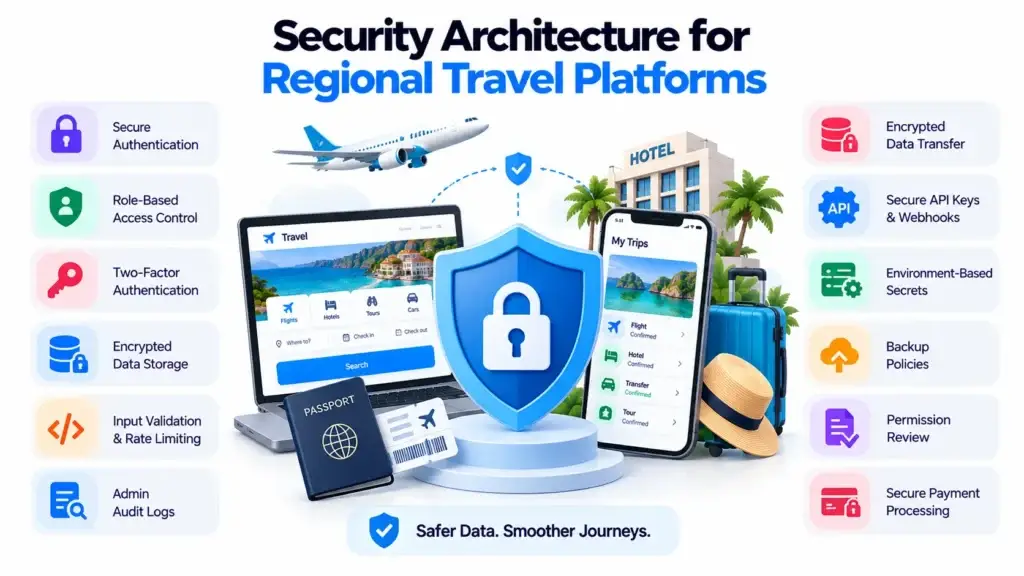
Travel platforms handle personal data, booking history, payment references, supplier records, and admin actions.
Security should be built into the architecture from the start.
Important security layers include:
- Secure authentication
- Password policies
- Session management
- Two-factor authentication for sensitive roles
- Role-based access control
- Encrypted data transfer
- Encrypted sensitive data storage
- Secure API keys
- Webhook signature verification
- Input validation
- Rate limiting
- Admin audit logs
- Environment-based secrets
- Backup policies
- Permission review
Payment card data should be handled through secure payment providers where available, not stored directly in the platform database.
For supplier APIs, credentials should be stored securely, rotated when needed, and separated by environment. Development, staging, and production should not share the same keys.
Testing and Deployment Architecture
A regional travel booking platform should be tested beyond normal page loading.
Important test areas include:
- Search filters
- Availability checks
- Booking creation
- Payment success
- Payment failure
- Duplicate payment prevention
- Supplier timeout
- Confirmation delay
- Cancellation request
- Refund workflow
- Coupon limits
- Wallet credits
- Vendor permissions
- Agent commission
- Admin role access
- Notification delivery
- Mobile responsiveness
- API error handling
Deployment should include staging, production, environment variables, CI/CD checks, database backups, monitoring, and rollback planning.
A practical deployment workflow may include:
- Developer commits code.
- Automated tests run.
- Build is created.
- Staging deployment happens.
- QA tests key booking flows.
- Payment gateway test mode is verified.
- Supplier API test flows are checked.
- Admin dashboard permissions are reviewed.
- Production deployment is approved.
- Logs and monitoring are watched after release.
The launch is not complete when the app goes live. Travel platforms need post-launch monitoring because APIs, payments, suppliers, and user behavior can expose issues that test data does not show.
Founder Decision Signals for Travel Platform Architecture
Supplier Complexity
If your platform depends on multiple flight, hotel, transport, or activity suppliers, prioritize adapter architecture, normalization, retries, and logs.
Booking Reliability
If users pay before supplier confirmation, use clear booking states, payment verification, confirmation queues, and refund workflows.
Operational Control
If agents, vendors, finance teams, and support teams use the platform, role-based access and admin audit logs should be planned early.
Launch Scope
If the first market only needs hotels and packages, do not overbuild every travel category before validating real demand.
Founders should also plan how the platform will attract travelers, suppliers, and early bookings after the technical foundation is ready. This guide on travel booking platform launch marketing explains what to prioritize before and after going live.
Startup Architecture Checklist
Before launch, founders should confirm:
- Core travel categories are selected
- Traveler search flow is clear
- Supplier integration strategy is defined
- Manual listing flow is available where needed
- Supplier API responses are normalized
- Availability and price refresh logic is planned
- Booking states are clearly mapped
- Payment verification is server-side
- Refund and cancellation workflows are documented
- Vendor dashboard permissions are scoped
- Agent and corporate workflows are included only if needed
- Admin dashboard supports booking operations
- Reports cover bookings, payments, refunds, margins, and suppliers
- Cache rules are defined for search and availability
- Queues are used for long-running tasks
- API rate limits and error handling are in place
- Logs and monitoring are configured
- Deployment uses staging before production
- Sensitive keys are protected
- Support teams can see booking timelines
Founders should also connect architecture decisions with monetization logic. This travel booking platform business model guide explains how commissions, service fees, package margins, supplier visibility, agent workflows, and platform revenue can work together.
Architecture should make the first launch reliable and future expansion easier.
Common Architecture Mistakes Founders Should Avoid
Connecting Supplier APIs Directly to the Frontend
Supplier responses should pass through backend adapters, normalization, validation, cache rules, and error handling before users see results.
Confirming Bookings Before Payment Verification
Booking status should update only after server-side payment verification and supplier confirmation rules are checked.
Using One Data Model for Every Travel Category
Flights, hotels, buses, cabs, packages, and activities have different rules. A flexible schema prevents expensive rework later.
Building the Admin Panel Too Late
Support, finance, suppliers, agents, and operators need booking visibility from the beginning. Admin workflows are part of the product, not an optional add-on.
How Miracuves Helps Founders Launch Travel Booking Platforms
Miracuves helps founders, travel agencies, tour operators, and regional travel businesses launch ready-made and white-label booking platforms with branded design, source-code ownership, supplier workflows, payment integrations, agent portals, corporate travel workflows, and admin control.
For founders evaluating a launch-ready product foundation, Miracuves’ travel booking platform foundation can help review traveler flows, supplier connections, booking categories, payments, margins, agent workflows, corporate travel, loyalty, and operator controls.
Businesses exploring broader travel and hospitality launch paths can also review Miracuves’ travel booking solutions for related platform models.
If you are comparing budget and rollout scope, review Miracuves’ guide on travel booking platform development cost. For vendor evaluation, this page on choosing a travel booking development partner can help you understand what to check before selecting a team.
When the ready-made scope fits the rollout requirement, Miracuves can support 6-day solution delivery, helping founders move faster without building every search, supplier, booking, payment, refund, loyalty, agent, corporate, and admin workflow from zero.
Final Thoughts: Architecture Decides How Well the Platform Operates
A regional travel booking platform is not only a frontend, database, and payment gateway. It is a complete operating layer for travelers, suppliers, agents, corporate users, finance teams, support teams, and platform operators.
The strongest architecture keeps each responsibility clear.
Supplier APIs should be normalized. Booking states should be controlled. Payments should be verified. Refunds should be traceable. Vendor access should be permission-based. Admin teams should have visibility. Search should be fast. Deployment should be monitored.
For founders, the best architecture is not always the most complicated one. It is the one that matches the first market, supports real booking operations, and leaves enough flexibility to add more suppliers, categories, and workflows later.
FAQs
What is regional travel booking platform architecture?
Regional travel booking architecture is the technical structure that connects traveler apps, web apps, backend APIs, supplier integrations, search, bookings, payments, refunds, vendor dashboards, agent portals, admin controls, and reporting.
Which backend stack is best for a travel booking platform?
The best backend stack depends on the team and product scope. Node.js can work well for API-heavy and real-time supplier aggregation. Laravel can work well for structured admin systems, faster MVPs, and SEO-friendly web workflows. The architecture matters more than the framework alone.
Why do travel platforms need supplier API adapters?
Supplier API adapters convert external supplier responses into internal platform formats. This helps keep search results, pricing, availability, booking rules, and error handling consistent even when different suppliers use different data structures.
How should payments work in a travel booking platform?
Payments should be initiated after backend price and availability validation. The booking should remain pending until the backend verifies gateway response or webhook confirmation. Only then should the system confirm the booking or continue supplier confirmation.
Why are booking status states important?
Booking status states help travelers, suppliers, support teams, finance users, and admins understand exactly where a booking stands. Clear states reduce confusion around pending payments, failed confirmations, cancellations, refunds, and disputes.
Should founders build every travel category at launch?
Not always. A focused launch is often safer. Start with the categories your market needs most and your operations can support well, then add more categories after validating demand and supplier reliability.
What should the admin dashboard include?
The admin dashboard should include users, suppliers, agents, corporate accounts, bookings, payments, refunds, cancellations, margins, coupons, loyalty, reports, role permissions, audit logs, and support visibility.
Can Miracuves help launch a travel booking platform faster?
Yes. Miracuves helps founders launch ready-made and white-label travel booking platforms with branded design, supplier workflows, booking management, payment integrations, admin dashboards, source-code ownership, and customization support. A 6-day launch may apply when the ready-made scope matches the rollout requirement.
Miracuves is an independent software development company. We are not affiliated with, connected to, sponsored by, or endorsed by any company or product named in this article.
Terms such as “X Clone” are used descriptively. It is how the software industry refers to building a platform with functionality comparable to a known service, and how clients search for it.
The entire design and codebase of our products is built by our own team. Our products contain no code, design, graphics, or content originating from any third-party website or applications.
All third-party names and marks referenced in this article are the property of their respective owners, referenced solely to identify the services discussed.



