



























Key Takeaways
- Collaborative Filtering for Ecommerce Marketplaces helps turn shopper behavior into more relevant product recommendations across large multi-vendor catalogs.
- Behavior signals such as views, searches, cart additions, purchases, wishlists, ratings, and repeat visits can improve recommendation quality.
- Item-to-item filtering is often a practical early approach because it can power similar products, frequently bought together, and related-item widgets.
- Recommendation systems should combine algorithmic relevance with inventory, seller quality, category rules, delivery availability, and admin controls.
- Founders should start with clean event tracking and simple discovery widgets before investing in advanced real-time personalization.
Recommendation Signals
- Purchases and cart actions usually provide stronger intent signals than simple product views or accidental clicks.
- Recommendation surfaces can include the homepage, product pages, cart, search results, email campaigns, and push notifications.
- Cold-start problems can be handled with trending products, new arrivals, category suggestions, content-based similarity, and curated collections.
- Admin rules should prevent out-of-stock, restricted, low-quality, or irrelevant products from appearing even when behavior data suggests a match.
- Analytics should track recommendation impressions, clicks, cart additions, purchases, revenue contribution, repeat sessions, and fatigue signals.
Real Insights
- Collaborative filtering becomes more valuable as catalogs grow because buyers cannot realistically compare every relevant product manually.
- A recommendation engine should not be treated as a separate AI feature; it should connect with catalog, seller, inventory, checkout, and analytics systems.
- Using only trending products creates popularity-based discovery, not true personalization.
- Seller fairness matters because recommendation systems that repeatedly favor the same products can limit discovery for relevant new inventory.
- The strongest progression is: track behavior → clean and structure events → launch simple product recommendations → measure engagement → add user-based personalization → combine collaborative, content, popularity, and business rules into a hybrid model.
Multi-Vendor Ecommerce Marketplaces become harder to navigate as product catalogs grow. A small marketplace may work with basic search, category filters, and manual product sorting. But once hundreds of sellers, thousands of SKUs, and different buyer preferences enter the platform, product discovery becomes a business problem.
Users do not always know exactly what to search for. They browse, compare, abandon carts, return later, follow discounts, explore similar products, and react differently depending on price, category, brand, availability, and delivery promise. Collaborative Filtering for Ecommerce Marketplaces helps learn from these behaviors and recommend products that feel more relevant to each shopper.
For founders, this is not just an AI feature. It is a product discovery layer that can improve browsing depth, seller visibility, repeat engagement, cart value, and marketplace monetization when implemented with the right data foundation.
Why Product Discovery Matters in Multi-Vendor Ecommerce Marketplaces
A marketplace does not win only by having more products. It wins when buyers can find the right products quickly and sellers can receive visibility without depending only on paid promotions.
As the catalog grows, discovery becomes more complex. Buyers may face too many similar options. New sellers may struggle to appear in front of relevant users. High-quality products may remain hidden because search ranking is too basic. Returning customers may leave if the experience feels repetitive or generic.
Product discovery helps solve this by connecting shopper intent with product relevance.
A strong discovery system can support:
- Faster product exploration
- More relevant search and category browsing
- Better exposure for long-tail inventory
- Higher engagement with recommended items
- Stronger cross-sell and upsell opportunities
- Personalized experiences for returning users
- Smarter merchandising for marketplace operators
For founders, the goal is not to make the platform look intelligent. The goal is to reduce friction between buyer intent and seller inventory.
What Is Collaborative Filtering in Ecommerce?
Collaborative filtering is a recommendation method that uses behavior patterns to predict what a shopper may like next.
Instead of relying only on product descriptions, category names, or manual merchandising, collaborative filtering studies how users interact with products. If many shoppers who view Product A also view Product B, the system can identify a relationship. If buyers who purchase one product often purchase another, the platform can recommend that second product to similar buyers.
In Multi-Vendor Ecommerce Marketplaces, collaborative filtering may use signals such as:
- Product views
- Search queries
- Cart additions
- Wishlist activity
- Purchases
- Ratings and reviews
- Repeat visits
- Category browsing
- Product comparison behavior
- Session duration
- Seller interactions
- Abandoned carts
The more clean and structured the behavior data is, the stronger the recommendation logic can become.
User-Based Collaborative Filtering
User-based collaborative filtering finds shoppers with similar behavior and recommends products based on what similar users liked, viewed, added to cart, or purchased.
Example
User A buys a laptop, laptop sleeve, wireless mouse, and screen cleaner.
User B buys the same laptop and laptop sleeve.
The platform may recommend the wireless mouse or screen cleaner to User B.
This model can be useful for marketplaces with strong repeat usage, logged-in customers, and enough historical activity. It helps create a more personalized experience for returning buyers.
However, user-based filtering can become harder to scale when the user base grows significantly. It also needs enough behavior data to understand meaningful patterns.
Item-to-Item Collaborative Filtering
Item-to-item collaborative filtering focuses on relationships between products rather than only relationships between users.
It asks questions such as:
- Which products are often viewed together?
- Which products are frequently purchased together?
- Which items are added to cart in the same session?
- Which products are compared by similar shoppers?
- Which alternatives do buyers explore before purchasing?
This approach is especially useful for ecommerce marketplaces because product relationships can power multiple recommendation widgets.
Common examples include:
- Similar products
- Frequently bought together
- Customers also viewed
- Customers also bought
- Related accessories
- Bundle suggestions
- Cart add-ons
For founders, item-to-item recommendations are often easier to introduce earlier than fully personalized user feeds because they can work from product-level interactions.
How Collaborative Filtering Improves Marketplace Product Discovery
Collaborative filtering improves product discovery because it learns from real marketplace behavior.
A buyer may not search for “wireless ergonomic office mouse with silent clicks.” They may simply search for “mouse,” open a few products, compare reviews, add one to the cart, and leave. The system can learn from these interactions and suggest relevant accessories, alternatives, or frequently paired items.
For marketplaces, this creates value across three sides:
| Marketplace Side | How Collaborative Filtering Helps | Business Impact |
|---|---|---|
| Buyers | Shows relevant products based on similar behavior and product relationships. | Reduces search friction and improves browsing experience. |
| Sellers | Gives products more chances to appear beyond basic search results. | Improves visibility for relevant inventory. |
| Platform Operator | Uses behavior data to improve recommendations, campaigns, and merchandising. | Supports engagement, retention, and monetization. |
Collaborative filtering is powerful because it reflects what users actually do, not only what the platform assumes they want.
Where Recommendations Should Appear in the Marketplace Journey
A recommendation engine becomes useful only when it appears at the right shopping moments.
Recommendation Surfaces for Multi-Vendor Ecommerce Marketplaces
| Marketplace Surface | Recommendation Example | Founder Impact |
|---|---|---|
| Homepage | Personalized products, trending categories, recently viewed items. | Makes returning users feel understood from the first screen. |
| Product Page | Similar products, related accessories, customers also viewed. | Keeps users browsing if the first product is not the right fit. |
| Cart Page | Add-on items, bundles, frequently bought together products. | Improves cross-sell potential before checkout. |
| Search Results | Behavior-informed ranking and category-aware suggestions. | Helps users find relevant products faster in large catalogs. |
| Email Campaigns | Products based on browsing history, abandoned cart, or past purchases. | Brings users back with more relevant re-engagement. |
| Push Notifications | Price drops, restocks, personalized category recommendations. | Supports repeat sessions without generic promotion fatigue. |
Data Foundations Needed for Collaborative Filtering
Collaborative filtering needs clean behavior data. Without reliable event tracking, the recommendation system may produce weak or irrelevant suggestions.
Founders should plan data capture before building advanced recommendation logic.
Important data points include:
- User ID or anonymous session ID
- Product ID
- Seller ID
- Category ID
- Search terms
- Product impressions
- Product clicks
- Add-to-cart events
- Wishlist events
- Purchase events
- Ratings and reviews
- Refunds and cancellations
- Location or delivery zone where relevant
- Device and session context
- Time-based behavior
The platform should also separate strong signals from weak signals. A completed purchase is stronger than a product view. A wishlist action may indicate interest, but not the same intent as checkout. A repeated category visit may show preference, while a single accidental click may not mean much.
Recommendation Architecture for Ecommerce Marketplaces
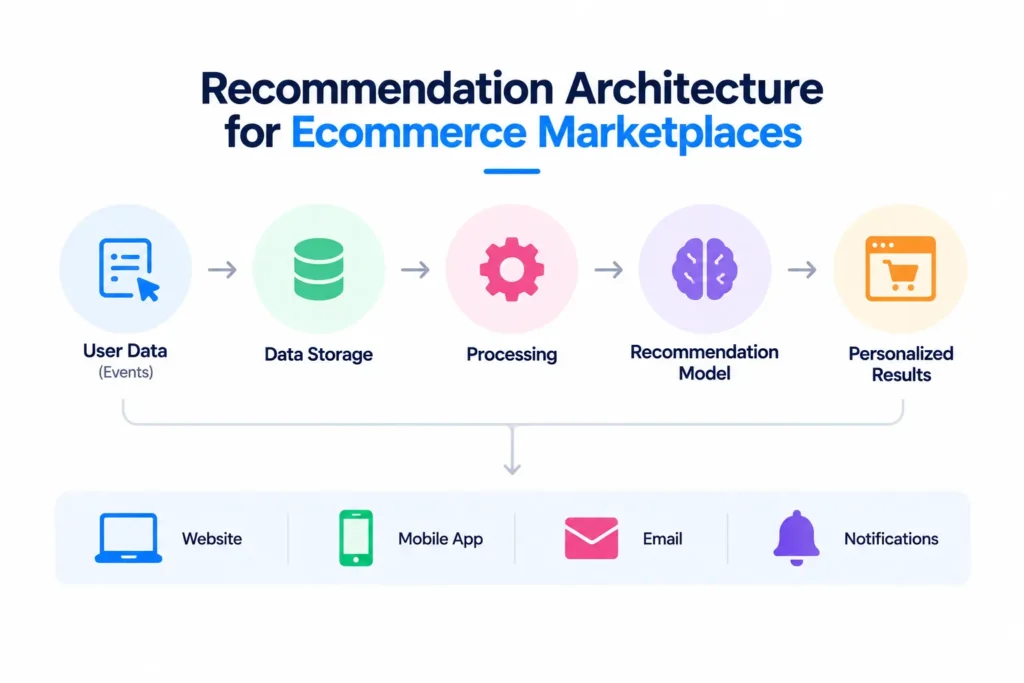
Founders do not need to become machine learning engineers, but they should understand the architecture well enough to make better development decisions.
A practical recommendation system may include:
- Event Tracking Layer
Captures user actions such as search, views, clicks, cart events, purchases, and ratings. - Data Storage Layer
Stores product, user, seller, category, order, and interaction data in a structured format. - Processing Layer
Cleans, groups, and prepares behavioral data for recommendation models. - Model Layer
Identifies relationships between users, products, categories, sessions, and purchase patterns. - Recommendation API Layer
Serves personalized or product-based suggestions to the website, mobile app, email system, or notification engine. - Ranking and Business Rules Layer
Filters recommendations based on availability, seller quality, delivery location, margin, category rules, and admin priorities. - Caching Layer
Helps recommendation widgets load faster by storing common suggestions such as trending products, similar products, and frequently bought together items. - Analytics Layer
Measures recommendation impressions, clicks, cart additions, purchases, revenue contribution, and user engagement.
The business value comes from connecting algorithmic relevance with marketplace rules. A product may be statistically relevant, but it should not be shown if it is out of stock, unavailable in the user’s delivery area, from a restricted seller, or irrelevant to the current category.
Collaborative Filtering vs Content-Based Recommendations
Collaborative filtering is not the only recommendation method. Many marketplaces use a hybrid approach.
| Recommendation Type | How It Works | Best Use Case |
|---|---|---|
| Collaborative Filtering | Uses behavior patterns from users and products. | Returning users, product relationships, bundles, and personalized discovery. |
| Content-Based Recommendations | Uses product attributes such as category, brand, price, tags, color, and specifications. | New products, new users, and marketplaces with limited behavioral data. |
| Popularity-Based Recommendations | Shows trending, best-selling, or most-viewed products. | Guest users, launch-stage platforms, seasonal campaigns. |
| Rule-Based Recommendations | Uses admin-defined rules such as category priority, margin, or sponsored placement. | Campaigns, merchandising, seller promotions, and operational control. |
| Hybrid Recommendations | Combines behavior, content, popularity, rules, and AI ranking. | Growing marketplaces with enough data and multiple recommendation surfaces. |
For most founders, the practical path is progressive personalization. Start simple, measure impact, then add more advanced recommendation models when the marketplace has enough user behavior data.
Cold Start Problem: What Happens When There Is Not Enough Data?
Collaborative filtering becomes weaker when the platform has new users, new products, or limited interaction history. This is known as the cold start problem.
A new buyer has no browsing or purchase history. A new product has no views, ratings, or purchases. A new seller may have limited trust signals.
To handle this, marketplaces can use:
- Popular products
- New arrivals
- Category-based recommendations
- Content-based similarity
- Seller-curated collections
- Admin-picked featured products
- Onboarding preference questions
- Location-based suggestions
- Seasonal or campaign-based recommendations
For early-stage marketplaces, cold start is normal. Founders should not overbuild complex AI before collecting clean behavioral data.
Admin Control Matters in Recommendation Systems
Recommendations should not be fully uncontrolled.
Marketplace operators need admin settings to protect user experience, seller fairness, and business rules.
Admin controls may include:
- Excluding out-of-stock products
- Prioritizing verified sellers
- Limiting low-rated products
- Managing sponsored recommendation slots
- Setting category-level rules
- Controlling campaign-based recommendations
- Reviewing recommendation performance
- Removing restricted products
- Adjusting product visibility
- Monitoring recommendation fatigue
A strong multi-vendor marketplace feature set should connect product discovery with catalog management, seller quality, inventory availability, checkout logic, admin rules, and analytics.
Founder Decision Signals
Speed
Start with simple recommendation widgets such as trending products, recently viewed items, similar products, and frequently bought together products before investing in complex real-time personalization.
Cost
Recommendation engine cost depends on data volume, event tracking, model complexity, infrastructure, API usage, and the number of product discovery surfaces.
Scalability
Large catalogs need caching, ranking rules, clean data pipelines, API optimization, and analytics so recommendations remain fast and useful as the marketplace grows.
Market Fit
Do not assume personalization is valuable until users respond to it. Track impressions, clicks, cart additions, conversions, and repeat sessions to validate impact.
For a deeper budget view, review this marketplace development cost factors guide before finalizing advanced discovery features.
How Collaborative Filtering Supports Marketplace Revenue
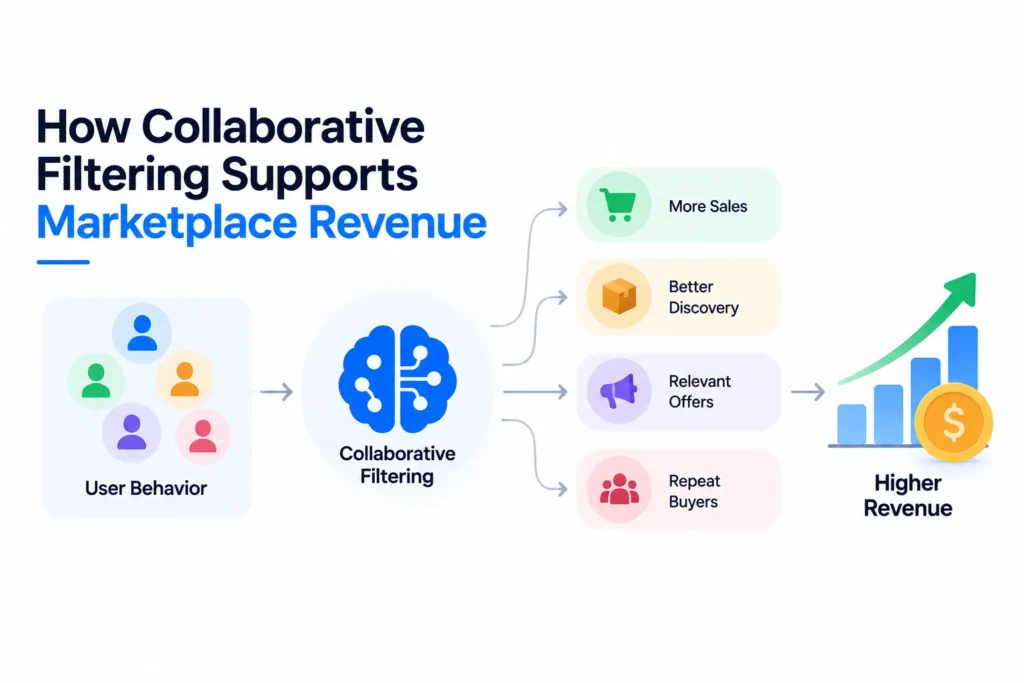
Collaborative filtering does not generate revenue directly by itself. It supports revenue by improving the shopping journey.
When buyers discover relevant products faster, they are more likely to browse deeper, add more items to cart, and return later. When sellers receive relevant visibility, they are more likely to stay active. When admins understand which recommendation widgets work, they can improve merchandising and sponsored placement decisions.
Collaborative filtering can support:
- Cross-selling
- Upselling
- Sponsored discovery
- Personalized campaigns
- Seller visibility
- Product bundling
- Repeat purchases
- Cart recovery
- Category engagement
For founders planning the financial side of the platform, this marketplace business model explains how commissions, seller plans, ads, logistics, and platform-controlled revenue streams connect.
Mistakes Founders Should Avoid
Building complex AI before tracking clean behavior data
A recommendation system is only as useful as the data behind it. If product views, cart actions, purchases, searches, and ratings are not tracked properly, advanced models will produce weak recommendations.
Using only trending products
Popularity-based suggestions are useful for new users, but they do not create true personalization. Growing marketplaces should combine popularity with behavior, product similarity, and business rules.
Ignoring seller fairness
If recommendations always favor the same sellers or products, new vendors may struggle to gain visibility. Admin rules should balance relevance, quality, availability, and marketplace fairness.
Forgetting recommendation analytics
Founders should track recommendation impressions, clicks, add-to-cart actions, purchases, revenue contribution, and user fatigue signals. Without analytics, it is impossible to know whether recommendations are helping.
Build Path: Start Simple, Then Move Toward Smarter Personalization
A founder does not need to launch with a highly complex recommendation engine from day one. The smarter route is to match recommendation depth with marketplace maturity.
| Marketplace Stage | Recommended Discovery Logic | Founder Goal |
|---|---|---|
| Launch Stage | Trending products, new arrivals, recently viewed items, category recommendations. | Create basic discovery and reduce empty browsing experiences. |
| Validation Stage | Similar products, frequently bought together, customers also viewed. | Improve product exploration and cross-sell potential. |
| Growth Stage | Personalized homepage, behavior-based emails, user-based recommendations. | Improve repeat engagement and customer retention. |
| Scale Stage | Hybrid recommendations, real-time ranking, semantic search, AI-assisted personalization. | Build deeper marketplace intelligence across large catalogs. |
This progressive path keeps the platform practical. It avoids overspending on advanced AI before the marketplace has enough activity to justify it.
How Miracuves Helps Founders Build Smarter Ecommerce Marketplaces
Miracuves helps founders build ready-made and white-label marketplace platforms with source-code ownership, seller workflows, admin dashboards, payment logic, catalog control, and scalable product foundations.
For founders planning product discovery, the important decision is not only which algorithm to use. The real decision is whether the marketplace foundation can support behavior tracking, product relationships, recommendation widgets, admin rules, analytics, and future personalization.
Miracuves can help founders start with a practical product foundation and then extend the platform with smarter discovery workflows as user behavior data grows. For businesses that want a faster route to market, Miracuves offers a launch-ready ecommerce marketplace foundation that can support multi-vendor catalog operations, seller workflows, product discovery, checkout, payments, and admin control.
Founders exploring broader ecommerce options can also review Miracuves’ white-label ecommerce marketplace solutions and white-label marketplace software for branded, source-code-owned marketplace execution.
Final Thoughts
Collaborative filtering helps Multi-Vendor Ecommerce Marketplaces turn user behavior into better product discovery. It can help buyers find relevant products faster, help sellers gain more contextual visibility, and help founders make the shopping journey more intelligent over time.
But recommendation systems should be built progressively. New marketplaces should begin with clean event tracking, simple widgets, product similarity, trending products, and admin-controlled merchandising. As user behavior data grows, founders can expand toward personalized feeds, hybrid recommendation models, real-time ranking, and AI-assisted product discovery.
The goal is not to add AI for appearance. The goal is to create a marketplace where product discovery becomes easier, seller visibility becomes smarter, and every recommendation supports the business model.
Before selecting a build partner, founders can review how to choose the right ecommerce marketplace development partner based on source-code ownership, customization flexibility, product discovery logic, seller workflows, and long-term platform control.
FAQs
What is collaborative filtering in Multi-Vendor Ecommerce Marketplaces?
Collaborative filtering is a recommendation method that uses user behavior and product interaction patterns to suggest relevant products. It can analyze views, searches, cart actions, purchases, ratings, wishlists, and similar shopper behavior.
How does collaborative filtering improve product discovery?
It improves discovery by showing products that similar users viewed, bought, compared, or added to cart. This helps shoppers find relevant products faster without depending only on search keywords or manual filters.
What is the difference between user-based and item-to-item collaborative filtering?
User-based filtering recommends products based on similar shopper behavior. Item-to-item filtering recommends products based on relationships between products, such as items frequently viewed, bought, or added to cart together.
Should a new ecommerce marketplace start with advanced AI recommendations?
Not usually. A new marketplace should first track clean behavior data and start with simple recommendation widgets such as trending products, similar products, new arrivals, recently viewed items, and frequently bought together products.
What data is needed for collaborative filtering?
Useful data includes product views, clicks, cart additions, purchases, wishlists, ratings, reviews, search queries, category visits, seller interactions, session activity, and product availability.
What is the cold start problem in recommendation systems?
The cold start problem happens when there is not enough data for new users, new products, or new sellers. Marketplaces can handle this with content-based recommendations, trending products, category suggestions, onboarding preferences, and admin-curated collections.
How can marketplace admins control recommendations?
Admins can set rules to exclude out-of-stock products, prioritize verified sellers, manage sponsored placements, limit low-rated items, filter restricted products, and review recommendation performance.
How does collaborative filtering support marketplace revenue?
It supports revenue by improving product visibility, cross-selling, upselling, repeat engagement, cart recovery, sponsored discovery, and personalized campaigns. Better discovery can help buyers find products faster and help sellers receive more relevant exposure.
Miracuves is an independent software development company. We are not affiliated with, connected to, sponsored by, or endorsed by any company or product named in this article.
Terms such as “X Clone” are used descriptively. It is how the software industry refers to building a platform with functionality comparable to a known service, and how clients search for it.
The entire design and codebase of our products is built by our own team. Our products contain no code, design, graphics, or content originating from any third-party website or applications.
All third-party names and marks referenced in this article are the property of their respective owners, referenced solely to identify the services discussed.