


Key Takeaways
- An online retail marketplace connects buyers, third-party sellers, payment providers, warehouses, and delivery partners.
- Sellers manage product listings and inventory while the platform supports discovery, checkout, fulfillment, and customer service.
- The business can earn through commissions, advertising, logistics fees, private-label margins, and payment partnerships.
- Cash on delivery, easy returns, order tracking, discounts, and flexible payments help reduce buyer hesitation.
- Marketplace growth depends on balancing product selection, seller quality, competitive pricing, delivery reliability, and customer trust.
Business Model Signals
- Define how sellers register, verify their businesses, publish products, manage inventory, and process orders.
- Plan platform commissions, seller settlements, advertising charges, logistics fees, returns, and refund deductions.
- Connect payment processing with order confirmation, delivery status, refunds, commissions, and seller payouts.
- Support discounts, flash sales, loyalty rewards, EMI options, product recommendations, and sponsored listings.
- Give administrators control over sellers, catalogs, orders, payments, disputes, promotions, delivery, and marketplace reports.
Real Insights
- A large product catalog creates little value when listings are inaccurate or sellers cannot fulfill orders reliably.
- Discount campaigns can attract buyers, but repeat purchases depend on product quality and delivery performance.
- Integrated logistics gives the marketplace greater control but also increases operational cost and complexity.
- Revenue features should be planned with the corresponding seller, payment, fulfillment, reporting, and admin workflows.
- Miracuves develops online retail marketplaces with buyer, seller, payment, logistics, loyalty, advertising, and admin capabilities.
An online retail marketplace looks simple from the customer side. A buyer searches for a product, compares options, places an order, receives delivery, and may return or review the item later. Behind that simple journey is a much larger business model connecting sellers, inventory, catalog rules, delivery operations, payment settlement, promotions, refunds, and platform-level decision-making.
The business model of Flipkart is often studied because it shows how a marketplace can connect millions of buyers and sellers through a structured ecommerce operating system. But for founders, the real lesson is not about copying one company. The real lesson is understanding how the marketplace engine works, where revenue is created, and what operational controls are needed before building a similar retail platform.
An online retail marketplace earns by enabling transactions, improving product visibility, supporting seller participation, managing delivery flows, and creating trust between every side of the platform. When these parts work together, the marketplace becomes more than a shopping app. It becomes a commerce infrastructure layer.
What Is an Online Retail Marketplace Business Model?
An online retail marketplace business model is a platform structure where multiple sellers list products, buyers purchase from those sellers, and the platform manages the digital infrastructure that connects both sides. The marketplace may not own every product it sells. Instead, it creates the environment where discovery, ordering, payment, fulfillment, and post-purchase support happen.
In a traditional ecommerce store, one company usually owns the inventory and sells directly to customers. In a marketplace model, the platform works as an intermediary and operator. It controls the rules, technology, visibility, payments, seller access, customer experience, and often parts of the delivery flow.
This model can support many retail categories, including electronics, fashion, grocery, home goods, beauty, appliances, books, local products, and regional commerce. For founders, the marketplace model is attractive because it can scale supply through third-party sellers instead of forcing the business to buy and hold all inventory from day one.
However, the model is also operationally demanding. A marketplace must balance buyer satisfaction, seller profitability, delivery reliability, pricing consistency, platform margins, and dispute resolution at the same time.
The Four Core Participants in an Online Retail Marketplace
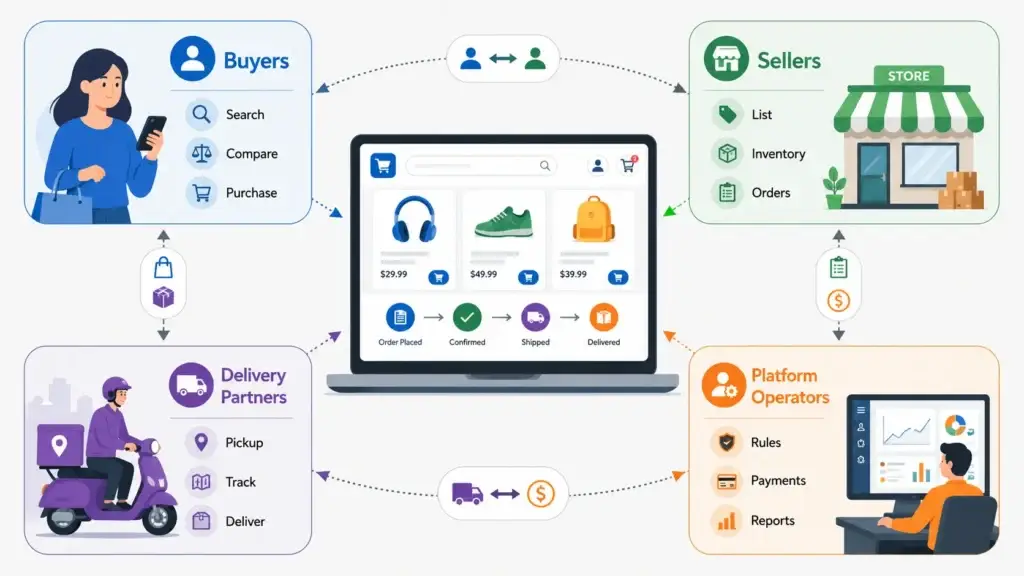
Image Source: AI-generated visual by Miracuves
A retail marketplace becomes easier to understand when broken into four connected groups: buyers, sellers, delivery partners, and platform operators. Each group has a different role, but the business model depends on all of them working together.
| Participant | Main Role | What They Need | Why They Matter |
|---|---|---|---|
| Buyers | Search, compare, purchase, review, and return products | Trust, variety, price clarity, fast delivery, support | They create demand and transaction volume |
| Sellers | List products, manage inventory, fulfill orders, handle returns | Visibility, fair commission, fast payouts, seller tools | They create supply and category depth |
| Delivery Partners | Pick up, transport, update, and deliver orders | Clear assignments, route visibility, payout tracking | They complete the last-mile experience |
| Platform Operators | Manage rules, payments, catalog, disputes, promotions, and reporting | Admin control, analytics, moderation, configuration | They protect trust, margin, and scalability |
A founder planning an online retail marketplace should not think only about the customer app. The real business sits across the complete operating system. If sellers cannot manage inventory, delivery partners cannot update order status, or the admin team cannot resolve refunds, the customer experience breaks quickly.
How Buyers Create Demand Inside the Marketplace
Buyers are the demand side of the marketplace. Their behavior decides which categories grow, which sellers perform, and which revenue streams become viable.
A typical buyer journey includes:
- Searching for a product
- Filtering by price, brand, category, rating, delivery time, or availability
- Comparing multiple sellers
- Reading product descriptions and reviews
- Adding products to cart
- Choosing payment and delivery options
- Tracking the order
- Requesting returns, refunds, or replacements when needed
- Reviewing the product and seller experience
Each of these actions generates business signals. Search data shows what customers want. Cart abandonment shows where pricing, delivery charges, or checkout friction may be hurting conversions. Reviews reveal seller quality. Return patterns expose catalog or fulfillment problems.
For platform operators, buyer activity is not just traffic. It is decision data. The marketplace uses this data to improve category planning, seller ranking, promotional campaigns, inventory recommendations, and customer retention.
How Sellers Power Supply, Catalog Depth, and Marketplace Growth
Sellers are the supply side of the marketplace. Without reliable sellers, the platform cannot offer product variety, competitive pricing, or category coverage.
A seller usually needs access to:
- Seller registration and verification
- Store profile management
- Product listing tools
- Bulk upload options
- Inventory and stock updates
- Order acceptance and processing
- Return and refund response workflows
- Commission visibility
- Payout tracking
- Sales analytics
- Promotion or featured listing options
The seller experience directly affects marketplace growth. If onboarding is complicated, sellers delay activation. If commissions are unclear, sellers lose trust. If payouts are slow or difficult to reconcile, sellers may move their catalog elsewhere.
This is why a marketplace business model is not only about acquiring customers. It is equally about building seller confidence. Strong seller operations help the platform maintain supply, improve assortment, and reduce dependency on heavy discounting.
How the Platform Earns Revenue From Marketplace Activity
A retail marketplace usually earns from multiple revenue streams. The strongest models do not depend only on commission because retail margins can be thin, especially in price-sensitive markets.
Here are the most common monetization layers.
Online Retail Marketplace Revenue Streams
| Revenue Stream | How It Works | Founder Impact |
|---|---|---|
| Sales Commission | The platform takes a percentage or fixed fee from each completed seller order. | Creates direct revenue from transaction volume but must be balanced with seller profitability. |
| Seller Subscription Plans | Sellers pay for monthly access, higher listing limits, lower commission, or advanced tools. | Adds predictable recurring revenue beyond per-order income. |
| Featured Listings | Sellers pay to improve visibility in search, category pages, or homepage placements. | Works better once the platform has enough seller competition and buyer traffic. |
| Delivery Charges or Delivery Margin | The platform charges delivery fees or keeps a margin between customer delivery price and fulfillment cost. | Can improve order economics but must be priced carefully to avoid cart abandonment. |
| Convenience or Handling Fees | Small fees may be added for specific payment, packaging, cash handling, or service workflows. | Helps recover operational costs when clearly justified and transparently communicated. |
| Advertising and Promotions | Brands or sellers pay for banners, sponsored products, category promotions, or campaign visibility. | Can become a strong margin layer once traffic quality improves. |
| Value-Added Seller Services | The platform may offer packaging, catalog support, analytics, warehousing, or marketing services. | Creates additional revenue while helping sellers perform better. |
For founders, the key lesson is sequencing. A new marketplace should not activate every fee from day one. Early-stage platforms usually need seller supply first. That often means keeping entry friction low, building order volume, and adding advanced monetization once sellers begin seeing value.
Why Commission Alone Is Not Enough for a Retail Marketplace
Commission is the most visible revenue stream, but it is not always enough. If the platform depends only on commission, it must either increase order volume or increase seller fees. Both paths have limits.
High commission can push sellers away, especially when they already sell through other channels. Low commission may attract sellers but can leave the platform struggling to cover marketing, support, technology, and logistics costs.
That is why modern retail marketplaces often combine commission with other monetization layers. Seller subscriptions, ads, featured placements, delivery economics, and value-added services allow the platform to improve revenue per seller or per order without putting all pressure on the basic commission rate.
The founder decision is not “how much commission should we charge?” The better question is: “Which revenue streams match our category, seller maturity, delivery model, and buyer behavior?”
How Delivery Connects the Buyer and Seller Experience
Delivery is where the marketplace promise becomes real. A buyer may discover the product online, but the experience is judged when the product arrives.
Delivery operations usually include:
- Serviceable location setup
- Delivery zone management
- Pickup assignment
- Seller handover
- Real-time order status updates
- Delivery partner tracking
- Failed delivery handling
- Cash collection where relevant
- Return pickup
- Proof of delivery
For a retail marketplace, delivery is not only a logistics function. It affects conversion, customer trust, refund rates, seller ratings, and repeat purchases. Slow delivery, unclear tracking, or poor return handling can weaken the entire business model even if the app interface looks polished.
Founders need to decide whether the platform will use third-party logistics, in-house delivery partners, seller-managed shipping, or a hybrid model. Each option affects margins, control, scalability, and customer experience.
| Delivery Model | Best For | Strength | Risk |
|---|---|---|---|
| Third-Party Logistics | Faster launch across many regions | Lower operational burden | Less control over experience |
| In-House Delivery | Dense local or regional operations | Stronger control and possible delivery margin | Higher operational complexity |
| Seller-Managed Shipping | Sellers with existing fulfillment systems | Flexible for large seller networks | Inconsistent buyer experience |
| Hybrid Delivery | Marketplaces with mixed categories and regions | Balanced control and coverage | Requires strong admin configuration |
The delivery model should match the business stage. A regional marketplace may begin with controlled local delivery. A category-led marketplace may rely on sellers or logistics partners. A scale-focused platform may need hybrid routing and delivery rules.
How Platform Operations Keep the Marketplace Under Control
The admin and operations layer is the control center of the marketplace. It decides whether the business can scale without becoming chaotic.
Platform operators usually need to manage:
- Buyer accounts
- Seller approvals
- Product moderation
- Category structure
- Commission settings
- Order disputes
- Return and refund rules
- Delivery zones
- Payment gateways
- Payout cycles
- Promotional campaigns
- Tax settings
- Reports and analytics
- Role-based access for internal teams
A weak admin system forces teams to depend on developers for everyday changes. A strong admin system lets the operator adjust business rules, approve sellers, manage campaigns, configure commissions, resolve disputes, and monitor transactions without breaking workflows.
This is one of the most important lessons for founders. The marketplace business model is not only built in the mobile app or website. It is built inside the operating dashboard where the platform team controls rules, exceptions, payments, and growth decisions.
Founder Decision Signals
Speed
If the market opportunity is time-sensitive, starting with a ready-made commerce foundation can reduce the time spent building standard marketplace workflows from zero.
Cost
Marketplace cost depends on buyer apps, seller tools, delivery workflows, payment systems, admin dashboards, integrations, and customization depth.
Scalability
A scalable marketplace needs structured catalog data, order status logic, payout workflows, role-based access, and reporting before transaction volume grows.
Market Fit
The right model depends on seller supply, buyer demand, delivery density, category margins, and how quickly the platform can validate repeat orders.
How Payments, Payouts, and Refunds Shape Marketplace Trust
Money movement is one of the most sensitive parts of the retail marketplace model. Buyers want payment safety. Sellers want transparent payouts. Delivery partners may need earnings visibility. Operators need records they can trust.
A typical order may involve:
- Buyer payment
- Platform commission deduction
- Seller wallet credit
- Delivery fee handling
- Tax calculation
- Refund reserve
- Payout request
- Settlement confirmation
- Refund or replacement adjustment
If these flows are not clear, disputes increase. Sellers may question deductions. Buyers may lose confidence in refunds. Operators may struggle to reconcile revenue.
That is why marketplace platforms need a structured wallet, ledger, or transaction history system. Every order should create a clear financial trail so the operator can understand who earned what, what was deducted, what was refunded, and what remains payable.
This is especially important in markets where cash-on-delivery, partial refunds, failed deliveries, or seller-specific commission rates are common.
Read More: Why Startups Choose a Ready-Made Online Retail Marketplace Over Custom Development
The Role of Catalog Quality in Marketplace Revenue
Catalog quality affects both buyer trust and platform revenue. A product listing is not just a page. It is a sales asset.
A strong catalog usually includes:
- Clear product title
- Accurate category mapping
- High-quality images
- Product variants such as size, color, weight, or storage
- Pricing and discount logic
- Stock status
- Delivery estimate
- Warranty or return rules
- Verified reviews
- Seller information
Poor catalog quality creates confusion. Buyers may abandon the purchase, return the product, or leave negative reviews. Sellers may upload duplicate products or inaccurate descriptions. The platform may struggle with search relevance and category performance.
For this reason, product moderation, catalog approval, image standards, attribute rules, and seller listing guidance are important operational features. Better catalog quality improves conversion without always increasing advertising spend.
How Advertising and Promotions Fit Into the Marketplace Model
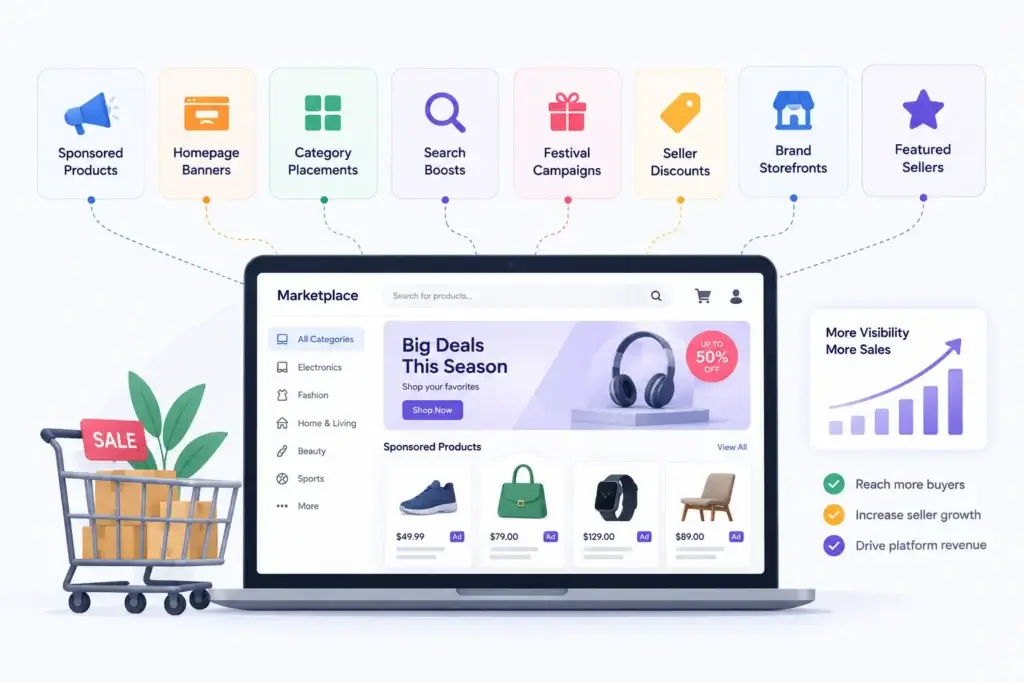
Image Source: AI-generated visual by Miracuves
Advertising becomes valuable when the platform has buyer traffic and seller competition. Early-stage marketplaces may not earn much from ads because sellers will only pay for visibility when the platform can deliver meaningful impressions or sales.
As traffic grows, promotional revenue can come from:
- Sponsored products
- Homepage banners
- Category page placements
- Search result boosts
- Festival or seasonal campaigns
- Seller-funded discounts
- Brand storefronts
- Featured seller badges
This revenue stream can be attractive because it does not always require the platform to own inventory. However, it must be handled carefully. Too many paid placements can hurt buyer trust if low-quality listings appear above better products.
The strongest approach is to combine paid visibility with quality signals such as ratings, return history, fulfillment reliability, and stock availability.
Marketplace Business Model vs Inventory-Led Ecommerce
Not every online retail business needs to begin as a full marketplace. Some founders start with their own inventory and add third-party sellers later. Others launch as an open seller marketplace from the beginning.
| Model | How It Works | Best For | Main Challenge |
|---|---|---|---|
| Inventory-Led Ecommerce | The business owns and sells products directly | Niche brands, private labels, controlled categories | Requires inventory investment |
| Multi-Seller Marketplace | Third-party sellers list and fulfill products | Category expansion, regional commerce, seller networks | Requires seller trust and platform governance |
| Hybrid Retail Marketplace | Platform sells some products and also allows sellers | Growing platforms with selective inventory control | Needs clear rules to avoid seller conflict |
| Managed Marketplace | Platform controls seller quality, catalog rules, and fulfillment standards tightly | Premium or trust-sensitive categories | Requires strong operations team |
Founders should choose the model based on supply access, category complexity, funding, operational capacity, and delivery control. A marketplace can scale faster in assortment, but it also requires stronger rules and seller management.
Operational Mistakes Founders Should Avoid
Launching Without Seller Operations
A marketplace cannot grow if sellers do not understand onboarding, listing rules, commission deductions, order handling, and payout timelines.
Depending Only on Discounts
Discounting may create early orders, but it does not build a sustainable marketplace unless supported by seller quality, delivery reliability, and repeat buyer trust.
Ignoring Return and Refund Workflows
Returns are not edge cases in online retail. They affect margins, customer support load, seller trust, and platform reputation.
Using a Weak Admin Dashboard
If every commission change, category update, dispute, or promotion requires developer support, the marketplace becomes difficult to operate at scale.
What Founders Should Validate Before Building a Retail Marketplace
Before investing in a marketplace platform, founders should validate the business assumptions behind the model.
Important questions include:
- Which product categories will attract repeat buyers?
- Can sellers supply enough variety and competitive pricing?
- Will sellers accept the commission and payout structure?
- Which delivery model works for the target region?
- Are returns manageable for the selected categories?
- Will the platform use cash, online payments, wallet credits, or multiple payment modes?
- What admin controls are needed from day one?
- How will the platform prevent fake listings, poor seller behavior, and catalog abuse?
- Which monetization streams should launch first, and which should wait?
These questions matter because marketplace failure often comes from operational mismatch, not only technology gaps. A founder may build a beautiful app but still struggle if sellers do not join, deliveries fail, payouts are unclear, or product quality is inconsistent.
Read More: What Is an Online Retail Marketplace and How Do Orders, Sellers, Payments, and Delivery Work?
Where Miracuves Fits Into Marketplace Launch Planning
Understanding the online retail marketplace business model is the first step. The next step is deciding how the buyer journey, seller operations, delivery workflow, payment flow, and admin control layer should work together in a real product.
Miracuves supports founders who want to move from marketplace planning to execution with a ready-made, white-label commerce foundation that can be adapted to their brand, category strategy, seller model, and launch goals.
This helps founders focus on the parts that create business value, such as:
- Choosing the right product categories for the target market
- Onboarding reliable sellers and managing product listings
- Setting up buyer, seller, delivery, and admin workflows
- Managing orders, payments, returns, refunds, and payouts
- Building delivery partnerships and fulfillment rules
- Testing customer demand before investing in heavy custom development
- Improving marketplace operations after launch with admin control and reporting
For retail marketplace founders, this matters because many core workflows are repeated across marketplace businesses. Product discovery, seller onboarding, catalog management, order tracking, payment handling, delivery updates, returns, refunds, and platform reporting should not always be built from zero.
A structured foundation allows founders to spend more time on seller acquisition, logistics planning, customer trust, marketing, and local market validation.
For readers ready to move from strategy to implementation, explore this launch-ready retail marketplace platform.
Final Thoughts: A Marketplace Business Model Works Only When the System Connects
An online retail marketplace is not just a website with products. It is a connected business system where buyers create demand, sellers create supply, delivery partners complete the promise, and platform operators control the rules that keep everything working.
The strongest marketplace models are built around balance. Buyers need choice and trust. Sellers need visibility and fair payouts. Delivery partners need clear assignments. Operators need control over catalog, commissions, payments, refunds, promotions, and reporting.
For founders, the biggest lesson is simple: do not think only about launching an ecommerce app. Think about building the operating system behind the marketplace. When the buyer, seller, delivery, and admin layers are connected properly, the platform has a stronger foundation for growth.
FAQs
What is an online retail marketplace business model?
An online retail marketplace business model connects buyers and third-party sellers through a digital platform. The platform enables product discovery, ordering, payments, delivery tracking, returns, refunds, seller management, and customer support while earning through commissions, seller fees, advertising, delivery charges, or value-added services.
How does an ecommerce marketplace make money?
An ecommerce marketplace can earn through sales commissions, seller subscription plans, featured listings, sponsored ads, delivery margins, convenience fees, payment-related income, and seller services such as catalog support or promotional tools.
Why are sellers important in a retail marketplace?
Sellers create product supply, category variety, price competition, and inventory depth. A marketplace with strong seller participation can offer more choices to buyers without owning all inventory directly.
What role does delivery play in a marketplace business model?
Delivery connects the online purchase to the physical customer experience. It affects conversion, trust, return rates, customer satisfaction, and repeat orders. Poor delivery workflows can damage marketplace performance even if the product catalog is strong.
What is the difference between inventory-led ecommerce and a marketplace?
In inventory-led ecommerce, the business usually owns and sells products directly. In a marketplace model, third-party sellers list products, and the platform manages transactions, visibility, payments, policies, and often delivery coordination.
Which revenue stream should a new marketplace start with?
Most new marketplaces start with a simple commission model because it is easy for sellers to understand. Seller subscriptions, advertising, featured placements, and advanced fees usually work better after the platform has enough traffic, seller competition, and order volume.
Why does a marketplace need a strong admin dashboard?
The admin dashboard helps the platform operator manage sellers, buyers, products, commissions, orders, refunds, delivery zones, payments, promotions, and reports. Without strong admin control, everyday marketplace operations become difficult to scale.
Can Miracuves help build an online retail marketplace?
Yes. Miracuves helps founders launch ready-made and white-label marketplace platforms with source-code ownership, branded design, admin control, and customization support for buyer, seller, delivery, and operator workflows.
Miracuves is an independent software development company. We are not affiliated with, connected to, sponsored by, or endorsed by any company or product named in this article.
Terms such as “X Clone” are used descriptively. It is how the software industry refers to building a platform with functionality comparable to a known service, and how clients search for it.
The entire design and codebase of our products is built by our own team. Our products contain no code, design, graphics, or content originating from any third-party website or applications.
All third-party names and marks referenced in this article are the property of their respective owners, referenced solely to identify the services discussed.