Key Takeaways
- A handmade marketplace must connect buyer discovery, seller operations, orders, payments, fulfilment, and platform administration.
- Independent makers need self-service onboarding, customizable storefronts, product management, order tools, and transparent earnings records.
- Buyers need effective search, detailed product pages, personalization options, secure checkout, messaging, reviews, and order tracking.
- Made-to-order, personalized, digital, and one-of-a-kind products require more flexible listing and inventory rules than standard retail goods.
- The strongest feature set supports the complete transaction lifecycle instead of offering disconnected marketplace screens.
Feature Evaluation Signals
- Review seller registration, identity verification, shop approval, profile completion, listing moderation, and suspension workflows.
- Test product variants, stock, customization requests, processing times, shipping rules, images, videos, categories, and search attributes.
- Confirm that one checkout can manage products from multiple sellers while keeping fulfilment and refunds separate.
- Inspect commission calculations, payment confirmation, seller earnings, withdrawals, refunds, adjustments, and payout reconciliation.
- Check admin controls for sellers, listings, orders, disputes, promotions, reviews, financial reports, and staff permissions.
Real Insights
- Approving a seller should not automatically approve every product the seller submits.
- A single buyer payment may create several seller orders, shipping journeys, commissions, and payout records.
- Seller trust depends on transparent deductions, pending earnings, refund adjustments, and settlement status.
- Features become difficult to scale when important seller, product, order, and financial actions cannot be traced.
- Miracuves develops white-label handmade marketplaces with seller onboarding, product listings, multi-seller orders, payments, commissions, payouts, admin controls, and source-code ownership.
A handmade marketplace has a different job from a conventional ecommerce store.
Instead of one merchant controlling the catalogue, inventory, fulfilment, pricing, and customer experience, the platform may need to support hundreds or thousands of independent makers. Each seller has their own products, production times, inventory constraints, customer conversations, and order responsibilities.
Buyers behave differently too. Someone shopping for handmade jewellery, artwork, personalised gifts, vintage pieces, or custom home décor often needs more information before purchasing. They may want to understand who made the product, explore variations, request personalisation, ask questions, compare makers, save favourites, and read reviews.
That means feature selection should not start with a long checklist.
It should start with two questions:
What helps independent makers sell without unnecessary operational friction?
And:
What gives buyers enough discovery, information, and trust to confidently purchase from those makers?
The strongest handmade marketplace platforms connect those two experiences while giving the marketplace operator enough control to manage quality, payments, listings, disputes, and growth.
Why Handmade Marketplaces Need a Different Feature Strategy

A standard online store is usually optimized around products.
A handmade marketplace needs to be optimized around products, makers, and relationships.
That distinction affects almost every feature decision.
A buyer purchasing a standardized electronic accessory may primarily compare price, specifications, and delivery time. A buyer purchasing a handmade necklace may care about the materials, the maker’s process, available engraving, production time, packaging, origin, and whether a custom variation can be requested.
The maker faces a different challenge as well. Independent sellers usually do not have ecommerce teams managing catalogues and operations. The platform needs to make listing products, responding to customers, processing orders, and understanding earnings straightforward enough to become part of the maker’s daily workflow.
For founders, this leads to an important principle:
Do not simply ask whether a feature exists. Ask which marketplace problem the feature solves.
1. Self-Service Maker Onboarding Should Reduce the Work Required to Start Selling
The supply side of a handmade marketplace grows only when suitable makers can join without excessive friction.
A practical onboarding journey should allow makers to create an account, provide relevant information, establish their shop identity, submit required verification information where applicable, and prepare their first listings.
The marketplace operator should still retain approval and moderation controls.
Useful capabilities can include:
- Maker registration
- Profile and shop setup
- Identity or business verification where appropriate
- Shop policies
- Product-category selection
- Payout information
- Approval workflows
- Seller status management
The founder decision here is about balancing accessibility with marketplace quality.
Make onboarding too complicated and promising makers may abandon it. Make it completely uncontrolled and catalogue quality, authenticity, and buyer trust may become harder to manage.
2. Individual Maker Storefronts Give the Marketplace Its Human Identity
A handmade marketplace should not make every seller disappear behind a uniform product grid.
Independent makers are part of the value proposition.
A seller storefront can give each maker room for a profile image, banner, shop description, policies, product collection, reviews, and information about their creative process.
That helps buyers answer questions that matter in handmade commerce:
Who created this?
What does this maker specialize in?
Where is it made?
What materials or techniques are involved?
What else does this shop sell?
Good storefront design therefore supports both seller identity and buyer confidence.
For the marketplace operator, standardized storefront templates are often useful because makers receive enough freedom to express their identity without creating inconsistent shopping experiences across the platform.
3. Product Listings Need to Explain More Than Price and Availability
Handmade products frequently require richer product information than mass-produced goods.
A useful listing system should support strong images, detailed descriptions, variations, inventory, dimensions, materials, production times, care instructions, shipping information, and personalisation fields where relevant.
Depending on the marketplace niche, useful listing options may include:
- Multiple product images
- Product video
- Size, colour, material, or style variations
- Made-to-order status
- Production or processing time
- Personalisation instructions
- Quantity or stock
- Shipping information
- Digital or physical product type
- Product tags and categories
The goal is not to create the longest possible listing form.
The goal is to give makers enough flexibility to accurately represent what they sell while giving buyers enough information to decide whether the product meets their expectations.
4. Personalisation and Custom-Order Features Can Be Central to Handmade Commerce
Customisation is not an edge case for many maker marketplaces. It can be part of the core buying experience.
A buyer might want a name engraved on jewellery, different dimensions for furniture, custom colours for artwork, a personalised message on a gift, or a variation that does not exist in the standard catalogue.
The platform therefore needs a way to capture those requirements clearly.
That could involve personalisation fields on the product page, configurable product variations, buyer notes, or direct communication between the buyer and maker.
The more complex the customisation, the more important communication becomes.
Founders building around bespoke products should map the entire custom-order journey before deciding which interface to use:
request → clarification → agreed specification → payment → production → fulfilment
A simple text field may work for engraving. A more complex commission may require conversation and attachments.
5. Search and Discovery Should Help Buyers Find Products They Cannot Name Precisely
Discovery is one of the hardest parts of a creative marketplace.
A buyer may know exactly what they want -“handmade ceramic coffee mug”- or they may only know the occasion, aesthetic, recipient, material, or budget.
Search therefore needs to work alongside browsing.
Useful discovery capabilities can include:
- Keyword search
- Search suggestions
- Category navigation
- Price filters
- Material filters
- Colour or style filters
- Location filters where relevant
- Rating filters
- Personalisation filters
- Sorting
- Related-product recommendations
The taxonomy behind those filters deserves particular attention.
If makers describe the same concept in completely different ways, buyers may struggle to discover relevant products. A structured category and attribute system helps organize the creative freedom of seller-generated listings into something buyers can actually browse.
6. Rich Product Pages Should Build Confidence Before Checkout
The product page is where discovery becomes evaluation.
For handmade products, strong photography is essential, but visual presentation is only one part of the decision.
A useful product page can combine:
- Product information: description, variations, dimensions, materials, stock, personalisation, production time, and delivery expectations.
- Maker information: shop identity, seller profile, ratings, location where relevant, and links to other products.
- Trust information: reviews, customer images, policies, return information, and clear payment or delivery expectations.
- Decision tools: favourites, sharing, messaging, variant selection, quantity, and add-to-cart actions.
The objective is to reduce unanswered questions without overwhelming the buyer.
7. Buyer-to-Maker Messaging Helps Support Products That Need Conversation
Communication has unusual commercial importance in handmade marketplaces.
Buyers may need to ask about dimensions, colours, materials, deadlines, custom requests, or whether a maker can modify an existing product.
A messaging system keeps that conversation connected to the marketplace instead of forcing both parties into unrelated communication channels.
Useful messaging capabilities may include:
- Conversation threads
- Image or file attachments
- Product references
- Notifications
- Conversation history
- Reporting or moderation controls
For operators, this also creates a clearer record when a custom order later leads to a disagreement about what was requested.
Messaging should therefore be considered part of the transaction journey rather than simply a social feature.
8. Wishlists, Favourites, and Saved Items Support Longer Buying Journeys
Not every handmade purchase happens during the first session.
A shopper looking for wedding décor, gifts, artwork, furniture, jewellery, or custom clothing may browse multiple makers before deciding.
Wishlists and favourites let buyers retain those discoveries.
Depending on the marketplace model, founders can consider:
- Product favourites
- Saved collections
- Favourite shops
- Saved searches
- Restock notifications
- Price or promotion alerts
These capabilities also create useful signals about what shoppers are interested in before they purchase.
The important point is not to add engagement mechanics for their own sake. They should make it easier for buyers to return to products and makers they genuinely intend to reconsider.
9. Reviews Should Build Trust Around Both the Product and the Maker
Reviews reduce uncertainty when buyers purchase from independent sellers they have never encountered before.
But a handmade marketplace may need richer feedback than a simple star score.
Buyers may care about product quality, whether the item matches its description, seller communication, packaging, customisation accuracy, and fulfilment.
Useful review functionality can include:
- Verified-purchase reviews
- Star ratings
- Written feedback
- Customer photos
- Seller responses
- Review reporting
- Operator moderation
The system should also be designed to discourage manipulation and abuse.
Trust is difficult to build and easy to damage, so review governance matters as much as displaying the rating itself.
10. A Multi-Maker Cart Can Simplify the Buyer Experience
A marketplace may allow a buyer to discover products from several makers during the same session.
Requiring an entirely separate shopping process for every seller adds friction.
A multi-maker cart can create a more convenient buyer experience while the platform handles seller-specific order details behind the scenes.
This becomes an operational design question as much as a checkout feature because different makers may have different:
- Processing times
- Shipping charges
- Fulfilment methods
- Stock
- Return policies
- Order statuses
The buyer should experience one understandable journey even when the underlying order involves multiple independent businesses.
11. Checkout and Payments Need to Be Designed for Marketplace Transactions
Payments in a marketplace are not identical to payments in a single-store ecommerce site.
The system needs to understand who sold what, what the platform earns, what needs to be refunded if an order changes, and what amount ultimately belongs to each maker.
From the buyer’s perspective, checkout should remain straightforward.
From the operator’s perspective, the underlying transaction records need to be accurate and traceable.
Depending on the operating model and payment infrastructure, founders may need to consider payment gateway integration, transaction records, seller balances, commissions, refunds, payout requests, and settlement history.
Payment and payout requirements should be designed around the marketplace’s operating jurisdiction and chosen payment providers rather than assumed to work identically everywhere.
12. Order Management Should Reflect How Makers Actually Produce and Fulfil Goods
Independent makers do not always operate like warehouses.
Some products are immediately available. Others are made after purchase. Custom products may require approval before production. Production times may vary considerably between sellers.
A seller dashboard should therefore help makers understand:
- New orders
- Buyer requirements
- Personalisation details
- Current order status
- Products awaiting fulfilment
- Shipping information
- Refund or cancellation requests
- Completed orders
Buyers should also receive clear status information so they understand whether an item is being prepared, shipped, or delivered.
The key is visibility.
When production takes time, uncertainty can become a customer-service problem even when the maker is operating exactly as expected.
13. Seller Dashboards Should Focus on Actions, Not Just Analytics
Independent makers need operational clarity more than complicated dashboards.
The most useful seller interface is usually the one that quickly answers:
What needs my attention today?
That may include new orders, customer messages, products running low, listings awaiting action, refunds, reviews, or payout information.
Analytics can still be valuable. Makers may benefit from understanding views, orders, popular products, conversion behaviour, and earnings.
But dashboards should prioritize decisions and actions rather than filling the screen with metrics simply because they can be measured.
14. Marketplace Moderation Protects Catalogue Quality
A handmade marketplace’s identity depends partly on what it allows into the catalogue.
As the seller base grows, operators may need processes for reviewing listings, responding to reports, handling prohibited items, managing misleading content, and addressing repeat violations.
Useful operator controls can include:
- Seller approval
- Listing review
- Product editing or removal
- Report queues
- Seller suspension
- Review moderation
- Dispute management
- Activity or decision records
Moderation should not be treated as something required only at launch.
It is an ongoing marketplace operation.
The larger the catalogue becomes, the more important efficient review workflows become.
15. Admin Controls Should Let the Operator Manage the Marketplace Without Developer Dependence
Founders sometimes focus so heavily on the customer app that they underinvest in the operator side.
That creates problems later.
The admin environment is where the business needs to manage sellers, listings, categories, transactions, commissions, disputes, promotions, content, and reporting.
A practical control layer should give authorized team members appropriate access to those operations.
Role-based permissions can become particularly useful as the company grows because the person reviewing sellers may not need the same access as someone responsible for financial operations.
The principle is straightforward:
Routine marketplace decisions should not require a developer every time they need to be made.
Which Handmade Marketplace Features Should Founders Prioritize First?
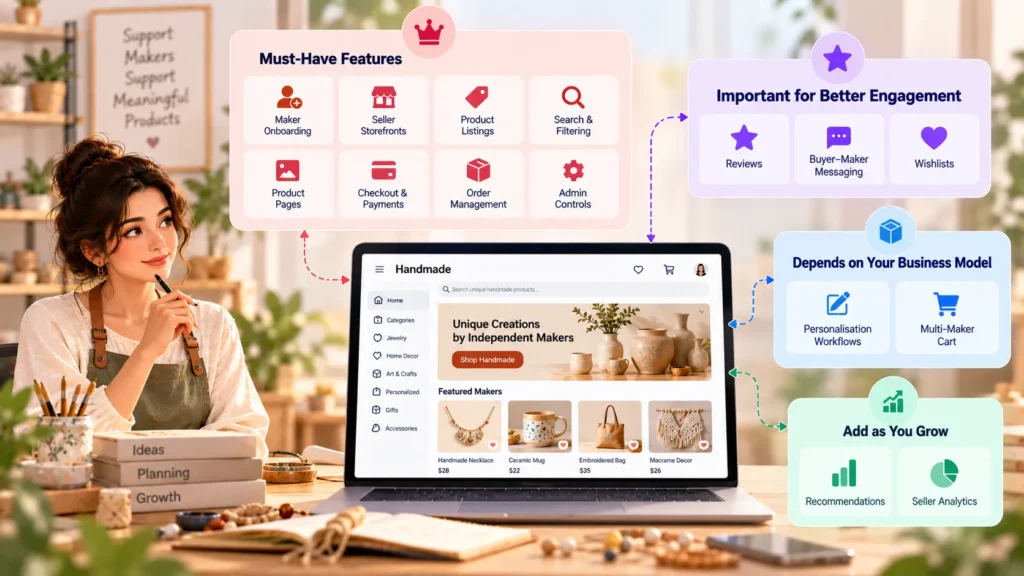
Not every marketplace needs every possible feature at launch.
Prioritization should follow the business model.
| Priority | Capability | Why It Matters |
|---|---|---|
| Essential | Maker onboarding | Creates marketplace supply |
| Essential | Seller storefronts | Gives makers identity and control |
| Essential | Product listings | Creates a structured catalogue |
| Essential | Search and filtering | Connects buyers with relevant products |
| Essential | Product pages | Supports product evaluation |
| Essential | Checkout and payments | Enables transactions |
| Essential | Order management | Keeps buyers and makers aligned |
| Essential | Admin controls | Lets the operator govern the marketplace |
| High | Reviews | Builds transaction confidence |
| High | Buyer-maker messaging | Supports questions and custom orders |
| High | Wishlists | Supports longer purchase journeys |
| Model-dependent | Personalisation workflows | Critical for bespoke products |
| Model-dependent | Multi-maker cart | Valuable when cross-shop purchasing is common |
| Growth-stage | Recommendations | Improves discovery as catalogue depth increases |
| Growth-stage | Seller analytics | Helps established makers optimize performance |
This framework is more useful than simply copying the feature set of a mature marketplace.
A niche marketplace for custom jewellery, for example, may need excellent personalisation and messaging from day one. A marketplace for ready-to-ship art prints may prioritize discovery, collections, favourites, and visual merchandising instead.
Founder Decision Signals: Choose Features Around Marketplace Behaviour
If makers sell highly customised products
Prioritize personalisation, attachments, buyer-maker messaging, production status, and detailed listing options.
If discovery is the main buyer challenge
Invest more heavily in taxonomy, filters, search quality, recommendations, collections, and favourites.
If you expect many small sellers
Make onboarding, listing creation, moderation, commissions, seller support, and payout administration operationally efficient.
If trust is the biggest barrier
Prioritize seller verification, reviews, clear policies, order history, dispute workflows, and marketplace moderation.
If repeat purchasing matters
Consider favourites, shop following, notifications, recommendations, promotions, and loyalty features after the transaction foundation is working reliably.
Features That Sound Impressive but Should Not Distract From the Core Marketplace
Feature ambition can become expensive when founders prioritize novelty before fixing basic marketplace workflows.
An AI recommendation engine will not compensate for poor product information.
Advanced seller analytics will not compensate for confusing order management.
A visually impressive mobile interface will not compensate for weak search.
Complex loyalty mechanics will not compensate for poor marketplace trust.
Before adding an advanced capability, ask:
- Does it remove a meaningful problem for makers or buyers?
- Does it increase operational complexity?
- Can the marketplace operate effectively without it initially?
- Does the current catalogue or transaction volume justify it?
- Will sellers actually use it?
Feature prioritization is ultimately a business decision, not a race to produce the longest specification.
How a Ready-Made Marketplace Foundation Changes Feature Planning
There are two broad ways founders can approach marketplace development.
One is to design and build every marketplace workflow from the beginning. That provides significant flexibility but also means seller onboarding, catalogues, search, checkout, order management, messaging, administration, and other foundations need to be designed, developed, integrated, and tested.
The other approach is to begin with a ready-made marketplace foundation and customize the parts that differentiate the business.
For founders evaluating an Etsy-like marketplace, Miracuves provides a ready-made solution designed around independent-seller commerce. The commercial solution page contains the detailed product scope, deployment information, and available marketplace capabilities, keeping those product-specific details separate from this feature-planning guide.
For applicable ready-made deployments, Miracuves offers a 6-day launch path, subject to the required branding, configuration, integrations, and customization scope.
The important strategic question is not simply whether ready-made or custom development sounds better.
It is:
Which parts of your marketplace genuinely differentiate your business, and which parts are standard infrastructure that simply need to work reliably?
That distinction can prevent founders from spending disproportionate time rebuilding standard marketplace mechanics while delaying the features that make their proposition unique.
Mistakes Founders Should Avoid When Planning Handmade Marketplace Features
Copying a mature marketplace feature for feature
A mature platform serves years of accumulated use cases. A new marketplace should prioritize the workflows required by its own makers, buyers, category, and operating model.
Treating sellers as ordinary product records
Independent makers need identities, storefronts, communication, order visibility, earnings information, and operational tools. The seller experience is part of the product.
Underestimating search taxonomy
Creative catalogues become difficult to navigate when categories, attributes, tags, and variations are inconsistent.
Ignoring moderation until the catalogue grows
Marketplace quality requires ongoing seller and listing governance. It is easier to establish those processes early than retrofit them after quality problems appear.
Building only for buyers
Beautiful product discovery does not solve seller onboarding, listing management, fulfilment, payouts, disputes, or operator administration.
Adding advanced features before fixing transaction basics
The first priority should be making the journey from maker onboarding to buyer purchase and successful fulfilment dependable.
Final Thoughts: Build Around Makers and Buyers, Not a Feature Checklist
The most useful handmade marketplace features are not necessarily the most technically impressive ones.
They are the capabilities that remove friction from the relationship between independent makers, buyers, and the marketplace operator.
Makers need a simple path from joining the platform to listing, communicating, selling, fulfilling, and understanding their earnings.
Buyers need a simple path from discovering something interesting to understanding the product and maker, asking questions, trusting the transaction, purchasing, and tracking what happens next.
Operators need enough control to maintain catalogue quality, manage marketplace activity, and resolve problems without turning every routine decision into a development task.
Once those three sides work together, advanced discovery, personalization, recommendations, loyalty, analytics, and automation can strengthen the marketplace rather than compensate for a weak foundation.
For founders who want to move from feature planning to an actual marketplace foundation, Miracuves offers a ready-made, white-label solution for independent-maker commerce with a 6-day deployment path where applicable.
FAQs
What features should a handmade marketplace platform include?
A handmade marketplace should generally include maker onboarding, individual seller storefronts, product listings, search and filters, rich product pages, buyer-maker messaging, reviews, checkout, order management, seller tools, and operator controls. Personalisation, multi-maker carts, recommendations, and other capabilities depend on the marketplace model.
What features are most important for independent makers?
Independent makers benefit most from straightforward onboarding, flexible product listings, storefront management, customer messaging, order visibility, personalisation support, and clear transaction or earnings records. The interface should minimize administrative work because many makers operate small businesses without dedicated ecommerce teams.
Why does a handmade marketplace need buyer-to-seller messaging?
Handmade products often generate questions about materials, dimensions, production time, colours, customisation, or bespoke requests. Messaging lets buyers clarify those details directly with makers while keeping the conversation connected to the marketplace transaction.
Should a handmade marketplace support custom orders?
If custom or made-to-order products are central to the niche, yes. The platform may need personalisation fields, configurable variations, buyer notes, messaging, attachments, or a more structured custom-order workflow depending on how complex the products are.
How important are reviews in an artisan marketplace?
Reviews are important because buyers are often purchasing from independent sellers they have never encountered before. Verified-purchase reviews, customer photos, written feedback, and seller responses can reduce uncertainty, while moderation tools help the operator protect the integrity of the review system.
Does every handmade marketplace need a multi-seller cart?
Not necessarily. It becomes more valuable when buyers frequently purchase from multiple makers during one shopping session. Founders should evaluate the convenience against the added complexity of seller-specific shipping, fulfilment, refunds, and order status.
Should a marketplace add AI features immediately?
Only when AI solves a defined user or operational problem. Listing assistance, search improvements, recommendations, or moderation support can be useful, but they should not take priority over reliable onboarding, catalogue management, discovery, checkout, order management, and marketplace trust.
How quickly can a ready-made handmade marketplace be launched?
Miracuves offers a 6-day deployment path for applicable ready-made marketplace solutions. The final scope depends on branding, integrations, configuration, and requested customization, so extensive custom development should be scoped separately.
Miracuves is an independent software development company. We are not affiliated with, connected to, sponsored by, or endorsed by any company or product named in this article.
Terms such as “X Clone” are used descriptively. It is how the software industry refers to building a platform with functionality comparable to a known service, and how clients search for it.
The entire design and codebase of our products is built by our own team. Our products contain no code, design, graphics, or content originating from any third-party website or applications.
All third-party names and marks referenced in this article are the property of their respective owners, referenced solely to identify the services discussed.