

Key Takeaways
- A handmade marketplace must balance quality seller supply, relevant buyer demand, and reliable operations.
- Seller acquisition creates value only when makers complete their shops, publish strong listings, and fulfil orders consistently.
- Curated collections, product stories, seasonal campaigns, and personalized discovery can attract high-intent buyers.
- Reviews, verified sellers, secure payments, order tracking, and transparent policies strengthen marketplace trust.
- Long-term growth depends on repeat purchases rather than continuous spending on first-time customer acquisition.
Marketplace Growth Signals
- Start with focused maker categories that can provide enough high-quality products for meaningful buyer choice.
- Track completed shop profiles, active listings, seller response times, order fulfilment, and seller retention.
- Improve product titles, images, descriptions, attributes, personalization details, and delivery information.
- Use wishlists, followed shops, cart reminders, recommendations, and occasion-based campaigns to encourage return visits.
- Measure conversion, repeat purchases, order value, seller activity, refunds, disputes, payouts, and category performance.
Real Insights
- Large seller numbers do not indicate growth when most shops remain incomplete or inactive.
- Increasing advertising spend will not solve weak listings, poor discovery, or missing buyer trust signals.
- Seller stories and product uniqueness can be stronger purchase drivers than discounts in handmade commerce.
- Marketplace growth becomes difficult when commissions, payouts, promotions, moderation, and disputes depend on manual work.
- Miracuves develops white-label handmade marketplaces with seller onboarding, catalogue management, buyer discovery, payments, commissions, analytics, admin controls, and source-code ownership.
A handmade marketplace does not grow like a normal ecommerce store.
In a traditional online store, the operator controls inventory, pricing, product presentation, fulfilment, and promotions. In a handmade marketplace, growth depends on many small sellers, each with their own product style, capacity, photography quality, customer communication, and fulfilment reliability.
That makes the growth challenge more complex. You are not only trying to bring buyers to a platform. You are also trying to attract the right makers, help them list better products, build buyer confidence, and create enough repeat purchase behavior to keep the marketplace healthy.
For founders, the real question is not just, “How do we get traffic?” The better question is, “How do we create a marketplace where makers want to sell, buyers want to return, and the platform can manage growth without becoming operationally heavy?”
This guide breaks down a practical handmade marketplace platform growth strategy for founders planning to build, launch, or scale a maker-led commerce platform.
Why Handmade Marketplace Growth Is Different From Generic Ecommerce Growth
A handmade marketplace is built around individuality. Buyers are not only searching for products. They are often looking for meaning, uniqueness, gifting value, craftsmanship, personalization, and connection with the maker.
This changes the growth model.
A generic ecommerce platform can compete through price, fast shipping, and wide inventory. A handmade marketplace usually wins through curation, trust, seller stories, niche communities, product uniqueness, and emotional buying triggers.
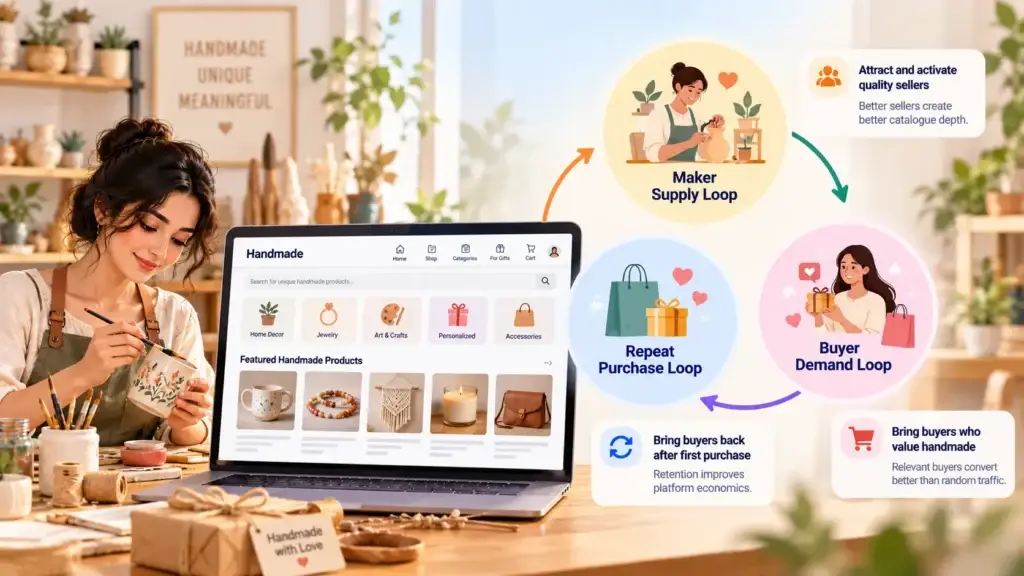
For founders, this means the platform cannot rely only on paid ads or discount campaigns. Growth has to come from three connected loops:
| Growth Loop | What It Means | Why It Matters |
|---|---|---|
| Maker Supply Loop | Attracting and activating quality sellers | Better sellers create better catalogue depth |
| Buyer Demand Loop | Bringing buyers who value handmade products | Relevant buyers convert better than random traffic |
| Repeat Purchase Loop | Bringing buyers back after first purchase | Retention improves platform economics |
If one loop is weak, the entire marketplace feels unbalanced. Too many sellers without buyers creates seller frustration. Too many buyers without enough quality listings creates poor discovery. First-time purchases without retention create constant pressure to spend on acquisition.
Read More: Handmade Marketplace Platform Features and Cost Factors: What Founders Should Evaluate Before Launch
Step 1: Attract Makers Before You Chase Mass Buyer Traffic
Many founders make the mistake of launching marketplace campaigns too early. They spend on buyer acquisition before the seller side is strong enough.
For a handmade marketplace, the first growth priority should be maker supply quality.
You need sellers who can create attractive listings, handle orders, communicate professionally, and maintain product consistency. A large number of inactive or low-quality sellers will not create marketplace value. A smaller group of active, well-presented makers can create a stronger early foundation.
Maker segments worth targeting first
A strong handmade marketplace can begin with focused seller groups such as:
- Local artisans with physical inventory
- Independent jewelry makers
- Home decor creators
- Custom gift sellers
- Digital product creators
- Print-on-demand artists
- Handmade fashion and accessory sellers
- Regional craft communities
- Small studios with limited but high-quality catalogues
The goal is not to onboard everyone. The goal is to build enough catalogue density in a focused category so buyers feel they have real choice.
What makes makers join a new marketplace?
Makers usually care about visibility, control, simplicity, and fair economics. They may not join a new platform just because it exists. They need a reason to believe the platform can help them sell without adding operational stress.
Founder decision signals:
- Can sellers create listings without technical help?
- Can they manage orders from one seller dashboard?
- Can they track payouts clearly?
- Can they promote products during seasonal campaigns?
- Can they tell their brand story through shop profiles?
- Can the platform operator support them without manual chaos?
This is where product infrastructure and growth strategy meet. Seller acquisition becomes easier when the platform gives makers practical tools to manage their shop.
Step 2: Build Seller Activation, Not Just Seller Signup
Seller signup is not the same as seller activation.
A seller is only useful to the marketplace when they complete profile setup, upload strong product listings, add pricing, configure shipping or fulfilment rules, respond to buyer messages, and stay active after the first few weeks.
A handmade marketplace should track activation milestones clearly.
| Seller Activation Milestone | Why It Matters |
|---|---|
| Shop profile completed | Builds buyer trust |
| First 5–10 products listed | Creates enough shop depth |
| Product photos uploaded | Improves conversion |
| Shipping or delivery rules added | Reduces order confusion |
| First response to buyer message | Builds platform reliability |
| First order fulfilled | Confirms seller readiness |
| Seller returns within 7 days | Shows early engagement |
A platform operator should not wait for sellers to figure everything out alone. The admin dashboard should help identify incomplete shops, low-quality listings, delayed responses, and sellers who need guidance.
Practical activation campaigns can include onboarding checklists, listing-quality tips, new seller webinars, seasonal catalogue drives, and early seller badges.
Step 3: Turn Product Listings Into Discovery Assets
In a handmade marketplace, every product listing is a marketing asset.
A plain listing with a weak title, poor images, and vague description will not perform, even if the product is good. A strong listing helps internal search, category browsing, recommendations, email campaigns, and social sharing.
The platform should encourage sellers to improve listing quality through structured fields and guidance.
Important listing elements include:
- Clear product title
- Category and subcategory
- Material details
- Handmade or customisation notes
- Dimensions or size options
- Delivery expectations
- High-quality images
- Personalization options
- Return or exchange notes
- Maker story or production context
This helps buyers understand what they are purchasing and why the item is worth choosing.
For the platform operator, structured listing data also improves filtering, search, recommendations, and campaign segmentation.
Step 4: Build Buyer Demand Around Intent, Not Just Traffic
Buyer acquisition should not be treated as “get everyone to the app.”
Handmade marketplace buyers usually arrive with specific intent. Some are shopping for gifts. Some want home decor. Some want custom products. Some want wedding items. Some want regional craft. Some want digital downloads. Some want something personal that does not feel mass-produced.
Your demand strategy should map campaigns to buyer intent.
| Buyer Intent | Growth Strategy |
|---|---|
| Gift shopping | Seasonal collections, gift guides, reminder campaigns |
| Home decor | Curated room-style collections and visual browsing |
| Custom products | Personalization filters and maker messaging |
| Regional craft | Location-led storytelling and artisan campaigns |
| Digital goods | Instant access, previews, and bundle offers |
| Wedding or event shopping | Collection pages, bulk order inquiry, saved items |
This approach builds better buyer relevance than broad advertising. Instead of saying “shop handmade products,” the platform can promote specific use cases such as personalized gifts, handmade decor, custom accessories, festival collections, or small-batch goods.
Step 5: Use Curation to Make the Marketplace Feel Alive
A handmade marketplace can easily become overwhelming if products are simply uploaded and displayed in chronological order.
Curation gives the platform editorial control.
Instead of relying only on search, the platform can guide buyers through themes, moods, seasons, occasions, and styles. This improves discovery and helps new sellers get visibility.
Useful curation formats include:
- New maker spotlight
- Trending handmade gifts
- Editor’s picks
- Festival collections
- Under-budget collections
- Personalized gift ideas
- Home decor by style
- Custom-made product collections
- Local maker campaigns
- Limited-time creator drops
Curation also gives the platform a reason to communicate with buyers beyond discounts. It makes the marketplace feel active, fresh, and human.
Step 6: Create Seller-Led Growth Loops
Every maker can become a distribution channel for the marketplace.
Creators often already have audiences on social platforms, messaging groups, local communities, and offline networks. A smart handmade marketplace helps sellers bring those audiences into the platform instead of leaving promotion entirely to the operator.
Seller-led growth features can include:
- Shareable shop links
- Product sharing buttons
- Seller referral campaigns
- Promo codes for individual shops
- Featured seller badges
- Social-ready product cards
- Seller analytics
- Shop follower updates
- Campaign participation dashboards
The platform benefits when makers promote their own shops because each seller brings a niche audience. Over time, these small audiences can become a meaningful acquisition engine.
However, seller-led growth only works when the platform makes sharing easy and gives makers a reason to invite buyers.
Step 7: Build Trust Before Asking Buyers to Purchase
Trust is one of the biggest barriers in a maker-led marketplace. Buyers may wonder whether the product will look like the photos, whether the seller will ship on time, whether customization will be handled correctly, or whether support will help if something goes wrong.
Trust signals should be built into the marketplace experience.
Important trust layers include:
- Verified seller profiles
- Product reviews with images
- Clear delivery timelines
- Buyer-to-seller messaging
- Transparent cancellation and refund policies
- Order tracking
- Secure payment flow
- Dispute management
- Seller response indicators
- Admin moderation for listings and reviews
For handmade products, trust also comes from storytelling. Buyers often want to know who made the product, how it is made, and what makes it different.
A strong marketplace gives sellers space to communicate that value without making the buying journey complicated.
Step 8: Use Personalization to Improve Buyer Retention
Handmade marketplace buyers often browse for inspiration before purchasing. They may save products, follow shops, compare styles, or return later for gifting occasions.
That means retention should begin before the first order.
Personalization features can include:
- Recently viewed products
- Saved items and wishlists
- Followed shops
- Similar product recommendations
- Price drop or restock reminders
- Cart recovery notifications
- Occasion-based reminders
- Personalized collections
- New arrivals from followed makers
The goal is not to spam buyers. The goal is to help them rediscover products they already showed interest in.
Repeat visits are especially important for handmade marketplaces because many purchases are seasonal, occasion-based, or emotionally triggered. A buyer who purchases a birthday gift may return later for weddings, festivals, home decor, or personalized gifts.
Step 9: Design Repeat Purchase Loops Around Occasions
Repeat purchases rarely happen by accident. They need planned triggers.
Handmade marketplaces can create repeat purchase loops around occasions, seasons, life events, and gifting behavior.
Examples include:
| Repeat Purchase Trigger | Marketplace Action |
|---|---|
| Birthday gifting | Reminder campaigns and personalized gift edits |
| Festivals | Seasonal collections and early-access campaigns |
| Home upgrades | Style-based decor recommendations |
| Weddings and events | Bulk inquiry and custom order flows |
| Buyer favorites a shop | New product alerts from that maker |
| Buyer purchases custom item | Follow-up recommendation for matching products |
| Cart abandonment | Gentle reminder with similar products |
A marketplace that understands buying cycles can reduce dependence on one-time acquisition campaigns.
This is where email, push notifications, in-app alerts, and personalized collections become valuable. They should be based on buyer behavior, not generic promotion blasts.
Step 10: Monetize Without Hurting Maker Trust
A handmade marketplace needs monetization, but the model should not make sellers feel punished for joining.
Common monetization options include:
- Commission on sales
- Seller subscription plans
- Featured product placement
- Sponsored listings
- Category promotion slots
- Delivery margin
- Value-added seller tools
- Premium analytics
- Custom shop branding options
The key is balance.
If monetization is too aggressive early, makers may hesitate to join. If the platform delays monetization completely, it may struggle to fund growth. A practical approach is to start with simple commissions and optional promotional tools, then introduce seller plans or premium features as the marketplace matures.
Founders should also make pricing transparent. Sellers need to understand what they pay, when they pay, and what value they receive.
Step 11: Track the Right Growth Metrics
Marketplace growth should be measured on both sides: sellers and buyers.
Traffic alone does not show marketplace health. A handmade platform can receive visitors and still fail if listings are weak, sellers are inactive, or buyers do not repeat.
Important seller-side metrics:
- Seller signup rate
- Seller activation rate
- Average listings per seller
- Active sellers per month
- Listing approval rate
- Seller response time
- Seller fulfilment rate
- Seller repeat listing activity
Important buyer-side metrics:
- Product view to cart rate
- Cart to purchase rate
- Search-to-product-click rate
- Wishlist usage
- Repeat purchase rate
- Average order value
- Review submission rate
- Buyer retention by cohort
Important operator-side metrics:
- Commission revenue
- Featured placement revenue
- Dispute rate
- Refund rate
- Support tickets per order
- Payout processing time
- Category-level performance
- Seller churn
These metrics help the founder understand whether the platform is actually improving or simply getting more visitors.
Step 12: Use Admin Control to Scale Without Operational Chaos
As a handmade marketplace grows, manual management becomes difficult.
The operator needs control over sellers, products, categories, payouts, commissions, promotions, moderation, disputes, and reports. Without admin control, growth creates more work instead of more leverage.
A strong admin layer should help the operator:
- Approve or reject sellers
- Review listings before publishing
- Manage categories and attributes
- Set commission rules
- Track orders and disputes
- Monitor seller performance
- Manage payouts and withdrawals
- Create promotional campaigns
- Review buyer complaints
- Export reports
- Control homepage collections
- Manage featured placements
This is why platform architecture matters. Growth strategy and product infrastructure cannot be separated. The marketplace must be built to support the operational reality of many small sellers.
Read More: Why Startups Choose a Ready-Made Handmade Marketplace Platform Over Custom Development
Founder Decision Signals for Handmade Marketplace Growth
Supply Quality
If sellers are joining but not listing good products, your marketplace has a seller activation problem, not only a marketing problem.
Buyer Demand
If traffic is arriving but conversion is weak, improve product discovery, trust signals, listing quality, and category curation before increasing ad spend.
Retention
If buyers purchase once and disappear, build saved shops, wishlists, occasion reminders, personalized recommendations, and post-purchase campaigns.
Operational Control
If every seller issue requires manual intervention, the admin dashboard needs stronger controls for moderation, payouts, commissions, reports, and disputes.
How Miracuves Helps Founders Launch Marketplace Platforms Faster
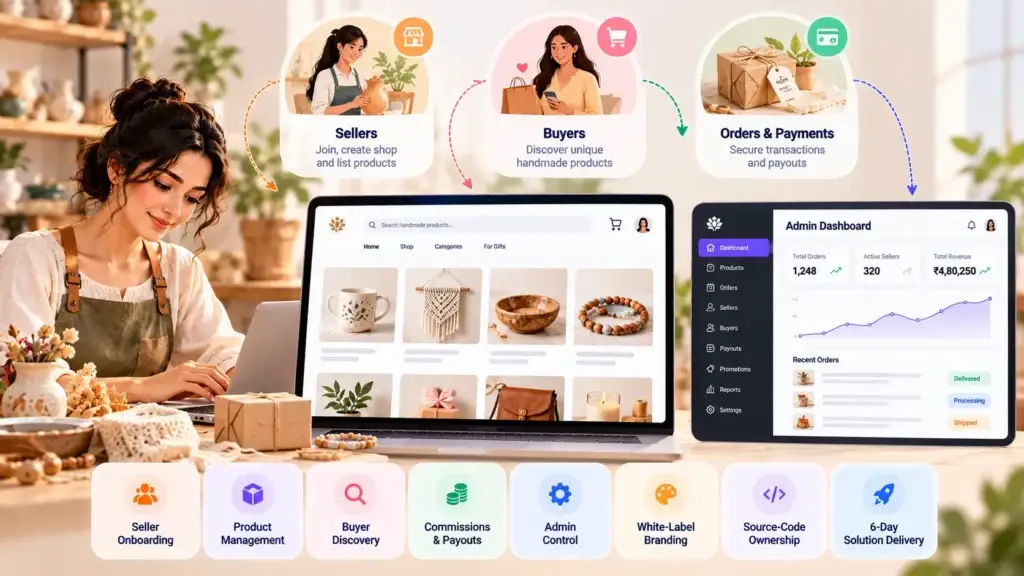
A handmade marketplace growth strategy becomes easier to execute when the platform foundation is already built for seller onboarding, catalogue management, buyer discovery, commissions, payouts, admin control, and promotional workflows.
Miracuves helps founders launch ready-made and white-label marketplace platforms with source-code ownership, branded design, admin dashboard, and faster deployment. For founders who do not want to spend months building core marketplace workflows from zero, a launch-ready foundation can make market validation faster and more practical.
With Miracuves, founders can focus more on growth, seller acquisition, buyer retention, and marketplace positioning instead of spending the early stage solving every technical workflow from scratch.
Key platform advantages include:
- Seller onboarding workflows that help makers register, create profiles, upload products, and manage their shop activity.
- Catalogue and product management for handmade items, categories, product details, pricing, inventory, and visual presentation.
- Buyer discovery features that support browsing, search, product filtering, curated collections, and personalized shopping journeys.
- Commission and payout controls to help marketplace operators manage seller earnings, platform revenue, and transaction visibility.
- Admin dashboard access for managing sellers, buyers, orders, products, promotions, disputes, reports, and platform activity.
- White-label branding so founders can launch the marketplace under their own brand identity.
- Source-code ownership for greater long-term flexibility, customization, and control.
- 6-day solution delivery where the ready-made scope matches the founder’s launch requirements.
If your goal is to build a maker-led marketplace, the strategic advantage is not only launching the app. It is launching with the operational controls needed to attract sellers, build buyer demand, and improve repeat purchase behavior over time.
Final Thoughts: Growth Comes From Balancing Makers, Buyers, and Operations
A handmade marketplace grows when three things work together: quality makers, motivated buyers, and strong platform operations.
Founders should not think of growth only as advertising. The better approach is to build a marketplace system where makers can onboard easily, listings are discoverable, buyers trust the platform, and repeat purchase loops bring people back.
The strongest handmade marketplace strategy is not about copying another platform’s surface-level tactics. It is about understanding why maker-led commerce works: personal products, seller stories, curated discovery, emotional buying intent, and operational trust.
FAQs
What is a handmade marketplace growth strategy?
A handmade marketplace growth strategy is a plan for attracting quality makers, building buyer demand, improving product discovery, increasing trust, and encouraging repeat purchases. It includes seller onboarding, catalogue quality, buyer acquisition, personalization, retention, and marketplace operations.
How do you attract sellers to a handmade marketplace?
Start with focused seller segments such as local artisans, custom gift makers, digital creators, home decor makers, or regional craft sellers. Offer simple onboarding, seller dashboards, clear commission rules, promotional tools, and visibility opportunities.
How do handmade marketplaces attract buyers?
They attract buyers through curated collections, seasonal campaigns, gift guides, personalized recommendations, product storytelling, social sharing, and strong trust signals such as reviews, seller profiles, secure payments, and clear delivery information.
What features help increase repeat purchases in a marketplace app?
Saved shops, wishlists, recently viewed products, personalized recommendations, cart reminders, new product alerts, occasion-based campaigns, and post-purchase communication can help improve repeat purchases.
Why is seller activation important for marketplace growth?
Seller activation ensures that sellers do more than sign up. Activated sellers complete profiles, upload quality listings, respond to buyers, fulfil orders, and continue using the platform. Without activation, seller acquisition does not create marketplace value.
What monetization models work for handmade marketplaces?
Common monetization models include sales commission, seller plans, featured listings, sponsored placements, category promotion, delivery margin, premium analytics, and custom shop branding tools.
Why does a handmade marketplace need an admin dashboard?
An admin dashboard helps the operator manage sellers, listings, categories, commissions, payouts, disputes, reports, promotions, and moderation. Without strong admin control, marketplace operations become difficult as the seller base grows.
Can Miracuves help launch a handmade marketplace faster?
Yes. Miracuves helps founders launch ready-made and white-label marketplace platforms with source code, branded design, admin dashboard, and faster deployment, including 6-day solution delivery where the ready-made scope fits the business requirement.
Miracuves is an independent software development company. We are not affiliated with, connected to, sponsored by, or endorsed by any company or product named in this article.
Terms such as “X Clone” are used descriptively. It is how the software industry refers to building a platform with functionality comparable to a known service, and how clients search for it.
The entire design and codebase of our products is built by our own team. Our products contain no code, design, graphics, or content originating from any third-party website or applications.
All third-party names and marks referenced in this article are the property of their respective owners, referenced solely to identify the services discussed.