Key Takeaways
- Fractional real estate investment platform architecture should connect property, investment, ownership, money, and exit workflows throughout the complete investment lifecycle.
- The core architecture should distinguish property records, investment structures, subscriptions, ownership registers, wallets, and financial ledgers rather than combining them into a single balance or record.
- Investment amounts should be connected to specific units or interests, while ownership should only be finalized after required funding, eligibility, agreement, and allocation conditions are satisfied.
- Rental income, expenses, reserves, distributions, transfers, and exits require connected financial and ownership records so every transaction can be explained and reconciled.
- A scalable platform should support historical ownership, multi-currency transactions, distribution batches, secondary transfers, role-based permissions, idempotency, audit trails, and explicit financial workflows.
Architecture Signals
- Core entities should include property, investment structure, share class or units, investor, subscription, ownership position, ledger entries, distributions, transfers, and exits.
- A wallet should represent liquid or transactional money, while the ownership register represents investment holdings and the ledger explains financial movements.
- Distribution workflows should connect property income and expenses to eligible holders, calculate entitlements, apply applicable FX, obtain approvals, post ledger entries, and generate statements.
- Secondary-market transactions require coordinated funding and ownership transfer so the buyer’s payment and seller’s ownership change do not become disconnected events.
- API actions involving subscriptions, funding, allocations, withdrawals, distributions, transfers, and exits should use explicit state transitions, validation, permission checks, and idempotency.
Real Insights
- A property listing and payment button are not enough; the architecture must explain exactly what an investor owns, when ownership became effective, and how money moved.
- Overwriting ownership balances can destroy historical information, so allocation and transfer events should remain reconstructable.
- Rental income is not automatically distributable income because operating expenses, reserves, financing, fees, and other obligations may affect the amount available to investors.
- Adding a secondary-market screen does not automatically create liquidity; eligibility, funding, settlement, ownership transfer, and applicable legal controls are also required.
- The strongest architecture path is: model property → define investment structure → onboard investors → create subscriptions → confirm funding and conditions → allocate ownership → track property economics → calculate distributions → manage transfers → process exits → preserve the complete investment history.
A fractional real estate investment platform may look simple from the investor’s side.
Browse a property. Choose an investment amount. Fund an account. Receive rental income. Sell later.
But behind that journey is a much more complicated system.
The platform needs to know exactly which property the investor is participating in, what ownership interest was issued, how much money settled, which share class applies, how rental income is calculated, how expenses affect distributions, what happens when an investor sells, and how the ownership register changes afterward.
That is why fractional property software cannot be designed as a property-listing website with a payment button added to it.
Its core architecture has to connect five things reliably:
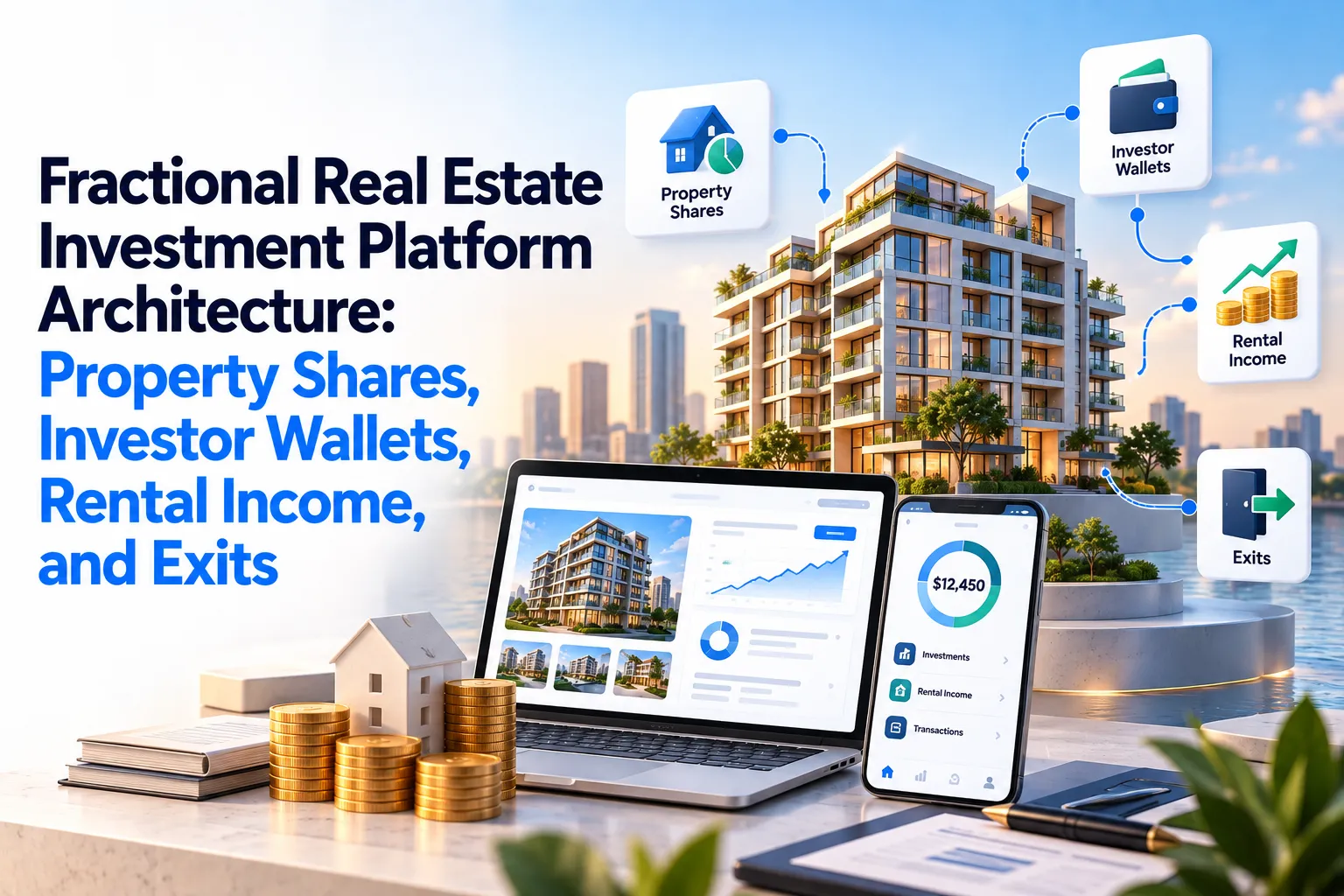
Property → Investment → Ownership → Money → Exit
If any one of those layers becomes disconnected, problems appear in investor statements, portfolio balances, distributions, reconciliation, transfers, and audit history.
For founders, the right architecture is therefore less about creating attractive investment cards and more about building a system that can explain every ownership and money movement throughout the investment lifecycle.
Founders exploring a broader launch-ready approach can also review Miracuves’ white-label fractional real estate platform to understand how property investment, ownership, wallet, distribution, and exit workflows can operate inside one system.
What Is Fractional Real Estate Investment Platform Architecture?
Fractional real estate platform architecture is the system design that connects investors to specific property-backed investment interests and maintains accurate records throughout the investment lifecycle.
At a high level, the platform needs several connected layers:
- Property sourcing and underwriting
- Property and investment structure
- Investor onboarding
- Subscription and payment
- Share allocation
- Ownership register
- Investor wallet and financial ledger
- Rental servicing
- Distribution calculation
- Portfolio reporting
- Secondary transfers
- Whole-property exit
Each layer has a different responsibility.
The mistake is trying to collapse several layers into one.
For example:
Wallet balance is not ownership.
Investment amount is not necessarily settled ownership.
Rental income is not automatically distributable cash.
A marketplace listing is not a completed exit.
A strong architecture maintains these distinctions while connecting the records behind them.
The Core Domain Model: Property, Investment, Ownership, and Money
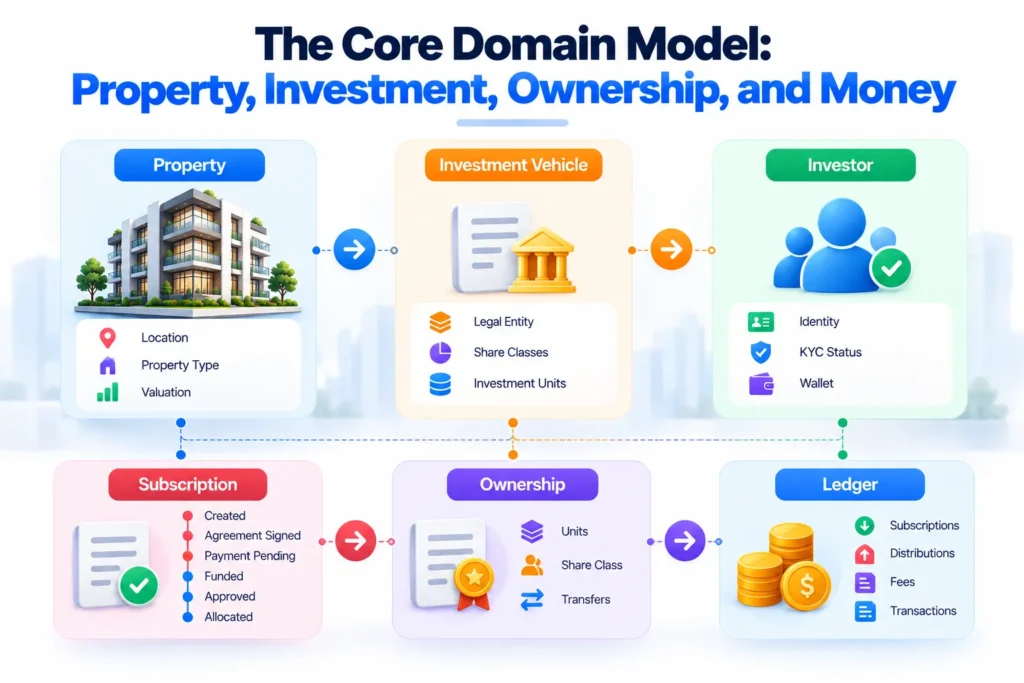
The platform should begin with a clear domain model.
At minimum, founders need to think about several core entities.
Property
The underlying real estate asset.
It may contain:
- Address
- Property type
- Acquisition value
- Valuation
- Bedrooms or units
- Occupancy
- Rental assumptions
- Actual rental income
- Expenses
- Documents
- Images
- Financing
- Exit assumptions
Investment Vehicle or Ownership Structure
This defines how investors participate economically or legally.
Depending on the structure and jurisdiction, that may involve:
- A property-specific legal entity
- Share classes
- Investment units
- Membership interests
- Securities
- Other ownership or economic interests
Investor
The person or entity participating.
The investor record may connect to:
- Identity
- KYC status
- Country
- Suitability
- Wallet
- Holdings
- Agreements
- Distributions
- Tax information
- Exit history
Subscription
The investor’s request to purchase a specific amount of an investment.
It may move through statuses such as:
Created → agreement signed → payment pending → funded → approved → allocated
Ownership
The durable record of what the investor actually holds.
Ledger
The financial record showing how money moved.
These entities are related, but they should not be interchangeable
Founders who want to see how property records, investor wallets, ownership registers, rental distributions, and exit workflows connect in a working product can review these fractional property platform features..
Property Shares: How Fractional Ownership Should Be Represented
The investor interface may show a simple number such as:
Investment: $10,000
But the backend needs to answer a deeper question:
What did that $10,000 buy?
Suppose a property investment has 100,000 available units at $10 each.
An investor who settles $5,000 may receive:
500 units
The platform should record the relationship between:
- Property
- Ownership structure
- Share class
- Investor
- Subscription order
- Units allocated
- Price per unit
- Allocation date
- Certificate or evidence
This is much stronger than recording only:
Investor A invested $5,000.
The investment amount explains the transaction.
The ownership record explains the investor’s position.
Why Share Classes Matter
Not every investor necessarily has identical rights.
A platform may eventually need multiple share classes with different:
- Distribution rights
- Voting rights
- Transfer restrictions
- Fees
- Eligibility rules
- Investment minimums
- Holding periods
- Redemption rules
Even if the first launch uses one class, architecture should avoid assuming that one property can only ever have one type of investor interest.
This matters because retrofitting share-class logic after thousands of ownership records already exist can become difficult.
Subscription Is Not the Same as Ownership
A critical architecture principle is separating subscription intent from settled ownership.
An investor may click “Invest” before:
- KYC has completed
- The subscription agreement is signed
- Funds have settled
- Eligibility checks pass
- The investment closes
- Allocation is approved
Creating ownership immediately at button-click creates problems.
A safer flow is:
Investor chooses amount
↓
Subscription order created
↓
Investor signs required documents
↓
Funding confirmed
↓
Required checks complete
↓
Allocation executes
↓
Ownership register updated
↓
Certificate or evidence issued
That sequence helps prevent failed or duplicate payments from creating incorrect investor positions.
Investor Wallet Architecture: Money Is Not Ownership
Investor wallets are useful, but they are easy to implement badly.
A wallet may support:
- Deposits
- Available cash
- Pending investment funds
- Rental distributions
- Sale proceeds
- Withdrawal requests
- FX conversion
- Fees
- Refunds
But the wallet should not determine how many property units an investor owns.
Consider an investor with:
- Wallet balance: $3,000
- Property A holding: $15,000
- Property B holding: $8,000
The investor’s total financial relationship with the platform is not represented by one wallet number.
The wallet shows liquid or transactional money.
The portfolio shows investment positions.
The ownership register proves holdings.
The ledger explains the financial movements.
These systems should work together without becoming the same database field.
Why a Double-Entry Ledger Matters
Investment platforms deal with more than simple incoming and outgoing payments.
One transaction may affect:
- Investor cash
- Platform clearing
- Property investment capital
- Fees
- Rental distributions
- Withdrawals
- FX adjustments
- Secondary-market settlement
A double-entry ledger helps ensure that every financial movement has corresponding entries.
For example, when an investor funds $5,000:
Investor cash account +$5,000
needs a corresponding entry representing where that money came from or is held.
Likewise, when $500 is distributed, the platform should be able to explain:
- Which property generated it
- Which distribution batch produced it
- Which investor was entitled to it
- Which currency applied
- Which ledger accounts changed
- Whether it has been paid or remains pending
Balances should ideally be derived from transaction records rather than maintained only as editable values.
Multi-Currency Wallets Add Another Layer
Cross-border fractional property platforms become more complicated when the asset and investor operate in different currencies.
An investor may:
- Earn salary in AED
- Invest in an AED-denominated property
- View portfolio analytics in GBP
- Receive a distribution converted to GBP
Another investor may hold the same property but report in USD.
The architecture therefore needs to distinguish:
- Property base currency
- Subscription currency
- Wallet currency
- Distribution currency
- FX quote
- FX execution rate
- Reporting currency
A currency selector in the frontend does not solve this.
The system needs financial records that explain exactly which rate was used when actual money moved.
Property Architecture: More Than a Listing Page
A fractional property record has to serve several teams at once.
Marketing may need:
- Property images
- Location
- Description
- Expected yield
- Investment minimum
Underwriting may need:
- Acquisition cost
- Rental history
- Occupancy
- Debt
- Expenses
- Valuation
- Risk assumptions
Finance may need:
- Rent received
- Operating expenses
- Reserves
- Distribution history
Compliance may need:
- Offering documents
- Ownership evidence
- Investor eligibility requirements
Property operations may need:
- Tenancy
- Lease records
- Maintenance
- Work orders
A strong architecture creates one authoritative property record rather than forcing every team to maintain a separate spreadsheet.
Rental Income Architecture: From Tenant Payment to Investor Distribution
One of the most important workflows is converting property operations into investor income.
Investors may see a simple notification:
Rental distribution received
But the system behind that notification should know how the amount was calculated.
A simplified flow may look like:
Rent received
↓
Property income recorded
↓
Operating expenses deducted
↓
Management or servicing fees applied
↓
Reserves accounted for
↓
Amount available for distribution determined
↓
Investor entitlements calculated
↓
Approval workflow completed
↓
Ledger entries posted
↓
Investor wallet credited or payout released
That workflow should be repeatable and auditable.
For founders modelling management fees, property income, distributions, secondary transactions, and platform revenue, this fractional property investment business model guide explains the commercial layer in more detail.
Rental Income Is Not the Same as Distributable Income
If a property generates $100,000 in rent, that does not necessarily mean investors should receive $100,000.
Property expenses may include:
- Management fees
- Maintenance
- Insurance
- Taxes
- Repairs
- Financing
- Vacancy
- Legal/accounting costs
- Reserves
A simplified calculation might be:
Gross rental income
– operating costs
– reserves
– financing costs
– applicable fees
= amount potentially available for distribution
The actual calculation depends on the legal investment terms and operating model.
Software should therefore distinguish:
- Gross income
- Net operating income
- Distributable amount
- Distributed amount
- Pending amount
Distribution Batching: Why It Matters
A platform with hundreds or thousands of investors should not calculate every payment manually.
Distribution batching allows finance teams to process one property period as a controlled operation.
A distribution batch may include:
- Define the property and period.
- Import or confirm property income.
- Confirm expenses.
- Determine distributable amount.
- Identify eligible holders.
- Calculate entitlements.
- Apply FX where appropriate.
- Review exceptions.
- Obtain approvals.
- Post ledger entries.
- Release payouts or wallet credits.
- Generate investor statements.
This workflow becomes particularly important when ownership can change between distribution periods.
The platform has to know who was entitled to income for the relevant period, not simply who owns units today.
Ownership Register Architecture
The ownership register should answer:
Who owns what right now?
But it should also be capable of answering:
Who owned what three months ago?
That historical question becomes important for:
- Distributions
- Investor statements
- Secondary transfers
- Voting
- Audits
- Tax records
- Disputes
An append-only event model can be useful because it records changes instead of overwriting history.
For example:
- Investor A receives 500 units.
- Investor A later sells 200.
- Investor B receives 200.
The system should not simply change:
A = 500
to:
A = 300
It should preserve the allocation and transfer events that explain why the current balance is 300.
Investor Portfolio Architecture
The portfolio is a read model built from deeper records.
It may show:
- Current property holdings
- Units held
- Acquisition cost
- Estimated valuation
- Rental income received
- Cash available
- Pending distributions
- Certificates
- Diversification
- Currency exposure
- Exit availability
The portfolio should not become another independent source of truth.
It should be calculated from:
- Ownership records
- Property values
- Ledger activity
- Distribution history
- FX data
That prevents portfolio totals from drifting away from financial or ownership records.
How Secondary-Market Exits Work
Fractional property investment becomes more attractive when investors have some path to exit before the whole property is sold.
One possible mechanism is a secondary marketplace.
A simplified flow can be:
- Investor chooses an eligible holding.
- Platform checks transfer restrictions.
- Investor creates a listing.
- Buyer reviews the investment information.
- Buyer submits or accepts an offer.
- Eligibility checks run.
- Buyer funds the transaction.
- Payment settlement is confirmed.
- Ownership transfers.
- Seller proceeds are credited.
- Register and portfolio records update.
The critical step is number nine.
A secondary trade is not complete merely because money moved.
Ownership must also move.
Atomic Ownership Transfer Prevents Partial Failure
Secondary transfers create a dangerous technical scenario:
Buyer pays, but ownership does not update.
Or:
Ownership changes, but payment fails.
That is why financial settlement and ownership transfer should be coordinated carefully.
A robust architecture aims to make the transaction effectively atomic from the platform’s perspective.
Either:
Payment settlement + ownership transfer succeed
or:
Neither is finalized
The actual legal and financial settlement arrangement will depend on the operator’s jurisdiction, provider relationships, and regulatory model.
Scheduled Exit Windows vs Open Secondary Markets
Not every platform needs continuous trading.
Possible liquidity structures include:
- Open listings
- Periodic secondary windows
- Redemption periods
- Operator-facilitated sales
- Whole-property exits
Each model creates different requirements.
Open marketplace
Needs:
- Listings
- Offers
- Pricing
- Buyer checks
- Trade settlement
Scheduled windows
Needs:
- Eligibility dates
- Cutoff periods
- Queue rules
- Pricing mechanism
- Allocation logic
Whole-property exit
Needs:
- Sale approval
- Investor voting where applicable
- Asset disposition
- Liability settlement
- Final distribution
The architecture should match the business model rather than adding a marketplace screen because “liquidity” sounds attractive.
Whole-Property Exit Architecture
Eventually, the asset itself may be sold.
That produces a different exit flow.
A simplified sequence:
- Operator proposes property sale.
- Required governance approval occurs.
- Sale executes.
- Debt and transaction costs are settled.
- Remaining property obligations are paid.
- Net proceeds are determined.
- Investor entitlements are calculated.
- Final distribution runs.
- Ownership positions close.
- Property status changes to exited.
- Investor statements retain the full history.
The investment should remain visible historically even after it is no longer active.
An investor should be able to see:
- Amount originally invested
- Units acquired
- Rental distributions received
- Transfers
- Final exit proceeds
- Total investment history
Platform Architecture by System Layer
Core Architecture Layers of a Fractional Property Platform
| Architecture Layer | Primary Responsibility | Key Records |
|---|---|---|
| Property Layer | Stores asset data, underwriting, rental economics, documentation, and operations. | Property, valuation, tenancy, expenses, documents |
| Investment Layer | Defines investment structure, share classes, subscription rules, and eligibility. | Offering, share class, subscription, agreement |
| Ownership Layer | Tracks investor holdings and ownership changes over time. | Allocation, certificate, transfer, ownership register |
| Money Layer | Records deposits, subscriptions, fees, distributions, FX, withdrawals, and exits. | Ledger entry, wallet transaction, payout, FX quote |
| Servicing Layer | Connects rental operations and property expenses to investor distributions. | Rent receipt, expense, reserve, distribution batch |
| Liquidity Layer | Supports secondary listings, transfers, redemption, or whole-property exits. | Listing, offer, transfer, redemption, exit |
| Compliance Layer | Supports identity, suitability, evidence, approvals, and audit history. | KYC case, evidence, suitability result, audit log |
API Architecture: Keep Investment Events Explicit
The API layer should represent investment events clearly rather than hiding every action behind generic update endpoints.
Conceptually, workflows may need operations such as:
POST /subscriptions
POST /subscriptions/{id}/sign
POST /subscriptions/{id}/fund
POST /subscriptions/{id}/allocate

POST /wallets/deposits
POST /wallets/withdrawals

POST /distributions
POST /distributions/{id}/calculate
POST /distributions/{id}/approve
POST /distributions/{id}/execute

POST /secondary/listings
POST /secondary/offers
POST /secondary/transfers

POST /properties/{id}/exit
The exact implementation will vary, but explicit actions make it easier to enforce:
- Permission checks
- Idempotency
- Approval workflows
- Audit logs
- State transitions
- Validation
Investment platforms should be careful with generic endpoints that allow sensitive financial states to be edited directly.
Idempotency Matters for Money and Ownership
External systems retry requests.
Payment gateways retry callbacks.
Users double-click.
Mobile connections drop.
If the same successful payment notification is processed twice, a poorly designed platform could:
- Credit a wallet twice
- Allocate shares twice
- Generate duplicate certificates
- Pay a distribution twice
Sensitive write operations therefore need idempotency protection.
A transaction should have a stable identifier so repeated delivery of the same event does not create a second economic outcome.
This is especially important for:
- Funding
- Subscription settlement
- Allocation
- Withdrawals
- Distributions
- Secondary transfers
Role-Based Admin Architecture
Fractional property investment requires several operational roles.
Possible users include:
- Investor support
- Property underwriting
- Investment committee
- Property operations
- Compliance
- Finance
- Settlement
- Customer support
- Platform administration
They should not automatically receive the same permissions.
For example:
Property operations may update tenancy and maintenance but should not approve investor withdrawals.
Finance may review distribution batches but should not alter KYC evidence.
Compliance may review investor cases but should not change property valuation assumptions.
Support may inspect an investor transaction but should not alter the financial ledger.
This is why role-based access control is part of architecture, not an admin-panel afterthought.
Founder Decision Signals
Ownership Model
If users invest in identified properties, define exactly what constitutes ownership, when it becomes effective, and how every change is recorded before designing portfolio screens.
Wallet Complexity
If investors can deposit, receive rent, convert currencies, withdraw, and fund secondary purchases, use a transaction-led ledger rather than treating the wallet as one editable balance.
Distribution Operations
If rental payouts are recurring, design batch calculation, review, approval, execution, and statement generation as a repeatable finance workflow.
Exit Model
Decide whether liquidity comes from secondary listings, scheduled windows, redemption, or whole-property sales because each option creates a different ownership and settlement architecture.
Mistakes Founders Should Avoid
Using Wallet Balance as the Ownership Record
Cash and property holdings are different assets. Wallet transactions should not replace a dedicated ownership register showing the investor’s actual property interests.
Allocating Shares Before Funding Settles
An investment order can exist before payment, eligibility, or closing conditions are complete. Ownership should only update after the required settlement conditions have been satisfied.
Overwriting Ownership Instead of Recording Transfers
Changing a unit total without preserving the underlying allocation and transfer events makes historical reconciliation difficult.
Calculating Rental Distributions Manually
Spreadsheet-based distribution processing becomes risky as properties, currencies, expenses, share classes, and ownership changes increase.
Calling a Listing Screen a Secondary Market
A genuine secondary-transfer workflow also needs eligibility checks, funding, settlement, ownership transfer, audit history, and appropriate legal controls.
Treating Regulatory Requirements as a Software Feature
KYC, suitability, audit trails, and approval workflows can support an operating model, but licensing, investor rules, custody requirements, securities treatment, and permission to raise capital depend on jurisdiction and professional advice.
Architecture Checklist Before Launch
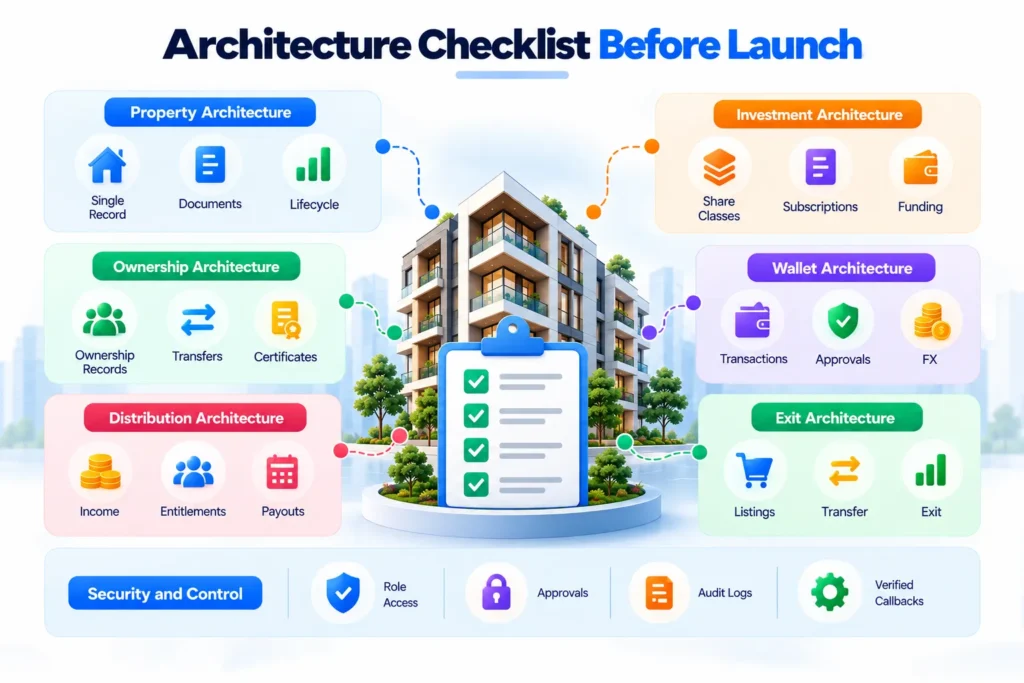
Before launching a fractional real estate investment platform, founders should confirm:
Property architecture
- Every property has one authoritative record.
- Underwriting data remains connected to the asset.
- Rental income and expenses can be recorded.
- Property documentation is versioned.
- Property status tracks the full lifecycle.
Investment architecture
- Share classes or units are defined.
- Subscription states are explicit.
- Funding and allocation are separate steps.
- Investor agreements remain attached to the transaction.
Ownership architecture
- Allocations create durable records.
- Ownership history is preserved.
- Transfers are traceable.
- Certificates can be linked to current holdings.
- Historical ownership can be reconstructed.
Wallet architecture
- Deposits are recorded as transactions.
- Withdrawals require appropriate approvals.
- Rental income is linked to distributions.
- FX conversions store actual transaction rates.
- Wallet balances derive from ledger activity.
Distribution architecture
- Rental income and expenses are recorded.
- Eligible investors are identified for each period.
- Entitlements are calculated systematically.
- Finance approval is logged.
- Distribution execution creates ledger records.
- Statements can be generated.
Exit architecture
- Secondary listing eligibility is defined.
- Buyer and seller checks exist.
- Funding and ownership transfer are coordinated.
- Scheduled exit windows can be supported where needed.
- Whole-property sales close positions cleanly.
Security and control
- Role-based access is enforced.
- Money-moving actions require stronger approval.
- Audit trails record sensitive changes.
- Provider callbacks are verified.
- Sensitive operations are idempotent.
How Miracuves Supports Fractional Property Platform Architecture
Miracuves provides a ready-made fractional property investment platform foundation connecting property records, subscriptions, share allocation, ownership registers, multi-currency wallets, financial ledgers, rental servicing, distribution batches, secondary-market workflows, and operator controls.
For founders evaluating a launch-ready product, Miracuves’ fractional property investment platform foundation provides a practical reference for how property, investor, ownership, money, and exit workflows can sit inside one connected system.
For founders comparing budget, integrations, wallet logic, ownership workflows, compliance modules, and rollout scope, this guide to fractional property platform development cost explains the main factors that can influence pricing.
If you are also evaluating implementation teams, this guide on choosing a fractional property platform development partner can help you review technical capability, customization, architecture, and operational support before selecting a team.
The current platform uses ledger-derived wallet balances, property-level investment records, an append-only ownership register, distribution batching, rent-roll workflows, multi-currency support, and secondary transfers rather than treating these capabilities as disconnected modules.
Where the standard ready-made scope fits the project, Miracuves can support 6-day solution delivery.
Live payment providers, KYC services, jurisdiction-specific requirements, security hardening, operating permissions, and compliance configuration should still be scoped around the target business and market.
Final Thoughts: The Real Architecture Connects Ownership and Money
The visible property catalogue is only the front door of a fractional real estate investment platform.
The difficult architecture sits underneath it.
A reliable system needs to know:
Which property is being invested in?
What units or rights were issued?
When did ownership become effective?
Where did investor money move?
How was rental income calculated?
Who was entitled to each distribution?
How did ownership change after a secondary sale?
What happened when the property exited?
Those questions should be answerable from connected platform records rather than reconstructed later from spreadsheets.
Businesses exploring broader investment products can also review Miracuves’ investment platform solutions for related wealth, asset-backed, and digital investment models.
For founders, the strongest architecture separates ownership, wallets, financial ledgers, rental servicing, and exits while keeping them synchronized through explicit workflows.
That is what turns a fractional property website into an actual investment operations platform.
FAQs
What is fractional real estate investment platform architecture?
It is the technical and operational system that connects property records, investment structures, investor subscriptions, ownership records, wallets, financial ledgers, rental distributions, secondary transfers, and property exits.
Is an investor wallet the same as property ownership?
No. A wallet tracks money such as deposits, distributions, sale proceeds, and withdrawals. Ownership should be maintained separately through a register or equivalent record showing the investor’s units or interests.
How are fractional property shares recorded?
After the required subscription, funding, and eligibility conditions are satisfied, the platform can create an allocation showing the investor, property investment, share class, units, acquisition event, and related certificate or evidence.
How does rental income reach investors?
Rental income is recorded against the property, relevant operating expenses and reserves are accounted for, the amount available for distribution is determined, investor entitlements are calculated, approvals occur, and the resulting amounts are posted to the financial ledger and paid or credited.
Why does a fractional property platform need a financial ledger?
A ledger provides a traceable record of deposits, investments, fees, rental distributions, withdrawals, FX conversion, sale proceeds, and secondary transfers. It makes balances and transactions easier to reconcile.
How do investors exit fractional property investments?
Possible routes include secondary-market transfers, scheduled liquidity windows, redemption mechanisms, operator-facilitated exits, or a whole-property sale. The exact mechanism depends on the investment terms, market model, and applicable rules.
How does a secondary property sale affect ownership?
A completed secondary transfer should update both money records and ownership records. The seller’s eligible units reduce, the buyer receives them, and the ownership history should preserve the transfer event.
Can a secondary marketplace guarantee liquidity?
No. A marketplace can provide a mechanism for eligible investors to offer interests for sale, but liquidity depends on buyer demand, transfer restrictions, investment terms, applicable rules, and market conditions.
What should founders build first?
Start with a reliable property record, subscription workflow, ownership model, ledger, and distribution logic. Secondary-market features are much easier to add when the ownership and financial foundations are already trustworthy.
Can Miracuves support this architecture?
Yes. Miracuves’ ready-made fractional property investment platform includes property records, subscription workflows, ownership records, investor wallets, ledger-backed financial activity, rental servicing, distribution workflows, and secondary-market functionality. A 6-day delivery may apply where the standard ready-made scope fits the project.
Miracuves is an independent software development company. We are not affiliated with, connected to, sponsored by, or endorsed by any company or product named in this article.
Terms such as “X Clone” are used descriptively. It is how the software industry refers to building a platform with functionality comparable to a known service, and how clients search for it.
The entire design and codebase of our products is built by our own team. Our products contain no code, design, graphics, or content originating from any third-party website or applications.
All third-party names and marks referenced in this article are the property of their respective owners, referenced solely to identify the services discussed.