Key Takeaways
- How SPVs work in real estate crowdfunding depends on creating a separate legal entity that connects a property with investors and their legally defined ownership or economic interests.
- A property-specific SPV can keep the asset, investors, ownership records, income, expenses, distributions, documents, and exit events connected within one structure.
- Investors may hold shares, membership interests, partnership interests, units, or other legally defined interests rather than directly holding a portion of the property’s title.
- The platform should connect investor onboarding, subscriptions, payments, ownership allocation, distributions, transfers, and property exits to the relevant SPV records.
- The exact legal structure, investor rights, securities requirements, tax treatment, and transfer rules depend on the jurisdiction and offering documents, so software should support rather than replace professional legal and compliance advice.
SPV Signals
- An SPV should have a durable identity connected to its legal entity information, jurisdiction, property, share classes, governing documents, investors, transactions, and status.
- Investment units or share classes may define subscription amounts, unit prices, minimum investments, voting rights, distribution rights, eligibility, and transfer restrictions.
- Ownership records should preserve investor, SPV, share class, units, acquisition date, certificates, transfers, and current position.
- Property income and expenses should flow through the SPV structure before eligible investor distributions are calculated according to the applicable terms.
- Investor ownership and financial movements should remain connected but distinct: the ownership register answers who owns what, while the financial ledger records where money moved.
Real Insights
- An SPV is not simply a field attached to a property page; it should function as a connected platform object linking the property, investors, ownership, documents, finance, distributions, and exits.
- An investment contribution does not automatically define legal ownership. The platform should connect settled subscriptions to the actual units, shares, or interests issued under the offering.
- Ownership changes should be recorded as historical events so additional purchases, transfers, and exits can be reconstructed without losing the original record.
- A property sale can require sale proceeds, liabilities, transaction costs, investor entitlements, final distributions, ownership updates, and SPV wind-down to be recorded as connected events.
- The core SPV workflow is: underwrite property → create SPV → define interests → onboard eligible investors → receive subscriptions → confirm funds → allocate ownership → operate property → calculate distributions → manage transfers or exit → preserve the complete investment history.
A property page may show investors the building, projected income, minimum investment, location, valuation, and expected holding period.
But that page does not answer the most important ownership question:
What exactly does the investor own after investing?
In many property-backed crowdfunding models, the answer involves a special purpose vehicle, or SPV.
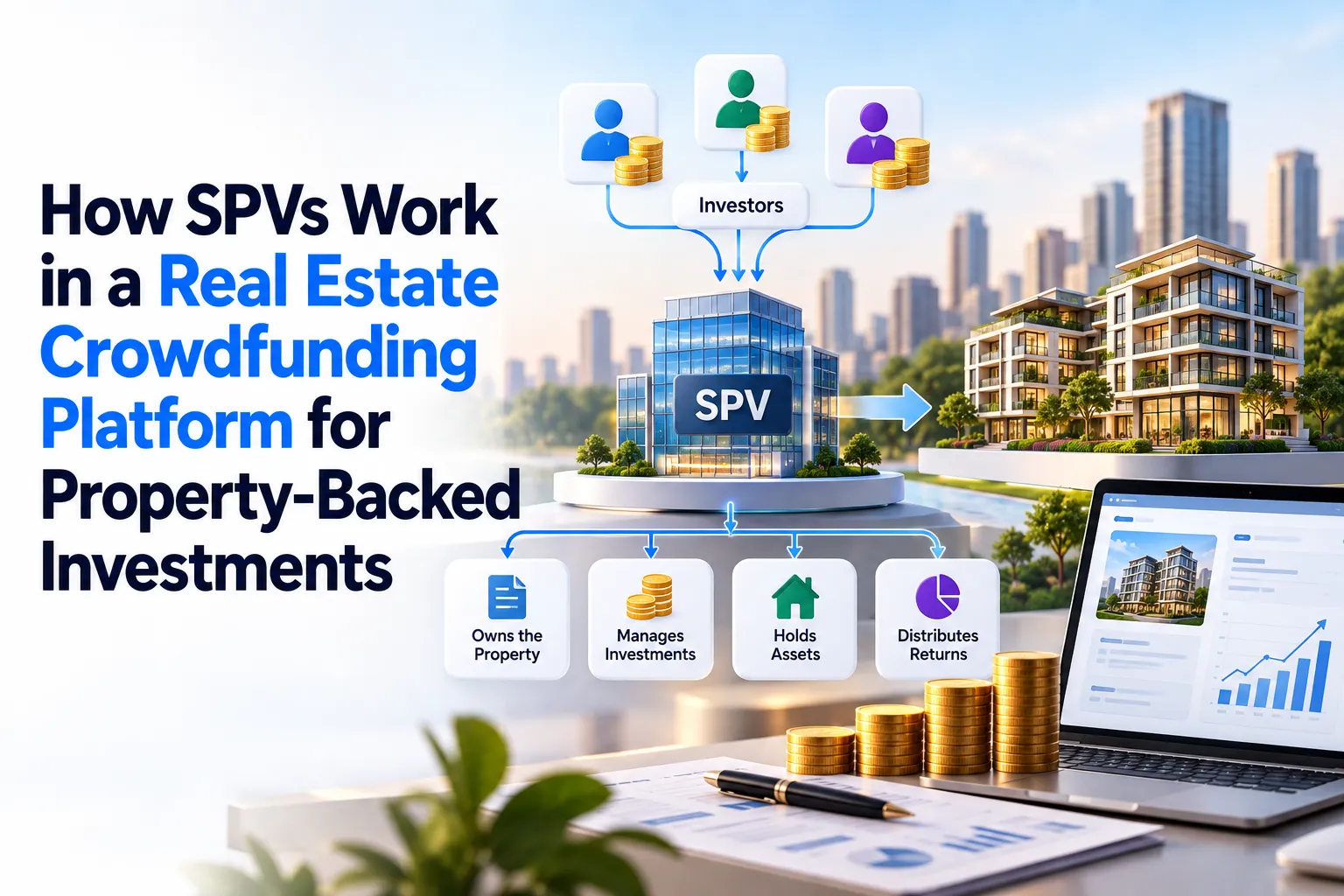
Instead of placing dozens or hundreds of investors directly onto the title of a property, an operator may create a separate legal entity for the investment. That entity can own the property itself or hold the relevant interest in the property-owning structure, while investors receive shares, membership interests, units, or another legally defined interest in the SPV.
The SPV therefore becomes the bridge between the physical asset and the people investing in it.
For founders building real estate crowdfunding platforms, understanding this structure matters because SPVs affect much more than legal paperwork. They influence investor onboarding, ownership records, distributions, voting, accounting, secondary transfers, property exits, and the platform’s entire data model.
What Is an SPV in Real Estate Crowdfunding?
An SPV, or special purpose vehicle, is a separate legal entity created for a narrow purpose.
In property crowdfunding, that purpose may be to acquire, hold, operate, finance, or dispose of one specific real estate investment.
A simplified structure can look like this:
Investors → SPV → Property
Instead of 200 investors independently buying portions of the property deed, they participate through interests issued by the SPV.
The exact legal instrument can differ.
Depending on the jurisdiction and structure, investors might hold:
- Company shares
- LLC membership interests
- Partnership interests
- Investment units
- Securities issued by the vehicle
- Economic interests defined by an offering structure
The important distinction is that fractional economic exposure does not necessarily mean each investor directly owns a fraction of the property title.
The investor’s legal rights come from the SPV documents, investment agreement, securities terms, local law, and operating structure.
Why Real Estate Crowdfunding Platforms Use SPVs
Without an SPV, direct fractional ownership can become difficult to administer.
Imagine one property with 800 investors.
If every investor had to appear directly within the property ownership structure, even routine events could become difficult:
- New investors entering
- Investors transferring interests
- Rental distributions
- Investor voting
- Refinancing
- Property expenses
- Ownership changes
- Property sale
- Tax reporting
- Investor death or succession
- Disputes
An SPV creates a cleaner separation.
The property-facing ownership can remain concentrated in one legal entity while the platform manages investor interests within that entity.
This does not remove legal complexity.
It organizes it.
One Property, One SPV: How the Model Works
A common fractional property model uses a separate SPV for each asset.
For example:
Property A → SPV A
Property B → SPV B
Property C → SPV C
An investor who wants exposure to Property A subscribes to interests associated with SPV A.
Another investor may choose Property C instead.
This can make the investment relationship more transparent because each SPV has its own:
- Property
- Capital structure
- Investors
- Ownership register
- Income
- Expenses
- Liabilities
- Distributions
- Documents
- Valuation history
- Exit event
Founders who want to understand how SPVs connect with share classes, investor subscriptions, ownership records, distributions, and investment operations can review these property-level SPV features in more detail.
Operationally, this is very different from simply placing all investor money into one generic platform wallet.
SPV vs Direct Property Ownership
SPV Ownership vs Direct Fractional Property Ownership
| Area | SPV-Based Structure | Direct Ownership Structure |
|---|---|---|
| Investor interest | Investor holds an interest in the entity connected to the property. | Investor may hold a direct registered interest in the property itself. |
| Ownership administration | Platform manages the investor register at the SPV level. | Property-level ownership records may need updating as owners change. |
| Investor transfers | May involve transferring an eligible interest in the SPV, subject to legal and platform rules. | May require changes to direct property ownership records. |
| Distributions | Income flows through the property/SPV structure before eligible distributions are calculated. | Income must be allocated directly across property owners. |
| Asset separation | A separate vehicle can maintain property-specific economics and records. | Ownership sits directly against the property. |
Step 1: The Property Is Identified and Underwritten
The SPV structure should not begin with a beautiful property card.
It begins with the asset.
Before investors are invited into the opportunity, the operator typically needs a process for reviewing areas such as:
- Property identity
- Ownership
- Acquisition price
- Existing debt
- Rental income
- Occupancy
- Operating expenses
- Maintenance requirements
- Valuation assumptions
- Insurance
- Title issues
- Legal documentation
- Expected holding period
- Potential exit scenarios
From a platform perspective, underwriting data should remain connected to the property rather than scattered across spreadsheets and PDFs.
Founders should also separate assumptions from outcomes.
A projected rental return is not the same thing as an actual distribution.
A projected exit valuation is not the same thing as a sale price.
That distinction needs to remain visible throughout the product.
Step 2: A Separate SPV Is Created for the Property
Once the operator decides how the offering will be structured, a legal entity may be created for that specific investment.
The SPV needs a durable identity inside the platform.
A useful SPV record may include:
- Legal entity name
- Jurisdiction
- Registration identifier
- Linked property
- Entity status
- Share or unit structure
- Authorized capital
- Manager or responsible party
- Formation documents
- Operating agreement
- Offering documents
- Banking relationships
- Relevant tax information
The software should not treat “SPV” as a text field on the property page.
It should be a real object connected to ownership, investors, documents, transactions, distributions, and exits.
Step 3: Share Classes or Investment Units Are Defined
The SPV then needs a way to represent investor interests.
The exact terminology depends on the structure, but the platform may need to understand:
- Total units or shares available
- Price per unit
- Minimum subscription
- Maximum investment
- Voting rights
- Distribution rights
- Transfer restrictions
- Investor eligibility
- Share class
- Issue date
- Cancellation rules
This is where many simple crowdfunding scripts become insufficient.
A pledge amount saying “Investor contributed $5,000” does not necessarily answer:
What does that $5,000 legally represent?
A serious property-backed investment system needs to connect money to an actual ownership or economic-interest record.
Step 4: Investors Complete Onboarding Before Subscribing
Before accepting an investment, the platform may need to collect information required by the operating model and applicable law.
Depending on jurisdiction, that may include:
- Identity verification
- Address
- Tax details
- KYC checks
- Screening
- Investor classification
- Accreditation or suitability information
- Risk acknowledgment
- Source-of-funds information
- Signed subscription documents
These requirements are jurisdiction-specific.
For example, U.S. Regulation Crowdfunding includes investor and issuer requirements and requires offerings under that exemption to take place through a registered intermediary. Certain crowdfunding vehicles are permitted under defined conditions, but those rules do not automatically apply to every real estate investment model or every jurisdiction.
Founders should therefore treat the software as compliance-supporting infrastructure, not as a substitute for securities counsel, licensing, exemptions, or jurisdiction-specific legal review.
Step 5: The Investor Subscribes to the SPV Interest
Once eligible, the investor chooses an amount or number of units.
At this stage, the platform may create a subscription order.
An important product principle is:
An order is not necessarily ownership yet.
The system may need to wait for:
- Agreement signature
- Payment confirmation
- Escrow conditions
- Offering minimums
- Compliance approval
- Closing conditions
Only after the appropriate conditions are satisfied should the platform create or finalize the corresponding ownership allocation.
This distinction helps prevent situations where a failed or duplicated payment creates an incorrect ownership record.
Step 6: Funds Move Through the Approved Payment or Custody Structure
Money movement in an investment platform requires much more care than ordinary ecommerce checkout.
Depending on jurisdiction and operating model, funds may involve:
- Banking partners
- Escrow
- Custodians
- Payment processors
- Trust or client-money arrangements
- Regulated intermediaries
The platform’s job is to maintain accurate transaction states.
For example:
Subscription initiated → payment pending → funds confirmed → ownership allocated
The platform should also plan for failures:
- Payment callback arrives twice
- Bank transfer remains pending
- Investor sends the wrong amount
- Payment succeeds after allocation window closes
- Investor cancels before closing
- Payment succeeds but compliance review fails
Investment systems should be designed around these exceptions, not only the happy path.
Step 7: Ownership Is Added to the Register
Once a subscription legally settles, the platform needs a reliable record showing who owns what.
The ownership register may connect:
- Investor
- SPV
- Share class
- Number of units
- Acquisition date
- Subscription price
- Certificate
- Transfer history
- Current status
For founders, one important architecture decision is whether ownership history can be reconstructed reliably.
Overwriting:
Investor owns 100 units
with:
Investor owns 60 units
after a transfer destroys part of the historical story.
A stronger model records changes as events or append-only ownership movements so the platform can explain how the current position was reached.
This becomes increasingly important as investors buy additional interests, sell units, transfer holdings, or participate in exits.
Step 8: The SPV Owns or Holds the Relevant Property Interest
After the investment closes, the property and SPV relationship becomes central.
The exact legal form varies.
Depending on the structure, the SPV might:
- Own the real property
- Own shares in the property-owning company
- Hold another legally defined property interest
Investors then participate economically according to their interests in the SPV.
This structure is why platform copy must be precise.
Saying “you own 1% of this property” can mean something very different legally from saying “you own an interest in the vehicle that owns the property.”
Product, legal, and marketing teams should use terminology consistent with the actual offering documents.
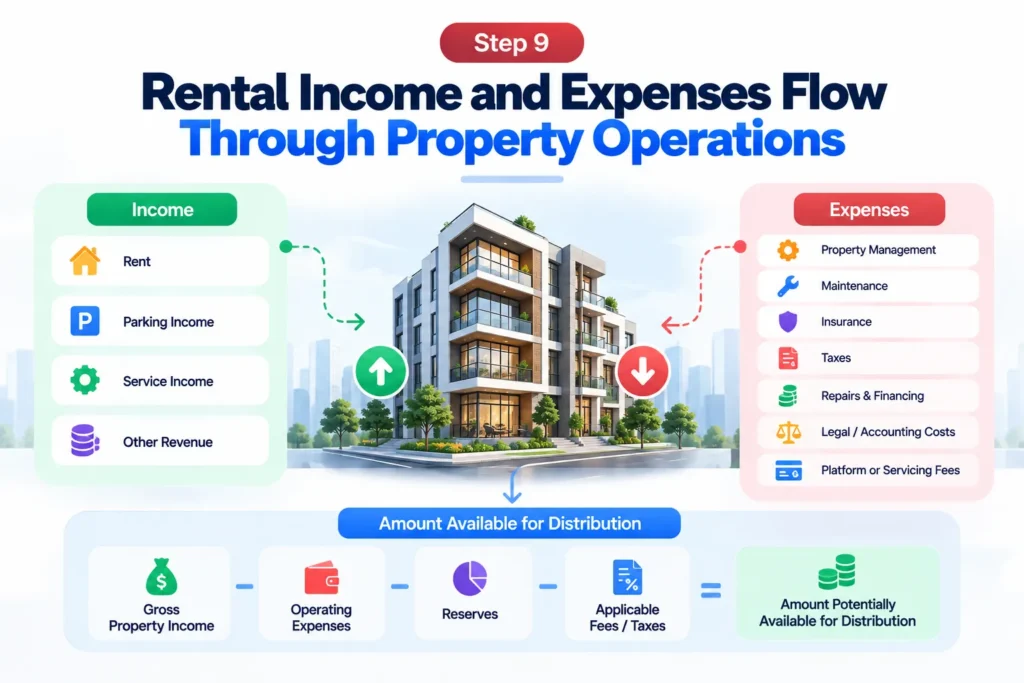
Step 9: Rental Income and Expenses Flow Through Property Operations
Owning the asset is only the beginning.
Property operations may generate:
Income
- Rent
- Parking income
- Service income
- Other property-level revenue
Expenses
- Property management
- Maintenance
- Insurance
- Taxes
- Repairs
- Financing costs
- Legal/accounting costs
- Platform or servicing fees
- Reserves
The distributable amount is therefore not simply:
Rent ÷ number of investors
A simplified model might look more like:
Gross property income
– operating expenses
– reserves
– applicable fees/taxes
= amount potentially available for distribution
For founders modelling management fees, transaction charges, property income, distributions, and other platform economics, this real estate crowdfunding business model guide explains the commercial layer in more detail.
The actual calculation must follow the legal documents and operating model.
Step 10: Investor Distributions Are Calculated
Once distributable income is known, eligible investors may receive their proportionate amount according to the SPV and share-class terms.
A platform distribution workflow may include:
- Accounting period closes.
- Property income is confirmed.
- Eligible expenses are deducted.
- Distributable amount is calculated.
- Investor entitlements are generated.
- Compliance/finance review occurs.
- Distribution receives required approval.
- Ledger entries are posted.
- Payments are released through the appropriate rails.
- Investor statements are generated.
This is why property crowdfunding software needs more than a payment gateway.
It needs a reliable connection between:
Property economics → SPV → ownership → distribution entitlement → payment record
Example: How an SPV Distribution Could Flow
Consider an illustrative property SPV with 10,000 equal economic units.
An investor holds 250 units.
That means the investor represents 2.5% of those units, subject to the actual rights and terms of that share class.
If the SPV determines that $40,000 is legally available for distribution for the period, the illustrative entitlement before any investor-specific taxes or adjustments would be:
$40,000 × 2.5% = $1,000
The software should be able to show how the number was produced.
It should not simply add $1,000 to a wallet without supporting calculation records.
That transparency matters for investors, finance teams, auditors, and platform operators.
Step 11: What Happens When an Investor Wants to Exit?
An SPV does not automatically make an investment liquid.
Property investing is naturally less liquid than holding cash or many publicly traded securities.
Possible exit mechanisms may include:
- Holding until property sale
- Scheduled redemption windows
- Approved transfers
- Secondary-market listings
- Operator buybacks where legally and commercially supported
- Whole-property sale
Every mechanism has different implications.
A secondary transfer might require:
- Seller eligibility
- Buyer eligibility
- Transfer restrictions
- Updated ownership records
- Payment settlement
- Tax treatment
- Compliance review
- Updated certificate
The platform should never imply guaranteed liquidity simply because it includes a marketplace screen.
If the business model includes secondary transfers or investor-to-investor trading, founders may also explore a white-label trading platform approach for managing eligible transaction and marketplace workflows.
Liquidity depends on actual buyers, applicable rules, contractual rights, and the operating structure.
Step 12: What Happens When the Property Is Sold?
A whole-property sale can close the investment lifecycle.
A simplified sequence might be:
- Sale is proposed.
- Required approvals occur.
- Property sale completes.
- Debt and transaction costs are settled.
- SPV liabilities and obligations are resolved.
- Remaining proceeds are calculated.
- Eligible investor entitlements are determined.
- Proceeds are distributed.
- Ownership records reflect the exit.
- SPV is wound down or otherwise handled according to the legal structure.
Again, the platform needs to preserve the history.
Investors should be able to see:
- Original subscription
- Ownership held
- Distributions received
- Transfers
- Final sale proceeds
- Relevant fees or deductions
- Final statement
That creates a complete investment record rather than a collection of disconnected payments.
Why the Ownership Register and Ledger Must Work Together
The ownership register answers:
Who owns what?
The financial ledger answers:
Where did the money move?
Those are different questions.
A strong property-backed investment platform needs both.
For example, if Investor A purchases 100 units, the system may need to record:
Ownership side
- Investor A
- SPV
- Share class
- 100 units
- Acquisition event
Financial side
- Investor funding
- Subscription settlement
- SPV capital
- Applicable fee entries
Later, a rental distribution creates another financial event but usually does not change ownership.
A secondary sale changes both.
Treating these systems as one generic wallet balance creates unnecessary risk.
Founder Decision Signals
Asset Structure
If investors choose individual properties, decide whether each property requires its own vehicle, share class, ownership record, documents, and distribution history.
Ownership Evidence
If investors receive legally defined interests, the product needs more than contribution totals. It needs durable records showing what each investor holds and how that position changed.
Money Movement
If subscriptions, distributions, refunds, transfers, and exits affect investor money, use a financial ledger capable of reconstructing every movement rather than relying on editable balances.
Regulatory Model
Before configuring KYC, investor classes, transfer rules, or custody flows, define the jurisdiction and offering structure with qualified legal and compliance advisers.
Common SPV Mistakes Founders Should Avoid
Treating the SPV as Just a Property Field
The SPV should connect to legal documents, share classes, subscriptions, ownership records, distributions, transactions, and exits rather than existing only as a name displayed on the property page.
Confusing Investment Amount With Ownership
A contribution amount does not by itself explain the investor’s legal interest. The platform should connect settled subscriptions to the exact units or securities issued under the offering structure.
Overwriting Ownership History
Transfers and additional purchases should preserve previous ownership events so the operator can reconstruct how the current position was reached.
Calculating Distributions in Spreadsheets
Manual calculations become risky as properties, investors, share classes, expenses, withholding, and transfers increase. Distribution logic should connect to the same ownership and financial records used by the platform.
Assuming Software Determines Legal Compliance
An SPV feature does not make an offering lawful. Legal structure, securities rules, licensing or exemptions, tax treatment, custody, disclosures, and investor eligibility depend on jurisdiction and professional advice.
What a Real Estate Crowdfunding Platform Should Track for Every SPV
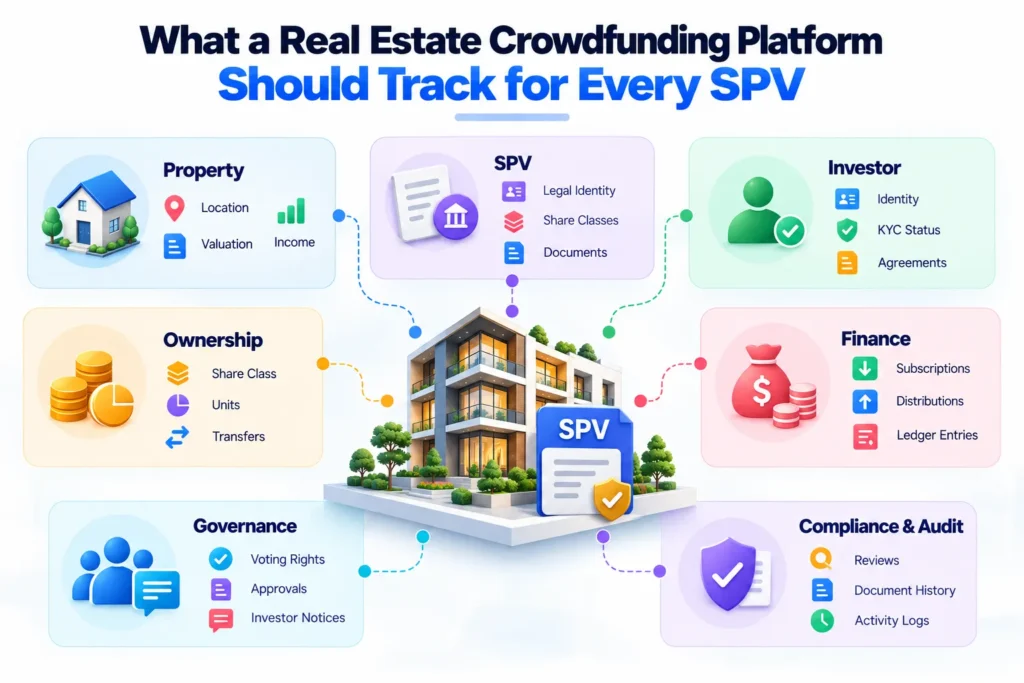
Before launching a property-backed investment platform, founders should confirm that the system can connect the following records.
Property
- Asset identity
- Location
- Valuation
- Underwriting
- Income
- Expenses
- Documents
- Exit history
SPV
- Legal identity
- Jurisdiction
- Property relationship
- Share classes
- Governing documents
- Status
Investor
- Identity
- Eligibility
- KYC status
- Signed agreements
- Tax information where required
Ownership
- Share class
- Units
- Issue event
- Transfers
- Certificates
- Current position
Finance
- Subscriptions
- Fees
- Distributions
- Refunds
- Secondary transfers
- Exit proceeds
- Ledger entries
Governance
- Voting rights
- Approvals
- Sale proposals
- Material notices
- Investor communications
Compliance and audit
- Reviews
- Evidence
- Document history
- Activity logs
- Approval trail
The key is relational integrity.
All of these records should describe the same investment rather than becoming separate systems that finance and compliance teams later have to reconcile manually.
How Miracuves Supports SPV-Based Property Investment Platforms
Miracuves provides a ready-made real estate investment platform foundation designed around property-level SPVs, share classes, investor ownership records, a double-entry ledger, distribution workflows, underwriting, KYC-related case management, operator controls, and secondary-market functionality.
Founders evaluating an SPV-based investment business can explore Miracuves’ real estate crowdfunding platform foundation to understand how property, investor, ownership, finance, and operator workflows can sit within one connected product.
For founders comparing budget, integrations, compliance workflows, investor modules, and rollout scope, this guide to real estate crowdfunding platform development cost explains the main factors that can affect pricing.
If you are also evaluating implementation teams, this guide on choosing a property investment platform development partner can help you review technical, operational, and customization considerations before selecting a team.
The current Miracuves platform uses property-specific SPVs and share classes alongside an append-only ownership register and double-entry ledger rather than treating investors as simple campaign pledges. The product also includes workflows for distributions and investment exits.
Businesses exploring broader wealth, investing, and asset-backed product models can also review Miracuves’ investment platform solutions for related digital investment workflows.
Where the standard ready-made scope fits the business requirement, Miracuves can support 6-day solution delivery. Production hardening, external providers, legal structure, KYC integrations, payment rails, and jurisdiction-specific requirements still need to be scoped according to the operator’s market.
Final Thoughts: The SPV Is the Ownership Layer Behind the Property Page
The visible property page is usually the easiest part of a real estate crowdfunding product to understand.
The SPV is where the ownership structure becomes real.
It connects the property to investor interests, subscription documents, share classes, ownership records, distributions, voting, transfers, and eventual exit proceeds.
For founders, that means SPV functionality should not be treated as one more feature on a checklist.
It affects the architecture of the entire platform.
Before launching, define clearly:
What does the investor own?
Which entity owns the property?
How does money become ownership?
How are distributions calculated?
How are ownership changes recorded?
What happens when the property is sold?
Once those questions have legally sound answers, the software can be designed around them.
That is the stronger foundation for a property-backed investment platform.
FAQs
What is an SPV in real estate crowdfunding?
An SPV is a separate legal entity created for a specific investment purpose. In property crowdfunding, the vehicle may own the property or the relevant property interest while investors hold legally defined interests in the SPV.
Do crowdfunding investors directly own the property?
Not necessarily. In an SPV structure, investors commonly own interests in the vehicle connected to the property rather than appearing individually on the property title. The exact structure depends on the offering and jurisdiction.
Why create one SPV for each property?
A property-specific SPV can keep ownership, financial records, investor interests, distributions, liabilities, and exit events associated with that asset separate from other investments. The legal consequences depend on how the structure is established.
How do investors make money through a property SPV?
Potential returns may come from eligible property income distributions and proceeds when the asset or relevant interest is sold. Returns are not guaranteed and depend on property performance, expenses, fees, financing, market conditions, and the investment terms.
How are SPV distributions calculated?
The SPV may receive property income, deduct applicable operating expenses, reserves, fees, taxes, and other obligations, and distribute the amount legally available according to investor rights and ownership proportions.
Can investors sell their SPV interests?
Possibly, but transfer rights depend on the offering documents, applicable securities rules, holding restrictions, buyer eligibility, and whether a suitable secondary-transfer mechanism exists. A marketplace feature does not guarantee liquidity.
Does an SPV protect investors from all property liabilities?
No structure should be presented as absolute protection. A separate legal entity may help segregate property-level ownership and obligations, but the actual legal effect depends on jurisdiction, contracts, financing, governance, and how the vehicle is operated.
Can Miracuves support property-level SPVs?
Yes. Miracuves’ ready-made real estate investment platform includes property-level SPV and share-class workflows, investor ownership records, ledger-backed money movements, distributions, operator controls, and other property-investment operations. A 6-day delivery may apply when the standard ready-made scope fits the project.
Miracuves is an independent software development company. We are not affiliated with, connected to, sponsored by, or endorsed by any company or product named in this article.
Terms such as “X Clone” are used descriptively. It is how the software industry refers to building a platform with functionality comparable to a known service, and how clients search for it.
The entire design and codebase of our products is built by our own team. Our products contain no code, design, graphics, or content originating from any third-party website or applications.
All third-party names and marks referenced in this article are the property of their respective owners, referenced solely to identify the services discussed.