Key Takeaways
What You’ll Learn
- Grofers clone scripts are designed for quick-commerce and grocery delivery businesses that need fast ordering, inventory visibility, and efficient fulfillment.
- Core modules include customer app, admin and vendor dashboard, and delivery executive app so the full grocery ecosystem works together smoothly.
- Important features like real-time inventory, express delivery ETA, one-click reorders, dark store control, and proof of delivery make the platform operationally strong.
- Pricing depends on platform depth, whether you need a basic grocery MVP, a full-feature quick-commerce platform, or an enterprise-grade delivery ecosystem.
- The biggest advantage is launching a ready-made Grofers-style grocery platform much faster than building a complete custom system from zero.
Real Insights
- Quick-commerce apps are operations-first platforms because inventory syncing, zone handling, and dispatch logic matter as much as user experience.
- Dark store and warehouse control is one of the biggest differentiators in a Grofers-style clone because fast delivery depends on backend efficiency.
- Advanced features like AI demand forecasting, smart batching, and route optimization are becoming important as grocery delivery becomes more competitive.
- A ready-made clone script reduces launch risk by giving founders proven workflows for catalog management, fulfillment, promotions, and customer support.
- The strongest opportunity lies in launching a localized, revenue-ready grocery platform that balances speed, convenience, and operational control.
Just a few years ago, waiting two hours for grocery delivery felt like magic. Today, users expect their detergent, eggs, and noodles to arrive in the time it takes to make a cup of tea. Welcome to the age of quick commerce, where companies like Grofers—now Blinkit—redefined the rules of grocery delivery by compressing the entire supply chain into 10-minute promises.
This shift didn’t happen overnight. It came with years of infrastructure evolution, the rise of dark stores, and a change in consumer psychology. People no longer plan grocery lists. They order what they need, when they need it. For startups and entrepreneurs, this is a powerful cue: the time to build ultra-fast grocery delivery platforms is now.
With Grofers clone script becoming more advanced and accessible, launching your own quick commerce business in 2026 is no longer a pipe dream. It’s a realistic path to capturing hyperlocal markets—if you have the right tech and strategy.
Why Quick Commerce Still Thrives in 2026
Quick commerce didn’t burn out—it just got smarter. While some big players struggled to sustain hyper-speed logistics, others optimized inventory, streamlined delivery networks, and focused on data-driven stocking.
The demand didn’t disappear. Urban customers, students, busy professionals, and even small offices continue to prefer apps that deliver essentials in under 15 minutes. For areas underserved by Blinkit, Instamart, or Zepto, this opens doors for local players with better unit economics and smarter zone targeting.
The rise of grocery micro-hubs and dark stores has also made it easier for entrepreneurs to build localized versions of Blinkit using Grofers clone script that handle everything from inventory syncing to dispatch routing.
Read More : What is Grofers App and How Does It Work?
Key Features of a Grofers Clone Script
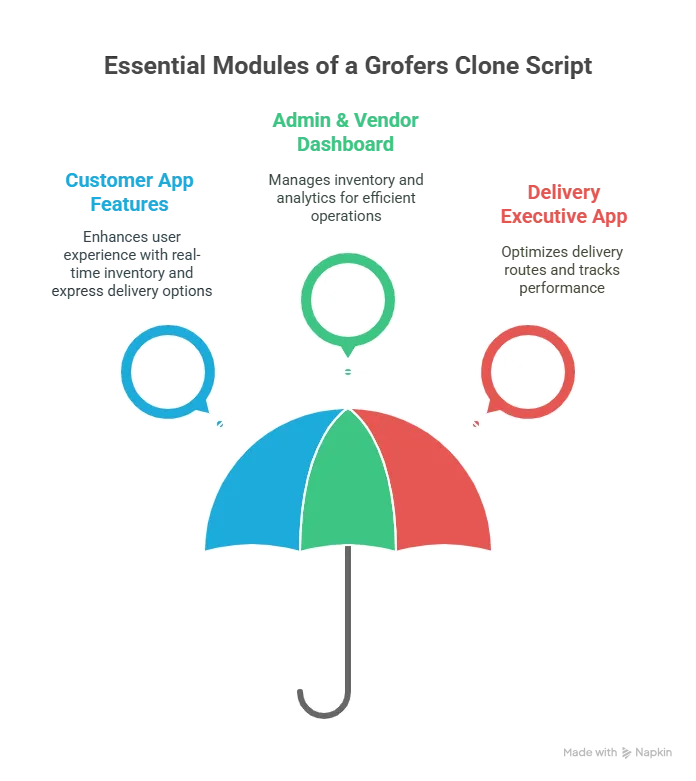
To meet the expectations of speed and accuracy, Grofers clone script must go beyond regular grocery app functionality. Here are the critical modules:
Customer App Features
- Real-time inventory with only available items displayed
- Express delivery option with ETA countdown
- One-click reorders and favorites
- Location-based product visibility
- In-app chat and issue reporting
- Offers and referral programs
Admin & Vendor Dashboard
- Product, category, and inventory management
- Location tagging and stock allocation by delivery zone
- Multi-warehouse or dark store control
- Real-time analytics (orders, revenue, delivery success rates)
- Customer management and support tracking
Delivery Executive App
- Assigned delivery with optimized routing
- Delivery time commitment tracking
- Proof of delivery (photo, OTP)
- Incentive module and earnings overview
- Return or issue logging system
These three modules ensure the system operates at scale, without bottlenecks in fulfillment, user experience, or reporting.
Advanced Features Emerging in 2026
With the quick commerce ecosystem becoming more competitive, clone providers are now offering advanced tools out of the box:
- AI-based demand forecasting for each hub or warehouse
- Order batching and auto-assign logic for last-mile delivery
- Predictive route optimization to avoid traffic delays
- Smart inventory depletion alerts for restocking
- Dynamic pricing or surge delivery fees
- Multi-lingual and voice search capabilities
The best clone script also include integrations for warehouse management systems (WMS), automated procurement from suppliers, and delivery partner aggregators
Read More : Reasons startup choose our Grofers clone over custom development
Global Cost Factors & Pricing Breakdown
Grofers-Like Grocery Delivery App Development — Market Price by Tech Stack
The tech stack affects the cost, delivery speed, and scalability of a Grofers-like grocery delivery platform. PHP/Laravel works well for cost-effective grocery app launches, Node.js/React.js supports real-time order tracking and inventory updates, while Go microservices suit large-scale grocery platforms with high order volume and multi-city operations.
These values reflect global development cost estimates for a Grofers-like grocery delivery platform. The Miracuves row shows our own custom-build pricing.
Miracuves Grofers-Like App Solution Cost and Tech Stack
Miracuves Pricing for a Grofers-Like Grocery Delivery Platform developed in PHP/Laravel with Flutter Apps for $2,499 USD (One-Time Price) in just 6 days
Get a fully developed, deployment-ready platform modeled after Grofers. Built on a reliable PHP/Laravel backend with Flutter mobile apps, this complete solution helps you launch and scale a grocery delivery business quickly and efficiently.
- Core Workflows: Product catalog browsing, cart system, order placement, real-time order tracking, inventory handling, and delivery management.
- Built-in Operations: Pricing logic, delivery fee setup, commission structure, inventory control, and payment processing.
- Management Hub: Centralized admin panel to manage customers, vendors, products, orders, delivery partners, transactions, and overall platform operations.
- Launch-Ready: Fully prepared for your branding, configuration, and immediate go-to-market execution.
Why is it so affordable?
Most modern grocery delivery platforms are built using complex architectures like Node.js or microservices. While powerful, these approaches require large engineering teams, longer timelines, and significantly higher development costs.
We took a smarter and more practical approach:
- You Aren’t Paying for Ground-Up Development: Our grocery delivery engine is already developed, tested, and ready to deploy. You skip months of development time and avoid the high costs of building from scratch.
- The Power of PHP / Laravel: Built on one of the most trusted and widely used frameworks globally, this solution keeps upfront costs low while ensuring long-term flexibility. With a large developer ecosystem, it becomes easier and more cost-effective to maintain, scale, and customize your platform.
- Built for Practical Growth: You get a strong, market-ready grocery delivery platform with essential features like inventory management, order workflows, and delivery tracking—without the complexity and expense of enterprise-level builds.
You get a scalable, production-ready platform without paying inflated development costs.
Note: This cost is for the solution, re-branding, deployment, and source code only.
Who Should Consider a Grofers Clone?
Not everyone should aim to be the next Blinkit. But here are some scenarios where a Grofers-style clone can thrive:
- Local supermarkets going digital with express delivery
- Dark store aggregators managing multiple fulfillment hubs
- Quick commerce startups in Tier-2 or Tier-3 cities
- B2B grocery suppliers offering delivery to cafes, offices, or caterers
- Phygital retailers combining walk-in stores with ultra-fast delivery
The market is wide open in places where large platforms haven’t yet established fast delivery networks or lack regional stock relevance.
Monetization Options in Quick Commerce
Speed doesn’t have to kill margins—especially if you layer revenue streams strategically. Here’s how Grofers clones are monetized:
- Delivery fees based on location, speed, or time of day
- Priority delivery charges for faster fulfillment
- In-app ads for product placement or featured brands
- Commission per item from vendors (if marketplace model)
- Private-label products for high-margin categories
- Subscription models for free delivery or early access to deals
Some platforms also integrate with meal kits, personal care boxes, or seasonal bundles, further increasing the average order value.
Read More :Grofers Marketing Strategy: Beyond Just Groceries
Conclusion
Grofers started a revolution. Quick commerce transformed how people shop, and the demand for hyperlocal, instant fulfillment shows no signs of slowing down in 2026. With the right Grofers clone script, entrepreneurs can tap into this demand, build trust through speed, and carve out profitable niches in the grocery delivery landscape.
Whether you’re looking to empower a local network of stores or centralize operations through dark stores, a Grofers-style app can be your gateway to becoming a regional leader in instant delivery.
At Miracuves, we help innovators launch high-performance app clones that are fast, scalable, and monetization-ready. Ready to turn your idea into reality? Let’s build together.
FAQs
What is a Grofers clone script?
It’s a pre-built grocery delivery platform inspired by Grofers (Blinkit) that supports fast order processing, inventory syncing, and ultra-fast delivery logistics.
Can it really deliver in 10 minutes?
Yes, if integrated with dark store infrastructure and optimized routing. The tech supports it; the logistics depend on your setup.
How many dark stores are needed to start?
You can begin with just one fulfillment hub covering a limited zone and scale as demand grows.
Is this model viable in small towns?
Absolutely. Tier-2 and Tier-3 cities have growing demand and less competition, making them ideal launchpads for quick commerce.
Can I offer both scheduled and express delivery?
Yes, most clone scripts allow setting delivery time windows or toggling instant delivery for certain SKUs or zones.
Do I need a large tech team to manage this?
Not necessarily. A good clone solution provides admin panels and tools that make operations manageable even for small teams.
Related Articles
Miracuves is an independent software development company. We are not affiliated with, connected to, sponsored by, or endorsed by any company or product named in this article.
Terms such as “X Clone” are used descriptively. It is how the software industry refers to building a platform with functionality comparable to a known service, and how clients search for it.
The entire design and codebase of our products is built by our own team. Our products contain no code, design, graphics, or content originating from any third-party website or applications.
All third-party names and marks referenced in this article are the property of their respective owners, referenced solely to identify the services discussed.