Key Takeaways
- Real Estate Crowdfunding Platform Risk Controls should cover property due diligence, investor protection, money movement, admin permissions, compliance workflows, and auditability.
- Property opportunities should pass structured document, valuation, financial, risk, and investment-structure reviews before being published to investors.
- Investor protection should include KYC, eligibility or accreditation checks, investment limits, document acknowledgments, investor classification, and controlled access to opportunities.
- Payment and investment workflows should use idempotency, ledger-backed reconciliation, payment status tracking, approval controls, and audit records to reduce transaction errors.
- Distributions, refunds, ownership transfers, and other sensitive financial actions should use separate approval stages and role-based permissions rather than unrestricted administrator access.
Risk Control Signals
- Property onboarding should move through draft, document review, financial review, investment approval, compliance review, publication, and post-launch monitoring.
- The financial architecture should connect investor wallets, subscriptions, payment status, SPV allocations, ownership records, distributions, refunds, fees, and settlement records.
- Distribution batches should be calculated, reviewed, approved, executed, posted to the ledger, reconciled, and reflected in investor dashboards.
- Secondary-market transactions require eligibility checks, listing controls, settlement verification, fee handling, and accurate ownership-register updates.
- Audit logs should record important actions such as property approvals, investor classification changes, payment updates, distribution approvals, fee changes, and exports.
Real Insights
- A property listing is only the visible layer; the real risk-control system exists underneath in due diligence, ownership records, payments, ledgers, documents, approvals, and reporting.
- Manual payment reconciliation may work during testing but becomes increasingly risky as investment transactions grow.
- Giving one administrator unrestricted access to property publishing, investor approvals, refunds, payments, and distributions creates avoidable internal risk.
- Software can support compliance-ready workflows, but it cannot replace legal counsel, jurisdiction-specific requirements, licensed providers, or operating policies.
- The strongest control path is: verify property → review investor eligibility → control access → process payments safely → record ledger activity → approve distributions → reconcile transactions → maintain audit history.
Launching a Real Estate Crowdfunding Platform is not just about listing attractive assets and allowing users to invest online. The real challenge is trust.
Investors need confidence that property information is verified, ownership records are accurate, money movement is controlled, and the operator has clear oversight of every transaction. Founders need confidence that the platform can support due diligence, investor onboarding, payment reconciliation, approvals, audit trails, and compliance-ready workflows without relying on spreadsheets behind the scenes.
This is where risk controls become the foundation of the product.
A strong property-backed investment platform should not behave like a simple listing website. It should operate like a controlled financial workflow where every property, investor, document, order, payment, and distribution can be reviewed, approved, tracked, and reported.
Founders exploring broader investment categories can also review Miracuves’ investment platform solutions to understand how different finance and investment software models are structured.
Why Risk Controls Matter More Than the Frontend
Many founders first think about the investor-facing product: property cards, ROI projections, dashboard design, and mobile experience. These are important, but they are not enough.
| Risk Area | Why It Matters | Founder Action |
|---|---|---|
| Property Due Diligence | Prevents weak, incomplete, or poorly documented assets from reaching investors. | Verify property documents, valuation logic, financial assumptions, and risk disclosures before publishing. |
| Investor Protection | Reduces onboarding, suitability, disclosure, and eligibility risks. | Add KYC, investor classification, risk acknowledgments, and document access controls. |
| Money Movement | Prevents payment mismatches, duplicate orders, incorrect balances, and payout errors. | Use ledger-backed settlement, payment reconciliation, approval workflows, and finance exports. |
| Admin Control | Keeps platform operations accountable and reduces internal mistakes. | Use role-based access, approval layers, audit logs, and restricted finance permissions. |
| Compliance Readiness | Supports legal and operational review across investor, payment, and property workflows. | Build configurable workflows and confirm final requirements with legal counsel. |
Property Due Diligence Controls: What Must Be Checked Before Listing an Asset
Property due diligence is the first major risk layer. Before a property goes live for investors, the operator should have a structured way to review its legal, financial, operational, and investment details.
This does not mean the software replaces lawyers, valuers, auditors, or local experts. It means the software should help the operator organize, track, and approve the due diligence process before investors see the opportunity.
Core Property Due Diligence Areas
| Due Diligence Area | What to Review | Platform Control Needed |
|---|---|---|
| Property identity | Address, asset type, ownership details, location, and asset description | Structured property profile with mandatory fields |
| Legal documents | Title records, SPV documents, agreements, disclosures, and investor terms | Secure document storage and version control |
| Valuation | Valuation method, appraiser details, assumptions, and supporting reports | Valuation history and approval workflow |
| Financial projections | Rental income, expenses, yield assumptions, exit scenarios, and fees | Projection fields with review status |
| Risk disclosures | Market risk, liquidity risk, asset-specific risk, and operating assumptions | Investor-facing disclosure section |
| Asset operations | Occupancy, rental status, maintenance obligations, and property manager data | Operator notes and admin review fields |
| Investment structure | SPV, share class, minimum investment, ownership model, and exit rules | SPV and share-class configuration |
Before choosing any software foundation, founders should check whether it supports SPVs, ledger workflows, investor dashboards, and property investment features that match their operating model.
The Due Diligence Workflow Should Have Approval Stages
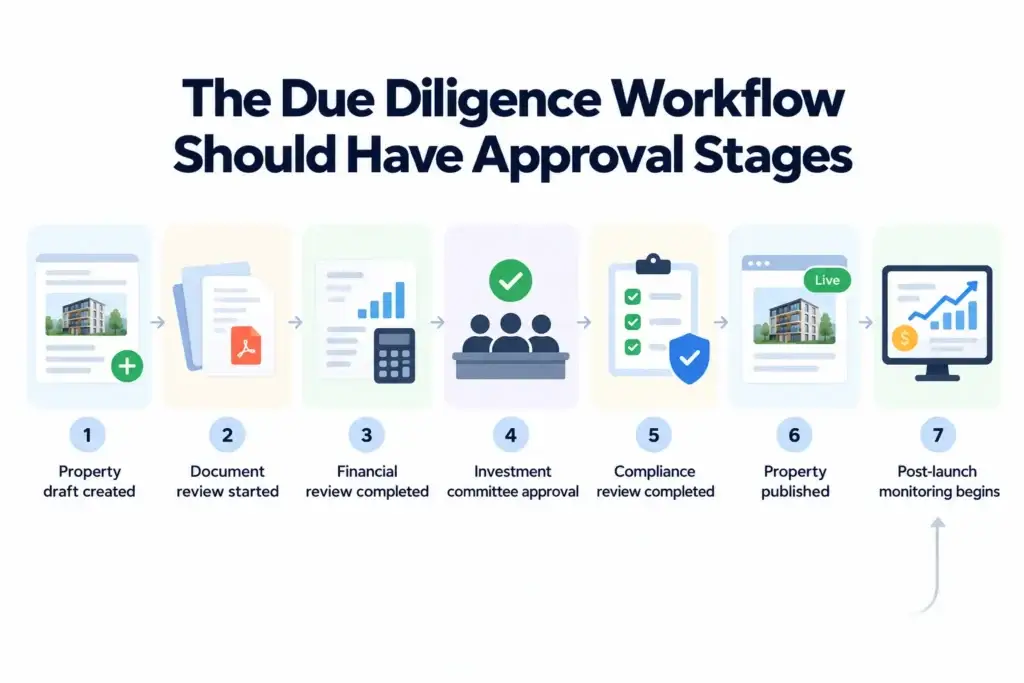
A common mistake is treating property onboarding as simple content publishing. In investment products, a property should not go from “draft” to “live” without internal review.
A safer workflow includes:
- Property draft created
The operator adds property details, documents, investment assumptions, and internal notes. - Document review started
Legal documents, valuation reports, title information, and risk disclosures are uploaded and reviewed. - Financial review completed
Revenue assumptions, expense estimates, expected returns, platform fees, and payout logic are checked. - Investment committee approval
Internal decision-makers approve or reject the property before it becomes available. - Compliance review completed
Required disclaimers, investor eligibility rules, and jurisdiction-specific conditions are checked. - Property published
The opportunity becomes visible to eligible investors. - Post-launch monitoring begins
Updates, distributions, rent performance, occupancy, and investor communications are tracked.
This type of workflow protects the business from accidental publishing, incomplete documentation, and inconsistent investor communication.
If your model uses property-specific legal structures, this guide on how SPVs work in real estate crowdfunding can help clarify why legal structure and platform workflow must align.
Investor Protection Starts Before the First Investment
Investor protection is not only about showing a risk warning at the bottom of the page. It begins with onboarding.
A property investment platform should be able to segment users by identity status, eligibility, accreditation status, investment limits, geography, and risk profile where applicable.
This matters because not every investor should be able to access every opportunity. Some markets require suitability checks, investor classification, document acknowledgments, or additional approvals before an investment order is accepted.
Investor Protection Controls to Build Early
| Control | Why It Matters | Platform Workflow |
|---|---|---|
| KYC verification | Confirms user identity before financial activity | KYC provider integration and admin review |
| AML workflow support | Helps flag suspicious activity patterns | Risk review queues and escalation notes |
| Accreditation or eligibility checks | Controls access to restricted opportunities | Investor class assignment and gating |
| Risk questionnaire | Helps assess suitability and understanding | Questionnaire workflow with stored responses |
| Document acknowledgment | Confirms investor viewed required materials | Timestamped acknowledgment records |
| Investment limits | Reduces overexposure and jurisdictional risk | Configurable limits by investor type |
| Investor status tracking | Keeps internal teams aligned | Investor 360 profile with KYC, orders, holdings, and documents |
The Miracuves Fundrise Clone page describes investor management as a combined view of holdings, orders, wallet, KYC state, documents, tickets, and relationship history, while KYC and accreditation queues are handled through case-based review.
Money Movement Risk: Where Platforms Can Break
Duplicate Orders
Payment retries should not create duplicate investment allocations. Use idempotency logic and payment status checks.
Reconciliation Gaps
Bank, gateway, wallet, and platform records should match through ledger-backed reconciliation workflows.
Distribution Errors
Rental or dividend distributions should move through calculation, review, approval, execution, and reporting stages.
Unauthorized Actions
Refunds, reversals, payouts, and ownership transfers should require role-based permissions and audit logs.
A weak backend can create expensive rebuilding later, which is why founders should understand platform architecture for property investment products before choosing a build path.
Why a Ledger-Backed System Matters
A ledger is not just a finance feature. It is the control layer that helps the operator understand how money entered, moved, settled, reversed, distributed, or exited.
In property investment software, the ledger should ideally connect:
- Investor wallet balances
- Subscription orders
- Payment gateway status
- SPV allocation
- Ownership record
- Distribution batches
- Refunds or reversals
- Platform fees
- Secondary market settlement
- Finance exports
Without ledger discipline, the platform may depend on payment gateway dashboards, bank statements, spreadsheets, and manual explanations. That may work for a handful of test users, but it becomes risky as the platform grows.
A safer system should support idempotency, payment status tracking, webhook verification, settlement checks, and reconciliation reports. The Miracuves money page highlights order flows with idempotency keys so retried requests do not create duplicate allocations, which is a useful example of how software controls can reduce transaction risk.
Distribution Controls: Protecting Investors and Operators
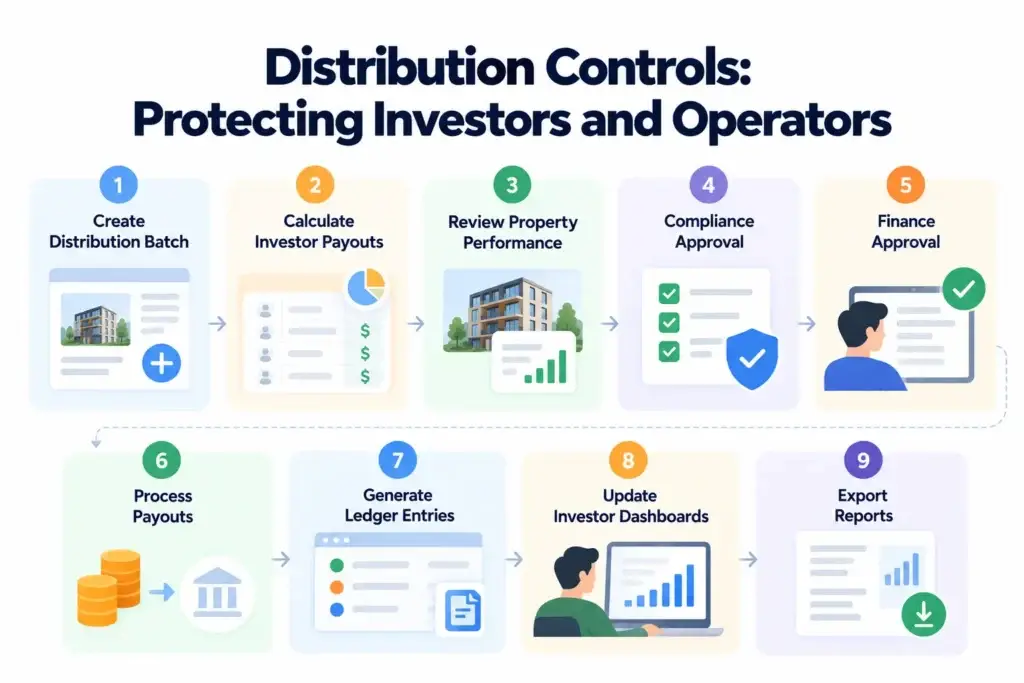
Distributions are where investor trust becomes visible. If rental income, dividends, or return payouts are unclear, delayed, or incorrectly calculated, users quickly lose confidence.
A safer distribution workflow should include:
- Finance creates a distribution batch.
- The system calculates investor-level line items.
- The operator reviews property performance and available funds.
- Compliance or internal approval is completed.
- A separate finance actor approves execution.
- Payouts are processed.
- Ledger entries are generated.
- Investor dashboards are updated.
- Reports are exported for records.
The important principle is separation of duties. The same person should not be able to create, approve, and execute sensitive money movement without oversight.
The Miracuves money page describes a distribution workspace where a batch can be calculated, reviewed, passed through compliance, approved in finance, and executed by a different actor.
Secondary Market Risk Controls
If the platform allows investors to resell ownership positions, risk controls become even more important.
A secondary market can improve liquidity, but it also introduces new operational questions:
- Who can list an ownership position for sale?
- Is the investor allowed to sell before a holding period?
- Can the buyer access the same disclosures?
- Does the platform update the ownership register correctly?
- Are fees calculated properly?
- Does settlement happen before ownership transfer?
- Is the operator able to freeze or review suspicious activity?
A controlled secondary marketplace should include listing rules, eligibility checks, pricing guidance, order matching or acceptance workflows, fee logic, settlement controls, and ownership register updates.
The platform should avoid creating a situation where ownership appears transferred on the frontend before the money movement and compliance checks are complete.
Admin Permissions: Who Can Do What?
Admin access is often underestimated. In investment platforms, weak admin permissions can create serious internal risk.
A founder should not give every team member full access to investor data, payment controls, property publishing, document edits, and distribution approvals.
Instead, the platform should support permission levels such as:
| Admin Role | Typical Access | Risk Control |
|---|---|---|
| Property manager | Property drafts, updates, operational notes | Cannot approve investment launch alone |
| Compliance reviewer | KYC cases, investor status, document checks | Cannot execute payouts |
| Finance admin | Payments, ledgers, distributions, exports | Requires approval for sensitive actions |
| Support team | Tickets, investor communication, limited profile view | No access to money movement |
| Super admin | Full platform governance | Should be limited and audited |
| Developer/admin technician | Technical configuration | Should not access unnecessary investor PII |
Role-based access control is not a “nice-to-have.” It protects the platform from internal mistakes, unauthorized changes, and unclear accountability.
Audit Logs: The Control Layer Founders Need Later
Most founders do not think about audit logs until something goes wrong.
But when an investor asks why a status changed, when finance reviews a reconciliation gap, or when legal counsel requests proof of a workflow, audit logs become critical.
A useful audit trail should capture:
- Who changed a property status
- Who approved a document
- Who updated investor classification
- Who changed payment status
- Who approved a distribution
- Who edited fee settings
- Who triggered an export
- Time, actor, resource, and action details
Audit logs protect both the investor and the operator. They reduce uncertainty and help the business reconstruct decisions later.
The Miracuves page describes audit search by resource, action, actor, and time range, along with investor, distribution, property, order, KYC, and payment exports.
Founder Decision Signals
Property Due Diligence
Choose a platform that supports document review, valuation checks, risk disclosures, and approval workflows before any property goes live.
Investor Protection
Add KYC, eligibility checks, document acknowledgments, investment limits, and investor status controls before accepting investment orders.
Money Movement
Use ledger-backed workflows, payment reconciliation, distribution approvals, and audit logs to reduce transaction and payout errors.
Admin Control
Separate permissions for property teams, compliance reviewers, finance admins, support teams, and super admins to reduce internal risk.
Common Mistakes Founders Should Avoid
Treating Property Listings as the Product
A property listing page is only the visible layer. The real product is the operating system behind it: due diligence, ownership records, investor status, payment settlement, ledger entries, documents, and reporting.
Launching Without Clear Investor Eligibility Rules
If every user can access every opportunity by default, the platform may create avoidable legal and operational risk. Investor class, jurisdiction, accreditation, and suitability workflows should be considered early.
Relying on Manual Payment Reconciliation
Manual reconciliation may work during testing, but it becomes risky when transactions increase. Ledger-backed settlement and payment status tracking should be planned before launch.
Giving Too Many Admins Full Access
Overly broad admin permissions create internal risk. Property publishing, investor approval, finance actions, and distribution execution should not all sit with the same uncontrolled role.
Assuming Software Alone Solves Compliance
Software can support compliance-ready workflows, but it does not replace legal counsel, jurisdiction-specific review, licensed providers, or proper operating policies.
Where Miracuves Fits Into Risk-Control Planning
Miracuves helps founders launch white-label, source-code-owned platforms with investor flows, operator controls, admin dashboards, and configurable workflows. For suitable ready-made scopes, Miracuves also offers a 6-day delivery timeline, which can help founders move faster without building every core workflow from zero.
The advantage of a launch-ready foundation is not just speed. It gives founders a structured base for property onboarding, SPV workflows, investor management, KYC queues, ledger-backed operations, distribution control, and audit visibility.
For founders evaluating a Fundrise-style launch path, Miracuves’ launch-ready property investment solution shows how investor onboarding, property workflows, operator control, source-code ownership, and money movement logic can work together.
Risk Controls Also Affect Pricing and Scope
Risk controls influence development cost because deeper controls require more planning, testing, configuration, integrations, and security hardening.
For example, a simple property listing interface is very different from a platform that includes KYC provider integration, payment routing, webhook verification, ledger reconciliation, audit logs, approval workflows, and jurisdiction-specific configuration.
Founders comparing build routes should review the development cost breakdown to understand how pricing changes with modules, integrations, hardening, and customisation scope.
Once the risk-control foundation is clear, founders should also study the revenue streams in a Fundrise-style model to connect platform controls with monetization planning.
Final Thoughts: Trust Is Built Through Controls, Not Just Design
A property investment platform succeeds when investors trust the opportunity, the operator trusts the workflow, and the business can prove what happened at every step.
That trust does not come from design alone. It comes from structured due diligence, investor protection workflows, controlled money movement, ledger-backed records, admin permissions, approval layers, and audit logs.
For early-stage founders, the practical goal is not to overbuild every advanced control on day one. The goal is to launch with the right foundation: enough structure to protect investors, enough control to operate responsibly, and enough flexibility to customise as the business grows.
After launch, acquisition and investor confidence become the next challenge, so this real estate crowdfunding growth strategy can support your go-to-market planning.
FAQs
What are risk controls in a property investment platform?
Risk controls are the workflows, permissions, checks, records, and approval layers that help reduce operational, investor, payment, compliance, and property-related risks. They include due diligence reviews, KYC checks, payment reconciliation, ledger entries, audit logs, and admin approval workflows.
Why is property due diligence important before listing an investment opportunity?
Property due diligence helps the operator verify ownership details, valuation, financial assumptions, legal documents, risk disclosures, and asset performance data before investors see the opportunity. It reduces the chance of publishing incomplete or misleading information.
How does investor protection work in property investment software?
Investor protection can include KYC, AML workflow support, accreditation checks, investor classification, risk questionnaires, document acknowledgments, investment limits, and eligibility-based access to opportunities.
Why does money movement need special controls?
Money movement affects subscriptions, wallets, ownership, fees, distributions, refunds, and secondary transfers. Without proper controls, platforms can face duplicate orders, payment mismatches, reconciliation errors, or incorrect investor balances.
What is the role of a ledger in investment platform risk management?
A ledger records how money moves through the platform. It helps operators reconcile payments, investment orders, ownership allocations, fees, distributions, refunds, and settlement activity.
Should a platform have separate approval levels for distributions?
Yes. A safer distribution workflow usually separates calculation, review, compliance approval, finance approval, and execution. This reduces the risk of accidental or unauthorized payouts.
Can software guarantee compliance?
No. Software can support compliance-ready workflows, but final compliance depends on jurisdiction, legal review, operating model, provider integrations, documents, and regulatory requirements.
How fast can Miracuves deliver a launch-ready platform?
For suitable ready-made scopes, Miracuves offers a 6-day delivery timeline. Final deployment depends on branding, hosting, provider accounts, security hardening, integrations, and customisation requirements.
Miracuves is an independent software development company. We are not affiliated with, connected to, sponsored by, or endorsed by any company or product named in this article.
Terms such as “X Clone” are used descriptively. It is how the software industry refers to building a platform with functionality comparable to a known service, and how clients search for it.
The entire design and codebase of our products is built by our own team. Our products contain no code, design, graphics, or content originating from any third-party website or applications.
All third-party names and marks referenced in this article are the property of their respective owners, referenced solely to identify the services discussed.