Key Takeaways
- PK Battles in Live Streaming are timed competitions between broadcasters where audience participation, commonly through virtual gifts, contributes to a live score.
- A reliable PK battle requires synchronized live media, server-controlled match states, real-time score updates, validated gift transactions, and durable result records.
- Battle scores, virtual coins, creator earnings, and withdrawable balances should remain separate because competitive points do not automatically represent real monetary value.
- Server-authoritative timers and scoring help prevent disputes caused by network latency, device-side clocks, duplicate gift requests, disconnects, or late transactions.
- PK battle success should be measured through participation, watch time, gifting activity, repeat engagement, retained revenue, contribution, and technical reliability—not gross gift spending alone.
Battle Signals
- The backend should create and maintain the official match record, including participants, rules, start time, deadline, and status.
- Eligible gifts should be validated before they affect the battle score or financial records.
- WebSockets or comparable event technologies can distribute score and timer updates while real-time media systems handle creator audio and video.
- Unique operation identifiers and idempotent transaction processing help prevent duplicate wallet debits and score contributions.
- Clear rules should define disconnections, late gifts, ties, match cancellation, scoring cutoffs, and result finalization before battles are launched.
Real Insights
- A PK battle is more than a countdown and scoreboard; it connects real-time communication, event synchronization, financial transactions, moderation, and competition rules.
- A creator winning a battle does not automatically mean they receive the entire value of gifts generated during that competition.
- Fraud controls should address duplicate transactions, abnormal activity, unauthorized wallet actions, outcome manipulation, and creator-community abuse.
- New platforms should introduce PK battles when they have sufficient creator participation and audience activity to support meaningful recurring competitions.
- The strongest implementation path is: define battle rules → create server-authoritative match state → validate audience actions → update scores in real time → finalize results → reconcile financial events → measure retention and contribution.
A creator starts a Live Streaming Entertainment Platform broadcast. Another broadcaster accepts a challenge. Their video feeds appear together, a countdown begins, and viewers start sending virtual gifts to support their preferred host.
As the scores change, both audiences become part of the competition. A last-minute gift can reverse the lead, a creator can celebrate a victory, and the match can encourage viewers to return for another round.
This is the experience behind a PK battle, a timed competition between broadcasters where audience activity contributes to a live score.
But the visible experience tells only part of the story.
Behind every countdown, score update, and virtual gift is a collection of technical systems managing real-time media, event synchronization, financial transactions, and competition rules.
For founders building creator-led entertainment businesses, understanding these PK battle mechanics is essential. A poorly designed competition may generate temporary excitement but can also introduce score disputes, unreliable wallet transactions, streaming delays, and moderation problems.
This guide explains how live PK battles work, how their technical components interact, how virtual gifts contribute to monetization, and which metrics help operators evaluate whether competitive broadcasting is creating sustainable business value.
What Is a PK Battle in Live Streaming?
PK is commonly understood as an abbreviation of Player Kill, a term originating in competitive gaming. In creator broadcasting, it describes a timed competition between two or more broadcasters.
Unlike a conventional game battle, participants do not necessarily compete through game controls or combat. They compete through audience participation.
A typical head-to-head session places two video feeds on the screen, presents a countdown timer, and displays each broadcaster’s score.
Viewers can support their preferred host by sending eligible virtual gifts, and the score changes as those gift events are processed.
When the timer expires, the participant with the higher validated score wins according to the platform’s rules.
The actual scoring formula, supported gift types, tie-breakers, and match length depend on the application’s configuration. There is no universal rulebook that applies to every creator platform.
Why do audiences participate?
Competitive broadcasts introduce an immediate shared objective.
A viewer is no longer only watching a conversation or performance. They can influence a visible outcome through participation.
This creates several engagement dynamics: anticipation as the timer approaches zero, social identity around particular creators, recognition of supporters, and anticipation of future matches.
However, an operator should not assume that more competitive activity automatically produces healthier engagement.
PK battles are part of a broader shift toward interactive digital entertainment, where audiences participate in creator experiences rather than simply consuming content. Competitive broadcasts, virtual gifting, social engagement, and creator-led communities all contribute to this evolving business model. Founders exploring these opportunities can review Miracuves’ media and entertainment software solutions to understand how different digital entertainment products support audience participation and creator monetization.
Excessive spending pressure, repeated low-quality matches, or unclear rules can damage trust. The most sustainable formats combine entertaining content with transparent participation and responsible monetization.
How Does a PK Battle Work From Start to Finish?
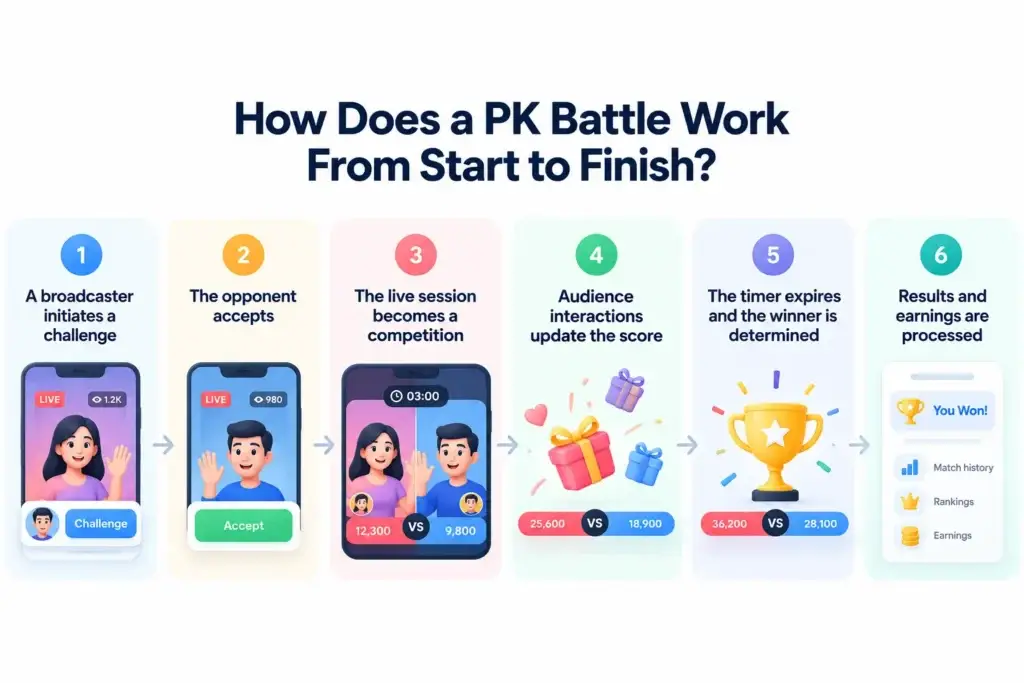
A reliable competition follows a defined event lifecycle.
The visible experience may appear simple, but every stage requires the system to maintain a consistent match state.
Stage 1: A broadcaster initiates a challenge
An eligible creator selects another broadcaster and sends a battle invitation.
The backend checks whether both hosts are authorized to participate and whether their current sessions allow a new competition.
This helps prevent conflicts such as a creator joining multiple incompatible battles.
Stage 2: The opponent accepts
After acceptance, the server creates a unique match record.
That record can contain the participating creator IDs, room identifiers, selected rules, start time, deadline, and initial scores.
A well-designed system also defines what happens when an invitation expires or one participant disconnects before the match starts.
Stage 3: The live session becomes a competition
Both creators appear in the appropriate broadcast layout.
The viewers see a shared countdown, score indicators, and relevant interaction controls.
The important design principle is that the countdown should represent a server-defined time, not independently created timers on different devices.
Otherwise, participants could see inconsistent match endings.
Stage 4: Audience interactions update the score
When an eligible gift is successfully processed, the corresponding scoring event is applied to the active match.
The backend updates the authoritative score and sends the new state to subscribed clients.
The viewer’s screen can animate the change, while the server maintains the official record.
Stage 5: The timer expires and the winner is determined
At the configured deadline, the backend stops accepting new scoring events according to its published cutoff rules.
It then finalizes the results, applies the tie-breaking policy if necessary, and stores a durable outcome record.
Stage 6: Results and earnings are processed
The participants receive the official result.
The system may update match histories, rankings, and eligible creator rewards.
Financial settlement should follow its own accounting rules rather than treating the competition result as a direct cash payout.
While the basic competition follows a challenge, scoring, and result workflow, the experience can become more sophisticated through different match formats and audience engagement mechanisms. Individual competitions, team battles, room-based challenges, leaderboards, and virtual gift interactions can create different technical requirements. Founders evaluating these possibilities can explore the available interactive broadcasting and PK battle capabilities to understand how competitive formats fit within a broader creator experience.
A win does not automatically mean the creator owns the entire gift value received during the match.
What Technical Systems Power a Real-Time PK Battle?
A PK battle combines several technical responsibilities, each serving a different purpose.
The media layer carries video and audio. The event layer carries invitations, timers, scores, and notifications. The financial layer records gift transactions. The database stores durable results.
These layers must exchange information while preserving their separate responsibilities.
Main technical components
| Technical Component | Responsibility | Why It Matters |
|---|---|---|
| Real-Time Media (RTC) | Transmits creator audio and video | Maintains interactive communication |
| Battle State Service | Tracks invitations, match status and deadlines | Prevents inconsistent competition states |
| WebSocket Gateway | Distributes score and timer updates | Keeps viewers informed |
| Wallet & Gift Ledger | Validates and records virtual transactions | Protects financial integrity |
| Database | Stores participants, events and results | Enables audits and dispute resolution |
| Cache / Event Infrastructure | Supports fast state reads and event distribution | Improves responsiveness at scale |
| Admin & Moderation | Monitors suspicious behavior and disputes | Supports safety and fair competition |
Why RTC and WebSockets serve different purposes
Real-time communication technologies, including WebRTC-based systems, are suitable for carrying interactive audio and video.
WebSockets or comparable event-transport technologies are commonly used to distribute battle-state information such as scores, invitations, and match status.
A score update does not need to be embedded inside the video stream.
Separating these responsibilities allows the application to manage media quality and event responsiveness independently.
For large audiences, an architecture may combine RTC between competing hosts with a server-mixed feed distributed through a content delivery network. This is one documented approach for interactive host battles, although the implementation depends on the media provider and latency requirements.
Why the server should control the match state
Suppose one creator’s device reports that a battle has ended while the opponent’s device continues counting down.
If the system trusts individual devices, the final scores may become disputed.
A more reliable design stores the official start time, deadline, match status, and scoring rules on the server.
Clients display this information but do not determine the official outcome.
This distinction becomes particularly important when virtual gifts affect scores and involve real financial transactions.
How Does Real-Time PK Battle Scoring Work?
A PK score is an event-derived measure of performance during a defined competition window.
In a gift-based model, eligible gift transactions contribute points to the supported creator’s score.
A simplified example is:
\[ \text{Battle Score} = \sum \text{Eligible Gift Points} \]
The platform must define how eligible gift points are calculated.
Some systems may use the virtual gift’s nominal coin value. Others may apply configured weighting, promotional rules, or battle-specific multipliers.
Those rules should be established before the match begins and remain explainable to users.
Example of gift-based scoring
Suppose Creator A receives eligible gifts worth 150, 300, and 50 points during a match.
Creator A’s resulting score is 500 points.
Creator B receives eligible gifts worth 200 and 350 points.
Creator B’s score is 550 points.
Under a simple highest-score-wins rule, Creator B wins by 50 points.
This is an illustrative scoring model, not a universal scoring policy.
How the backend should process a gift event
A robust system should validate that the sender has sufficient eligible balance, confirm that the target creator and match are valid, and process the gift transaction without allowing duplicate financial debits.
The accepted event must then be associated with the correct battle and scoring window.
A possible processing sequence is:
- Receive a gift request with a unique operation identifier.
- Validate the sender, recipient, item, and active battle.
- Debit the eligible balance and record the gift in a durable transaction.
- Persist the associated score contribution.
- Publish the accepted event for real-time display.
- Reconcile the final score from committed events when the match closes.
The implementation should also handle retries and duplicate messages. A repeated network request must not cause a second debit or an extra score contribution.
Why a score is not a payment balance
One of the most important distinctions is that battle points are not automatically equivalent to creator earnings or withdrawable money.
A gift may contribute its configured point value toward the competition while the associated economic transaction follows different revenue-sharing and conversion rules.
Keeping these values separate helps prevent reporting errors and disputes.
How Do Virtual Gifts Generate Revenue During PK Battles?
PK battles create a time-limited setting where supporters can influence a visible outcome.
That can encourage bursts of gifting activity, especially during close matches.
However, the financial system must distinguish between the viewer’s purchase, the digital item consumed, the amount allocated to creators, and the platform’s retained revenue.
The virtual gift transaction journey
The process typically begins when a viewer purchases in-app currency using an available payment method.
The viewer then spends some of that currency on an eligible gift.
The system records the transaction, applies the configured economic allocation, and credits the appropriate creator reward accounts.
If the gift is associated with an active battle, its eligible scoring value is applied to that match.
Virtual gifting involves several connected financial records, including purchased coins, gift consumption, creator rewards, platform earnings, and withdrawal obligations. These values must be tracked separately to maintain accurate accounting and transparent creator settlements. For a deeper understanding of these financial relationships, founders can explore the virtual currency and creator-economy operations guide, which explains how wallet activity and monetization workflows influence platform economics.
Finally, any creator withdrawal follows the platform’s payout and eligibility procedures.
These events are connected, but they serve different purposes.
Example of a revenue allocation
Suppose a gift transaction has an illustrative economic value of $10 under the platform’s internal accounting model.
A hypothetical arrangement might allocate $3 to the operator, $1 to an agency, and $6 to the creator.
The corresponding competitive score could still be based on the gift’s configured points rather than the creator’s $6 share.
This distinction matters because a competitive points system should not be confused with actual cash accounting.
The economic illustration excludes taxes, processor charges, refunds, other financial obligations, and any differences between face value and redeemable value.
Founders evaluating broader revenue arrangements can explore Miracuves’ creator monetization and revenue-sharing framework.
How Do PK Battles Influence Creator Engagement and Monetization?
PK battles are designed to turn passive viewing into a shared competitive experience.
Their commercial value comes from the interaction between creators, audiences, and a visible short-term objective.
Audience participation becomes measurable
Ordinary viewing sessions can generate engagement through chat, follows, and reactions.
A competition introduces an additional signal: viewers can see how their participation contributes to a changing match score.
That visibility can increase emotional involvement, although the effect will differ across audiences and creators.
Competition can encourage repeat sessions
A creator who loses a close match may arrange another competition.
Regular match schedules, familiar rivalries, and community participation can give audiences reasons to return.
However, operators should distinguish healthy recurring interest from engagement driven primarily by financial pressure.
Creator collaboration can improve discovery
When two broadcasters participate in the same event, each may receive exposure to viewers who primarily follow the other participant.
That creates a potential audience-discovery benefit separate from direct gifting revenue.
The value depends on whether viewers subsequently follow creators, watch future broadcasts, and return without needing constant financial incentives.
Revenue is only one measure of success
Operators should assess whether competitions improve broader product performance.
A successful match may generate revenue, but its long-term business value also depends on viewer retention, creator satisfaction, and the cost of delivering the experience.
The strongest outcome is sustainable participation, not simply a temporary spike in virtual gift spending.
For wider context on the role of digital gifts and balances, see Miracuves’ guide to virtual currency and creator-economy operations.
What KPIs Should Founders Track for PK Battle Monetization?
Gross gift spending alone cannot show whether a competitive feature is creating meaningful business value.
A founder should measure both financial performance and the quality of audience engagement.
| KPI | What it measures | Founder significance |
|---|---|---|
| Battle participation rate | Percentage of eligible live creators participating in matches | Creator adoption |
| Average battle watch time | Viewing duration during competitive sessions | Audience engagement |
| Eligible gift value per battle | Total qualifying gift activity | Monetization activity |
| Paying viewer conversion | Share of battle viewers making eligible purchases | Purchase participation |
| Repeat battle participation | Creators and viewers returning for future matches | Retention |
| Net revenue retained | Revenue after applicable allocations and deductions | Financial performance |
| Battle completion rate | Matches finishing without cancellation or failure | Technical reliability |
Two additional metrics are particularly useful.
Incremental retained revenue per battle compares expected retained revenue with the revenue the business might have generated from ordinary broadcasting during a comparable period.
Contribution per battle subtracts directly attributable expenses from retained revenue. Depending on the architecture and commercial model, these expenses could include additional media usage, promotional incentives, and transaction-related charges.
The profitability of a competitive broadcast also depends on expenses beyond virtual gift transactions. Additional media consumption, cloud resources, payment processing, moderation, and creator incentives can reduce the financial contribution of an otherwise successful event. Founders looking to evaluate these recurring obligations can explore the operating costs and budget considerations for live-video businesses to understand how engagement-driven activity affects long-term spending.
These calculations help founders avoid attributing all gift spending during a match to the PK feature itself.
For instance, an established creator might already generate significant gift activity during ordinary broadcasts. A competition should be evaluated by the incremental value it creates, not just the total transactions recorded while it is active.
Why operator dashboards matter
A useful reporting system should distinguish match events from financial transactions.
The operator may need to investigate a match that generated high points but unusually low retained revenue, or a competition with many participating viewers but limited repeat engagement.
Reliable reporting creates the basis for adjusting match formats, creator incentives, moderation policies, and promotional spending.
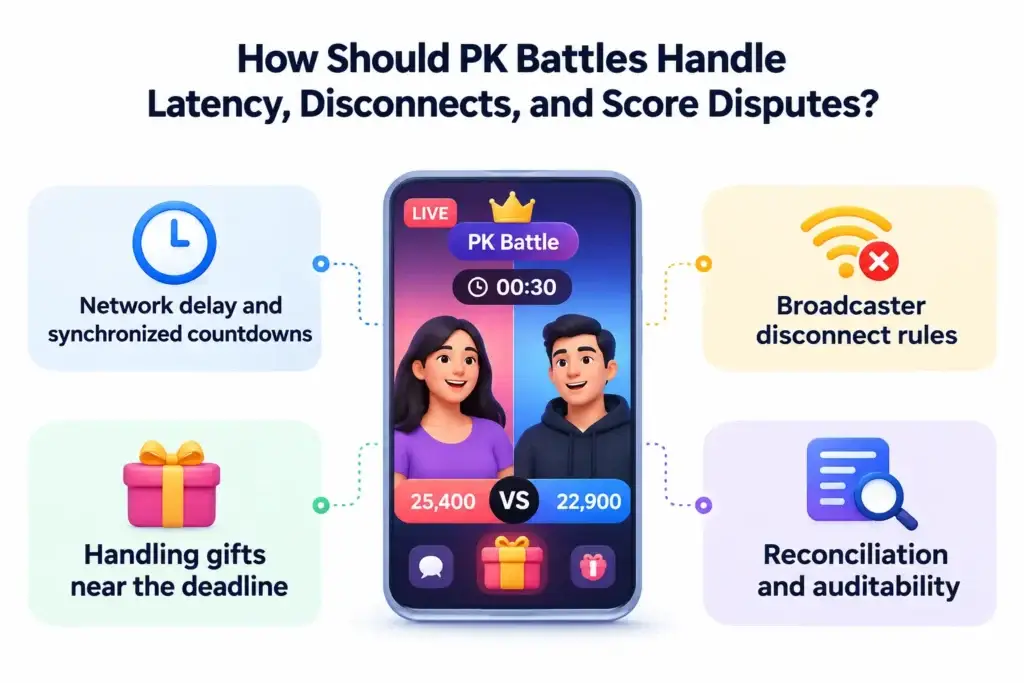
How Should PK Battles Handle Latency, Disconnects, and Score Disputes?
Competition introduces a higher expectation of fairness than ordinary video viewing.
If a viewer sends a gift during the final seconds, they expect the system to explain whether it counted.
If a broadcaster temporarily disconnects, the participants need predictable rules governing whether the match continues or ends.
These questions should be addressed in the technical design before competitive events are launched.
Network delay and synchronized countdowns
Real-time applications experience network latency.
Different viewers may receive updates at slightly different times because of device performance, location, network conditions, or the media delivery architecture.
The official battle deadline should therefore be maintained on the backend.
The displayed countdown can be synchronized against the server’s time reference, but visual timing differences should never become the basis for financial or scoring decisions.
What happens when a broadcaster disconnects?
The match should have clearly defined interruption rules.
Depending on the product design, the system might allow a short reconnection period, pause the match, or terminate it after a specified condition is met.
There is no single correct policy for every business.
What matters is that participants understand the policy and that the backend applies it consistently.
Handling gifts near the deadline
A particularly important edge case occurs when a gift request is submitted moments before the match ends.
The system needs an authoritative acceptance policy.
For example, the rules might count a gift only if its transaction was successfully committed before the official deadline.
An alternative could use server-side request admission time with a defined settlement window.
Whichever approach is adopted, it should be documented, enforceable, and consistent with the financial ledger.
The client device’s displayed timer should not determine eligibility.
Reconciliation and auditability
When a match is finalized, its score should be reconcilable against accepted scoring events.
Event identifiers, timestamps, match IDs, recipient IDs, and corresponding gift-transaction references can support investigations.
This is especially important for paid participation because errors may affect both the perceived fairness of a competition and the users’ financial balances.
How Can Operators Prevent PK Battle Fraud and Abuse?
Competitive systems can attract manipulation when public rankings, rewards, or creator incentives are connected to participation.
Operators should monitor suspicious activity without assuming that every unusually large gift or rapid score change is fraudulent.
Common risk patterns
Potential problems include repeated automated gift attempts, coordinated account abuse, unauthorized wallet activity, transaction reversals, and attempts to manipulate match outcomes.
Operator teams may also encounter harassment between creator communities or pressure on viewers to overspend.
An effective safety strategy needs a combination of technical controls and enforceable community rules.
Practical safeguards
Transaction processing should prevent duplicate debits and ensure that accepted scoring events correspond to valid financial records.
Rate limiting and anomaly detection can help flag unusual activity patterns for further review.
Role-based access control can prevent unauthorized changes to competition rules, creator balances, or financial records.
Operators should also maintain clear dispute procedures and avoid allowing support staff to make unexplained changes to finalized results.
Where paid virtual gifts are used, transparent participation rules, spending controls, refund policies, and age-appropriate safeguards deserve particular attention.
These measures help protect creator trust and the platform’s long-term reputation.
Founder Decision Signals: Is Your PK Battle System Ready?
This compact HTML block works well after the security section, before founder implementation decisions.
Launch Budget
Can your initial budget cover essential features, video infrastructure, testing, and launch without investing heavily in unnecessary functionality?
Operating Costs
Can you track streaming bandwidth, cloud hosting, video SDK usage, payment processing fees, and creator payouts as your audience grows?
Scalability
Can your infrastructure support more concurrent viewers, live rooms, and gifting transactions without causing unpredictable monthly expenses?
Revenue Sustainability
Can virtual gifts, subscriptions, paid rooms, and platform commissions generate enough revenue to cover infrastructure and operating expenses?
When Should a Creator-Led Business Introduce PK Battles?
Competitive broadcasting can be an effective engagement mechanism, but introducing it too early may produce disappointing results.
A battle requires participating creators and a sufficiently active audience.
If a new service has only one or two broadcasters available at unpredictable times, consistent matchmaking may be difficult.
Similarly, if audiences have not yet established relationships with creators, there may be limited motivation to participate in head-to-head competitions.
Start with reliable creator participation
Before introducing recurring competitions, founders should determine whether broadcasters are active at consistent times and whether audiences regularly attend their sessions.
That creates a stronger starting point for scheduled events.
Establish transparent gift and earnings rules
Creators should understand how virtual gifts are valued, which gifts qualify for scoring, and how rewards are allocated.
If the platform uses agency relationships, those agreements should also be reflected in the relevant financial workflows.
Test the competition with a controlled audience
An initial rollout can focus on a smaller group of creators.
This allows the team to assess score accuracy, streaming stability, moderation needs, and the user experience under realistic conditions.
The results can guide technical improvements before broader promotion.
Expand based on retention, not excitement alone
A successful first event may generate a temporary engagement spike.
Founders should look for repeated participation, returning viewers, and acceptable operational costs before building a larger competition calendar.
This approach connects well with Miracuves’ go-to-market planning guide for creator-led broadcasting businesses, which covers the broader relationship between creator supply, audience acquisition, and product growth.
Common PK Battle Implementation Mistakes to Avoid
Using device-side scores as the official result
Keep authoritative scoring and finalization on the backend. Client interfaces should display results rather than decide them.
Updating competition scores before confirming gifts
Score changes must correspond to valid accepted events, with duplicate requests and retries handled safely.
Treating virtual points as withdrawable currency
Separate competitive scoring, purchased balances, creator earnings, and cash-settlement obligations.
Ignoring disconnections and deadline disputes
Publish clear rules for interruptions, reconnections, late events, ties, and match cancellation.
Measuring success only by total gift spending
Evaluate repeat participation, contribution margin, creator satisfaction, and healthy audience retention.
How a Ready-Made Foundation Fits Into PK Battle Implementation
For founders planning interactive creator experiences, the decision is not simply whether to add a competitive interface.
The more important question is whether the underlying software already supports the required connections between live media, battle state, virtual gifts, creator balances, and operator oversight.
Implementing competitive broadcasting involves more than building a timer and scoreboard. Match coordination, real-time notifications, gift validation, financial records, and administrative workflows all influence engineering effort. The initial investment also depends on whether these components are developed independently or configured within an existing software foundation. Founders comparing implementation approaches can review the development cost and pricing factors for interactive broadcasting software before finalizing their technical budget.
Building these systems independently can involve significant engineering and integration work.
An existing software foundation may reduce the amount of development needed before initial market validation.
Implementing PK battles requires more than displaying competing hosts and a countdown timer. The underlying software must coordinate real-time scoring, gift transactions, creator activity, and administrative oversight. Founders who want to avoid rebuilding these interconnected workflows can explore a customizable live broadcasting software foundation that brings together live rooms, virtual gifting, creator management, and competitive interactions under one branded experience.
Miracuves provides a ready-made foundation for interactive broadcasting businesses with documented PK battle workflows, gift transactions, and administrative control.
The live product documentation describes support for multiple battle formats, including individual, team, room, family, agency, and tournament competitions. Its standard ready-made delivery timeline is six working days, with additional production-readiness and customization work depending on the agreed scope.
The reliability of a PK battle experience also depends on the team responsible for implementing and maintaining it. Founders should evaluate experience with real-time communication, synchronized event processing, wallet transactions, administrative controls, and production testing. Understanding what to assess in a streaming software development partner can help businesses identify technical responsibilities and reduce avoidable implementation risks.
For a founder, the benefit of a ready-made starting point is not simply launching quickly. It is reducing the need to reconstruct core product relationships before testing whether audiences and creators will adopt the experience.
However, buyers should still review implementation details, payment requirements, media-provider configuration, testing coverage, security work, and expected usage before selecting a launch plan.
For a broader overview of related workflows, review the interactive engagement and broadcasting feature documentation.
Final Thoughts: PK Battles Need More Than a Countdown and a Scoreboard
A successful PK battle combines four essential elements: an engaging creator experience, reliable real-time technology, transparent financial accounting, and consistent operator controls.
The visible competition may last only a few minutes, but the underlying systems must handle media synchronization, gift processing, score accuracy, event finalization, and financial obligations without compromising user trust.
For founders, the strongest implementation strategy starts with clear competition rules and measurable business objectives.
Technical reliability determines whether audiences trust the results. Financial accuracy determines whether creators trust their earnings. Thoughtful engagement design determines whether participants want to return.
Miracuves helps founders evaluate ready-made product foundations that can shorten initial implementation work while leaving room for branding and future customization.
Ultimately, PK battles create the most sustainable value when competitive engagement supports genuine creator relationships and transparent monetization rather than relying solely on short bursts of spending.
FAQs
What is a PK battle in live broadcasting?
A PK battle is a timed competition between creators, commonly using eligible virtual gifts or other configured audience actions to determine a score. Viewers can follow the competition through live scoreboards, timers, and interactive broadcasting features.
How are PK battle scores calculated?
Scores are calculated according to the product’s configured rules. In a gift-based system, accepted gifts contribute an eligible point value during the active match window. The backend should maintain the authoritative score and finalize the result when the match ends.
Do PK battle points equal real money?
Not necessarily. Competition points, purchased coins, creator earnings, and withdrawable balances can represent different values. A reliable financial system keeps their records and conversion rules separate.
Which technologies support real-time PK battles?
An implementation may use real-time media technology for audio and video, WebSockets for score notifications, backend services for authoritative match state, and databases for durable transaction records. The exact architecture depends on scale, latency requirements, and the media provider.
Can PK battles increase creator monetization?
They may encourage more audience participation and gifting during competitive sessions. However, the business impact should be measured through incremental retained revenue, repeat engagement, creator satisfaction, and associated operating costs rather than gross gift activity alone.
How can a system prevent PK score manipulation?
Server-authoritative scoring, validated gift transactions, unique event identifiers, duplicate-request protection, transaction logs, and final-result reconciliation can reduce opportunities for manipulation and support investigations.
What happens if a creator disconnects during a match?
The behavior depends on the competition rules. A system may provide a reconnection period, pause the event, or terminate it. The important requirement is that the backend applies the chosen rules consistently and communicates the outcome clearly.
Should every new creator app introduce PK battles immediately?
Not necessarily. Competitive events are more useful when there are enough active creators and engaged viewers to support reliable matchmaking and recurring participation. Founders should evaluate audience readiness before making the feature central to their monetization strategy.
Miracuves is an independent software development company. We are not affiliated with, connected to, sponsored by, or endorsed by any company or product named in this article.
Terms such as “X Clone” are used descriptively. It is how the software industry refers to building a platform with functionality comparable to a known service, and how clients search for it.
The entire design and codebase of our products is built by our own team. Our products contain no code, design, graphics, or content originating from any third-party website or applications.
All third-party names and marks referenced in this article are the property of their respective owners, referenced solely to identify the services discussed.