


Key Takeaways
- Five of the six revenue lines on a food delivery dispatch app improve only when somebody agrees to pay more, and the delivery fee is the one whose margin widens without the published number changing at all.
- Cost per delivery is not the rider’s trip payment, it is that payment plus paid idle time, incentives and guarantees, the cost of failed deliveries, and the support minutes the order consumes.
- Completed drops per rider hour is the number that moves everything, because the price of an hour is set by your labour market and the denominator is set by you.
- A rider standing in a restaurant for eleven minutes is being paid to stand there, which makes prep accuracy a margin lever wearing an operations costume.
- Scheduled and invoiced business orders are the only demand type that lowers cost per delivery without any operational change, and they land in the flat midday hour where that cost is worst.
Cost Per Delivery Signals
- Assemble cost per delivery from all five components before you touch the published fee.
- Record accepted, quoted ready, rider arrived and handed over as named timestamps on every order.
- Report drops per rider hour by hour of day rather than as one daily average.
- Move incentive spend out of the marketing budget and into the cost-per-delivery calculation.
- Build organizations, spend limits, delivery windows and monthly invoicing before you sell a corporate account.
Real Insights
- Raising the delivery fee runs a live elasticity test on your whole customer base in one evening, and small baskets leave first, which costs you the density that was holding cost per delivery down.
- Improving cost per delivery is invisible to customers, invisible to competitors and needs nobody’s agreement, which is exactly why it compounds while a fee advantage lasts an afternoon.
- A zone drawn as a radius rather than in travel minutes buys orders at the edge that lose money at the same fee earning comfortably three streets from the centre.
- Membership is better understood as a demand-smoothing instrument than a revenue line, because its real return is the density it creates for every order in the zone, members or not.
- Miracuves builds food delivery dispatch platforms with named lifecycle timestamps, zone-scoped dispatch and business account invoicing already in place, and eligible ready-made scopes follow a 6-day deployment path for the build itself.
Two delivery operations run in the same city. Both charge almost the same delivery fee, close enough that a diner comparing them at checkout would not decide on that number. One makes money on delivery. The other loses money on every order it dispatches.
Nothing at checkout explains the gap. The entire difference sits on the other side of the subtraction, in what each operator pays to get a bag from a counter to a door.
That is the useful fact about this business. Five of the six revenue lines on a food delivery dispatch app are prices you publish, and your influence ends at the number. One line is earned, because its margin is the gap between what a delivery earns and what it costs you, and you own the second half of that gap.
This article is about the second half. What a delivery actually costs on a food delivery dispatch app, the operating number that moves that cost, why raising the fee is the weaker response, and the one demand type that improves your economics with no operational change at all.
Grubhub charges a fee that looks much like everyone else’s, and what separates it is the cost sitting underneath.
Same Fee, Two Businesses: Food Delivery Dispatch Economics
Two platforms can charge exactly what Grubhub charges and still run completely different businesses.
The profitable operator did not find a cheaper courier or negotiate a better wage. Both buy hours in the same labour market at the same rate.
A Fee Is a Price. A Margin Is a Subtraction.
A delivery fee is a number you publish. It takes four seconds to change in a configuration table.
Cost per delivery is not published, it is an outcome, assembled from a dozen operational decisions taken across a week: how the zone was drawn, how long riders stand in kitchens, how many orders land in the same fifteen minutes, how many trips end in a refund.
The First Instinct Is Usually the Wrong One
An operator losing money on delivery reaches for the fee first. It is the lever nearest to hand and the only one that does not require changing how the operation runs.
It also fails quietly. The fee goes up, dashboard margin improves, delivered volume falls, riders spend more of the hour waiting, and cost per delivery on the remaining trips rises to meet the new fee. Six weeks later the contribution line is where it started, with fewer customers attached.
The business-model page treats that as a headline rather than a footnote, and reading how the business model works is worth it before you decide which line to move.
Six Revenue Lines in Food Delivery Dispatch, One of Them Earned
A food delivery dispatch app usually carries six ways of making money: restaurant commission, the delivery fee, service and small-order charges, promoted placement, customer membership, and contracted delivery for businesses with orders and no drivers.
The Five You Price
Five of those improve in exactly one way. To earn more from commission you charge restaurants a higher percentage. To earn more from placement you raise the rate card. To earn more from membership you raise the monthly price.
Every one of those asks somebody to agree to pay more than they paid last month. Some will, some will leave, and the size of each group is not yours to decide.
The One You Earn
The delivery fee is different in kind. Its margin is the fee minus the cost of the delivery, so you can leave the published number where it is and still widen the margin, by making the delivery cheaper to perform.
Nobody has to agree to that. No customer sees it, no restaurant negotiates it, no competitor reads it off your checkout screen. It is the only line where an operational improvement converts into money with no permission required.
What a Delivery Actually Costs in Dispatch Terms
Ask an operator what a delivery costs and you get one number: what the rider was paid for that trip. It is real and it is the largest single component. On most operations it is also well under half the total.
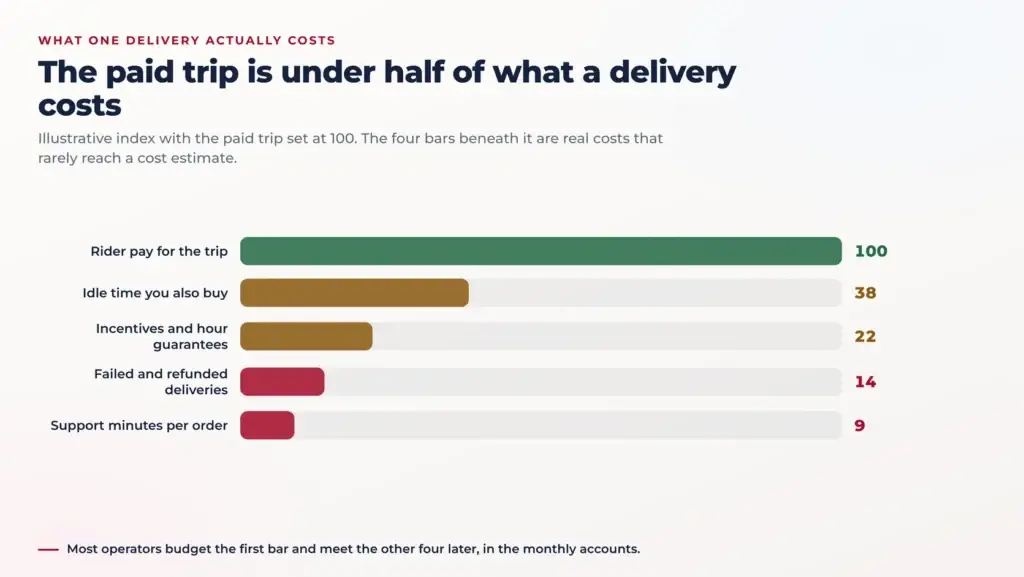
Image Source: AI-generated visual by Miracuves
The Paid Trip, and the Paid Hour Around It
Riders are not paid only while carrying food. If you pay by the hour or guarantee a minimum, every minute a rider waits for an offer is a minute you bought and did not use.
Pay strictly per drop and you buy that idle time indirectly. Riders whose earnings per hour fall below what the work is worth to them stop logging in, and you replace them with incentives, which is the same money under another name and usually more of it. No payment model makes idle time free.
Incentives, Guarantees and the Top-Up
Peak bonuses, hourly guarantees, completion streaks and referral payments are not marketing spend, though they are usually budgeted as though they were. They bought deliveries, and they belong beside the trip payment.
They get filed separately for a structural reason. Trip payments live in the order record. A weekly incentive budget lives with operations and is approved as a lump. Nothing joins them, so nothing divides the total by completed drops.
The Failed Delivery and the Support Minutes
A delivery that fails costs more than one that succeeds and earns nothing. The rider is paid, the food is written off, the customer is refunded, and somebody spends ten minutes establishing what happened.
Support minutes attach to ordinary orders too. Every late order and missing item is a paid person for a measurable number of minutes, and that total divided by completed deliveries is a per-delivery cost whether or not you record it as one.
Drops Per Rider Hour Is the Number Dispatch Lives On
Once the cost side is assembled honestly, one operating number governs most of it. The price of a rider hour is set by your local labour market and you will not change it. Completed deliveries per rider hour is set by nobody but you.
The Arithmetic, as an Example
Take a rider hour that costs the platform some fixed amount. Spread across two completed drops, each delivery carries half of that hour. Spread across three, each carries a third.
Moving from two drops an hour to three cuts the labour component of cost per delivery by a third, without touching a wage, a fee or a commission rate. The figures are illustrative, but no pricing change moves that far without a demand consequence. The hour did not get cheaper. The denominator got bigger.
Why a Busy Hour Is Cheaper Than a Quiet One
Founders treat peak as the expensive period, because peak is when incentives are paid. Measured per delivery, the opposite is usually true.
A busy hour has short gaps between offers, short travel between pickups, and riders and restaurants in the same few streets. A quiet hour has a rider idle in a car park, then riding four kilometres to a pickup, to complete one delivery. The quiet hour is the expensive one, and no fee change corrects it.
Everything That Raises Drops Per Hour
Every item on the list is operational.
Density, and the Ceiling on Batching
Orders close together are cheaper to serve than the same count spread out, which is why a small dense footprint beats a larger one on cost per delivery while looking worse on every metric a deck would show.
Batching turns density into money. Two orders from one kitchen going to doors four hundred metres apart is a single trip completing two deliveries, and the second drop costs the extra minutes rather than another whole trip with its own travel and its own wait.
The ceiling is customer tolerance. The second customer on the route pays for the first one’s convenience in minutes, and batch hard enough and the saving returns as refunds. It is a margin lever with a lateness budget attached, not a free one.
Dead Heading Is the Quiet Loss
Dead heading is distance covered with nothing in the bag: the ride out to a pickup, and the ride back after a drop at the edge of the zone.
It is invisible in most reporting because no order status advances during it, yet it consumes the same minutes as a paid leg. Seeing it needs continuous rider location and status history rather than event-only records. How to Keep Restaurants, Riders, and Customers Happy Simultaneously covers keeping those clocks aligned in practice.
Zone Shape Is an Economic Decision
A zone drawn as a radius is a coverage decision. A zone drawn in travel minutes is an economic one, and on any street network with a river or a one-way system the two produce different shapes. Orders at the far edge of a circle take longer to reach and hold a rider out of the dense core on the way back, so they often lose money at the fee that earns comfortably three streets from the centre. Coverage geometry is an input to cost per delivery, not a marketing choice.
Restaurant Wait Time Is Your Cost, Not Theirs
A rider reaches a restaurant at seven forty-one for an order accepted at seven twenty-eight with a twelve-minute prep estimate. The food is handed over at seven fifty-two. The rider stood in that doorway for eleven minutes, and the platform paid for every one of them.
The Incentive Points the Wrong Way
The restaurant carried no part of that cost. It appeared nowhere on their profit and loss, and no mechanism exists by which they would feel it.
A restaurant optimizing its own kitchen accepts orders early, because accepting holds the order and stops the platform steering that customer elsewhere. It quotes an optimistic prep time, because a long wait loses the order at checkout. Both are rational for a business with its own rent and a thin margin. Both are expensive for you.
What You Have to Measure Before You Can Fix It
Four named timestamps per order, held per restaurant: accepted, quoted ready, rider arrived, handed over. Quoted ready against actually ready is prep accuracy. Rider arrived against handed over is rider wait, and rider wait is your money.
With a per-restaurant distribution in front of you the responses are obvious and none involve renegotiating commission. Delay the dispatch offer for kitchens that consistently run late. Show each kitchen its own wait figure, because almost none have seen it.
Stock accuracy belongs to the same family, because an item unavailable after dispatch converts a completed delivery into a refund and a wasted return trip. The Out-of-Stock Trap: Why Cheap Delivery Scripts Ruin Restaurant Relationships is the long version of that leak.
Why Raising the Fee Is the Worse Lever
Operators under margin pressure still raise the fee first, so it is worth being precise about why the other lever is better.
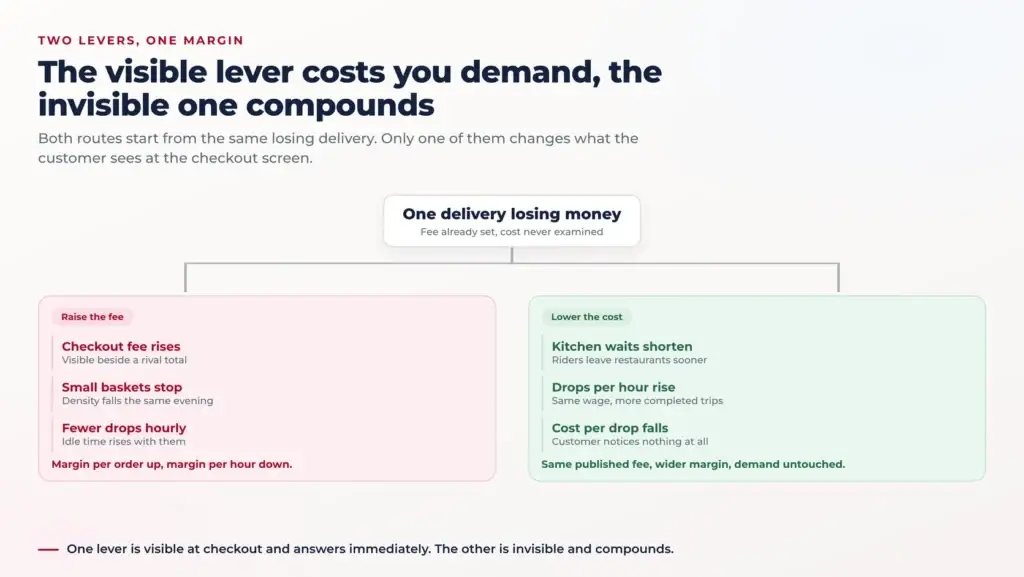
Image Source: AI-generated visual by Miracuves
Demand Answers the Same Evening
A fee increase is a live elasticity experiment run on your whole customer base at once with no control group, and the answer arrives inside a day.
It does not arrive evenly. Small baskets go first, because the fee is a larger share of them. What remains is a smaller count of larger orders, which reads as an improvement and is a loss of density, pushing cost per delivery up on everything still moving.
The Number Sits Next to Somebody Else’s
The delivery fee is the one line item a customer compares against an alternative, at the moment of purchase, on a screen built to make the total prominent. Commission is invisible to them. So is placement spend. A membership price is seen once a month at most.
Every increment also makes the basket itself less worth ordering. Past some point the customer does not switch to a rival, they cook, and that demand does not return when the fee comes back down, because what broke was a habit.
Improving cost per delivery has none of those properties. The customer sees nothing, the competitor sees nothing, nobody has to agree. It compounds too: a shorter average wait raises drops per hour, which lowers cost, which funds the density that raises drops per hour again.
Counting only the paid trip
A cost per delivery built from the rider’s trip payment alone understates reality badly. Idle time, incentives, failures and support minutes all divide by the same denominator.
Budgeting incentives as marketing
Rider bonuses and hourly guarantees buy deliveries, not awareness. Filed under marketing they never reach the cost calculation, and the number you quote stays comfortably wrong.
Treating restaurant wait as an operations issue
Eleven minutes of rider time in a doorway is money leaving the business. Until wait time per restaurant is measured, prep optimism is a subsidy you pay silently every evening.
Drawing zones as circles
A radius is a coverage statement. Travel minutes are an economic one. Orders at the far edge lose money at a fee that earns well in the core, and you chose them by drawing the shape.
Selling corporate accounts too early
A business account is a promise to somebody whose colleagues go hungry when it breaks. Sell it while lateness is still unpredictable and you convert your cheapest demand into your loudest churn.
Commission Per Order, and Why Restaurants Push Back Hardest on It
Commission belongs to the five priced lines and improves only by being raised. It still earns a section, because it is the line restaurants argue about most.
What the Percentage Buys, and Why It Still Stings
From the platform’s side, commission funds demand generation, the ordering surface, payment processing and settlement, customer support, and the share of dispatch the delivery fee does not cover. It is the price of arriving at a kitchen with a customer attached.
From the restaurant’s side it is a percentage of gross on a transaction where the food was already bought and the cook already paid. Rent is fixed and ingredients scale with covers at a known price. Commission scales with revenue and is deducted before the money is ever seen. It is the only significant cost that rises precisely when the restaurant does well.
Which is why the negotiation is rarely won with a rate. It is won with a report: orders you generated, how many were new customers, what share reordered. Tiered rates are the usual answer, and the tier is a guess until your cost per delivery is known. The features page sets out what the restaurant-facing side has to hold.
Business Orders Are a Different Demand Type Entirely
Everything so far treats demand as one thing arriving whenever it feels like it. One category does not, and on most dispatch platforms it is the most underbuilt source of volume there is.
Scheduled, Larger and Predictable
A consumer order is impulsive. Somebody is hungry now, decides in four minutes and expects food inside thirty. Volume follows appetite, which follows the clock and the weather.
A business order is decided in advance. A team lunch for fourteen on Thursday is placed on Tuesday. The address is an office that will certainly still be there, staffed, with a named person expecting the bags. The basket is several times a consumer basket and the recipient does not change their mind.
Why They Are Cheaper to Serve
Run a scheduled office order back through the cost decomposition and every component moves in your favour. The rider is not held speculatively, because you knew about this order two days ago. Travel is to a known address the rider has already learned, and the building has a delivery entrance.
Failed deliveries are close to zero, because an office at one in the afternoon is full of people, and that removes the most expensive item in the decomposition. Support contacts per unit of value are lower, since one contact covers a basket worth several consumer orders.
This is the rare case where a demand type improves cost per delivery with no operational change whatsoever. You did not get better at dispatching. You acquired orders that are cheaper to dispatch.
The Same Cost Decomposition, Two Demand Types
| Cost component | Impulse consumer order | Scheduled business order |
|---|---|---|
| Dispatch planning | Reactive, supply guessed minutes ahead | Known days ahead, a shift can be offered |
| Address and access | New building, unclear entrance, intercom | Repeat office, delivery entrance, reception |
| Failed delivery risk | Customer absent, phone unanswered, refund | Near zero, the room is full of people |
| Hour of day | Clusters into the two peaks | Lands in the flat, expensive middle |
| Payment and settlement | Card at checkout, per order | Invoiced monthly against an account |
What the Platform Needs Before It Can Take a Corporate Account
A corporate customer is not one user holding a card, and almost none of the consumer assumptions survive contact with an office.
Many Users, One Payer, and a Rule Between Them
A company account has several people who can order, a budget that constrains what they order, and one entity that settles the bill. Those are three separate concepts, and most consumer data models collapse all three into a single user with a saved payment method.
What you need is an organization that owns users, a spend limit per person or per event, and an approval step above it. Having no concept of a limit is what loses the account, because the buyer is an office manager personally accountable for that number.
Windows, Invoices and a Receipt That Survives Expenses
A consumer order is as soon as possible. A business order is a window: between twelve thirty and one, which also means not at twelve fifteen when the room is still in a meeting. Scheduling with a real window is not a convenience here, it is the product.
Settlement is monthly and invoiced rather than charged at checkout: credit terms, a statement that reconciles to every order on it, purchase order references carried through to the invoice, and a tax document an accounts payable department accepts without a phone call.
Each order still needs a receipt an employee can file: itemized, tax shown, dated, with the ordering person and cost centre on it. That is the difference between a company using you once and every week, and it is scope worth agreeing during food delivery app development rather than after a finance department says no.
The Middle of the Day Is Your Worst Number
Business demand does something else that is easy to miss while you are admiring the basket size. It arrives at the exact hour your operation is least efficient.
A food delivery dispatch app’s day is two spikes and a long flat middle. Riders are scarce at eight in the evening and idle at two in the afternoon, and an average utilization figure hides both. That flat middle is where idle time is highest, drops per rider hour lowest, and cost per delivery quietly inflated.
Office lunch volume lands precisely there, and it is predictable days ahead rather than minutes ahead. That turns supply from a guess into a plan: you know on Tuesday how many drops Thursday’s one o’clock hour holds, so you can offer a shift instead of buying supply with a real-time incentive.
Incentives paid to conjure supply at short notice are a cost line in the decomposition, and volume that lets you schedule instead reduces it directly. The whole argument fits in one sentence: the demand type with the lowest cost to serve arrives in the hour with the highest cost per delivery.
Membership Is a Demand-Smoothing Instrument
Customer membership gets described as recurring revenue, and the subscription fee is genuine money. Treating it primarily as a revenue line undersells what it does and leads to pricing it against the wrong thing.
A member has prepaid the friction. The fee that made a small order feel not worth placing has gone, so it gets placed. Frequency rises and average basket falls, which looks like a mixed result and is not. More orders inside one zone is more density, more batchable pairs and higher drops per rider hour for every order there, including orders from people who are not members.
The failure mode is selling unlimited free delivery below what a member’s deliveries cost, to customers whose behaviour does not change. It works only if it moves frequency and pays only if it moves density, which makes it a cost-side product priced against your cost per delivery rather than against what customers might tolerate.
Carrying Other People’s Orders
The sixth line is the clearest expression of the argument. Once you have a fleet completing deliveries at a known cost, that capability is sellable on its own terms to businesses with orders and no way to move them.
You Sell the Thing You Made Efficient
A restaurant group with its own ordering site, a grocery, a pharmacy, a florist: each has demand and no drivers. None want your marketplace or will pay commission for customers they already had. They will pay a per-delivery rate, because dispatch is the part they cannot build.
If your cost per delivery sits below the contracted rate, the line earns on every trip using capacity that already exists. It also fills hours your own demand does not, which raises drops per rider hour and lowers cost on the marketplace side too. Migrating from SaaS to Owned Infrastructure: A Peak-Hour Performance Comparison matters here, because selling capacity means committing to performance you control.
What breaks is different. The order does not originate in your app and the recipient is not your customer, so the tracking page and support path have to work for somebody who has never heard of you and may be looking at another brand, which is where a white-label delivery app earns its keep. Billing is contractual and monthly, the same machinery the corporate accounts needed.
Settle capacity priority in advance. When your own marketplace and a contracted client both need a rider at seven in the evening, a written rule should decide it rather than whoever escalates loudest.
The Sequencing: Which Line to Switch On First
Six lines do not arrive at once, and the wrong order is expensive in ways that are hard to reverse.
The Fee Comes With the Operation, Not Before It
Commission and the delivery fee are live from day one because they are what the platform is. Neither is optimizable then. The launch fee is a guess informed by your market, and it stays one until enough deliveries have completed for you to know what one costs.
What matters early is that the measurement exists from week one, because a fee is only improvable against a known cost. Whether it arrives with a ready-made build or is written from scratch is a separate decision, and Ready-Made Delivery Food delivery dispatch app vs Custom Development: What Should Food Delivery Startups Choose? works through it properly.
Business Accounts Come Once Cycle Time Is Stable
A corporate account is a promise about reliability made to somebody whose colleagues will be sitting in a room at one o’clock with nothing to eat if you break it. Selling that before your lateness distribution is under control converts your cheapest demand type into your loudest churn.
The order is: make cycle time and lateness predictable, then build organizations, budgets, windows and invoicing, then sell. The build is small. The credibility takes months and cannot be bought forward.
Membership and Contracted Delivery Come Last
Membership needs a known cost per delivery because it is priced against that figure. Contracted delivery needs spare capacity and a fleet whose performance you will commit to in writing. Both are legitimate second-year lines and dangerous first-year ones. Promoted placement sits in the same group.
The question at the start is which of these your platform supports without a rebuild, which is an architecture question rather than a roadmap one. The development cost breakdown and the team that builds it set out what is included as standard, and the delivery facts page states exactly what the 6-day build window does and does not cover.
Founder Decision Signals
Speed
Instrument drops per rider hour, rider wait per restaurant and dead-heading minutes in week one, so every later improvement is measured against a baseline you already hold.
Cost
Assemble cost per delivery from all five components before touching the published fee. An operator who knows only the trip payment has a single lever, and it is the wrong one.
Scalability
Organizations, spend limits, delivery windows and monthly invoicing serve corporate accounts and contracted delivery equally. Build it once and two revenue lines open on one foundation.
Market Fit
Scheduled business volume lands in the flat midday hour where cost per delivery is worst, so winning it improves every consumer order in the same zone.
Final Thoughts: The Line You Improve Rather Than Raise
The line Grubhub improves is cost per delivery. The fee is only the line customers notice.
Go back to the two operators charging the same fee. The profitable one is not smarter about pricing, they are three or four operational habits ahead: they know what a delivery costs across all five components, they measure how long riders stand in kitchens, they drew zones in minutes rather than metres, and they went looking for the demand that is cheapest to serve.
None of that is visible to a customer, which is what makes it durable. A fee advantage lasts until a competitor matches the number, which takes an afternoon. A cost advantage lasts as long as the discipline behind it, and it compounds while the competitor is still adjusting their checkout screen.
If you are choosing a platform to build on, the question is not which revenue lines it supports, because most list all six. It is whether it records the timestamps that make cost per delivery calculable, and whether it holds an organization, a budget, a delivery window and a monthly invoice without a rebuild. Our food delivery solution is built around those assumptions, and the fastest way to test it against your city is to walk through your own numbers on a scheduled consultation.
FAQs
How does the Grubhub revenue model improve cost per delivery?
Because its margin is a subtraction rather than a price. Commission, placement, membership and service charges all improve only when somebody agrees to pay more than they paid last month. The delivery fee can keep exactly the number it has today and still widen its margin, provided the delivery underneath it becomes cheaper to perform. Nobody has to consent to that, and no competitor can see it happen.
What belongs inside cost per delivery in dispatch?
Five things, not one. The rider’s payment for that trip is the largest and the only one most operators count. Add the idle time you also pay for between offers, the incentives and hourly guarantees that bought those deliveries, the cost of a failed or refunded trip including written-off food, and the support minutes the order consumes. Divide the combined figure by completed deliveries, not by orders placed.
Why does drops per rider hour matter more than the delivery fee?
Because the price of a rider hour is set by your local labour market and you will not change it, while the number of completed deliveries inside that hour is set by you. Spread a fixed hourly cost across two drops and each carries half of it. Spread it across three and each carries a third. That is a large move in the labour component, achieved without touching any price.
Why is raising the delivery fee the wrong first dispatch move?
Three reasons. Demand answers within a day, and small baskets leave first, which costs you density and pushes cost per delivery up on everything still moving. The fee is the one line item a customer compares against an alternative at the moment of purchase. And past some point people do not switch platforms, they cook, and that habit does not come back when the fee comes down.
Why is restaurant wait time the platform’s cost rather than the restaurant’s?
Because the rider standing in the doorway is on your payroll. Those minutes appear nowhere on the restaurant’s profit and loss, so the kitchen has no mechanism by which it would ever feel them. Meanwhile accepting early and quoting optimistically are both rational for the restaurant. Fixing it starts with four timestamps per order and a per-restaurant distribution of rider wait, not with a commission negotiation.
What makes scheduled business orders cheaper to serve?
Every component of the cost decomposition improves. The order was known days ahead, so the rider is not held speculatively. The address is a repeat office with a delivery entrance. Failed deliveries are close to zero because the room is full of people at one in the afternoon. And the basket is several times a consumer basket, so fixed costs per order spread across more revenue.
What does a platform need before it can take a corporate account?
An organization that owns several ordering users, a spend limit per person or per event, and an approval step above it. Then delivery windows rather than as soon as possible, monthly invoicing with credit terms and purchase order references, a statement that reconciles to every order on it, and a per-order receipt an employee can file for expenses with tax and cost centre shown.
When should membership and contracted delivery be switched on?
After the first two lines are measured, not before. Membership is priced against your cost per delivery, so it needs that figure to exist or you are selling a discount to people whose behaviour was never going to change. Contracted delivery needs genuine spare capacity and a fleet whose performance you will commit to in writing. Both are sound second-year lines and dangerous first-year ones.
Miracuves is an independent software development company. We are not affiliated with, connected to, sponsored by, or endorsed by any company or product named in this article.
Terms such as “X Clone” are used descriptively. It is how the software industry refers to building a platform with functionality comparable to a known service, and how clients search for it.
The entire design and codebase of our products is built by our own team. Our products contain no code, design, graphics, or content originating from any third-party website or applications.
All third-party names and marks referenced in this article are the property of their respective owners, referenced solely to identify the services discussed.



