


Key Takeaways
- The build decision is not about quality. It is about which parts of a delivery platform are genuinely yours and which are identical in every delivery business.
- Custom delivery builds rarely overrun on the customer app. They overrun on dispatch, whose requirements only appear under real order pressure.
- A ready-made platform is only a foundation if operators can change dispatch rules without a developer and the source code becomes yours.
- Sort every feature into commodity, configurable, and genuinely yours before comparing vendors or quotes.
- Custom is the honest answer when the fulfilment model cannot be expressed in an existing platform, and that case should be written down rather than assumed.
Build Decision Signals
- Write the order lifecycle on one page, including every exception you already know about.
- Drive two demos yourself instead of watching them: change an assignment rule, draw a zone, open a settlement.
- Name one configuration change, one branding change, and one code-level change, then compare cost and timeline on each.
- Get source-code ownership confirmed in writing, deployable on infrastructure you control.
- Cost both routes to the first hundred delivered orders, including delayed launch and idle operations hires.
Real Insights
- Custom builds fail quietly. The visible product lands on time and the operational layer arrives thin, which is discovered after launch.
- Ready-made fails when the settings that matter turn out not to be settings. Test that during evaluation, not afterwards.
- A licence to run a hosted copy is not ownership, and the difference only becomes visible during a disagreement.
- No customer ever chose a delivery app because its address book was better written.
- Miracuves builds white-label delivery platforms with source-code ownership, configurable dispatch rules, and 6-day build time for eligible ready-made scopes.
A founder with funding, a launch city, and a nine-month runway sits down to answer one question: build the delivery platform from scratch, or start from one that already works.
It gets framed as a quality question. Custom means made for us, ready-made means generic. That framing is wrong, and it leads founders to spend their most expensive months rebuilding software that was never going to differentiate them.
The better question is narrower. Which parts of a delivery platform are genuinely yours, and which parts are the same in every delivery business on earth?
Once you can answer that, the build decision mostly answers itself. A customer browsing a menu, a card being charged, a push notification firing, a rider marking an order collected: none of that is your competitive advantage. Your supply strategy, your pricing model, your zone economics and your niche are. The software choice should protect the second list and stop consuming time on the first.
This article compares a ready-made delivery dispatch platform with custom development honestly, including where each one genuinely fails. It is written for founders at the point of decision, not as an argument for one answer.
What Custom Development Actually Means for a Delivery Platform
Custom development is usually pitched as freedom. In practice it means a team writing, from zero, the same six systems every delivery platform has, before writing anything that makes yours different.
The Part Teams Estimate Correctly
A competent team estimates the visible product well. Customer app, restaurant panel, menu management, cart and checkout, payment integration, order history, ratings, push notifications, an admin dashboard. These are well-understood problems with well-understood answers, and the estimates tend to be close.
This is also the part a founder can see and test, which is why progress feels good for the first two or three months. There are screens to click through and a demo to show investors.
The Part That Overruns
Then comes dispatch, and dispatch does not behave like the rest of the product.
Assignment logic is easy to build badly and hard to build well, because its requirements only reveal themselves under real conditions. Nobody writes a specification that says “when three riders decline in a row, keep the order’s original timestamp so it does not fall behind newer orders in the queue”. That requirement is discovered at 8pm on a Friday, six weeks after launch, when a customer has been waiting forty minutes and nobody can explain why.
The same is true of batching limits, zone overlap rules, rider waiting time at pickup, cash deposit ceilings, and what happens when a restaurant accepts an order and then goes quiet. Each one is a small piece of logic. Collectively they are the difference between a delivery network that works and one that needs a person watching a screen all evening.
The full feature surface involved is covered in Which Features Does a Food Delivery Dispatch Platform Need for Order Assignment, Rider Tracking, and Fleet Control?. Reading it as a build specification is a useful exercise, because every item on it is something a custom team has to discover, design, build, and then tune.
Why Month Two Looks Fine and Month Seven Does Not
Custom delivery builds rarely fail loudly. They drift.
The pattern is consistent. The visible product lands roughly on time. The operational layer is thinner than planned because it was scoped from imagination rather than observation. Launch happens anyway. Then the first real month generates a backlog of operational requests, each individually small, and the team spends the next quarter building the dispatch platform it thought it had already built.
Meanwhile the founder is not testing pricing, signing restaurants, or learning which zones work. The runway is being spent on software archaeology rather than on the business.
What a Ready-Made Delivery Platform Actually Is
The term covers three very different things, and conflating them is how founders end up disappointed.
Not a Template, and Not a Subscription
A template is a set of screens with no operational logic behind them. It demos well and collapses the moment real orders arrive, usually at the menu-sync layer first. That failure mode is examined in The Out-of-Stock Trap: Why Cheap Delivery Scripts Ruin Restaurant Relationships.
A hosted subscription platform is a different proposition again. You rent working software and pay per order or per month, forever, and you do not own what you are running on. That trade has its own arithmetic, worked through in The 36-Month TCO Comparison: SaaS Delivery Builders vs. Owned White-Label Engines.
A ready-made white-label platform is neither. It is a complete, working delivery system, including the operational layer, that is rebranded and configured for you and whose source code becomes yours.
Two Questions That Separate a Foundation From a Wrapper
Most of the difference between a serious ready-made platform and a repackaged demo comes down to two questions, and both are easy to ask before signing anything.
Can an operator change dispatch behaviour without a developer? Assignment radius, offer method, response window, batching limits, zone boundaries, fee bands, payout rules. If changing any of those needs a code release, the platform is a demo with a login screen, and you have bought a constraint rather than a foundation.
Do you receive the source code? Not access to a dashboard, not a licence to run a hosted copy. The actual repository, deployed on infrastructure you control. Without it you cannot change what the vendor will not change, and you cannot leave.
A platform that answers yes to both is a starting point. One that answers no to either is a subscription wearing different clothes.
Ready-Made vs Custom Development: The Honest Comparison
Both routes end with a working delivery platform. What differs is when you get there, what you spend getting there, and what you are able to change afterwards.
Ready-Made Foundation vs Custom Development
| Dimension | Ready-Made Foundation | Custom Development |
|---|---|---|
| Time to first live order | Days to weeks, since the operational layer already exists | Months, and the operational layer is usually the last part finished |
| Dispatch logic | Built and tuned against previous deployments | Designed from assumptions, then corrected after launch |
| Cost profile | Known upfront, with customization scoped separately | Estimated upfront, commonly revised during the build |
| Fit to an unusual model | Good within the delivery marketplace shape, weaker outside it | Unlimited, which is the reason to choose it |
| Where risk sits | Whether the platform bends far enough for your model | Whether the build finishes before the runway does |
| Team required at launch | Operators first, engineers later | A full engineering team from day one |
| What you own | Source code, if the vendor genuinely transfers it | Source code, unambiguously |
The row worth sitting with is the second to last. Both routes carry risk, but the risks are not comparable in kind. The ready-made risk is discovered early, during evaluation, and is usually recoverable. The custom risk is discovered late, after most of the money is spent, and often is not.
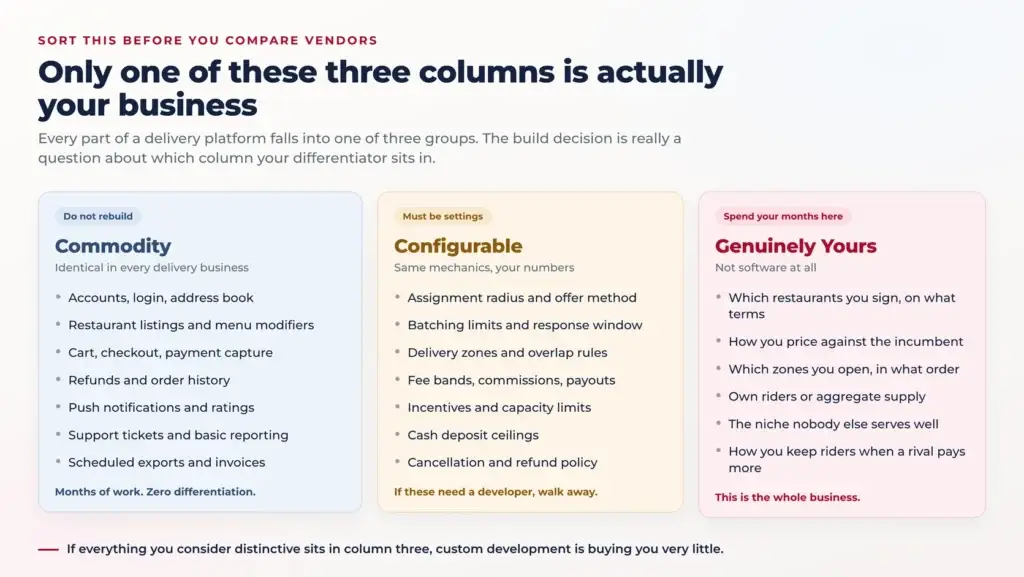
Image Source: AI-generated visual by Miracuves
Which Modules Are Commodity and Which Are Genuinely Yours
This is the analysis that actually decides the question, and most founders never do it explicitly. Every part of a delivery platform falls into one of three groups.
Commodity: Identical in Every Delivery Business
Account creation and login. Address management. Restaurant listings and menu structure with modifiers. Cart and checkout. Payment capture and refunds. Order history. Push notifications. Ratings and reviews. Support tickets. Basic reporting.
No customer has ever chosen a delivery app because its address book was better. Building these from zero is several months of work that produces exactly the same outcome as not building them from zero.
Configurable: Same Mechanics, Different Settings
Dispatch rules, delivery zones, fee structures, commission rates, rider payout models, incentive schemes, capacity limits, cancellation policies, cash handling thresholds.
Every delivery business needs these and every one sets them differently. They are not commodity and they are not bespoke. They are settings, and the right platform exposes them as settings rather than burying them in code. This is the group that most determines whether a platform will still suit you in year two.
Genuinely Yours: Where the Business Actually Lives
Which restaurants you sign and on what terms. How you price against the incumbent. Which zones you open and in what order. Whether you run your own riders or aggregate. What niche you serve that nobody else serves well. How you retain delivery partners when a competitor offers more per trip.
Almost none of this is software. It is commercial strategy, and it is where a founder’s months are best spent.
Run this exercise on your own plan before choosing a build route. If everything you consider distinctive sits in the third group, custom development is buying you very little. If something genuinely sits in the first or second group and cannot be configured, that is a real argument for custom, and it should be written down explicitly rather than felt.
Founder Decision Signals
Speed
If your funding assumes revenue within two quarters, months spent rebuilding commodity modules come directly out of the time available to find product-market fit.
Cost
Compare total cost to the first hundred delivered orders, not licence price. Delayed launch, idle operations hires, and post-launch dispatch rework all belong in the number.
Scalability
Both routes scale if built properly. The question is whether opening a second zone means a configuration change or an engineering ticket.
Market Fit
If your model is a recognizable delivery marketplace, a foundation fits. If fulfilment works in a way nobody has built before, custom is the honest answer.
When Custom Development Is the Right Call
There are real cases where a foundation is the wrong starting point, and pretending otherwise would not help anyone choosing.
A Fulfilment Model Nobody Has Built
If orders do not move from one merchant to one customer within a delivery window, marketplace assumptions stop holding. Scheduled multi-stop routes, temperature-controlled chains, subscription meal plans with weekly logistics, consolidation across several merchants into one drop: each breaks the order model deeply enough that configuration cannot reach it.
Regulated or Hardware-Coupled Workflows
Age verification at handover, prescription handling, licensed goods, tamper-evident custody, or integration with weighing and labelling hardware all introduce compliance steps into the order lifecycle itself. When the regulation shapes the workflow rather than sitting beside it, custom is usually cleaner than bending a general platform.
An Existing Business With Systems That Must Be Respected
A chain already running an ERP, a warehouse system, a loyalty programme and a POS estate is not starting from zero. It is adding a delivery capability to an existing operation, and the integration surface can easily be larger than the delivery platform itself. That is a genuine custom engagement, and it is the kind of work custom development exists for.
One honest note on all three: they justify custom work on the parts that are actually unusual. They rarely justify rebuilding login, checkout and push notifications alongside it.
When a Ready-Made Foundation Is the Right Call
The cases on this side are more common, and they share one trait: the uncertainty sits in the market rather than in the software.
You Are Validating Demand
You believe a city, a cuisine, or a customer segment is underserved, and you need evidence. The fastest way to be wrong cheaply is to launch a real service in one zone and watch what happens. Spending six months building software to test a market hypothesis inverts the risk: you commit the expensive resource before learning whether the cheap assumption held.
Speed Is the Competitive Edge
In markets where an incumbent has not arrived yet, restaurant relationships are the moat and they are won by whoever signs them first. A platform that launches in weeks lets you spend the intervening months building supply instead of waiting for a build.
Delivery Is a Capability, Not the Whole Business
A restaurant group, a grocery chain, or a cloud kitchen adding its own delivery does not need a novel delivery platform. It needs a reliable one that carries its brand and keeps commission in-house. Here the entire value is in owning the channel, and none of it is in the software being unique.
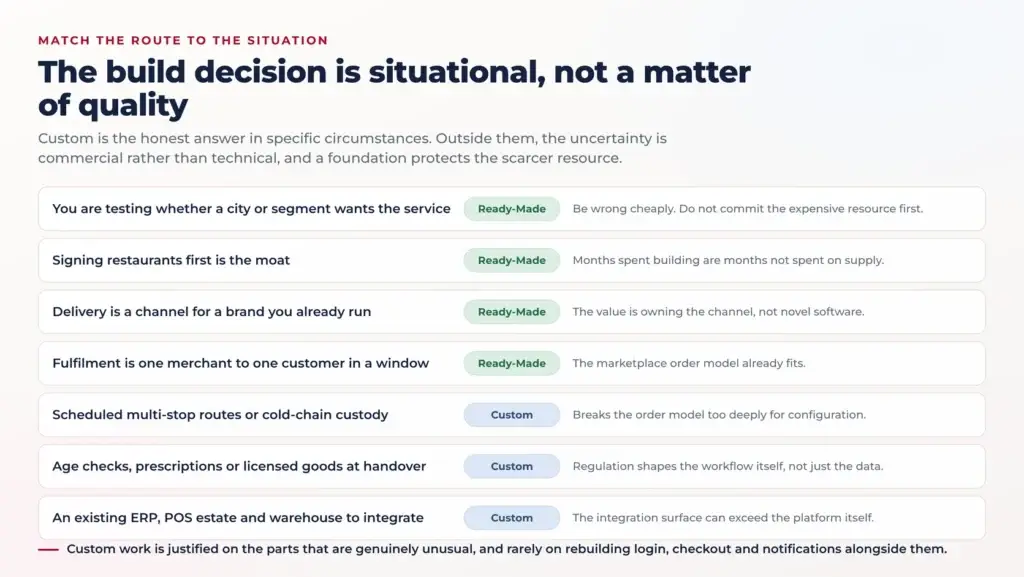
Image Source: AI-generated visual by Miracuves
What a 6-Day Deployment Does and Does Not Mean
Fast deployment timelines are quoted often and understood rarely, so it is worth being exact.
At Miracuves, 6 working days is build time for an eligible ready-made scope. It covers white-labelling and rebranding the platform with your details, deploying it to hosting you provide, and publishing the apps to developer accounts you own.
It is not a calendar promise from first conversation to first order, because several things sit outside anyone’s control. App store review runs on Apple’s and Google’s schedules. Payment gateway onboarding and KYC run on the provider’s. Your domain, hosting, branding assets, business details and third-party API keys have to exist before the build starts.
The full list of what sits with Miracuves and what sits with the client is maintained on the Miracuves facts page as a single source of truth rather than restated across pages.
Work that goes beyond the standard scope is quoted separately, and custom builds run 2 to 8 weeks depending on what is actually being built. A vendor who answers “how long” without first asking what you need changed is guessing.
The reason to be precise about this is simple. A founder who plans a launch date around a misunderstood timeline signs restaurants too early, and those restaurants lose confidence before the first order is delivered.
What Customization on Top of a Ready-Made Platform Looks Like
“Customizable” is claimed by every vendor and means three different things. Knowing which one you are being offered matters more than the word.
Configuration
Settings changed from the admin panel with no developer involved: zones, fees, commissions, payout rules, dispatch behaviour, offers, notification templates, supported languages and currencies. This should cover the majority of what a delivery business needs to change in its first year, and it should be available on day one.
Branding and Interface
Your identity across customer app, rider app, restaurant panel, admin and emails. Colours, typography, iconography, tone, app store presence. This is what white-label means in practice, and it should leave no visible trace of the underlying platform anywhere a user can see.
Code-Level Change
New workflows, new integrations, changes to the order model itself. This is real development work, it is scoped and quoted separately, and it should be described that way rather than folded into a headline timeline.
The practical test when evaluating a vendor is to name one change from each category and ask what it costs and how long it takes. Vendors who answer all three the same way have not thought about it, and you will discover that later at your own expense.
The Risks of Each Route, Stated Plainly
Neither route is safe. They fail differently, and knowing how helps you watch for the right warning signs.
How Custom Development Fails
Timeline extends while the visible product looks finished. The operational layer arrives thin, and post-launch engineering is consumed by dispatch corrections. Key knowledge concentrates in one or two engineers whose departure becomes an existential event. Budget is exhausted before the market question has been answered.
The early warning is a plan where dispatch, fleet management and settlement appear as single line items late in the schedule.
How Ready-Made Fails
The platform turns out to be a demo rather than an operating system, and the settings that matter are not settings. Source code is promised and delivered as restricted access. The model needed one behaviour the platform cannot express, and it was not discovered until after launch. Or the founder treated launch as the finish line and never configured the platform for their actual economics.
The early warning is a demo that cannot be driven off its script. Ask to change an assignment rule during the call and watch what happens.
Source-Code Ownership Is the Line That Matters
If only one thing from this article survives into your evaluation, make it this one.
Ownership is what converts a ready-made platform from a shortcut into a foundation. With the source code you can change what a vendor will not change, move hosting, hire your own engineers, pass technical due diligence, and continue if the vendor relationship ends. Without it, every one of those is somebody else’s decision.
It also changes the shape of the cost. Owned software is a capital decision made once. Rented software is an operating cost that grows with order volume, which means it grows fastest exactly when the business is working. The arithmetic behind that is in the 36-month TCO comparison, and what migrating later actually involves is covered in Migrating from SaaS to Owned Infrastructure: A Peak-Hour Performance Comparison.
Ask the question directly and get the answer in writing: do we receive the complete source code, and may we deploy it on infrastructure we control. Anything hedged is a no.
Mistakes Founders Should Avoid When Choosing a Build Route
Treating custom as automatically higher quality
A platform refined across many deployments has met edge cases a new build has not reached yet. Custom guarantees fit, not maturity, and in the dispatch layer maturity is what protects you.
Comparing licence price instead of cost to first hundred orders
Delayed launch, operations staff hired before there is anything to operate, and post-launch dispatch rework are all real costs. Leaving them out makes the wrong option look cheaper.
Judging a platform by its customer app
The customer app is the easiest part to build and the least differentiating. Evaluate the admin panel and the dispatcher workspace, because that is where you will actually spend your evenings.
Accepting access instead of ownership
A licence to run a hosted copy is not source-code ownership. Get the answer in writing before money moves, not during the first disagreement.
Assuming ready-made means finished
A foundation still needs your economics configured: zones, fees, commissions, payouts, incentives. Launching on defaults means launching on somebody else’s business model.
Choosing custom to protect an idea that is not in the software
If the differentiator is your supply strategy or your niche, rebuilding checkout protects none of it. Spend the months on the thing that is actually yours.
A Practical Way to Decide in a Week
This decision does not need a long evaluation. It needs a structured one.
- Write down your order lifecycle. From placement to settlement, including every exception you already know about. One page.
- Sort every feature into the three groups. Commodity, configurable, genuinely yours. Be honest about how short the third list is.
- Take two demos and drive them yourself. Do not watch a scripted walkthrough. Change an assignment rule, draw a zone, open an order’s settlement.
- Name three changes, one per customization category. Ask for cost and timeline on each. Compare the answers, not the promises.
- Get the ownership answer in writing. Complete source code, deployable on your own infrastructure.
- Cost both routes to the first hundred delivered orders. Include delayed launch and the operations hires waiting for something to operate.
- Ask what happens if you are wrong. Which route lets you change direction in month four without starting again?
Founders who work through those seven steps rarely find the decision difficult afterwards. The difficulty almost always comes from deciding on instinct about quality rather than evidence about fit.
How Miracuves Helps Founders Launch Without Rebuilding the Commodity
Miracuves builds white-label delivery platforms that arrive with the operational layer already present: customer ordering, restaurant panels, rider applications, dispatcher tools, zone configuration, payment and payout workflows, and admin reporting.
Founders receive source-code ownership and a configurable rule set rather than a fixed product, which is the distinction this article has argued matters most. Deployment for eligible ready-made scopes runs on a 6-day build timeline, with customization scoped and quoted separately.
For teams weighing the numbers, the delivery platform development cost breakdown sets out what drives price, and the development partner page covers how engagements are structured. Work that falls outside the standard model is handled as food delivery app development, and the wider catalogue sits under ready-made and white-label app solutions and the ready-made food delivery solution.
Final Thoughts: Choose the Route That Protects Your Scarcest Resource
For an early-stage delivery business the scarcest resource is almost never engineering talent or capital. It is calendar time before the market answers.
Custom development is the right choice when your model genuinely cannot be expressed in an existing platform, and that case should be written down rather than assumed. A ready-made foundation is the right choice when the uncertainty is commercial rather than technical, which describes most delivery startups at the point they are deciding.
What does not change either way is the standard to hold a vendor to: settings that are genuinely settings, an operational layer that exists before launch rather than after it, and source code that is unambiguously yours. Any route that clears those three is a route you can run a business on.
FAQs
Is a ready-made delivery platform good enough for a serious startup?
Yes, when it is a genuine foundation rather than a template. The test is whether an operator can change dispatch rules, zones, fees and payout logic without a developer, and whether the source code becomes yours. A platform that passes both has the operational maturity a new custom build has not reached yet, because its edge cases were found in previous deployments rather than in your first month of trading.
When should a food delivery startup choose custom development?
Custom is the right answer when the fulfilment model cannot be expressed in an existing platform. Scheduled multi-stop routes, temperature-controlled chains, consolidation across several merchants into one drop, regulated handover steps such as age or prescription checks, or integration with an existing ERP, POS and warehouse estate. In each case the workflow itself differs, not just the settings.
What actually causes custom delivery builds to overrun?
Dispatch. The customer app, restaurant panel and checkout are well-understood and usually estimated accurately. Assignment logic, batching limits, zone overlap rules, rejection handling and settlement records are discovered under real order pressure, so they tend to be scoped from assumption and corrected after launch, which consumes the quarter following go-live.
Which parts of a delivery platform are worth building from scratch?
Very few. Sort every feature into three groups: commodity such as login, addresses, cart, checkout and notifications; configurable such as dispatch rules, zones, fees, commissions and payouts; and genuinely yours, which is supply strategy, pricing, zone selection and niche. The third group is almost never software, and it is where founder time pays back.
What does a 6-day deployment actually include?
At Miracuves, 6 working days is build time for an eligible ready-made scope. It covers white-labelling and rebranding the platform, deploying it to hosting you provide, and publishing the apps to developer accounts you own. It is not a calendar promise from first conversation to first order, because app store review, payment gateway onboarding and KYC run on third-party schedules. Custom builds run 2 to 8 weeks depending on scope.
How customizable is a ready-made delivery platform really?
Customization comes in three forms and they are not equivalent. Configuration changes settings from the admin panel with no developer. Branding applies your identity across every app and panel. Code-level change adds new workflows or integrations and is scoped and quoted separately. When evaluating a vendor, name one change from each category and compare the cost and timeline answers.
Why does source-code ownership matter so much?
Ownership is what turns a ready-made platform from a shortcut into a foundation. With the source code you can change what a vendor will not, move hosting, hire your own engineers, pass technical due diligence, and continue if the relationship ends. It also changes the cost shape: owned software is a capital decision made once, while rented software is an operating cost that grows fastest exactly when the business starts working.
How can a founder decide between the two routes quickly?
Write your order lifecycle on one page including known exceptions, sort every feature into commodity, configurable and genuinely yours, drive two demos yourself rather than watching them, name three changes across the customization categories and compare answers, get the ownership answer in writing, and cost both routes to the first hundred delivered orders rather than comparing licence price.
Miracuves is an independent software development company. We are not affiliated with, connected to, sponsored by, or endorsed by any company or product named in this article.
Terms such as “X Clone” are used descriptively. It is how the software industry refers to building a platform with functionality comparable to a known service, and how clients search for it.
The entire design and codebase of our products is built by our own team. Our products contain no code, design, graphics, or content originating from any third-party website or applications.
All third-party names and marks referenced in this article are the property of their respective owners, referenced solely to identify the services discussed.



