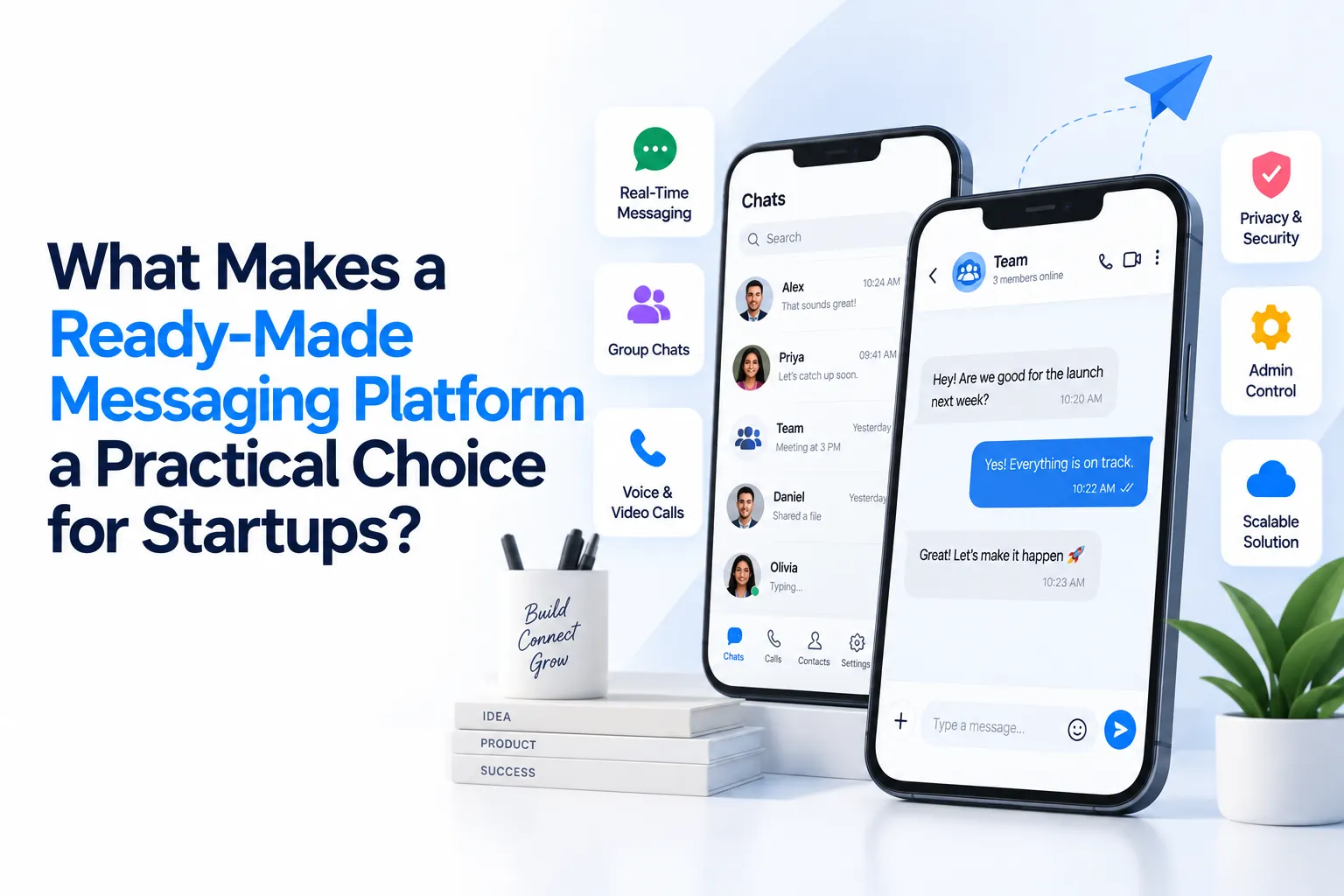
For many startup founders, a messaging app looks simple from the outside. Users sign up, send messages, share media, join groups, make calls, and receive notifications. But once development begins, the product becomes much more complex.
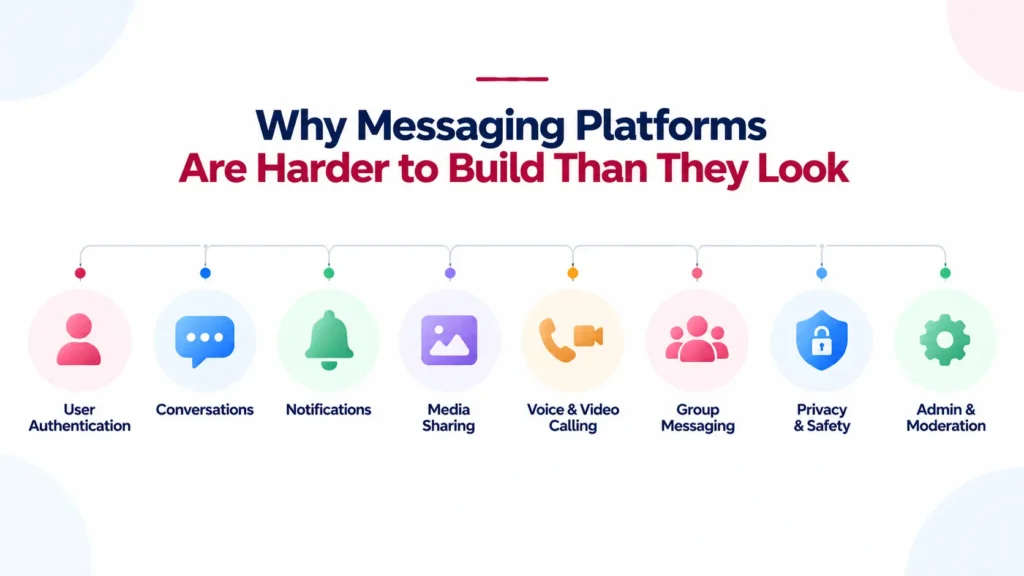
A serious messaging platform needs real-time chat architecture, user authentication, media handling, push notifications, privacy controls, call stability, moderation tools, admin management, app deployment, and continuous testing. If one part fails, users notice immediately. A delayed message, broken media upload, or missed notification can damage trust before the product has a chance to grow.
That is why many founders compare two paths before investing heavily: build a messaging platform completely from scratch, or start with a ready-made messaging platform that can be branded, customized, and improved around a specific business model.
This article explains why a ready-made messaging platform can be a practical choice for startups, especially when speed, validation, budget control, and operational clarity matter.
Key Takeaways
- A ready-made messaging platform helps startups avoid rebuilding common chat infrastructure from zero.
- Custom development offers deep flexibility, but it can increase timeline, budget, coordination, and testing pressure.
- Startup founders often benefit more from faster validation than from building every technical layer before launch.
- White-label branding, admin control, moderation, and source-code ownership help a ready-made platform become a real business asset.
- Miracuves helps founders move from idea to launch faster with ready-made and white-label app solutions built around practical execution.
Why Messaging Platforms Are Harder to Build Than They Look
Messaging apps become part of daily user behavior only when they feel instant, stable, and familiar. A user does not think about sockets, databases, background jobs, file storage, or notification queues. They simply expect the message to arrive now.
For a startup, that expectation creates a heavy technical burden. A messaging platform is not just a chat screen. It is a connected system where authentication affects user discovery, user discovery affects conversations, conversations affect notifications, notifications affect retention, and media sharing affects storage and performance.
Voice and video calling adds another layer of complexity. Group messaging adds permission logic. Privacy controls add safety expectations. Admin tools add operational responsibility. Reporting and moderation become important as soon as real users begin interacting.
Custom development can work when a startup has enough time, budget, technical leadership, and product clarity. But many early-stage founders are still trying to answer a more basic question: will users actually adopt this communication platform for a specific purpose?
Read more : What Is a Messaging Platform and How Does Real-Time Communication Work Across Chats, Calls, and Groups?
What Is a Ready-Made Messaging Platform?
A ready-made messaging platform is a launch-ready communication foundation that already includes the essential flows required for a chat-based product. Instead of building every common module from scratch, founders start from a working base and customize it around their brand, audience, use case, and revenue model.
This does not mean copying another company’s identity, protected assets, or proprietary experience. The practical value is not imitation. The value is using a proven product structure as a foundation, then shaping it into a distinct platform for a specific market.
A strong ready-made messaging platform may include:
- One-to-one chat
- Group messaging
- Media sharing
- Voice notes
- Voice and video calls
- Push notifications
- Read receipts and typing indicators
- User profiles and contact discovery
- Block and report controls
- Admin dashboard
- Moderation workflows
- Branding and configuration options
The founder can then decide what makes the platform different: regional language support, business chat workflows, private communities, creator groups, customer engagement tools, professional communication, internal team collaboration, or marketplace messaging.
Ready-Made Messaging Platform vs Custom Development: What Actually Changes?
The real decision is not whether one approach is always better. The better question is: which approach fits the startup’s current stage?
Custom development is useful when the product requires unusual workflows, new interaction models, deep technical experimentation, or a long-term roadmap backed by strong funding. A ready-made messaging platform is often more practical when the founder needs to launch, test, learn, and improve without spending months on baseline infrastructure.
Ready-Made Messaging Platform vs Custom Development
| Decision Area | Custom Development | Ready-Made Messaging Platform |
|---|---|---|
| Launch speed | Requires planning, design, architecture, development, QA, deployment, and revisions before release. | Starts from an existing product foundation that can be branded and configured faster. |
| Startup risk | Higher upfront execution risk if the market is not yet validated. | Helps founders test demand before committing to a deeper custom roadmap. |
| Feature readiness | Core messaging features must be scoped, built, tested, and debugged individually. | Common modules such as chat, media, groups, calls, notifications, and admin controls can already exist in the foundation. |
| Founder focus | Founder attention may shift toward technical coordination, vendor management, and delay control. | Founder can focus more on positioning, acquisition, retention, monetization, and user feedback. |
| Customization | Highly flexible, but usually slower and more resource-heavy. | Customizable around branding, workflows, integrations, and business model priorities. |
| Long-term control | Depends on contract terms, documentation, and source-code handover clarity. | Source-code ownership can give founders stronger control over future changes and scaling decisions. |
Why Speed Matters More for Startups Than Perfect First-Version Customization
Speed is not just a development metric. For a startup, speed affects market timing, investor conversations, feedback cycles, cash runway, hiring plans, and user acquisition.
If a founder spends months building basic messaging infrastructure, the business may still not know whether users want the product. A faster launch helps answer the real market question earlier: will people use this platform repeatedly for a specific communication need?
A ready-made messaging platform can shorten the path between idea and user feedback. Instead of waiting until every module is built from zero, the startup can begin with essential communication flows and test the platform with a defined audience.
This is especially useful for:
- Private community messaging apps
- Business communication platforms
- Creator or fan-group chat products
- Regional communication apps
- Professional network messaging
- Healthcare or appointment-based communication workflows
- Marketplace buyer-seller chat systems
- Internal organization communication tools
The sooner the product reaches real users, the sooner the founder can learn what should be improved, removed, monetized, or expanded.
Core Messaging Features Should Not Consume the Entire Startup Budget
Every startup needs to decide where its early budget creates the most value. In a messaging product, spending too much on foundational modules can leave less room for growth, onboarding, community building, marketing, partnerships, and retention experiments.
Most users already expect certain communication features. They do not see real-time chat, group messaging, notifications, and media sharing as innovation. They see them as the minimum standard.
This is where a ready-made foundation changes the cost logic. The startup does not need to treat every expected feature as a fresh invention. It can invest more energy into the parts that actually create differentiation:
- Who the platform is for
- Why users should join
- What communication problem it solves
- How the experience differs from generic messaging apps
- How the platform will acquire and retain users
- How the product will eventually generate revenue
For founders, this is often the more practical use of capital. The first version should be strong enough to validate the market, not so overbuilt that the business runs out of runway before users arrive.
White-Label Branding Helps the Platform Feel Like a Real Product
One common concern about ready-made software is that it may feel generic. That concern is valid when the platform is rigid, poorly designed, or limited to surface-level changes.
A practical white-label messaging platform should allow founders to control the brand experience. This includes the app name, logo, colors, onboarding flow, interface details, language preferences, content policies, and operational settings.
Branding matters because users do not join a messaging platform simply because it has chat. They join because the platform serves a specific context. That context may be privacy, regional identity, professional trust, community control, business support, creator access, customer communication, or internal collaboration.
The stronger approach is not to launch a copy-paste product. It is to use a ready-made communication foundation and shape it into a product that feels aligned with the audience.
Admin Control Is What Turns Messaging Into a Manageable Business
User-facing screens are only one part of a messaging platform. The business also needs an operational layer. Without admin control, the founder may depend on developers for everyday management decisions.
An admin dashboard helps the platform operator manage users, reports, blocked accounts, moderation queues, support workflows, settings, and activity insights. This becomes important as soon as real users begin interacting with each other.
For example, a community messaging platform may need to review abuse reports. A business chat platform may need to manage user roles. A marketplace messaging layer may need dispute records. A private organization may need account approval controls. A creator-led community may need moderation and access management.
When these controls are available from the start, the founder can operate the product with less technical friction. That does not remove the need for future development, but it gives the startup a stronger operational foundation.
Founder Decision Signals
Speed
Choose a ready-made messaging platform when getting to real user feedback matters more than rebuilding every common communication module from zero.
Cost
Choose a ready-made foundation when the budget should support validation, branding, onboarding, growth, and useful customization.
Scalability
Choose a platform that can support future backend, notification, moderation, analytics, and integration needs as usage grows.
Market Fit
Choose the route that helps the startup test adoption, user behavior, and retention before committing to a larger custom roadmap.
Source-Code Ownership Helps Startups Avoid Long-Term Lock-In
A ready-made platform is most useful when it does not trap the founder inside a closed system. Source-code ownership matters because a messaging product may evolve after launch.
A startup may begin with private chat and group messaging, then later add business profiles, broadcast workflows, subscription groups, paid communities, CRM integrations, file-sharing controls, analytics, wallet features, or advanced moderation tools.
If the business does not have access to the source code, every meaningful change can become dependent on vendor permission, limited licensing, or expensive rework. With source-code ownership, founders have more control over audits, handovers, customization, infrastructure decisions, and future product direction.
This is one reason Miracuves positions ready-made app solutions around white-label branding, admin control, customization, and source-code ownership. For founders, the goal is not only to launch faster. The goal is to launch faster without giving up future flexibility.
Security and Privacy Controls Should Be Planned Early
Messaging platforms carry trust. Users may share personal conversations, media, documents, business information, community discussions, or support requests. That means security and privacy controls should not be treated as optional extras.
A practical messaging foundation should consider encrypted data transfer, privacy-conscious data handling, account controls, role-based admin access, moderation workflows, abuse reporting, activity logs, and secure API integration where relevant.
Different business models may need different controls. A healthcare communication app may require stricter privacy workflows. A professional network may need identity controls. A marketplace messaging layer may need dispute records. A creator community may need content moderation and reporting tools.
The important point is to build with security-conscious workflows from the beginning. Final compliance depends on jurisdiction, legal review, infrastructure choices, integrations, and the way the business operates the platform.
Customization Should Support the Business Model, Not Just Add More Features
Many founders think customization means adding as many features as possible. In reality, useful customization means shaping the platform around the business model.
A messaging app for private communities may need group permissions, invite controls, reporting, and language support. A business communication app may need broadcast messaging, team roles, analytics, CRM integration, and customer support workflows. A creator community may need subscriptions, gated groups, creator profiles, and moderation. A marketplace chat layer may need buyer-seller conversations, order context, dispute history, and admin review.
Customization should answer a business question: what does this audience need from communication that a generic messaging app does not provide?
That is where a ready-made platform becomes practical. It gives founders a working communication base, then allows them to invest in the workflows that make the product more relevant to their market.
Monetization Can Be Planned Before the Platform Becomes Too Complex
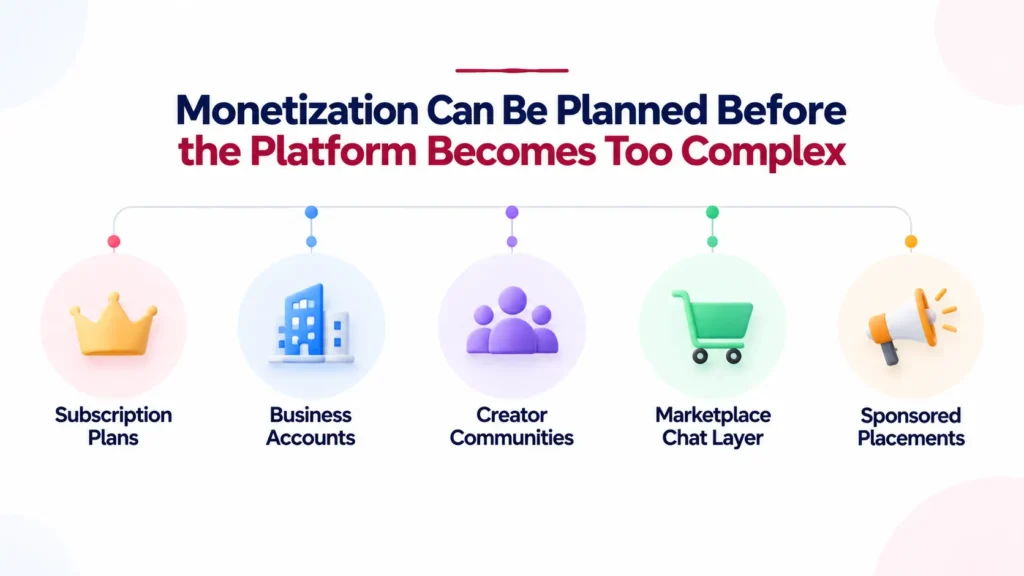
Messaging platforms often start with adoption before monetization. But founders should still understand the possible revenue model early because monetization affects product structure.
If the startup wants to charge businesses, it may need business profiles, team seats, analytics, support tools, and broadcast controls. If it wants to serve creators, it may need subscriptions, paid groups, access rules, and creator dashboards. If it wants to serve private organizations, it may need membership controls, admin approvals, and branded access.
| Monetization Model | How It Works | Best Fit |
|---|---|---|
| Subscription plans | Users or organizations pay for premium communication features, larger groups, storage, or advanced controls. | Private communities, professional networks, internal organizations |
| Business accounts | Businesses pay for branded profiles, support workflows, broadcast tools, or customer chat management. | B2B communication, customer engagement, local commerce |
| Creator communities | Creators charge for access to paid groups, private updates, or exclusive communication spaces. | Creator-led platforms, fan communities, niche networks |
| Marketplace chat layer | Messaging supports transactions, bookings, dispute records, and buyer-seller communication. | Rental, services, ecommerce, and delivery marketplaces |
| Sponsored placements | Relevant promotions appear in controlled, non-intrusive areas such as discovery or community sections. | Large community platforms and regional networks |
When monetization is considered early, founders can avoid rebuilding the platform later. The platform does not need every revenue feature on day one, but it should not block the future business model.
When Custom Messaging App Development Still Makes Sense
A ready-made messaging platform is not the right answer for every startup. Custom development may be the stronger route when the product depends on highly unusual communication logic, complex enterprise integrations, regulated workflows, advanced AI interaction, or a completely new user experience that cannot be shaped from an existing foundation.
Custom development may also make sense when the startup has a strong technical team, stable funding, detailed specifications, and enough time to build, test, and refine the product before launch.
The practical decision is not “ready-made or custom forever.” Many founders use a ready-made platform to validate the market, then expand the product through deeper customization once they understand real user behavior.
Mistakes Founders Should Avoid
Choosing features before defining the audience
A messaging platform succeeds when it solves a specific communication problem. Adding features without audience clarity can make the product harder to position and harder to grow.
Ignoring moderation and admin workflows
Messaging products need operational control from the beginning. Reports, blocked users, privacy controls, and admin visibility should not be left until after the first user issue.
Treating ready-made software as a final product
The foundation helps you launch faster, but the startup still needs branding, positioning, onboarding, feedback loops, and a clear reason for users to return.
How Miracuves Helps Startups Launch Messaging Platforms Faster
Miracuves helps founders start with a ready-made, white-label, source-code-owned app foundation that can be customized around their brand, users, workflows, and business model.
For founders evaluating a branded communication product, Miracuves’ ready-made messaging platform solution offers a direct next step for reviewing the messaging platform structure, demo experience, deployment scope, and feature foundation.
The practical advantage is speed with control. A startup can avoid rebuilding common messaging infrastructure from zero, while still shaping the product around its own audience and growth strategy. Where relevant, Miracuves can support a 6-day launch approach for ready-made solutions, helping founders move from planning to validation faster.
Final Thoughts: Build Faster, Validate Smarter, and Keep Control
A ready-made messaging platform is not practical because it avoids product strategy. It is practical because it gives founders a stronger starting point for strategy.
Instead of spending early-stage time and capital rebuilding expected communication modules, startups can begin with a working foundation and focus on what actually decides adoption: audience clarity, trust, onboarding, retention, monetization, and operational control.
Custom development still has its place. But for many founders, the smarter first step is to launch with a flexible foundation, learn from real users, and customize based on evidence rather than assumptions.
FAQs
Why do startups choose a ready-made messaging platform over custom development?
Startups choose a ready-made messaging platform because it helps reduce development time, technical uncertainty, and upfront execution risk. Instead of building every core messaging feature from zero, founders can start with a working foundation and focus on branding, market validation, users, and monetization.
Is a ready-made messaging platform the same as copying another app?
No. A serious ready-made platform should not copy another company’s brand, protected assets, or proprietary code. It should use a proven communication structure and allow the founder to customize the product around a new brand, audience, workflow, and business model.
What features should a startup messaging platform include?
A startup messaging platform should usually include one-to-one chat, group messaging, media sharing, push notifications, voice notes, voice and video calls, read receipts, typing indicators, user profiles, privacy controls, reporting, moderation, and an admin dashboard.
Can a ready-made messaging platform be customized?
Yes. A practical ready-made platform should support customization around brand identity, user flows, languages, admin settings, integrations, monetization features, privacy rules, and business-specific workflows.
When is custom messaging app development a better choice?
Custom development may be better when the product requires unique communication logic, complex integrations, specialized architecture, advanced regulatory workflows, or a completely new interaction model that cannot be adapted from a ready-made foundation.
Why does source-code ownership matter for messaging startups?
Source-code ownership gives founders stronger control over future customization, audits, infrastructure decisions, team handovers, and product direction. It helps reduce dependency on closed systems or limited template licenses.
How does a ready-made messaging platform help with market validation?
It helps founders launch faster and observe real user behavior earlier. Instead of waiting months to complete baseline development, the startup can test whether users actually need the platform, which features matter, and what should be improved next.
Miracuves is an independent software development company. We are not affiliated with, connected to, sponsored by, or endorsed by any company or product named in this article.
Terms such as “X Clone” are used descriptively. It is how the software industry refers to building a platform with functionality comparable to a known service, and how clients search for it.
The entire design and codebase of our products is built by our own team. Our products contain no code, design, graphics, or content originating from any third-party website or applications.
All third-party names and marks referenced in this article are the property of their respective owners, referenced solely to identify the services discussed.