
Key Takeaways
- A video streaming platform can support subscriptions, advertising, pay-per-view, rentals, live streaming, premium content, and hybrid monetization within one ecosystem.
- Subscription-only OTT software focuses primarily on recurring paid access, making monetization simpler but potentially limiting pricing and audience segmentation options.
- Operator flexibility depends on content access models, monetization controls, live and on-demand support, user management, integrations, analytics, and the ability to expand revenue streams.
Platform Flexibility Signals
- Flexible streaming software can combine SVOD, AVOD, TVOD, PPV, live events, free content, premium tiers, and promotional access based on different audience segments.
- Subscription-only platforms prioritize plan management, recurring billing, renewals, gated catalogs, subscriber retention, and predictable recurring revenue.
- Content management, DRM, multi-device playback, payment gateways, ad integrations, recommendations, localization, APIs, and analytics determine how easily operators can adapt the platform.
Operator Decision Insights
- Operators should compare content type, audience behavior, revenue goals, geographic reach, pricing strategy, live-streaming needs, and future expansion before choosing a platform model.
- A broader video streaming architecture can offer more monetization freedom, while subscription-only OTT software may suit businesses built around a focused recurring-membership model.
- Miracuves develops customizable video streaming platforms with subscriptions, advertising, PPV, live streaming, content management, payments, analytics, recommendations, and admin controls.
Choosing streaming software is not only a technical decision. It is a business model decision.
A subscription-only OTT product may look simple at the start. You upload content, create subscription plans, collect recurring payments, and give users access to a private video library. For some operators, that is enough.
But many streaming businesses do not stay that simple.
A regional media brand may want subscriptions today and pay-per-view events later. A creator-led platform may need paid memberships, video rentals, tips, and private content. A sports operator may want live passes, highlights, ads, and sponsor inventory. An education video business may start with courses and later add bundles, certificates, corporate access, or trainer-led live sessions.
That is why the real comparison is not just video streaming platform vs subscription-only OTT software. The better question is: which option gives operators enough flexibility to change the business model after launch?
For founders evaluating a broader OTT roadmap, Miracuves’ white-label video streaming platform is built around the idea that video businesses need more than a basic subscription wall. They need content control, monetization flexibility, admin visibility, and room to expand.
Why This Comparison Matters for Streaming Operators
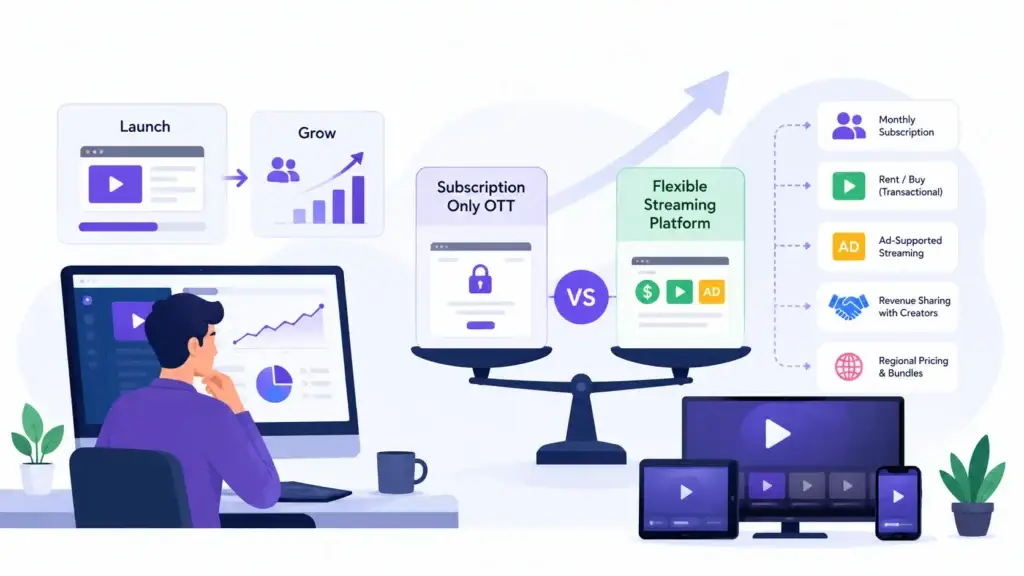
Streaming businesses often fail to plan for the second phase of growth.
In the first phase, the operator wants to launch. The focus is on uploading videos, accepting payments, and giving users a clean viewing experience. A subscription-only OTT product can support that starting point.
The problem begins when the business needs more control.
What happens when users do not want to commit to a monthly plan? What happens when some content should be rented individually? What happens when sponsors want ad inventory? What happens when creators or producers want revenue sharing? What happens when one region needs a lower price while another can support premium bundles?
A subscription-only system may force every monetization decision into one model. A flexible video streaming platform lets the operator adjust access, pricing, packaging, and revenue streams based on audience behavior.
This matters even more now because viewers are becoming more price-sensitive. Deloitte’s 2026 Digital Media Trends notes that many subscribers would cancel a favorite streaming service after a monthly price increase, while ad-supported streaming adoption continues to grow.
What Is a Video Streaming Platform?
A video streaming platform is a complete software ecosystem for hosting, managing, distributing, monetizing, and analyzing video content.
It usually includes more than a viewer app. A serious platform may include a content management system, admin dashboard, user management, subscription controls, rentals, pay-per-view, ad integration, live streaming, content approval, analytics, payment flows, and video delivery infrastructure. Operators who want to understand this product layer in more detail can explore the core OTT platform features that shape viewer experience, admin control, and monetization flexibility.
The key advantage is flexibility.
A video streaming platform can support multiple content types, such as movies, shows, live events, training videos, creator content, sports clips, regional entertainment, educational lessons, and private community videos. It can also support different monetization paths instead of depending only on monthly subscriptions.
Miracuves’ video content platform development page positions this category around streaming, content creation, monetization, live broadcasts, video-on-demand, and scalable delivery.
What Is Subscription-Only OTT Software?
Subscription-only OTT software is built mainly around SVOD, or subscription video on demand.
In this model, users pay a recurring fee to access the content library. The operator creates plans, controls access, and earns predictable recurring revenue from subscribers.
This model works well when the platform has a strong content library, loyal audience, frequent content updates, and clear ongoing value. Fitness classes, niche education, devotional content, premium entertainment, professional training, and community-led video libraries can all work with a subscription-first approach.
The limitation is that subscription-only software may not support wider monetization needs. If the product is not designed for rentals, ads, pay-per-view, live events, coupons, producer payouts, or content-level access rules, the operator may need expensive customization later.
Video Streaming Platform vs Subscription-Only OTT Software
| Comparison Area | Flexible Video Streaming Platform | Subscription-Only OTT Software |
|---|---|---|
| Monetization | Supports subscriptions, rentals, pay-per-view, ads, bundles, live events, and hybrid models | Mainly supports recurring subscription plans |
| Best Use Case | Operators planning multi-format video businesses | Operators with a simple paid content library |
| Content Control | Can support categories, creators, producers, access rules, approvals, and catalog segmentation | Usually focused on subscriber access to a gated library |
| Pricing Flexibility | Allows regional pricing, content-level pricing, trial access, bundles, and premium events | Usually limited to monthly or yearly plans |
| Audience Reach | Can serve free, paid, casual, premium, and event-based viewers | Works best for users ready to subscribe |
| Revenue Risk | Revenue can be diversified across multiple models | Revenue depends heavily on subscriber acquisition and retention |
| Scaling Flexibility | Better for expanding into live, ads, partners, Smart TV apps, and advanced analytics | May require rebuilds or vendor customization for new models |
| Operator Control | Stronger admin, CMS, analytics, and monetization control | Simpler admin control focused on subscriptions |
The practical takeaway is simple: subscription-only OTT software can be enough for a focused content business, but a full video streaming platform gives operators more strategic room.
Where Subscription-Only OTT Software Makes Sense
Subscription-only OTT software is not a bad choice. It is just a narrower choice.
It makes sense when the operator already knows that recurring paid access is the core business model. For example, a yoga instructor with a loyal paid audience may not need ads or rentals on day one. A training company with corporate subscribers may only need account access, course libraries, and renewal billing. A niche entertainment brand with premium content may prefer a clean ad-free subscription model.
Subscription-only OTT software is also easier to explain to users. One price. One library. One access rule.
The risk appears when the business is still discovering how users prefer to pay. In that situation, locking the entire platform into subscriptions can limit future experiments.
Why Flexible Video Streaming Platforms Give Operators More Control
A flexible video streaming platform gives operators control over how content is packaged, priced, promoted, and expanded.
This is important because video businesses often have different content values inside the same catalog. A newly released film may deserve rental access. An old archive may work better with ads. A live event may need a one-time ticket. A premium course may need a bundle. A creator channel may need revenue sharing.
When the platform supports only subscriptions, the operator must either force every asset into the same plan or pay for custom changes later.
A broader streaming platform lets the operator test the market without rebuilding the product every time the business model changes.
This is why many modern OTT monetization guides now discuss SVOD, AVOD, TVOD, FAST, and hybrid models together rather than treating subscriptions as the only default.
Monetization Flexibility Is the Real Decision Layer
Most founders compare streaming software by features. That is useful, but incomplete.
The deeper decision is monetization flexibility.
SVOD gives recurring revenue. AVOD opens access to free viewers and earns through ads. TVOD allows users to rent or buy specific content. Pay-per-view works well for events, sports, concerts, workshops, and premium releases. FAST can support scheduled ad-funded channels. Hybrid monetization combines more than one model inside the same platform. A deeper OTT business model breakdown can help operators decide whether subscriptions, ads, rentals, pay-per-view, or hybrid monetization should lead their launch strategy.
A platform that supports multiple revenue models gives the operator more ways to serve different audience segments.
For example, a viewer may not subscribe to a full library but may pay for one live event. Another viewer may tolerate ads for free access. A loyal viewer may upgrade to a premium subscription. A regional audience may prefer lower-cost bundles. A high-intent fan may rent exclusive releases.
The more payment behaviors the platform can support, the more flexible the business becomes.
Product Control: Admin Dashboard, CMS, Analytics, and Access Rules
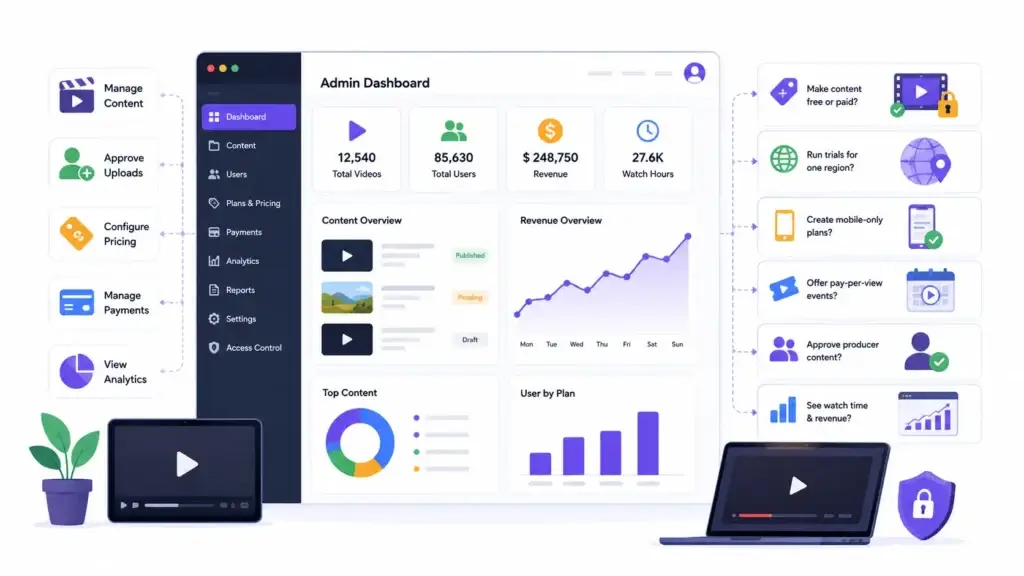
Operator flexibility also depends on backend control.
A streaming business needs more than a beautiful viewer app. The admin layer decides how quickly the operator can manage content, approve uploads, configure pricing, handle users, review analytics, create plans, manage payments, and resolve access issues.
A flexible admin dashboard should help the operator answer practical questions:
- Can we make one title free and another paid?
- Can we run a trial for one region?
- Can we create separate plans for mobile-only viewers?
- Can we offer a pay-per-view event without affecting existing subscribers?
- Can we approve producer content before publishing?
- Can we see which videos drive watch time and revenue?
- Can we manage coupons, refunds, reports, and user disputes?
These questions are operational, not theoretical. If the admin dashboard cannot support them, the operator depends on developers for every small change. That slows experimentation and makes growth harder.
Technical Flexibility: CDN, DRM, Apps, APIs, and Future Integrations
Streaming platforms are infrastructure-heavy products.
Video delivery depends on encoding, adaptive streaming, CDN setup, device compatibility, playback quality, bandwidth usage, and security controls. A subscription-only product may handle the basic viewing flow, but future expansion can require deeper technical flexibility.
For example, adding Smart TV apps may affect authentication and playback. Adding ads may require ad server integration and tracking. Adding rentals may require content-level entitlement logic. Adding DRM may affect player configuration. Adding a producer panel may require approval workflows and payout visibility. Security should also be part of the platform decision, especially when operators handle premium video libraries, paid access, and restricted content. This guide on OTT app security risks explains why DRM, payments, API security, and content protection matter for streaming trust.
Miracuves has already covered technical areas such as OTT bandwidth cost optimization and OTT DRM and piracy protection, both of which connect directly to the flexibility and profitability of video platforms.
A strong platform should not only launch content. It should give the operator room to improve delivery, protect content, reduce waste, and add integrations as the business grows.
Founder Decision Signals
Speed
Choose subscription-only OTT software if you need a narrow paid library quickly. Choose a flexible video streaming platform if your roadmap includes rentals, ads, live events, or partner content.
Revenue Model
If subscription revenue is your only plan, SVOD may be enough. If you want to test multiple pricing behaviors, hybrid monetization gives more room.
Control
Look closely at the admin dashboard, content management system, access rules, payment logic, and analytics before choosing the software.
Scalability
If you expect regional growth, live streaming, Smart TV apps, creator partnerships, or high watch time, choose a platform that can scale beyond basic subscriptions.
Mistakes Operators Should Avoid
The first mistake is choosing software only because it supports subscriptions. Subscription billing is important, but it is not the entire OTT business.
The second mistake is ignoring content-level access control. If every video must follow the same access rule, pricing flexibility becomes limited.
The third mistake is treating ads, rentals, and pay-per-view as “future problems.” If the platform architecture does not support them, future monetization can become expensive. Before finalizing a build route, founders should review the main OTT platform development cost factors that affect pricing, customization, integrations, and launch scope.
The fourth mistake is overlooking analytics. Operators need to know what users watch, where they drop off, which plans convert, which content drives revenue, and which segments need different pricing.
The fifth mistake is buying software without understanding source code, hosting, and customization rights. Flexibility is not only about features. It is also about whether the operator can control and extend the platform later.
How Miracuves Supports Flexible Streaming Platform Launches
Miracuves helps founders and operators launch ready-made and white-label app platforms with source-code ownership, branded design, admin control, and faster deployment.
For streaming businesses, this matters because the first version of the product should not trap the operator inside one revenue model. A stronger platform foundation can support subscriptions today while leaving room for rentals, pay-per-view, ad integration, creator content, producer workflows, live events, and future custom features.
For a more product-specific breakdown, Miracuves also covers OTT software features and pricing for founders comparing ready-made streaming platform options before choosing a flexible video streaming platform.
Operators who want to explore a broader entertainment app ecosystem can also review Miracuves’ entertainment solutions and solutions hub for related product directions.
Final Thoughts: Flexibility Matters More Than the First Billing Model
Subscription-only OTT software can be the right choice when the business model is simple, the audience is loyal, and recurring paid access is the main revenue plan.
But operators who want long-term flexibility should think bigger.
For founders planning a flexible OTT product, Miracuves can help build a launch-ready OTT Streaming Platform that supports faster market entry without limiting future monetization options.
A video streaming platform gives more room to test subscriptions, ads, rentals, pay-per-view, live events, partner content, regional pricing, bundles, and future integrations. It gives the operator more control over content, pricing, users, analytics, and growth.
The smarter decision is not always the simplest software. It is the platform foundation that lets the business adapt after launch.
For founders planning a flexible OTT product, Miracuves can help build a launch-ready video streaming platform that supports faster market entry without limiting future monetization options.
FAQs
What is the difference between a video streaming platform and subscription-only OTT software?
A video streaming platform is a broader system for managing, delivering, monetizing, and scaling video content. Subscription-only OTT software mainly focuses on recurring paid access to a content library. The broader platform gives more flexibility for ads, rentals, pay-per-view, live events, and hybrid monetization.
Is subscription-only OTT software enough for a streaming startup?
It can be enough if the startup has a clear subscription-first business model, a strong content library, and no immediate need for ads, rentals, or live events. If the operator wants to test multiple revenue models, a flexible video streaming platform is usually a stronger foundation.
Which OTT monetization model gives operators the most flexibility?
Hybrid monetization gives the most flexibility because it can combine SVOD, AVOD, TVOD, pay-per-view, FAST, rentals, and premium bundles. This lets the operator serve different audience segments instead of relying on one payment behavior.
Why is admin control important in OTT software?
Admin control helps operators manage content, users, pricing, subscriptions, access rules, payments, analytics, approvals, and reports. Without strong admin control, even small business changes may require developer support.
Can a video streaming platform support both subscriptions and pay-per-view?
Yes. A flexible video streaming platform can support subscriptions for recurring access and pay-per-view for individual videos, live events, sports content, workshops, premium releases, or limited-time content.
What should operators check before choosing OTT software?
Operators should check monetization options, content management, user access rules, admin dashboard, analytics, CDN readiness, DRM support, payment integrations, app support, source code rights, and customization flexibility.
Why is source-code ownership important for streaming platforms?
Source-code ownership gives operators more control over customization, scaling, integrations, audits, and future development. It reduces dependency on a single vendor and helps the business adapt its platform roadmap over time.
How does Miracuves help with video streaming platform development?
Miracuves helps founders launch ready-made and white-label video streaming platforms with branded design, admin control, source-code ownership, monetization workflows, and faster deployment. The platform can be customized based on the operator’s content strategy and growth roadmap.
Miracuves is an independent software development company. We are not affiliated with, connected to, sponsored by, or endorsed by any company or product named in this article.
Terms such as “X Clone” are used descriptively. It is how the software industry refers to building a platform with functionality comparable to a known service, and how clients search for it.
The entire design and codebase of our products is built by our own team. Our products contain no code, design, graphics, or content originating from any third-party website or applications.
All third-party names and marks referenced in this article are the property of their respective owners, referenced solely to identify the services discussed.