The real estate marketplace has moved far beyond static property listings. Buyers expect map-based discovery, saved searches, price insights, mortgage tools, instant contact with agents, and verified property details. Sellers, brokers, and developers expect dashboards that help them manage listings, leads, appointments, and visibility.
That is why demand for a Zillow Clone Script is growing in 2026. Founders do not simply want a property listing website. They want a launch-ready real estate marketplace that can support buyers, renters, property owners, brokers, agents, builders, and platform administrators from one connected system.
Zillow itself has trained users to expect much more than search. Its platform includes buying, renting, selling, mortgage tools, agent discovery, rental manager tools, listings, applications, rent payment flows, and home-value-related resources. For founders, this creates both opportunity and pressure. A simple classified listing site may not be enough anymore.
A ready-made Zillow-style platform can help reduce development time, but only when the script includes the right foundation. The real decision is not “Which Zillow script is cheapest?” The better question is: Which Zillow clone script gives you enough control, scalability, customization, and monetization potential to build a real business?
Miracuves helps founders launch real estate marketplace products faster with white-label, source-code-owned app foundations that can be customized for local property markets, broker networks, rental platforms, and real estate listing businesses.
What Is a Zillow Clone Script?
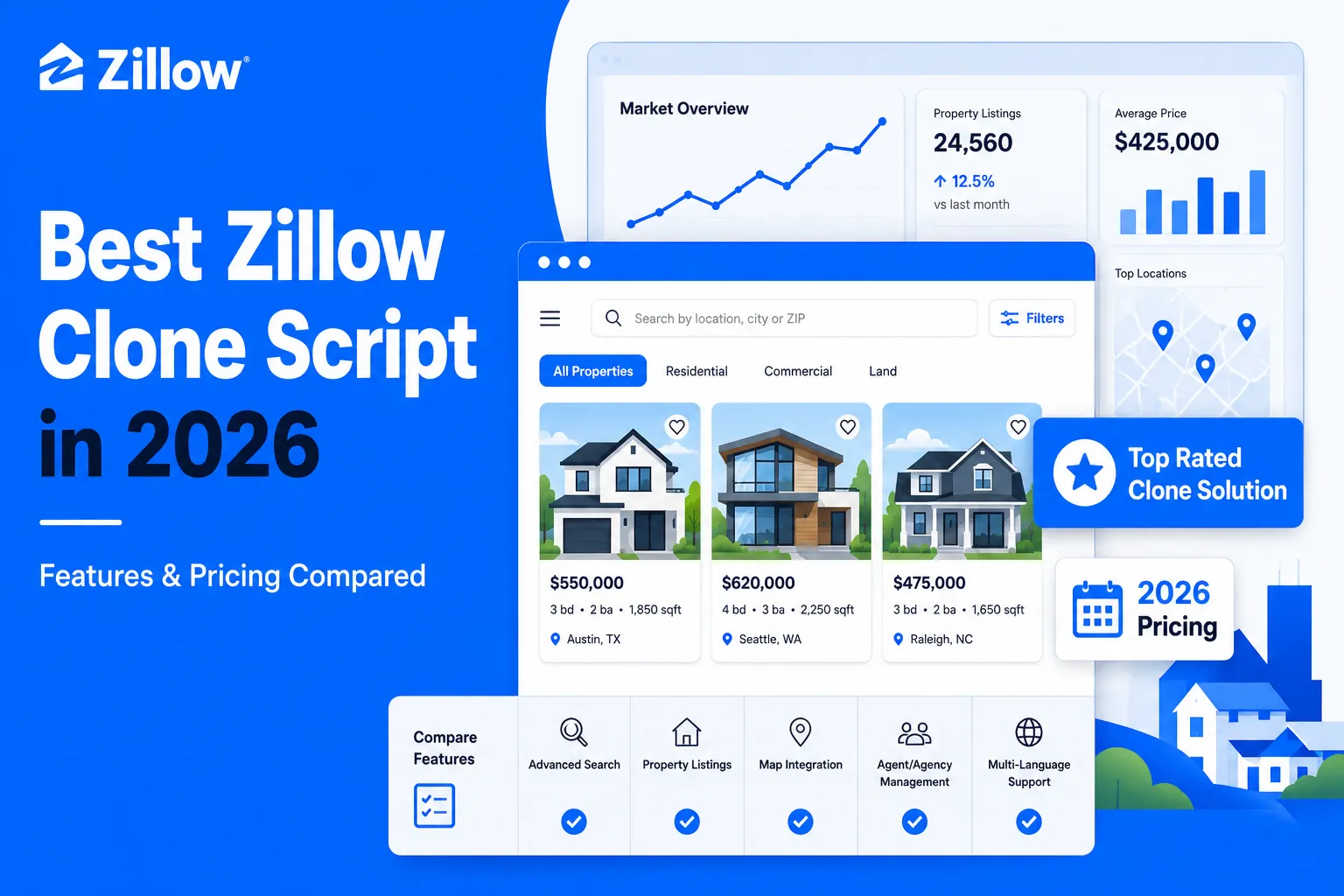
A Zillow clone script is a ready-made real estate marketplace software foundation designed to replicate the core business logic of platforms such as Zillow. It allows users to search for properties, compare listings, save homes, contact agents, request tours, and explore homes for sale or rent.
For property professionals, it usually includes listing management, lead management, profile control, inquiry handling, and sometimes CRM-style workflows. For the platform operator, it includes an admin dashboard to manage users, agents, properties, categories, approvals, subscriptions, payments, analytics, and reports.
A strong Zillow clone script usually supports:
| Module | What It Does | Why It Matters |
|---|---|---|
| Buyer/Renter Panel | Search, filters, saved listings, inquiries, tour requests | Improves user discovery and engagement |
| Agent/Broker Dashboard | Add listings, manage leads, update availability, respond to users | Helps professionals adopt the platform |
| Property Owner Panel | Post and manage properties independently | Expands listing supply |
| Admin Dashboard | Manage users, listings, approvals, payments, reports, disputes | Gives the founder operational control |
| Map Search | Lets users browse properties by location | Critical for real estate discovery |
| Mortgage/EMI Calculator | Helps buyers estimate affordability | Supports buyer decision-making |
| Lead Management | Tracks inquiries and agent follow-ups | Turns traffic into business opportunities |
| Monetization Tools | Subscriptions, featured listings, ads, lead fees | Helps the platform generate revenue |
The value of a Zillow clone script is not that it copies Zillow visually. The value is that it gives founders a proven real estate marketplace structure that can be customized for a city, region, country, niche property category, rental segment, commercial real estate network, or broker-led model.
Why Founders Are Comparing Zillow Clone Scripts in 2026
Real estate marketplaces are difficult to build from zero because they require multiple moving parts: property data, map search, user profiles, agent workflows, lead capture, media uploads, verification, admin control, and mobile access. A founder can spend months building the foundation before even testing whether agents and buyers will use the platform.
That is why ready-made real estate clone scripts are attractive. They reduce the blank-page problem.
But 2026 buyers are more careful than earlier buyers. They know that not every script is equal. Some scripts are outdated. Some do not include source code. Some look good in demos but fail when listings, agents, media files, and location filters start scaling. Some are too rigid to support a local business model.
A founder comparing Zillow clone scripts usually wants answers to five questions:
- Can I launch faster without sacrificing quality?
- Can I customize the platform for my real estate market?
- Can agents, brokers, and owners manage listings easily?
- Can I monetize through subscriptions, ads, leads, and featured listings?
- Will I own enough of the product foundation to scale later?
This is where the decision becomes strategic. The right Zillow clone script should not only help you launch. It should help you operate.
Core Features Every Zillow Clone Script Should Include
A basic real estate listing platform can display properties. A scalable Zillow-style marketplace should help users discover, compare, contact, and act.
Essential Zillow Clone Script Features
| Feature | Business Value | Founder Impact |
|---|---|---|
| Advanced Property Search | Users can filter by price, location, property type, bedrooms, amenities, and availability. | Improves discovery and reduces drop-offs. |
| Interactive Map Search | Users explore listings visually by neighborhood, distance, and local context. | Makes the platform feel modern and location-aware. |
| Property Listing Management | Agents, owners, and builders can add, edit, and manage property inventory. | Helps increase listing supply without manual admin work. |
| Agent and Broker Dashboard | Real estate professionals can manage inquiries, leads, profiles, and listing performance. | Improves agent retention and monetization potential. |
| Saved Listings and Alerts | Users can save homes and receive updates when prices or availability change. | Increases repeat visits and buyer engagement. |
| Virtual Tours and Media Uploads | Listings can include photos, videos, 360-degree tours, and walkthroughs. | Improves trust and reduces unnecessary site visits. |
| Mortgage or EMI Calculator | Users estimate affordability before contacting agents. | Creates a more decision-ready buyer experience. |
| Admin Dashboard | The platform operator manages users, listings, payments, approvals, disputes, reports, and content. | Gives the founder control without depending on developers for every small change. |
Many Zillow-style real estate platforms highlight similar feature sets such as advanced search filters, interactive maps, agent dashboards, mortgage calculators, saved listings, property inquiries, and secure payment workflows. However, the real value is not simply having these features listed on a page. A stronger Zillow clone script should explain how each feature supports marketplace liquidity, agent adoption, user trust, lead conversion, and long-term revenue control.
Read More : Reasons startup choose our Zillow clone over custom development
Advanced Features That Separate a Basic Zillow Script From a Growth-Ready Platform
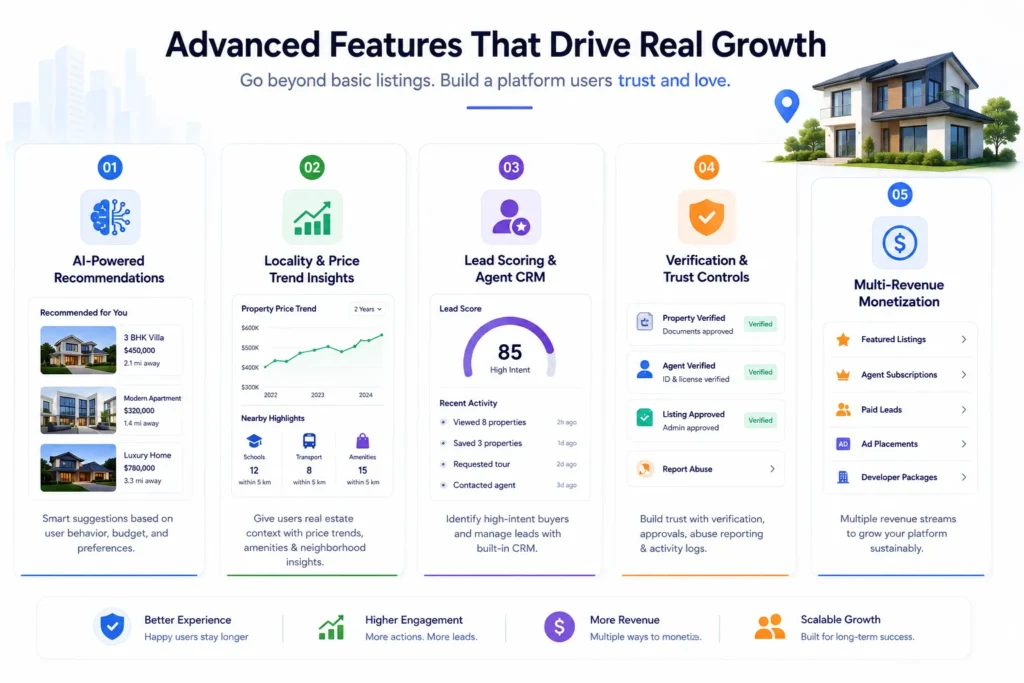
A low-cost script may be enough for a simple property directory. But a founder who wants to build a serious real estate marketplace should look beyond basic listings.
AI-Based Property Recommendations
AI-powered recommendations can help users discover similar homes based on location, budget, saved properties, and browsing behavior. This becomes useful when a platform has enough listings and user activity to personalize discovery.
Locality and Price Trend Insights
Real estate users want context. A listing becomes more useful when users can compare area-level pricing, past price movement, nearby schools, transport, amenities, and neighborhood value. Zillow itself includes several discovery and home-value-related tools, which is why users increasingly expect more than images and contact forms.
Lead Scoring and Agent CRM
Agents do not only need inquiries. They need qualified leads. A strong Zillow app can help track user intent signals such as saved listings, repeat visits, budget filters, tour requests, and contact actions.
Verification and Trust Controls
Fake listings damage user trust quickly. A real estate platform should include property verification, agent verification, document upload, admin approval, abuse reporting, and activity logs.
Multi-Revenue Monetization
A scalable Zillow-style platform should support more than one monetization model. Founders may start with featured listings and later add subscriptions, paid leads, ad placements, broker plans, or developer packages.
Zillow Script Pricing Compared in 2026
Pricing depends heavily on the route you choose. A basic licensed script may look affordable upfront, while a customized web and mobile marketplace with maps, CRM, media workflows, and integrations can cost much more.
Public pricing varies widely. For example, Logicspice lists a $895 one-time pro license for its real estate classifieds software and notes that custom features are available at additional charge. On the broader development side, one 2026 real estate app cost guide estimates real estate app development at USD 12,000 to USD 40,000+, depending on features and complexity. Another guide estimates a complex Zillow/Redfin-style app at $150,000 to $500,000+ when building a feature-rich product with MLS/IDX integration, advanced search, agent dashboards, and a robust backend. Quickway’s 2025 guide places a base Zillow/Trulia-style build at $30,000 to $80,000, with AI recommendations, virtual tours, and MLS database access potentially pushing the cost beyond $200,000.
| Build Route | Typical Pricing Logic | Best For | Watch Out For |
|---|---|---|---|
| Basic Real Estate Script | Lower upfront license cost; customization extra | Small listing directories or early testing | May lack scalability, app quality, source-code flexibility, or advanced workflows |
| White-Label Zillow Script | Depends on modules, branding, customization, support, app platforms | Founders who want faster launch with customization | Must verify source code, support, admin control, and upgrade scope |
| Custom Zillow-Style Development | Higher cost due to design, backend, mobile apps, APIs, maps, data, and testing | Enterprises with complex proprietary workflows | Longer timeline and higher execution risk |
| Hybrid Ready-Made + Customization | Starts from a ready-made foundation, then customizes key modules | Startups and agencies seeking speed plus control | Requires clear scope and vendor transparency |
Miracuves follows a ready-made and white-label approach for founders who want to move faster without building every module from zero. Final pricing should be confirmed based on selected features, integrations, branding, launch scope, and customization requirements.
Global Cost Factors & Pricing Breakdown for Zillow-Like Apps
| Tech Stack | Market Price (USD) | Description |
|---|---|---|
|
PHP/Laravel Architecture
Standard & Scalable
Cost-Effective
|
$7,000 – $17,000
global price range
|
Ideal for launching a Zillow-like real estate platform quickly with essential features like property listings, advanced search filters, agent profiles, inquiry forms, saved properties, admin management, and basic lead handling. This stack offers strong community support, lower development cost, and faster launch for startups entering the real estate marketplace.
|
|
Node.js/Python
Real-Time & Data Heavy
Advanced Logic
|
$19,500 – $49,000
global price range
|
Best suited for advanced Zillow-like platforms with real-time property updates, map-based search, AI-powered recommendations, mortgage calculators, CRM integrations, analytics dashboards, and high-volume property data processing. This stack handles dynamic operations efficiently but requires experienced developers for long-term scaling.
|
|
Go (Golang) Microservices
Enterprise High-Concurrency
Global Scale
|
$58,000 – $131,000
global price range
|
Designed for enterprise-grade Zillow-like ecosystems operating across multiple regions, agencies, brokers, and property categories. This architecture supports distributed systems, high concurrency, large property databases, real-time alerts, and scalable search performance, making it ideal for large real estate businesses planning aggressive growth.
|
Miracuves Zillow-Like App Solution Cost and Tech Stack
Get a fully developed, deployment-ready real estate marketplace platform modeled after Zillow. Built on a rock-solid PHP/Laravel foundation, this complete package includes everything you need to launch and scale:
- Core Workflows: Property listings, agent profiles, buyer inquiries, saved properties, search filters, and real estate marketplace operations.
- Built-in Finance: Mortgage calculator, pricing details, property comparison, and lead-focused inquiry flows.
- Management Hub: Comprehensive admin dashboard to manage users, agents, listings, categories, inquiries, banners, and platform content.
- Launch-Ready: Fully prepped for your custom branding, configuration, deployment, and immediate market entry.
Why Miracuves’ Zillow Like App is so affordable?
Most complex real estate apps force you into expensive architectures like Node.js, Python, or Go. Building from scratch with those frameworks requires highly specialized engineering teams, advanced data modeling, map integrations, and long development timelines, which can drive the cost into the tens or hundreds of thousands of dollars.
We took a smarter, more practical approach:
- You Aren’t Paying for Ground-Up Development: Our real estate marketplace engine is already developed, battle-tested, and ready to deploy. You skip the inflated costs and months of waiting associated with building from scratch.
- The Power of PHP / Laravel: We built this on one of the most reliable, globally adopted frameworks in the world. Not only does this keep our upfront costs down, but it also protects your future budget. PHP has a massive global talent pool, making it incredibly easy and cost-effective for you to find developers for future scaling or customizations.
You get an enterprise-capable, feature-ready real estate marketplace foundation without the inflated Silicon Valley price tag.
Note: This cost is for the solution, re-branding, deployment and source code only.
What Actually Drives Zillow Clone Script Cost?
The price of a Zillow script is not only about the number of screens. It is about product complexity, integrations, data flow, scalability, and support.
1. Web, Android, and iOS Scope
A web-only real estate platform is usually simpler than a full ecosystem with web, Android, iOS, and admin dashboards. Mobile apps require more testing, device optimization, push notifications, location handling, app store deployment, and ongoing updates.
2. Map and Location Integration
Map-based search is central to real estate discovery. The cost depends on whether the platform uses basic location filters, radius search, polygon search, nearby amenities, commute insights, or advanced geospatial logic.
3. Property Data and Listing Workflows
A platform with manual listings is easier to build than one that includes bulk upload, broker feeds, MLS/IDX-style integrations, duplicate detection, listing approvals, document uploads, and automated expiry controls.
4. Agent and Broker Tools
Agent dashboards, CRM, lead scoring, subscription plans, response tracking, profile verification, and performance analytics increase development complexity but can make the platform more valuable to real estate professionals.
5. Media, Video, and Virtual Tours
Photo galleries are standard. Video walkthroughs, 360-degree tours, virtual staging, and large media storage require stronger cloud architecture and optimization.
6. Admin Control Layer
The admin panel is where the founder manages the business. A weak admin panel forces the operator to depend on developers for simple changes. A strong admin panel should support listing approvals, user management, category control, payment tracking, disputes, reports, content management, subscription control, and analytics.
7. Security and Verification
Marketplace trust depends on identity, payment safety, dispute control, and transparent records. For a real estate marketplace, useful layers include user verification, agent verification, secure payment gateway integration, document handling, audit logs, activity logs, role-based access control, content moderation, abuse reporting, and admin approval controls.
Founder Decision Signals Before Choosing a Zillow Script
Founder Decision Signals
Speed
Choose a ready-made foundation when your priority is launching quickly, testing a local property market, or onboarding agents before competitors capture supply.
Cost
Compare total ownership cost, not only script price. Customization, apps, support, maps, data integrations, hosting, and maintenance affect the final budget.
Scalability
Check whether the script can handle more listings, larger media files, more search traffic, and multiple agent accounts as the platform grows.
Market Fit
Your platform should match your business model: rentals, resale, broker listings, new projects, commercial properties, luxury homes, or regional real estate.
Vendor Comparison Checklist for Zillow Script Buyers
Before buying a Zillow script, compare vendors using operational questions, not just demo screenshots.
| Question | Why It Matters |
|---|---|
| Do I get source code access? | Source-code ownership reduces vendor lock-in and improves long-term flexibility. |
| Is the solution white-label? | Branding control matters when building trust in real estate. |
| Does it include web, Android, and iOS? | Platform scope affects reach, pricing, and launch planning. |
| How strong is the admin dashboard? | Admin control decides how efficiently you can manage users, listings, payments, reports, and disputes. |
| Can agents and brokers manage their own listings? | Self-service supply creation helps the marketplace grow faster. |
| Does it support map search and location filters? | Real estate discovery is location-led. |
| Can I add subscriptions, ads, or featured listings? | Monetization flexibility matters after launch. |
| What support is included? | Bugs, updates, deployment, and maintenance affect post-launch reliability. |
| Can the platform be customized for my country or city? | Real estate workflows vary by region, property type, and user behavior. |
| What security controls are included? | Verification, access control, audit logs, and moderation protect platform trust. |
A low price can be attractive, but an inflexible script can become expensive later if you need to rebuild core modules.
Monetization Models for a Zillow-Style Real Estate Marketplace
The strongest real estate platforms usually combine multiple revenue streams. A Zillow script should allow founders to start simple and add monetization layers as supply and demand grow.
| Revenue Model | How It Works | Best For |
|---|---|---|
| Featured Listings | Agents or owners pay to highlight properties | Early monetization |
| Agent Subscriptions | Brokers pay monthly or yearly for listing access and leads | Broker-heavy marketplaces |
| Lead Fees | Agents pay per qualified inquiry or contact | High-intent buyer markets |
| Ad Placements | Developers, mortgage providers, movers, or interior brands advertise | High-traffic platforms |
| Premium Broker Profiles | Agents pay for enhanced visibility and trust badges | Competitive property markets |
| Rental Management Fees | Landlords pay for rent collection, applications, or screening tools | Rental-focused platforms |
| New Project Packages | Builders pay to showcase project pages, videos, and campaigns | Developer-driven markets |
Founders should not add every revenue model on day one. Start with the model that matches your strongest side of the marketplace. If your first supply comes from agents, start with agent subscriptions or featured listings. If your traffic grows quickly, ads and paid placements become more practical later.
Mistakes Founders Should Avoid When Buying a Zillow Script
Mistakes Founders Should Avoid
Choosing Only by Lowest Price
A low-cost script can become expensive if it lacks source code, support, mobile apps, map performance, or customization flexibility. Compare long-term operating cost, not only purchase price.
Ignoring the Admin Dashboard
The admin dashboard is the business control center. Without strong admin controls, founders struggle to manage listings, approvals, payments, disputes, agents, reports, and moderation.
Launching Without Listing Verification
Fake or outdated listings can quickly damage marketplace trust. Add verification workflows, listing expiry, abuse reporting, and admin approval controls from the beginning.
Overbuilding Before Market Validation
Founders often want AI, virtual tours, CRM, ads, and analytics immediately. A better approach is to launch a strong first version, validate agent and buyer behavior, then expand modules based on usage.
Why Miracuves Is a Practical Option for Zillow Clone Script Buyers
For founders planning a real estate marketplace, the goal is not to copy Zillow feature by feature. The goal is to create a platform that supports your market, your agents, your property categories, and your monetization strategy.
Miracuves can help founders build a white-label Zillow clone script with a ready-made foundation, branded interface, admin dashboard, source-code ownership, and customization support. This approach is useful when you want to launch faster than a full custom build while still keeping flexibility for local workflows, regional property types, broker onboarding, and future monetization.
A ready-made solution from Miracuves can be aligned with:
- Residential property listings
- Rental marketplaces
- Broker-led real estate platforms
- New project and builder listing portals
- Commercial property marketplaces
- Local city-based real estate discovery platforms
- Niche marketplaces for luxury, vacation, student, or co-living properties
The stronger decision is not always the longest build. For many founders, the stronger decision is to start with a launch-ready product foundation, validate supply and demand, and then customize based on real usage.
Final Thoughts: Choose the Zillow Clone Script That Helps You Operate, Not Just Launch
The best Zillow script in 2026 is not simply the one with the longest feature list or the lowest entry price. It is the one that gives founders the right balance of speed, control, customization, admin visibility, marketplace trust, and monetization flexibility.
A real estate marketplace succeeds when listings are fresh, users can search easily, agents can respond quickly, and the platform operator can control the business from the backend. That means your decision should focus on product foundation, not just demo screens.
For founders planning to launch faster, Miracuves offers a practical white-label approach that helps you start with a ready-made real estate marketplace foundation and customize it around your target market.
FAQs
What is a Zillow clone script?
A Zillow clone script is a ready-made real estate marketplace software solution that includes core Zillow-style features such as property listings, advanced search, map browsing, user accounts, agent dashboards, saved listings, inquiries, and admin control.
How much does a Zillow clone script cost in 2026?
The cost depends on features, platforms, customization, integrations, design, source code, support, and launch scope. Public prices vary widely. Some basic real estate scripts may show low license pricing, while custom Zillow-style development can cost much more depending on complexity. Final pricing should be confirmed with the vendor based on your exact requirements.
What features should a Zillow clone app include?
A Zillow clone app should include property search, map filters, listing management, buyer/renter profiles, agent dashboards, saved listings, media uploads, virtual tours, mortgage or EMI calculators, lead management, notifications, admin controls, payment integration, and analytics.
Is a ready-made Zillow clone script better than custom development?
A ready-made Zillow clone script is better when speed, cost efficiency, and faster market validation matter. Custom development is better when the product requires unique workflows, proprietary data logic, complex integrations, or enterprise-level architecture from day one.
Can I customize a Zillow clone script for my local real estate market?
Yes, a strong Zillow clone script should be customizable for local property categories, languages, currencies, map regions, agent workflows, broker plans, rental rules, commercial listings, and monetization models.
How does a Zillow-style real estate marketplace make money?
Common revenue models include featured listings, agent subscriptions, lead fees, paid broker profiles, advertisements, project promotions, rental tools, and service partnerships with mortgage, insurance, moving, or interior service providers.
Why is source-code ownership important in a Zillow clone script?
Source-code ownership gives founders more flexibility to customize, scale, integrate, and maintain the platform over time. It reduces dependency on one vendor and supports long-term product control.
Related Articles
Miracuves is an independent software development company. We are not affiliated with, connected to, sponsored by, or endorsed by any company or product named in this article.
Terms such as “X Clone” are used descriptively. It is how the software industry refers to building a platform with functionality comparable to a known service, and how clients search for it.
The entire design and codebase of our products is built by our own team. Our products contain no code, design, graphics, or content originating from any third-party website or applications.
All third-party names and marks referenced in this article are the property of their respective owners, referenced solely to identify the services discussed.