
Key Takeaways
- Online travel agency platform cost factors extend beyond the initial software price and can include supplier integrations, travel products, customization, payments, mobile apps, infrastructure, support, and ongoing maintenance.
- The required inventory model, target markets, B2C or B2B workflows, supplier relationships, payment requirements, and launch scope should be defined before comparing platform prices.
- Supplier integrations can significantly affect implementation because different suppliers may require different APIs, authentication, booking logic, certifications, and commercial arrangements.
- Customization ranges from simple branding changes to new booking workflows, integrations, business rules, and functionality, with deeper engineering generally increasing scope and cost.
- A realistic budget should separate platform price from third-party services, implementation, infrastructure, maintenance, support, upgrades, and future customization.
Cost Signals
- Flights, hotels, transfers, vehicles, tours, and packages can introduce different inventory, search, booking, supplier, support, and reconciliation requirements.
- Payment gateways, currencies, refunds, local payment methods, taxes, and merchant onboarding can add market-specific implementation requirements.
- B2B capabilities such as agent accounts, credit limits, markup rules, commissions, invoices, permissions, and reporting can expand platform scope.
- Source-code ownership, hosting requirements, third-party dependencies, documentation, and portability can influence long-term ownership economics.
- Third-party APIs, supplier contracts, payment processing, mapping, messaging, analytics, hosting, and other external services may create separate transactional, subscription, or usage-based expenses.
Real Insights
- The lowest headline price does not necessarily represent the lowest investment because a smaller quote may exclude integrations, mobile apps, customization, deployment, support, or third-party costs.
- Ready-made platforms can reduce initial engineering when their existing workflows closely match the business requirements, while custom development may be appropriate for highly specialized functionality.
- Founders should evaluate cost over the full ownership period rather than comparing only the initial development or licensing amount.
- A structured demo using real destinations, dates, booking scenarios, payment flows, cancellations, refunds, admin tasks, and B2B requirements can reveal hidden implementation needs.
- The strongest evaluation path is: define business requirements → map inventory and suppliers → identify integrations → define customization → separate third-party costs → compare ownership → calculate ongoing costs → normalize proposals → evaluate total investment.
Two online travel agency platforms can look remarkably similar in a demo and still represent very different investments.
Both may offer flight search, hotel booking, traveler accounts, payments, an admin dashboard, and mobile apps.
The meaningful differences often appear underneath those screens.
Where does the inventory come from?
How is availability validated?
Which travel products can actually be booked?
How are supplier integrations handled?
What happens when a reservation fails after payment?
Can commissions and markups be configured?
Who owns the source code?
What is included in the quoted price—and what becomes an additional implementation cost?
For founders, comparing OTA platforms should therefore go beyond counting features or choosing the lowest initial price.
The objective is to determine whether the platform fits the inventory model, transaction flow, operating model, growth plan, and technical ownership requirements of the business.
Founders who are still mapping the complete customer journey can first review how an online travel platform works across search, comparison, booking, payments, and reservation management. Understanding that journey makes it easier to identify which platform capabilities are foundational and which are optional for the intended business model.
This guide provides a practical framework for making that comparison.
Start With Business Requirements, Not a Feature Checklist
A feature only matters when it supports something the business actually needs to do.
A regional hotel marketplace does not have the same requirements as a multi-country OTA selling flights, hotels, transfers, tours, and packages.
Likewise, a B2C booking platform can have different operational requirements from a business that also needs agents, resellers, corporate accounts, or B2B distribution.
Before comparing software, founders should define:
- Travel products being sold
- Target countries or regions
- Expected inventory sources
- B2C, B2B, B2B2C, or hybrid model
- Payment requirements
- Revenue model
- Mobile and web requirements
- Languages and currencies
- Supplier relationships
- Internal operational workflows
- Launch requirements
- Future expansion plans
Only then does a feature comparison become meaningful.
A Practical OTA Platform Comparison Framework
What Founders Should Compare Before Investing
| Evaluation Area | What to Compare | Why It Matters |
|---|---|---|
| Inventory | Supplier APIs, direct inventory, availability, supported travel products | Determines what customers can actually search and book |
| Booking | Reservation states, confirmation, cancellations, refunds, itinerary management | Determines transaction reliability |
| Commercial Controls | Markups, commissions, promotions, agent margins and reporting | Connects the software to the business model |
| Payments | Gateways, currencies, refunds, reconciliation and payment states | Affects checkout and financial operations |
| Operations | Admin, supplier, agent and customer-management workflows | Determines how efficiently the business can operate |
| Ownership | Source code, hosting, data, third-party dependencies and access | Affects long-term control and portability |
| Implementation | Branding, integrations, migration, deployment and customization | Determines actual launch scope |
| Ongoing Cost | Supplier fees, infrastructure, maintenance, support and upgrades | Reveals total cost beyond the initial purchase |
Compare Inventory Architecture Before Interface Design
Travel platforms ultimately depend on inventory.
A polished interface has limited commercial value if travelers cannot find relevant, bookable supply.
Founders should first determine how the platform obtains flights, accommodation, cars, transfers, tours, or other products.
Inventory might come from direct suppliers, aggregators, distribution systems, local partners, manually managed products, or a combination of sources.
The important comparison is not simply:
“Does the platform support hotel booking?”
Ask instead:
“How does hotel inventory enter the system, how frequently does availability change, and how does the platform keep search and booking synchronized?”
That distinction can materially affect implementation scope.
Supplier Integrations Should Be Evaluated Individually
“API integration supported” is too broad to be useful as a buying criterion.
Different suppliers can have different authentication requirements, search structures, rate formats, booking workflows, cancellation rules, response times, certification processes, and commercial agreements.
Founders should clarify whether required supplier connections already exist, need configuration, or require new integration work.
Also determine who is responsible for supplier onboarding and credentials.
Software access does not automatically create commercial access to every external inventory source.
The business may still need agreements, accounts, approvals, credentials, deposits, or commercial arrangements with the relevant suppliers.
Search Quality Depends on More Than a Search Bar
Most travel platforms can display a search form.
That does not mean their search capabilities are equivalent.
Evaluate whether the search experience supports the criteria that matter for your chosen travel products.
For hotels, that might include location, dates, occupancy, amenities, property type, ratings, cancellation conditions, and price.
For flights, it may include cabin class, stops, schedules, carriers, baggage information, and fare conditions.
For multi-product OTAs, founders should also examine whether search behavior remains consistent as additional inventory sources are introduced.
A platform with extensive inventory but poor filtering or normalization can make more supply feel like more complexity.
Real-Time Availability and Price Validation Matter
Travel inventory is time-sensitive.
The option displayed during search may change before checkout.
A platform therefore needs appropriate mechanisms for refreshing or validating availability and pricing at important points in the journey.
Founders should ask how the system handles:
- Changed prices
- Sold-out inventory
- Supplier timeouts
- Expired search results
- Failed booking requests
- Duplicate attempts
- Confirmation delays
These are less visually impressive than homepage design, but they have much greater influence on booking reliability.
Examine the Entire Booking Lifecycle
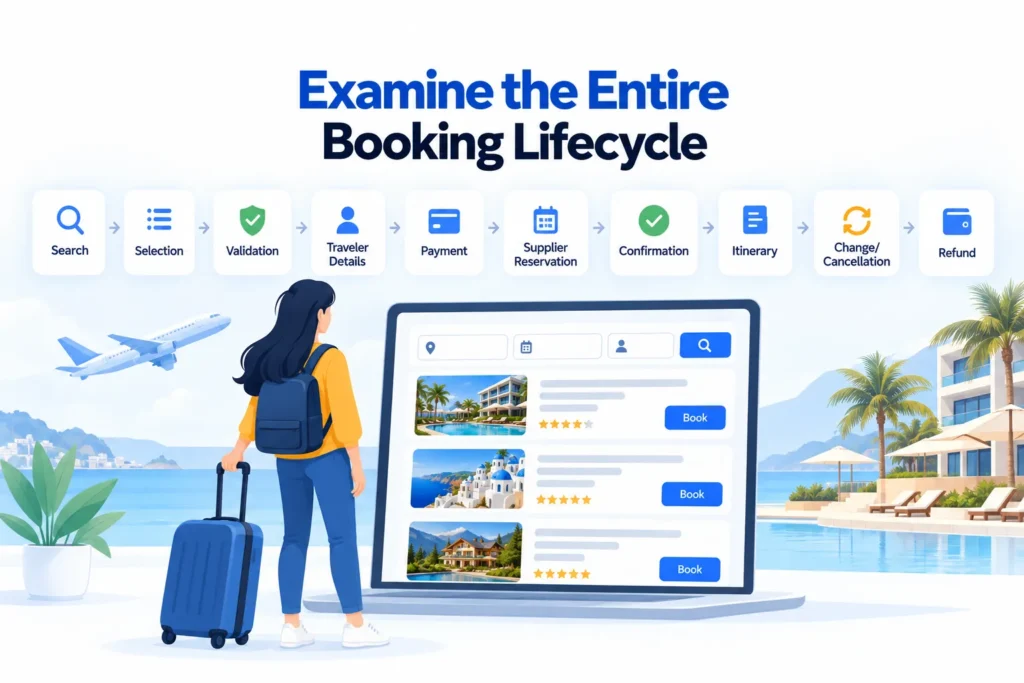
Do not evaluate a booking engine only by completing a successful demo reservation.
Successful bookings are the easy scenario.
The more important question is how the system behaves when something changes.
Consider the lifecycle:
Search → selection → validation → traveler details → payment → supplier reservation → confirmation → itinerary → change/cancellation → refund.
The platform should have clear states for the stages relevant to the chosen business model.
For example, payment success and booking confirmation should not automatically be treated as the same event if an external supplier still needs to confirm the reservation.
Founders should understand how exceptions are recorded, surfaced to administrators, and communicated to travelers.
Compare Multi-Product Capabilities Based on Your Actual Launch Scope
Flights, hotels, transfers, vehicles, tours, and packages can all be useful.
That does not mean every startup needs all of them on day one.
Supporting additional travel products can introduce additional inventory sources, search logic, booking conditions, supplier workflows, support requirements, and reconciliation processes.
A focused platform that reliably handles its core transaction can be more useful than a broad platform where half the modules are irrelevant to the launch strategy.
Compare multi-product capabilities against your roadmap rather than against the longest available feature list.
Bundling Requires Real Transaction Logic
A “flight + hotel” label does not necessarily mean a platform has sophisticated package capabilities.
Founders interested in bundling should understand how the system coordinates dates, traveler counts, availability, pricing, payments, confirmations, and cancellation conditions across products.
Also determine whether the business needs fixed packages, dynamic packaging, cross-selling, or simply the ability to add related products during the journey.
Those are different requirements.
The implementation and operational complexity can be different as well.
Payment Capabilities Should Match the Markets You Serve
Payment requirements can change substantially by country, customer segment, and business model.
Compare supported payment gateways, currencies, refund workflows, payment statuses, reconciliation requirements, and any relevant local payment methods.
Founders should also clarify which parts of payment configuration are included in the standard platform and which depend on external merchant onboarding.
A software provider can integrate a payment gateway, but the business still needs an approved account with the appropriate provider where required.
That distinction should be understood before setting the launch timeline.
Admin Features Matter More Than They Appear in a Demo
Travel businesses are not operated entirely through customer-facing screens.
Administrators may need to manage bookings, customers, content, promotions, supplier configurations, markups, commissions, refunds, reports, and support issues.
Founders should therefore spend significant time evaluating the admin experience.
Ask:
Can operators locate a booking quickly?
Can pricing rules be changed without developer intervention?
Can administrators understand why a reservation failed?
Can permissions be separated between team members?
Can financial and booking reports be exported?
Can important operational actions be audited?
A strong customer experience often depends on operational tools travelers never see.
Agent and B2B Capabilities Should Be Compared Separately
If agents, resellers, corporate customers, or sub-agencies are part of the business model, do not assume standard B2C functionality will cover those requirements.
B2B travel workflows can involve separate accounts, credit limits, markup rules, commissions, invoices, booking permissions, reports, and white-label requirements.
Clarify whether those capabilities are native, configurable, available as modules, or require customization.
This can materially affect both scope and cost.
Revenue Controls Should Fit the Business Model
Founders should understand how the platform supports the economics they intend to operate.
Depending on the model, relevant controls might include:
- Supplier commissions
- Booking markups
- Service fees
- Agent margins
- Promotional discounts
- Package margins
- Subscription or membership logic
- Affiliate revenue
- Featured inventory
Do not choose a monetization model merely because the software supports it.
First define where the business creates value and how revenue should be captured.
Those commercial controls should be evaluated against the underlying online travel agency business model. Commissions, markups, service fees, supplier agreements, ancillary revenue, and other monetization approaches can require different pricing rules, reporting capabilities, and administrative workflows within the platform.
Then confirm that the required commercial rules can be implemented and administered efficiently.
Compare Traveler Features by Business Outcome
Feature comparisons often become enormous lists.
That makes evaluation harder rather than easier.
Group traveler features according to what they accomplish.
Discovery: search, filters, maps, sorting and recommendations.
Conversion: clear pricing, reviews, policies, checkout and payments.
Booking management: itinerary, vouchers, confirmations, cancellations and support.
Retention: profiles, favorites, loyalty, alerts and personalization.
This framework makes it easier to distinguish foundational requirements from optional enhancements.
Founders who need help deciding what belongs in the initial roadmap can also review which OTA features matter most across search, booking, bundling, and retention. This helps separate foundational transaction capabilities from features that can be introduced later as the marketplace and customer base develop.
Once those priorities are defined, founders can examine the broader range of travel platform features across supplier connectivity, booking operations, payments, administration, traveler experiences, and business management. The useful comparison is not how many fea
A loyalty system should not receive the same priority as reliable inventory or booking confirmation if the business has not yet solved the core transaction.
Mobile Apps Should Be Evaluated as Products, Not Deliverables
Seeing “iOS + Android included” on a proposal is not enough.
Founders should understand what those applications actually support.
Are they full booking applications or limited companions?
Do they support the same inventory as the web experience?
Can users access itineraries and booking details?
How are notifications handled?
How are application updates managed?
Who controls the store accounts?
The important comparison is the functional and operational scope of the apps—not simply whether two mobile deliverables appear on a pricing sheet.
Source-Code Ownership Can Change Long-Term Economics
Initial price is only one part of software investment.
Ownership and portability can become equally important later.
Founders should clarify:
- Whether complete source code is provided
- Whether important components are encrypted
- Whether the business can host the platform independently
- Whether another development team can modify it
- Who owns project-specific customizations
- Which components depend on third-party licenses
- What documentation and credentials are transferred
A lower purchase price can become expensive if the business remains permanently dependent on one provider for every meaningful change.
Conversely, owning code still requires the technical capability to maintain it.
Both sides of that tradeoff should be considered.
Customization Needs Should Be Defined Before Comparing Quotes
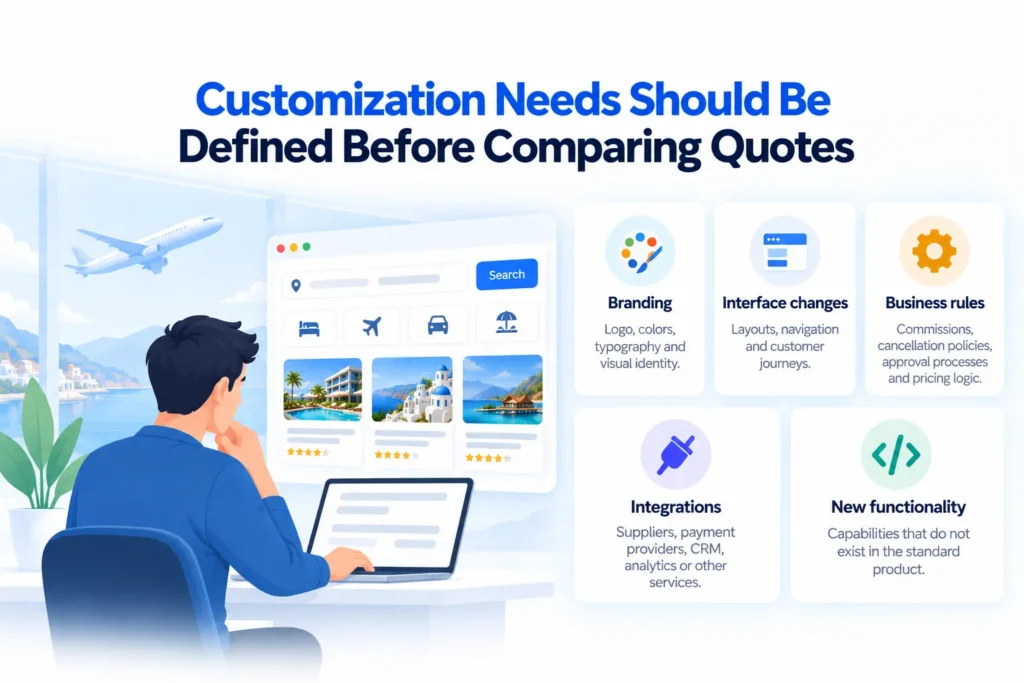
“Fully customizable” can mean different things.
Changing colors and logos is very different from changing booking logic.
Founders should divide customization into categories.
Branding: logo, colors, typography and visual identity.
Interface changes: layouts, navigation and customer journeys.
Business rules: commissions, cancellation policies, approval processes and pricing logic.
Integrations: suppliers, payment providers, CRM, analytics or other services.
New functionality: capabilities that do not exist in the standard product.
The further a requirement moves from configuration toward new engineering, the more likely it is to affect cost and timeline.
Security Should Be Treated as a Foundation
Travel platforms can process personal information, account data, booking records, supplier connections and payment-related workflows.
Security should therefore be evaluated as part of architecture and operations rather than as an optional premium feature.
Founders should discuss authentication, authorization, administrative access, secure transport, secrets management, data handling, logging, backups, dependency management, and incident processes where relevant.
Compliance should also be treated carefully.
A software platform can provide a compliance-ready foundation and support appropriate workflows, but final compliance depends on factors such as jurisdiction, infrastructure, integrations, policies, legal requirements, and how the business operates the platform.
Scalability Means More Than Supporting More Users
Founders often ask whether a platform is “scalable.”
That question needs more precision.
Growth can increase:
- Search requests
- Supplier API traffic
- Concurrent users
- Booking volume
- Payment activity
- Data volume
- Geographic markets
- Travel products
- Administrative workload
The architecture should be evaluated against the type of scale the business realistically expects.
A startup does not necessarily need enterprise infrastructure on day one.
But founders should understand which parts of the platform can be extended without requiring an expensive rebuild later.
What Actually Determines OTA Platform Cost?
OTA pricing cannot be evaluated meaningfully from a single headline number.
Several layers can affect total investment.
Founders who have defined their expected scope can then examine travel platform development cost factors in greater detail. Supplier integrations, booking modules, mobile applications, payment requirements, customization, market coverage, and implementation choices can all influence the investment required beyond a headline software price.
Major OTA Platform Cost Drivers
Platform Scope
Web, mobile apps, admin panels, agent functionality and the number of travel products all affect scope.
Supplier Integrations
Existing connectors, new APIs, certification requirements and supplier-specific booking logic can change implementation effort.
Customization
Branding changes are different from custom workflows, new modules or substantial booking-engine changes.
Payments & Markets
Gateways, currencies, taxes, local requirements and market-specific integrations can expand scope.
Infrastructure
Hosting, storage, monitoring, backups, traffic and performance requirements contribute to ongoing costs.
Post-Launch Operations
Maintenance, upgrades, support, API changes and ongoing product development affect total ownership cost.
The important question is therefore not:
“What does an OTA platform cost?”
It is:
“What does an OTA platform with my required inventory, integrations, workflows, ownership model, and launch scope cost?”
Separate Platform Price From Third-Party Costs
Some costs do not belong to the software vendor.
Supplier contracts, external APIs, payment processing, hosting, mapping, messaging, analytics, identity services, app-store accounts, and other third-party services can introduce their own charges.
These may be transactional, subscription-based, usage-based, or commercially negotiated.
Founders should create a separate third-party cost inventory instead of assuming the platform purchase price covers the complete operating environment.
This makes financial planning considerably more realistic.
Separate Launch Cost From Total Cost of Ownership
A platform can be inexpensive to launch and expensive to operate.
The reverse can also happen.
A useful comparison therefore looks beyond initial development or licensing cost.
Consider:
Initial platform cost + implementation + integrations + infrastructure + third-party services + maintenance + support + upgrades + future customization.
Evaluate those costs over a meaningful operating period.
This is especially important when comparing a ready-made foundation with ground-up development.
A ready-made platform can reduce initial engineering work when its existing architecture closely matches the business requirements.
Custom development can provide deeper control over unique requirements but generally involves a different level of engineering scope, time, testing, and ongoing technical responsibility.
Neither approach should be chosen based on the headline price alone.
Ask What Is Included in the Quoted Price
Before comparing proposals, normalize them.
One quote might include mobile apps, deployment and source code.
Another may cover only the web application.
A third might exclude supplier integration or post-launch support.
Without normalization, the lowest quote may simply contain the smallest scope.
Ask providers to separate:
Included in standard scope
Configuration required
Third-party dependencies
Optional add-ons
Custom development
Recurring costs
Post-launch support
Customer responsibilities
This produces a much more useful comparison than placing several headline prices in a spreadsheet.
Ready-Made vs Ground-Up Development Should Be a Fit Decision
Ready-made and custom development solve different procurement problems.
A ready-made OTA foundation can make sense when the business model relies heavily on established travel workflows such as search, booking, traveler accounts, payments, administration, and supplier connectivity.
The founder can then concentrate investment on differentiation, market-specific requirements, supplier relationships, acquisition, and operations.
Ground-up development may make more sense when the business requires highly unusual workflows or when the software itself represents a significant source of proprietary differentiation.
Platform cost should also be considered alongside the business’s ability to generate demand after launch. A broader online travel agency growth strategy connects supplier inventory, traveler acquisition, booking conversion, retention, and repeat bookings so founders can evaluate the technology investment against the marketplace they intend to grow.
The decision should depend on fit, not ideology.
If a ready-made system already solves most of the standard transaction, rebuilding those components may create little customer differentiation.
If extensive portions need to be replaced, the economics of the ready-made approach should be reconsidered.
Evaluate the Demo With Real Scenarios
Do not evaluate an OTA demo by clicking randomly through the homepage.
Create scenarios based on your actual business.
Try a destination that matters.
Change dates.
Apply filters.
Start a booking.
Check price clarity.
Review cancellation information.
Inspect the mobile journey.
Look at the admin panel.
Find the reservation as an operator.
Review reporting.
Ask what happens if a supplier request fails.
Ask how refunds are represented.
If B2B functionality matters, test the agent workflow.
A structured demo reveals much more than a polished presentation.
Questions Founders Should Ask Before Investing
OTA Platform Due-Diligence Checklist
- Which travel products are supported in the standard platform?
- How does inventory enter the system?
- Which supplier integrations already exist?
- What requires a new integration?
- How are availability and prices validated before booking?
- How are failed, pending, cancelled and refunded reservations handled?
- Which payment gateways and currencies are supported?
- Can markups, commissions and agent margins be configured?
- What functionality exists for administrators, suppliers and agents?
- What source code and technical access are transferred?
- Which customizations are configuration versus new development?
- What is included in deployment?
- Which third-party costs remain the buyer’s responsibility?
- What support is provided after launch?
- What would need to change if the business expands to another market?
The answers should be documented wherever they materially affect price, ownership, launch scope, or operational responsibility.
The same checklist can be used when evaluating a travel platform development partner. Rather than comparing providers only by proposal price, founders can assess how well each team understands supplier integrations, booking states, payments, operational workflows, ownership, customization, deployment, and post-launch requirements.
Moving From Comparison to Platform Selection
Once requirements have been defined, founders can compare platforms much more effectively.
A useful shortlist should answer four questions:
Does the platform support our core transaction?
Can it connect to the supply and payment ecosystem we need?
Can our team operate and extend it after launch?
Does its total implementation cost make sense relative to our business model?
Only after those questions are answered should secondary feature differences become decisive.
Miracuves Expedia-Like Platform Solution Cost and Tech Stack
Miracuves Pricing for an Expedia-Like Online Travel Agency Platform developed in JavaScript For $3,999 USD (One-Time Price) in just 6 days
Get a fully developed, deployment-ready online travel agency platform modeled around Expedia-style flight, hotel, package, and travel booking operations. Built on a modern JavaScript foundation, this complete package includes everything you need to launch and scale:
Core Workflows: Flight search, hotel discovery, travel package booking, destination search, availability checking, traveler details, checkout, booking confirmation, itinerary management, cancellations, and customer notifications.
Built-in Revenue Logic: Booking commissions, service fees, supplier margins, featured listings, sponsored placements, package markups, advertising revenue, cancellation fees, and partner-based travel monetization.
Management Hub: Centralized admin dashboard, traveler management, supplier management, booking monitoring, inventory controls, payment records, refund handling, promotional offers, support management, and travel analytics.
Launch-Ready: Fully prepared for your custom branding, configuration, payment gateway setup, travel API integration, supplier onboarding, booking workflow configuration, and immediate market entry.
Why Is Expedia-Like Platform Development More Affordable?
Most online travel agency platforms become expensive when businesses choose fully custom development from scratch. Building separate workflows for flights, hotels, packages, travelers, suppliers, inventory, payments, cancellations, pricing, booking confirmations, and admin controls can increase cost, timeline, and technical complexity.
We took a smarter, more practical approach:
You Aren’t Paying for Ground-Up Development: Our online travel agency engine is already developed, tested, and ready to deploy. You skip the inflated cost and long waiting period usually required to build an Expedia-style travel booking platform from scratch.
The Power of JavaScript: We built this solution on a modern JavaScript architecture that supports fast travel search, scalable booking workflows, dynamic inventory updates, interactive user experiences, API-driven integrations, and smooth admin operations.
You get a launch-ready Expedia-like online travel agency platform with practical search, booking, supplier, payment, itinerary, and monetization features, source code access, and faster deployment without the high custom development price tag.
For founders whose requirements align with a ready-made OTA model, Miracuves provides an online travel agency platform covering core travel-booking workflows, supplier connectivity, administration, payments, mobile experiences, and source-code delivery, with configuration and customization available around project requirements.
At this stage, founders can evaluate the requirements as part of a complete travel booking platform, where inventory, search, supplier connectivity, reservations, payments, administration, traveler management, and post-booking operations need to function as one coordinated system.
For suitable ready-made travel solution scopes, Miracuves offers a 6-working-day deployment path. That timeline applies to the ready-made implementation process; additional supplier integrations, substantial custom functionality, market-specific requirements, and other non-standard work should be scoped separately.
Founders who are still comparing different travel marketplace structures can also explore Miracuves’ travel booking solutions to evaluate different ready-made travel concepts against their intended inventory, customer journey, transaction model, and operational requirements.
The practical advantage of a ready-made approach is not simply speed.
It is the ability to avoid rebuilding standard travel-booking infrastructure when those components do not differentiate the business.
That allows founders to focus more attention on supplier relationships, distribution, pricing strategy, customer acquisition, retention, and the parts of the experience that actually create market differentiation.
Final Thoughts
Choosing an OTA platform should not become a competition to find the longest feature list or the smallest headline price.
The right comparison starts with the business.
Define the inventory.
Define the transaction.
Define the suppliers.
Define the markets.
Define the revenue model.
Then determine which software can support those requirements with acceptable implementation complexity and long-term ownership economics.
Features matter.
Price matters.
But fit between the platform and the operating model matters more than either one in isolation.
A founder who understands that distinction is in a much stronger position to compare travel technology investments objectively.
FAQs
What features should founders compare in an OTA platform?
Founders should compare inventory connectivity, search, availability, booking workflows, payments, cancellation and refund handling, administration, commercial controls, mobile functionality, supplier or agent workflows, reporting, ownership, and customization capabilities.
What affects the cost of an online travel agency platform?
Major factors include travel-product scope, supplier integrations, mobile apps, payment requirements, customization, B2B functionality, infrastructure, market-specific requirements, deployment, and post-launch maintenance.
Are supplier API costs included in an OTA platform price?
Not necessarily. Software implementation and third-party supplier commercial arrangements are separate considerations. Founders should identify which integrations are included in the platform scope and which external provider fees, accounts, or agreements remain their responsibility.
Is a ready-made OTA platform cheaper than custom development?
A ready-made foundation can reduce the amount of standard booking functionality that needs to be engineered from zero. Whether it produces a lower total cost depends on how closely the existing platform matches the required workflows and how much customization is necessary.
Why is source-code ownership important?
Source-code ownership can provide greater control over hosting, future modifications, integrations, and development-provider choices. Founders should still consider documentation, dependencies, maintainability, and the technical resources needed to manage the code.
How should founders compare OTA pricing quotes?
Normalize each proposal by identifying standard functionality, mobile apps, supplier integrations, payment setup, source code, deployment, customization, third-party expenses, support, maintenance, and recurring costs.
How long does it take to launch an OTA platform?
The timeline depends on whether the platform is ready-made or custom, along with integration, customization, market, testing, and deployment requirements. Miracuves offers a 6-working-day path for suitable ready-made solution scopes, while additional or non-standard work should be separately scoped.
What should founders test in an OTA demo?
Test real search scenarios, filters, price visibility, booking flows, payment states, booking management, cancellations, mobile usability, admin operations, reporting, and any B2B or supplier workflows relevant to the intended business.
Miracuves is an independent software development company. We are not affiliated with, connected to, sponsored by, or endorsed by any company or product named in this article.
Terms such as “X Clone” are used descriptively. It is how the software industry refers to building a platform with functionality comparable to a known service, and how clients search for it.
The entire design and codebase of our products is built by our own team. Our products contain no code, design, graphics, or content originating from any third-party website or applications.
All third-party names and marks referenced in this article are the property of their respective owners, referenced solely to identify the services discussed.