
























Key Takeaways
- A handmade marketplace connects independent makers with buyers looking for handcrafted, personalized, vintage, or specialist products.
- Unlike a single online store, the platform coordinates products, inventory, orders, fulfilment, and earnings across multiple sellers.
- Makers create storefronts and listings, while buyers use search, categories, filters, reviews, and recommendations to discover products.
- The marketplace operator manages seller access, listing standards, commissions, refunds, disputes, payouts, and platform policies.
- Every workflow must remain connected from seller registration and product publishing to order completion and final payout.
How the Marketplace Works
- Makers register, submit required information, create shop profiles, and complete the platform’s approval process.
- Approved sellers publish structured listings containing images, prices, variations, stock, personalization options, and fulfilment details.
- Buyers discover products, evaluate seller credibility, select options, add items to the cart, and complete checkout.
- The platform sends each seller the relevant part of the order and tracks preparation, shipping, delivery, cancellation, or refund states.
- After commissions, refunds, and adjustments are calculated, eligible seller earnings move through the payout process.
Real Insights
- A buyer may experience one checkout even when the order contains products from several independent sellers.
- Customer payments and seller payouts are different financial events and should be recorded separately.
- More listings do not improve the buyer experience when categories, product attributes, search, and moderation are poorly structured.
- Transparent earnings, commission deductions, refund adjustments, and payout records are essential for seller trust.
- Miracuves develops white-label handmade marketplaces with maker onboarding, product listings, buyer checkout, multi-seller orders, commissions, payouts, admin controls, and source-code ownership.
A handmade marketplace looks simple from the buyer’s side. Someone searches for a handcrafted necklace, personalised gift, art print, home décor item, or another distinctive product, places an order, and waits for it to arrive.
Behind that purchase is a much more interesting marketplace system.
Independent makers need to create shops and publish products. Listings need enough structure to become searchable. Buyers need to discover and compare products across many sellers. Orders have to reach the correct maker. Payments need to be recorded correctly. Commissions, refunds, fulfilment events, and seller balances need to remain traceable before money becomes eligible for payout.
That is what separates a handmade marketplace platform from a simple online store.
A normal ecommerce store typically manages products from one business or a centrally controlled catalog. A maker marketplace coordinates commerce across many independent sellers, each with their own products, inventory, orders, customer interactions, and earnings.
Understanding those relationships is useful whether you are researching how marketplace apps work or evaluating a niche commerce idea of your own.
What Is a Handmade Marketplace Platform?
A handmade marketplace platform is a multi-seller commerce environment designed to connect independent makers, artisans, creators, and specialist sellers with customers looking for distinctive products.
Instead of the platform operator owning every product, participating makers create and manage their own listings.
That changes the operating model.
A traditional online retailer may control its catalog, stock, pricing, fulfilment, and customer service centrally. A maker marketplace distributes many of those responsibilities across independent sellers while the platform provides the infrastructure connecting everyone.
The basic relationship looks like this:
Maker → Listing → Buyer Discovery → Order → Fulfilment → Settlement → Payout
But the platform sits around that entire sequence.
It may establish seller approval rules, listing policies, commission logic, order statuses, payment integrations, dispute procedures, payout conditions, and marketplace-wide reporting.
For founders, the important lesson is that a handmade marketplace is not simply a collection of product pages. It is an operating system for coordinating many small sellers and many individual transactions.
Read More: What Features Should a Handmade Marketplace Platform Include for Independent Makers and Buyers?
Who Participates in a Maker Marketplace?
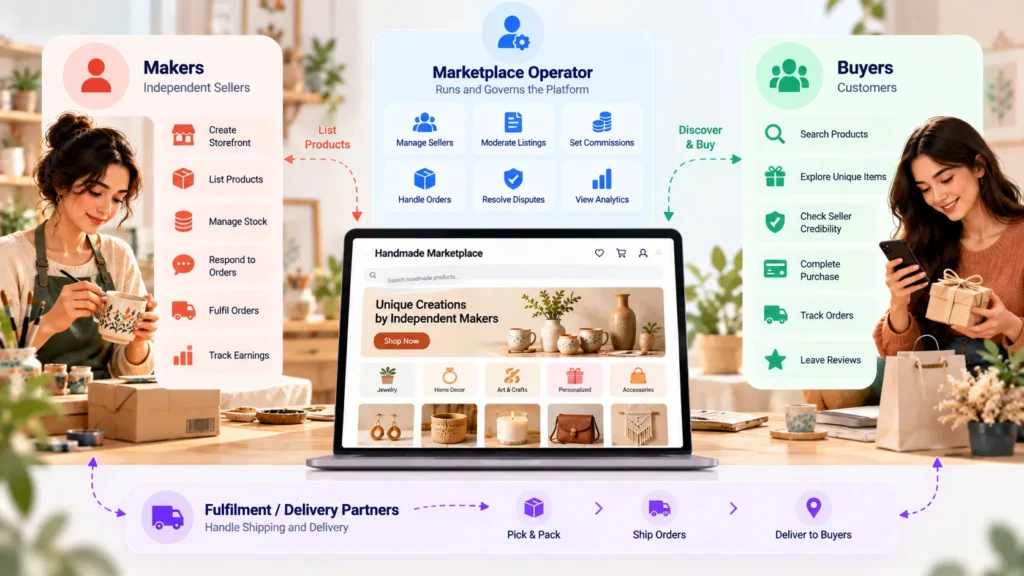
Most handmade marketplaces have three primary participants: makers, buyers, and the marketplace operator. Depending on the business model, fulfilment or delivery partners can form another operational layer.
Makers or Independent Sellers
Makers provide the supply.
They may sell jewellery, clothing, artwork, craft products, personalised gifts, home décor, stationery, accessories, digital creations, or products serving a specialised community.
Their responsibilities commonly include creating a storefront, publishing listings, maintaining product information, updating stock, responding to orders, preparing items for fulfilment, handling buyer communication, and monitoring earnings.
For the platform operator, makers are more than registered users. They create the catalog that attracts buyers.
Buyers
Buyers create demand.
Their experience revolves around finding products, understanding what makes each item different, evaluating seller credibility, selecting variations, completing checkout, monitoring orders, and resolving issues when something goes wrong.
Because products may come from many independent sellers, strong discovery and trust mechanisms become especially important.
Marketplace Operator
The operator governs the ecosystem rather than manually selling every item.
This means managing areas such as seller access, marketplace categories, listing moderation, commissions, order oversight, disputes, refunds, financial records, and payout rules.
As the number of makers increases, operator tooling becomes increasingly important. A marketplace with twenty sellers can sometimes survive manual processes that become impossible with hundreds or thousands.
How Does Maker Onboarding Work?
Every marketplace starts with supply, so seller onboarding is one of its most important workflows.
A maker generally begins by creating an account and providing the information required to operate a storefront. Depending on the marketplace and jurisdiction, that may include profile information, business details, payout information, identity or business documents, shop details, and acceptance of marketplace policies.
The operator then decides how much control should exist before a maker can begin selling.
A highly curated marketplace may review every seller before activation. A more open marketplace may allow quicker registration while reviewing listings individually or monitoring seller activity after onboarding.
Neither approach is automatically right for every business.
The appropriate workflow depends on what the marketplace promises buyers. If exclusivity, authenticity, craftsmanship, or specialist quality is central to the brand, seller admission and listing governance become part of the customer proposition.
Why Low-Friction Onboarding Matters
Independent makers are often small businesses or individual creators. Many do not have dedicated ecommerce teams.
A complicated seller setup can therefore become a supply-side growth problem.
The platform should collect the information required for marketplace operations without making every maker depend on an administrator for routine tasks. Self-service storefront management, product publishing, inventory updates, order handling, and earnings visibility can reduce operational overhead as seller numbers increase.
The principle is simple: the marketplace should scale seller participation without scaling manual administration at the same rate.
How Do Product Listings Work in a Handmade Marketplace?
A listing is the bridge between a maker’s physical or digital product and marketplace discovery.
At a basic level, it contains information such as:
- Product title
- Description
- Images
- Category
- Price
- Available quantity
- Product variations
- Attributes or tags
- Shipping or fulfilment information
- Seller identity
But marketplace listings have another dimension: governance.
The platform may need to determine whether a listing is active, pending review, rejected, out of stock, hidden, reported, or removed.
That distinction matters because the operator does not create every product.
Listings Need Structure, Not Just Descriptions
Consider two makers selling handcrafted rings.
One calls a product “Moonlight Ring.”
Another calls theirs “Handmade Sterling Silver Adjustable Moon Ring.”
To a human, both may make sense. To a marketplace search system, structured attributes such as material, colour, category, style, size, price, and availability make the products much easier to organize and retrieve.
Good listing architecture therefore helps both sides:
- Makers can describe products accurately.
- Buyers can search, filter, compare, and discover them efficiently.
The marketplace operator also gains cleaner catalog data for moderation, merchandising, reporting, and category management.
Why Listing Moderation Matters More in a Handmade Marketplace
A maker marketplace does not completely control its catalog because sellers continuously add to it.
That creates an ongoing governance problem.
The operator may need to identify prohibited products, misleading descriptions, inappropriate images, duplicate listings, incorrect categories, intellectual-property complaints, suspicious seller activity, or products that violate marketplace rules.
Moderation should therefore be viewed as an operating workflow rather than a one-time setup exercise.
Possible controls include seller verification, pre-publication review, post-publication monitoring, user reporting, administrative review queues, audit histories, and clear approval or rejection states.
The stricter the marketplace’s positioning-handmade, curated, local, sustainable, specialist, luxury, or another defined niche-the more important catalog governance becomes.
How Do Buyers Discover Products From Independent Makers?
Once supply exists, the marketplace needs to turn that supply into discoverable demand.
Buyers rarely arrive knowing the exact internal listing name used by a maker. They may instead search by product type, occasion, style, material, recipient, price, or another characteristic.
Discovery can therefore involve several layers:
- Search helps users express direct intent.
- Categories provide structured browsing.
- Filters narrow large result sets.
- Sorting helps buyers prioritize relevance, price, ratings, or other criteria.
- Seller storefronts let buyers explore more products from a maker they trust.
- Recommendations and merchandising can expose products the buyer did not explicitly search for.
For handmade marketplaces, discovery has an additional challenge: the catalog can be highly diverse.
Standardized retail marketplaces may have hundreds of sellers offering similar versions of the same item. Handmade marketplaces can contain products that are genuinely different from one another. Search and category design therefore need to organize variety without removing the uniqueness that makes the marketplace valuable.
What Happens When a Buyer Places an Order?
Checkout may look like the end of the buyer journey, but operationally it is the beginning of the order lifecycle.
Suppose a buyer purchases two products from two different makers.
The customer may experience one checkout, but the marketplace needs to understand which items belong to which seller.
That distinction affects:
- Seller order queues
- Inventory
- Fulfilment responsibility
- Shipping
- Commission calculations
- Refunds
- Seller earnings
- Payout eligibility
The marketplace therefore needs an order model that can preserve the relationship between the overall customer purchase and the individual seller’s responsibility.
A Typical Order Lifecycle
A simplified order flow might look like:
1. Buyer checks out
The platform records the selected products, quantities, variations, seller relationships, address, payment method, and totals.
2. Payment status is recorded
The system needs a reliable record of whether payment succeeded, failed, remains pending, or uses another supported method.
3. Relevant maker receives the order
Each seller should see the portion of the order they are responsible for rather than unrelated seller information.
4. Maker prepares the product
The seller processes the order and updates the appropriate fulfilment state.
5. Fulfilment progresses
Depending on the marketplace model, delivery may be handled by sellers, third-party logistics providers, or a platform-managed delivery operation.
6. Order reaches a completion state
Successful completion can affect earnings and eventual payout eligibility.
This lifecycle is why order status design is more important than it initially appears. Statuses are not merely labels shown to customers; they can trigger inventory, notification, refund, financial, and payout logic.
Read More: Why Startups Choose a Ready-Made Handmade Marketplace Platform Over Custom Development
How Do Payments and Seller Earnings Connect?
This is where marketplace commerce becomes fundamentally different from a simple store.
A buyer paying $100 does not necessarily mean a seller instantly receives $100.
The transaction may need to account for the seller’s share, platform commission, discounts, refunds, taxes, delivery charges, gateway considerations, or other business rules.
The exact financial model varies between platforms and markets, but the underlying requirement remains consistent:
Every movement of money should have a clear reason and traceable record.
For example, the marketplace needs to distinguish between:
- What the customer paid
- What portion relates to a particular seller
- What the marketplace earns
- What has been refunded
- What remains pending
- What the seller has earned
- What has already been paid out
Without that separation, reconciliation becomes difficult as transaction volume increases.
How Do Marketplace Payouts Work?
A payout is the process through which eligible seller earnings are transferred or made available to the maker according to the marketplace’s financial workflow.
Payment and payout should not be treated as identical events.
Payment concerns money entering the transaction from the buyer.
Payout concerns eligible seller funds being settled after the relevant marketplace rules have been satisfied.
That separation can be important when orders are cancelled, refunded, disputed, or not yet completed.
A marketplace might therefore maintain seller balances with different states, such as pending earnings, available earnings, withdrawn amounts, adjustments, or refunded amounts.
The precise terminology can differ, but the goal is the same: both the operator and seller should be able to understand why a balance changed.
Why Payout Visibility Builds Seller Trust
Makers need more than a final number.
They need to understand which orders generated earnings, which fees or commissions were applied, whether adjustments occurred, and when funds can be withdrawn or settled.
A transparent financial history reduces ambiguity between sellers and the platform.
For the operator, the same records support reconciliation, dispute handling, financial reporting, and investigation when a seller questions a balance.
What Happens When an Order Is Cancelled or Refunded?
The happy path is easy to understand:
Buyer pays → maker fulfils → customer receives → seller earns → payout follows.
Real marketplaces also need to handle exceptions.
A buyer might cancel before fulfilment. A seller might reject an order because stock is unavailable. A product might arrive damaged. A customer may request a refund. A partial refund might apply to one product in a multi-item order.
Each event can affect more than the visible order status.
It may also affect inventory, seller earnings, marketplace commission, payment records, customer balances, payout eligibility, notifications, and administrative records.
That is why mature marketplace operations are built around state transitions, not simply “order received” and “order completed.”
How Does the Marketplace Operator Keep Everything Under Control?
The operator needs a consolidated view across marketplace activity.
That control layer commonly includes oversight of:
| Operational Area | What the Operator Needs to Understand |
|---|---|
| Makers | Who can sell and whether accounts require review |
| Listings | What is being published and whether intervention is required |
| Categories | How products are organized and discovered |
| Orders | What stage transactions have reached |
| Refunds | Which transactions require reversal or investigation |
| Commission | What the platform earns from transactions |
| Seller balances | What each maker has earned or has pending |
| Payouts | What has been settled or requested |
| Reports | What requires operational attention |
| Permissions | Which team members can access sensitive controls |
This administrative layer is especially important as the marketplace grows.
Without centralized control, routine exceptions eventually become manual support problems.
What Makes Handmade Marketplaces Different From General Online Stores?
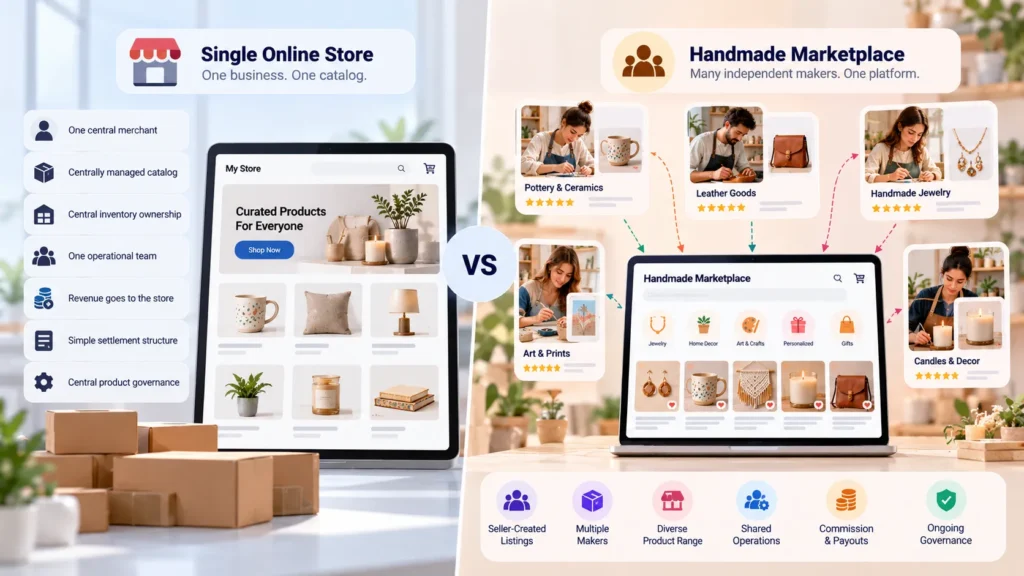
The biggest difference is not simply the type of products being sold.
It is the distribution of ownership and responsibility.
A single-store retailer can centrally control products, prices, inventory, fulfilment, and customer policies.
A handmade marketplace coordinates many independent commercial actors.
That creates different product requirements:
| Single Online Store | Handmade Marketplace |
|---|---|
| One central merchant | Many independent makers |
| Centrally managed catalog | Seller-created listings |
| Central inventory ownership | Inventory distributed across sellers |
| One operational team | Seller + operator workflows |
| Revenue belongs primarily to store | Transaction value may be split across participants |
| Simple settlement structure | Seller earnings and payouts require tracking |
| Central product governance | Continuous seller and listing governance |
The marketplace operator therefore has to build systems around coordination and trust, not simply checkout.
What Should Founders Understand Before Launching a Maker Marketplace?
The first question should not be, “How many features can we add?”
A stronger question is, “Which marketplace relationships must work reliably from day one?”
Four areas deserve particular attention.
1. Can Makers Operate Without Constant Administrative Help?
If every new product, stock change, order, or payout question requires staff intervention, operating costs can rise with seller growth.
Self-service workflows become increasingly valuable as the seller base expands.
2. Can Buyers Find Products Across an Irregular Catalog?
More listings do not automatically produce a better marketplace.
Categories, attributes, filters, search, seller storefronts, and catalog quality determine whether growing supply actually improves the customer experience.
3. Can Every Order Be Traced Across Its Lifecycle?
Operators should be able to understand what happened from checkout through fulfilment, refund, completion, and settlement.
This becomes particularly important when customer support or seller disputes arise.
4. Can Seller Earnings Be Explained Clearly?
If a maker asks why their available balance changed, the platform should have an answer based on transaction records rather than manual reconstruction.
Founder Decision Signals
Seller Scale
If the business expects many small independent makers, self-service onboarding and seller tooling should be treated as core marketplace infrastructure.
Catalog Quality
If product uniqueness is part of the brand promise, structured listings and moderation matter as much as the number of products available.
Operational Control
If orders involve multiple sellers, refunds, commissions, or fulfilment states, the operator needs traceability across the complete transaction lifecycle.
Seller Trust
If makers depend on the marketplace for income, transparent earnings and payout records become part of seller retention.
How Do These Workflows Connect as the Marketplace Grows?
The most useful way to understand a handmade marketplace is not as a feature checklist but as a chain of dependent workflows.
A maker cannot generate an order without a useful listing.
A listing cannot generate consistent discovery if the catalog lacks structure.
An order cannot be fulfilled reliably if seller responsibilities are unclear.
Seller earnings cannot be calculated reliably if order and financial records are disconnected.
Payouts become difficult to reconcile when refunds and adjustments are not linked to the underlying transaction.
And the operator cannot govern any of those areas efficiently without visibility across the system.
That is why marketplace design should start with relationships between workflows rather than isolated screens.
From Marketplace Mechanics to a Launch-Ready Product
Once founders understand how makers, listings, orders, and payouts connect, the next question is usually whether those workflows should be developed individually or started from an existing marketplace foundation.
That is where the decision moves from education into product evaluation.
Miracuves offers ready-made marketplace for independent makers with seller, buyer, order, catalog, administration, and payout workflows already forming part of the platform foundation.
For businesses that fit the existing solution scope, Miracuves offers deployment in six working days. Deeper customisation or additional modules depend on the final requirements and should be scoped separately.
The advantage of starting from an established marketplace foundation is not simply speed. It allows the founder to spend more early effort on the parts software cannot solve automatically: attracting the right makers, defining marketplace policies, building buyer demand, establishing category positioning, and creating a reason for both sides to remain active.
Final Thoughts: A Handmade Marketplace Is a System of Relationships
A handmade marketplace is not defined only by handcrafted products or attractive storefronts.
Its real structure lies in the relationships between makers, listings, buyers, orders, payments, marketplace rules, and payouts.
Makers create supply. Listings turn that supply into searchable marketplace inventory. Buyers create orders. Orders generate fulfilment and financial events. Those financial events determine seller earnings and eventual payouts. Around everything sits the operator, responsible for maintaining visibility, rules, trust, and control.
For founders, understanding those relationships before focusing on individual features leads to better marketplace decisions.
The goal is not simply to create somewhere people can list products.
It is to create a marketplace where independent makers can operate efficiently, buyers can discover products confidently, and the operator can understand what is happening from the first seller registration through the final payout.
FAQs
What is a handmade marketplace platform?
A handmade marketplace platform is a multi-seller commerce system where independent makers or artisans can create storefronts, publish product listings, receive orders, manage fulfilment, and earn money from sales while the marketplace operator governs the wider ecosystem.
How is a handmade marketplace different from a normal ecommerce store?
A normal ecommerce store usually operates around one central merchant or catalog owner. A handmade marketplace coordinates products, orders, inventory, and earnings across many independent sellers, which creates additional requirements around seller onboarding, listing governance, commissions, disputes, and payouts.
How do makers add products to a marketplace?
Makers generally use a seller interface to create listings containing product titles, descriptions, images, categories, prices, inventory, variations, and other attributes. Depending on marketplace policy, listings may become active immediately or enter a moderation workflow first.
How do multi-seller marketplace orders work?
The buyer may experience one checkout, while the platform maintains the relationship between individual items and their respective sellers. Each maker then manages the portion of the order for which they are responsible.
How do sellers get paid on a handmade marketplace?
The exact process depends on the marketplace’s payment and financial configuration. Generally, the platform needs to record seller earnings separately from customer payments and account for relevant commissions, refunds, adjustments, and payout conditions before funds become eligible for settlement.
Why are seller payouts different from customer payments?
A customer payment records money entering a transaction. A seller payout concerns money becoming eligible for settlement to a maker. Separating the two makes it possible to account for order completion, refunds, commissions, disputes, and other adjustments.
Why does listing moderation matter for maker marketplaces?
Independent sellers continuously create the catalog, so the operator needs mechanisms for maintaining marketplace standards. Moderation can help address prohibited products, inaccurate information, inappropriate content, reports, policy violations, and other catalog-quality issues.
What should founders prioritize when planning a handmade marketplace?
Founders should first make sure seller onboarding, listing management, product discovery, order states, financial records, payouts, moderation, and operator controls connect logically. Additional features are much more useful once these fundamental marketplace relationships are reliable.
Miracuves is an independent software development company. We are not affiliated with, connected to, sponsored by, or endorsed by any company or product named in this article.
Terms such as “X Clone” are used descriptively. It is how the software industry refers to building a platform with functionality comparable to a known service, and how clients search for it.
The entire design and codebase of our products is built by our own team. Our products contain no code, design, graphics, or content originating from any third-party website or applications.
All third-party names and marks referenced in this article are the property of their respective owners, referenced solely to identify the services discussed.