Key Takeaways
- An astrology portal platform can generate revenue through paid reports, consultations, AI tools, subscriptions, commerce, promotions, and advertising.
- Free kundali, horoscopes, panchang, compatibility, and numerology tools can attract users before introducing relevant paid services.
- Paid reports provide a practical first-purchase opportunity without requiring an astrologer to be available for every transaction.
- Human consultations create higher-value interactions, while AI tools support instant questions, report explanations, and scalable engagement.
- The strongest revenue model connects every paid service through shared accounts, wallets, user history, payments, and admin controls.
Revenue Model Signals
- Decide which free tool will attract users and which paid report or service should become their first purchase.
- Configure per-minute consultations, fixed appointments, report pricing, subscriptions, AI credits, and practitioner commissions.
- Use one wallet to support reports, consultations, AI questions, subscriptions, products, refunds, and promotional credits.
- Connect spiritual products, remedies, puja services, and courses to relevant reports or consultations instead of presenting a disconnected store.
- Track conversion from free tools to paid reports, consultation revenue, subscription renewals, AI usage costs, product sales, and repeat purchases.
Real Insights
- Charging users before they experience meaningful free value can reduce trust and weaken conversion.
- Depending only on consultations creates pressure around astrologer availability, scheduling, service quality, and payouts.
- AI should support instant and affordable guidance while directing high-intent users toward reports or human consultations.
- Commerce performs better when products and services are connected to a user’s report, consultation, or identified need.
- Miracuves develops white-label, source-code-owned astrology portal platforms with reports, consultations, AI tools, wallets, subscriptions, commerce, admin control, and six-day delivery where the standard scope applies.
Astrology portals no longer depend only on display ads, daily horoscope traffic, or one-time consultation bookings. The stronger platforms now work like layered digital businesses. A user may enter through a free kundali, horoscope, panchang, compatibility report, tarot reading, numerology tool, or content page. The platform then creates multiple paid paths from that same intent.
That is why the revenue model matters before the feature list.
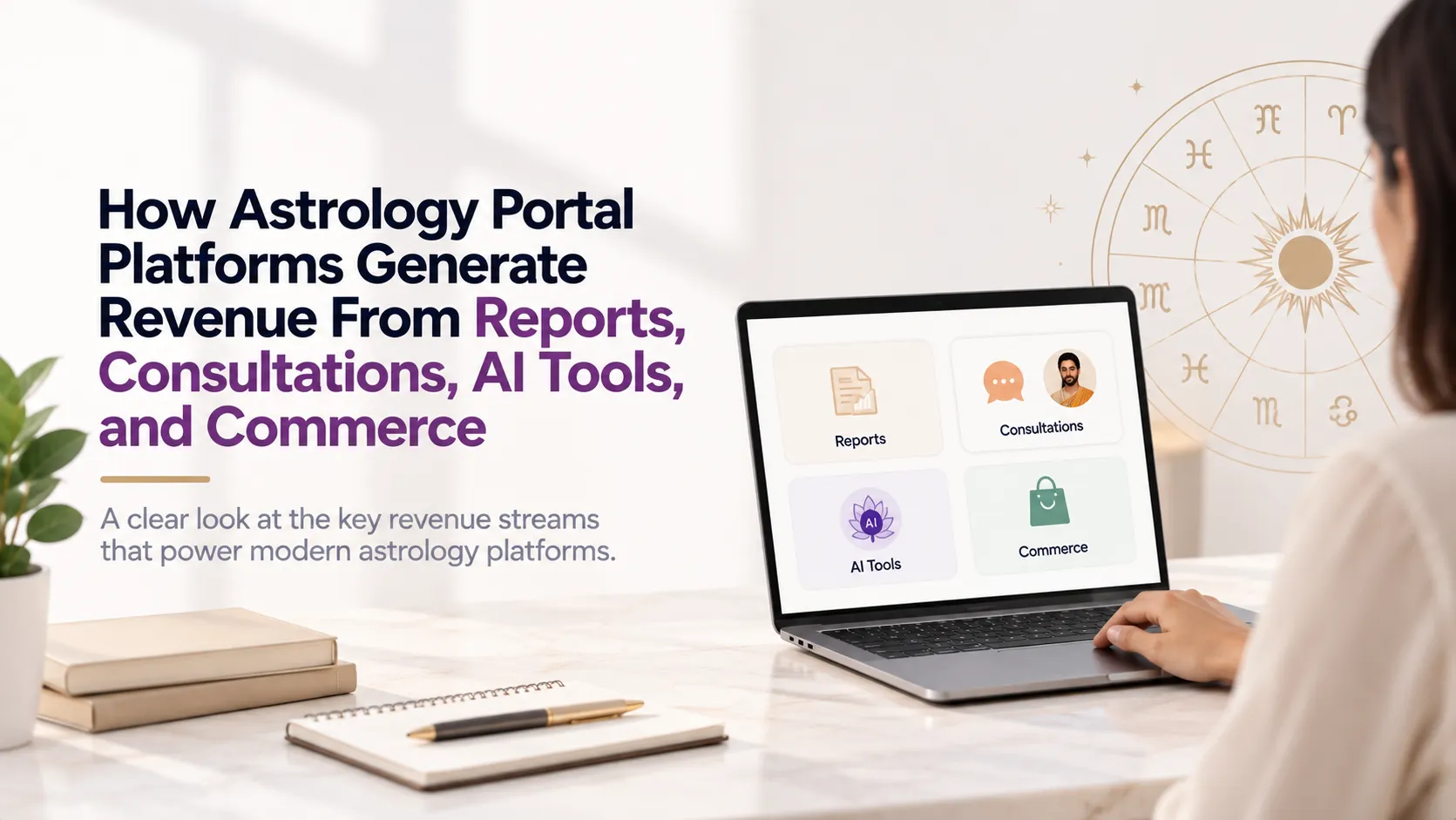
A founder building an astrology portal has to answer one core question: where does free curiosity turn into paid trust? The answer usually sits across four major revenue layers: paid reports, expert consultations, AI-assisted tools, and spiritual commerce.
Miracuves helps founders build astrology portal platforms where these monetization flows can be connected through user accounts, wallets, admin controls, practitioner dashboards, and white-label branding. But before choosing the product foundation, founders should understand how the money actually moves inside the platform.
Why Astrology Portals Need Layered Monetization
A user rarely arrives on an astrology portal with one fixed purchase intent. Some users want a free birth chart. Some want a quick answer about marriage, career, finance, health, or compatibility. Some are ready to speak with an astrologer immediately. Others need repeated engagement before they pay.
That makes astrology monetization different from a simple ecommerce store or appointment booking app. The platform must support different levels of trust:
- Free discovery for first-time visitors
- Low-ticket digital purchases for curious users
- Human consultation for high-intent users
- AI-assisted guidance for instant engagement
- Commerce and remedies for follow-up purchases
- Subscriptions for recurring value
The best monetization strategy is not to push every user toward the same product. It is to give users a natural next step based on their intent.
A visitor who checks a daily horoscope may not be ready for a paid consultation. But a visitor who generates a detailed kundali, downloads a compatibility report, or asks multiple career questions may be closer to a paid action. The platform’s job is to recognize these moments and offer the right revenue path.
The Core Revenue Streams in an Astrology Portal Platform
An astrology portal can monetize through several connected flows. The strongest model usually combines automated digital revenue with expert-led services.
| Revenue Stream | How It Works | Why It Matters for Founders |
|---|---|---|
| Paid astrology reports | Users pay for kundali, compatibility, yearly forecast, career, marriage, or personalized reports | Creates a low-friction first purchase |
| Consultations | Users pay per minute, per session, or through prepaid wallet balance for astrologer chat, call, or video | Builds deeper trust and higher user value |
| AI readings | Users ask instant questions or receive AI-assisted interpretations based on chart inputs | Supports scalable engagement when human supply is limited |
| Subscriptions | Users pay monthly or yearly for premium horoscopes, alerts, reports, or member benefits | Creates recurring revenue |
| Spiritual commerce | Users buy remedies, gemstones, puja services, yantras, reports, or related products | Extends revenue after guidance is delivered |
| Practitioner promotions | Astrologers pay or share revenue for better visibility, profile boosting, or lead flow | Helps monetize the supply side |
| Ads and sponsored content | Brands pay for placement across high-traffic content pages | Useful for large organic traffic surfaces |
| Courses and live events | Users pay for astrology learning, workshops, webinars, or group sessions | Adds education-led monetization |
The key is not the number of revenue streams. The key is whether these streams are connected through one user journey.
If reports, consultations, AI tools, and commerce sit in separate systems, users drop off. If they work through the same wallet, profile, chart history, and admin dashboard, the platform can monetize more naturally.
Read More: From Free Kundli to Paid Consultation: Designing the User Journey in a Digital Astrology Platform
Paid Astrology Reports: The First Step From Free Traffic to Revenue

Paid reports are often the most practical first monetization layer for astrology portals. A user may arrive for a free birth chart, horoscope, guna milan, panchang, or numerology reading. Once the user sees value in the free result, the platform can offer a deeper paid version.
Examples of paid report categories include:
- Detailed birth chart reports
- Compatibility and marriage reports
- Yearly prediction reports
- Career and finance reports
- Health and wellness astrology reports
- Transit and dasha-based reports
- Numerology reports
- Vastu reports
- Tarot summaries
- Personalized remedy reports
The business advantage is simple: reports can be packaged, priced, and delivered without requiring live human availability for every order. This makes them useful for early-stage founders who are still building their astrologer network.
But report monetization only works when the free-to-paid transition feels natural. If the free report is too thin, users do not trust the platform. If the paid prompt appears too early, users feel blocked. The right balance is to offer meaningful free value, then position the paid report as a deeper explanation.
Founder Decision Signal
Paid reports work best when your platform has strong free-tool traffic but limited expert availability. They give users a paid step before consultations and help validate whether the audience is willing to spend.
Consultations: Where Trust Turns Into Higher-Value Revenue
Consultations are the most relationship-driven revenue stream in an astrology portal. Users pay to speak with a human practitioner through chat, call, video, or live session formats.
A strong consultation flow usually includes:
- Astrologer profiles
- Categories and specializations
- Availability controls
- Per-minute or fixed-session pricing
- Wallet recharge
- Queue management
- Chat, voice, or video integration
- Ratings and reviews
- Payout tracking
- Admin dispute handling
For founders, consultations create stronger monetization because users are not only paying for content. They are paying for reassurance, interpretation, and personal attention.
However, consultation revenue also has operational complexity. The platform must manage supply quality, practitioner onboarding, availability, payouts, cancellations, refunds, and trust signals. Without strong admin controls, the experience can become inconsistent.
This is where a platform approach matters. Consultation monetization should not be added as a disconnected plugin. It should connect with wallet balance, user history, practitioner dashboards, admin reports, and support workflows.
AI Astrology Tools: Scalable Engagement Without Replacing Human Trust
AI tools can make astrology portals more responsive, but they should be used carefully. The strongest use of AI is not to replace every astrologer. It is to create instant, structured, and affordable guidance while escalating high-intent users to paid reports or human consultations.
AI-powered astrology experiences may include:
- Instant chart summaries
- First-question guidance
- Personalized horoscope explanations
- Compatibility interpretation
- Career or relationship prompts
- Report summaries
- Follow-up question flows
- AI-assisted practitioner notes
- Smart content generation for horoscopes or FAQs
For founders, AI tools can reduce friction. A user can ask something immediately instead of waiting for a practitioner. The platform can also use AI as a low-ticket paid feature, a subscription benefit, or a lead qualification layer before consultation.
The risk is quality. Astrology users expect interpretations that feel consistent, contextual, and respectful. If AI outputs feel random, generic, or inaccurate, the platform loses trust. That is why AI tools should be connected to structured chart data, clear disclaimers, human escalation, and admin review where needed.
Commerce: Turning Guidance Into Follow-Up Purchases
Astrology commerce works because guidance often leads to action. A user may receive a remedy recommendation, gemstone suggestion, puja service, personalized report, or ritual product recommendation after a reading.
Commerce categories can include:
- Gemstones
- Rudraksha
- Yantras
- Puja kits
- Spiritual accessories
- Personalized remedy reports
- Digital rituals or puja bookings
- Astrology courses
- Gift cards
- Premium content bundles
Commerce should not feel like a random store attached to an astrology website. It works better when the purchase is contextually connected to the user’s report, consultation, or AI reading.
For example, after a compatibility report, the platform may recommend a relationship consultation. After a career reading, it may suggest a detailed yearly forecast. After a remedy report, it may show relevant products or services.
This turns commerce into a continuation of the user journey rather than an unrelated upsell.
Wallets and Credits: The Revenue Layer That Connects Everything
Wallets are important because astrology platforms often deal with micro-transactions. A user may pay for a short chat, a quick AI question, a downloadable report, or a small remedy purchase.
A wallet-based model can support:
- Prepaid balance
- Per-minute consultation deductions
- AI query credits
- Report purchases
- Refund handling
- Promotional credits
- Practitioner payouts
- Transaction history
- Admin reconciliation
From a business perspective, wallets reduce payment friction. Instead of asking users to make a payment every time they ask a question, the platform lets them recharge once and spend across services.
For founders, the wallet is more than a payment feature. It is the control layer for repeat monetization.
Subscriptions: Building Recurring Revenue Around Habit
Subscriptions work when the platform gives users a reason to return regularly. This is where astrology has a natural advantage because users often check daily, weekly, monthly, and yearly predictions.
Subscription benefits can include:
- Premium horoscopes
- Daily personalized alerts
- Monthly transit reports
- Compatibility updates
- Limited AI questions
- Discounted consultation minutes
- Free or discounted reports
- Priority astrologer access
- Festival-specific guidance
- Member-only content
The mistake is launching subscriptions too early without enough recurring value. Users will not pay monthly just because the app exists. They pay when the platform becomes part of their routine.
A practical strategy is to first validate free repeat usage, then add subscription layers around the highest-retention experiences.
Ads and Sponsorships: Useful, But Not the Main Revenue Engine
Ads can work for astrology portals with strong organic traffic, especially horoscope, panchang, festival, and content-led pages. But ads should not be the only monetization model.
Ad revenue depends heavily on traffic volume, geography, ad rates, page experience, and user retention. It can support the platform, but it rarely gives founders the same control as paid reports, consultations, AI tools, or commerce.
A better approach is to treat ads as one layer, not the business model.
For example, a free horoscope page can carry ads, but it should also guide users toward personalized reports, AI readings, or consultation options. That way the platform monetizes both anonymous traffic and logged-in users.
How Reports, Consultations, AI, and Commerce Work Together
The strongest astrology portal revenue model is not a list of disconnected monetization ideas. It is a journey.
A practical user journey may look like this:
- A user lands on a free horoscope or kundali page.
- The user generates a free chart or reads a daily prediction.
- The platform offers a deeper paid report.
- The user buys the report through wallet or checkout.
- The report suggests an AI follow-up question or consultation.
- The user speaks to an astrologer through chat, call, or video.
- The astrologer or system recommends a remedy, product, or subscription.
- The user returns for alerts, forecasts, or future consultations.
This is how one acquisition event can create multiple revenue opportunities.
Founder Decision Signals
Speed
If you already have traffic or content demand, paid reports and AI tools can create monetization faster than waiting to onboard a large practitioner network.
Cost
Consultations may generate strong value, but they require supply operations. Automated reports and AI-assisted readings can reduce dependence on human availability at the early stage.
Scalability
A scalable portal connects reports, wallet, consultations, AI tools, commerce, and admin controls through one operating system rather than separate plugins.
Market Fit
The right revenue model depends on user behavior. Free-tool users may convert first to reports, while high-intent users may move directly to consultations.
What Founders Should Decide Before Building an Astrology Portal
Before choosing features, founders should define the monetization sequence.
Ask these questions:
- Will the platform start with free tools, consultations, or content?
- What is the first paid action a user should take?
- Will reports be one-time purchases or part of a subscription?
- Will AI tools be free, credit-based, or premium?
- Will consultations use per-minute pricing, fixed sessions, or packages?
- Will commerce be built in from day one or added later?
- Will practitioners manage availability and payouts themselves?
- How will admins handle refunds, disputes, abuse reports, and failed payments?
- What user data should be saved to personalize future offers?
These decisions shape the product architecture. A portal built only as a content website will struggle to support consultations. A consultation app without report automation may miss low-ticket monetization. A commerce store without user context may feel disconnected.
A revenue-ready astrology portal should be designed around the full monetization journey.
Mistakes Founders Should Avoid
Charging Too Early
If every tool is locked before users experience value, the platform may lose trust before conversion begins. Free tools should create confidence before paid offers appear.
Depending Only on Consultations
Consultations can be valuable, but they require astrologer supply, scheduling, quality control, and payout management. Reports, AI tools, and subscriptions can balance the model.
Treating AI as a Shortcut for Accuracy
AI should support structured guidance, summaries, and instant engagement. It should not produce unsupported predictions without proper data logic, disclaimers, and escalation paths.
Adding Commerce Without Context
Spiritual products and remedy services convert better when connected to a report, consultation, or user need. A random store inside the app may not create meaningful revenue.
Read More: AI Astrologer vs Human Astrologer: What Role Should Each Play in a Digital Astrology Platform?
Revenue Model Comparison for Astrology Portal Platforms
Choosing the right revenue model depends on how users enter the astrology portal, how much trust they need before paying, and whether the platform is built for one-time transactions or repeat engagement. Some revenue streams, such as paid reports and AI readings, are easier to automate, while consultations and commerce require stronger operational control. The comparison below helps founders understand which monetization layer fits each stage of the user journey.
Astrology Portal Revenue Streams Compared
| Revenue Model | Best For | Business Value | Operational Complexity |
|---|---|---|---|
| Paid Reports | Free-tool traffic, kundali users, compatibility users | Creates a low-friction first purchase | Medium |
| Consultations | Users needing personal answers | Higher trust and stronger user value | High |
| AI Readings | Instant questions and scalable engagement | Reduces waiting time and supports microtransactions | Medium |
| Subscriptions | Repeat horoscope, forecast, and alert users | Creates recurring revenue | Medium |
| Commerce | Remedies, products, rituals, and follow-up purchases | Extends revenue after guidance | Medium to High |
| Ads and Sponsorships | High-traffic content portals | Monetizes anonymous traffic | Low to Medium |
Where Miracuves Fits Into the Astrology Portal Revenue Model
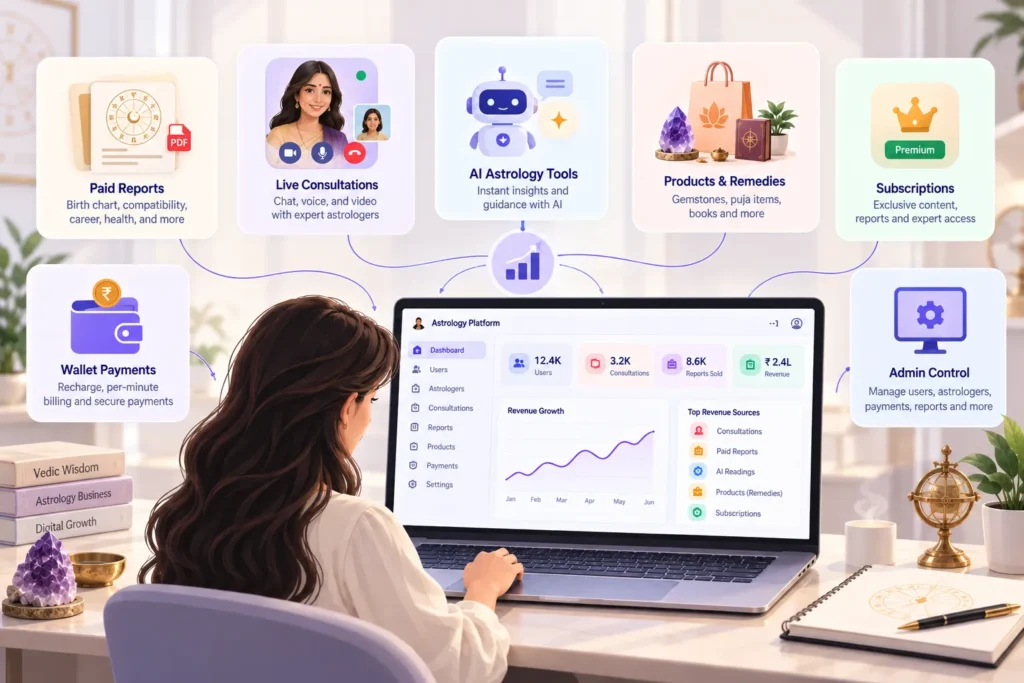
A monetization strategy only works when the product foundation can support it. Reports, consultations, AI tools, commerce, wallets, and subscriptions all need connected workflows to generate revenue smoothly.
Miracuves helps founders build white-label astrology platforms where these revenue layers work together instead of operating as disconnected modules.
Key advantages include:
- Faster validation of paid reports, consultations, AI readings, and commerce flows
- Better user journey from free astrology tools to paid services
- Centralized admin control for users, astrologers, payments, reports, and products
- Flexible monetization through wallet payments, subscriptions, commissions, and AI credits
- White-label branding with source-code ownership for long-term customization
- A launch-ready foundation that can support growth as the platform scales
For founders who want a faster route, the Miracuves AstroSage clone solution can support free astrology tools, paid reports, AI readings, practitioner consultations, commerce, wallet flows, and operator control while the money page remains the main destination for buyers comparing product options.
Related reading: astrology platform features guide.
Final Thoughts: Build the Revenue Journey Before Building the Feature List
The real business model of an astrology portal is not “add reports” or “add consultations.” It is the journey between curiosity, trust, payment, repeat usage, and follow-up value.
Free tools bring users in. Paid reports create the first transaction. AI tools answer instant questions. Consultations deepen trust. Commerce extends the relationship. Subscriptions create recurring engagement. Wallets connect the entire system.
For founders, the smarter question is not only “how will the astrology portal make money?” It is “what should the user pay for first, what should they return for, and how should every paid step feel helpful rather than forced?”
FAQs
How do astrology portal platforms make money?
Astrology portal platforms make money through paid reports, consultations, AI readings, subscriptions, commerce, practitioner promotions, ads, and wallet-based microtransactions. The strongest model usually combines several of these instead of depending on only one revenue stream.
What is the first revenue stream a new astrology portal should launch?
Paid reports are often a practical first revenue stream because they can convert free-tool users into paying users without needing a large astrologer network from day one. Consultation features can be added or scaled as practitioner supply grows.
Are AI astrology tools profitable?
AI astrology tools can support revenue when they are used for instant readings, low-ticket questions, report summaries, or subscription benefits. Profitability depends on usage volume, AI cost control, pricing, quality, and whether users trust the output.
How do consultations generate revenue in astrology apps?
Consultations usually generate revenue through per-minute chat, call, video sessions, fixed packages, wallet deductions, or commission-sharing with astrologers. The platform earns from user payments while managing availability, session tracking, and payouts.
Can an astrology portal earn revenue from ecommerce?
Yes. Astrology commerce can include gemstones, rudraksha, yantras, puja kits, remedy products, digital rituals, reports, courses, and spiritual gifts. Commerce works better when recommendations are connected to user reports or consultations.
Should astrology portals use subscriptions?
Subscriptions work well when users return regularly for horoscopes, alerts, monthly reports, compatibility updates, premium AI questions, or consultation benefits. Founders should validate repeat usage before making subscriptions the main revenue model.
What is the role of a wallet in astrology monetization?
A wallet helps users recharge once and spend across reports, consultations, AI questions, products, and subscriptions. It reduces payment friction and gives the platform better transaction control.
How can Miracuves help build an astrology portal platform?
Miracuves helps founders build white-label astrology portal platforms with source code, admin control, paid reports, AI-assisted experiences, consultation workflows, wallet systems, commerce modules, and faster launch support.
Miracuves is an independent software development company. We are not affiliated with, connected to, sponsored by, or endorsed by any company or product named in this article.
Terms such as “X Clone” are used descriptively. It is how the software industry refers to building a platform with functionality comparable to a known service, and how clients search for it.
The entire design and codebase of our products is built by our own team. Our products contain no code, design, graphics, or content originating from any third-party website or applications.
All third-party names and marks referenced in this article are the property of their respective owners, referenced solely to identify the services discussed.