Key Takeaways
- A complete astrology platform should connect free tools, paid reports, expert consultations, payments, and admin operations.
- Important user features include kundali generation, horoscopes, panchang, compatibility matching, personalized reports, and astrologer discovery.
- Chat, audio calls, video sessions, appointments, wallets, and per-minute billing support consultation-based revenue.
- Astrologers need verification, availability, pricing, session management, earnings, and payout tools.
- Founders should prioritize connected user journeys instead of selecting features only by quantity.
Platform Evaluation Signals
- Test whether free kundali, horoscope, matching, and panchang tools naturally guide users toward paid services.
- Review report generation, payment confirmation, PDF delivery, purchase history, and refund workflows.
- Check astrologer onboarding, verification, availability, consultation pricing, reviews, commissions, and payouts.
- Inspect wallet recharges, balance deductions, per-minute billing, promotional credits, and transaction records.
- Confirm that administrators can manage users, experts, content, pricing, payments, disputes, permissions, and analytics.
Real Insights
- Free astrology tools can attract search traffic and build trust before users are ready to make a purchase.
- Paid reports create a lower-friction first transaction than requiring every user to book a live consultation.
- Weak wallet and payout logic can create billing disputes between users, astrologers, and platform operators.
- Advanced AI, live events, and commerce features should follow reliable onboarding, reports, consultations, and admin workflows.
- Miracuves develops white-label astrology platforms with user tools, expert workflows, wallet billing, admin control, source-code ownership, and six-day delivery where the standard scope applies.
An astrology portal is not just a horoscope page with a payment button. A serious astrology platform needs to connect free tools, personalized reports, astrologer consultations, wallet flows, content publishing, and admin control into one working product.
For founders, this matters because astrology users often enter through free intent. They may search for kundali, horoscope, panchang, compatibility, numerology, tarot, remedies, or auspicious timing before they ever pay. The platform must help them move naturally from free discovery to deeper paid guidance without making the experience feel forced.
That is where planning the right astrology portal platform features becomes important.
If the product only has basic daily horoscopes, users may visit once and leave. If it only has paid consultations, acquisition becomes expensive. A stronger astrology portal combines both: free utility for traffic, personalized reports for conversion, and human or AI-assisted guidance for retention.
This guide breaks down the most important astrology portal platform features to include if you want to support kundali generation, horoscopes, reports, consultations, and long-term monetization.
Why Feature Planning Matters Before Building an Astrology Portal
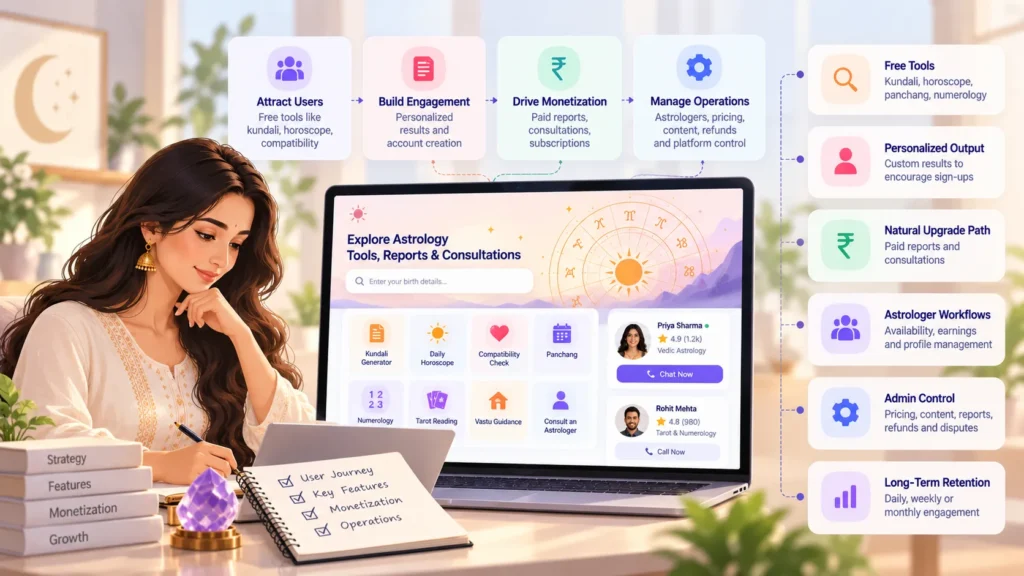
Astrology platforms have a different user journey from many other service marketplaces. A user may not arrive with purchase intent on the first visit. They may want a free birth chart, today’s horoscope, compatibility check, or panchang before they trust the platform enough to buy a paid report or consult an astrologer.
That means your feature set should not be planned only around “booking consultations.” It should also answer these business questions:
- What free tools will bring users into the platform?
- What personalized output will make them create an account?
- What paid step feels natural after the free result?
- How will astrologers manage availability and earnings?
- How will the platform operator control pricing, content, reports, refunds, and disputes?
- How will users return daily, weekly, or monthly?
The strongest astrology portal platforms work because they connect acquisition, engagement, monetization, and operations. Each feature should support one of those goals.
Read More: How Astrology Portal Platforms Generate Revenue From Reports, Consultations, AI Tools, and Commerce
Core Astrology Portal Platform Features Every User Experience Should Include
The user side is where trust begins. If the first experience feels confusing, slow, or generic, users may not move toward reports or consultations.
A strong astrology portal should make the user journey simple: enter details, receive useful insight, save history, explore deeper guidance, and pay only when the value is clear.
1. Kundali Generation and Birth Chart Tools
Kundali generation is often the entry point for astrology users. The platform should allow users to enter birth date, birth time, and birth location, then generate a structured birth chart experience.
Important kundali features include:
- Birth detail input with location support
- North Indian and South Indian chart style options where relevant
- Lagna, moon sign, rashi, nakshatra, and planetary position sections
- Dasha and transit-related sections
- Chart saving inside the user profile
- Option to download or upgrade to a detailed paid report
- Compatibility with mobile and web layouts
From a business perspective, kundali tools are not only a feature. They are an acquisition asset. Users search for birth charts frequently, and a free kundali experience can become the front door to paid reports, remedies, and consultations.
2. Horoscope Pages for Daily, Weekly, Monthly, and Yearly Engagement
Horoscopes help create recurring visits. A user may generate a kundali once, but they can return for daily, weekly, monthly, or yearly predictions if the content is easy to access.
An astrology portal should include horoscope pages for all zodiac signs, with clear navigation across time periods.
Useful horoscope features include:
- Daily horoscope
- Weekly horoscope
- Monthly horoscope
- Yearly horoscope
- Love, career, finance, health, and family sections
- Sign-wise landing pages
- Shareable horoscope snippets
- Push notifications or email reminders
- Horoscope archive or history where useful
For founders, horoscope content also supports SEO. Each sign and time period can become a structured content surface, helping the platform build topical relevance instead of depending only on paid ads.
3. Panchang, Muhurat, and Festival Timing Tools
Panchang and muhurat tools are important because they support practical astrology use cases. Users may visit the platform to check auspicious timings, tithi, nakshatra, yoga, karana, sunrise, sunset, festival details, or religious dates.
A strong panchang feature should include:
- Location-based panchang
- Daily tithi, nakshatra, yoga, and karana
- Sunrise and sunset timings
- Festival and vrat calendar
- Auspicious and inauspicious time windows
- Muhurat finder for marriage, business, travel, naming, housewarming, and other events
- Regional calendar support where relevant
This type of feature helps an astrology portal become useful beyond one-time predictions. It gives users a reason to return when they need timing-based guidance.
4. Kundali Matching and Compatibility Reports
Kundali matching can serve a different user intent from general horoscopes. It often involves two users, family decision-making, marriage planning, and deeper trust.
A portal should include compatibility workflows such as:
- Boy and girl birth detail entry
- Guna milan score
- Manglik analysis
- Dosha checks
- Match summary
- Compatibility report download
- Option to consult an astrologer after the match result
- Saved matching history
This feature can work as both a free tool and a paid-report funnel. The basic score may be free, while detailed analysis, remedies, or astrologer review can become a paid step.
Paid Report Features That Turn Free Users Into Buyers
Free astrology tools attract users. Paid reports convert users. The important decision is where to draw the line between free insight and premium detail.
A good astrology report system should avoid locking everything behind payment immediately. Instead, it should give users enough value to trust the output, then offer deeper interpretation when they want more clarity.
5. Downloadable Astrology Reports
Paid reports can include detailed analysis for life areas such as career, marriage, finance, health, education, compatibility, remedies, yearly predictions, and planetary periods.
Useful paid report features include:
- Report category selection
- Preview before purchase
- PDF download
- User report library
- Multi-language report support
- Report pricing control
- Wallet or direct checkout payment
- Admin-managed report templates
- Report regeneration or update logic where applicable
For founders, paid reports are attractive because they can generate revenue without requiring every user to book a live consultation. They create a lower-friction first purchase before a user commits to speaking with an astrologer.
6. Personalized Remedy and Recommendation Flows
Many astrology users are not only looking for predictions. They want the next step. This is where remedies, rituals, gemstone guidance, mantra suggestions, donation recommendations, or lifestyle guidance may appear.
A platform can support remedy workflows through:
- Dosha-based remedy mapping
- Report-linked recommendations
- Product or service suggestions
- Remedy explanation pages
- Optional marketplace integration
- Astrologer-reviewed remedy suggestions
- Admin control over what appears to users
This feature should be handled carefully. The platform should explain remedies clearly and avoid exaggerated claims. The value is in structured guidance and user trust, not aggressive selling.
Consultation Features for Astrologers and Users
Consultations are usually the highest-intent monetization layer in an astrology portal. But a consultation marketplace needs more than a “call now” button. It needs availability, pricing, wallet control, communication tools, user history, reviews, and platform governance.
7. Astrologer Profiles and Discovery
Users need to compare astrologers before starting a session. The profile page should make that decision easier without overwhelming them.
Important astrologer profile features include:
- Name, photo, language, and specialization
- Experience and consultation categories
- Chat, call, and video availability
- Per-minute or fixed-session pricing
- Ratings and reviews
- Profile verification status
- Short bio and expertise areas
- Availability status
- Follow or favorite option
- Report or block option for safety
The goal is not only to list astrologers. The goal is to help users choose the right advisor quickly and confidently.
8. Chat, Audio, Video, and Appointment Booking
Consultation platforms should support different levels of urgency. Some users want instant chat. Others prefer scheduled calls. Some may want video sessions for deeper guidance.
A practical consultation system can include:
- Instant chat consultations
- Audio calls
- Video calls
- Scheduled appointments
- Session reminders
- Queue or waitlist logic
- Attachments where needed
- Session history
- Mid-session wallet top-up
- End-session summary
- User rating after consultation
The consultation flow should be designed to reduce drop-offs. If a user runs out of wallet balance during a session, for example, the top-up flow should not force them to restart the entire consultation.
9. Wallet, Billing, and Commission Logic
Wallet logic is one of the most important backend features in an astrology consultation platform. It controls how users pay, how astrologers earn, and how the platform tracks revenue.
Wallet and billing features may include:
- User wallet recharge
- Consultation balance deduction
- Per-minute billing
- Fixed-fee booking
- Promo credits
- Refund handling
- Astrologer commission rules
- Payout dashboard
- Transaction history
- Admin adjustment controls
- Invoice or receipt generation
Without a strong wallet system, disputes become difficult to manage. Users need transparency, astrologers need earnings clarity, and the operator needs full visibility into every transaction.
Astrology Portal Feature Map
| Feature Area | Business Value | Founder Impact |
|---|---|---|
| Kundali Generation | Brings search-led users into the platform through free utility. | Creates an organic acquisition surface before paid conversion. |
| Horoscope Pages | Encourages repeat visits through daily, weekly, and yearly content. | Supports SEO growth and recurring user engagement. |
| Paid Reports | Creates a low-friction first purchase before live consultation. | Helps monetize free-tool users without depending only on astrologer supply. |
| Consultation Tools | Enables chat, call, video, and appointment-based revenue. | Turns the platform into a service marketplace, not just a content site. |
| Wallet and Billing | Controls payments, deductions, refunds, commissions, and payouts. | Reduces operational confusion and improves financial visibility. |
| Admin Dashboard | Manages users, astrologers, pricing, reports, content, and disputes. | Gives the operator control without depending on developers for every change. |
Astrologer Panel Features That Improve Supply Quality
Astrologers are not just service providers. They are also a trust layer, content layer, and retention driver. If their dashboard is weak, the platform will struggle with availability, payouts, profile quality, and user satisfaction.
10. Astrologer Onboarding and Verification
Before astrologers appear publicly, the platform should support an onboarding and approval workflow.
Useful onboarding features include:
- Profile submission
- Document upload
- Experience and specialization fields
- Language selection
- Pricing setup
- Bank or payout details
- Admin approval
- Verification status
- Profile completion score
Verification helps users feel safer when choosing an astrologer. It also gives the platform operator better control over service quality.
11. Availability, Scheduling, and Session Management
Astrologers need simple tools to manage their working hours and consultation load.
Astrologer scheduling features can include:
- Online/offline status
- Weekly availability calendar
- Break and holiday settings
- Appointment acceptance or auto-confirmation
- Session reminders
- Consultation history
- Chat and call records
- Earnings per session
- Missed session tracking
This directly affects user experience. If users repeatedly see unavailable astrologers, failed sessions, or unclear timings, trust drops quickly.
12. Astrologer Earnings and Payout Dashboard
A transparent earnings dashboard helps reduce support tickets and disputes.
It should show:
- Total earnings
- Pending payouts
- Completed sessions
- Commission deductions
- Refund adjustments
- Bonus or promotion earnings
- Payout status
- Transaction history
For founders, this feature is operationally important. A platform with many astrologers needs payout clarity from the beginning, not after disputes begin.
Admin Dashboard Features for Platform Control
The admin dashboard is where the astrology business actually runs. It should not be treated as a simple user list. It should give the operator control over users, astrologers, content, reports, payments, pricing, disputes, and growth.
13. User and Astrologer Management
The admin should be able to view and manage the full platform ecosystem.
Important controls include:
- User profile management
- Astrologer profile approval
- Verification status control
- Blocking and suspension
- Wallet adjustment history
- Consultation history
- Report purchase history
- Support notes
- Exportable records where needed
This helps the platform operator resolve issues quickly without asking developers to manually check the database.
14. Pricing, Commission, and Revenue Controls
Astrology portals usually have several monetization layers. Each should be configurable from the admin panel.
The dashboard should support pricing controls for:
- Paid reports
- Chat consultations
- Call consultations
- Video consultations
- Appointment bookings
- Subscription access
- Promotional offers
- Astrologer commissions
- Platform fees
- Refund rules
This matters because pricing will change after launch. Founders may test different report tiers, introductory offers, commission models, or consultation rates. The admin panel should support that experimentation.
15. Content Management for SEO and Trust
Astrology platforms often rely on content to grow. A blog, news section, horoscope archive, FAQ system, help center, and static CMS pages can all support organic traffic and user education.
Content features may include:
- Blog publishing
- Horoscope content management
- FAQ pages
- Help center categories
- Landing pages
- Author profiles
- Astrologer-written articles
- Internal linking controls
- Meta title and description fields
- Reader analytics
This is especially important when the platform wants to rank for astrology-related searches. Content should not sit outside the product. It should connect naturally to tools, reports, and consultations.
16. Moderation, Safety, and Dispute Management
Astrology platforms involve personal conversations, payments, advice, reviews, and sometimes emotional user situations. Safety and moderation features should be planned from the start.
Important trust features include:
- Review moderation
- Abuse reporting
- Chat monitoring controls where legally appropriate
- Blocked keyword settings
- Refund workflows
- Dispute records
- Astrologer suspension controls
- User complaint tracking
- Role-based admin access
Security and trust should be treated as product foundations. Final legal, privacy, and compliance requirements depend on the target market, business model, and legal review.
Founder Decision Signals
Speed
If you need to validate demand quickly, prioritize kundali, horoscope, report, wallet, and consultation flows before advanced experiments.
Cost
Feature overload increases scope. Start with the features that connect acquisition, conversion, and operations.
Scalability
Scalability depends on backend structure, wallet accuracy, content workflows, and admin control, not only server size.
Market Fit
Regional astrology habits matter. Vedic astrology, tarot, numerology, panchang, and consultations may perform differently by audience.
Monetization Features an Astrology Portal Should Support
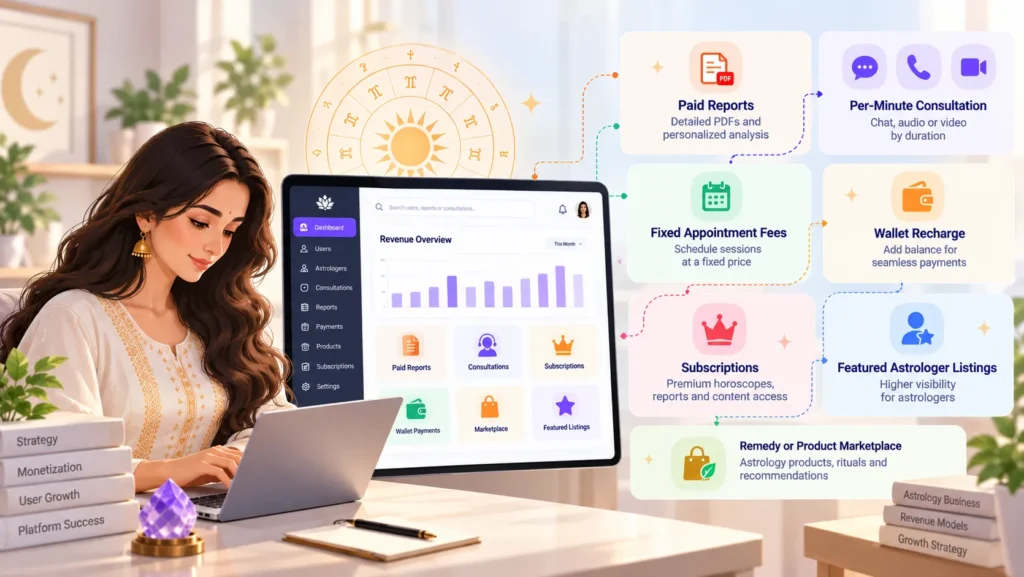
A strong astrology portal should not depend on one revenue stream. The platform can combine free tools, paid reports, consultations, subscriptions, content, and marketplace-style add-ons.
Common monetization models include:
| Revenue Model | How It Works | Best Use Case |
|---|---|---|
| Paid Reports | Users pay for detailed PDFs or personalized analysis. | Good first purchase after free kundali or matching. |
| Per-Minute Consultation | Users pay for chat, audio, or video by duration. | Useful for astrologer-led platforms. |
| Fixed Appointment Fees | Users book a scheduled session at a fixed price. | Useful for premium astrologers or longer guidance. |
| Wallet Recharge | Users add balance before using paid features. | Helps reduce payment friction during sessions. |
| Subscriptions | Users pay for premium horoscopes, reports, or content access. | Useful for recurring engagement. |
| Featured Astrologer Listings | Astrologers pay or use platform credits for higher visibility. | Useful when astrologer supply grows. |
| Remedy or Product Marketplace | Users purchase related products, rituals, or recommendations. | Works when operations and fulfillment are clearly managed. |
The right monetization mix depends on your launch strategy. A content-heavy astrology portal may start with reports and subscriptions. A consultation-first platform may prioritize wallet, chat, calls, and astrologer discovery.
Technical and Integration Features to Consider
The technical foundation should support accurate calculations, smooth consultations, secure payments, and admin flexibility.
Important integrations may include:
- Astrology calculation APIs or internal astrology engines
- Payment gateway integration
- Wallet and ledger system
- SMS and OTP service
- Email notification system
- Push notifications
- Chat infrastructure
- Audio/video consultation provider
- PDF generation
- Analytics integration
- CRM or support tool integration
- Cloud hosting and backup setup
The goal is not to add every integration on day one. The goal is to identify which integrations are required for your first launch version and which can wait until users prove demand.
Mistakes Founders Should Avoid While Planning Astrology Portal Features
Building only paid consultations
If the platform has no free tools or content surface, acquisition may depend too heavily on ads. Kundali, horoscope, panchang, and matching features can help attract users earlier in the journey.
Adding advanced features before core flows work
AI, live streaming, gamification, or marketplace add-ons are useful only after the core journey works: user onboarding, chart generation, report purchase, wallet billing, consultation, and admin control.
Ignoring astrologer operations
Astrologer onboarding, availability, earnings, reviews, and disputes need clear workflows. Without them, service quality becomes difficult to manage.
Treating the admin panel as an afterthought
The admin dashboard controls pricing, content, reports, users, astrologers, payouts, and platform trust. Weak admin control increases manual work after launch.
What Should You Launch First?
Founders often ask whether they should launch every astrology feature at once. The better question is: which features create the shortest path from discovery to paid value?
A practical first launch version can include:
- User registration and profile
- Kundali generation
- Horoscope pages
- Kundali matching
- Basic panchang or muhurat tools
- Paid report purchase
- Wallet recharge
- Astrologer profiles
- Chat or call consultation
- Admin dashboard
- Payment gateway
- Content pages and FAQs
- Notifications
- Review and rating system
Features like advanced AI advisors, large remedy marketplaces, live events, multi-brand operations, or deep personalization can be added once the platform has clear user behavior data.
How Miracuves Helps Founders Build Astrology Portal Platforms Faster
Miracuves helps founders build ready-made and white-label astrology consultation platforms with user tools, astrologer workflows, admin control, wallet logic, branded design, and source-code ownership.
For founders who do not want to build every kundali, horoscope, report, consultation, wallet, and admin module from zero, a ready-made foundation can reduce launch complexity. Instead of spending time only on backend setup, founders can focus on market positioning, user acquisition, astrologer onboarding, and monetization strategy.
With Miracuves, founders can move faster because the platform foundation can support:
- Kundali generation, horoscope sections, panchang tools, and report workflows
- Astrologer profiles, availability settings, chat, call, and consultation flows
- Wallet recharge, payment handling, transaction history, and commission logic
- Admin controls for users, astrologers, reports, pricing, content, and disputes
- White-label branding so the platform can be customized for the founder’s business identity
- Source-code ownership for long-term flexibility, customization, and scaling
- Faster launch planning compared with building every core module from zero
The stronger decision is not always to build the biggest feature list first. It is to launch with the right product foundation, test demand, and expand based on user behavior.
Final Thoughts
An astrology portal platform should not be planned as a random collection of features. Kundali, horoscopes, panchang, matching, reports, consultations, wallets, content, and admin controls should work together as one business system.
Free tools bring users in. Reports create the first paid step. Consultations build deeper trust. Wallets and dashboards keep the business manageable. Content and recurring horoscope experiences bring users back.
For founders, the real opportunity is not simply launching another astrology app. It is building a platform where every feature has a clear role in acquisition, engagement, monetization, or operations.
FAQs
What are the most important features of an astrology portal platform?
The most important features include kundali generation, horoscope pages, panchang, muhurat tools, kundali matching, paid reports, astrologer consultations, wallet billing, user profiles, astrologer dashboards, admin controls, content management, and payment integration.
Should an astrology portal offer free tools?
Yes. Free tools such as kundali, horoscope, panchang, and compatibility checks can help attract users before they are ready to pay. These tools create trust and can guide users toward paid reports or consultations.
How do paid astrology reports help monetize a portal?
Paid reports create a low-friction purchase option. Users who are not ready for a live consultation may still pay for detailed kundali analysis, compatibility reports, yearly predictions, career reports, or remedy guidance.
What consultation features should an astrology platform include?
A consultation platform should include astrologer profiles, availability status, chat, audio calls, video calls, appointment booking, wallet deduction, session history, reviews, ratings, and dispute handling.
Why is wallet logic important in astrology consultation apps?
Wallet logic controls recharges, deductions, refunds, commissions, payouts, and transaction history. It helps users understand spending, astrologers track earnings, and platform operators manage revenue accurately.
What should the admin dashboard control in an astrology portal?
The admin dashboard should control users, astrologers, verification, pricing, reports, wallet adjustments, payments, commissions, content, reviews, disputes, notifications, and analytics.
Can an astrology portal include AI-based astrology features?
Yes, but AI features should support the core experience rather than replace the entire product. AI can help with guided reports, quick responses, content assistance, or personalization, while human astrologers can handle deeper consultations.
What should founders build first in an astrology portal?
Founders should start with the features that connect discovery to revenue: kundali, horoscope pages, matching, reports, wallet, astrologer profiles, chat or call consultation, payments, and admin control. Advanced features can be added after launch based on user behavior.
Miracuves is an independent software development company. We are not affiliated with, connected to, sponsored by, or endorsed by any company or product named in this article.
Terms such as “X Clone” are used descriptively. It is how the software industry refers to building a platform with functionality comparable to a known service, and how clients search for it.
The entire design and codebase of our products is built by our own team. Our products contain no code, design, graphics, or content originating from any third-party website or applications.
All third-party names and marks referenced in this article are the property of their respective owners, referenced solely to identify the services discussed.