


Key Takeaways
- Online travel agency platform architecture connects supplier integrations, search and inventory, pricing, booking, payments, fulfillment, administration, and post-booking workflows into one coordinated system.
- Supplier APIs should remain behind controlled integration layers so different authentication methods, data formats, response structures, and supplier rules do not spread throughout the application.
- Search results should be normalized before ranking, while critical availability, pricing, and booking conditions may need revalidation before purchase.
- Payment and reservation states should remain separate because successful payment does not necessarily mean that the supplier has confirmed the booking.
- Explicit booking states, idempotency, queues, caching, monitoring, and failure-recovery workflows help the platform remain reliable when external systems behave unpredictably.
Architecture Signals
- The supplier layer should handle authentication, request formatting, response mapping, timeout behavior, retries, and supplier-specific rules.
- The search layer needs to handle parallel supplier requests, latency, partial failures, duplicates, inconsistent naming, currency differences, and cancellation conditions.
- The pricing layer should calculate or validate supplier rates, taxes, markups, fees, promotions, commissions, and currency rules through trusted backend logic.
- The booking engine should coordinate offer validation, availability checks, order creation, payment, supplier confirmation, booking states, and fulfillment.
- Queues and background workers can move notifications, document generation, supplier synchronization, analytics, reconciliation, and other asynchronous tasks outside the critical booking path.
Real Insights
- An OTA architecture is not simply a collection of screens and databases; its main challenge is coordinating systems that do not fully control one another.
- Search availability is not guaranteed inventory, so important availability, pricing, and booking conditions may need to be checked again before reservation.
- Supplier timeouts, duplicate callbacks, failed payments, cancellations, amendments, refunds, and unresolved bookings should be treated as expected architecture scenarios.
- Observability should connect internal orders, payment references, supplier requests, confirmations, fulfillment events, and post-booking changes so teams can trace what happened.
- The strongest architecture flow is: connect suppliers → normalize inventory → orchestrate search → validate pricing → recheck availability → create booking state → process payment → confirm with supplier → fulfill reservation → monitor and manage post-booking changes.
An Online Travel Agency Platform may look simple from the traveler’s side: enter a destination, compare options, pay, and receive a confirmation.
Behind that journey is a much more demanding architecture.
A search for a hotel, flight, transfer, or activity may require the platform to communicate with multiple external suppliers, interpret different data formats, normalize inventory, apply commercial rules, verify availability, calculate the final price, process payment, create a reservation, wait for supplier confirmation, issue documents, and preserve enough state to manage cancellations or refunds later.
That is what makes OTA architecture different from a conventional marketplace.
The difficult part is not simply displaying travel listings. It is keeping inventory, price, payment, reservation status, and supplier confirmation consistent while several independent systems are involved in the same transaction.
For founders who want to understand the customer-facing journey before examining the technical architecture, this guide explains how an online travel platform works across travel search, comparison, booking, payments, and reservation management.
For founders and technical teams evaluating a travel platform, understanding these layers makes it easier to determine what should be built internally, what should remain behind integrations, and where architectural failures are most likely to affect travelers.
The Core Architecture of an Online Travel Agency
A useful way to understand an OTA is to follow the booking from supply to fulfillment.
| Architecture Layer | Main Responsibility | Critical Question |
|---|---|---|
| Supplier Layer | Connect airlines, hotels, activities, transfers and other inventory sources. | Where does bookable supply come from? |
| Search & Inventory | Collect, normalize, rank and present availability. | What can the traveler book right now? |
| Pricing Layer | Combine supplier rates with taxes, markups, fees and commercial rules. | What should the traveler actually pay? |
| Booking Engine | Coordinate reservation state across traveler, supplier and internal systems. | Has a valid reservation actually been created? |
| Payment Layer | Authorize or capture money and maintain transaction state. | Has payment succeeded, failed or become uncertain? |
| Fulfillment Layer | Deliver confirmations, vouchers, tickets and post-booking actions. | Can the traveler now consume the purchased service? |
The important architectural principle is that these layers are connected but should not be treated as the same thing.
A successful search does not guarantee that inventory will still be available at checkout. A successful payment does not guarantee supplier confirmation. A supplier confirmation does not necessarily mean every fulfillment step has completed.
The system needs to preserve those distinctions.
Supplier APIs Are the Supply Side of the OTA
An OTA usually does not own every hotel room, airline seat, activity slot, or transfer shown to travelers.
Inventory can arrive through direct supplier integrations, aggregators, distribution systems, wholesalers, channel partners, or inventory managed directly within the platform.
The supplier-integration layer creates a controlled boundary between those external systems and the OTA.
These supplier connections become part of a broader travel booking platform where inventory, traveler searches, booking workflows, payments, supplier confirmations, and administrative operations need to work together rather than as isolated systems.
Instead of allowing the rest of the application to understand every supplier’s API independently, a stronger architecture places supplier-specific logic behind connectors or adapters.
The application can then request something conceptually consistent—such as hotel availability—while each connector handles the authentication, request format, response mapping, timeout behavior, and supplier-specific rules behind it.
Why Supplier Abstraction Matters
Imagine that three accommodation suppliers describe the same concept differently.
One returns room_type.
Another returns unitName.
A third nests the room inside an offer object.
If these differences spread throughout the application, every new supplier creates changes across search, checkout, booking, and administration.
A normalization layer converts those supplier-specific structures into the OTA’s internal model.
That separation makes it easier to add, replace, or temporarily disable a supplier without rewriting the entire booking journey.
Search Should Aggregate Supply Without Making Every Supplier Look Identical
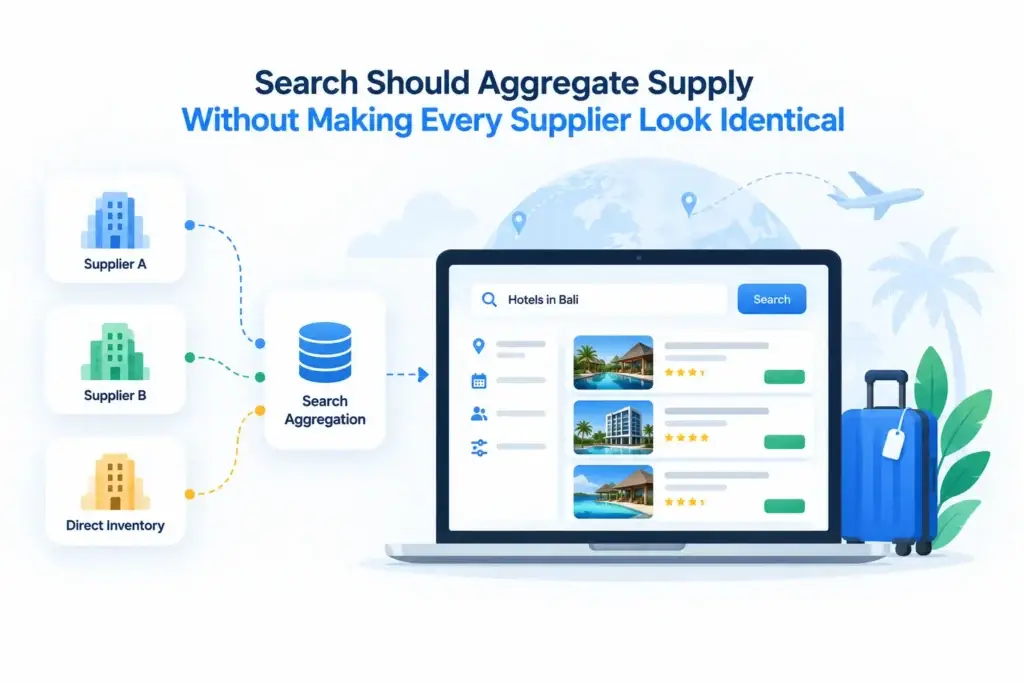
Travel search is not simply a database query.
A single request can trigger several external calls at once.
For example, a hotel search might query a primary supplier, a secondary supplier, and directly managed inventory. The platform then has to merge the results into a useful response.
The architecture therefore needs to deal with parallel requests, supplier latency, partial failures, duplicates, inconsistent naming, currency differences, and different cancellation conditions.
Waiting indefinitely for the slowest supplier is usually a poor traveler experience.
Search orchestration should define how long the platform waits, whether partial results can be displayed, how fallback sources are handled, and how late responses are treated.
Normalize Before Ranking
Supplier responses should normally be transformed into a common internal representation before ranking and presentation.
That representation might standardize properties such as supplier identifier, product identifier, destination, dates, availability, base rate, taxes, cancellation terms, currency, and booking requirements.
Normalization gives the search and booking layers a stable contract even when the external supply network changes.
Search Results Are Not Permanent Inventory
One of the most important architectural distinctions in travel is the difference between discovery data and bookable inventory.
A traveler may see a room at 10:03 AM and attempt to purchase it at 10:08 AM.
During those five minutes, the supplier may sell the last room or change the rate.
This means an OTA cannot blindly treat every search result as a guaranteed reservation.
Search caching can improve performance and reduce supplier API usage, but cached availability needs an appropriate lifetime. The closer the traveler gets to payment, the more important it becomes to revalidate critical information.
The platform may need to reconfirm availability, rate, cancellation conditions, traveler requirements, or other supplier rules before creating the final reservation.
The Pricing Layer Sits Between Supplier Cost and Traveler Price
Supplier inventory often arrives with a net or base price.
The amount displayed to the traveler may additionally depend on taxes, markups, service fees, promotions, commissions, currency rules, or market-specific commercial logic.
That makes pricing an architectural responsibility rather than merely a frontend calculation.
Critical values should be calculated or validated by trusted backend systems.
Otherwise, the OTA risks situations where the search page displays one amount, checkout calculates another, the payment provider receives a third, and the supplier expects a fourth.
Pricing logic should also reflect the online travel business model being operated. Revenue based on commissions, markups, service fees, supplier agreements, or other commercial structures can influence how rates are calculated, transactions are reconciled, and booking revenue is recorded.
A dependable pricing layer should be able to explain how the final payable amount was produced.
This also makes reconciliation easier later.
The Booking Engine Is an Orchestrator, Not Just a Booking Table
A booking engine is often misunderstood as the database where reservations are stored.
Its more important responsibility is orchestration.
When the traveler clicks the final booking button, several things may need to happen in a controlled sequence: validate the session, confirm the selected offer, recheck availability, establish the final amount, create an internal order, process or authorize payment, send the reservation request to the supplier, receive the supplier reference, update booking state, and trigger fulfillment.
The order can vary depending on the supplier and payment model.
What matters is that the platform knows exactly which steps have completed.
Use Explicit Booking States
A booking should not simply be true or false.
Real reservation workflows contain intermediate conditions.
A transaction might be:
Created → Payment Pending → Payment Confirmed → Supplier Pending → Confirmed → Fulfilled
Another might become:
Created → Payment Confirmed → Supplier Failed → Refund Pending → Refunded
Explicit states make failures visible and recoverable.
The booking engine also connects many of the operational travel platform features that users and administrators interact with. Search, booking management, payments, supplier connectivity, and administrative controls may appear as separate capabilities, but the underlying architecture has to keep their data and states synchronized.
Without them, support teams end up trying to infer what happened from payment records, supplier dashboards, emails, and application logs.
Payments and Reservations Need Separate State Machines
This is one of the most important architectural principles in an OTA.
Payment success and booking success are different events.
A payment provider controls the financial transaction.
A supplier controls whether the requested travel inventory can actually be reserved.
Those systems can disagree temporarily.
Consider this sequence:
The traveler chooses a hotel. Availability is revalidated. The OTA creates an order. The gateway confirms payment. The hotel supplier then times out.
The system cannot safely tell the traveler the reservation is confirmed merely because money was collected.
It needs to determine whether the supplier eventually confirms, whether the reservation can be retried safely, whether operations need to intervene, or whether the transaction should move toward refund.
Idempotency Matters
Travel transactions are particularly vulnerable to retries.
Travelers double-click buttons. Mobile networks reconnect. Gateways resend callbacks. Supplier requests time out after the supplier has already processed them.
Critical operations therefore need protection against unintended duplication.
A retry should not casually create a second payment, reservation, or refund.
Supplier Failure Should Be an Expected Architecture Scenario
Third-party services fail.
That does not necessarily mean the OTA itself should fail completely.
Supplier calls can become slow, authentication can expire, rate limits can be reached, responses can be malformed, or an entire service can temporarily become unavailable.
The architecture should decide in advance what happens in each case.
For search, the system may be able to continue with other sources.
During booking, the options are more constrained because the traveler has selected a specific offer.
The booking engine needs to know whether a request can be retried safely, whether supplier status can be queried independently, and when a reservation should move into manual review rather than automatically retrying.
This is why supplier fallback during search and supplier recovery during booking should not be treated as identical problems.
Fulfillment Begins After Reservation Confirmation
Booking confirmation is not always the final technical step.
Depending on the travel product, the traveler may still need a ticket, voucher, itinerary, supplier reference, invoice, pickup instructions, policy document, or other travel documentation.
That is the fulfillment layer.
It consumes the confirmed booking state and turns it into something operationally usable by the traveler.
Fulfillment may also trigger email, SMS, push notifications, document generation, CRM updates, analytics events, or downstream partner processes.
Many of these tasks do not need to block the booking request itself.
Queues and background workers are therefore useful for work such as confirmation emails, document generation, supplier synchronization, notifications, and other asynchronous tasks.
The booking engine can complete the critical reservation path while secondary processes continue reliably in the background.
Post-Booking Architecture Is Part of the Booking Engine
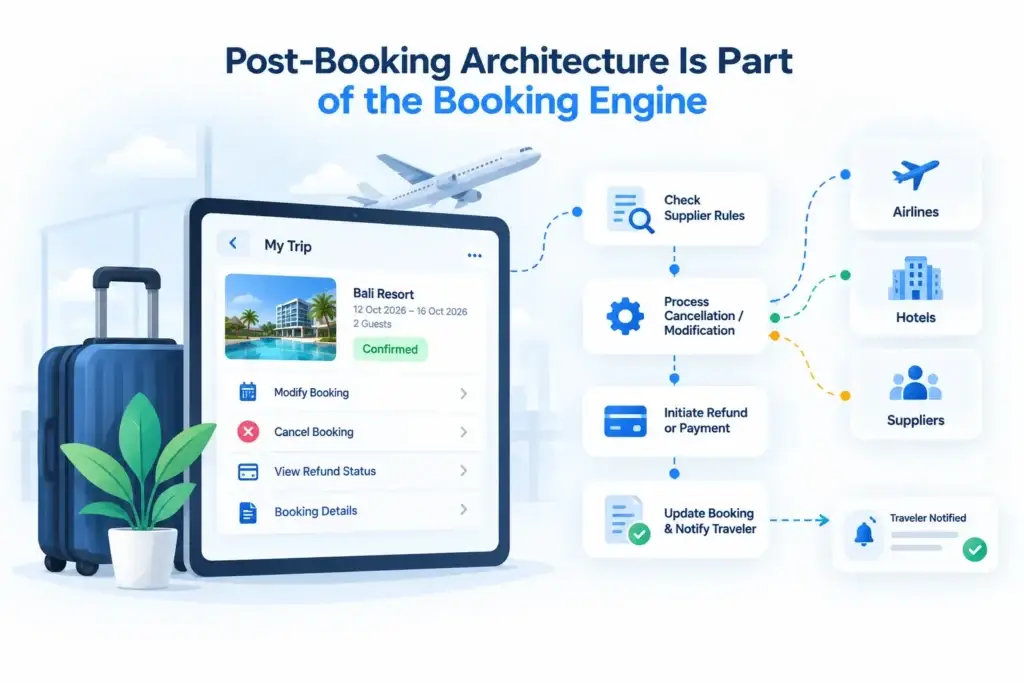
A travel platform cannot be designed only around successful new reservations.
Travel changes after purchase.
Customers cancel. Flights move. Hotels modify availability. Suppliers reject amendments. Refunds take time. Support teams intervene.
The architecture therefore needs to model post-booking operations deliberately.
A cancellation flow might need to retrieve the latest supplier rules, determine the eligible refund, request supplier cancellation, update the internal reservation, initiate the appropriate payment action, record the change, and notify the traveler.
The same principle applies to modifications.
The OTA needs to know which system is authoritative for each part of the change and what should happen if only part of the process succeeds.
Caching Helps Search Performance, but Booking Requires Freshness
Travel search can generate a high volume of external API calls.
Caching popular routes, destinations, property metadata, static content, or short-lived search responses can reduce latency and supplier usage.
But caching needs to be selective.
Property descriptions may remain useful for hours or days.
Room availability may become inaccurate in minutes.
A final price may need to be revalidated immediately before purchase.
Architecture should therefore assign freshness rules according to the business meaning of the data rather than applying one cache duration everywhere.
Queues Keep Slow Work Outside the Critical Booking Path
Not every task should happen while the traveler waits for the browser to respond.
Background processing is useful for supplier synchronization, notification delivery, document generation, analytics, reconciliation, scheduled inventory refreshes, and other work that can happen asynchronously.
Queues also make retry behavior easier to control.
If an email provider fails temporarily, for example, the reservation itself should not necessarily fail.
But moving work to a queue does not mean ignoring failures. Operations teams still need visibility into failed jobs, repeated retries, and tasks that remain unresolved.
Observability Connects Technical Failures to Booking Outcomes
An OTA can have thousands of technically successful API requests while still creating poor booking outcomes.
Monitoring therefore needs context.
Useful signals include supplier response time, supplier error rates, searches returning no inventory, payment failures, payment-to-confirmation time, unresolved bookings, failed callbacks, refund delays, queue failures, and abnormal differences between payment and reservation states.
Logs should also make important transactions traceable through the architecture.
A support or engineering team investigating one reservation should ideally be able to connect the internal order, payment reference, supplier request, supplier confirmation, fulfillment events, and subsequent changes without manually searching several unrelated systems.
Architecture Decisions Founders Should Make Before Development
Architecture discussions often become debates about programming languages too early.
Framework choice matters, but it comes after more fundamental decisions.
Founders should first define where inventory will come from, how many supplier sources may exist per category, which travel products will be sold, whether inventory will also be managed directly, how rates are transformed, how payments are routed, what happens after supplier failure, which booking states are required, and how cancellations and refunds will be handled.
These architectural choices can directly influence travel platform development costs. A platform requiring multiple supplier integrations, complex payment routes, additional booking workflows, infrastructure changes, or market-specific customization can involve a different implementation scope from a more standardized OTA deployment.
Architecture should also be part of the evaluation when selecting a travel platform development partner. Founders should ask how supplier integrations, inventory normalization, booking states, payment workflows, failure recovery, fulfillment, and post-launch technical responsibilities will be handled—not only which customer-facing screens can be delivered.
Only then can the engineering team make informed decisions about application structure, databases, queues, caching, deployment, and scaling.
Supply Control
Can suppliers be added, replaced, prioritized or temporarily disabled without rebuilding the booking journey?
State Control
Can the platform distinguish payment, supplier confirmation, fulfillment, cancellation and refund states?
Failure Recovery
Does the system know what to do when a supplier, gateway, callback or background process fails?
Operational Visibility
Can teams trace one booking across the internal order, payment, supplier request and fulfillment lifecycle?
Ready-Made Architecture vs Building Every Layer From Zero
Understanding the architecture does not mean every founder needs to engineer each component from the beginning.
A business with unusual supplier workflows, proprietary inventory, highly specialized fulfillment, or complex enterprise requirements may need substantial custom engineering.
Other businesses primarily need a proven foundation that already connects traveler journeys, booking logic, supplier integrations, payments, administration, and fulfillment—and can then be configured or extended around their market.
Founders comparing a ready-made foundation with a ground-up build can also review how travel platform scripts, features, and pricing differ across implementation approaches. This provides a commercial comparison alongside the architectural considerations covered here.
That is where Miracuves‘ online travel agency platform becomes relevant. Instead of treating the architecture as a collection of disconnected modules, the ready-made foundation brings the major booking layers together while allowing the business to work on branding, supplier relationships, launch-market configuration, and required customization.
For suitable ready-made deployments, Miracuves offers a 6-working-day solution delivery path. Additional integrations and custom requirements should be scoped separately rather than assuming every architecture change fits inside that standard deployment window.
Founders considering different marketplace concepts can also explore Miracuves’ travel booking solutions to see how different travel platform models can be approached according to their target market, inventory strategy, booking journey, and operating requirements.
The practical question for founders is therefore not simply “Should we build or buy?”
It is:
Which parts of our OTA create unique business value, and which parts are established infrastructure we do not need to reinvent?
Common OTA Architecture Mistakes to Avoid
Building Supplier Logic Directly Into the Frontend
Supplier-specific authentication, response formats and booking rules should remain behind controlled integration layers rather than spreading through customer-facing applications.
Treating Search Availability as Guaranteed Inventory
Travel inventory changes quickly. Critical availability, price and booking conditions may need validation again before reservation.
Using One Status for Payment and Booking
Payment and supplier confirmation are separate events. Combining them makes partial failures, refunds and reconciliation considerably harder to manage.
Designing Only for the Successful Booking Path
Supplier timeouts, duplicate callbacks, failed payments, cancellations, amendments and refunds need explicit architecture too.
Choosing the Stack Before Defining the Booking Model
Programming languages cannot compensate for unclear inventory ownership, supplier routing, booking states, payment rules and fulfillment responsibilities.
Final Thoughts
The architecture behind an online travel agency is ultimately an exercise in coordinating systems that do not fully control one another.
Suppliers control inventory.
Payment providers control financial transactions.
The OTA controls orchestration.
That orchestration layer has to turn changing supply, external APIs, pricing rules, payment events, reservation responses, and fulfillment processes into one understandable booking journey for the traveler.
A strong architecture therefore does more than process the successful path.
It knows what state every reservation is in, which system is authoritative at each stage, what can safely be retried, what should happen when an external provider fails, and how operations teams can recover when automation reaches an uncertain state.
For founders evaluating a travel platform, those architectural questions are often more revealing than the programming language written on the technology-stack diagram.
FAQs
What are the main components of an online travel agency architecture?
A typical OTA architecture includes supplier integrations, search and inventory aggregation, normalization, pricing logic, a booking engine, payment processing, booking-state management, fulfillment, administration, caching, queues, monitoring, and post-booking workflows.
What does a booking engine do in an OTA?
A booking engine coordinates the reservation lifecycle. It validates the selected offer, maintains booking state, communicates with suppliers, connects reservation events with payment status, stores references, and triggers confirmation or fulfillment processes.
Why do OTAs need multiple supplier APIs?
Different suppliers can provide different travel products, geographic coverage, prices, or availability. An OTA may combine several sources to expand inventory or reduce dependence on one provider.
What is inventory normalization?
Inventory normalization converts different supplier data structures into a consistent internal format. This allows the OTA’s search, pricing, booking, and administration layers to work with stable internal models instead of supplier-specific formats.
Should OTA search results be cached?
Some search information can be cached to improve speed and reduce external API calls, but freshness requirements vary. Availability and prices may need shorter cache periods or revalidation before purchase.
What happens when payment succeeds but the supplier rejects the booking?
Some search information can be cached to improve speed and reduce external API calls, but freshness requirements vary. Availability and prices may need shorter cache periods or revalidation before purchase.
Why is idempotency important in travel booking?
Networks, gateways, suppliers, and users can repeat requests. Idempotent processing helps prevent a repeated request from unintentionally creating another charge, reservation, or refund.
Can a ready-made OTA platform reduce development time?
A ready-made foundation can reduce the amount of standard booking infrastructure that needs to be built from scratch. The actual delivery timeline still depends on supplier connections, payment integrations, market configuration, branding, and custom requirements.
Miracuves is an independent software development company. We are not affiliated with, connected to, sponsored by, or endorsed by any company or product named in this article.
Terms such as “X Clone” are used descriptively. It is how the software industry refers to building a platform with functionality comparable to a known service, and how clients search for it.
The entire design and codebase of our products is built by our own team. Our products contain no code, design, graphics, or content originating from any third-party website or applications.
All third-party names and marks referenced in this article are the property of their respective owners, referenced solely to identify the services discussed.



