Key Takeaways
- An online travel agency platform connects travelers with flights, hotels, transfers, cars, activities, tours, packages, and other travel inventory through integrated booking workflows.
- The platform coordinates search, live inventory, supplier APIs, data normalization, pricing, availability revalidation, checkout, payment, booking, and supplier confirmation.
- Payment success and booking confirmation should be treated as separate states because a supplier reservation can fail even after a successful payment.
- Post-booking management is essential for cancellations, refunds, itinerary access, booking changes, support, and supplier communication.
- A scalable OTA needs more than a booking interface; it requires reliable supplier integrations, clear booking states, caching, queues, monitoring, reconciliation, and strong administrative controls.
Platform Signals
- Supplier responses should be normalized into consistent internal formats for properties, rooms, fares, prices, availability, policies, and supplier references.
- Pricing engines may apply taxes, supplier fees, markups, commissions, currency conversion, promotions, coupons, and membership or corporate pricing.
- Search results may require short-term caching, but selected inventory should be revalidated before the final booking decision.
- Booking systems should support states such as pending, confirmed, failed, canceled, refund pending, and refunded to keep operational and financial workflows traceable.
- Background queues can handle confirmation emails, vouchers, supplier synchronization, notifications, refunds, analytics, reconciliation, and retry jobs without blocking the main booking experience.
Real Insights
- An OTA is fundamentally an orchestration system connecting travelers, suppliers, payment providers, booking engines, agents, and operators.
- Adding more suppliers does not automatically improve the platform because every integration introduces additional mapping, timeout, reconciliation, and support requirements.
- Failed, delayed, changed, canceled, and refunded bookings need as much architectural attention as successful reservations.
- A reliable foundation should be established before expanding into additional categories, suppliers, personalization, packages, loyalty, AI trip planning, or advanced monetization.
- The strongest OTA workflow is: search → connect suppliers → normalize inventory → apply pricing → revalidate → collect traveler details → process payment → create booking → confirm with supplier → generate itinerary → manage post-booking changes and refunds.
A traveler enters a destination, selects dates, taps Search, and within seconds sees hundreds of flights, hotels, transfers, cars, and activities.
It looks simple.
Behind that single search, however, an online travel agency platform may be communicating with multiple suppliers, requesting live availability, normalizing different data formats, calculating prices, applying business rules, sorting results, checking inventory again before payment, creating a reservation, waiting for supplier confirmation, and generating the final itinerary.
That is what makes an OTA more than a travel website.
It is an orchestration layer between travelers, suppliers, payment systems, booking engines, agents, and operators.
For founders, understanding this flow is important because travel platforms are not simply listing marketplaces. Availability can change in seconds, fares can expire, rooms can sell out, supplier APIs can time out, payments can succeed while a reservation fails, and cancellations may require synchronization across several systems.
A strong OTA therefore needs to control the complete journey:
Search → live inventory → pricing → revalidation → checkout → payment → booking → supplier confirmation → itinerary → post-booking management.
What Is an Online Travel Agency Platform?
An online travel agency platform is a digital system that helps users search, compare, reserve, pay for, and manage travel services.
Depending on the business model, it can support:
- Flights
- Hotels
- Holiday packages
- Car rentals
- Airport transfers
- Activities
- Tours
- Homestays
- Travel insurance
- Corporate travel
- Agent-assisted bookings
The platform itself does not necessarily own all of this inventory.
Instead, it may connect to:
- Airlines
- Hotel suppliers
- Global distribution systems
- Bed banks
- Tour operators
- Car rental suppliers
- Activity providers
- Local inventory partners
- Aggregators
- Direct hotel contracts
The OTA becomes the layer that brings these sources together into one searchable traveler experience.
The Basic OTA Booking Journey
At a high level, the booking journey looks like this:
- Traveler enters search criteria.
- Platform validates the request.
- Search service queries relevant suppliers.
- Suppliers return inventory and pricing.
- Platform normalizes the responses.
- Search results are filtered and ranked.
- Traveler selects an option.
- Platform revalidates availability and price.
- Traveler enters details.
- Payment is initiated.
- Booking request is sent to the supplier.
- Supplier returns a reservation result.
- Platform creates the final booking record.
- Confirmation and itinerary are sent.
- Booking remains available for future changes, cancellation, refund, or support.
Each step can involve several systems.
Step 1: Traveler Search Begins the Workflow
A traveler may search using:
- Origin
- Destination
- Check-in date
- Check-out date
- Departure date
- Return date
- Number of travelers
- Number of rooms
- Cabin class
- Hotel star category
- Price range
- Amenities
- Cancellation preference
- Car type
- Activity category
The frontend sends these inputs to the platform’s search API.
The search layer should validate the request before contacting suppliers.
For example, it may check:
- Are dates valid?
- Is the destination recognized?
- Is traveler count supported?
- Does the supplier cover this market?
- Is the requested category currently enabled?
Once validated, the request moves to the supplier-integration layer.
Step 2: The Platform Requests Live Inventory
Travel inventory changes constantly.
A hotel room available five minutes ago may already be sold. A flight fare may change between search and checkout. A transfer supplier may have limited vehicles. An activity may have a fixed number of available seats.
That is why an OTA needs live or near-live inventory.
The platform can request inventory from:
- Direct supplier APIs
- GDS connections
- Travel aggregators
- Hotel wholesalers
- Internal inventory
- Local supplier dashboards
One traveler search may trigger several supplier requests at the same time.
For example:
Hotel search
Traveler request
→ Supplier A
→ Supplier B
→ Direct hotel inventory
→ Internal contracted inventory
The OTA then receives several different response formats.
That creates the next challenge: normalization.
Step 3: Supplier Data Must Be Normalized
Not every supplier describes travel inventory in the same way.
One hotel API may return:
room_name
Another may return:
roomType
Another may return:
accommodation_unit
The platform cannot expose these inconsistencies to users.
It needs an internal normalized format.
For example:
property_id
property_name
room_type
board_type
currency
base_rate
taxes
final_rate
available_units
cancellation_policy
supplier_id
supplier_reference
The same principle applies to flight inventory, transfers, activities, and packages.
Normalization lets the OTA combine multiple suppliers into one consistent user interface.
Step 4: Pricing Rules Are Applied
Supplier price is not always the final traveler price.
Before displaying an option, the platform may need to apply:
- Taxes
- Supplier fees
- Platform markup
- Agent markup
- Currency conversion
- Service fees
- Promotions
- Coupons
- Membership discounts
- Corporate pricing
- Package discounts
Founders planning markups, commissions, service fees, package margins, and supplier earnings can review the travel booking platform business model to understand how monetization connects with booking operations.
A simplified pricing flow can look like:
Supplier rate + taxes + configured margin − eligible discount = traveler price
The important part is traceability.
The platform should know exactly how the displayed price was calculated so administrators can later reconcile bookings, refunds, commissions, and supplier settlements.
Step 5: Search Results Are Ranked and Displayed
Once supplier data is normalized and priced, the platform can display results.
Travelers may sort or filter by:
- Lowest price
- Recommended
- Rating
- Distance
- Duration
- Departure time
- Arrival time
- Amenities
- Cancellation policy
- Supplier availability
- Popularity
- Package value
The ranking logic should balance business objectives with traveler usefulness.
A result should not rank highly only because it has the largest margin if it is poorly matched to the traveler’s request.
Search Architecture at a Glance
What Happens During an OTA Search?
| Stage | Platform Action | Why It Matters |
|---|---|---|
| Search Input | Collect destination, dates, travelers, rooms, filters, or category details. | Defines what inventory should be requested. |
| Supplier Request | Send requests to appropriate supplier APIs, aggregators, or internal inventory sources. | Retrieves available travel products. |
| Normalization | Convert supplier-specific responses into one internal data format. | Creates a consistent traveler experience. |
| Pricing | Apply taxes, margins, commissions, discounts, and currency rules. | Produces the traveler-facing price. |
| Ranking | Sort and filter results based on traveler preferences and platform logic. | Helps users find relevant options faster. |
| Display | Show price, availability, policies, photos, details, and booking options. | Supports comparison and purchase decisions. |
Step 6: Availability and Price Should Be Revalidated
This is one of the most important stages.
Search results can become stale.
The traveler may have spent several minutes comparing rooms or flights. During that time:
- The last room may have sold.
- The fare class may have closed.
- Supplier price may have changed.
- Cancellation policy may have changed.
- A promotion may have expired.
Before checkout, the platform should revalidate the selected option.
The revalidation request asks the supplier:
Is this exact product still available at this price and under these conditions?
Possible outcomes include:
- Available at the same price
- Available at a different price
- Available with changed conditions
- No longer available
- Supplier timeout
- Supplier error
The platform should communicate changes clearly rather than silently charging a different amount.
Step 7: Traveler and Booking Details Are Collected
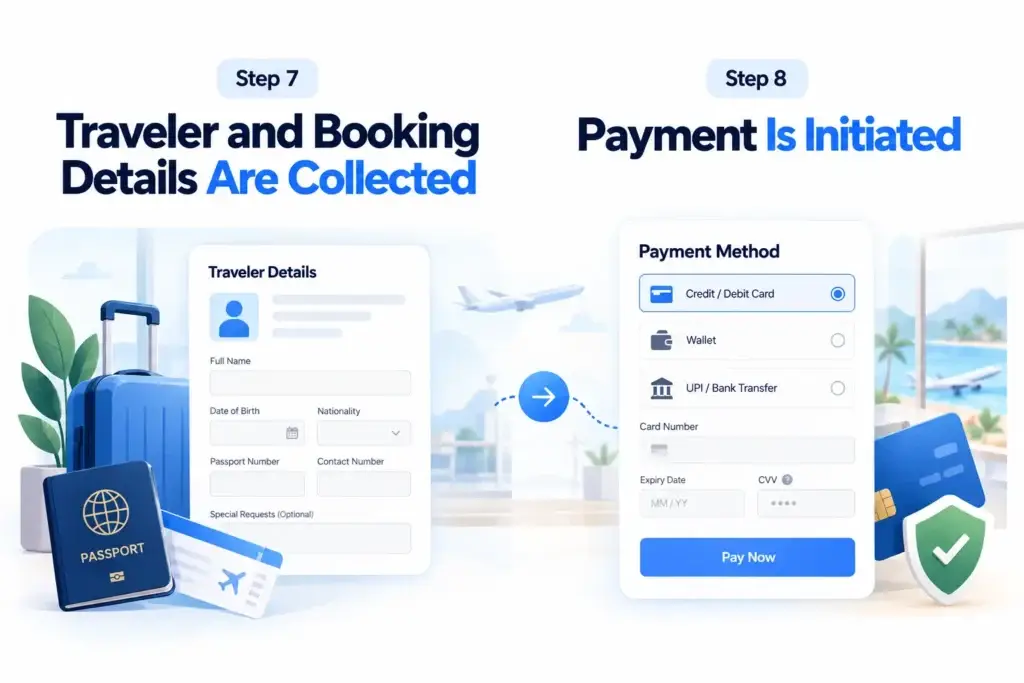
Once availability is confirmed, the platform collects the information required to create the reservation.
Depending on the travel product, this can include:
- Traveler name
- Date of birth
- Gender where required
- Passport details
- Nationality
- Contact information
- Room guest details
- Special requests
- Loyalty number
- Billing information
- Emergency contact
- Agent reference
- Corporate account details
The system should validate this information before creating the booking.
Errors here can cause supplier rejection even when inventory is available.
Step 8: Payment Is Initiated
Payment and reservation are closely connected, but they are not the same event.
The payment flow may include:
- Create payment intent.
- Show checkout.
- User authorizes payment.
- Payment gateway processes the transaction.
- Platform verifies the gateway response.
- Booking service continues based on the configured workflow.
Depending on the architecture, the platform may:
- Authorize payment before supplier booking
- Capture payment after supplier confirmation
- Use a wallet
- Use an agent credit balance
- Allow partial payment
- Support multiple payment methods
Because checkout, traveler data, supplier APIs, and booking records are tightly connected, founders should also plan travel booking platform security across payments, access controls, API communication, and post-booking operations.
The important principle is that the system must know the status of both payment and booking independently.
Payment Success Does Not Always Mean Booking Success
Consider this scenario:
- User pays successfully.
- Platform sends booking request.
- Supplier inventory disappears.
- Supplier rejects the reservation.
The platform now has:
Payment = successful
Booking = failed
This requires a controlled recovery workflow.
Possible actions include:
- Automatic payment void
- Automatic refund
- Manual review
- Alternative inventory suggestion
- Support escalation
Treating payment success as automatic booking confirmation is a serious architecture mistake.
Step 9: The Booking Request Is Sent to the Supplier
Once all required conditions are satisfied, the OTA sends a booking request.
The supplier may require:
- Selected inventory ID
- Rate key
- Traveler details
- Payment token or payment status
- Booking reference
- Contact details
- Special requests
- Currency
- Agency credentials
The supplier then processes the reservation.
Possible responses include:
- Confirmed
- Pending
- Failed
- On request
- Timed out
The platform should map each supplier response to its own internal booking states.
Step 10: Supplier Confirmation Is Received
A booking should only be displayed as confirmed when the relevant confirmation conditions have been met.
The supplier may return:
- Reservation ID
- Hotel confirmation number
- Ticketing reference
- PNR
- Voucher ID
- Supplier booking reference
- Cancellation conditions
- Confirmed price
- Traveler details
- Service details
The OTA stores these against its own internal booking record.
That gives the platform two important identifiers:
Internal booking ID — used by the OTA.
Supplier booking reference — used when communicating with the underlying supplier.
Booking Status Architecture
A practical booking system may use states such as:
Common OTA Booking States
| Status | Meaning | Typical Next Action |
|---|---|---|
| Pending | The reservation request exists but final confirmation has not been received. | Wait for supplier response or retry safely. |
| Confirmed | The supplier has accepted the reservation and returned confirmation details. | Generate itinerary and notify traveler. |
| Failed | The reservation could not be created. | Release payment authorization, refund, retry, or offer alternatives. |
| Canceled | The reservation has been canceled according to applicable rules. | Calculate refund and update supplier records. |
| Refund Pending | Cancellation is complete but the financial reversal is still processing. | Track gateway and supplier refund status. |
| Refunded | The applicable refund has been completed. | Close financial workflow and notify traveler. |
Clear booking states prevent support teams, travelers, suppliers, and finance teams from seeing different versions of the same reservation.
Step 11: Confirmation and Itinerary Are Generated
After supplier confirmation, the traveler needs a clear record.
The confirmation may include:
- Booking ID
- Supplier reference
- Traveler details
- Hotel or flight details
- Dates
- Check-in information
- Fare or room type
- Payment summary
- Cancellation rules
- Contact information
- Voucher
- Ticket details
- Transfer instructions
- Activity meeting point
Confirmation can be delivered through:
- App
- Website account
- SMS
- Push notification
The traveler should also be able to reopen the itinerary later.
Step 12: Post-Booking Management Begins
Booking confirmation is not the end of the OTA workflow.
Travelers may later need to:
- View booking
- Download voucher
- Resend confirmation
- Change traveler details
- Cancel reservation
- Request refund
- Contact support
- Check flight status
- Add another travel service
- Rebook a similar trip
The platform therefore needs a persistent booking-management layer.
This is also where operators need visibility into supplier responses, payments, refunds, support cases, and transaction history.
How Cancellations and Refunds Work
Cancellation is often more complex than booking.
The platform must first determine:
- Is cancellation allowed?
- Is it fully refundable?
- Is there a deadline?
- What supplier penalty applies?
- Does the platform charge a service fee?
- Has payment already been settled?
- Does the supplier require an API cancellation request?
A simplified cancellation flow is:
Traveler requests cancellation
→ Platform retrieves current policy
→ Cancellation amount is calculated
→ Traveler accepts terms
→ Supplier cancellation is submitted
→ Supplier confirms cancellation
→ Refund amount is calculated
→ Payment refund begins
→ Booking status updates
The user-facing cancellation status and financial refund status should remain separate.
Why Supplier APIs Are Critical
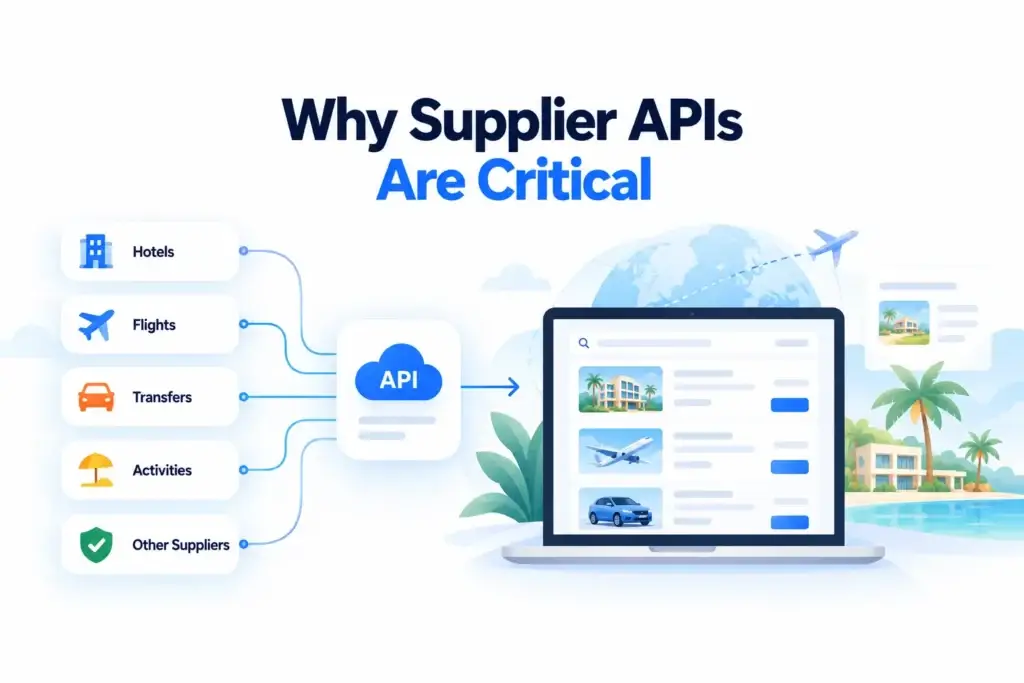
Supplier integrations give the OTA access to inventory it does not own directly.
A supplier API may provide:
- Availability
- Pricing
- Fare rules
- Room types
- Images
- Amenities
- Cancellation policy
- Booking creation
- Booking status
- Cancellation
- Refund status
However, connecting an API is only the beginning.
The platform also needs to manage:
- Authentication
- Rate limits
- Timeouts
- Failed requests
- Mapping
- Duplicate results
- Currency conversion
- Logging
- Retries
- Supplier priority
- Reconciliation
Founders should think of supplier connectivity as an ongoing operational layer, not a one-time development task.
Why Caching Matters in OTA Search
Travel search can be expensive.
If hundreds of users repeatedly request the same destination and dates, sending every request directly to every supplier may create:
- Higher API usage
- Slower results
- Supplier rate-limit problems
- More infrastructure load
Caching can help reduce repeated requests.
But travel inventory is time-sensitive.
The platform should decide carefully:
- What can be cached?
- For how long?
- Which prices require revalidation?
- Which availability data must always be live?
Search results can often tolerate short caching windows. Final booking decisions usually require fresh validation.
Why Queues Matter
Not every OTA process should block the traveler screen.
Background queues can handle tasks such as:
- Confirmation emails
- SMS
- Voucher generation
- Supplier synchronization
- Refund processing
- Analytics updates
- Notification sending
- Reconciliation
- Retry jobs
This makes the booking flow more resilient.
If an email provider is temporarily unavailable, the booking itself should not automatically fail.
Founder Decision Signals
Inventory Strategy
If your business depends on broad international inventory, supplier and aggregator integrations should be a core architecture priority. If the platform focuses on local travel, direct supplier onboarding may matter more.
Search Speed
If multiple suppliers are queried for every search, plan normalization, caching, timeout rules, and partial-result handling before adding more inventory sources.
Booking Reliability
If prices or availability change quickly, build revalidation into the checkout journey instead of assuming search results remain valid.
Operational Control
If support teams will handle failed bookings, refunds, supplier disputes, or manual confirmations, give the admin dashboard enough information to trace every booking state.
For a deeper technical view of supplier APIs, search orchestration, booking engines, payments, databases, and deployment planning, this guide on travel booking platform architecture can support the next stage of product planning.
Startup Checklist for an OTA Booking Flow
Before launching, founders should confirm:
- Which travel categories launch first?
- Which suppliers provide inventory?
- Are supplier APIs live or cached?
- How will duplicate listings be handled?
- How will supplier data be normalized?
- Where are markups and commissions applied?
- When is inventory revalidated?
- When is payment authorized?
- When is payment captured?
- What happens when payment succeeds but booking fails?
- Which booking states exist?
- How are supplier references stored?
- How are vouchers generated?
- How do cancellations work?
- How are refunds tracked?
- Which operations require queues?
- What should the admin dashboard show?
- How are agent bookings handled?
- How are supplier errors logged?
- Which reports are required for reconciliation?
The goal is not only to make successful bookings work.
Founders planning traveler flows, supplier connectivity, booking states, payments, agent access, refunds, and operator controls can also review the travel booking platform features needed to support a scalable OTA.
The goal is to make failed, delayed, canceled, changed, and refunded bookings manageable too.
If you are comparing launch-ready approaches, this guide on ready-made travel booking platform options explains how features, scripts, pricing, and rollout scope can be evaluated before development.
Mistakes Founders Should Avoid
Using Search Results as Final Availability
Travel inventory can change quickly. Revalidate the selected option before treating the displayed price and availability as final.
Treating Payment Success as Booking Confirmation
A payment can succeed while the supplier booking fails. Keep payment and reservation states separate and define recovery workflows.
Connecting Too Many Suppliers Too Early
More APIs do not automatically create a better platform. Each supplier adds mapping, support, reconciliation, timeout, and failure-handling complexity.
Ignoring Failed and Pending States
The happy path is only part of travel operations. Pending reservations, API timeouts, refunds, cancellations, and manual reviews need clear workflows.
How Miracuves Helps Founders Launch Online Travel Agency Platforms
Miracuves helps founders and travel businesses launch ready-made and white-label OTA platforms with multi-category booking, supplier integration layers, traveler experiences, agent workflows, payment processing, booking management, and operator dashboards.
For founders evaluating a launch-ready foundation, Miracuves’ online travel booking platform can support workflows across flight, hotel, car, and tour search, supplier connectivity, checkout, confirmation, and administration.
Businesses exploring multiple travel-platform models can also review Miracuves’ travel booking solutions for related ready-made options.
If your product requires AI-assisted itinerary discovery, intelligent trip planning, or modern booking workflows, Miracuves’ travel booking platform software provides another relevant path.
When the standard ready-made scope fits the rollout, Miracuves can support 6-day deployment, including the ready-made platform foundation, branding, supplier/payment setup within agreed scope, QA, and deployment preparation.
Final Thoughts
An online travel agency platform looks simple from the traveler’s side because the complexity is hidden behind the interface.
The user sees a search box.
The platform sees suppliers, availability, pricing rules, mapping, APIs, cache, payment states, booking states, confirmations, refunds, queues, and reconciliation.
That is why a reliable OTA is not just a website with travel listings.
It is a transaction and orchestration system.
Founders who understand the full journey—from the first search request to the final confirmed itinerary—can make better decisions about suppliers, architecture, pricing, payments, support, and launch scope.
Start with a reliable booking flow.
If you are comparing budget and rollout scope, review Miracuves’ guide on travel booking platform development cost. For vendor evaluation, this page on choosing a travel platform development partner can help you understand what to check before selecting a team.
Then add more suppliers, categories, personalization, packages, agents, loyalty, AI trip planning, and advanced monetization only when the operational foundation is ready.
FAQs
What is an online travel agency platform?
An online travel agency platform is a digital system that allows travelers to search, compare, book, pay for, and manage travel services such as hotels, flights, cars, transfers, tours, and activities.
How does an OTA get live hotel and flight inventory?
OTAs can connect with direct suppliers, travel aggregators, hotel wholesalers, airline systems, GDS providers, or their own contracted inventory databases.
Why does an OTA check availability again before booking?
Search results can become outdated while a traveler is comparing options. Revalidation confirms that the selected inventory, price, and conditions are still available before the reservation proceeds.
What happens if the price changes before checkout?
The platform should show the updated price clearly and ask the traveler to accept it rather than automatically charging a different amount.
Is payment confirmation the same as booking confirmation?
No. Payment and reservation are separate processes. A payment can succeed while a supplier booking fails, so the platform should maintain independent payment and booking statuses.
What information does a supplier return after confirmation?
Depending on the product, a supplier may return a reservation ID, PNR, voucher number, ticket reference, cancellation conditions, confirmed price, and service details.
How do cancellations work on an OTA platform?
The platform checks the applicable policy, calculates penalties and refundable amounts, submits cancellation to the supplier, updates the reservation status, and then processes or tracks the financial refund.
Why are queues important in travel booking systems?
Queues allow non-blocking work such as email delivery, vouchers, notifications, supplier synchronization, retries, refund processing, and analytics to run without delaying the main booking flow.
Can an OTA use multiple suppliers?
Yes. Many platforms connect multiple inventory sources. However, each additional supplier requires normalization, timeout handling, duplicate management, reconciliation, monitoring, and support processes.
Can Miracuves help launch an OTA platform?
Yes. Miracuves offers ready-made travel platforms with booking engines, supplier integration capability, traveler and agent workflows, payment support, admin controls, and full source code. Ready-made deployments can follow a 6-working-day launch process when the standard scope and required client accounts/assets are ready.
Miracuves is an independent software development company. We are not affiliated with, connected to, sponsored by, or endorsed by any company or product named in this article.
Terms such as “X Clone” are used descriptively. It is how the software industry refers to building a platform with functionality comparable to a known service, and how clients search for it.
The entire design and codebase of our products is built by our own team. Our products contain no code, design, graphics, or content originating from any third-party website or applications.
All third-party names and marks referenced in this article are the property of their respective owners, referenced solely to identify the services discussed.