Key Takeaways
- A Teladoc-like app needs patient, doctor, and admin flows.
- Video consultation, booking, and payments are core features.
- Medical data security must be planned from the start.
- E-prescriptions and records improve patient experience.
- A focused launch scope helps reduce development risk.
Telemedicine Feature Signals
- Patients need signup, search, booking, chat, and video calls.
- Doctors need profiles, schedules, consultation tools, and earnings.
- Admins need control over doctors, patients, payments, and reports.
- Notifications help manage appointments and follow-ups.
- Secure storage is needed for prescriptions and health records.
Real Insights
- Telehealth apps need trust before user growth.
- Poor video quality can reduce consultation completion.
- Doctor verification helps protect patient safety.
- Clear pricing and refunds reduce support issues.
- Miracuves builds online doctor consultation apps with secure healthcare flows.
Building an App Like Teladoc is no longer just about adding video calls between doctors and patients. A serious online doctor consultation platform needs patient onboarding, doctor verification, appointment booking, video/audio/chat consultation, e-prescriptions, secure medical record handling, payments, admin control, and compliance-ready workflows.
Founders who want to build an app like Teladoc often also study platforms like Practo because both models connect patients, doctors, appointments, and online healthcare services. The difference is in the business focus. Teladoc is strongly associated with virtual consultation and remote care, while a Practo-style healthcare marketplace usually combines doctor discovery, clinic profiles, appointment booking, and consultation workflows.
This guide explains what it takes to build a telemedicine app like Teladoc, what features matter, how much development can cost, what compliance layers founders should plan for, and how Miracuves can help launch a healthcare marketplace platform faster with a ready-made, white-label foundation.Building an App Like Teladoc is no longer just about adding video calls between doctors and patients. A serious online doctor consultation platform needs patient onboarding, doctor verification, appointment booking, video/audio/chat consultation, e-prescriptions, secure medical record handling, payments, admin control, and compliance-ready workflows.
Founders who want to build an app like Teladoc often also study platforms like Practo because both models connect patients, doctors, appointments, and online healthcare services. The difference is in the business focus. Teladoc is strongly associated with virtual consultation and remote care, while a Practo-style healthcare marketplace usually combines doctor discovery, clinic profiles, appointment booking, and consultation workflows.
This guide explains what it takes to build a telemedicine app like Teladoc, what features matter, how much development can cost, what compliance layers founders should plan for, and how Miracuves can help launch a healthcare marketplace platform faster with a ready-made, white-label foundation.
What Is an App Like Teladoc?
An app like Teladoc is a telemedicine platform that allows patients to connect with licensed healthcare professionals remotely. Instead of visiting a clinic physically for every consultation, users can search for doctors, book appointments, share medical concerns, consult through video or audio calls, receive prescriptions, and manage follow-ups through a digital platform.
For founders, the opportunity is not simply “doctor video calling.” The real product is a healthcare access layer. It should reduce friction between patients and providers, help doctors manage consultations efficiently, and give platform operators enough admin control to manage users, doctors, appointments, payments, disputes, reports, and operational risk.
A strong telemedicine app like Teladoc may include patient mobile apps, doctor apps, web panels, admin dashboards, appointment scheduling, video consultation, chat, e-prescriptions, payment gateways, patient records, notifications, reporting, and compliance-ready data handling.
The more serious the healthcare model, the more important the backend becomes. A basic app can connect a patient and doctor, but a scalable healthcare marketplace needs verification, access control, appointment logic, refund workflows, medical record security, payout management, and trust-building systems.
Why Founders Are Investing in Online Doctor Consultation Apps
Online doctor consultation apps solve a real access problem. Patients want faster healthcare access. Doctors want better digital workflows. Clinics want a better way to manage appointments, follow-ups, remote consultations, and patient communication without depending only on physical visits.
For founders, this creates a practical business opportunity. A telemedicine app can serve local clinics, multi-specialty doctor networks, wellness providers, mental health professionals, chronic care programs, corporate healthcare plans, and regional healthcare marketplaces.
Patients benefit because they can consult doctors without unnecessary travel, waiting-room friction, or limited clinic hours. Doctors benefit because they can manage appointments, consultation queues, availability, prescriptions, and earnings from one system. Platform owners benefit because the model can support commissions, subscriptions, provider listing fees, corporate plans, and additional healthcare services.
The founder decision is not simply whether telemedicine is useful. The real decision is what kind of telehealth platform fits the target market. Some businesses need a simple online doctor consultation app. Others need a full healthcare marketplace with doctor discovery, clinic profiles, lab booking, pharmacy delivery, insurance flows, and admin-level operational control.
Read More: How Telehealth Software Development Improves Secure EHR Storage Systems
Teladoc Business Model: How Virtual Healthcare Platforms Work
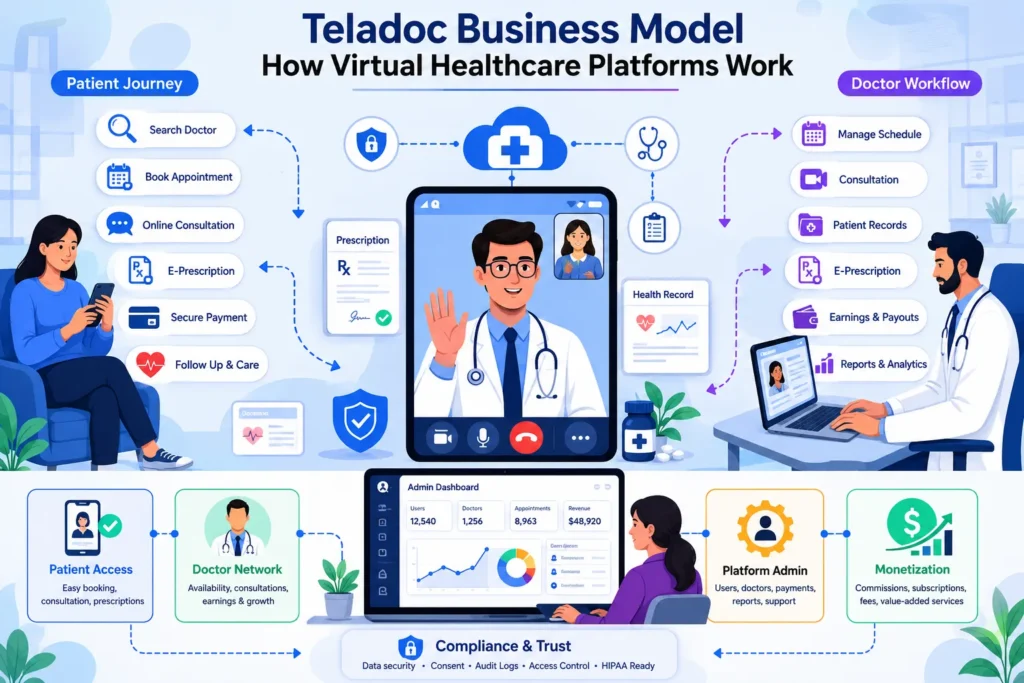
A Teladoc-like platform works by connecting patients with healthcare professionals through a managed digital system. The patient searches for a doctor or requests a consultation, selects a time slot or joins an available session, shares symptoms or medical records, pays the consultation fee, and connects through video, audio, or chat.
After the consultation, the doctor can add notes, issue an e-prescription, recommend follow-up care, or request further tests. The admin team manages doctors, users, payments, refunds, platform fees, reports, support tickets, and compliance logs.
The business model usually has several layers:
| Business Layer | How It Works | Founder Impact |
|---|---|---|
| Patient Access | Patients search, book, consult, pay, and receive prescriptions. | Improves healthcare convenience and user retention. |
| Doctor Network | Doctors manage availability, consultations, records, and earnings. | Quality doctor onboarding directly affects trust and supply strength. |
| Platform Admin | Admins manage users, doctors, appointments, fees, payments, disputes, and reports. | Strong admin control reduces operational dependency on developers. |
| Monetization | The platform earns through commissions, subscriptions, listing fees, and value-added healthcare services. | Multiple revenue streams make the model more scalable. |
| Compliance and Trust | Data security, consent, audit logs, and access controls protect sensitive workflows. | Trust becomes a core product requirement, not a secondary feature. |
This is why a Teladoc-like app should be planned as a healthcare operating system, not only a booking tool.
Teladoc vs Practo: What Founders Should Understand Before Building
A Teladoc-style app focuses strongly on virtual consultation, remote diagnosis support, and digital care delivery. A Practo-style platform usually combines doctor discovery, clinic profiles, appointment booking, patient reviews, location-based search, and consultation workflows.
This distinction matters because the app structure changes based on the business model.
If your goal is only online doctor consultation, your core investment will go into secure video consultation, doctor availability, e-prescriptions, patient records, payments, and follow-ups.
If your goal is a broader doctor appointment and healthcare marketplace, you also need clinic listings, search filters, doctor profiles, patient reviews, location-based discovery, provider onboarding, and marketplace-style admin workflows.
| Platform Direction | Core Focus | Best For |
|---|---|---|
| Teladoc-Style App | Remote consultation, virtual care, video/audio/chat appointments | Founders focused on online consultation and remote healthcare access |
| Practo-Style Platform | Doctor discovery, clinic profiles, appointment booking, reviews, consultations | Founders building a healthcare marketplace with doctors, clinics, and patients |
| Hybrid Healthcare Marketplace | Doctor booking, teleconsultation, pharmacy, lab booking, insurance, clinic tools | Founders planning a broader healthcare ecosystem |
If your goal is to launch a doctor appointment and consultation marketplace, explore the Miracuves Practo Clone App as a supporting solution path.
Core Features of an App Like Teladoc
Feature planning should begin with platform roles. A telemedicine app needs different workflows for patients, doctors, and admins. Optional modules can be added based on whether the business wants to support pharmacy delivery, lab booking, insurance, clinic management, or remote patient monitoring.
A strong App Like Teladoc should not simply copy features from an existing platform. It should connect each feature to a business function: patient trust, doctor productivity, platform control, monetization, and compliance readiness.
Patient App Features
The patient app is the main access point for users. It should make healthcare discovery, booking, consultation, payment, and follow-up simple.
Signup and login
Patients should be able to register using email, phone number, or social login depending on the target market. For healthcare platforms, onboarding should be simple but secure.
Doctor search
Users should be able to search doctors by specialty, availability, consultation type, rating, language, fee, and location where relevant.
Doctor profiles
A doctor profile should show qualifications, experience, specialization, consultation fee, availability, patient reviews, and supported consultation modes.
Appointment booking
Patients should be able to book instant or scheduled appointments based on doctor availability.
Medical history upload
Users should be able to upload reports, symptoms, past prescriptions, notes, and medical documents securely before consultation.
Video, audio, and chat consultation
The consultation experience should be stable, secure, and easy to use. Poor video quality or call drops can damage trust quickly in healthcare.
E-prescription
Doctors should be able to issue prescriptions digitally after consultation. Patients should be able to view, download, or share them where legally allowed.
Payments
Patients should pay consultation fees through secure payment gateway integration. The system should support refunds, failed payment handling, and invoices.
Reviews and ratings
Patient feedback helps improve doctor discovery and builds marketplace trust.
Follow-up reminders
Automated reminders for follow-up consultations, medicines, or test recommendations can improve care continuity and repeat usage.
Doctor App or Doctor Panel Features
The doctor app or doctor panel should help healthcare providers manage their digital practice efficiently. If the doctor workflow is weak, the platform will struggle to retain quality providers.
Profile management
Doctors should manage their qualifications, specialties, experience, consultation fees, languages, and profile visibility.
Availability calendar
Doctors should be able to set working hours, break times, consultation slots, emergency availability, and unavailable dates.
Consultation queue
Doctors should see upcoming, active, completed, cancelled, and missed consultations in one place.
Patient records
Doctors need secure access to patient notes, uploaded reports, symptoms, consultation history, and previous prescriptions.
Prescription management
E-prescription workflows help doctors issue structured care instructions after consultations.
Earnings dashboard
Doctors should be able to track completed consultations, platform deductions, payouts, refunds, and pending earnings.
Follow-up notes
Doctors should be able to add care notes and recommend follow-up appointments where needed.
Notifications
Doctors should receive alerts for new bookings, cancellations, upcoming sessions, patient uploads, and payout updates.
Admin Dashboard Features
The admin dashboard is one of the most important parts of a telemedicine app like Teladoc. It decides whether the platform operator can manage the business without depending on developers for every small operational change.
Doctor verification
Admins should review doctor documents, credentials, specialties, profile details, and approval status before allowing them to consult patients.
Patient management
Admins should monitor user accounts, activity, complaints, blocked accounts, and support requests.
Appointment monitoring
The platform should track scheduled, completed, cancelled, missed, refunded, and disputed consultations.
Commission control
Admins should configure platform fees, doctor payout logic, subscription plans, and promotional pricing.
Payments and refunds
Payment tracking, refund requests, doctor payouts, patient invoices, and failed transactions should be visible from one place.
Reports and analytics
Admins need data on bookings, revenue, doctor performance, patient activity, cancellation trends, consultation categories, and growth patterns.
Compliance logs
Audit trails and activity logs help support responsible healthcare operations.
Content management
Admins should manage specialties, FAQs, banners, help content, policies, and platform guidelines.
Dispute handling
Complaint workflows are important for failed consultations, refund requests, doctor issues, patient dissatisfaction, and support escalation.
Without strong admin control, a telemedicine platform becomes difficult to manage after launch.
Optional Advanced Healthcare Features
Once the core platform is stable, founders can add advanced modules based on market demand.
Optional features may include pharmacy delivery, lab test booking, insurance workflow support, AI symptom checker, remote patient monitoring, multi-language support, clinic management tools, electronic health record integration, corporate wellness plans, subscription care packages, and family health accounts.
These features should not be added only because competitors mention them. Each add-on should connect to a revenue stream, operational advantage, or user retention goal.
For example, pharmacy delivery can create post-consultation monetization. Lab booking can extend the care journey. Remote patient monitoring can support chronic care. Multi-language support can help regional expansion. Clinic management can make the platform more valuable for doctors and healthcare providers.
Global Cost of Development for a Teladoc-Like App
Teladoc-Like Online Doctor Consultation App Development — Market Price by Tech Stack
The tech stack affects video consultation quality, appointment booking, patient records, doctor availability, and payment flow in a Teladoc-like telemedicine app. PHP/Laravel works well for cost-effective healthcare app launches, Node.js/React.js supports real-time video, chat, and booking workflows, while Go microservices suit large healthcare platforms with high user traffic, multi-clinic operations, and stronger scalability needs.
PHP/Laravel is often the most practical choice for launching an app like Teladoc quickly and affordably. Node.js/Python fits better when real-time consultation flows and data-heavy healthcare activity become more important, while Go microservices are better suited for enterprise-scale telemedicine platforms with higher concurrency and more complex infrastructure needs.
These values reflect global development cost estimates. Final pricing varies based on patient and doctor apps, video consultation, appointment scheduling, e-prescriptions, medical records, payments, admin controls, compliance needs, and platform complexity.
Miracuves Teladoc-Like App Solution Cost and Tech Stack
Miracuves Pricing for a Teladoc-Like App developed in PHP/Laravel with Flutter Apps for $4,299 USD (One-Time Price) in just 6 days
Get a fully developed, deployment-ready telemedicine platform modeled after Teladoc. Built for online healthcare consultations, doctor discovery, appointment booking, and secure patient communication, this complete package includes everything you need to launch and scale:
- Core Workflows: Patient registration, doctor listing, appointment booking, video consultation, chat consultation, prescription sharing, medical history, and consultation status updates.
- Built-in Revenue Logic: Doctor consultation fees, platform commissions, subscription plans, follow-up packages, featured doctor listings, corporate healthcare plans, and pharmacy or lab partner monetization.
- Management Hub: Centralized admin dashboard, doctor management, patient management, appointment tracking, payment records, prescription records, support handling, and healthcare analytics.
- Launch-Ready: Fully prepared for your custom branding, configuration, payment gateway setup, doctor onboarding, consultation workflow setup, and immediate market entry.
Why Is Teladoc-Like App Development More Affordable?
Most online doctor consultation apps become expensive when businesses choose fully custom development from scratch. Building separate workflows for patients, doctors, admins, video calls, payments, prescriptions, appointments, notifications, and medical records can increase cost, timeline, and technical complexity.
We took a smarter, more practical approach:
- You Aren’t Paying for Ground-Up Development: Our telemedicine platform engine is already developed, tested, and ready to deploy. You skip the inflated cost and long waiting period usually required for building a healthcare consultation platform from scratch.
- Built for Fast Healthcare Launches: The solution supports essential telehealth workflows such as doctor discovery, appointment scheduling, video consultation, patient records, prescription sharing, payments, and admin control.
You get a launch-ready Teladoc-like online doctor consultation platform with practical healthcare features, source code access, and faster deployment without the high custom development price tag.
Note: This cost is for the solution, re-branding, deployment, and source code only.
Technology Stack Required to Build an App Like Teladoc
The technology stack for an online doctor consultation app depends on the expected scale, app roles, integrations, compliance needs, and future roadmap.
A small clinic app may need a simpler architecture. A multi-city telehealth marketplace needs stronger backend systems, video infrastructure, secure storage, monitoring, analytics, and admin controls.
| Layer | Possible Technology Choice | Why It Matters |
|---|---|---|
| Mobile App | Flutter, React Native, Swift, Kotlin | Supports patient and doctor mobile experiences across platforms. |
| Web App | React, Next.js, Angular, Vue | Useful for patient web booking, doctor panels, and admin access. |
| Backend | Node.js, Laravel, Python, Java, Go | Handles users, appointments, payments, records, notifications, and business rules. |
| Database | PostgreSQL, MySQL, MongoDB | Stores structured healthcare, booking, payment, and user data. |
| Video Consultation | WebRTC, Twilio, Agora, Zoom SDK | Powers real-time video/audio consultations. |
| Cloud and Storage | AWS, Google Cloud, Azure | Supports scalable hosting, secure storage, backups, and monitoring. |
| Payments | Stripe, Razorpay, PayPal, local gateways | Enables consultation fees, subscriptions, refunds, and payouts. |
| Healthcare Integrations | EHR/EMR, HL7, FHIR APIs | Supports healthcare data exchange where required by the operating model. |
| Notifications | Firebase, Twilio, SendGrid, push notification services | Keeps patients and doctors updated about bookings, reminders, and follow-ups. |
| Analytics | Custom dashboards, BI tools, event tracking | Helps admins monitor growth, revenue, cancellations, and provider performance. |
Founders should avoid choosing technology only based on cost. In healthcare, the stronger question is whether the stack supports secure data handling, consultation reliability, auditability, scalability, and future integrations.
Read More:Healthcare App Development Guide for Entrepreneurs
Compliance Requirements for a Telemedicine App Like Teladoc
Healthcare compliance cannot be treated as a marketing badge. It should be planned as part of the product foundation.
A telemedicine app may need to support HIPAA, GDPR, local healthcare regulations, e-prescription rules, data retention policies, medical consent workflows, and secure communication depending on the target country and operating model.
A safe way to frame this is: the app can be built with a compliance-ready foundation and configured to support healthcare compliance requirements. Final compliance depends on jurisdiction, legal review, integrations, hosting setup, medical workflows, and how the business operates.
Healthcare Compliance Checklist for an App Like Teladoc
HIPAA-ready architecture
Important for US-focused healthcare workflows involving protected health information.
GDPR data privacy
Important for businesses handling user data in the European market.
Encrypted video consultation
Video and audio communication should protect sensitive consultation data.
Role-based access control
Patients, doctors, admins, and support teams should only access permitted information.
Secure medical record storage
Medical reports, prescriptions, and consultation notes should be stored securely.
EHR/EMR integration
Needed when the app connects with existing hospital, clinic, or healthcare record systems.
HL7/FHIR support
Useful for healthcare data exchange and interoperability where required.
Audit logs
Activity tracking helps monitor access, changes, and operational accountability.
Consent management
Patients should understand and approve how their data is collected, stored, and used.
E-prescription security
Prescription creation, sharing, and storage should follow applicable medical rules.
PCI-ready payment flow
Payment workflows should use secure gateways and avoid unsafe storage of card details.
Admin access controls
Platform operators should control what internal teams can view, edit, approve, or export.
This is where many weak telemedicine apps fail. They add consultation features but ignore healthcare trust layers. For a healthcare marketplace, trust is the product.
Timeline to Launch an Online Doctor Consultation App
A custom-built telemedicine app can take several months depending on complexity. Discovery, UI/UX, app development, backend development, video integration, payment setup, testing, compliance review, deployment, and post-launch fixes all add time.
| Development Route | Typical Timeline Logic | Founder Consideration |
|---|---|---|
| Custom Build From Scratch | Several months depending on complexity, integrations, and compliance review. | More control, but higher cost and longer validation cycle. |
| Ready-Made White-Label Foundation | Faster launch when core modules already exist and customization is controlled. | Useful for founders who want to test demand faster and avoid rebuilding standard workflows. |
| Enterprise Healthcare Ecosystem | Longer timeline due to advanced integrations, security, governance, and stakeholder approvals. | Better suited for hospitals, insurers, or large healthcare networks. |
For ready-made solutions where the scope fits, Miracuves can support faster deployment using white-label app foundations, source code, branded design, admin control, and launch-ready workflows.
The practical founder question is this: do you need a fully custom platform from day one, or do you need a strong first version that can validate demand, onboard doctors, process consultations, and generate early traction?
If the goal is faster market validation, a ready-made foundation may be more practical. If the goal is complex enterprise healthcare integration, custom development may be necessary.
Monetization Models for a Teladoc-Like App
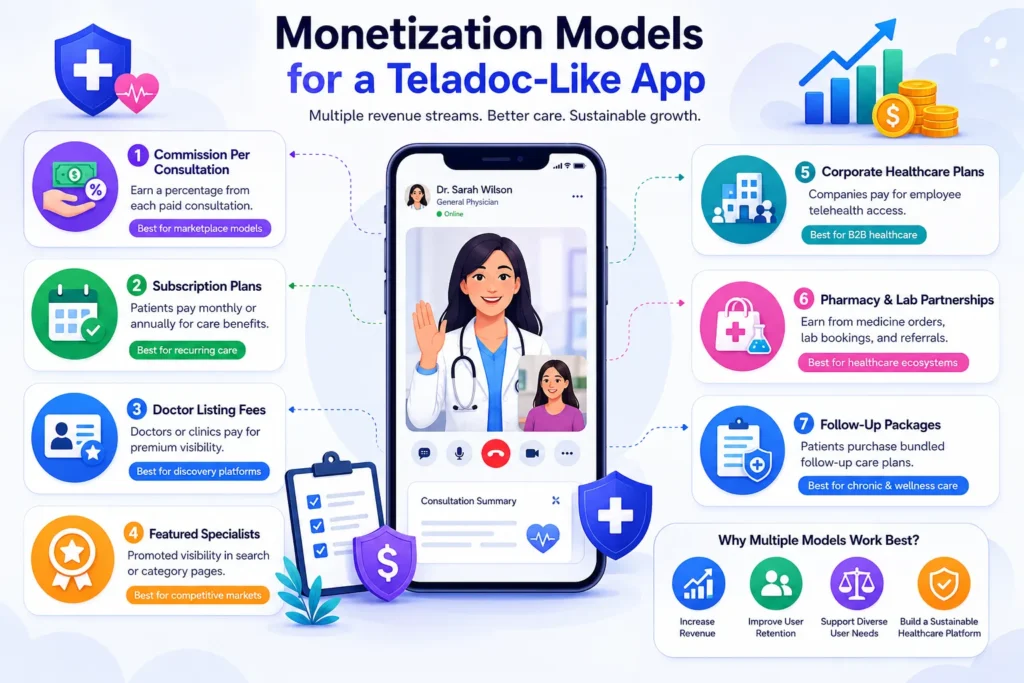
A telemedicine app can use multiple monetization models. The right choice depends on whether the platform is focused on single consultations, subscriptions, clinic partnerships, corporate care, or healthcare marketplace services.
| Revenue Model | How It Works | Best Fit |
|---|---|---|
| Commission Per Consultation | The platform earns a percentage from each paid doctor consultation. | Marketplace-style doctor consultation platforms. |
| Subscription Plans | Patients or families pay monthly or annual fees for access to consultations or care benefits. | Recurring telehealth and wellness models. |
| Doctor Listing Fees | Doctors or clinics pay for profile visibility or premium listing placement. | Doctor discovery and appointment booking platforms. |
| Corporate Healthcare Plans | Companies pay for employee telehealth access. | B2B healthcare platforms and workplace wellness. |
| Pharmacy and Lab Partnerships | The platform earns from medicine orders, lab bookings, or referral partnerships. | Healthcare ecosystems beyond consultation. |
| Featured Specialists | Doctors or clinics pay for promoted visibility in search or category pages. | Marketplace platforms with many providers. |
| Follow-Up Packages | Patients purchase bundled follow-up care plans. | Chronic care, therapy, wellness, and specialist care models. |
The monetization model should be decided before development because it affects admin settings, payment flows, doctor payout rules, subscriptions, invoices, reporting, and user experience.
For example, a commission-based platform needs doctor payout logic. A subscription-based platform needs plan management. A corporate healthcare platform needs organization-level access, employee eligibility, billing, and reporting. A pharmacy-linked model needs prescription-to-order workflows.
Read More: Healthcare Tech Is About Lives, Not Just Code: The Business of Telemedicine
Common Mistakes to Avoid While Building a Telehealth App
Building Only Video Calls Instead of a Healthcare Workflow
A video call feature alone does not create a telemedicine business. The platform also needs doctor onboarding, appointment management, medical records, prescriptions, payments, reminders, admin control, support workflows, and reporting.
Founders often underestimate this because video consultation looks simple from the user side. But behind the interface, the app needs scheduling logic, access controls, secure records, cancellation handling, doctor availability, payment settlement, and post-consultation workflows.
Ignoring Compliance Until the End
Healthcare compliance should be considered during architecture planning, not after launch. Access controls, encryption, consent, audit logs, secure storage, and medical data handling affect both product design and development cost.
Adding compliance layers after launch can be expensive and risky because the platform may need changes in database design, access permissions, hosting, data retention, and admin workflows.
Using Unrealistic Cost and Timeline Assumptions
Telemedicine platforms are more complex than basic service apps. Unrealistic cost expectations can lead to weak architecture, missing security layers, poor video performance, and expensive rebuilds later.
A serious healthcare app should be planned with realistic development, testing, compliance, and scaling requirements.
Weak Doctor Onboarding
If doctors are not verified, searchable, bookable, and supported with proper tools, the platform will struggle to build patient trust.
Doctor onboarding should include credential review, profile setup, availability management, consultation fee settings, document verification, and approval controls.
No Admin Control Over Operations
Founders need control over doctor approvals, consultation fees, refunds, disputes, reports, appointments, and compliance logs. Without this, every operational change becomes a development dependency.
A strong admin dashboard is not optional for a healthcare marketplace. It is the control center of the business.
Adding Advanced Features Too Early
AI symptom checkers, remote patient monitoring, pharmacy integration, insurance flows, and lab booking can be valuable. But adding everything before validating core consultation demand can increase cost and delay launch.
Founders should prioritise the features that directly support patient trust, doctor supply, booking, consultation, payment, and admin control first.
Founder Decision Signals Before You Build
Speed
If you need to test demand quickly, a ready-made healthcare marketplace foundation may be more practical than building every module from zero. Speed matters when the market opportunity is clear but the business still needs validation.
Cost
If your budget cannot support a full custom telehealth build, prioritise core patient, doctor, admin, booking, payment, and consultation workflows first. Avoid spending heavily on advanced integrations before proving usage.
Scalability
If you plan to add multiple specialties, clinics, pharmacy, labs, insurance, or corporate healthcare workflows, choose an architecture that can expand beyond the first version.
Market Fit
If your market needs doctor discovery and appointment booking in addition to virtual consultation, a Practo-style marketplace direction may fit better than a pure consultation-only model.
Compliance Readiness
If you are entering a regulated healthcare market, plan access control, encryption, audit logs, consent, medical record handling, and legal review from the beginning.
How Miracuves Helps You Build a Doctor Consultation Platform
Miracuves helps founders build ready-made and white-label healthcare marketplace app solutions with source-code ownership, branded design, admin control, and faster deployment. For a founder planning an online doctor consultation app, this approach can reduce avoidable development effort by starting with reusable patient, doctor, appointment, consultation, payment, and admin workflows.
The goal is not to copy Teladoc blindly. The smarter approach is to use a proven healthcare app pattern, adapt it to your market, and customise the platform around your business model.
That may mean a Teladoc-style virtual consultation app, a Practo-style doctor appointment marketplace, or a broader healthcare ecosystem with pharmacy, lab, and clinic workflows.
Miracuves can help founders evaluate the right product direction, select the right modules, customise branding, configure admin controls, and prepare the platform for faster market entry. For ready-made healthcare marketplace solutions where the scope fits, Miracuves’ white-label approach can support faster deployment compared with building every module from scratch.
If your goal is to validate an online doctor consultation model without waiting months, Miracuves can help you move from idea to launch with a more practical product foundation.
Final Thoughts: Build a Healthcare App With Trust, Control, and Realistic Planning
The real challenge in building an App Like Teladoc is not adding a video consultation button. It is creating a trusted healthcare platform where patients can find doctors, book appointments, share sensitive information, consult securely, receive prescriptions, make payments, and return for follow-up care.
For founders, the strongest decision is to start with clarity. Define whether you need a pure telemedicine app, a doctor appointment marketplace, or a broader healthcare ecosystem. Then plan your patient app, doctor panel, admin dashboard, compliance workflows, cost, timeline, and monetization model around that direction.
A strong healthcare platform should be useful for patients, efficient for doctors, controllable for admins, and realistic for the business to operate.
Miracuves can support this journey with ready-made, white-label, source-code-owned healthcare marketplace foundations that help founders launch faster while keeping room for customization, admin control, and future growth.
FAQs
What is an app like Teladoc?
An app like Teladoc is an online doctor consultation platform that allows patients to connect with healthcare professionals through video, audio, or chat. It usually includes appointment booking, doctor profiles, patient records, e-prescriptions, payments, notifications, and admin management.
What features are required in a telemedicine app like Teladoc?
Core features include patient signup, doctor search, appointment booking, video/audio/chat consultation, medical history upload, e-prescription, payments, notifications, doctor availability management, patient records, admin dashboard, reports, refunds, and compliance logs.
Is a Teladoc-like app the same as a Practo-style platform?
Not exactly. A Teladoc-like app focuses mainly on remote consultation and virtual healthcare delivery. A Practo-style platform usually includes doctor discovery, clinic profiles, appointment booking, reviews, and consultation workflows. Many founders choose a hybrid model based on their market.
What compliance requirements should a telemedicine app support?
A telemedicine app may need to support HIPAA-ready architecture, GDPR data privacy, encrypted communication, role-based access control, secure medical record storage, audit logs, consent management, e-prescription security, and EHR/EMR integrations. Final compliance depends on jurisdiction, legal review, integrations, and business operations.
How long does it take to launch an online doctor consultation app?
With Miracuves’ ready-made healthcare marketplace solution, founders can launch an online doctor consultation app in 6 days, depending on the final customization scope. The launch-ready foundation can include patient, doctor, appointment booking, consultation, payment, and admin dashboard workflows, helping businesses move faster than building every module from scratch. For advanced custom features, third-party integrations, or compliance-specific configurations, the timeline may vary based on project requirements.
How does a Teladoc-like app make money?
A Teladoc-like app can earn through consultation commissions, patient subscriptions, doctor listing fees, corporate healthcare plans, featured specialist listings, pharmacy partnerships, lab booking partnerships, and premium care packages.
Can Miracuves help build a healthcare marketplace app?
Yes. Miracuves helps founders build ready-made and white-label healthcare marketplace solutions with patient, doctor, appointment, consultation, payment, and admin workflows. The platform can be customised based on branding, integrations, compliance needs, and business model.
What is the difference between a telemedicine app and a doctor appointment booking app?
A telemedicine app focuses on remote consultation through video, audio, or chat. A doctor appointment booking app focuses on helping patients find doctors and book clinic or online appointments. A healthcare marketplace can combine both models.
Miracuves is an independent software development company. We are not affiliated with, connected to, sponsored by, or endorsed by any company or product named in this article.
Terms such as “X Clone” are used descriptively. It is how the software industry refers to building a platform with functionality comparable to a known service, and how clients search for it.
The entire design and codebase of our products is built by our own team. Our products contain no code, design, graphics, or content originating from any third-party website or applications.
All third-party names and marks referenced in this article are the property of their respective owners, referenced solely to identify the services discussed.