


Key Takeaways
What You’ll Learn
- Brex combines corporate cards, expense management, and banking tools into one fintech platform.
- The company mainly earns revenue through interchange fees and software subscriptions.
- Brex focuses heavily on startups, high-growth businesses, and enterprise clients.
- Automation and financial controls help businesses manage spending more efficiently.
- Its integrated fintech ecosystem creates recurring revenue opportunities beyond corporate cards.
Stats That Matter
- Brex has served more than 100,000 businesses across the United States.
- The platform generates significant revenue from card transaction interchange fees.
- Brex expanded from corporate cards into expense management, travel, and financial software.
- Fintech platforms offering integrated finance tools continue seeing strong global adoption.
- Subscription-based SaaS revenue is becoming a larger part of Brex’s business strategy.
Real Insights
- Modern businesses prefer financial platforms that combine payments, cards, and expense tracking.
- Real-time spending visibility helps companies improve financial decision-making.
- Integrated fintech ecosystems increase customer retention and long-term platform value.
- Automation reduces manual accounting and operational inefficiencies for growing companies.
- Brex’s growth shows how fintech platforms can scale by solving business finance challenges with software.
Brex went from a startup serving Y Combinator founders to a $12B+ fintech powerhouse, redefining how startups and enterprises manage spending, credit, and financial operations.
In less than a decade, business model of Brex has transformed from a simple corporate card provider into a full-stack financial operating system for businesses. Unlike traditional banks, Brex doesn’t just offer financial services — it embeds itself into how companies spend, save, and scale.
What makes Brex particularly fascinating in 2026 is its hybrid fintech + SaaS model, combining: Corporate cards ,Spend management software ,Treasury and cash management Global payments infrastructure For entrepreneurs, Brex represents a blueprint for building high-retention, high-margin platform businesses in the fintech ecosystem.
At Miracuves, we’ve seen increasing demand for similar platforms — founders today are not just building apps, but financial ecosystems with layered monetization and sticky user behavior.
How the Brex Business Model Works
Brex operates as a hybrid fintech + SaaS platform, designed to replace traditional banking infrastructure for modern businesses. Instead of acting like a bank, Brex positions itself as a financial operating system, integrating payments, credit, expense management, and treasury into one ecosystem.
Core Business Model Overview
At its core, Brex combines multiple models into a unified platform:
- Type of Model:
Hybrid → Fintech + SaaS + Embedded Finance Platform - Primary Structure:
- Corporate cards (interchange-driven revenue)
- Spend management SaaS (subscription + enterprise pricing)
- Cash management & treasury (yield + float-based revenue)
- Corporate cards (interchange-driven revenue)
Key Stakeholders in the Ecosystem
Brex’s ecosystem depends on balancing multiple participants:
- Businesses (Primary Users) → Drive transactions and subscription revenue
- Merchants & Payment Networks (Visa, etc.) → Enable interchange revenue
- Banking Partners (e.g., Evolve Bank & Trust) → Regulatory compliance layer
Software Integrations (QuickBooks, NetSuite, Slack) → Increase platform stickiness
Why Brex’s Model Works in 2026
Brex is perfectly aligned with modern market trends:
- Businesses demand all-in-one financial platforms
- CFOs prioritize automation + real-time insights
- Global teams require borderless financial infrastructure
- Fintech adoption is replacing legacy banking systems
Additionally, Brex benefits from:
- High switching costs once integrated
- Continuous product expansion (increasing lifetime value)
Data-driven insights that improve user experience over time
At Miracuves, this layered model is exactly what we help founders build — platforms that start with one core feature but evolve into full ecosystems with multiple revenue layers and high retention loops .
Read more : What Is Brex and How Does It Work?
Target Market & Customer Segmentation Strategy
Brex’s growth is deeply rooted in its precision targeting and disciplined segmentation strategy. Instead of chasing mass adoption, Brex focuses on high-value, high-growth businesses — ensuring stronger monetization and long-term retention.
Primary & Secondary Customer Segments
Brex has refined its audience over time, especially after exiting the SMB segment in 2023.
Primary Segments (2026 Focus)
1. Venture-Backed Startups
- Tech startups with significant funding (Seed → Series D+)
- High burn rates and rapid scaling needs
- Require flexible credit and automated financial operations
2. Mid-Market & Enterprise Companies
- Companies with global operations
- Multi-entity financial complexity
- Dedicated finance teams needing control and visibility
Secondary Segments
3. Finance Teams & CFOs
- Decision-makers for adoption
- Focus on compliance, reporting, and efficiency
4. Global Remote Teams
- Distributed organizations managing cross-border payments
- Need multi-currency and international spend capabilities
Customer Journey: From Discovery to Retention
Brex’s funnel is highly optimized for high-intent users:
1. Discovery
- VC ecosystem (Y Combinator, Andreessen Horowitz, etc.)
- Founder communities and startup networks
- Content marketing targeting finance leaders
2. Conversion
- Fast onboarding (minutes, not weeks like banks)
- No personal guarantee — major conversion driver
- Immediate access to high credit limits
3. Activation
- Integration with accounting tools (QuickBooks, NetSuite)
- Card issuance + spend policies setup
- Real-time dashboards for finance teams
4. Retention & Expansion
- Deep workflow integration (hard to switch away)
- Continuous feature upgrades (treasury, bill pay, travel, etc.)
- Enterprise-level customization
Customer Segment Analysis
| Segment Type | Needs | Brex Solution | Revenue Potential |
| Startups | Credit + speed | Corporate cards + automation | Medium |
| Mid-Market Companies | Control + scalability | Spend + treasury tools | High |
| Enterprises | Global finance infrastructure | Full financial OS | Very High |
| Finance Teams (CFOs) | Visibility + compliance | Reporting + policy controls | Indirect |
Revenue Streams and Monetization Design
Now that we understand who Brex serves, the next critical question is: How does Brex actually make money?
Brex’s monetization is a multi-layered, fintech-driven revenue architecture — combining transaction-based income with recurring SaaS revenue and capital efficiency strategies.
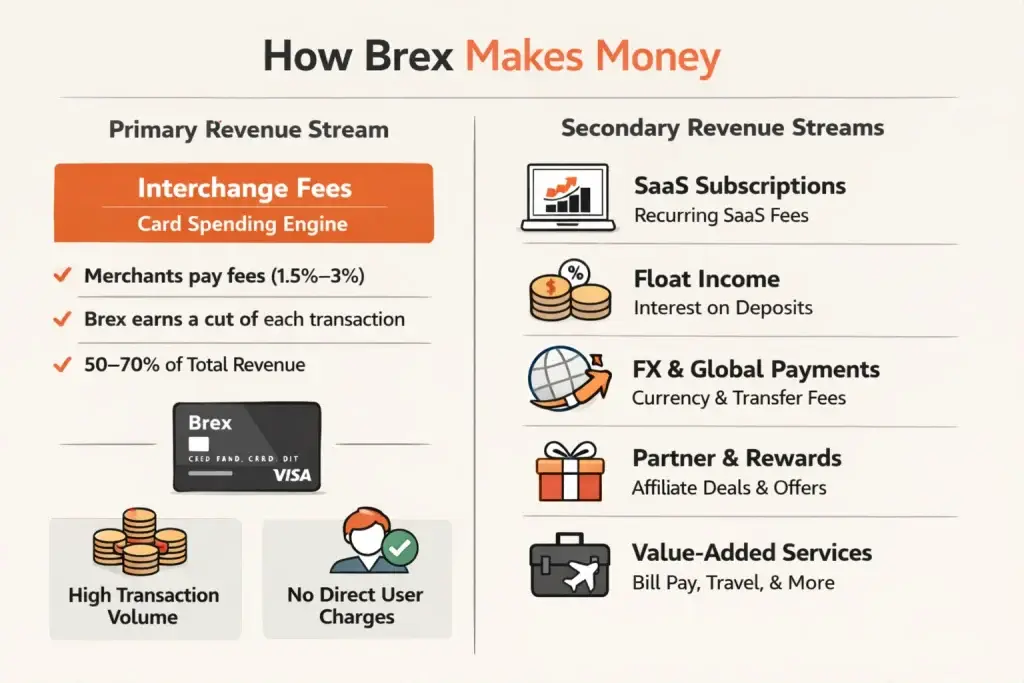
Primary Revenue Stream: Interchange Fees (Card Spending Engine)
This is Brex’s core revenue driver, especially in its early growth phase.
How it Works
Every time a Brex card is used:
- Merchants pay a fee (typically ~1.5%–3%)
- A portion of that fee goes to Brex via card networks (Visa, etc.)
Why It Scales
- Revenue grows directly with customer spend
- High-spending startups and enterprises = massive transaction volume
- No need to charge users directly → lowers adoption friction
Revenue Contribution
- Historically 50–70% of total revenue (declining as SaaS grows)
- Still a major driver in 2026 due to enterprise-scale transactions
Secondary Revenue Streams
1. SaaS Subscriptions (Brex Premium / Enterprise Plans)
Brex has aggressively expanded into SaaS — a key shift for profitability.
What users pay for:
- Advanced spend controls
- Custom workflows
- Multi-entity management
- Enterprise reporting & analytics
Pricing Model:
- Tiered subscription (Free → Premium → Enterprise)
- Custom pricing for large clients
2. Float Income & Treasury Yield
Brex earns revenue on idle customer funds:
- Customer deposits are held in partner banks or treasury products
- Brex earns interest or yield spreads
Why this matters in 2026:
- Higher interest rate environments = higher margins
- Large enterprise balances significantly boost income
3. Foreign Exchange (FX) & Global Payment Fees
As Brex expands globally:
- Charges small margins on currency conversion
- Monetizes cross-border transactions
Growth driver:
- Remote teams and global companies increasing in 2026
4. Partner Ecosystem & Rewards Monetization
Brex offers rewards (e.g., travel, SaaS discounts), but also monetizes:
- Partner deals and affiliate revenue
- Sponsored integrations
Read more : Brex Revenue Model: How Brex Makes Money in 2026
Operational Model & Key Activities
Behind Brex’s sleek user experience lies a highly sophisticated operational engine. Unlike traditional banks, Brex runs as a technology-first financial platform, where automation, compliance, and scalability are tightly integrated.
Core Operations
Brex’s daily operations revolve around maintaining a seamless financial ecosystem:
1. Platform & Infrastructure Management
- Cloud-native architecture (high scalability and uptime)
- Real-time transaction processing systems
- API-driven integrations with financial tools
2. Risk & Compliance Management
- Credit underwriting based on cash flow (not credit scores)
- Fraud detection using AI and transaction monitoring
- Regulatory compliance via partner banks
This is critical because:
- Fintech = high regulatory scrutiny
- Risk mismanagement can collapse the model
3. Spend Management & Product Operations
- Expense tracking automation
- Policy enforcement (limits, approvals)
- Corporate card lifecycle management
These features drive daily engagement, making Brex indispensable.
4. Customer Support & Success
- Dedicated account managers for enterprise clients
- Onboarding teams for smooth migration
- 24/7 support for financial operations
5. Sales & Marketing Operations
- Enterprise sales teams targeting high-value clients
- Founder-led community marketing (early-stage advantage)
Strategic Partnerships & Ecosystem Development
Brex’s success is not built in isolation — it’s powered by a carefully designed partnership ecosystem that extends its capabilities far beyond what a single platform could achieve alone.
In fintech, partnerships are not optional — they are infrastructure. Brex understands this deeply and has built a network that strengthens compliance, expands functionality, and accelerates growth.
Collaboration Philosophy
Brex follows a simple but powerful principle:
“Own the experience, partner for the infrastructure.”
Instead of becoming a licensed bank, Brex:
- Partners with regulated financial institutions
- Focuses internally on product, UX, and innovation
- Uses APIs and integrations to scale rapidly
Key Partnership Types
1. Technology & API Partners
These integrations make Brex a central hub in a company’s financial stack:
- Accounting tools → QuickBooks, NetSuite
- HR & payroll systems → Gusto, Rippling
- Communication tools → Slack
Impact:
- Deep workflow integration
- Increased switching costs
- Higher product stickiness
2. Banking & Financial Infrastructure Partners
Since Brex is not a bank, it relies on licensed institutions:
- Partner banks (e.g., Evolve Bank & Trust)
- Card networks (Visa)
- Payment processors
Impact:
- Regulatory compliance
- Ability to issue cards and hold funds
- Faster global expansion
3. Payment, FX & Global Infrastructure Alliances
To support global businesses, Brex partners with:
- Cross-border payment providers
- Currency exchange systems
- Treasury infrastructure platforms
Impact:
- Enables multi-currency operations
- Unlocks global customer segments
- Adds new revenue streams (FX margins)
4. Marketing & Distribution Partnerships
Brex has leveraged high-leverage ecosystems for growth:
- Venture capital firms (YC, a16z, etc.)
- Startup accelerators
- Founder communities
Impact:
- Warm, high-quality leads
- Built-in trust with early-stage companies
- Viral adoption within startup ecosystems
5. Rewards & Commercial Partnerships
Brex offers perks through partnerships:
- AWS credits
- SaaS discounts (Notion, Slack, etc.)
- Travel rewards
Impact:
- Enhances user value
- Attracts startups
- Generates affiliate/partner revenue
Growth Strategy & Scaling Mechanisms
Brex’s growth journey is a masterclass in focused scaling, strategic pivots, and ecosystem-driven expansion. Unlike many startups that chase rapid user acquisition, Brex prioritized high-quality growth over volume, which significantly improved its long-term economics.
Growth Engines
1. Organic Virality & Referral Loops
Brex’s early growth was deeply rooted in the startup ecosystem:
- Founders recommending Brex within VC networks
- Word-of-mouth across Y Combinator and tech communities
- Built-in credibility through association with top investors
2. VC-Led Distribution Strategy
One of Brex’s smartest growth hacks:
- Partnerships with venture capital firms
- Exclusive deals for portfolio companies
- Early access incentives
Impact:
- Instant access to high-growth startups
- Reduced customer acquisition cost (CAC)
- High-quality, high-spend users from day one
3. Product-Led Growth (PLG)
Brex designed its product for fast adoption and immediate value:
- Quick onboarding (minutes vs weeks)
- Instant card issuance
- Intuitive UI for finance teams
This created:
- Low friction entry
- Rapid activation
- Strong early retention
4. Enterprise Sales Expansion (2024–2026 Shift)
Brex evolved from PLG to a hybrid PLG + sales-led model:
- Dedicated enterprise sales teams
- Custom onboarding for large clients
- Tailored financial solutions
Result:
- Higher deal sizes
- Increased ARPA (Average Revenue Per Account)
- Stronger long-term contracts
5. Product Expansion as a Growth Lever
Brex doesn’t just acquire users — it grows within accounts:
- Cards → Spend management → Treasury → Global payments
- Continuous feature rollout
Competitive Strategy & Market Defense
Brex operates in one of the most competitive fintech spaces, facing pressure from traditional banks, neobanks, and fast-growing fintech startups. Yet, it has carved out a strong position by focusing on product depth, customer quality, and ecosystem control.
Core Competitive Advantages
1. Strong Network Effects & Switching Barriers
Brex builds operational lock-in, not just user adoption:
- Deep integrations with accounting, HR, and finance tools
- Embedded workflows across expense management, payments, and reporting
- Centralized financial data within the platform
Once a company runs its financial operations on Brex, switching becomes:
- Technically complex
- Operationally risky
- Time-consuming
2. Premium Brand Positioning
Brex is not positioned as a generic fintech tool — it’s positioned as:
“The financial platform for high-growth, ambitious companies.”
This creates:
- Strong brand affinity among startups and enterprises
- Perception of innovation and reliability
- Alignment with venture-backed growth culture
3. Product Innovation & Financial OS Vision
Unlike competitors focusing on one feature (cards, banking, or expenses), Brex:
- Builds a full-stack financial platform
- Continuously launches new modules (treasury, global payments, travel)
- Integrates everything into a unified experience
This reduces the need for multiple tools, making Brex indispensable.
4. Data-Driven Intelligence
Brex leverages financial data to:
- Improve credit underwriting
- Personalize user experience
- Provide real-time insights to finance teams
This creates a feedback loop:
More usage → more data → better product → higher retention
5. Compliance & Infrastructure Strength
Fintech trust is built on compliance:
- Strong banking partnerships
- Robust regulatory frameworks
- Enterprise-grade security
Lessons for Entrepreneurs & Implementation
Brex’s journey is more than a fintech success story — it’s a playbook for building scalable, high-retention, multi-revenue platforms. For entrepreneurs, the real value lies in extracting principles that can be replicated, adapted, and executed.
Key Factors Behind Brex’s Success
1. Start with a Sharp, High-Value Niche
Brex didn’t target everyone — it focused on:
- Venture-backed startups
- High-spending, fast-scaling companies
This ensured:
- Strong early traction
- High transaction volume
- Premium positioning from day one
2. Solve a Core Pain, Then Expand
Brex began with a simple but powerful problem:
Startups couldn’t access corporate credit easily.
Once that was solved, it expanded into:
- Spend management
- Treasury
- Global payments
Lesson:
Win one problem deeply before expanding horizontally.
3. Layer Monetization Over Time
Instead of relying on a single revenue stream, Brex built:
- Interchange (early growth)
- SaaS subscriptions (stability)
- Treasury + FX (margin expansion)
This created a balanced and resilient revenue model.
4. Build for Retention, Not Just Acquisition
Brex increases retention by:
- Embedding into financial workflows
- Integrating deeply with other tools
- Becoming operationally essential
The goal is not downloads — it’s dependency.
5. Strategic Pivoting is a Strength
Brex made a bold move:
- Exited the SMB market
Why it worked:
- Focused on profitable customers
- Increased ARPA (Average Revenue Per Account)
Improved unit economics
Implementation Roadmap
Phase 1: Foundation
- Identify niche market
- Build core MVP (single strong feature)
- Establish key partnerships (payments, compliance)
Phase 2: Product Expansion
- Add adjacent features
- Introduce basic monetization
- Improve UX and integrations
Phase 3: Monetization Scaling
- Launch subscription tiers
- Introduce premium features
- Optimize pricing strategy
Phase 4: Platform & Ecosystem
- Build integrations
- Expand into new markets
- Develop partner ecosystem
Ready to implement Brex’s proven business model for your market?
Miracuves builds scalable platforms with tested business models and growth mechanisms. We’ve helped many entrepreneurs launch profitable apps across fintech, SaaS, and marketplace ecosystems.
Get your free business model consultation today and start building your next big platform.
Conclusion
Brex’s journey highlights a powerful truth about modern digital businesses:
Success doesn’t come from offering more features — it comes from building a system users can’t operate without.By evolving from a simple corporate card provider into a full-scale financial operating system, Brex has demonstrated how combining fintech infrastructure with SaaS intelligence creates: High retention , Multiple revenue streams ,Strong competitive moats
For entrepreneurs, the bigger lesson is this: The future belongs to platforms that integrate deeply into user workflows, not standalone tools . As we move further into 2026 and beyond, platform economies will continue to dominate — especially in fintech, SaaS, and embedded finance. Companies that can combine financial services, automation, and ecosystem thinking will define the next generation of billion-dollar startups.
And Brex stands as a clear example of how: Innovation + execution + strategic focus = sustainable, scalable growth
FAQs
1. What type of business model does Brex use?
Brex uses a hybrid fintech + SaaS business model, combining corporate cards, spend management software, and financial services into a unified platform.
2. How does Brex’s model create value?
It simplifies financial operations for businesses by offering integrated tools for payments, expense tracking, and treasury, reducing complexity and saving time.
3. What are its key success factors?
Brex’s success comes from niche targeting, product depth, strong integrations, and layered monetization, along with a focus on high-value customers.
4. How scalable is it?
Highly scalable — its cloud-based infrastructure and API-driven model allow it to expand globally while serving larger enterprises efficiently.
5. What are the biggest challenges?
Key challenges include regulatory compliance, intense fintech competition, and maintaining profitability while scaling operations.
6. How can entrepreneurs adapt it to their region?
They can focus on local financial needs, partner with regional banks, and build niche-specific solutions tailored to underserved markets.
7. What are alternatives to this model?
Alternatives include pure SaaS finance tools, traditional banking models, or single-feature fintech apps like payment gateways or expense trackers.
8. How has it evolved over time?
Brex evolved from a startup-focused corporate card provider to a full financial operating system targeting mid-market and enterprise clients.
Related Articles
Miracuves is an independent software development company. We are not affiliated with, connected to, sponsored by, or endorsed by any company or product named in this article.
Terms such as “X Clone” are used descriptively. It is how the software industry refers to building a platform with functionality comparable to a known service, and how clients search for it.
The entire design and codebase of our products is built by our own team. Our products contain no code, design, graphics, or content originating from any third-party website or applications.
All third-party names and marks referenced in this article are the property of their respective owners, referenced solely to identify the services discussed.