


Key Takeaways
- A direct restaurant ordering platform should combine digital menus, online ordering, payments, pickup and delivery, POS integrations, customer accounts, loyalty, marketing tools, analytics, and restaurant admin controls.
- Development scope depends on restaurant workflows, number of locations, ordering channels, payment methods, POS connectivity, fulfillment options, customer engagement features, and customization requirements.
- Total cost is influenced by app and web complexity, backend architecture, third-party integrations, branded apps, security, cloud infrastructure, testing, maintenance, and future feature expansion.
Feature & Cost Signals
- Core features can include menu management, modifiers, carts, promo codes, scheduled orders, multiple payment methods, order tracking, refunds, notifications, loyalty rewards, and reorder options.
- Restaurant-side requirements may include order acceptance, kitchen workflows, operating hours, item availability, staff permissions, POS synchronization, multi-location management, customer data, and performance reporting.
- Costs can increase with branded mobile apps, advanced POS integrations, delivery partner connections, subscriptions, marketing automation, personalized offers, CRM features, complex analytics, and multi-location customization.
Founder Planning Insights
- Founders should define target restaurant types, ordering channels, POS requirements, payment methods, pickup and delivery workflows, monetization model, MVP scope, and expected order volume before estimating development cost.
- A phased roadmap can prioritize menus, ordering, payments, restaurant dashboards, POS connectivity, and essential admin tools first, then add loyalty, branded apps, automation, personalization, and advanced analytics later.
- Miracuves develops customizable direct restaurant ordering platforms with menu management, online ordering, POS integrations, payments, loyalty, delivery workflows, analytics, marketing tools, and admin controls.
For restaurants moving toward direct digital ordering, the difficult question is rarely whether customers should be able to order online. The harder decision is determining what the platform actually needs to do without turning the project into an unnecessarily expensive collection of features.
A simple ordering website may be enough for a single restaurant offering pickup. A multi-location restaurant group may need centralized menu management, outlet-specific availability, payment integrations, delivery zones, loyalty tools, customer records, reporting, and operational controls. A business planning to support several independent restaurants introduces another level of complexity.
This is why planning a direct restaurant ordering platform should begin with the operating model rather than a long feature wishlist.
The most useful question is not, “How many features can we add?” It is, “Which capabilities are necessary to take an order successfully, fulfil it reliably, retain the customer, and give the operator enough control to run the business?”
That distinction influences both product quality and development cost.
Start With the Restaurant Operating Model, Not the Feature List
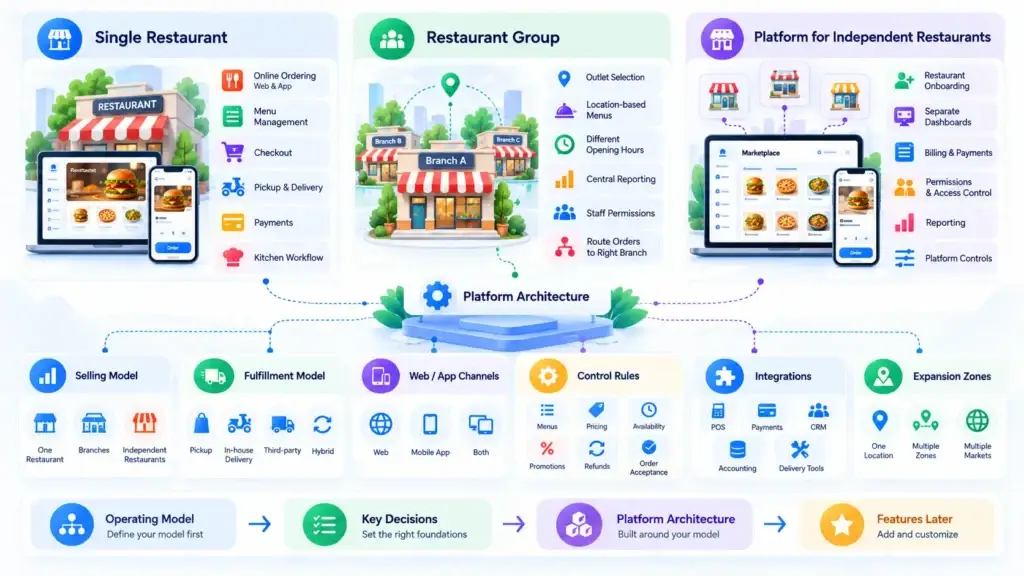
Two restaurant businesses can both need online ordering while requiring very different platforms.
A single-location restaurant primarily needs a reliable digital storefront connected to its menu, checkout, payments, pickup or delivery rules, and internal order workflow. A restaurant group may need outlet selection, location-specific menus, different opening hours, centralized reporting, branch-level staff permissions, and routing that sends each order to the correct location.
A platform operator serving independent restaurants has an even broader problem. It may need restaurant onboarding, separate dashboards, billing logic, account permissions, reporting, and controls that would be unnecessary for a single restaurant.
Before development begins, define several operating decisions:
- Who will sell through the platform: one restaurant, multiple branches, or multiple independent restaurants?
- Will customers order for pickup, restaurant-managed delivery, third-party delivery, or a combination?
- Will ordering happen through the web, mobile apps, or both?
- Who controls menus, pricing, availability, promotions, refunds, and order acceptance?
- Does the restaurant need to connect the system with existing POS, payment, CRM, accounting, or delivery tools?
- Will the platform serve one location or need to expand across different delivery zones and markets?
These decisions are more important than choosing advanced features too early because they determine the architecture underneath the ordering experience.
Which Features Matter Most in a Direct Restaurant Ordering Platform?
A strong platform needs to connect customer convenience with restaurant operations. An attractive ordering interface has limited value if staff cannot manage unavailable dishes, customers cannot customize meals correctly, or administrators cannot resolve failed payments and cancelled orders.
The following capability groups deserve priority during planning. Founders who want to see how these requirements translate into an actual product can explore the restaurant ordering platform features available across customer ordering, restaurant operations, menu management, payments, and administrative control.
Menu and Availability Management
The menu is not static website content. It is operational data that can change throughout the day.
Restaurants may need to change prices, mark dishes unavailable, modify categories, add meal variations, manage extras, communicate dietary information, schedule menus, or apply location-specific availability.
A well-planned menu layer can therefore support:
- Categories and subcategories
- Item variations and sizes
- Add-ons and modifiers
- Item availability
- Images and descriptions
- Special instructions
- Restaurant or outlet-specific pricing
- Scheduled availability
- Dietary or allergen information where appropriate
This becomes increasingly important as the number of locations grows. A system that works for 40 items at one restaurant may become cumbersome when several outlets need different prices and availability.
Frictionless Cart and Checkout
Checkout is where product design becomes revenue infrastructure.
Customers should be able to move from menu selection to confirmed order without unnecessary steps. The platform needs to preserve selected options, quantities, extras, delivery or pickup preferences, addresses, discounts, taxes, charges, and the final amount accurately.
Guest checkout can also be worth considering. Requiring account creation before every customer can place an order may create avoidable friction, particularly when the restaurant is acquiring first-time diners through search, social media, QR codes, or direct links.
The correct checkout design depends on the business. The goal should be to collect the information required to fulfil the order without making the transaction harder than necessary.
Secure and Flexible Payments
Payment requirements can significantly affect both implementation scope and ongoing operations.
A restaurant may need card payments, wallets, local payment methods, cash, or other options depending on its target market. Beyond displaying payment choices, the platform needs to handle payment status, failed transactions, refunds, order confirmation, and reconciliation correctly.
Secure payment gateway integration and clear transaction records should therefore be treated as core infrastructure rather than decorative features.
The number of gateways and the complexity of payment flows also influence development cost. Adding every possible payment option at launch may be unnecessary if customer demand can be served by a smaller, carefully chosen set.
Pickup, Delivery and Scheduled Ordering
Not every direct-ordering business needs its own delivery operation.
Some restaurants may focus on collection. Others may use their own drivers. Restaurant groups might combine internal fulfilment with external logistics providers. These choices change the platform significantly.
Delivery can introduce requirements such as delivery zones, distance rules, delivery charges, driver assignment, live location, proof of delivery, customer ETAs, and dispatch management. Pickup generally requires fewer moving parts, although accurate preparation times and customer notifications remain important.
Scheduled orders add another layer because the system must understand capacity, operating hours and future fulfilment slots rather than simply accepting an order immediately.
This is a good example of why cost should follow the business model rather than a generic feature checklist.
Restaurant Operations Need Their Own Control Layer
A customer-facing ordering experience is only half of the system.
Restaurant staff need an efficient way to receive and manage orders. If every menu update, cancellation, opening-hour change, or unavailable dish requires developer intervention, operating costs can quickly become more important than the initial build cost.
A practical restaurant dashboard may need to support order acceptance, preparation status, menu editing, opening hours, sold-out items, promotions, transaction history, customer requests, and basic reporting.
For businesses with several outlets, permissions become particularly important. Head-office teams may require wider visibility while individual restaurant managers need control only over their own locations.
Readers who have already defined their operational requirements can explore Miracuves’ ready-made restaurant ordering solution to compare those requirements with an existing product foundation.
Notice that the decision should still happen in that order: define the operating requirement first, then evaluate whether an existing platform covers it.
Customer Communication Should Be Designed Into the Order Journey
Customers become anxious when money has been charged but they do not know whether the restaurant received the order.
Order communication should therefore be planned around meaningful events: confirmation, restaurant acceptance, preparation, readiness for collection, dispatch, delivery, cancellation, or refund.
Depending on the business model, these updates might use:
- Push notifications
- SMS
- In-app status
- Live delivery tracking
More communication is not automatically better. The goal is to provide useful visibility at the moments when customers would otherwise need to call the restaurant.
That has an operational benefit as well. Clear order status can reduce avoidable support requests and give restaurant teams more time to focus on fulfilment.
Loyalty and Customer Retention Features Need a Business Purpose
One of the strategic advantages of direct ordering is the ability to build a first-party relationship with customers, subject to appropriate privacy and consent practices.
Those customer relationships also influence how the platform creates long-term business value. Before adding subscriptions, loyalty rewards, promotions, service charges, or other commercial mechanisms, founders should define the direct restaurant ordering business model those features are expected to support.
That makes retention tools valuable, but they should not be added simply because competing products have them.
Loyalty points, wallet credit, coupons, referral incentives, reorder functionality, personalized offers, and customer segmentation all introduce rules that need to be managed. Before implementing them, decide what customer behavior the restaurant is trying to encourage.
For example, a restaurant trying to increase ordering frequency may value simple rewards and easy reordering more than a complicated multi-tier membership program. A multi-location brand may place greater value on customer history that works across its outlets.
Feature priority should follow the retention strategy.
The Admin Dashboard Is Where Business Control Lives
The customer interface attracts most of the visual attention, but founders should spend just as much time planning administrative controls.
The admin layer determines how easily the platform operator can manage accounts, restaurants, orders, payments, promotions, delivery rules, disputes, permissions, and reports without relying on developers for routine changes.
Good admin architecture becomes increasingly important as the platform grows. Small manual tasks that seem manageable with 50 orders can become expensive operational bottlenecks at larger volumes.
This is why admin requirements should be documented during initial planning rather than treated as a back-office feature to add later.,
Miracuves Direct Restaurant Ordering Platform Solution Cost and Tech Stack
Miracuves Pricing for a Direct Restaurant Ordering Platform developed in PHP For $2,799 USD (One-Time Price) in just 6 days
Get a fully developed, deployment-ready direct restaurant ordering platform built for independent restaurants, restaurant chains, cloud kitchens, cafés, takeaway businesses, and hospitality brands planning to accept customer orders without relying entirely on third-party marketplaces. Built on a stable PHP foundation, this complete package includes everything you need to launch and scale:
Core Workflows: Customer registration, restaurant menu browsing, item customization, cart checkout, pickup and delivery selection, scheduled ordering, order confirmation, real-time order status, cancellations, and customer notifications.
Built-in Revenue Logic: Direct order payments, delivery charges, service fees, minimum-order rules, upselling and add-ons, loyalty programs, promo codes, subscription offers, and repeat-order campaigns.
Management Hub: Centralized admin dashboard, menu management, order monitoring, customer management, delivery zone controls, payment records, coupon management, refund handling, operating hours, and sales analytics.
Launch-Ready: Fully prepared for your custom branding, restaurant configuration, payment gateway setup, menu creation, delivery and pickup rules, promotional offers, notification setup, and immediate market entry.
Why Is Direct Restaurant Ordering Platform Development More Affordable?
Most restaurant ordering platforms become expensive when businesses choose fully custom development from scratch. Building separate workflows for menus, customers, ordering, payments, delivery zones, pickup options, promotions, notifications, refunds, loyalty programs, and admin controls can significantly increase cost, timeline, and technical complexity.
We took a smarter, more practical approach:
You Aren’t Paying for Ground-Up Development: Our direct restaurant ordering engine is already developed, tested, and ready to deploy. You skip the inflated cost and long development cycles normally associated with building a complete restaurant ordering system from scratch.
The Power of PHP: We built this solution on a reliable and cost-effective PHP architecture. This keeps the upfront price affordable while supporting essential menu management, direct ordering, customer accounts, payment workflows, delivery controls, promotions, and administrative operations.
You get a launch-ready direct restaurant ordering platform with practical ordering, payment, customer retention, delivery, and management features, source code access, and faster deployment without the high custom development price tag.
Note: This cost is for the solution, re-branding, deployment, and source code only.
What Actually Determines the Cost of a Restaurant Ordering Platform?
There is no meaningful universal development price for every direct-ordering platform because two projects described with the same label can have very different technical scopes.
The useful approach is to identify the variables that create work.
| Cost Factor | Lower-Complexity Scope | Higher-Complexity Scope | Why It Affects Cost |
|---|---|---|---|
| Business structure | Single restaurant | Multi-location or multi-restaurant | More account, menu and permission logic |
| Ordering channels | Responsive web ordering | Web plus native/mobile apps | More interfaces to develop and maintain |
| Fulfilment | Pickup | Delivery, dispatch and tracking | Adds logistics workflows |
| Menu | Standard items | Variations, modifiers, schedules and location rules | More data and management logic |
| Payments | Limited gateway setup | Multiple gateways and complex payment flows | More integrations and exception handling |
| Restaurant systems | Standalone platform | POS, CRM or accounting integrations | External APIs require implementation and testing |
| Promotions | Basic coupons | Loyalty, referrals, wallets and advanced campaigns | Adds business rules and tracking |
| Administration | Basic controls | Granular roles, reporting and multi-location oversight | Expands backend complexity |
| Customization | Standard branded UI | Specialized workflows and unique UX | Requires additional design and engineering |
| Infrastructure | Predictable initial usage | Higher availability and scaling requirements | Changes deployment and architecture needs |
This framework is more useful than asking for a development price before the operating model is known.
Once the operating model and required modules are clear, founders can make a more realistic budget assessment. A detailed restaurant ordering platform development cost breakdown can help connect decisions around platform coverage, integrations, customization, payment flows, and operational features with the overall development scope.
Miracuves follows the same principle for customizations: final scope depends on selected modules, integrations, branding, and customization requirements. Miracuves-Pricing-Rules
Web Ordering or Mobile Apps: Do You Need Both?
A dedicated mobile app is not automatically necessary for every restaurant at launch.
A well-designed mobile-responsive ordering website can work particularly well when acquisition depends on search, QR codes, social media, direct links, or occasional customers. There is no installation barrier, which can make first-order conversion simpler.
Mobile apps become more compelling when customers order frequently and the business can benefit from saved preferences, persistent login, push notifications, loyalty engagement, and stronger repeat-order behavior.
Some businesses need both.
The important cost lesson is that channel decisions should be based on customer behavior rather than the assumption that every restaurant technology project needs an iOS app, Android app and complex website immediately.
Integrations Can Change the Budget More Than Visible Features
Founders often concentrate on what customers can see, but integrations can represent substantial implementation work.
A restaurant platform may need to communicate with payment processors, POS systems, mapping services, communication providers, analytics platforms, CRM software, accounting tools, or external delivery services.
Each integration creates questions around authentication, data synchronization, error handling, API limits, webhooks, testing, and future maintenance.
This is why “integrates with our POS” is not a small checkbox in a project brief. The specific system, available API, required data flow, and desired synchronization behavior need to be identified.
When budgeting, separate essential launch integrations from useful future integrations. That single exercise can prevent considerable scope inflation.
Custom Development vs a Ready-Made Foundation
Once the requirements are clear, founders can make a more informed build decision.
Custom development provides maximum flexibility when the business depends on workflows that existing architectures cannot support. The trade-off is that the ordering engine, dashboards, payment flows, operational logic, testing, and deployment all have to be built or assembled for that particular project.
That makes the capabilities of the implementation team an important part of the decision. Businesses with specialized workflows or complex integrations should evaluate the restaurant ordering platform development expertise available for architecture, customization, integration, testing, deployment, and future product evolution.
A ready-made foundation starts from functioning product architecture and focuses more heavily on configuration, branding, integrations, and required modifications. This can be attractive when the intended business model closely matches workflows the platform already supports.
The right approach depends on how much of the business model is genuinely unique. Founders still comparing these routes can explore the trade-offs between ready-made and custom restaurant ordering development before committing to a build strategy.
Miracuves uses this approach across its ready-made delivery portfolio and publishes a six-working-day deployment timeline for qualifying ready-made solutions once the required launch inputs are available. For a direct restaurant ordering concept, the relevant Miracuves restaurant ordering platform currently includes source code, rebranding and a six-day go-live proposition.
The important distinction is that six-day delivery applies to an appropriate ready-made solution scope, not to an unrestricted custom platform containing any imaginable feature. That keeps the comparison realistic.
Founder Decision Signals
Choose Scope Before Features
Define who orders, who fulfils, who delivers, who gets paid and who controls each operational decision before expanding the feature list.
Separate Launch From Later
Prioritize capabilities needed to complete and manage real orders. Advanced engagement and automation can follow when there is a demonstrated business need.
Audit Integrations Early
Identify payment, POS, mapping, CRM and delivery integrations before budgeting because external system requirements can materially change development scope.
Match the Build Route to Differentiation
If the business model uses established ordering workflows, a ready-made foundation may reduce unnecessary development. Highly specialized operating logic can justify deeper custom engineering.
How to Control Development Cost Without Weakening the Product
Cost control does not mean choosing the smallest possible platform. It means avoiding engineering work that does not contribute to the initial business objective.
A useful scope should protect the complete transaction: customers discover the menu, configure an order, check out, pay, receive confirmation, and collect or receive their food while the restaurant and operator retain sufficient control over the process.
From there, enhancements can be prioritized according to measurable needs.
For example, sophisticated recommendations may sound attractive, but reliable menu availability may create more immediate value. Complex gamification can wait if basic repeat ordering is still cumbersome. Advanced analytics are less useful if staff cannot efficiently handle incoming orders.
The strongest initial scope is therefore not necessarily the platform with the fewest features. It is the platform with the fewest unnecessary features and no missing critical workflows.
Common Planning Mistakes That Increase Cost
Many expensive product decisions happen before development starts.
Building for every possible future scenario. Designing the first release around hypothetical international expansion, dozens of restaurant types and complex edge cases can increase scope before the core ordering model has been proven.
Ignoring restaurant-side workflows. A beautiful customer experience cannot compensate for cumbersome menu management, order acceptance or fulfilment operations.
Adding delivery complexity unnecessarily. If restaurants already manage their own delivery or the business initially focuses on pickup, building a sophisticated fleet operation immediately may be premature.
Treating integrations as simple add-ons. External systems can introduce substantial implementation and maintenance requirements.
Choosing features without operational ownership. Every refund rule, promotion, loyalty program and delivery policy eventually needs someone to administer it.
Evaluating only the initial development price. Hosting, external APIs, payment processing, maintenance, updates and future customization also affect the economics of owning the platform.
Avoiding these mistakes makes budgeting more accurate and gives the development team a clearer specification.
Security and Data Control Should Be Part of the Foundation
Direct ordering involves customer information, addresses, order histories and payment-related workflows. Security should therefore be planned as infrastructure rather than added after launch.
Depending on scope, appropriate considerations can include encrypted data transfer, secure payment gateway integration, role-based administrative access, activity or audit logs, permission-based dashboards, secure APIs, and privacy-conscious handling of customer information.
Payment credentials should be handled through appropriate payment infrastructure rather than casually stored by the restaurant platform.
Requirements will also vary by jurisdiction and operating model, so regulatory or privacy obligations should be reviewed for the target market rather than assuming that a technology stack automatically guarantees compliance. This follows Miracuves’ standard security positioning: technology can support compliance workflows, while final obligations depend on jurisdiction, integrations and operating practices. Miracuves-Security-Rules
What Should Be in Your Brief Before Requesting a Quote?
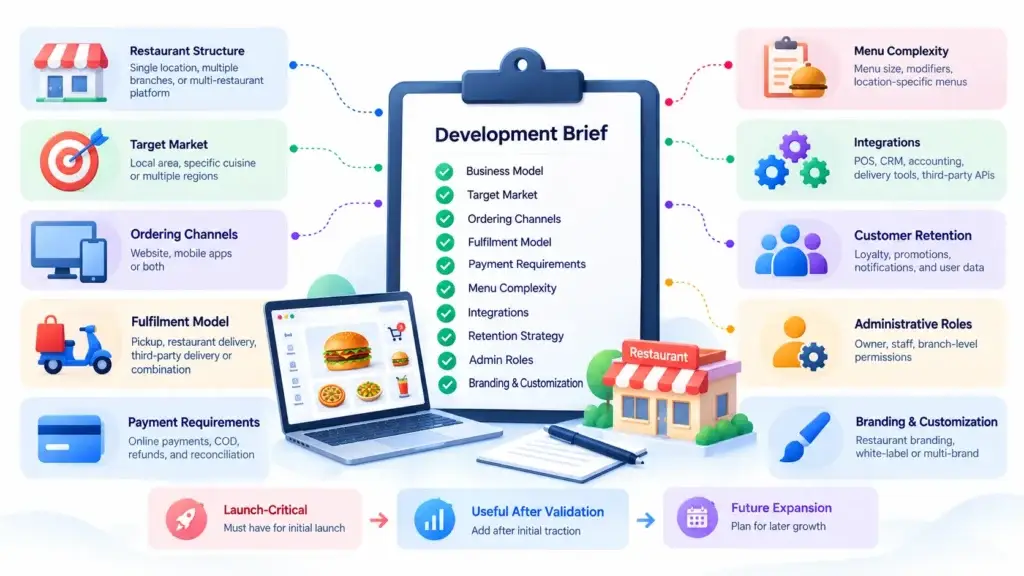
A useful development brief does not need to describe every screen. It should explain the business clearly enough for technical teams to understand what must happen.
Founders who want to take that planning further can use this restaurant ordering app development guide to understand how business requirements translate into product architecture, development decisions, and implementation planning.
Include the restaurant structure, target market, ordering channels, fulfilment model, payment requirements, menu complexity, essential integrations, customer retention requirements, administrative roles, expected branding changes, and any workflows that make the concept different from a standard direct-ordering operation.
Also separate requirements into launch-critical, useful after validation, and future expansion.
That makes development estimates easier to compare because different vendors or build options are responding to roughly the same problem rather than interpreting an ambiguous feature wishlist differently.
Where Miracuves Fits After the Planning Stage
Once those decisions have been made, the next question becomes whether the business needs a completely custom build or whether an existing restaurant-ordering foundation already covers most of the required workflows.
Miracuves offers ready-made and custom food and delivery technology. Its broader delivery catalogue covers multiple operating models, while its direct restaurant-ordering solution provides a more focused path for businesses seeking branded ordering, restaurant controls and direct customer relationships.
For founders whose requirements align with an existing foundation, the ready-made route can shift the project away from rebuilding standard ordering functionality and toward branding, configuration and relevant customization. Qualifying Miracuves ready-made solutions can be deployed in six working days, while requirements outside that established scope need to be evaluated separately.
If that approach matches your launch plan, you can explore Miracuves’ direct restaurant ordering solution to review the product foundation before deciding whether additional customization is required.
Final Thoughts: Plan the Ordering Operation Before You Plan the App
A direct restaurant ordering platform should not be treated as a collection of popular app features.
It is an operating system for moving an order from customer intent through payment, restaurant preparation and fulfilment while preserving enough control for the business to manage exceptions, customer relationships and future growth.
That is why the best planning decisions happen before screens are designed. Define the restaurant structure. Decide how orders will be fulfilled. Identify which integrations are genuinely necessary. Determine what staff and administrators need to control. Separate launch requirements from future improvements.
Only then should features, architecture and development cost be evaluated.
For founders, this approach does more than reduce unnecessary scope. It makes it much easier to determine whether the business genuinely needs a custom platform or whether a proven, configurable foundation can get the right product into the market considerably faster.
FAQs
What features should a direct restaurant ordering platform have?
The core requirements generally include menu management, cart and checkout, payments, order management, pickup or delivery configuration, customer notifications, restaurant controls and an admin dashboard. The exact scope should depend on the restaurant structure and fulfilment model rather than a generic feature checklist.
What affects the cost of building a restaurant ordering platform?
Major cost factors include the number of user interfaces, single- versus multi-location architecture, delivery workflows, mobile applications, payment gateways, POS and other integrations, menu complexity, loyalty functionality, administrative controls and custom workflows.
Does a restaurant need both a website and mobile app for direct ordering?
Not always. A mobile-responsive ordering website can reduce friction for first-time and occasional customers because installation is unnecessary. Dedicated apps can become more valuable for businesses with frequent repeat customers, loyalty programs, saved preferences and push-notification strategies.
Why do POS integrations affect development cost?
POS integration requires two systems to exchange the correct information reliably. Depending on the integration, this can involve menu synchronization, orders, prices, availability, payments or other operational data. API quality and the required synchronization logic influence implementation effort.
Should delivery tracking be included from launch?
It depends on who handles fulfilment. A business operating its own delivery fleet may need dispatch and tracking much earlier than a restaurant focusing on pickup or using another delivery provider. The fulfilment model should determine the technology requirement.
How can restaurants reduce platform development costs?
Start by defining the essential order journey and separating launch-critical functionality from later enhancements. Avoid unnecessary integrations, channels and advanced features until their business value is clear. A ready-made foundation can also reduce duplicated engineering when its existing workflows closely match the required model.
How quickly can a direct restaurant ordering platform be launched?
Timelines depend heavily on the build route and customization scope. Miracuves states a six-working-day deployment process for qualifying ready-made solutions after required branding, hosting, developer accounts and payment-gateway inputs are supplied; custom development follows a different scope and timeline. Miracuves Solutions
What should founders evaluate before choosing restaurant ordering software?
Evaluate menu complexity, restaurant and location structure, ordering channels, payment requirements, fulfilment model, integrations, administrative control, customer retention requirements, source-code ownership, customization needs and the ongoing cost of operating the technology.
Miracuves is an independent software development company. We are not affiliated with, connected to, sponsored by, or endorsed by any company or product named in this article.
Terms such as “X Clone” are used descriptively. It is how the software industry refers to building a platform with functionality comparable to a known service, and how clients search for it.
The entire design and codebase of our products is built by our own team. Our products contain no code, design, graphics, or content originating from any third-party website or applications.
All third-party names and marks referenced in this article are the property of their respective owners, referenced solely to identify the services discussed.



