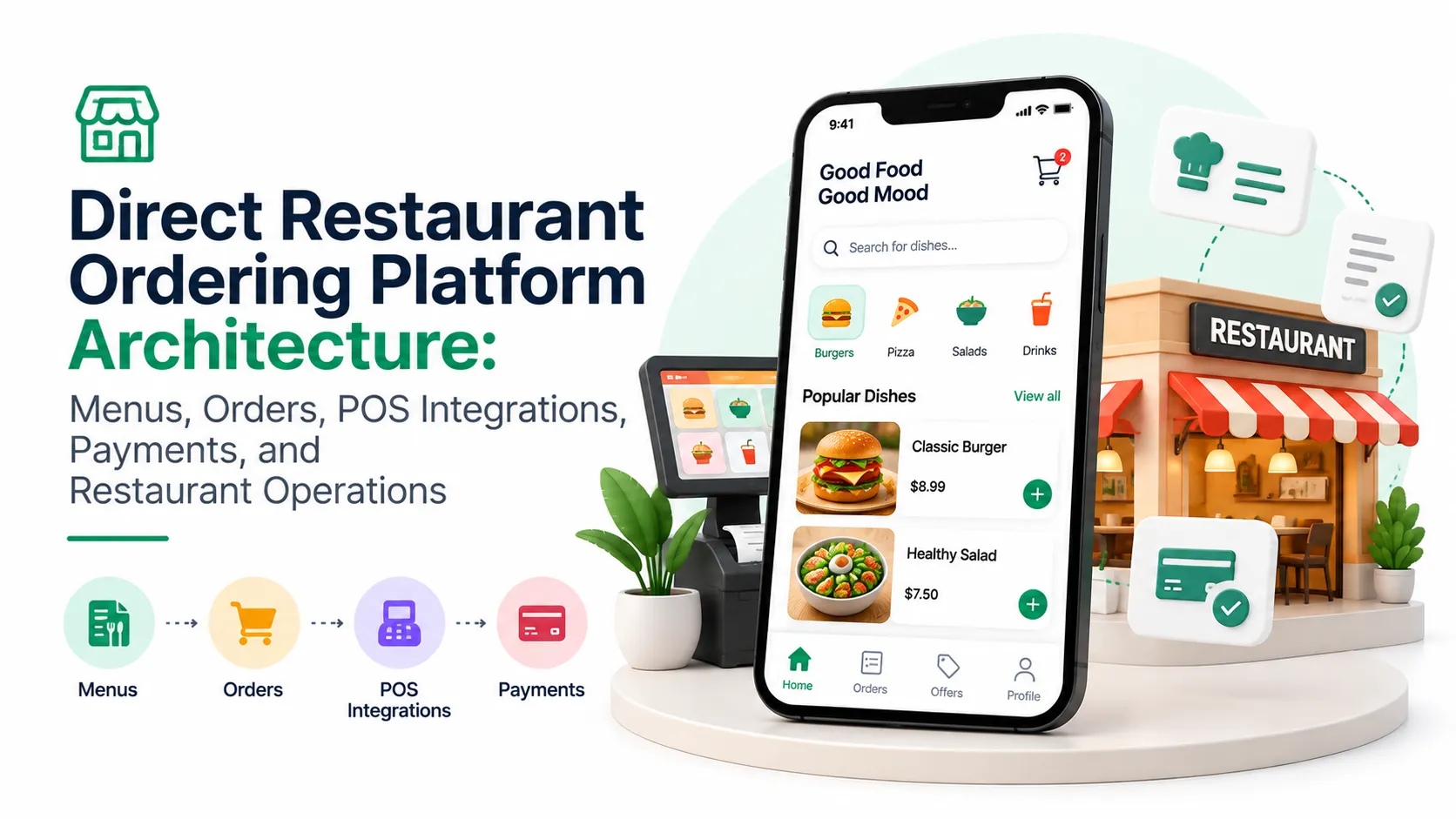
Key Takeaways
- A direct restaurant ordering platform architecture should connect menus, carts, orders, POS systems, payments, customer data, fulfillment, notifications, and restaurant operations through coordinated services.
- The platform should synchronize menu availability, pricing, modifiers, order status, payment confirmation, preparation workflows, and customer updates across digital ordering channels.
- A modular architecture helps restaurants manage web, mobile, pickup, and delivery orders while allowing POS, payment, loyalty, analytics, and operational integrations to scale independently.
Architecture & Integration Signals
- Menu services can manage categories, items, modifiers, pricing, availability, taxes, images, location-specific menus, scheduled menus, and real-time stock changes.
- POS integrations should synchronize incoming orders, item availability, order status, transaction records, kitchen workflows, and location-level operations while reducing duplicate data entry.
- Payment architecture can support cards, wallets, digital payment methods, authorization, refunds, tips, taxes, transaction status, gateway callbacks, reconciliation, and failed-payment recovery.
Restaurant Operations Insights
- Restaurant dashboards should support order acceptance, preparation timing, pickup and delivery modes, operating hours, menu updates, promotions, refunds, staff permissions, and customer support.
- Operators should monitor order volume, acceptance rate, preparation time, payment success, cancellations, refunds, average order value, repeat customers, POS sync failures, and location-level performance.
- Miracuves develops customizable direct restaurant ordering platforms with menu management, online ordering, POS integrations, payments, restaurant operations, customer data, analytics, and admin controls.
A restaurant ordering platform can look deceptively simple from the customer side. A diner opens a website or mobile app, browses the menu, adds dishes to a cart, pays, and waits for the order. Behind that short journey, however, several systems have to exchange information accurately and at the right time.
The menu needs to reflect the correct branch, price, modifier, tax rule, availability, and service mode. The order must reach the appropriate restaurant without being duplicated. Payment status has to remain synchronized with order status. If a point-of-sale system is involved, data may need to move between the digital ordering layer and the restaurant’s existing operational software. The kitchen then needs clear preparation information, while managers need visibility into orders, refunds, availability, and performance.
That interconnected operational layer is what makes direct restaurant ordering platform architecture important.
For founders and restaurant businesses evaluating their own ordering channel, the question is therefore not simply whether customers can place an order. The more useful question is whether menus, orders, payments, POS connections, kitchen workflows, and restaurant controls can operate as one dependable system.
What Is Direct Restaurant Ordering Platform Architecture?
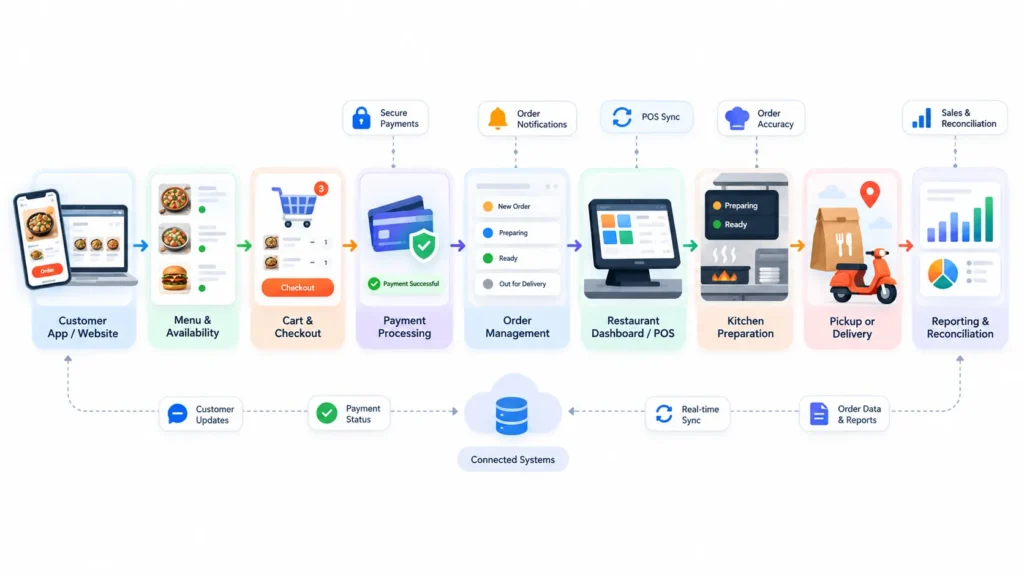
Direct restaurant ordering platform architecture describes the technical and operational structure connecting the customer ordering interface with the systems responsible for menus, checkout, payments, order processing, restaurant management, POS connectivity, kitchen operations, notifications, and fulfilment.
Instead of treating the ordering website or app as the entire product, it is more useful to think of it as one layer in a broader restaurant technology stack.
A typical flow looks something like this:
Customer interface → menu and availability layer → cart and checkout → payment processing → order management → restaurant/POS workflow → kitchen preparation → pickup or delivery → reporting and reconciliation
Each stage depends on information produced somewhere else. If those dependencies are poorly designed, problems quickly become visible to customers and restaurant teams. An unavailable dish may still be orderable. A modifier may not reach the kitchen. A paid transaction may appear as unpaid in the restaurant dashboard. Staff may have to enter online orders manually into the POS. A cancelled order may not trigger the corresponding payment workflow.
Readers who want more context on the underlying customer-to-restaurant workflow can first explore how direct restaurant ordering works before examining the individual architecture layers.
Architecture therefore determines much more than technical performance. It affects order accuracy, staff workload, customer experience, operational control, and the ability to add more restaurants or branches later.
The Core Layers Behind a Restaurant Ordering System
A scalable restaurant ordering ecosystem usually needs several distinct but connected layers. Separating responsibilities makes the platform easier to maintain and allows individual modules to evolve without unnecessarily disrupting the entire ordering flow.
| Architecture Layer | Primary Responsibility | Operational Importance |
|---|---|---|
| Customer ordering layer | Menu discovery, cart, checkout and order tracking | Determines ordering convenience and conversion |
| Menu service | Items, categories, modifiers, prices and availability | Keeps the digital storefront accurate |
| Order management | Creates and tracks the order lifecycle | Provides a reliable operational record |
| POS integration layer | Exchanges restaurant data and orders | Reduces manual re-entry and disconnected workflows |
| Payment layer | Authorization, capture, refunds and payment status | Protects financial accuracy |
| Restaurant operations layer | Order acceptance, preparation and branch controls | Gives staff practical control |
| Fulfilment layer | Pickup, delivery or other handoff workflows | Connects preparation with order completion |
| Notification layer | Customer and restaurant status updates | Keeps participants informed |
| Admin layer | Restaurants, users, configurations and reporting | Provides platform-level oversight |
| Data and analytics layer | Operational and business reporting | Supports better management decisions |
The exact implementation varies with the business model. A single restaurant with pickup ordering does not require the same architecture as a multi-restaurant platform operating across several locations. What matters is defining clear ownership of data and responsibilities before integrations multiply.
Founders moving from architecture planning to product evaluation can also review the restaurant ordering platform features that support customer ordering, restaurant management, administration, payments, and day-to-day operations.
Menu Architecture Is More Complex Than Displaying Food Items
A restaurant menu is structured operational data, not simply a page containing product names and prices.
A single menu item may have a base price, variants, modifiers, add-ons, tax treatment, preparation constraints, dietary information, branch-specific availability, scheduled availability, stock status, images, promotional pricing, and fulfilment restrictions. Some restaurants also maintain separate menus for breakfast, lunch, dinner, pickup, delivery, or specific locations.
This creates an important architectural question: which system is the authoritative source for menu information?
If the ordering platform controls the menu, restaurant teams need tools to update it quickly. If a POS or another restaurant system is the primary source, the integration needs a reliable synchronization process. Allowing several systems to independently modify the same data without clear ownership can produce mismatched prices and availability.
Menu Synchronization and Availability
Real-time or near-real-time menu synchronization becomes particularly valuable when item availability changes frequently. A restaurant that sells out of a popular dish during dinner service should be able to stop accepting orders for it without requiring staff to update multiple disconnected channels.
The menu layer should therefore be designed around operational events such as:
- item availability and out-of-stock status;
- branch-specific prices and menus;
- categories and menu schedules;
- variants, extras and modifier groups;
- minimum and maximum modifier selections;
- taxes and applicable charges;
- promotional pricing and coupons;
- pickup or delivery availability;
- restaurant opening and closing schedules;
- temporary order pauses during high-volume periods.
For multi-branch businesses, the platform also needs to avoid assuming that every location has identical inventory, operating hours, pricing, or fulfilment capability.
Order Management Should Be the Operational Spine
Once a customer submits checkout, the platform moves from browsing into transaction orchestration. At this point, the order management layer becomes one of the most important components in the architecture.
An order is not simply “placed” or “completed.” It progresses through a series of states that may include payment pending, confirmed, accepted, preparing, ready for pickup, dispatched, completed, rejected, cancelled, or refunded.
The platform needs clearly defined rules for how an order moves between those states and which participant is allowed to initiate each transition.
For example, payment confirmation may allow the order to enter the restaurant queue. The restaurant may then accept it and provide a preparation estimate. Once preparation is complete, a pickup order can move to ready status, while a delivery order may need an additional dispatch workflow.
The important architectural principle is that every transition should be deliberate and traceable.
Why Order State Management Matters
Weak state management produces some of the most frustrating restaurant-ordering failures. Customers can receive contradictory notifications, restaurant staff may prepare cancelled orders, refunds may be initiated without the corresponding order record changing, or two systems may show different versions of the same transaction.
A stronger design creates a dependable source of truth for the order while allowing connected services to react to state changes.
This also makes troubleshooting easier. Instead of asking staff to reconstruct what happened from several dashboards, an operations team can inspect the order history and determine when it was created, paid, accepted, prepared, cancelled, refunded, or completed.
POS Integration Should Remove Operational Friction
POS connectivity is often treated as a feature checkbox. Architecturally, it is better understood as an integration boundary between the digital ordering environment and the restaurant’s existing operational infrastructure.
Without integration, staff may receive an online order and manually enter it into another system. That adds labour and creates opportunities for mistakes in quantities, modifiers, prices, customer notes, and taxes.
A well-designed restaurant ordering system with POS integration can automate part of that handoff.
Depending on the POS capabilities and business requirements, the integration may exchange:
- menu items and categories;
- modifiers and variations;
- prices and taxes;
- item availability;
- incoming orders;
- payment information;
- order status;
- branch identifiers;
- discounts and promotional data.
The challenge is that integrations are rarely identical. Different systems expose different APIs, authentication models, data structures, rate limits, webhook capabilities, and operational rules.
For that reason, the ordering platform should avoid embedding POS-specific logic throughout the entire application.
Why an Integration Layer Makes POS Connectivity Easier to Scale
A dedicated integration or adapter layer can translate the restaurant platform’s internal data model into the format required by each connected system.
Imagine the platform has one internal representation for an order. One POS expects modifiers as nested objects, another uses separate line items, and another requires external product identifiers. Rather than changing the core order engine for every connection, adapters can handle those translations at the integration boundary.
This architecture also provides a better foundation for error handling.
If a POS API temporarily fails, the customer order should not simply disappear. The platform may need to retain the order, record the integration failure, retry where appropriate, notify operations, and provide a manual fallback.
The objective is not merely to connect two APIs. It is to ensure restaurant operations remain understandable when one of those APIs does not behave as expected.
Payments and Orders Should Be Connected Without Becoming the Same Thing
Payment status and order status are closely related, but they should not be treated as identical.
A payment can be authorized while the restaurant has not yet accepted the order. A restaurant may reject an order after a transaction has been initiated. A customer may receive a partial or complete refund later. Payment confirmation may also arrive asynchronously from a payment provider.
Separating the payment domain from the operational order lifecycle gives the platform more flexibility to handle these scenarios correctly.
The payment layer may need to manage:
- payment initiation;
- authorization and capture;
- successful and failed transactions;
- asynchronous payment confirmations;
- refunds;
- transaction references;
- payment-method metadata;
- reconciliation records;
- applicable platform or restaurant charges.
Secure payment gateway integration should also minimize unnecessary exposure to sensitive payment data. The exact security and regulatory requirements depend on the gateway, jurisdiction, operating model, and implementation.
Avoiding Duplicate Payment Events
Distributed systems can send the same event more than once. A payment provider, for example, may retry a notification when it does not receive a successful response.
If the restaurant platform processes every repeated event as a new transaction, duplicate updates can occur. Payment workflows should therefore be designed so that processing the same valid event again does not create an unintended second outcome.
The same principle matters for order creation and POS synchronization. Retries are useful for reliability only when the receiving system can recognize work that has already been completed.
From Checkout to Kitchen: Designing the Restaurant Operations Workflow
Architecture becomes valuable when it reflects what restaurant staff actually do.
Once an order arrives, someone or something has to determine whether it can be fulfilled. Staff may need to accept the order, review customer notes, confirm preparation time, route items to the appropriate kitchen station, mark dishes as prepared, and coordinate pickup or delivery.
The restaurant operations layer should make those actions straightforward rather than forcing staff to interpret technical system states.
A practical restaurant dashboard can provide visibility into incoming and active orders while allowing authorized staff to manage preparation, availability, service status, and exceptions.
For restaurants with busy service periods, operational controls can be especially important. The ability to adjust preparation time, mark items unavailable, or temporarily pause online ordering can prevent the digital channel from accepting demand the kitchen cannot fulfil.
Kitchen Routing and Preparation Need Their Own Logic
Not every item in an order necessarily goes to the same preparation station. Drinks may be routed differently from hot food, desserts, or specialty items. Depending on the restaurant setup, an order platform may need to communicate with kitchen displays, printers, POS-connected kitchen workflows, or another preparation system.
The objective is to preserve all the information the kitchen needs without introducing unnecessary complexity.
Modifier accuracy is particularly important here. “No onions,” “extra cheese,” a cooking preference, allergy-related notes, or a side substitution can be operationally more important than the menu item’s basic name.
A strong order model therefore preserves item-level configuration and customer instructions through the entire journey from cart to preparation.
Multi-Branch Restaurant Management Changes the Architecture
Adding a second location is not simply a matter of creating another restaurant record.
Branches may have different menus, operating hours, taxes, delivery areas, stock availability, prices, preparation capacity, payment settings, staff permissions, and POS connections. The ordering platform needs to determine which settings belong to the overall restaurant brand and which belong to an individual location.
Location selection can also affect the customer journey. The platform may choose a branch based on customer selection, service area, delivery address, or another routing rule.
This means the branch context should remain consistent throughout menu retrieval, checkout, payment, order creation, and fulfilment. Losing that context can cause an order to be priced using one branch’s menu and sent to another location.
For founders planning expansion, designing branch boundaries early is considerably easier than retrofitting them after restaurants and orders are already using a single-location data model.
These architectural decisions can also affect monetization, especially when subscriptions, restaurant charges, commissions, or location-level commercial rules are involved. Founders evaluating this side of the platform can explore the restaurant ordering platform business model separately.
Admin Architecture Provides the Platform-Level Control Layer
Restaurant staff need operational controls, while the platform operator needs a broader administrative view.
The admin layer can govern restaurant accounts, branches, user access, configurations, transactions, disputes, reports, integrations, and other platform-level settings. Role-based access becomes increasingly important as different employees and restaurant partners need different permissions.
A restaurant manager, for example, may need to modify menus and inspect orders without being allowed to change platform-wide configurations. Finance personnel may need transaction and refund visibility without operational menu access.
Clear permissions reduce both operational confusion and security risk.
This is also where auditability becomes useful. Important actions such as refunds, configuration changes, restaurant approvals, permission changes, or manual order interventions should be traceable when appropriate.
Notifications Should Follow Events, Not Drive the Core Workflow
Customers expect updates when an order is confirmed, accepted, prepared, dispatched, ready for pickup, or completed. Restaurant teams may also need alerts for new orders, cancellations, payment issues, or operational exceptions.
Notifications are therefore important, but they should usually respond to verified events rather than determine the underlying state of the order.
For example, the order service can record that an order is ready for pickup. A notification service then reacts by sending the appropriate message. If the message provider temporarily fails, the underlying order should still remain correctly marked as ready.
Separating those responsibilities prevents a communication failure from corrupting the restaurant’s operational record.
Reliability Matters More Than a Perfect Happy Path
Architecture diagrams often show everything working successfully. Real restaurant operations involve exceptions.
A payment gateway may respond slowly. A POS endpoint may be unavailable. A restaurant can reject an order. A menu can change while a customer has an item in the cart. A webhook can arrive twice. A kitchen may need more preparation time than originally estimated.
A production-ready ordering architecture should therefore be designed around failure as well as success.
Important reliability considerations include retry policies, idempotent operations, integration logs, monitoring, fallback procedures, clear error states, data backups, and operational visibility. The appropriate implementation depends on scale and infrastructure, but the underlying principle remains the same: a temporary failure in one integration should not make an order impossible to understand.
Security Should Be Built Into Restaurant Operations
Restaurant ordering platforms handle customer accounts, restaurant information, order histories, transaction references, staff access, and integration credentials. Security therefore needs to be part of the platform foundation rather than an additional feature introduced after launch.
Useful controls can include encrypted data transfer, secure API integration, permission-based dashboards, role-based access control, protected integration credentials, activity logs, user verification, and appropriate payment-security practices.
Platforms should also avoid giving every operational user unrestricted administrative access. The principle of least privilege helps limit the effect of compromised accounts and accidental configuration changes.
Payment and privacy obligations vary by jurisdiction, provider, and operating model. Architecture can support compliance-ready workflows, but final compliance depends on the applicable regulations, integrations, legal review, and how the platform is operated.
Data Architecture Should Support Operations Before Advanced Analytics
Restaurant platforms generate substantial amounts of operational data, but founders do not need to begin by building an enormous analytics stack.
The first priority should be accurate transactional records.
Orders, line items, payment references, restaurant identifiers, branch information, timestamps, order states, refunds, and operational events need to be stored consistently. Once the core data is trustworthy, reporting becomes considerably more useful.
Restaurant managers can then answer practical questions such as which periods generate the most orders, which dishes are frequently ordered, where cancellations occur, how long preparation takes, and how performance varies by location.
Platform operators may require a different level of reporting covering restaurant activity, transaction volume, platform operations, integrations, and service performance.
The architecture should preserve this distinction rather than forcing restaurant-level and platform-level analytics into the same view.
API Design Becomes More Important as the Platform Expands
The customer application, restaurant dashboard, admin system, POS adapters, payment services, notification providers, and fulfilment components all need predictable ways to exchange data.
Clear API contracts help prevent one part of the system from depending too heavily on implementation details from another.
This becomes increasingly important when mobile apps, web ordering, restaurant applications, and external integrations coexist. Changes to one interface should not require uncontrolled changes throughout the platform.
Founders do not necessarily need to start with dozens of independent services. A well-structured application with clear module boundaries can be a sensible foundation. Infrastructure can then evolve as transaction volume, integration requirements, and operational complexity justify it.
The architectural goal should be maintainability and clear ownership rather than complexity for its own sake.
A Practical Direct Ordering Architecture
At a high level, the platform can be viewed as four connected areas.
Customer experience: The customer-facing web or mobile experience handles discovery, menus, carts, checkout, payment initiation, account functions, and order tracking.
Commerce and ordering core: Menu, pricing, promotion, order, payment, restaurant, and branch logic form the transactional core of the platform.
Restaurant operations: Restaurant dashboards, POS adapters, kitchen workflows, fulfilment controls, staff permissions, and operational reporting connect digital demand with real restaurant work.
Platform infrastructure: Authentication, databases, queues or background jobs where appropriate, caching, notifications, monitoring, logging, storage, APIs, and admin controls support the system as a whole.
Thinking in these layers makes architectural decisions easier because founders can ask where each new capability belongs and which system should own its data.
Founder Decision Signals
Operational Complexity
If restaurants need several dashboards just to process one digital order, the architecture is creating work rather than removing it. Map the full order journey before adding more integrations.
Integration Depth
Decide whether POS connectivity needs only order injection or deeper synchronization of menus, prices, availability, payments, and statuses. Integration scope changes architecture significantly.
Expansion
If multi-branch or multi-restaurant operation is part of the roadmap, define branch-level configuration and data ownership early instead of treating every location as identical.
Launch Strategy
Separate capabilities required for reliable first-market operations from integrations that can be introduced later. This prevents unnecessary architecture from delaying validation.
Common Architecture Mistakes Restaurant Platform Founders Should Avoid
A restaurant ordering platform can become unnecessarily difficult to operate when technical decisions are made without considering restaurant workflows.
Treating the menu as static content. Menus contain operational rules. Availability, modifiers, branch differences, taxes, schedules, and prices should be modeled as structured data rather than hard-coded presentation content.
Mixing payment state with order state. A successful payment does not necessarily mean the restaurant has accepted the order. Keeping these lifecycles distinct makes cancellations, failures, and refunds easier to manage correctly.
Building each POS connection directly into the ordering core. This makes future integrations harder to maintain. A dedicated integration layer creates cleaner boundaries.
Ignoring failed integrations. APIs and external services occasionally fail. The platform needs visibility, retries where appropriate, and operational fallback procedures.
Designing only for one branch. If expansion is likely, branch-level settings should be considered before menu, pricing, payment, and fulfilment assumptions become deeply embedded.
Overengineering too early. Scalability does not automatically require the maximum possible infrastructure complexity. Clear modules, dependable data models, observability, and well-designed interfaces are usually more valuable than premature architectural fragmentation.
Build From Zero or Start With a Ready-Made Restaurant Ordering Foundation?
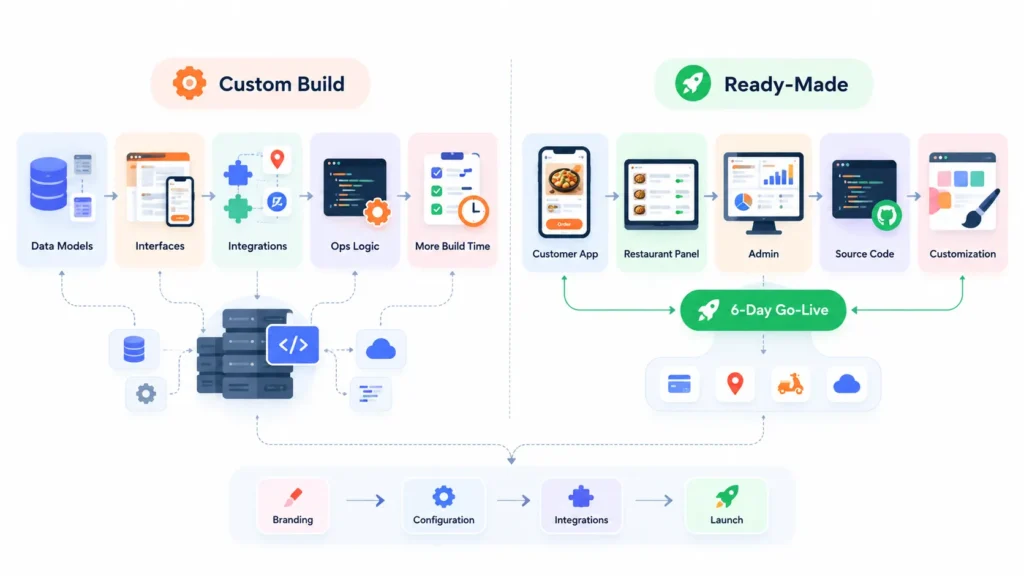
Architecture does not automatically imply that every module has to be developed from scratch. The scope of POS connections, payment workflows, branch logic, restaurant dashboards, APIs, and fulfilment integrations can significantly influence the development cost of a restaurant ordering platform.
A fully custom build gives a business substantial freedom over its data models, interfaces, integrations, and operational logic. That approach can make sense when the business model depends on highly specialized workflows or when existing foundations cannot accommodate critical requirements. It also means the team has to build and validate considerably more of the ordering ecosystem.
A ready-made foundation takes a different approach. Core customer, restaurant, ordering, administration, and fulfilment workflows can already exist, allowing the implementation effort to focus more heavily on branding, configuration, integrations, and business-specific modifications.
Founders still comparing both approaches can examine ready-made restaurant software vs custom development in more detail, including the trade-offs around launch speed, customization, ownership, and engineering effort.
Miracuves provides a ready-made direct restaurant ordering solution for businesses that want this route. The platform includes customer, restaurant and administrative interfaces alongside ordering functionality, with complete source code and customization options. Businesses evaluating the product itself can explore the restaurant ordering platform solution separately from this architecture guide.
For the ready-made configuration, Miracuves highlights a 6-day go-live timeline, while deeper customization or additional integrations should be scoped according to the required functionality. That distinction matters: deploying an existing product foundation is different from designing a heavily customized restaurant technology ecosystem from zero.
When Does a Direct Ordering Platform Need More Custom Architecture?
A standard ordering flow may be sufficient for many businesses, but architecture requirements grow when operations become unusual.
Deeper customization may be worth considering when the platform needs complex multi-brand management, proprietary restaurant systems, unusual payment routing, advanced franchise permissions, custom kitchen processes, region-specific fulfilment, specialized loyalty infrastructure, extensive POS connectivity, or other business-specific workflows.
The decision should come from operational requirements rather than from the assumption that more custom engineering automatically produces a better platform.
When those requirements involve specialized integrations or complex operational workflows, choosing an experienced restaurant ordering development partner becomes an important part of the implementation decision.
Founders should map the actual restaurant journey first: how menus are maintained, where orders should appear, how staff process them, how payments are reconciled, how fulfilment works, and which exceptions happen during real service. Architecture can then support those workflows instead of forcing restaurants to adapt to the software.
How Miracuves Can Support a Direct Restaurant Ordering Launch
The value of a restaurant ordering platform is not limited to putting a digital menu online. The product needs to connect customer ordering with restaurant operations in a way that remains manageable as transaction volume, locations, integrations, and business requirements grow.
Miracuves helps businesses start from an existing restaurant-ordering foundation rather than rebuilding every standard module from zero. The ready-made approach can provide a faster route to launch while retaining source-code ownership and room for business-specific customization.
Businesses comparing direct ordering with marketplace, restaurant SaaS, and delivery-led models can also explore Miracuves’ broader food delivery platform solutions before deciding which operating structure fits their market.
Businesses primarily researching architecture can use this guide to define their menu, order, POS, payment, and operations requirements. When the decision moves from architecture research to evaluating a deployable product, the ready-made restaurant ordering platform provides the relevant commercial and product details.
Final Thoughts: Architecture Should Make Restaurant Operations Simpler
The strongest direct ordering architecture is not necessarily the one containing the largest number of services or integrations. It is the one that makes the complete restaurant order lifecycle reliable and understandable.
Menus need clear ownership. Orders need consistent state management. Payments need proper reconciliation. POS connections should eliminate duplicate work. Restaurant teams need operational control, while administrators need visibility across the platform. External failures should be manageable without losing track of customer orders.
When those foundations are designed well, customer-facing ordering becomes only the visible edge of a much stronger operational system.
For founders, that changes the architecture discussion from “What features should the app have?” to a more valuable question: How should every system work together from the moment a menu changes to the moment an order is completed and reconciled?
That is the foundation on which a scalable direct restaurant ordering business can be built.
FAQs
What is direct restaurant ordering platform architecture?
It is the technical and operational structure connecting the customer ordering experience with menus, cart validation, payments, order management, restaurant systems, kitchen workflows, fulfilment, notifications, and administration. Good architecture defines how these components exchange data and which system owns each business state.
How does an online restaurant ordering platform integrate with a POS?
A platform can use APIs, webhooks, and a dedicated integration layer to exchange menu information, availability, orders, statuses, and other operational data with a POS. Using POS-specific adapters helps keep differences between external systems out of the platform’s core order logic.
Should the POS or online ordering platform control the menu?
Either approach can work, but there should be a clearly defined source of truth. If the POS controls menus, online menu data should synchronize from it. If the ordering platform is the master system, connected restaurant systems need appropriate synchronization rules.
Why are payment status and order status separate?
A successful payment does not necessarily mean the restaurant has accepted the order. Keeping transaction state separate from operational order state makes rejection, cancellation, refund, and reconciliation workflows easier to control.
What happens when a POS integration goes offline?
The platform should have a defined failure strategy that can include safe retries, queues, monitoring, alerts, and manual recovery. Idempotency is important so retries do not accidentally create duplicate restaurant orders.
How should multi-location restaurant ordering systems be structured?
Multi-location systems should separate brand-level controls from branch-level data. Each branch may require its own menu availability, pricing, operating hours, delivery zones, POS configuration, payment settings, and preparation capacity.
Is it necessary to build a restaurant ordering system from scratch?
Not always. Fully custom development can be appropriate for highly specialized business models. When standard menu, ordering, restaurant, payment, admin, and fulfilment workflows already cover much of the requirement, a customizable ready-made foundation can reduce the amount of baseline engineering required.
How quickly can Miracuves deploy a ready-made restaurant ordering solution?
Miracuves currently states a 6-day go-live option for its ready-made restaurant ordering product. Custom integrations or substantially different workflows can affect scope, so requirements should be confirmed before treating that timeline as applicable to a specific project.
Miracuves is an independent software development company. We are not affiliated with, connected to, sponsored by, or endorsed by any company or product named in this article.
Terms such as “X Clone” are used descriptively. It is how the software industry refers to building a platform with functionality comparable to a known service, and how clients search for it.
The entire design and codebase of our products is built by our own team. Our products contain no code, design, graphics, or content originating from any third-party website or applications.
All third-party names and marks referenced in this article are the property of their respective owners, referenced solely to identify the services discussed.