Key Takeaways
- A ready-made direct restaurant ordering platform gives startups an existing foundation for digital menus, online orders, payments, POS integrations, pickup, delivery, loyalty, and restaurant management.
- Compared with custom development, a prebuilt platform can reduce repeated engineering across ordering workflows, customer accounts, payment processing, menu management, notifications, and admin operations.
- Founders should still evaluate source-code ownership, customization depth, POS compatibility, scalability, security, integration flexibility, maintenance requirements, and long-term product control.
Ready-Made Platform Signals
- Prebuilt modules can include menu management, modifiers, carts, promo codes, scheduled orders, payment gateways, order tracking, restaurant dashboards, refunds, and customer notifications.
- Startups can customize branding, restaurant workflows, ordering channels, payment methods, delivery settings, loyalty programs, subscriptions, promotions, customer engagement, and multi-location operations.
- A modular foundation can make it easier to add branded apps, advanced POS integrations, marketing automation, delivery partners, CRM tools, personalized offers, analytics, and additional restaurant locations over time.
Startup Decision Insights
- Startups should compare development effort, available budget, technical resources, customization requirements, integration complexity, ownership needs, maintenance, and total cost of operation.
- Custom development may suit highly specialized restaurant products, while a customizable ready-made foundation can help teams validate ordering, restaurant adoption, repeat customers, and revenue without rebuilding standard modules from scratch.
- Miracuves develops customizable direct restaurant ordering platforms with digital menus, online ordering, POS integrations, payments, loyalty, delivery workflows, marketing tools, analytics, and admin controls.
For a startup entering restaurant technology, one of the earliest product decisions is also one of the most expensive to get wrong: should the entire ordering platform be engineered from scratch, or should the business begin with a ready-made foundation and customize it around its market?
Building from zero can sound attractive because it promises complete control over every workflow. But early-stage companies rarely face a shortage of possible features. They face a shortage of validated assumptions. Restaurant acquisition, pricing, onboarding, customer adoption, payment flows, fulfilment and retention all need to be tested in the real market.
A ready-made direct restaurant ordering platform changes where the startup spends its first months. Instead of using most of that period to recreate standard ordering functionality, founders can concentrate on branding, restaurant partnerships, positioning, integrations and the operational details that actually differentiate the business.
That does not mean custom development is unnecessary. It means startups should determine where customization creates a competitive advantage and where it simply recreates infrastructure that already exists.
Why the Build-vs-Buy Decision Matters More for Startups
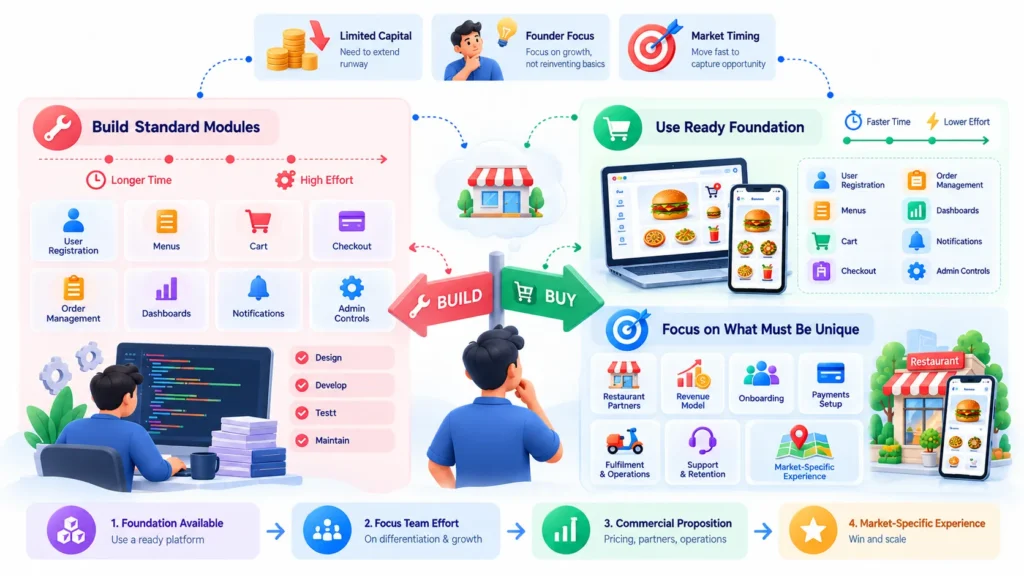
An established company may be able to fund a long product-development cycle before testing the finished system commercially. Startups operate under different constraints. Capital, founder attention and market timing are limited, which means every month spent engineering standard functionality carries an opportunity cost.
A restaurant ordering business is also more than an application. The startup still needs to recruit restaurant partners, define its revenue model, establish onboarding processes, configure payments, determine how orders are fulfilled, support users and convince restaurants that another technology platform deserves a place in their daily operations.
This changes the development question.
Instead of asking, “Can we build this ourselves?” a founder should ask, “Which parts actually need to be unique for our business to win?”
Customer registration, menus, carts, checkout, order management, restaurant dashboards, notifications and administrative controls are important, but their existence alone rarely differentiates a new restaurant technology company. When those foundations are already available, the startup can put more effort into its commercial proposition and market-specific experience.
What Is a Ready-Made Direct Restaurant Ordering Platform?
A ready-made direct ordering platform is an existing software foundation containing the core workflows needed to connect restaurants, customers and platform administrators. Rather than beginning with an empty codebase, the startup configures and customizes an established product foundation around its branding and operating model.
Founders who are still evaluating the underlying concept may also want to understand how a direct restaurant ordering platform works before comparing development approaches. Understanding the relationship between restaurants, customers, ordering workflows, and platform operations makes the ready-made-versus-custom decision easier to evaluate.
Depending on the platform and project scope, the foundation may support areas such as:
- Restaurant onboarding and management
- Digital menus and item configuration
- Customer registration and profiles
- Cart and checkout workflows
- Online payments
- Order placement and management
- Pickup or delivery workflows
- Promotions and customer engagement
- Restaurant dashboards
- Platform administration
- Notifications and order updates
- Reporting and operational visibility
For founders comparing product foundations, the feature set should be evaluated as a collection of connected operational workflows rather than a checklist. Customer ordering, restaurant management, menu controls, payments, order processing, notifications, and platform administration need to work together from the first transaction. Reviewing the available restaurant ordering platform features can help founders identify which essential workflows are already covered and where business-specific customization may still be required.
The important distinction is that ready-made does not necessarily mean fixed. A useful white-label foundation should give the business enough flexibility to establish its own identity, configure relevant workflows and extend the product where genuine differentiation is required.
For startups that have reached the stage of evaluating an actual deployable platform, Miracuves provides a ready-made direct restaurant ordering solution with commercial and product details available separately. This keeps the product evaluation separate from the strategic build-vs-buy decision discussed here.
Why Startups Often Choose Ready-Made Restaurant Ordering Software
Faster Market Validation Matters More Than Finishing Every Possible Feature
Before launch, founders work largely with assumptions. They may believe restaurants want a particular pricing model, onboarding process, loyalty mechanism or customer experience, but those assumptions become meaningful only when restaurants and customers interact with the product.
A lengthy custom build delays that feedback.
Starting from an existing ordering foundation allows the startup to reach the stage where it can answer more valuable questions: Are restaurants willing to join? How difficult is onboarding? Which features do operators actually use? Where do customers abandon checkout? Which pricing structure is easier to sell?
The faster those questions can be tested, the sooner the product roadmap can be based on evidence instead of predictions.
Engineering Capital Can Be Reserved for Real Differentiation
Custom development consumes more than development fees. It consumes management time, product planning, QA capacity and attention.
Every standard module built from scratch has to be specified, designed, developed, tested and maintained. Even familiar functionality such as menu modifiers or order statuses can create edge cases once restaurants begin using the platform during busy operating hours.
A ready-made foundation can shift engineering effort away from recreating basic infrastructure and toward functionality that may actually distinguish the startup.
That could include a specialized restaurant onboarding workflow, local payment integration, unusual subscription model, niche restaurant category, loyalty concept or market-specific operational process.
The strategic advantage is therefore not simply “less coding.” It is more selective coding.
Founders Can Focus Earlier on Restaurant Acquisition
Software alone does not create the restaurant network.
A startup still needs to identify its ideal restaurant profile, develop its sales proposition, build onboarding materials, configure menus, establish support processes and demonstrate why restaurants should adopt the platform.
These activities can easily become secondary when founders are occupied with a large custom software project. A faster technology route gives the commercial side of the company an opportunity to start learning sooner.
For a B2B restaurant technology startup, that can be particularly important because restaurant feedback may influence the product more than the founder’s original feature assumptions.
Reaching launch sooner also allows the startup to test how it attracts, onboards, and retains restaurant partners. Product readiness alone does not create adoption; positioning, restaurant outreach, merchant education, retention, and customer demand all influence growth. A focused restaurant platform marketing strategy can help founders think beyond development and prepare the go-to-market layer alongside the technology.
A Working Foundation Makes Product Decisions More Concrete
Planning an ordering system entirely through specifications can make almost every proposed feature seem essential. Evaluating a working foundation forces more useful decisions.
Instead of asking whether the platform needs “restaurant management,” founders can examine the actual workflow and ask whether it reflects how their target restaurants operate. Instead of requesting “advanced ordering,” they can test modifiers, availability, checkout, order acceptance and exception handling.
This moves product planning from abstract feature lists toward real operational scenarios.
Ready-Made vs Custom Development: What Actually Changes?
The two approaches should not be treated as “good” and “bad.” They optimize for different business conditions.
| Decision Area | Ready-Made Platform | Custom Development |
|---|---|---|
| Starting point | Existing ordering foundation | New architecture and codebase |
| Time to initial market entry | Typically faster because standard modules already exist | Longer because core workflows must be designed and developed |
| Upfront engineering requirement | Focused mainly on configuration, branding, integrations and selected customization | Broader design, development, testing and infrastructure work |
| Product flexibility | Depends on architecture, source-code access and customization scope | High when requirements are properly engineered |
| Validation speed | Earlier opportunity to test restaurant and customer assumptions | Validation generally follows a longer build cycle |
| Technical risk | Existing modules can reduce the amount of untested functionality introduced at launch | More components need to be validated for the first release |
| Best fit | Startups whose differentiation sits above standard ordering infrastructure | Businesses whose core advantage requires unusual proprietary workflows |
| Founder focus | More attention can move toward go-to-market and operations | More attention is required for product specification and development |
The useful question is therefore not which approach offers the maximum theoretical flexibility. It is which level of flexibility the startup genuinely needs before market validation.
The Opportunity Cost of Building Everything From Scratch
Development budgets are visible. Opportunity cost is easier to overlook.
If a startup spends months developing foundational ordering functionality, it is also delaying restaurant conversations, onboarding experiments, customer acquisition tests and revenue-model validation. Market conditions may change during that period, but the larger problem is that the team is still learning mainly from internal assumptions.
The financial comparison should also account for more than the initial coding budget. Infrastructure, payment integrations, testing, maintenance, third-party services, updates, and ongoing engineering can all influence restaurant ordering platform development costs. Looking at these cost drivers alongside time-to-market gives founders a more realistic basis for comparing a ready-made foundation with ground-up development.
There is also a sequencing issue. Some custom requirements only become obvious after restaurants begin using the system.
A founder might initially prioritize visual customization, for example, while early restaurant partners reveal that menu onboarding speed, staff permissions or order exception handling causes far more operational friction. Building extensively before gathering that information can result in technically polished functionality that solves the wrong priority.
A ready-made foundation lets the startup reverse the sequence: establish the standard product layer, expose it to the market, then invest more heavily in customization where evidence supports it.
Direct Ordering Creates a Different Startup Proposition
A direct restaurant ordering business should not automatically be treated as another broad delivery marketplace.
The proposition can instead revolve around helping restaurants operate a stronger branded digital ordering channel, maintain closer customer relationships and gain greater control over how digital orders are managed. The startup’s role therefore extends beyond acquiring consumers. It must create enough operational value for restaurants to continue using the platform.
That value proposition also shapes monetization. Depending on the operating strategy, a platform can generate revenue through recurring restaurant plans, onboarding services, transaction-related charges, delivery services, promotional tools, or other value-added offerings. Founders defining their commercial strategy can explore the direct restaurant ordering business model in more detail before deciding which revenue streams fit their target restaurants.
That can influence product priorities.
Restaurant onboarding needs to be manageable. Menus need to stay accurate. Incoming orders need clear statuses. Payment and fulfilment responsibilities need to be understood. Administrators need visibility into restaurant activity and platform operations.
For founders wanting a deeper technical view of how those layers connect, Miracuves’ guide to direct restaurant ordering platform architecture covers menus, orders, payments, POS integrations and restaurant operations in more detail.
The Founder Decision Signals That Favor a Ready-Made Platform
Speed
Your immediate objective is to put a functional product in front of restaurants and validate demand rather than spend the first phase building standard ordering infrastructure.
Capital Allocation
You would rather reserve more early-stage resources for restaurant acquisition, onboarding, operations, marketing and differentiated functionality.
Product Scope
Your first release primarily needs established restaurant-ordering workflows, with customization concentrated around branding, integrations and your business model.
Market Learning
You expect restaurant and customer feedback to influence the long-term roadmap and want those insights before committing to extensive proprietary development.
There is another signal worth considering: uncertainty.
If the startup is still learning which restaurant segment it should serve, which revenue model performs better or which integrations the market considers essential, committing immediately to an extensive custom architecture can lock capital into assumptions that have not yet been validated.
In that situation, flexibility should mean the ability to learn and change, not simply the ability to specify more functionality before launch.
Ready-Made Should Not Mean Giving Up Product Ownership
One legitimate concern about ready-made software is dependency.
A platform may launch quickly but create long-term restrictions if the business cannot access the source code, control its infrastructure, extend important modules or migrate away from the original provider. For founders building a company rather than running a temporary experiment, those questions deserve attention before selecting a platform.
Evaluate issues such as:
- Whether source code is included
- Whether the product can carry your own branding
- Whether business-specific workflows can be modified
- How integrations are handled
- Who controls deployment and infrastructure
- Whether new modules can be added later
- What happens if the original development relationship ends
- Whether there are recurring platform or revenue-share dependencies
This is where the difference between a simple software subscription and a source-code-owned product foundation becomes strategically important.
Miracuves’ ready-made approach emphasizes white-label deployment and source-code ownership, allowing founders to begin from an existing foundation without treating the first release as the permanent limit of the product.
Where Custom Development Still Makes More Sense
Ready-made development is not automatically the right route for every startup.
Custom development becomes more compelling when the startup’s central innovation cannot be expressed effectively through an existing platform architecture. If the business depends on a proprietary restaurant workflow, unconventional fulfilment model, specialized hardware ecosystem or technical capability that changes how ordering fundamentally works, adapting a standard foundation could eventually create more complexity than building the right architecture directly.
This is where architecture deserves closer examination. Menu logic, order processing, payment routing, restaurant operations, third-party integrations, and administrative controls can determine whether an existing foundation is suitable for deeper customization. Founders facing these requirements can use this restaurant ordering platform architecture guide to understand the technical layers before deciding how far customization should go.
Custom development may deserve stronger consideration when:
- The proprietary workflow itself is the startup’s defensible advantage
- Existing platforms would require extensive structural modification
- Specialized hardware or unusual third-party systems define the product
- The organization has sufficient capital and technical resources for a longer build
- Requirements are already well validated through existing operations or customer evidence
The distinction is important. Startups should not choose ready-made technology simply because it is faster, just as they should not choose custom development simply because it offers more theoretical control.
The right choice depends on where the company’s differentiation actually lives.
How to Evaluate a Ready-Made Restaurant Ordering Foundation Before Committing
Speed should never replace due diligence.
A startup evaluating an existing platform should test it as an operating business would, rather than evaluating it from screenshots or a feature checklist alone. Walk through customer ordering, restaurant acceptance, menu changes, payment events and administrative tasks.
Pay particular attention to operational exceptions. What happens when an item becomes unavailable after an order begins? Can restaurants adjust their availability? How are failed or cancelled orders represented? Which controls belong to the restaurant and which belong to the platform operator?
The evaluation should also look beyond today’s launch.
The team behind the technology deserves the same scrutiny as the software itself. Founders should understand how customization requests are handled, who manages deployment, what happens during source-code handover, how integrations are scoped, and what support is available after launch. Evaluating these factors can make it easier to choose a restaurant ordering development partner that fits both the immediate launch and the longer-term product roadmap.
Founders need to understand how the platform handles customization, source-code access, deployment, future integrations and scaling requirements. A foundation is valuable when it accelerates the initial launch without unnecessarily restricting the roadmap that follows it.
Why a Six-Day Deployment Can Change Startup Economics
Time-to-market is not merely a technical metric. For an early-stage company, it determines when market learning can begin.
Miracuves’ current ready-made restaurant ordering solution is positioned for deployment in six days and includes white-labeling and source-code ownership. The commercial solution page provides the current scope and product details.
That timeline matters because a startup that can reach a functional launch quickly can begin spending its next cycle on restaurant acquisition, onboarding feedback and business-model validation rather than waiting for foundational modules to be completed.
The six-day delivery should not be confused with six days for unlimited custom software development. It applies to the ready-made solution foundation. Additional business-specific changes should be scoped according to the required integrations and customization.
This distinction helps founders compare options realistically: rapid deployment for the established foundation, selective development for what makes the startup different.
Common Mistakes Startups Make When Choosing Their Development Route
Confusing More Features With Better Validation
A larger pre-launch feature list does not prove that restaurants will adopt the product. Prioritize the workflows required to test the business proposition, then let actual usage influence deeper development.
Choosing Speed Without Checking Ownership
A fast launch is less valuable if the startup becomes permanently dependent on a restrictive platform. Source-code access, customization rights and deployment control should be understood before committing.
Customizing Before Understanding Restaurant Operations
Extensive early customization can encode assumptions that restaurant partners later invalidate. Separate genuine differentiation from preferences that can wait until operational feedback exists.
Ignoring the Commercial Work Around the Software
The platform still needs restaurants, onboarding, support, positioning and a viable revenue model. Product development should create room for those activities rather than consuming the startup’s entire first phase.
Think Beyond Launch: What Happens After Validation?
Choosing a ready-made foundation does not mean choosing a permanently static product.
In fact, one of the strongest approaches for a startup can be to separate product development into two categories: standard infrastructure and evidence-backed differentiation.
Standard ordering functionality can provide the initial operating layer. Once the startup observes how restaurants and customers behave, its development budget can move toward features supported by actual demand.
Perhaps restaurant partners need deeper POS synchronization. Perhaps multi-location management becomes essential. Perhaps a particular loyalty mechanic materially improves repeat ordering. Perhaps the startup discovers that a specialized onboarding workflow is its strongest competitive advantage.
Those are better reasons to invest in custom engineering than simply rebuilding everything because the company wants to call the product custom.
When Should a Startup Move From Ready-Made to Deeper Customization?
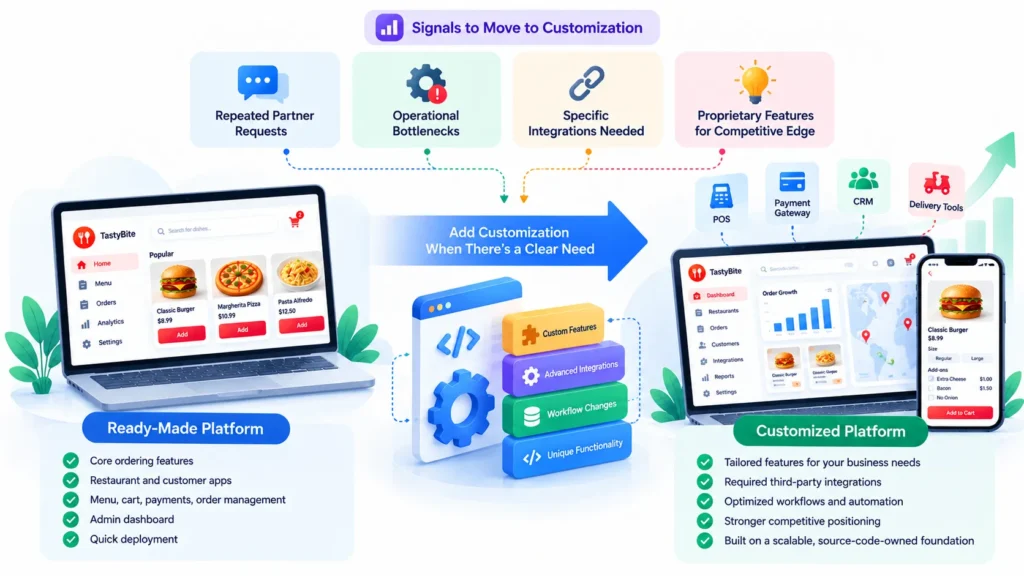
The transition should be triggered by business evidence rather than an arbitrary product roadmap.
Signals can include repeated requests from valuable restaurant partners, operational bottlenecks that cannot be solved through configuration, integration requirements that affect acquisition, or proprietary functionality that materially strengthens the startup’s positioning.
At that point, customization is no longer speculative. It is solving a demonstrated business problem.
Source-code ownership becomes especially useful here because the startup can treat the ready-made platform as a product foundation rather than a disposable prototype.
How Miracuves Supports This Startup Approach
Miracuves helps founders start with an established restaurant-ordering foundation rather than requiring every standard module to be engineered again before launch.
The approach is particularly relevant for startups that want to validate a restaurant technology proposition quickly while retaining the ability to brand, configure and extend the product. A ready-made foundation can be deployed in six days where applicable, while additional integrations or custom workflows can be scoped around the actual business requirements.
The objective is not to remove custom development from the roadmap. It is to use it more deliberately.
When founders have completed the strategic comparison and are ready to inspect the actual product, the Miracuves restaurant ordering platform provides the relevant features, demos, deployment details and commercial information.
Related reading: ready-made or custom for a food gifting marketplace.
Final Thoughts: Build What Differentiates the Business
The strongest argument for a ready-made direct restaurant ordering platform is not simply that it can reduce development work. It changes when a startup begins learning from the market.
Building every standard module from scratch may provide maximum control, but control has limited value when the underlying business assumptions remain untested. An existing foundation allows founders to move standard functionality closer to launch while reserving custom engineering for areas that restaurant feedback, customer behaviour and operational evidence show actually matter.
Custom development still has an important role. When proprietary technology or unusual workflows form the core competitive advantage, building specifically for those requirements can be the right investment.
For many early-stage restaurant technology companies, however, the more practical sequence is different: establish the ordering foundation, validate the commercial model, learn from restaurants, and then customize more deeply around what the market proves valuable.
FAQs
What is a ready-made restaurant ordering platform?
A ready-made restaurant ordering platform is an existing software foundation containing core digital ordering workflows such as restaurant management, menus, customer ordering, checkout, payments, order processing and administrative control. It can then be branded, configured and customized for a particular business model.
Why do startups use ready-made restaurant ordering software?
The primary advantage is speed to market and validation. Instead of spending the entire initial development cycle recreating standard ordering functionality, startups can focus sooner on restaurant onboarding, customer acquisition, operations and testing their commercial assumptions.
Is a ready-made restaurant ordering platform customizable?
Customization depends on the platform and provider. Founders should evaluate branding options, source-code access, integrations, workflow changes and the ability to extend functionality rather than assuming every ready-made product provides the same level of control.
Is custom restaurant ordering app development better for scalability?
Not automatically. Scalability depends on architecture, infrastructure, code quality, database design and how the system is operated. A custom product can be highly scalable, but being custom-built does not by itself guarantee better performance or scalability.
When should a startup choose custom development instead?
Custom development becomes particularly relevant when proprietary functionality is central to the business, existing foundations require major structural changes, unusual hardware or integrations define the product, or the startup already has validated requirements that justify a larger engineering investment.
Can a startup begin with ready-made software and customize it later?
Yes, provided the selected foundation supports modification and the business has appropriate access to the underlying product. This approach allows early market feedback to guide later customization instead of attempting to predict every requirement before launch.
What should founders check before buying white-label restaurant ordering software?
Founders should examine real workflows, branding flexibility, source-code ownership, deployment control, payment and integration options, administrative capabilities, future customization and the support available after deployment. Evaluating an operational demo is more useful than relying only on a feature list.
How quickly can Miracuves deploy a ready-made restaurant ordering solution?
Miracuves currently offers a six-day launch for its ready-made restaurant ordering solution. That timeline applies to deployment of the existing solution foundation; additional integrations and custom development should be scoped according to the specific requirements of the startup.
Miracuves is an independent software development company. We are not affiliated with, connected to, sponsored by, or endorsed by any company or product named in this article.
Terms such as “X Clone” are used descriptively. It is how the software industry refers to building a platform with functionality comparable to a known service, and how clients search for it.
The entire design and codebase of our products is built by our own team. Our products contain no code, design, graphics, or content originating from any third-party website or applications.
All third-party names and marks referenced in this article are the property of their respective owners, referenced solely to identify the services discussed.