Key Takeaways
- Credit card rewards platform go to market strategy works best when founders combine a focused launch segment, strong trust messaging, first-payment activation, useful rewards, partnerships, referrals, and billing-cycle retention.
- The first target audience should be narrow enough to understand deeply, such as premium cardholders, salaried professionals, rewards-focused users, or people managing multiple credit cards.
- Fintech acquisition should build trust before excitement because users need confidence in card linking, payment security, financial data handling, and reward accuracy.
- SEO, paid search, partner campaigns, referrals, creator marketing, and app store optimization can work together once onboarding and first-payment activation are reliable.
- GTM success should be measured through card linking, first successful payments, repeat payments, reward redemption, referrals, and retention rather than downloads alone.
GTM Signals
- A focused launch wedge helps founders create sharper positioning, more relevant rewards, better onboarding, and more efficient acquisition campaigns.
- The strongest positioning usually combines utility and reward, such as helping users manage bills while providing meaningful benefits after payment.
- Referral incentives should be connected to verified actions such as card linking, successful bill payments, or repeat usage to reduce fraud.
- Partner campaigns can strengthen acquisition when offers are relevant to the target audience and support the platform’s reward economics.
- Lifecycle campaigns should follow billing cycles through bill reminders, payment nudges, reward updates, offers, and next-cycle re-engagement.
Real Insights
- Targeting everyone with a credit card usually creates vague messaging; starting with one high-intent segment makes GTM testing more measurable.
- Paid acquisition should not scale until users can successfully complete onboarding, link cards, make payments, understand rewards, and return for another billing cycle.
- Rewards may drive initial interest, but payment trust, useful reminders, credit insights, and relevant offers are more important for building a recurring habit.
- GTM planning should influence product scope because referral campaigns, partner offers, rewards, and retention strategies require corresponding product and admin controls.
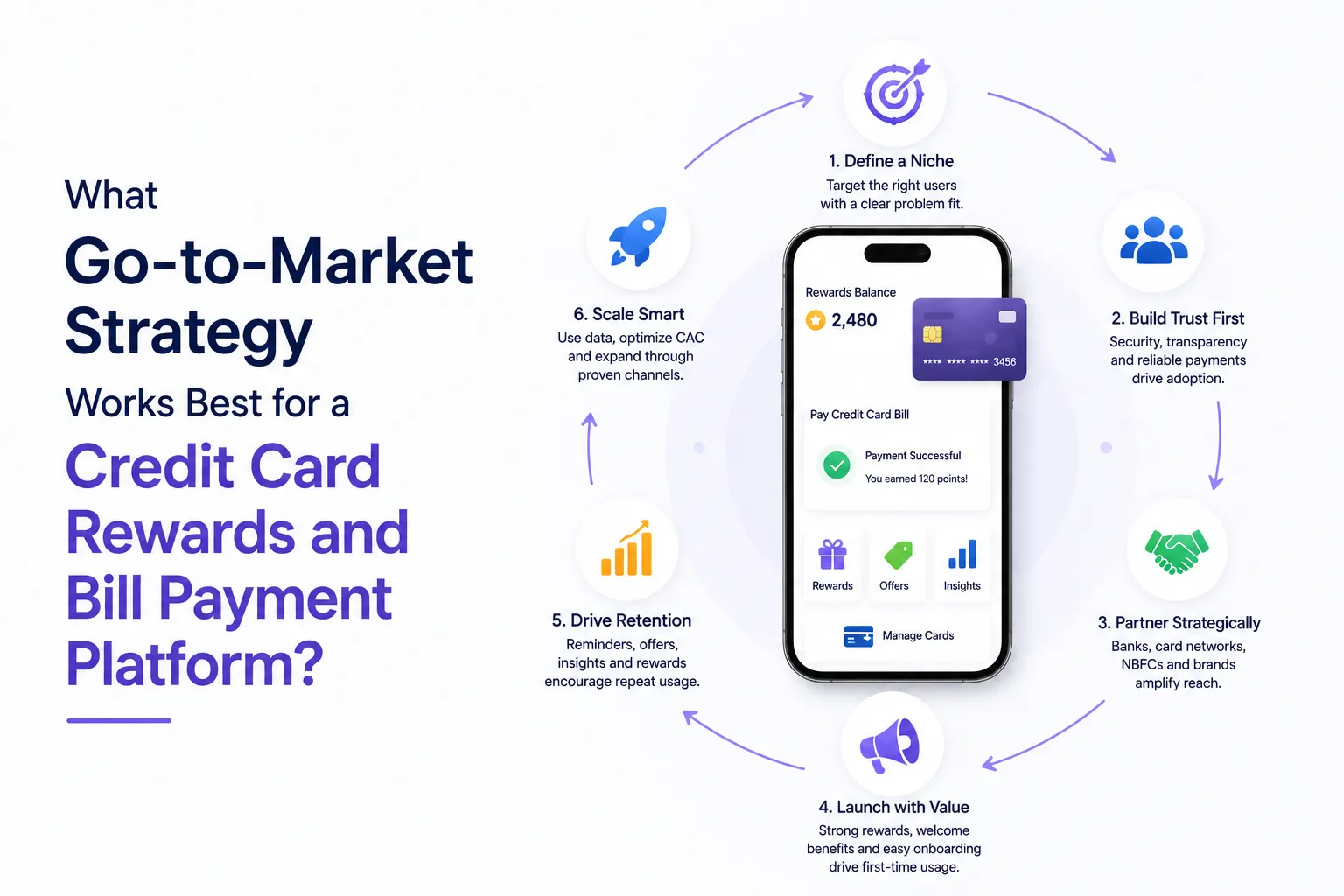
- The strongest launch path is: choose a segment → establish trust → activate first payment → deliver reward value → build retention → encourage referrals → scale acquisition.
Launching a credit card bill payment platform is not only a technology challenge. It is a trust, timing, acquisition, and habit-building challenge.
Users do not download a financial app simply because it has bill reminders or rewards. They need a strong reason to connect their cards, trust the payment flow, share financial data, return every billing cycle, and believe the rewards are worth their attention.
That is why go-to-market strategy matters.
A credit rewards platform needs more than broad app marketing. It needs a focused launch wedge, a clear trust message, the right early users, strong reward positioning, reliable payment flows, partner-led growth, referral loops, and retention campaigns built around billing cycles.
This guide explains credit card rewards platform go to market strategy works best for a credit card rewards and bill payment platform, how founders should choose their first market segment, which acquisition channels matter, and how to turn early adoption into repeat usage.
Why GTM Strategy Is Different for Fintech Rewards Platforms
A normal consumer app can sometimes grow by offering convenience, entertainment, or discounts. A fintech rewards app has a higher trust barrier.
Users are not just browsing content. They are connecting credit cards, tracking bills, initiating payments, checking rewards, and sometimes viewing credit behavior. That means the go-to-market message must reduce anxiety before it creates excitement.
A strong launch strategy should answer five user questions:
- Why should I use this app instead of my bank app?
- Is my payment safe?
- Will my card details and financial data be handled carefully?
- What real value do I get after paying bills?
- Why should I return next month?
If the GTM strategy answers only “earn rewards,” the product may attract users who chase offers once and leave. If the strategy combines trust, utility, reminders, payment clarity, and valuable rewards, the platform has a stronger chance of becoming a recurring financial habit.
Read more- How Credit Card Bill Payment and Rewards Apps Work: User Journey, Trust Logic, and Engagement Model
Start With the Right Launch Wedge
The biggest GTM mistake is launching to “everyone with a credit card.”
That audience is too broad. Different users have different motivations. Some care about rewards. Some care about due-date reminders. Some care about credit score visibility. Some care about paying multiple cards from one place. Some care about premium offers.
A focused launch wedge helps founders design sharper messaging, better onboarding, and stronger early acquisition campaigns.
Useful launch wedges include:
| Launch Wedge | User Pain Point | Best GTM Message |
|---|---|---|
| Premium credit card users | Managing multiple cards and maximizing rewards | Manage cards, pay on time, and unlock better benefits |
| Salaried professionals | Avoiding late payments and tracking bills | Never miss a card bill again |
| Rewards-focused users | Discovering cashback, vouchers, and offers | Turn monthly bill payments into useful rewards |
| Frequent online shoppers | Matching cards with relevant offers | Find better offers around your spending habits |
| Young credit users | Understanding credit behavior | Track dues, utilization, and payment habits in one place |
| Partner-brand audiences | Using loyalty benefits | Pay bills and access curated partner rewards |
The first market should be narrow enough to understand deeply and large enough to validate demand.
Define the Core Positioning Before Spending on Acquisition
A credit card rewards product can be positioned in several ways. The positioning should match the user segment and product strength.
Possible positioning angles include:
- Bill payment convenience
- Multiple card management
- Due-date reminder app
- Rewards and cashback platform
- Credit behavior companion
- Premium financial membership
- Partner-offer marketplace
- Cardholder engagement app
- Loyalty and referral platform
The strongest positioning often combines two layers: utility and reward.
For example:
- “Pay card bills on time and earn rewards.”
- “Manage all your cards in one place while unlocking partner offers.”
- “Track dues, avoid late fees, and make bill payments more rewarding.”
- “Turn monthly credit card payments into a repeat rewards habit.”
The message should not sound like a generic fintech app. It should make the recurring problem obvious and the value immediate.
Build Trust Before Running Aggressive Campaigns
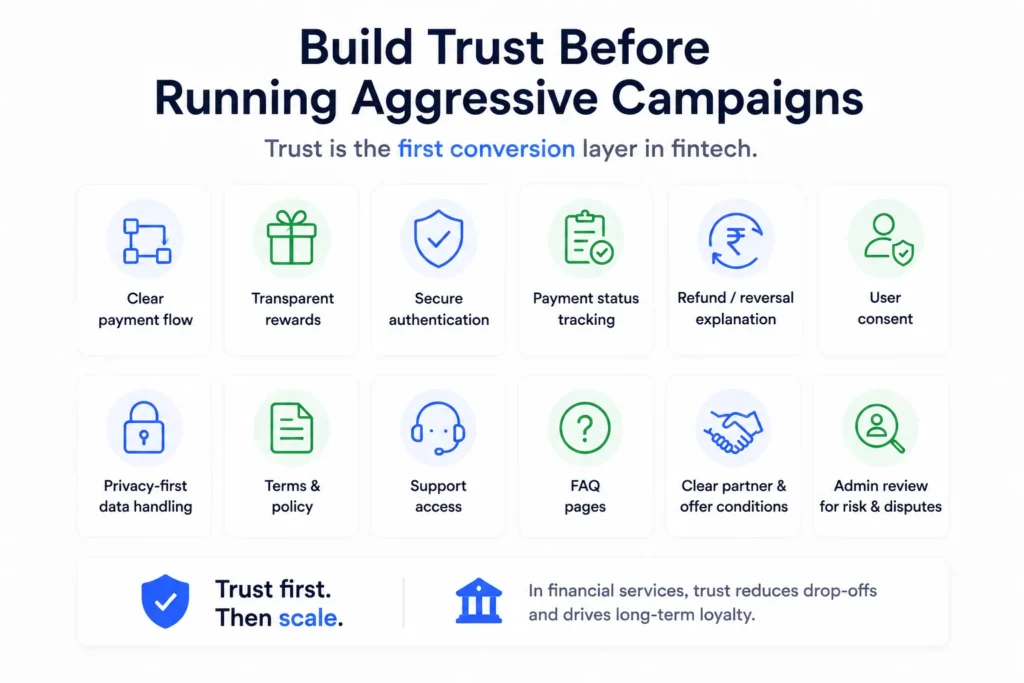
Trust is the first conversion layer in fintech.
Before scaling paid ads, influencer campaigns, or referral programs, the product and website should show clear trust signals.
Important trust assets include:
- Clear explanation of payment flow
- Transparent reward rules
- Secure authentication
- Payment status tracking
- Refund or reversal handling explanation
- User consent screens
- Privacy-conscious data handling
- Activity logs
- Support access
- FAQ pages
- Terms and policy pages
- Clear partner and offer conditions
- Admin review workflows for risk and disputes
For founders building in banking, credit, payments, or financial rewards, Miracuves’ banking and insurance app solutions page can help connect the product model to broader fintech workflows.
Map the User Journey Before Choosing Channels
Channels do not fix weak journeys.
Before deciding whether to use paid ads, SEO, influencers, referrals, or partnerships, founders should map the first user journey.
A practical first journey looks like this:
| Journey Stage | User Question | Product/GTM Requirement |
| Discovery | Why should I try this app? | Clear value proposition |
| Landing page | Is this safe and useful? | Trust copy, FAQs, visuals, security language |
| Signup | Is onboarding simple? | Low-friction account creation |
| Card setup | Can I add my card safely? | Secure card workflow and clear consent |
| Bill reminder | Will this help me avoid missing payments? | Accurate reminder logic |
| Payment | Can I pay without confusion? | Payment status clarity |
| Reward | What did I earn? | Visible reward rules and ledger |
| Return | Why should I come back? | Next-cycle reminder, offers, insights, streaks |
The GTM strategy should not only bring users into the funnel. It should help them reach the first successful bill payment and return for the next cycle.
First 90 Days GTM Plan for a Credit Card Bill Payment Platform
A practical launch plan should focus on controlled validation before heavy scaling.
Days 1–30: Validate the Segment and Trust Message
In the first month, founders should focus on understanding the highest-intent user segment.
Key actions:
- Define the target segment
- Build landing pages around the primary pain point
- Test 3–5 positioning messages
- Create onboarding explainers
- Prepare trust FAQs
- Launch a waitlist or private beta
- Interview early users
- Build reward rules carefully
- Set up analytics before campaigns
- Prepare support workflows
The goal is not mass acquisition yet. The goal is to learn which message creates trust and activation.
Days 31–60: Drive First Payments and Reward Activation
The second month should focus on moving users from signup to first successful payment.
Key actions:
- Launch targeted acquisition campaigns
- Use referral campaigns with verification conditions
- Run partner reward campaigns
- Send bill-cycle reminders
- Track onboarding drop-off
- Monitor payment failure reasons
- Improve reward visibility
- Collect feedback after first payment
- Compare user cohorts by segment
- Adjust reward cost controls
The most important metric in this phase is not downloads. It is first successful payment and reward activation.
Days 61–90: Improve Retention and Referral Loops
The third month should focus on repeat usage.
Key actions:
- Send next-cycle payment reminders
- Introduce streaks or tier progress
- Launch limited-time partner offers
- Segment users based on activity
- Nudge inactive users before due dates
- Build referral bonuses around verified users
- Improve reward redemption flow
- Measure repeat payment rate
- Review support tickets
- Prepare expansion into the next segment
At this stage, founders should know whether the product is creating a habit or only attracting one-time reward seekers.
Acquisition Channels That Work Best
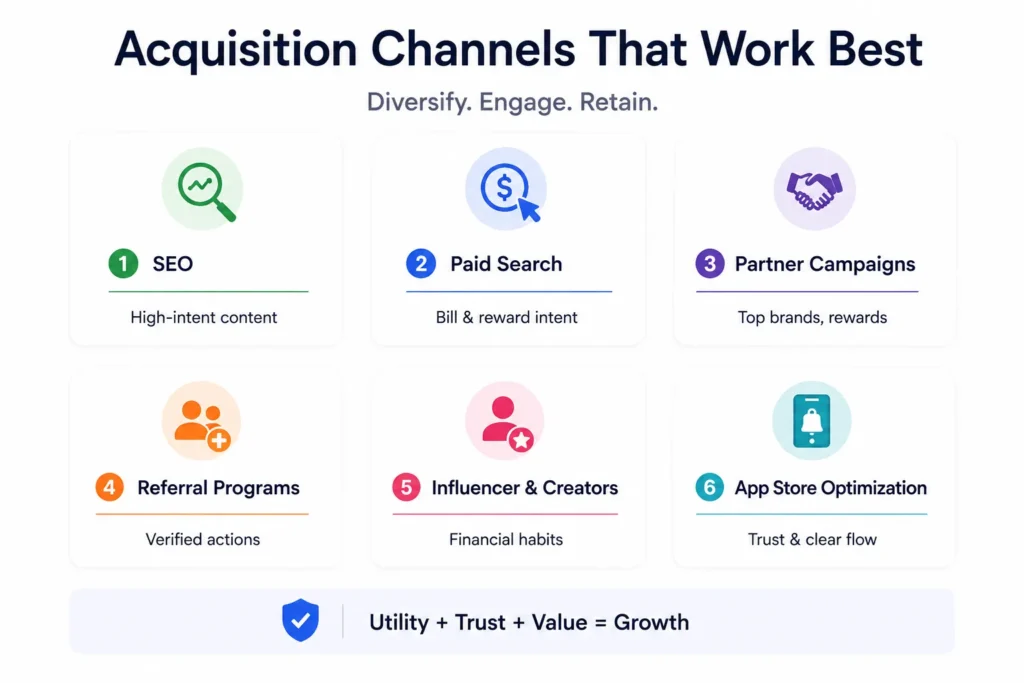
A credit rewards platform should not depend on one channel. The best GTM strategy usually combines intent-based acquisition, partner-led growth, referral loops, and retention campaigns.
1. SEO for High-Intent Financial Questions
SEO works well because users search for bill payment, credit card rewards, due dates, cashback, credit score, and card management questions.
Useful content clusters include:
- How to manage multiple credit cards
- How credit card bill payment apps work
- How to avoid missed card payments
- How credit card rewards work
- How payment reminders help cardholders
- How credit utilization affects financial behavior
- How rewards platforms make money
- How fintech apps build trust
This content should educate first and convert later. It should not copy the commercial landing page.
2. Paid Search for Bill Payment and Reward Intent
Paid search can work when the user has immediate payment or reward intent.
Campaigns can target:
- Credit card bill payment
- Pay credit card bill online
- Bill reminder app
- Credit card rewards app
- Cashback on bill payment
- Track credit card due dates
- Manage multiple credit cards
The ad copy should focus on utility first. Rewards can be a hook, but trust and payment clarity should support the click.
3. Partner Campaigns With Lifestyle and Financial Brands
Partner campaigns can make rewards feel real.
Possible partners include:
- Food delivery brands
- Travel platforms
- Ecommerce stores
- Subscription products
- Premium lifestyle brands
- Insurance providers
- Financial product providers
- Wallet and payment partners
- Credit education platforms
- Merchant networks
The platform can use partner rewards to improve acquisition, activation, and repeat engagement. For a deeper view of revenue and partnership logic, founders can review the credit and rewards platform business model.
4. Referral Programs With Verification Controls
Referrals can grow fintech apps quickly, but they can also create fraud if reward conditions are too loose.
A safer referral program should reward:
- Verified signup
- Card added
- First successful bill payment
- Repeat payment
- Genuine referral activity
- No suspicious duplicate accounts
- No fake payment attempts
The referral message should be simple: invite friends who pay credit card bills and both users receive a meaningful reward after a valid action.
5. Influencer and Creator Campaigns Around Financial Habits
Creators can help explain why the app matters.
Useful creator angles include:
- How I track my card due dates
- How to avoid late payment stress
- How rewards apps make bill payments more useful
- How to manage multiple cards
- What to check before paying card bills
- How to use cashback and partner offers wisely
The right creators are not only finance influencers. Productivity, lifestyle, shopping, travel, and young professional creators may also work if their audience uses credit cards actively.
6. App Store Optimization for Utility and Trust
App store pages should not only promote rewards.
They should communicate:
- Card bill reminders
- Secure bill payment
- Multiple card management
- Reward tracking
- Credit insights
- Partner offers
- Payment status clarity
- Support and trust
Screenshots should show the flow clearly: card dashboard, bill reminder, payment confirmation, reward credited, offer redemption, and profile progress.
Reward Strategy as a GTM Lever
Rewards can attract users, but they must be financially controlled.
A launch reward strategy may include:
- First payment bonus
- Referral bonus after verified payment
- Streak rewards
- Partner vouchers
- Tier unlocks
- Limited-time cashback campaigns
- Offer bundles for early users
- Category-based reward multipliers
The mistake is making rewards too generous without understanding payback. Founders should calculate reward cost, partner contribution, expected repeat usage, and fraud risk before launching campaigns.
Reward rules should be transparent. Users should know when rewards are earned, when they expire, and why they may be pending.
Read more- How Can a Credit Rewards Platform Turn Bill Payments Into Repeat User Engagement?
Product Features That Support GTM Success
A go-to-market plan works only when the product can support the promise.
GTM-Ready Product Features for Credit Rewards Platforms
| Feature | GTM Value | Founder Impact |
|---|---|---|
| Card vault | Supports the “manage all cards” positioning | Improves activation and product stickiness |
| Bill reminders | Creates recurring reasons to return | Improves retention across billing cycles |
| Payment status tracking | Builds trust during transaction moments | Reduces support pressure and user anxiety |
| Reward engine | Powers acquisition campaigns and retention loops | Turns bill payments into engagement moments |
| Referral system | Enables lower-cost user acquisition | Supports growth when verification rules are strong |
| Offer marketplace | Improves perceived reward value | Creates partnership and monetization opportunities |
| Credit insights | Adds value beyond rewards | Improves long-term trust and retention |
| Admin campaign console | Lets teams manage campaigns without developer dependency | Speeds up GTM experiments |
For founders comparing product scope before launch, these credit card rewards app features show how bill payment, rewards, referrals, offers, and operator controls support acquisition and retention.
Landing Page Strategy for a Credit Card Bill Payment Platform
The landing page should not feel like a generic app page. It should reduce financial hesitation.
Useful sections include:
- Clear headline around bill payment and rewards
- Problem statement around missed due dates or fragmented cards
- How it works in 3–4 steps
- Trust and security language
- Reward examples
- Payment status explanation
- Screenshots or product mockups
- FAQ section
- Partner offer preview
- Referral or early-access incentive
- Compliance caveat where needed
- Clear CTA
For early-stage launches, the CTA can be “Join Waitlist,” “Get Early Access,” “Try the App,” or “Talk to Product Expert,” depending on the stage.
Pricing and Development Scope Before GTM
GTM planning should happen before development scope is locked.
Why? Because the acquisition strategy affects the product roadmap.
If the launch depends on referrals, the product needs referral tracking and fraud checks. If the launch depends on partner offers, the product needs offer management and redemption controls. If the launch depends on credit insights, the product needs data integration and consent flows. If the launch depends on premium membership, the product needs subscription gating and plan logic.
Founders estimating build scope can review these fintech rewards app development cost factors before finalizing the first version.
Choosing the Right Development Partner for GTM Readiness
A credit rewards product is not only a mobile interface. It requires payment logic, reminders, reward rules, admin controls, offer catalogs, referral validation, support workflows, and security planning.
A strong development partner should understand:
- Fintech onboarding
- Payment gateway integration
- Reward ledger logic
- Offer marketplace workflows
- Referral rules
- Admin campaign controls
- User segmentation
- Notification systems
- Compliance-ready foundations
- Secure API integration
- Post-launch iteration
Founders comparing implementation options can use this guide on selecting a credit card bill payment app development company to evaluate product readiness before launch.
Founder Decision Signals
Segment Focus
If your target user is too broad, narrow the GTM wedge before scaling acquisition. Premium cardholders, salaried professionals, and rewards-focused users need different messaging.
Trust Readiness
If users hesitate to add cards or complete payments, improve security language, payment status clarity, consent flows, FAQs, and support visibility.
Reward Economics
If reward costs are unclear, pause aggressive campaigns until cashback limits, partner contributions, expiry rules, and fraud controls are defined.
Retention Fit
If users do not return for the next billing cycle, improve reminders, credit insights, reward nudges, offer relevance, and next-cycle triggers.
Growth Metrics Founders Should Track
Downloads are not enough.
A credit card bill payment platform should track:
| Metric | Why It Matters |
| Landing page conversion rate | Shows whether positioning is working |
| Signup completion rate | Shows onboarding friction |
| Card linking rate | Measures trust and activation |
| First bill reminder engagement | Shows whether users value utility |
| First payment completion rate | Measures core product success |
| Payment failure rate | Highlights trust and technical issues |
| Reward redemption rate | Shows reward relevance |
| Repeat payment rate | Measures retention |
| Referral conversion rate | Shows viral potential |
| Notification opt-out rate | Warns against over-messaging |
| Support ticket rate | Reveals user confusion |
| Partner offer engagement | Measures commercial value |
The strongest GTM strategy is measured around activation and retention, not just acquisition.
Mistakes Founders Should Avoid
Launching With Rewards but Weak Trust
Users may click for cashback, but they will not stay if payment status, card data handling, reward rules, or support flows feel unclear.
Targeting Everyone With a Credit Card
A broad audience creates vague messaging. Start with one high-intent segment and build a repeatable acquisition loop before expanding.
Spending on Ads Before Activation Works
If users do not add cards, pay bills, redeem rewards, or return next month, paid acquisition will only scale the leak.
Ignoring Partner Quality
Low-value offers can weaken the reward experience. Partner campaigns should feel useful, relevant, and aligned with the user segment.
Miracuves Perspective: GTM Works Better When Product Logic Is Ready
A fintech go-to-market strategy only works when the product can support the promise. If the campaign says “pay bills and earn rewards,” the platform needs reliable bill reminders, payment status handling, reward logic, redemption records, fraud controls, and admin campaign management.
Miracuves helps founders build fintech and rewards platforms with ready-made workflows, white-label branding, admin dashboards, payment integration support, reward systems, and source-code ownership. For founders who want a launch-ready product foundation before scaling acquisition, the Miracuves credit and rewards app solution is the most relevant next step.
The advantage of starting with a structured foundation is that founders can focus on positioning, partnerships, user acquisition, reward economics, and retention instead of rebuilding every core fintech module from zero.
When Clone App Development Services Make Sense
Some founders want to move faster by starting with a proven app pattern and customizing it for their audience, region, payment workflows, brand identity, reward system, and partner ecosystem.
Miracuves’ clone app development services can support founders who want to use a ready-made foundation while still shaping the product around their own business model.
This approach can be especially useful when GTM speed matters and the founder wants to validate whether the market responds to the bill payment plus rewards model before investing in a long custom build.
Related reading: how credit rewards platforms combine cards, bills and loyalty.
Final Thoughts
The best go-to-market strategy for a credit card bill payment platform is not built around broad promotion. It is built around a focused user segment, a strong trust message, a clear first-payment journey, useful rewards, partner value, and retention across billing cycles.
Founders should start narrow, validate the strongest pain point, prove that users will link cards and complete payments, then use rewards, referrals, partner offers, and credit insights to bring users back.
The goal is not only acquisition. The goal is habit formation.
When the platform helps users remember due dates, pay confidently, earn clearly, redeem meaningfully, and return next month, the product becomes more than another fintech app. It becomes part of the user’s financial routine.
FAQs
What is the best go-to-market strategy for a credit card bill payment platform?
The best GTM strategy is to start with a focused user segment, build trust around payments and data handling, drive first bill-payment activation, use rewards to create motivation, and improve retention through reminders, offers, referrals, and credit insights.
Who should a credit rewards platform target first?
Good early segments include premium credit card users, salaried professionals, rewards-focused users, young credit users, frequent online shoppers, and users managing multiple cards.
Which acquisition channels work best for fintech rewards apps?
Useful channels include SEO, paid search, referral programs, partner campaigns, creator marketing, app store optimization, and lifecycle notifications built around card billing cycles.
How can rewards improve fintech user acquisition?
Rewards can improve acquisition by giving users a reason to try the app. However, rewards should be tied to valid actions such as verified signup, card linking, successful bill payment, referrals, or repeat usage.
What should founders measure after launching?
Founders should track signup completion, card linking rate, first payment completion, repeat payment rate, reward redemption, referral conversion, payment failures, support tickets, and return rate before the next billing cycle.
Why is trust important in fintech GTM?
Trust is important because users are connecting cards, making payments, viewing financial records, and expecting reward accuracy. Clear security language, transparent status updates, privacy-conscious workflows, and support access improve conversion and retention.
Should founders launch with paid ads immediately?
Paid ads can work, but only after the product journey is ready. If onboarding, card linking, payment completion, and reward redemption are weak, paid ads may scale acquisition without improving retention.
When should founders use a ready-made fintech foundation?
A ready-made fintech foundation can help when founders want to launch faster, test demand, and start with core workflows such as card management, bill reminders, payments, rewards, referrals, offers, and admin controls already structured.
Miracuves is an independent software development company. We are not affiliated with, connected to, sponsored by, or endorsed by any company or product named in this article.
Terms such as “X Clone” are used descriptively. It is how the software industry refers to building a platform with functionality comparable to a known service, and how clients search for it.
The entire design and codebase of our products is built by our own team. Our products contain no code, design, graphics, or content originating from any third-party website or applications.
All third-party names and marks referenced in this article are the property of their respective owners, referenced solely to identify the services discussed.