Key Takeaways
- Online travel agency platform growth strategy should connect relevant inventory, traveler acquisition, booking conversion, transaction economics, and repeat bookings into one growth system.
- Growth should begin with a clearly defined market, target traveler, destination, travel product, and booking need before selecting acquisition channels.
- Supplier inventory is part of growth because relevant, available, and bookable supply directly affects search quality, conversion, and acquisition efficiency.
- SEO, paid acquisition, partnerships, and lifecycle marketing should be measured against confirmed bookings and customer economics rather than traffic, clicks, or app installs alone.
- Retention, repeat bookings, post-booking experience, personalization, loyalty, and relevant communication can reduce dependence on repeatedly acquiring the same traveler.
Growth Signals
- Inventory depth should be measured against actual traveler demand, not simply the total number of properties, rooms, flights, or activities available.
- Search data can reveal inventory gaps, destination demand, poor availability, and underrepresented product attributes that may guide supplier expansion.
- The booking funnel should be measured in stages: search → results viewed → product selected → checkout → payment → confirmed booking.
- Relevant bundling, ancillary services, saved searches, price alerts, and lifecycle communication can increase the value generated from existing demand.
- Growth metrics should be reviewed by destination, product type, acquisition source, device, market, and customer cohort where useful.
Real Insights
- More marketing traffic cannot solve weak inventory, poor search relevance, confusing pricing, unreliable checkout, or booking failures.
- If inventory is strong but demand is weak, acquisition may be the constraint; if traffic is strong but bookings are weak, the booking funnel may require attention.
- A successful first booking creates the foundation for retention through useful itinerary management, notifications, support, saved preferences, and easier future bookings.
- Growth should be evaluated against customer acquisition cost, booking contribution, repeat booking behavior, and customer value rather than isolated campaign metrics.
- The strongest growth path is: define the target market → build relevant supply → acquire qualified travelers → improve search and conversion → increase booking value → deliver reliable post-booking service → strengthen retention → use repeat demand to improve the supplier proposition.
Growing an online travel agency platform is not simply a marketing problem.
You can spend aggressively on search ads, social campaigns, influencers, destination content, or app installs. But if travelers arrive and find weak inventory, uncompetitive options, confusing pricing, or an unreliable booking journey, additional traffic can simply increase the number of people who leave.
The reverse is also true.
A platform can have strong supplier relationships and substantial inventory but struggle if travelers never discover it.
That is why OTA growth should be treated as a marketplace system rather than a collection of marketing campaigns.
The growth loop looks more like this:
Relevant inventory → traveler acquisition → useful search results → booking conversion → reliable trip experience → repeat bookings → stronger demand → stronger supplier proposition.
Before building an acquisition strategy, founders should understand how an online travel platform works across search, comparison, booking, payment, and reservation management. That customer journey helps identify where marketing creates demand and where the product itself must convert that demand into a completed booking.
For founders, the objective is to strengthen every stage of that loop without allowing customer acquisition costs to grow faster than booking economics.
The OTA Growth Flywheel
Relevant Supply
Build useful inventory for the destinations, dates, products, and traveler segments you want to serve.
Traveler Acquisition
Attract users through channels that correspond to real travel intent.
Search & Conversion
Turn demand into bookings through relevant results, clear pricing, trust, and low-friction checkout.
Booking Value
Increase usefulness and economics through relevant packages, add-ons, and additional travel products.
Retention
Use a reliable post-booking experience, profiles, personalization, and lifecycle communication to encourage return visits.
Repeat Demand
More repeat demand can improve acquisition economics and strengthen the platform’s proposition to suppliers.
Start Growth Strategy With a Market, Not a Marketing Channel
One of the easiest mistakes is beginning with:
“Should we run Google Ads, SEO, social media, or influencers?”
The first question should be:
“For which travelers, destinations, and booking needs do we intend to be useful?”
An OTA targeting regional hotel bookings has a different acquisition strategy from one focused on international flights, luxury packages, business travel, activities, or last-minute accommodation.
Define the market before selecting channels.
Founders should know which destinations matter, which travel products will drive the first transaction, which traveler segments are being served, and which booking problems the platform intends to solve better.
Without that focus, marketing can become expensive experimentation against an undefined audience.
Supplier Inventory Is Part of Growth
Inventory is often treated as an operations or integration problem.
It is also a growth problem.
If travelers repeatedly search for destinations where the platform has limited options, unsuitable availability, or weak product coverage, acquisition spending becomes less efficient.
Useful supply improves the probability that acquired traffic finds something worth booking.
That means growth teams and supply teams should not operate independently.
Search-demand data can reveal where additional inventory is needed. Supplier coverage can determine which destinations are worth promoting.
The two sides should inform each other.
Inventory Depth Matters More Than Raw Inventory Count
A platform claiming access to thousands of properties or travel products may sound impressive.
But total inventory count is not necessarily the right growth metric.
What matters is whether the platform has enough relevant and bookable supply for the searches its target customers actually make.
Suppose most customer demand concentrates around ten destinations.
Adding enormous amounts of inventory in markets those travelers rarely search may have less growth impact than improving availability, price coverage, and product diversity in those ten destinations.
Founders should therefore measure inventory depth against demand, not inventory volume in isolation.
Search Data Can Guide Supplier Expansion
Every unsuccessful search contains information.
Travelers may search for destinations where the platform has no inventory. They may select dates with poor availability. They may repeatedly filter for attributes that are underrepresented.
Those patterns can become supply-side signals.
Instead of acquiring suppliers only through broad business-development targets, founders can use marketplace demand to prioritize where additional supply could have the greatest effect.
This creates a useful feedback loop:
Traveler demand → inventory gaps → supplier acquisition → improved search results → greater conversion potential.
That is one of the reasons OTA growth requires coordination between product, marketing, supply, and operations.
Organic Search Should Capture Travel Intent at Different Stages
Travel search behavior does not begin with a booking page.
People search while choosing destinations, comparing neighborhoods, evaluating travel dates, understanding costs, building itineraries, and deciding where to stay.
An organic acquisition strategy can therefore cover multiple layers of intent.
Destination guides can reach travelers early.
More specific pages can address location, category, or travel-product intent.
Commercial pages can serve users closer to booking.
The key is to connect informational discovery to useful next steps rather than creating content purely to generate traffic.
A destination article that receives thousands of visits but produces no meaningful movement toward travel search may have limited commercial value.
Organic growth should therefore be evaluated by qualified travel demand, not pageviews alone.
Destination SEO Needs Inventory Behind It
There is an important relationship between SEO and supply.
A platform should be careful about aggressively targeting destination searches where it cannot provide useful inventory or booking options.
Ranking a destination page creates an expectation.
If the visitor reaches the platform and finds little usable supply, organic traffic will not necessarily translate into marketplace growth.
That suggests a more disciplined expansion model:
Build supply → validate availability → create useful destination/search experiences → acquire demand → measure conversion → deepen supply where demand proves valuable.
SEO then becomes part of marketplace expansion rather than an isolated content program.
Paid Acquisition Should Be Measured Against Booking Economics
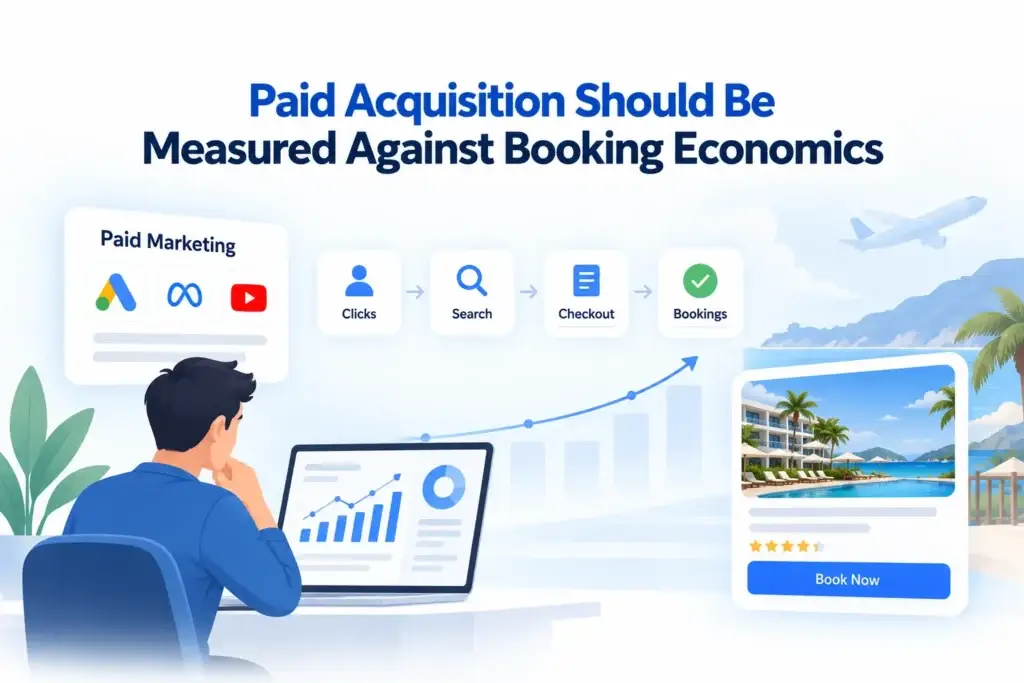
Paid marketing can create demand quickly, but speed can hide poor economics.
Clicks, installs, and registrations are intermediate events.
An OTA ultimately needs to understand what happens after acquisition.
How many acquired users search?
How many find suitable inventory?
How many reach checkout?
How many produce confirmed bookings?
How much margin does the platform retain?
How many return without requiring the same acquisition cost again?
Customer acquisition cost should therefore be evaluated alongside contribution from bookings and future customer value.
A campaign generating inexpensive app installs may be less valuable than a more expensive campaign that consistently produces confirmed bookings from high-intent travelers.
Segment Acquisition by Traveler Intent
Not all travel traffic behaves the same way.
Someone searching for a specific hotel on specific dates is much closer to a transaction than someone casually browsing destination inspiration.
Those users should not necessarily receive the same marketing journey.
High-intent demand may be appropriate for performance campaigns and direct booking funnels.
Earlier-stage demand may need destination content, saved searches, alerts, trip-planning tools, or remarketing before a transaction becomes realistic.
Segmenting by intent helps the platform match acquisition cost and messaging to the traveler’s actual stage.
Conversion Is a Growth Channel Too
Growth teams often focus heavily on bringing more people into the funnel.
Sometimes the larger opportunity is improving what happens to the traffic already arriving.
If 100,000 people visit but very few reach confirmed booking, buying another 50,000 visits does not fix the underlying problem.
Conversion friction can come from poor search relevance, unclear total pricing, weak mobile UX, missing payment options, slow responses, limited inventory, confusing cancellation conditions, or checkout failures.
Conversion optimization therefore deserves to be treated as part of the growth strategy.
Conversion also depends on whether the platform has the right travel marketplace features at each stage of the journey. Search, inventory, booking management, payments, supplier connectivity, administration, and post-booking capabilities should support the conversion path rather than exist as disconnected items on a feature checklist.
The cheapest incremental booking may come from improving an existing funnel rather than purchasing another click.
Search-to-Booking Conversion Should Be Diagnosed in Stages
A single conversion percentage can hide the actual problem.
Instead, break the journey down:
Search → results viewed → product selected → checkout started → payment attempted → booking confirmed.
A large drop between search and product selection could suggest weak inventory or search relevance.
A large drop before checkout could indicate pricing, policy, or trust concerns.
A large drop during payment may point toward checkout or payment issues.
A gap between payment and confirmed reservation may indicate booking or supplier problems.
This makes growth analysis more actionable.
The objective is not simply to know that conversion is low.
It is to know where the booking journey is losing demand.
Bundling Can Increase Value Without Increasing Acquisition Cost
Once a traveler has been acquired, related travel needs create an opportunity to improve booking economics.
A flight customer may need accommodation.
A hotel customer may need airport transportation.
A traveler who has booked the major components may still need activities or other services.
Relevant bundling can increase convenience while increasing the value generated from already-acquired demand.
But relevance matters.
Showing every possible add-on to every traveler can create friction.
A useful bundle reflects destination, dates, traveler count, trip context, and what has already been selected.
The growth objective should be more value per useful customer journey, not simply more offers per screen.
First-Booking Economics and Repeat-Booking Economics Are Different
The first booking may be expensive to acquire.
Paid media, introductory offers, partnerships, or other acquisition activities can absorb much of the initial margin.
Repeat bookings can change that equation.
If a traveler returns directly through the app, email, saved trip, loyalty benefit, or brand search, the business may not need to repurchase the customer through the original acquisition channel.
That is why retention can materially affect OTA economics.
A business should not evaluate customer acquisition only against the first booking if its model reasonably expects customers to travel again.
These acquisition and retention decisions should ultimately reflect the online travel agency business model behind the platform. Commissions, markups, service fees, supplier agreements, ancillary revenue, and other monetization approaches can change how much the business can economically invest in acquiring and retaining each traveler.
Instead, founders should understand how booking frequency and customer lifetime value develop over time.
Retention Begins With the First Booking
Retention is often discussed as if it starts weeks after checkout.
In reality, it starts during the first transaction.
Was the displayed price accurate?
Was checkout understandable?
Did the reservation confirm properly?
Could the traveler find the itinerary?
Were important updates communicated clearly?
Could support understand the booking if something went wrong?
A poor first-booking experience cannot always be repaired with loyalty points later.
The most effective retention strategy begins by delivering the transaction the customer already paid for.
Post-Booking Experience Creates the Bridge to the Next Trip
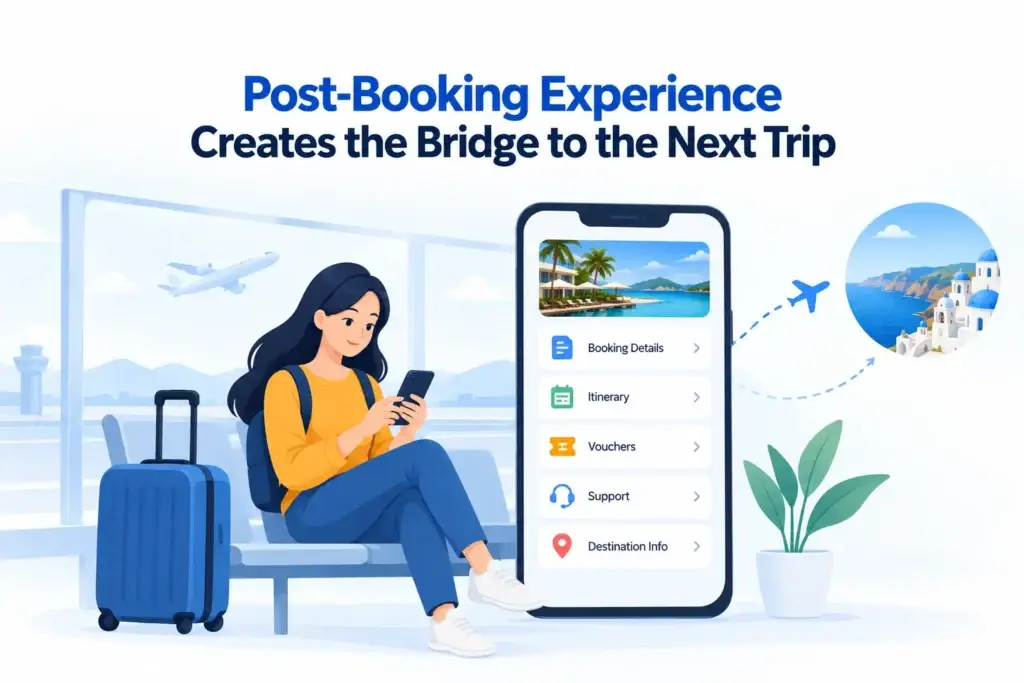
The period after booking gives an OTA a legitimate reason to remain useful.
Travelers may need confirmation details, vouchers, itinerary information, reminders, cancellation policies, support, or destination information.
These interactions should primarily solve current-trip problems.
But they also maintain the relationship between purchase and travel.
When handled well, the platform remains associated with useful trip management rather than disappearing after checkout.
That makes future engagement more natural.
Lifecycle Marketing Should Respond to Traveler Behavior
Generic promotional email blasts are not a retention strategy.
Lifecycle communication becomes more useful when it corresponds to meaningful traveler behavior.
Examples include an unfinished search, saved destination, price alert, upcoming trip, completed trip, or an appropriate future booking window.
The communication should answer:
Why is this message useful to this traveler now?
If there is no convincing answer, sending it may create more fatigue than growth.
Behavioral relevance usually matters more than message volume.
Abandoned Searches Can Be More Valuable Than Abandoned Carts
Travelers frequently search well before they are ready to purchase.
That means the platform can lose potential customers before a traditional checkout abandonment event ever exists.
Saved searches, recently viewed options, appropriate price alerts, and destination reminders can help travelers return to an unfinished planning journey.
The objective should not be to pressure every browser into immediate purchase.
Travel decisions often require time.
Growth systems should make it easy for high-intent travelers to resume rather than forcing them to restart their research.
Loyalty Should Reward Useful Repeat Behavior
A loyalty program can support retention, but points alone do not create loyalty.
Travelers return when the platform remains useful.
Rewards can reinforce that behavior through member benefits, relevant offers, booking incentives, or easier repeat experiences.
But loyalty should be measured by outcomes such as repeat booking rate, booking frequency, customer value, and retention—not merely program enrollment.
A large rewards membership with little repeat transaction activity may look impressive while contributing little to marketplace economics.
Personalization Should Reduce the Cost of the Next Decision
Travelers repeatedly provide signals about what matters to them.
Common departure locations, preferred accommodation types, trip patterns, destinations, saved searches, and previous bookings can potentially make future discovery easier when handled appropriately.
The growth value of personalization is not simply showing individualized content.
It is reducing the effort required to make the next relevant decision.
Useful personalization might improve search defaults, destination recommendations, reminders, or offers.
It should remain adaptive rather than turning a single past booking into a permanent assumption about the customer.
Supplier Growth and Traveler Growth Should Reinforce Each Other
Marketplaces become stronger when both sides create value for each other.
More relevant inventory can improve traveler choice.
More qualified traveler demand can make participation more valuable for suppliers.
Stronger supplier participation can improve coverage.
Better coverage can support more acquisition and conversion.
This creates a potential marketplace flywheel:
Supplier coverage → traveler value → bookings → supplier value → stronger supply → stronger traveler proposition.
But the flywheel only works when the platform grows the right supply and the right demand.
As supplier coverage expands, the technical foundation also becomes more important. Founders can explore online travel agency platform architecture to understand how supplier APIs, inventory, booking engines, payments, and fulfillment need to work together as marketplace activity grows.
Raw supplier count and raw traffic are not enough.
Liquidity matters.
Partnerships Can Add Supply or Demand
Not every growth channel needs to be advertising.
Partnerships can strengthen either side of the marketplace.
A supply partnership may expand inventory or geographic coverage.
A distribution partnership may expose the platform’s travel products to another audience.
Financial, loyalty, affiliate, corporate, or other commercial partnerships can also create acquisition paths where the partner already has a relevant customer relationship.
Founders should evaluate partnerships based on what they contribute:
inventory, distribution, trust, customer access, economics, or operational capability.
A partnership should solve a strategic constraint rather than exist simply because the brands appear compatible.
Growth Metrics Should Connect Marketing to Marketplace Outcomes
OTA dashboards can easily become crowded with numbers.
The most useful metrics connect activity to business outcomes.
OTA Growth Metrics by Stage
| Growth Stage | Useful Metrics | What They Help Diagnose |
|---|---|---|
| Supply | Inventory coverage, availability, search coverage | Whether target demand can find suitable supply |
| Acquisition | Qualified traffic, CAC, cost per booking | Whether demand is being acquired economically |
| Conversion | Search-to-selection, checkout rate, confirmed-booking rate | Where the booking funnel loses travelers |
| Booking Value | Average booking value, ancillary attachment, margin | How much economic value each transaction creates |
| Retention | Repeat booking rate, booking frequency, returning customer share | Whether acquired travelers come back |
| Customer Value | Contribution by cohort, retention, customer lifetime value | Whether acquisition economics improve over time |
These metrics should also be examined by destination, product type, acquisition source, device, market, and customer cohort where useful.
The implementation team should also understand how technology connects to marketplace growth. When evaluating a travel platform development partner, founders should consider experience with supplier integrations, inventory, booking workflows, payments, analytics, post-booking operations, and scalability—not simply the ability to reproduce customer-facing screens.
Founders comparing implementation routes can also examine travel platform scripts, features, and pricing to understand how ready-made foundations differ in functionality and commercial scope before deciding which capabilities need to be available for the initial growth stage.
Averages can conceal where the business is actually growing efficiently.
Founders Should Diagnose the Growth Constraint Before Scaling Spend
When growth slows, the instinct is often to increase marketing.
That is not always the correct response.
If search demand exists but inventory is weak, improve supply.
If inventory is strong but traffic is low, acquisition may be the constraint.
If traffic and supply are healthy but booking conversion is weak, investigate the funnel.
If first bookings are growing but customers rarely return, retention may deserve more attention.
If bookings grow while unit economics deteriorate, the issue may be acquisition cost, margin, incentives, or operational cost.
Diagnose the Constraint Before Scaling
Investigate inventory depth, availability, relevance, and supplier coverage.
Evaluate SEO, paid acquisition, partnerships, positioning, and geographic demand generation.
Examine pricing, trust, product details, checkout friction, payments, and booking reliability.
Review post-booking experience, lifecycle communication, loyalty, personalization, and customer support.
Analyze acquisition cost, incentives, contribution margin, supplier economics, and cohort-level customer value.
Growth becomes more efficient when the business invests against the current constraint rather than trying to scale every part of the marketplace simultaneously.
Build the Growth System Before Scaling the Marketing Budget
A scalable OTA needs product and operational capabilities behind its marketing strategy.
Supplier connectivity supports inventory.
Search and booking workflows turn demand into transactions.
Payment and reservation management help complete those transactions.
Traveler accounts, trip management, notifications, and appropriate personalization can support retention.
Analytics connect these activities so founders can see where the growth loop is strengthening or breaking.
This is why platform decisions and growth decisions eventually meet.
A business can have an excellent acquisition strategy but still struggle if the underlying travel marketplace cannot reliably convert and retain the demand it creates.
Businesses still evaluating the right travel marketplace structure can also explore Miracuves’ travel booking solutions to compare different travel concepts according to their target audience, inventory strategy, transaction model, and growth requirements.
For founders who want a ready-made foundation instead of building the standard OTA workflow from zero, Miracuves provides an online travel agency platform that can be configured around travel inventory, supplier connections, booking operations, payments, and the intended traveler journey.
Founders comparing implementation routes can also examine travel platform scripts, features, and pricing to understand how ready-made foundations differ in functionality and commercial scope before deciding which capabilities need to be available for the initial growth stage.
For suitable ready-made solution scopes, Miracuves offers a 6-day solution delivery path. Additional supplier integrations, extensive customization, market-specific requirements, and other project-specific work should be scoped separately according to the intended launch.
As the growth strategy becomes clearer, founders can evaluate the broader requirements of a travel booking platform, where supplier inventory, traveler search, reservations, payments, trip management, administration, and retention workflows need to operate as one connected marketplace system.
That allows the growth conversation to move beyond:
“How do we build the software?”
toward the more important questions:
Where will our supply come from?
Which travelers will we acquire first?
Why will they complete a booking?
What will make them return without being reacquired from scratch?
Final Thoughts
Sustainable OTA growth is not created by one advertising campaign, one supplier integration, or one loyalty program.
It comes from connecting supply and demand effectively.
Relevant inventory makes acquisition more productive. Better acquisition brings qualified travelers into the marketplace. Strong search and booking experiences turn that demand into transactions. Reliable fulfillment creates trust. Retention makes future bookings less dependent on reacquisition. Repeat demand makes the marketplace more valuable to suppliers.
That is the growth loop founders should optimize.
Before increasing marketing spend, identify the weakest connection between inventory, acquisition, conversion, booking economics, and retention.
Improving that constraint may create more sustainable growth than simply buying more traffic.
FAQs
What is an OTA growth strategy?
An OTA growth strategy coordinates supplier inventory, traveler acquisition, booking conversion, transaction economics, retention, and repeat bookings. The objective is to grow both marketplace activity and the economic value of acquired customers.
Why does supplier inventory affect OTA marketing?
Marketing can only convert effectively when travelers find suitable bookable options. Weak inventory in heavily promoted destinations can reduce search relevance and booking conversion, making acquisition spending less productive.
How can an online travel agency acquire travelers?
Potential channels include organic search, destination content, paid search, social acquisition, affiliates, partnerships, app discovery, referrals, CRM, and other channels appropriate to the target market. The channel mix should reflect traveler intent and booking economics.
Which metrics matter most for OTA growth?
Useful metrics can include inventory coverage, qualified traffic, customer acquisition cost, cost per booking, search-to-book conversion, confirmed bookings, booking value, contribution margin, repeat booking rate, booking frequency, and customer lifetime value.
How can an OTA increase repeat bookings?
Retention can be supported through a reliable first booking, useful post-booking tools, traveler profiles, saved searches, appropriate price alerts, lifecycle communication, loyalty benefits, personalization, and an easier repeat-booking experience.
Is loyalty enough to improve traveler retention?
Not by itself. Loyalty programs can reinforce repeat behavior, but travelers are more likely to return when inventory, pricing, booking reliability, trip management, and support consistently provide value.
Why should OTAs measure customer lifetime value?
The first booking may carry significant acquisition cost. Understanding value across subsequent bookings helps founders assess whether customer economics improve as travelers return.
When should an OTA increase its marketing budget?
Marketing spend should generally be scaled with visibility into inventory quality, booking conversion, acquisition economics, and operational capacity. If another part of the marketplace is the main constraint, increasing traffic may amplify the problem rather than solve it
Miracuves is an independent software development company. We are not affiliated with, connected to, sponsored by, or endorsed by any company or product named in this article.
Terms such as “X Clone” are used descriptively. It is how the software industry refers to building a platform with functionality comparable to a known service, and how clients search for it.
The entire design and codebase of our products is built by our own team. Our products contain no code, design, graphics, or content originating from any third-party website or applications.
All third-party names and marks referenced in this article are the property of their respective owners, referenced solely to identify the services discussed.