

Key Takeaways
What You’ll Learn
- Fiverr is a freelance marketplace that connects businesses with service providers globally.
- Users hire freelancers through structured gig listings with clear pricing and delivery timelines.
- Freelancers offer services across categories like design, development, marketing, and content.
- Secure payments are handled within the platform to protect both buyers and sellers.
- Gig-based model is what helped Fiverr scale rapidly in the global freelance economy.
Stats That Matter
- Fiverr has over 4 million active buyers worldwide.
- The global freelance market is expected to exceed $450 billion by 2026.
- Digital services like design, writing, and development drive major platform demand.
- Commission-based revenue is Fiverr’s primary monetization model.
- Freelance platforms are becoming a core part of modern remote work culture.
Real Insights
- Simplicity wins when services are packaged clearly with fixed pricing.
- Strong platforms balance buyers, freelancers, and trust systems together.
- Ratings and reviews help build credibility and repeat engagement.
- Category expansion helps platforms scale beyond initial service offerings.
- Growth comes from quality service delivery, not just low pricing.
Fiverr started in 2010 with a simple idea — let anyone sell a service online for just $5. Fifteen years later, it’s a global marketplace processing billions in freelance transactions annually, connecting over 5 million buyers with 1 million active sellers across 160+ countries.
The Business Model of Fiverr transformed freelancing from an informal side hustle into a structured, scalable digital economy. It redefined how professionals sell creative, technical, and business services online — democratizing work by allowing anyone to monetize skills instantly.
In 2026, with remote work and AI-assisted productivity at their peak, the Business Model of Fiverr remains a masterclass in platform efficiency, network growth, and monetization design. For entrepreneurs, it’s a blueprint for building two-sided marketplaces that thrive on trust, transparency, and scalability.
Planning to build in this space? Miracuves offers a ready-made freelance gig marketplace platform that you can launch under your own brand.
How the Fiverr Business Model Works
Fiverr operates as a two-sided digital marketplace connecting freelancers (sellers) with businesses or individuals (buyers) seeking digital services — from design and marketing to AI tools and coding. Its core innovation lies in productizing services: transforming freelance work into predefined “Gigs” that users can browse, purchase, and review instantly, much like e-commerce products.
Model Type:
Marketplace + Transaction-Based Platform
Fiverr doesn’t employ freelancers directly — it facilitates transactions and earns a commission on each. It’s a pure-play platform business model, focusing on network scale, liquidity, and user trust.
Key Components of the Model
1. Value Proposition
- For Buyers:
- Instant access to global talent with transparent pricing.
- Standardized “Gig” offerings that reduce uncertainty and negotiation time.
- Reviews, delivery timelines, and secure payments ensure reliability.
- For Sellers:
- A platform to monetize skills with minimal marketing effort.
- Built-in exposure to a massive buyer base.
- Tiered seller levels (New, Level 1, Level 2, Top Rated) for performance-based visibility.
2. Stakeholders and Ecosystem Roles
- Buyers (Demand side): Businesses, startups, agencies, and entrepreneurs.
- Sellers (Supply side): Freelancers and professionals offering digital services.
- Fiverr (Platform operator): Facilitates discovery, payments, reputation, and dispute resolution.
- Fiverr Business/Pro (Premium layer): Enterprise clients and curated professionals.
3. Evolution Over Time
- 2010–2015: Fixed $5 pricing and limited service categories.
- 2016–2019: Introduction of variable pricing, Fiverr Pro, and service bundles.
- 2020–2023: Remote work boom → demand surge; Fiverr Business launched for teams.
- 2024–2026: Integration of AI tools, subscription-based gigs, and Fiverr Neo (AI assistant for buyers).
4. Why It Works in 2026
- The global freelance economy now exceeds $1.6 trillion.
- AI augmentation has boosted productivity and demand for specialized microservices.
- Fiverr’s trust-first design and data-driven recommendations make it frictionless for users.
- Its network effects compound as more users attract higher-quality talent and broader service diversity.
Read more : What is Fiverr App and How Does It Work?
Target Market & Customer Segmentation Strategy
Fiverr’s success lies in its ability to understand, segment, and scale across multiple customer archetypes — from startups seeking affordable services to enterprises outsourcing complex projects. The company has built a precise segmentation framework that ensures personalized experiences for every user category.
1. Primary Customer Segments
a. Small Businesses & Startups
- Profile: Early-stage ventures or solopreneurs needing logo design, web setup, or marketing on tight budgets.
- Behavior: Project-based buying, low acquisition cost, and high repeat rate.
- Need: Fast, affordable, and reliable delivery.
b. Freelancers & Independent Professionals (Sellers)
- Profile: Skilled individuals offering specialized services like SEO, coding, or AI content creation.
- Behavior: Multi-gig strategy to increase visibility; long-term client building via reviews.
- Need: Exposure, credibility, and income stability.
2. Secondary Customer Segments
a. Agencies & SMBs (Mid-market buyers)
- Use Fiverr Business for multi-member collaboration, project tracking, and vetted freelancer pools.
b. Enterprises & Global Brands
- Rely on Fiverr Enterprise Solutions for curated professionals, compliance, and data security.
c. Niche Professionals
- Consultants and AI-driven service providers offering innovative tools, automation scripts, and workflow systems.
3. Customer Journey Map
| Stage | Buyer Journey | Seller Journey |
| Discovery | Search via keywords, Fiverr recommendations, or AI assistant (Fiverr Neo). | Create gigs optimized with tags and SEO. |
| Conversion | Compare gig packages, view reviews, and purchase instantly. | Receive order notifications and manage deadlines via dashboard. |
| Delivery | Receive work securely and review quality. | Deliver final work, earn ratings, and build credibility. |
| Retention | Use Fiverr Business to manage recurring needs. | Upsell through buyer relationships and subscription gigs. |
4. Acquisition Channels
- Organic Search & SEO: Fiverr ranks on millions of long-tail keywords (“hire logo designer,” “voiceover freelancer,” etc.).
- Paid Ads: Google Ads, YouTube, and social media retargeting.
- Affiliate Program: Drives referral traffic through content creators and bloggers.
- Partnerships: With productivity platforms like Slack and Trello for integrated project workflows.
5. Market Positioning & Differentiation
- Brand Voice: Empowering, inclusive, and skill-positive — “Doers deserve better.”
- Competitive Edge: Seamless buying experience, AI recommendations, and global trust framework.
- Share of Market (2026): Fiverr holds roughly 25% of the global freelance services marketplace, competing with Upwork, Freelancer, and Toptal.
- Differentiation: Productized service model (Gigs) vs. traditional bidding platforms.
Read more : How to Develop a Fiverr App Alternative
Revenue Streams and Monetization Design
Fiverr’s financial strength comes from a multi-layered monetization system that blends transactional revenue with premium subscriptions, platform services, and AI-powered enhancements.
Its strategy emphasizes predictable recurring income, scalable margins, and ecosystem monetization rather than traditional ad dependence.
1. Primary Revenue Stream – Transaction Fees (~85% of total revenue)
Mechanism:
- Fiverr takes a 20% commission from every completed transaction — deducted from the seller’s payment.
- Buyers also pay a service fee (5.5% of the purchase amount + $2 for orders under $50).
- This dual-fee model ensures consistent revenue flow from both sides of the marketplace.
Growth Trajectory (2020–2026):
- Gross Services Volume (GSV) crossed $1.2 billion in 2024, up 13% YoY.
- Average spend per buyer increased from $262 (2023) to $304 (2026) due to bundled gig packages and repeat clients.
2. Secondary Revenue Streams
a. Fiverr Business (Subscription SaaS model)
- Offers team management tools, curated talent pools, and project dashboards.
- Pricing: $149/year per team account, enabling steady recurring revenue.
b. Fiverr Pro & Enterprise
- Curated marketplace with verified professionals for enterprise-grade projects.
- Higher transaction fees (25–30%) for premium visibility and account management.
c. Fiverr Learn (Upskilling Platform)
- Online course platform for freelancers learning new digital skills.
- Monetized via one-time course fees and bundled offers.
d. Fiverr Subscriptions & Milestone Projects
- Enables freelancers to sell recurring monthly services.
- Improves revenue predictability and lifetime value per client.
e. Promoted Gigs (Advertising Revenue)
- Sellers pay to feature their gigs at the top of search results.
- Cost-per-click (CPC) auction model — similar to Google Ads, integrated within Fiverr’s search algorithm.
3. Overall Monetization Strategy
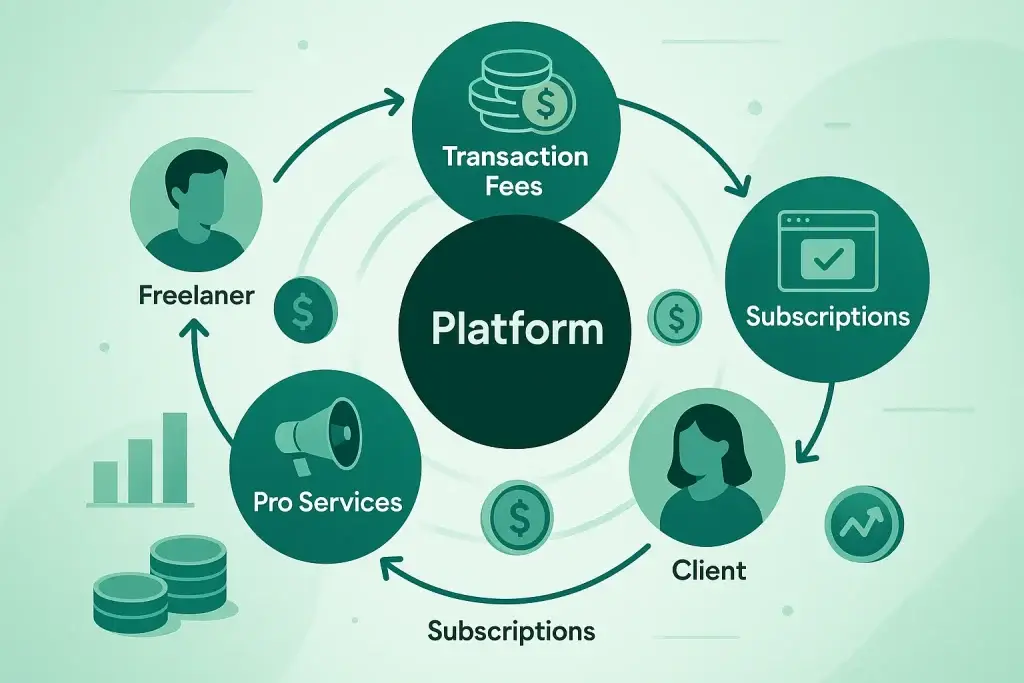
Fiverr’s revenue model is a self-reinforcing loop:
- Transaction fees fuel platform operations and trust systems.
- Subscription layers generate recurring cash flow.
- Advertising and AI tools increase seller competition — boosting average revenue per user.
By combining performance-based revenue with subscription-driven income, Fiverr achieves both scalability and profit stability — a rare balance in platform businesses.
Psychology Behind Pricing & Tiering:
- Transparent pricing reduces friction and accelerates decisions.
- Sellers can use anchor pricing (Basic / Standard / Premium) to nudge buyers toward mid-tier packages.
- Fiverr’s “Gig Packages” subtly mirror SaaS pricing psychology, fostering predictability in buyer behavior.
Operational Model & Key Activities
Behind Fiverr’s sleek user experience lies a highly optimized operational engine designed for scalability, automation, and continuous innovation.
The company runs a lean, technology-first model that minimizes manual intervention and maximizes platform efficiency — enabling millions of transactions daily with minimal friction.
1. Core Operations
a. Platform Management
- Continuous UI/UX optimization to maintain seamless gig discovery and ordering.
- AI-driven recommendations and personalization to match buyers with relevant sellers.
- Fraud prevention systems powered by machine learning for identity verification and payment safety.
b. Payments & Escrow System
- Fiverr acts as an intermediary: holding buyer funds until order completion.
- Automated payout processing in multiple currencies and payment gateways (Payoneer, PayPal, etc.).
- Smart contract–style release ensures trust and dispute resolution.
c. Quality Assurance & Community Governance
- Tiered seller levels (New, Level 1, Level 2, Top Rated) ensure service reliability.
- Algorithmic detection of low-quality or plagiarized services.
- Seller Success Managers support top-performing freelancers.
d. Marketing & Growth Operations
- Global marketing through content, influencer partnerships, and performance ads.
- SEO optimization across millions of gig listings to capture organic traffic.
- Localized campaigns for emerging markets like India, Brazil, and Indonesia.
2. Technology Infrastructure
- Cloud Stack: AWS-based microservices architecture for global scalability.
- AI Tools: Fiverr Neo (AI assistant), pricing optimization engines, fraud detection.
- Data Analytics: Real-time dashboards tracking GSV, buyer cohorts, and churn rates.
- Localization Framework: Automated translation and currency adaptation for 160+ markets.
3. Operational Strength
Fiverr’s automation-first DNA allows it to operate with lean human resources — roughly 1,100 employees supporting a marketplace of millions.
This efficiency results in EBITDA margins exceeding 28% and exceptional scalability without proportionate cost inflation.
Strategic Partnerships & Ecosystem Development
Fiverr’s long-term success isn’t built on transactions alone — it’s powered by a deep ecosystem of partnerships that enhance trust, visibility, and functionality across global markets.
By aligning with leading technology, payment, and productivity platforms, Fiverr has evolved into a complete digital work infrastructure rather than just a marketplace.
1. Collaboration Philosophy
Fiverr follows a “connect and empower” partnership approach — building integrations that expand opportunities for freelancers while simplifying processes for buyers.
Its partnerships are designed to strengthen three pillars: efficiency, credibility, and ecosystem value
2. Key Partnership Types
a. Technology & API Partners
- Slack & Trello Integrations: Buyers can manage Fiverr projects within their existing workflows.
- Google Workspace & Microsoft 365: File-sharing, communication, and productivity integrations.
- AI & Automation Providers: Fiverr Neo and Fiverr Logo Maker powered by AI partnerships with OpenAI, Runway, and Midjourney-like platforms for creative assistance.
b. Payment & Logistics Alliances
- Payoneer, PayPal, Stripe: Multi-currency payment gateways ensuring secure and fast global transactions.
- Wise (formerly TransferWise): Used for regional currency optimization and low-fee withdrawals.
- Local Banking Partnerships: In emerging economies (India, Nigeria, Philippines) to facilitate fast settlements.
c. Marketing & Distribution Partners
- YouTube & Meta Ads: Cross-channel ad partnerships for global reach.
- Affiliate & Influencer Networks: Fiverr’s Ambassador Program features creators promoting gig success stories.
- Educational Platforms: Partnerships with Coursera and Udemy to promote Fiverr Learn courses.
d. Regulatory & Expansion Alliances
- Collaborations with data protection authorities and compliance consultants for GDPR, CCPA, and ISO 27001 alignment.
- Engagement with remote work organizations and freelancer advocacy groups to legitimize digital work models globally.
3. Ecosystem Strategy & Network Effects
- Ecosystem Growth: Each partnership expands the total addressable market and reduces entry barriers for new users.
- Partner Value Creation: Fiverr offers co-branded opportunities for SaaS providers and creative tools.
- Network Effects: As new integrations attract more freelancers, service diversity increases — improving buyer satisfaction and platform stickiness.
- Monetization via Ecosystem: Fiverr earns indirect revenue through affiliate commissions, partnership integrations, and AI-powered upsell systems.
4. Competitive Moat through Partnerships
By embedding itself into tools entrepreneurs already use — like Slack, Google Workspace, and Zoom — Fiverr creates contextual stickiness.
This ensures users stay within its ecosystem from project ideation → collaboration → delivery → feedback without switching platforms.
Growth Strategy & Scaling Mechanisms
Fiverr’s evolution from a $5 service marketplace to a global freelancing powerhouse has been driven by a multi-engine growth strategy — combining viral acquisition, strategic diversification, and continuous product innovation.
In 2026, Fiverr’s scaling mechanisms focus on AI integration, market expansion, and retention-driven monetization.
1. Core Growth Engines
a. Organic Virality & Network Effects
- Each successful transaction fuels social proof through ratings, reviews, and repeat orders.
- The more sellers list gigs, the broader the buyer appeal — reinforcing a self-growing loop of supply and demand.
- Fiverr’s referral system incentivizes both buyers and sellers with credit-based rewards.
b. Paid Marketing & Customer Acquisition
- Aggressive cross-channel performance marketing campaigns on YouTube, Instagram, and Google.
- Localized campaigns with taglines like “Freelance Services for Every Startup” and “Work Without Limits.”
- Retargeting campaigns for inactive users using behavioral data and personalized recommendations.
c. Product Expansion & Vertical Diversification
- Fiverr Business: A SaaS suite for organizations managing teams and projects.
- Fiverr Enterprise: Premium services for large companies with SLA-backed support.
- Fiverr Logo Maker & Fiverr Neo: AI-powered tools that merge creativity with automation.
- Fiverr Learn: Upskilling ecosystem connecting education with earning potential.
d. Geographic Expansion
- Localized interfaces and currency support across 160+ countries.
- Targeted investments in fast-growing freelance economies: India, Indonesia, Nigeria, and Brazil.
- Regional ambassador programs and influencer-driven brand advocacy.
2. Scaling Challenges & Fiverr’s Solutions
| Challenge | Description | Fiverr’s Response |
| Operational Complexity | Managing millions of transactions in real-time. | Advanced automation and scalable AWS microservices. |
| Quality Control | Maintaining buyer trust as volume grows. | AI moderation tools and tiered seller levels. |
| Regulatory Compliance | Varying tax and employment laws globally. | Partnering with local compliance advisors and building internal governance frameworks. |
| Platform Saturation | Overcrowding in popular categories. | AI-driven gig recommendations and new category creation (AI tools, metaverse, AR/VR). |
| Retention & Engagement | Keeping freelancers loyal amidst competitors. | Subscriptions, Fiverr Learn, and business-focused ecosystem tools. |
3. Innovation as a Scaling Mechanism
Fiverr continually reinvents its platform:
- Fiverr Neo (2025–2026): An AI buying assistant that recommends freelancers based on project goals and tone.
- Fiverr Workspace: A full project management system integrated into the marketplace.
- Predictive Analytics: Uses behavior patterns to forecast demand and prompt sellers to update their gigs accordingly
These innovations reduce friction, enhance user satisfaction, and increase transaction frequency — the trifecta of platform scaling.
Read more : Fiverr App Marketing Strategy: How to Get Your App Buzzing
Competitive Strategy & Market Defense
In an increasingly saturated freelance economy, Fiverr’s enduring dominance stems from its data-driven adaptability, brand trust, and ecosystem depth.
While rivals like Upwork, Freelancer, and Toptal chase similar markets, Fiverr has built a unique defensive architecture that turns competition into momentum.
1. Core Competitive Advantages
a. Network Effects & Switching Barriers
- Every new buyer attracts more freelancers, and vice versa — reinforcing liquidity and reducing wait times.
- Sellers build profiles, portfolios, and reviews within Fiverr’s ecosystem, creating natural switching resistance.
- Buyer trust grows as the volume of verified sellers expands, compounding retention rates.
b. Brand Equity & Trust Framework
- Fiverr’s “Service-as-a-Product” model standardizes expectations — clear pricing, delivery timelines, and verified feedback.
- The Fiverr Pro badge and Business verification enhance confidence for enterprise clients.
- Its reputation for affordability and speed ensures consistent brand recall among SMBs and startups.
c. Innovation & AI Integration
- Fiverr Neo and predictive pricing models differentiate it from bidding-based competitors.
- Internal AI engines improve gig discovery, content moderation, and quality scoring.
- Continuous experimentation with creative automation (logo generator, AI text gigs) keeps Fiverr ahead of trends.
d. Data-Driven Personalization
- Advanced behavioral analytics power gig recommendations and user retention strategies.
- Machine learning models personalize the homepage for every buyer based on project history and sentiment analysis.
2. Market Defense Tactics
a. Strategic Feature Rollouts
- Fiverr consistently releases features in emerging niches before competitors (e.g., “AI Services” and “NFT Art” categories).
- Incremental updates rather than overhauls ensure continuity for users while evolving the platform.
b. Pricing & Positioning Strategy
- Maintains a broad spectrum: from $5 gigs to enterprise packages worth thousands.
- Avoids race-to-the-bottom pricing wars by offering value-tiered experiences — Fiverr Pro, Business, and Enterprise.
c. Partnerships & Acquisitions
- Selective acquisitions (e.g., Working Not Working, CreativeLive) help Fiverr tap premium creative markets.
- Ecosystem partnerships with SaaS and payment tools enhance platform stickiness .
d. Compliance & Global Trust
- By aligning with ISO 27001 and GDPR, Fiverr attracts enterprise clients sensitive to data compliance.
- Proactive regulatory engagement in freelance economies keeps barriers low for expansion.
3. Defensive Position in 2026
- Fiverr’s AI ecosystem and predictive engagement loop now act as defensive walls — making replication difficult.
- Continuous innovation paired with strong user loyalty ensures it sustains leadership even as newer freelance platforms emerge.
- Its brand as the “eBay of services” — familiar, efficient, and trusted — remains unmatched.
Read more : Best Fiverr Clone Scripts in 2025: Features & Pricing Compared
Lessons for Entrepreneurs & Implementation
For entrepreneurs, Fiverr’s business model is more than a case study — it’s a blueprint for building scalable, self-sustaining digital ecosystems.
Whether you’re launching a local services marketplace or a specialized gig platform, the principles behind Fiverr’s rise can guide your own platform strategy.
1. Key Factors Behind Fiverr’s Success
- Simplicity First: Started with a $5 fixed-price concept — reducing cognitive friction for both buyers and sellers.
- Trust at Scale: Ratings, reviews, and escrow-based payments created instant credibility in an unregulated market.
- Automation Over Management: Minimal human intervention; most processes handled by algorithms and machine learning.
- Data-Driven Personalization: Every interaction feeds back into the recommendation engine, improving user retention.
- Continuous Innovation: New categories (AI, digital marketing, SaaS setup, etc.) keep the platform relevant to trends.
2. Replicable Principles for Startups
a. Start Narrow, Scale Broad
Launch with a tight niche (e.g., local freelancers or a specific service) before expanding horizontally.
b. Productize the Experience
Turn abstract services into tangible, pre-defined offerings that feel like shopping on an e-commerce site.
c. Prioritize Trust Mechanisms
Include verified profiles, secure payment systems, and transparent reviews from day one.
d. Build for Data, Not Just Design
User behavior analytics should drive every improvement — from pricing tiers to onboarding.
e. Layer Monetization Gradually
Start with transaction fees, then add subscriptions, advertising, and SaaS layers as your network matures.
3. Common Mistakes to Avoid
- Overcomplicating the MVP (Minimum Viable Product).
- Ignoring seller incentives — they’re the engine of the marketplace.
- Scaling without community moderation and anti-fraud systems.
- Treating branding as an afterthought — Fiverr built a movement, not just a platform.
4. Adaptation Strategies for Local or Niche Markets
- Hyperlocalization: Build city- or region-specific marketplaces (e.g., “Fiverr for Jaipur” or “Fiverr for legal consultants”).
- Vertical Specialization: Focus on one domain like design, logistics, wellness, or education.
- White-Label Solutions: Use pre-built, customizable app frameworks (like Miracuves’) to launch faster and cheaper.
Ready to implement Fiverr’s proven business model for your market?
Miracuves builds scalable freelance marketplaces with tested growth systems, AI-powered matching, and secure payment modules.
We’ve helped entrepreneurs launch profitable platforms within 6 Days.
Get your free business model consultation today at Miracuves.
Conclusion :
Fiverr’s story isn’t just about freelancing — it’s about democratizing access to opportunity.
What began as a $5 experiment has evolved into a global infrastructure where creativity meets commerce, empowering millions to earn on their own terms.
In the broader landscape of platform economies, Fiverr proves that the future belongs to ecosystems that simplify trust, automate value exchange, and personalize every interaction. Its model embodies the balance between scalability and human connection — where algorithms handle efficiency, and reputation drives loyalty.
For entrepreneurs, Fiverr is living proof that execution matters as much as innovation.
The founders didn’t invent freelancing; they reinvented how the world interacts with it — through a platform so intuitive that “buying a service” became as easy as buying a product.
As we move through 2026 and beyond, the next wave of digital marketplaces will be built on the same foundation: trust, automation, and inclusivity. Those who master this trifecta — with the right partners like Miracuves — will lead the next decade of platform innovation.
FAQs :
1. What type of business model does Fiverr use?
Fiverr operates on a two-sided digital marketplace model, connecting freelancers (sellers) with clients (buyers). It primarily earns money through transaction commissions, service fees, and subscription-based upgrades such as Fiverr Business and Fiverr Pro.
2. How does Fiverr’s model create value?
Fiverr simplifies freelancing by productizing services into predefined “Gigs.”
This reduces negotiation friction, ensures transparency, and builds trust — creating value for both buyers (through convenience) and sellers (through exposure and monetization).
3. What are Fiverr’s key success factors?
Fiverr’s success comes from its transparent pricing, strong network effects, AI-powered personalization, and tiered seller systems that ensure quality. Continuous innovation through tools like Fiverr Neo and Business keeps it ahead.
4. How scalable is Fiverr’s business model?
It’s highly scalable — Fiverr’s automation-first and AI-driven platform supports millions of users with minimal overhead. Its microservices setup allows rapid expansion once liquidity builds.
5. What are the biggest challenges Fiverr faces?
Maintaining quality while scaling, handling global compliance, avoiding oversaturation in popular categories, and retaining top freelancers amid rising competition.
6. How can entrepreneurs adapt Fiverr’s model for their region?
By building localized or niche marketplaces (e.g., for legal, design, or wellness sectors) using Miracuves’ ready white-label solutions, entrepreneurs can launch Fiverr-style apps in under a week.
7. What resources and timeframe are needed to launch a Fiverr-style app?
A small core team (2–3 admins, 1 marketer) and Miracuves’ marketplace tech stack can deliver a launch 6 days guaranteed delivery, start at $2,499
8. What are alternatives to Fiverr’s business model?
Upwork (bidding-based), Toptal (vetted experts), TaskRabbit (local tasks), and LinkedIn Services (professional gigs) are notable variations of the freelance marketplace model.
9. How has Fiverr’s business model evolved over time?
From $5 gigs (2010) to Pro tiers (2016), then Fiverr Business (2020), and now AI-driven tools like Fiverr Neo (2025–2026) — the platform continuously adapts to global work trends.
10. What is the long-term outlook for Fiverr’s model?
Fiverr’s hybrid of human and AI services positions it for long-term dominance, bridging automation with creativity in the fast-growing global freelance economy.
Related Article :
Miracuves is an independent software development company. We are not affiliated with, connected to, sponsored by, or endorsed by any company or product named in this article.
Terms such as “X Clone” are used descriptively. It is how the software industry refers to building a platform with functionality comparable to a known service, and how clients search for it.
The entire design and codebase of our products is built by our own team. Our products contain no code, design, graphics, or content originating from any third-party website or applications.
All third-party names and marks referenced in this article are the property of their respective owners, referenced solely to identify the services discussed.