


Key Takeaways
- Freelancer earns from commissions on completed projects.
- Premium memberships create recurring revenue.
- Featured listings increase platform income.
- Payment and service fees add extra revenue.
- Multiple income streams improve marketplace profitability.
Revenue Signals
- Project commissions remain the primary revenue source.
- Subscription plans unlock additional platform features.
- Featured projects improve client visibility.
- Escrow and payment services generate fees.
- Advertising options create additional monetization opportunities.
Real Insights
- Marketplace growth increases revenue potential.
- Recurring subscriptions improve revenue predictability.
- Trust and payment security affect conversions.
- Retention is often more valuable than acquisition.
- Successful freelancer platforms monetize both clients and freelancers.
Freelancer is one of the world’s largest freelancing marketplaces, and its revenue continues to grow steadily over the years. In 2026, it generated over AU$27 million in the first half alone, showcasing clear year-over-year momentum and strong marketplace activity. With millions of users and thousands of transactions happening daily, Freelancer clone has built a revenue engine that scales efficiently without proportionally increasing operational costs — a major advantage of digital marketplace economics.
What makes this model valuable is its flexibility. Freelancer doesn’t rely on just one income source; it monetizes bids, contracts, subscriptions, enterprise clients, and even visibility upgrades. This layered revenue structure is what many startups fail to implement — but it’s exactly what turns a platform from a simple listing website into a scalable business.
For entrepreneurs planning to build a Freelancer-style marketplace, this revenue model reveals powerful monetization strategies, low-risk scaling opportunities, and a proven path to profitability with the right technology and execution.
Freelancer Revenue Overview – The Big Picture
Current valuation and revenue (2026):
Freelancer delivered AU$27.07 million in revenue in the first half of 2026, reflecting strong marketplace activity.
Year-over-year growth:
Revenue increased by 8.5% compared to the previous year’s period.
Revenue breakdown by region:
The platform earns the most from North America, Europe, and Asia-Pacific, with emerging markets contributing rising volumes of small-ticket projects.
Profit margin analysis:
Freelancer achieved a positive net profit after tax in 2026, driven by higher GMV, cost optimization, and improved take-rate efficiency.
Market position vs competitors:
Freelancer remains among the top global marketplaces alongside Upwork and Fiverr, strengthened by diversified income streams and global user acquisition.
Read More: Freelancer App Explained – Features, Benefits & How It Works
Primary Revenue Streams Deep Dive
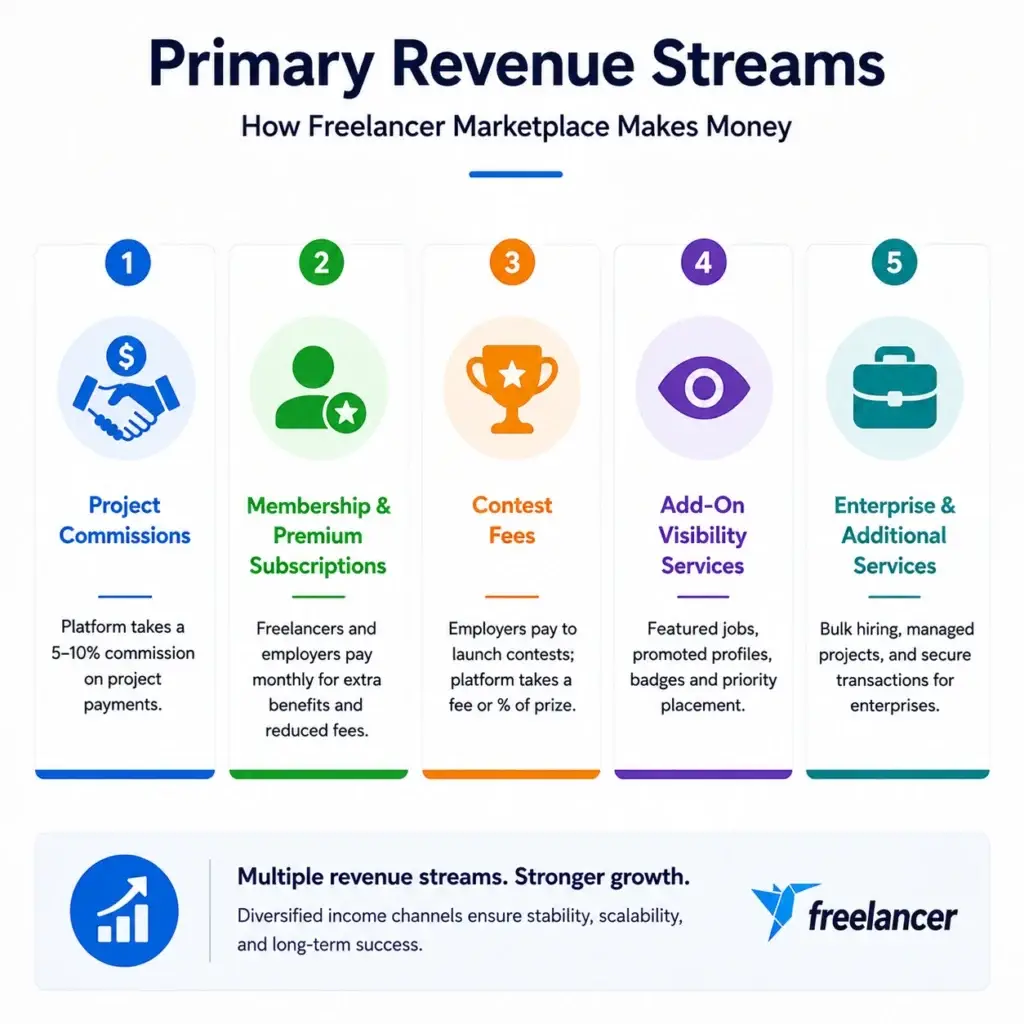
1. Project Commissions
Freelancer charges a percentage fee (commonly 5–10%) on project payments. This is the platform’s primary revenue source, contributing the largest share to yearly revenue.
2. Membership & Premium Subscriptions
Freelancers and employers pay recurring fees for premium tiers with benefits like more bids, better visibility, and reduced commissions.
3. Contest Fees
Employers can launch contests where freelancers submit entries. The platform charges listing fees or takes a portion of prize payouts.
4. Add-On Visibility Services
Featured jobs, highlighted profiles, badge verification, promoted proposals, and priority placement generate high-margin revenue.
5. Enterprise & Additional Services
Larger companies use Freelancer for bulk hiring, managed projects, and secure transactions via escrow-like services, adding a growing B2B revenue stream.
| Revenue Stream | Approx % of Total Revenue |
|---|---|
| Project Commissions | 50–60% |
| Premium Subscriptions | 10–20% |
| Contest Fees | 5–10% |
| Visibility & Add-Ons | 5–10% |
| Enterprise & Services | 10–20% |
The Fee Structure Explained
User-Side Fees
Freelancers pay commissions on completed projects, membership upgrades, and paid skills/profile enhancements.
Provider-Side Fees
Employers pay contest fees, job-posting boosts, featured listings, and project upgrades.
Hidden Revenue Layers
Upsells such as priority placement, subscription bundles, and profile certifications increase ARPU.
Regional Pricing Differences
Fees vary by region to match spending power and market competitiveness.
Complete fee structure by user type
| User Type | Fee Type | Typical Range |
|---|---|---|
| Freelancer | Commission | 5–10% per project |
| Freelancer | Premium Membership | Monthly/Annual |
| Employer | Contest/Listing Fees | Fixed per post |
| Both | Add-Ons/Boosts | Variable ($5–$100+) |
| Global Users | Regional Adjustments | Varies |
How Freelancer Maximizes Revenue Per User
Segmentation: Users are grouped by membership tiers, spending history, and region to personalize pricing and offers.
Upselling: Free users are nudged toward premium tiers; employers are nudged to advertise job posts.
Cross-selling: Users are encouraged to use add-ons, contests, and enterprise services.
Dynamic pricing: Fees vary based on region, user type, and project size.
Retention monetization: Repeat clients benefit from better profiles, reputation badges, and reduced fees, encouraging more transactions.
LTV optimization: Enhanced visibility tools and recurring memberships increase lifetime revenue from each user.
Psychological pricing: Tiered pricing, limited-time boosts, and discount bundles increase conversion.
Real numbers example: With GMV in the hundreds of millions per quarter and revenue scaling proportionally, the platform maintains a healthy take-rate in the 5–7% range.
Global Cost Factors & Pricing Breakdown
Building a Freelancer clone can include core workflows like project posting, freelancer bidding, service listings, milestone payments, escrow logic, messaging, reviews, admin control, and secure payout management in one platform. The cost depends on the feature depth, tech stack, payment and commission flows, dashboard complexity, user roles, and backend scalability needed to support long-term growth.
PHP/Laravel is often the most practical choice for launching a Freelancer clone quickly and affordably. Node.js/Python fits better when real-time workflows and heavier marketplace activity become more important, while Go microservices are better suited for enterprise-scale Freelancer-like platforms with higher concurrency and more complex infrastructure needs.
Miracuves Freelancer-Like Platform Solution Cost and Tech Stack
Miracuves Pricing for a Freelancer-Like Platform developed in PHP/Laravel with Flutter Apps for $2,799 Original price was: $3,699.$2,799Current price is: $2,799. USD (One-Time Price) in just 6 days
Get a fully developed, deployment-ready platform inspired by Freelancer. Built on a reliable PHP/Laravel backend with Flutter apps, this package includes the core systems needed to launch and grow a freelance bidding marketplace faster:
- Core Workflows: Project posting, freelancer bidding, client-freelancer interactions, and service marketplace flows.
- Built-in Marketplace Logic: Bid management, commission setup, milestone handling, escrow-style payment flow, and transaction controls.
- Management Hub: Freelancer and client management, category control, dispute handling, and a centralized admin backend.
- Launch-Ready: Prepared for rebranding, deployment, configuration, and faster market entry.
Why Is Freelancer-Like Platform Development More Affordable?
Many freelance marketplace platforms are built using expensive custom stacks that require larger engineering teams, longer timelines, and much higher development budgets. When businesses build from scratch, the total cost rises quickly because every bidding workflow, payment layer, and admin function must be planned, developed, and tested separately.
We took a smarter and more practical approach:
- You Aren’t Paying for Ground-Up Development: Our freelance marketplace engine is already developed, refined, and ready to deploy. That helps you avoid the inflated cost and long wait that usually come with building a Freelancer-like platform from zero.
- The Power of PHP / Laravel: We use one of the most trusted and widely adopted frameworks in the world. This keeps development practical, maintenance easier, and future customizations more cost-effective because PHP developers are widely available across global markets.
You get a strong, scalable, and business-ready foundation without taking on the oversized cost of a fully custom marketplace build from day one.
Note: This cost is for the solution, re-branding, deployment, and source code only.
Future Revenue Opportunities & Innovations
- AI-powered matching: Charging for AI-recommended best freelancers or fast proposal matching.
- Skill verification monetization: Paid certifications, premium badges, and automated testing.
- Expansion markets: Emerging economies will drive low-ticket but high-volume project growth.
- Enterprise expansion: More managed services and B2B hiring solutions.
- New revenue streams: Micro-task marketplaces, workflow tools, project management suites.
- 2025–2027 predictions: Expect stronger take-rate, higher premium adoption, and increased enterprise share.
- Threats/risks: Competition, regulatory changes, and fee-sensitive users.
- Opportunities for new players: Niche-focused freelancer platforms with specialized pricing models.
Read more : Freelancer Clone Revenue Model: How Freelancer Makes Money in 2026
Lessons for Entrepreneurs & Your Opportunity
- What works: Multi-stream monetization combining commissions, subscriptions, and add-ons.
- What to replicate: Tiered pricing, premium visibility tools, enterprise solutions.
- Market gaps: Specialized industries (legal, AI, medical, fintech, creative tech) remain underserved.
- Improve on the model: Lower fees for new users, region-based incentives, community-building tools, verified local talent pools.
Final Thought
Freelancer’s model clearly proves that a well-built marketplace can generate multiple revenue streams, scale globally, and achieve profitability fast. Contact With Miracuves, you don’t just study this model—you can launch it. Our ready-to-launch Freelancer Clone helps entrepreneurs start earning within weeks, supported by built-in monetization tools.
FAQs
1. How much does Freelancer make per transaction?
Around 5–10% of each project.
2. What’s Freelancer’s most profitable revenue stream?
Project commissions, followed by premium upgrades.
3. How does Freelancer’s pricing compare to competitors?
The pricing is competitive — lower than Fiverr and similar to Upwork, offering strong marketplace value. With Miracuves, you can build such a platform starting at just $2,799
4. What percentage does Freelancer take from freelancers?
About 10%, with discounts for premium members.
5. How has Freelancer’s revenue model evolved?
It expanded from commissions to memberships, contests, visibility boosts, and enterprise services.
6. Can small platforms use this model?
Yes, even niche platforms can monetize effectively with the same structure.
7. What’s the minimum scale for profitability?
Once GMV grows steadily and CAC decreases; niche platforms can break even sooner.
8. How can entrepreneurs implement the same model?
Use commissions, subscriptions, and add-ons. Miracuves’ Freelancer Clone has these built-in.
9. What alternatives exist to Freelancer’s model?
Subscription-only, pay-per-lead, SaaS hiring tools, and enterprise talent platforms.
Miracuves is an independent software development company. We are not affiliated with, connected to, sponsored by, or endorsed by any company or product named in this article.
Terms such as “X Clone” are used descriptively. It is how the software industry refers to building a platform with functionality comparable to a known service, and how clients search for it.
The entire design and codebase of our products is built by our own team. Our products contain no code, design, graphics, or content originating from any third-party website or applications.
All third-party names and marks referenced in this article are the property of their respective owners, referenced solely to identify the services discussed.