Planning a regional travel booking platform is not only about adding flight search, hotel listings, and a checkout page. The real work starts when a founder decides which travel categories to launch first, which suppliers to connect, how bookings will be confirmed, how refunds will be handled, how agents or local partners will participate, and how the admin team will control pricing, commissions, coupons, support, and reporting.
This is where many travel startups make the wrong decision. They either build too little and cannot manage real booking operations, or they build too much before validating regional demand. A regional travel platform needs a careful balance between traveler convenience, supplier reliability, operational control, and development cost.
The goal is not to copy a large travel portal feature by feature. The smarter goal is to understand what your target region actually needs, what booking flows must work from day one, and which cost factors will shape your launch budget. For founders, travel agencies, local tour operators, hotel aggregators, and regional marketplace businesses, this planning stage decides whether the platform becomes a useful booking business or just another search interface.
Key Takeaways
- A regional travel booking platform should be planned around real booking operations, not only attractive search screens.
- The most important features include multi-category search, supplier integrations, booking confirmation, secure payments, cancellation workflows, admin control, vendor management, and reporting.
- Major cost factors include number of travel categories, API integrations, mobile apps, web platform, admin dashboard, partner portals, payment workflows, localization, security, and scalability.
- A ready-made foundation can reduce launch time when the founder needs core booking flows, admin control, and white-label branding without building every module from zero.
- Miracuves helps founders plan and launch travel booking platforms with source-code ownership, branded design, admin control, and faster deployment.
What Is a Regional Travel Booking Platform?
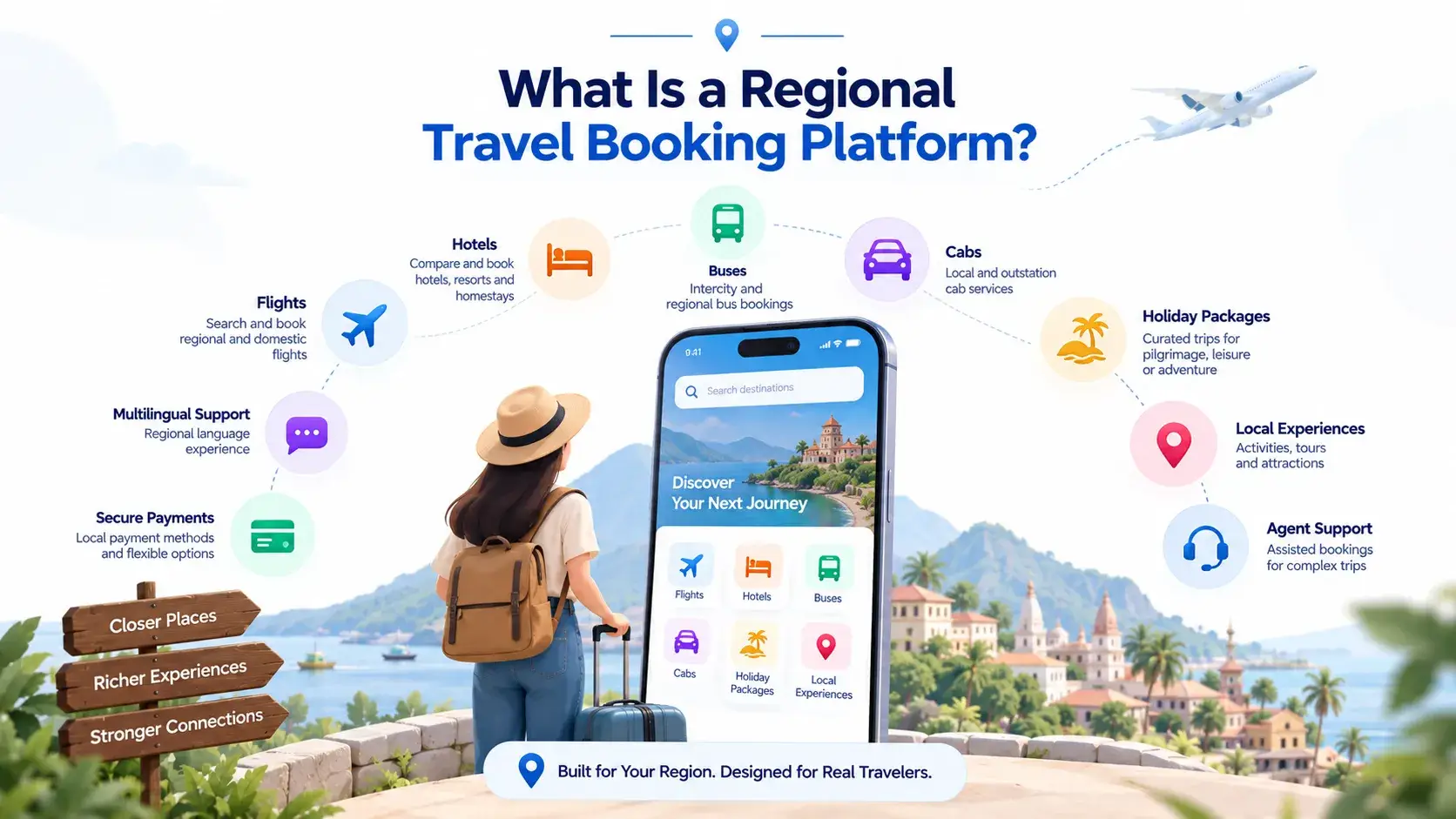
A regional travel booking platform is an online marketplace that helps travelers search, compare, book, pay for, and manage travel services in a specific geography, language, customer segment, or destination category. It may include flights, hotels, buses, cabs, holiday packages, local experiences, homestays, pilgrimage tours, adventure trips, corporate travel, or agent-assisted bookings.
The regional angle matters because travel is deeply local. A platform built for one country, city cluster, tourism circuit, or language market may need different suppliers, payment methods, cancellation rules, customer support workflows, seasonal pricing, and discovery patterns than a generic travel portal.
For example, a platform focused on religious tourism may need itinerary bundles, group bookings, verified hotels near key locations, cab packages, multilingual support, and agent-assisted bookings. A platform focused on weekend getaways may need hotel deals, activity bookings, flexible cancellation, wallet offers, and destination guides. A corporate-focused regional travel platform may need approval workflows, policy controls, GST invoices, spend reporting, and role-based access.
That is why the first planning question should not be “how many features can we add?” It should be “which travel flows must work reliably for our region, our customers, and our revenue model?”
Why Regional Travel Platforms Need a Different Feature Strategy
A national travel app can compete on large supplier coverage, heavy advertising, loyalty depth, and broad inventory. A regional travel booking platform usually wins differently. It can focus on a specific traveler need, destination type, agent network, local hotel inventory, language preference, support experience, or bundled trip experience that larger platforms may not prioritize deeply.
This difference changes the product strategy. Instead of trying to launch every travel category with equal depth, founders should identify the category mix that creates the strongest booking value in their region.
- Hotel-led regions may need direct hotel onboarding, seasonal rates, room inventory, cancellation rules, and supplier settlements.
- Flight-led regions may need reliable fare search, PNR generation, payment verification, and refund handling.
- Tourism circuit platforms may need packages, local transport, activities, guides, and itinerary management.
- Agent-led markets may need agent wallets, commissions, credit limits, client booking records, and settlement reports.
- Corporate travel platforms may need policy controls, approvals, invoices, department-wise reporting, and manager dashboards.
The strongest regional platforms usually do not begin by becoming everything for everyone. They begin by owning one clear travel use case better than a generic platform, then expand into adjacent services once booking volume, supplier relationships, and customer trust improve.
Core Features That Matter Most in a Regional Travel Booking Platform
Features should be selected based on business function, not because they sound impressive. A travel booking feature is valuable only when it improves discovery, conversion, payment reliability, supplier coordination, margin control, support quality, or repeat bookings.
1. Multi-Category Travel Search
The platform should allow travelers to search the categories that matter in your region. This may include flights, hotels, buses, trains, cabs, holiday packages, activities, homestays, or local experiences. The goal is not to activate every category immediately. The goal is to make each active category searchable, comparable, bookable, and manageable.
A weak travel platform only lists services. A stronger platform helps users filter by price, timing, distance, rating, amenities, cancellation terms, traveler type, and availability. Regional search also benefits from local terms, destination clusters, nearby attractions, and package-style discovery because many travelers do not always search by exact hotel or supplier name.
2. Supplier API and Inventory Integration
Supplier integration is one of the most important technical layers in a travel booking platform. Flights, hotels, buses, cabs, and activities may come from different providers, each with its own API structure, rate rules, authentication, timeout behavior, availability logic, booking response, and cancellation policy.
The platform should not treat every supplier response as identical. A proper integration layer should normalize supplier data so travelers see clean results, while the backend still tracks where the inventory came from, what rules apply, how confirmation works, and how changes or cancellations should be processed.
For founders evaluating technical scope, this is where cost can rise quickly. A simple hotel listing directory is very different from a real-time booking platform with live rates, room availability, supplier confirmation, payment verification, cancellation rules, and refund reconciliation.
For deeper technical planning, founders can review Miracuves’ guide on regional travel booking platform architecture to understand how supplier APIs, payments, booking management, and admin systems connect behind the scenes.
3. Booking Engine and Confirmation Logic
The booking engine is the operational heart of the platform. It manages the journey from search result to selected option, traveler details, fare or room breakdown, payment attempt, supplier confirmation, voucher or ticket generation, and booking record creation.
This matters because travel bookings can fail at several points. A traveler may pay while the supplier fails to confirm. A hotel room may become unavailable during checkout. A flight fare may change before payment is completed. A payment gateway may retry a transaction. A user may tap the pay button twice. A supplier may return a delayed response.
A serious travel platform should plan for these cases before launch. The backend should know when to lock an amount, when to verify payment, when to confirm with the supplier, when to issue a booking, when to trigger an automatic refund, and when to send a booking into manual review.
This is one of the biggest differences between a simple travel website and a real booking platform. The user sees a smooth confirmation screen, but the business needs a controlled workflow that protects revenue, prevents double charges, and reduces support pressure.
4. Traveler Accounts and Trip Dashboard
A traveler account should do more than store login details. It should make repeat booking easier. Users should be able to save traveler profiles, contact information, documents where relevant, recent searches, wishlist items, wallet balance, coupons, loyalty points, booking history, invoices, cancellation status, refund status, and support tickets.
For regional platforms, this dashboard can become a strong retention tool. A traveler who books a weekend package today may return later for a family hotel stay, local cab, activity, or seasonal trip. The more useful the account experience is, the easier it becomes to turn one booking into repeat business.
5. Web and Mobile Booking Experience
Travel search often starts on mobile, but many users still compare options across devices before making a booking. A regional platform should decide whether it needs Android, iOS, mobile web, desktop web, or all of them at launch. This decision directly affects cost, testing effort, user experience, and release planning.
A mobile-first app is useful for repeat travelers, wallet engagement, push notifications, app-only deals, and location-aware offers. A strong web platform helps with SEO, destination pages, package landing pages, hotel discovery, content marketing, and first-time search traffic. Many founders need both, but the launch sequence should follow the acquisition strategy.
If your first traffic source is paid ads, local partnerships, or existing agency customers, an app-led launch may work. If organic search, destination guides, hotel pages, and content-led discovery are central to growth, the web experience should be treated as a serious product surface, not a secondary add-on.
6. Admin Dashboard for Real Business Control
The admin dashboard is where a travel platform becomes manageable. Without strong admin control, every price change, supplier issue, refund case, coupon update, banner change, or booking dispute becomes a developer dependency or manual spreadsheet task.
A regional travel booking platform should give operators control over users, bookings, categories, suppliers, vendors, agents, coupons, margins, commissions, payments, refunds, support tickets, cancellations, reports, and content. This matters because travel operations change often. Rates change seasonally. Suppliers go offline. Regional campaigns need quick updates. Refund rules vary. Local partners need onboarding. Support teams need visibility.
Admin control is not just a backend convenience. It directly affects speed of response, customer trust, operational efficiency, and the founder’s ability to test business decisions without waiting for engineering work every time.
7. Vendor, Agent, and Partner Workflows
Many regional travel businesses are not purely consumer marketplaces. They also depend on local hotels, homestay owners, activity providers, transport operators, travel agents, and corporate clients. If these partners are part of your business model, they need proper workflows.
A vendor or supplier portal can help partners manage listings, rates, availability, bookings, documents, reviews, payouts, and settlement records. An agent portal can help local agents book on behalf of clients, track commissions, manage credit limits, and view monthly settlements. A corporate portal can support travel policies, approval flows, employee bookings, invoices, and department-level reporting.
These partner workflows can increase development cost, but they also expand how the platform earns. A consumer-only travel app depends heavily on direct customer acquisition. A platform with agent, supplier, and corporate workflows can open additional distribution and revenue channels.
Founders planning monetization can use Miracuves’ travel booking platform business model page to map booking margins, supplier commissions, agent channels, add-ons, and corporate workflows before deciding launch scope.
8. Payments, Wallet, Coupons, and Refunds
Payment is not a simple checkout button in travel. The platform needs to manage payment initiation, amount locking, gateway verification, supplier confirmation, failed booking refunds, cancellation refunds, wallet balance, coupons, promo codes, gift cards, invoices, partial payments where relevant, and reconciliation reports.
For regional markets, payment planning should also consider local payment preferences. Some markets rely heavily on UPI or wallets. Some need card payments and net banking. Some agent-led markets may need credit limits and settlement cycles. Some corporate buyers may need invoice-first or approval-first workflows.
Refund clarity is equally important. Travel customers care deeply about what happens if a booking fails, a trip changes, a cancellation is requested, or a supplier modifies availability. The platform should show cancellation rules before payment and provide status visibility after the request is placed.
9. Localization for Regional Demand
Regional travel platforms need localization beyond language translation. The platform may need local currencies, taxes, invoice formats, region-specific filters, destination categories, local payment methods, pickup/drop locations, customer support timing, seasonal campaigns, and content that matches how travelers actually search.
A platform serving domestic weekend travelers may need “nearby stays,” “family packages,” “budget hotels,” “self-drive trips,” and “festival travel” categories. A platform serving international outbound travelers may need visa support, forex services, insurance, baggage rules, and documentation guidance. A platform serving pilgrimage travelers may need route bundles, group travel, local transport, and stay options near key destinations.
Localization can increase cost when it requires multiple languages, multi-currency pricing, tax configuration, region-wise suppliers, different cancellation rules, or different customer support workflows. But it can also become a strong differentiator if your regional audience feels the platform is built for them rather than adapted from a generic template.
10. Security, Access Control, and Trust Features
Travel platforms handle personal information, payment activity, trip records, supplier credentials, invoices, documents, support conversations, and admin actions. Security should be planned as part of the product foundation, not added after launch.
Important security layers include secure login, encrypted data transfer, encrypted data storage where required, role-based access control, audit logs, secure payment gateway integration, tokenized payments, suspicious activity monitoring, refund controls, API authorization, rate limits, and permission-based dashboards.
This is especially important when multiple roles use the platform. Travelers should only access their own bookings. Vendors should only access their inventory and reservations. Agents should only access their clients and commission records. Finance teams should see settlement and refund data. Support teams should see booking context without unnecessary access to sensitive controls. Admins should have visibility, but even admin access should be structured carefully.
For a deeper checklist, read the Miracuves guide on travel booking platform security, which explains traveler accounts, payments, APIs, access controls, fraud monitoring, and operational trust workflows.
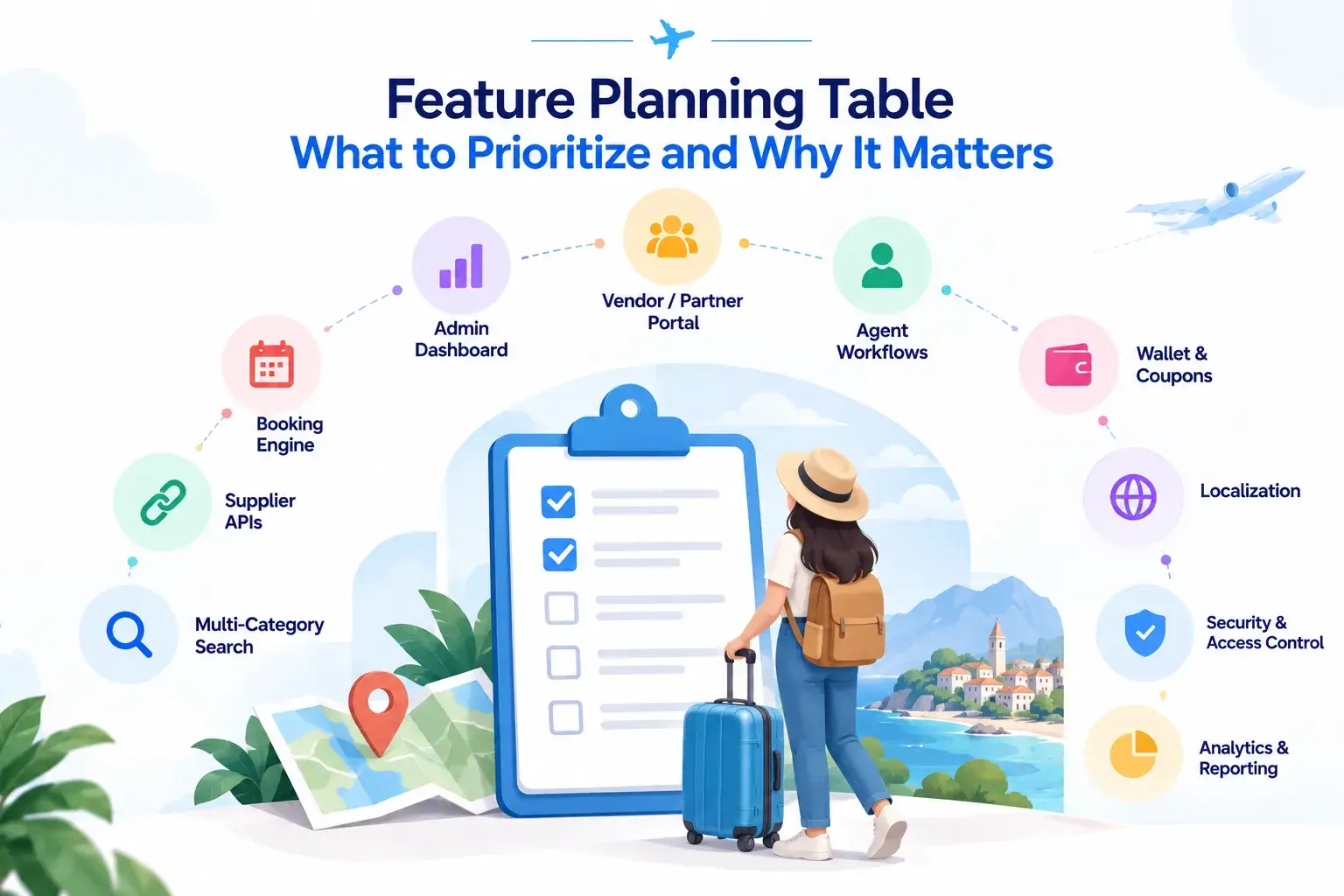
Feature Planning Table: What to Prioritize and Why It Matters
| Feature Area | Why It Matters | Cost Impact | Founder Decision |
|---|---|---|---|
| Multi-category search | Allows travelers to compare flights, hotels, transport, packages, and experiences in one place. | Medium to high, depending on number of categories and supplier depth. | Start with the categories that match your regional demand instead of launching everything equally. |
| Supplier APIs | Connects the platform to live rates, availability, booking confirmation, and cancellation rules. | High when multiple suppliers, fallback rules, and real-time inventory are needed. | Prioritize reliable suppliers first; add additional suppliers after the core flow works. |
| Booking engine | Controls payment, confirmation, booking records, failed bookings, cancellations, and refunds. | High because it affects revenue, trust, and support operations. | Do not treat this as optional; this is the foundation of a real booking business. |
| Admin dashboard | Gives the operator control over bookings, margins, users, suppliers, coupons, refunds, and reports. | Medium to high depending on roles, permissions, and reporting depth. | Invest early because weak admin control increases manual work after launch. |
| Vendor or partner portal | Lets hotels, hosts, activity providers, or transport partners manage inventory and bookings. | Medium to high depending on partner autonomy and settlement needs. | Add it if regional supplier relationships are central to your model. |
| Agent workflows | Supports local travel agents with client booking, commission tracking, wallet, and settlements. | Medium depending on commission and credit logic. | Useful when your region still has strong offline or agent-assisted bookings. |
| Wallet and coupons | Supports retention, repeat bookings, refunds, cashback, and promotional campaigns. | Medium because payment and ledger accuracy matter. | Use it to improve repeat booking, but avoid discounting without a margin plan. |
| Localization | Matches regional language, payment habits, taxes, content, and travel behavior. | Low to high depending on depth. | Prioritize the local elements that directly improve conversion and trust. |
| Security and access control | Protects accounts, payments, bookings, partner data, and admin actions. | Medium, but expensive to fix later if ignored. | Build access roles, audit logs, and payment safeguards from day one. |
| Analytics and reporting | Shows booking volume, revenue, cancellations, supplier performance, campaign results, and margins. | Medium depending on dashboard complexity. | Track what helps decisions, not vanity metrics only. |
Cost Factors That Matter Most When Planning the Platform
The cost of a regional travel booking platform depends less on the surface design and more on the depth of booking operations. A polished homepage is not the expensive part. Cost increases when the platform must manage multiple travel categories, live suppliers, real-time availability, payments, cancellations, refunds, partner portals, admin permissions, analytics, security, and regional customization.
Here are the cost factors founders should evaluate before choosing a build route.
1. Number of Travel Categories
Every category adds its own search logic, filters, supplier rules, booking fields, cancellation conditions, pricing model, confirmation process, and support scenarios. Flights are different from hotels. Hotels are different from buses. Activities are different from holiday packages. Cabs are different from homestays.
Launching with more categories can improve user convenience, but it also increases scope. Founders should decide which categories create the strongest regional use case. A platform for a destination-heavy region may start with hotels, packages, cabs, and activities. A business travel platform may start with flights, hotels, approvals, invoices, and reporting. A local agent network may begin with hotels, packages, and agent booking tools.
2. Supplier Integration Complexity
Supplier integrations are one of the biggest cost drivers because they require backend work, testing, error handling, data normalization, credential management, rate limits, and booking confirmation workflows. One supplier may be manageable. Multiple suppliers across categories require a stronger integration layer.
Cost also depends on whether the platform needs supplier fallback. Fallback means the platform can route search or booking flow to another supplier when one provider fails or does not return reliable data. This improves reliability, but it requires additional logic.
For a regional launch, founders can reduce complexity by starting with trusted suppliers, direct inventory, or fewer categories, then expanding API depth after demand is validated.
3. Booking Failure and Refund Handling
Travel booking failures are not rare edge cases. They are normal operational realities. A fare may expire, room availability may change, payment may succeed before supplier confirmation, or a cancellation may require a partial refund. If the platform does not plan for these cases, the cost moves from development into customer support, reputation damage, and manual reconciliation.
A stronger booking engine should track booking state clearly: search initiated, option selected, payment initiated, payment verified, supplier confirmation requested, booking confirmed, booking failed, refund initiated, refund completed, cancellation requested, or manual review needed.
This increases development complexity, but it protects the business. In travel, trust is built when the platform handles uncertainty clearly.
4. Mobile Apps, Website, and Admin Surfaces
Cost changes depending on how many surfaces the platform needs. A founder may need a customer-facing website, Android app, iOS app, admin dashboard, vendor portal, agent portal, and corporate portal. Each surface adds design, frontend development, backend permissions, testing, and maintenance.
The right decision depends on the business model. A consumer OTA may need app and web from the beginning. A regional hotel aggregator may prioritize web, vendor portal, and admin controls first. An agent-led travel business may prioritize agent dashboard and booking management before advanced consumer app features.
This is why founders should avoid buying or building features only because they sound standard. Every surface should have a clear user role and business purpose.
5. Partner Portals and Role-Based Permissions
Partner portals are valuable when the business model depends on suppliers, local agents, corporate buyers, or internal operations teams. But they also increase cost because each role needs a separate dashboard, permissions, workflows, reports, and notifications.
A hotel partner may need inventory, rates, bookings, payouts, and reviews. An agent may need customer records, booking tools, commission, credit limits, and settlements. A corporate manager may need approvals, spend policies, employee booking history, and invoice reports. A finance user may need settlements, refunds, taxes, and reconciliation.
Role-based permissions are not only about privacy. They keep operations clean. When every user sees only what they need, the platform becomes safer and easier to manage.
6. Payment Gateway, Wallet, and Reconciliation
Payment features influence both development cost and operating risk. A basic payment gateway integration may be simple, but a travel platform often needs more: multiple payment methods, wallet balance, promo codes, refunds, partial cancellations, gift cards, agent credit, invoices, and transaction reports.
Reconciliation is especially important. The finance team should know which bookings were paid, confirmed, failed, refunded, settled with suppliers, or pending action. Without this visibility, the business may appear to process bookings successfully while losing money through failed confirmations, manual refunds, or unclear settlement records.
7. Regional Customization
Regional customization can be light or deep. Light customization may include branding, language, homepage banners, destination categories, and payment preferences. Deep customization may include multi-language content, multi-currency support, region-specific taxes, local supplier workflows, special trip categories, government document fields, custom invoice formats, and location-based service availability.
The more the platform reflects local buying behavior, the better it may convert. But every customization should be tied to a business reason. Adding complexity without a clear use case can slow launch and increase maintenance.
8. Security, Fraud Monitoring, and Admin Logs
Security costs are often underestimated because they do not appear as visible user features. But they protect the business from account abuse, payment issues, unauthorized access, refund manipulation, supplier data misuse, and admin mistakes.
At minimum, founders should plan secure authentication, password protection, session control, payment verification, role-based access, audit logs, API authorization, input validation, rate limiting, fraud signals, and secure handling of booking and payment data.
Security becomes more important as the platform adds vendors, agents, corporate users, finance users, support staff, and multiple admin roles.
9. Scalability for Seasonal Travel Demand
Travel demand is not flat. Regional platforms may see spikes during holidays, long weekends, school vacations, festivals, local events, and seasonal tourism windows. A platform that works on a normal weekday may struggle during peak search and booking periods if architecture is not planned properly.
Scalability planning includes caching, queue-based notifications, rate limiting, database optimization, supplier timeout handling, load-balanced servers, background jobs, and reporting systems that do not slow down booking flows.
This does not mean every founder needs enterprise infrastructure from day one. It means the platform should be built in a way that can scale without a complete rebuild when traffic grows.
10. Source Code, Ownership, Support, and Deployment
Ownership affects long-term cost. A rented platform may appear easier at first, but monthly fees, per-booking charges, limited customization, and dependency on the provider can become expensive as the business grows. Source-code ownership gives founders more control over branding, roadmap, integrations, custom workflows, and future technical decisions.
Support and deployment also matter. A travel platform includes many moving parts, so founders should clarify what is included in deployment, handover, documentation, bug fixing, post-launch guidance, app publishing, server setup, payment configuration, and supplier integration support.
Miracuves’ ready-made approach is useful for founders who want a white-label, source-code-owned travel booking foundation with admin control and faster launch readiness. Where the scope fits a ready-made deployment, Miracuves can help move faster with a 6-day solution delivery path instead of building every core module from zero.
Ready-Made vs Custom Development: Which Route Fits Regional Travel Founders?
Both ready-made and custom development can work. The better choice depends on how much of your platform is standard booking logic and how much is unique to your operating model.
| Build Route | Best For | Strength | Watch-Out |
|---|---|---|---|
| Ready-made white-label platform | Founders who need core travel booking workflows, branding, admin control, and faster launch. | Reduces time spent building standard modules from zero. | Custom requirements should be scoped clearly before launch. |
| Custom development | Businesses with unusual workflows, proprietary supplier logic, or highly differentiated user journeys. | Maximum flexibility for unique product requirements. | Usually requires more time, more budget, and deeper project management. |
| Phased hybrid approach | Founders who want to launch core modules first and add advanced regional features later. | Balances speed, learning, and customization. | Requires a clear roadmap so phase two does not become messy. |
A ready-made platform works well when your first priority is to launch a reliable booking foundation, test regional demand, onboard suppliers, start campaigns, and manage bookings from an admin panel. Custom development becomes more suitable when your product model is substantially different from standard OTA flows or requires deep proprietary logic from the beginning.
For founders comparing routes, the practical question is not “which option has more features?” The better question is “which option gets the right booking experience into the market with enough control to learn, adjust, and grow?”
How to Decide Your First Launch Scope
The safest launch scope is usually not the smallest feature set. It is the smallest complete business flow. A complete business flow means the traveler can search, compare, book, pay, receive confirmation, manage the booking, request support, and trust the result. The admin team can manage users, inventory, suppliers, payments, cancellations, refunds, and reporting. Partners can participate if they are part of the business model.
Here is a practical way to plan the first version:
- Choose the first travel category mix. Decide whether flights, hotels, buses, cabs, packages, activities, or homestays matter most in your region.
- Map the user journey. Write the exact path from search to payment, confirmation, cancellation, refund, and support.
- Map the operator journey. Decide how admins will manage bookings, suppliers, pricing, promotions, and issues.
- Identify supplier dependencies. Clarify which APIs, direct partners, manual inventory sources, or local vendors are needed before launch.
- Define monetization early. Decide whether revenue comes from booking margins, supplier commission, agent commission, packages, corporate plans, ads, featured listings, or add-ons.
- Prioritize trust workflows. Make cancellation, refund, support, verification, and payment status easy to understand.
- Plan phase two before phase one launches. Know which features can wait, so the initial platform stays focused.
If you need a direct cost-specific breakdown, review the travel booking platform development cost page to understand how scope, ownership, channels, and included modules affect the final quote.
Founder Decision Signals
Speed
If your main risk is waiting too long to test regional demand, a ready-made foundation can help you launch core booking workflows faster.
Cost
If your budget is sensitive, reduce first-version scope by choosing fewer travel categories and only the partner workflows you truly need.
Scalability
If your region has seasonal demand spikes, plan caching, queues, supplier timeout handling, and booking-state tracking early.
Market Fit
If your audience is niche, prioritize local inventory, regional content, payment preferences, language, and support workflows over generic features.
Cost Planning by Founder Type
Not every founder needs the same travel platform on day one. The right cost plan depends on the starting advantage of the business.
| Founder Type | Best First Scope | Features to Prioritize | Features to Delay |
|---|---|---|---|
| Local travel agency moving online | Hotels, packages, cabs, agent-assisted booking, admin control. | Booking management, customer records, package builder, payments, invoices, support. | Advanced loyalty, multi-country currency, complex corporate approval flows. |
| Regional hotel aggregator | Hotel listings, vendor onboarding, availability calendar, rates, reviews, payments. | Vendor portal, map search, seasonal pricing, cancellation rules, supplier settlements. | Flight booking, train booking, large agent network features. |
| Destination or activity marketplace | Activities, local experiences, packages, cabs, guides, itinerary pages. | Experience listings, time slots, group booking, reviews, local content, refund rules. | Complex flight API integrations unless they are essential to the package. |
| Corporate regional travel desk | Flights, hotels, policy controls, approvals, invoices, employee booking records. | Corporate portal, manager approvals, spend reports, role permissions, invoices. | Consumer loyalty features and broad local experience catalogues. |
| Startup OTA for a specific region | Core app, web platform, hotels, packages, selected transport, wallet, admin control. | Search, booking engine, payment verification, admin dashboard, marketing pages, analytics. | Too many categories before supplier readiness is confirmed. |
This approach keeps the platform commercially realistic. It lets founders spend on the workflows that support bookings and revenue rather than building every possible feature before proving demand.
Mistakes Founders Should Avoid While Planning Features and Cost
Mistakes Founders Should Avoid
Building every travel category before validating demand
More categories can increase convenience, but they also increase supplier work, testing, support complexity, and cost. Start with the category mix that matches your strongest regional opportunity.
Treating supplier APIs as a small task
Supplier integrations involve availability, rates, authentication, mapping, confirmation, cancellations, refunds, errors, and timeouts. Underestimating this layer can create booking failures after launch.
Ignoring admin control until operations become messy
Admin workflows should be planned early because pricing, coupons, bookings, cancellations, refunds, partners, reports, and support cannot depend on developer intervention every time.
Adding discounts without a margin strategy
Coupons and cashback can support growth, but they should be connected to category margins, repeat booking goals, supplier terms, and wallet strategy.
Forgetting cancellation and refund visibility
Travel customers want clarity. If the platform does not show cancellation terms, refund status, and support context clearly, trust can drop even when the booking inventory is strong.
How Miracuves Helps Founders Plan and Launch Faster
For many founders, the challenge is not understanding that travel booking has opportunity. The challenge is converting that opportunity into a platform that can actually manage users, suppliers, payments, bookings, cancellations, margins, support, and growth from one controlled system.
Miracuves helps founders build ready-made and white-label travel booking platforms with branded design, source-code ownership, admin dashboards, user and partner workflows, payment integration, and launch-focused execution. Instead of spending months recreating standard travel modules, founders can begin with a stronger product foundation and customize it for their regional market.
If your goal is to launch a travel booking business with a ready-made foundation, Miracuves’ MakeMyTrip Clone solution can help you evaluate the platform modules, travel categories, admin workflows, and 6-day deployment path before deciding your final scope.
You can also review the travel booking platform features page if you want to compare traveler, agent, vendor, corporate, and admin workflows in more detail.
Final Thoughts: Plan the Booking Business, Not Just the App
A regional travel booking platform succeeds when the product matches the business model. Search screens, hotel cards, and booking buttons are only the visible layer. The deeper value sits in supplier coordination, payment reliability, refund handling, admin control, partner workflows, regional localization, and the ability to adapt pricing and operations as demand changes.
Founders should start by identifying the strongest regional use case, the first travel categories that matter, the suppliers needed to support them, the admin controls required to operate them, and the cost factors that will affect launch scope. A focused platform with reliable booking workflows is usually stronger than a bloated platform that looks complete but struggles when real travelers, suppliers, payments, and refunds enter the system.
The smarter decision is not always the longest build. It is the build that gives you the right foundation, enough control, and a practical path to market validation.
FAQs
What is the most important feature in a regional travel booking platform?
The most important feature is the booking engine because it connects search, pricing, payment, supplier confirmation, booking records, cancellations, refunds, and support. Without a reliable booking engine, the platform may look good but fail during real transactions.
How much does it cost to build a regional travel booking platform?
The cost depends on travel categories, supplier APIs, mobile apps, web platform, admin dashboard, vendor or agent portals, payment workflows, localization, security, scalability, and customization scope. A simple listing platform costs less than a real-time booking platform with suppliers, payments, refunds, and partner workflows.
Which travel categories should a regional platform launch first?
A regional platform should launch with the categories that match its strongest demand. Hotel-led regions may start with stays and packages, agent-led markets may need booking tools and commissions, while corporate travel platforms may prioritize flights, hotels, approvals, invoices, and reporting.
Do regional travel platforms need supplier API integrations?
Supplier APIs are important when the platform needs live rates, availability, confirmation, cancellation rules, and booking updates. Some founders may begin with direct inventory or fewer suppliers, but real-time booking usually requires a structured integration layer.
Why is the admin dashboard important for travel booking platforms?
The admin dashboard helps operators manage users, bookings, suppliers, margins, coupons, payments, refunds, cancellations, support tickets, reports, and partner activity. Strong admin control reduces manual work and helps the founder adjust operations without depending on developers for every small change.
Should I choose ready-made or custom development for a travel booking platform?
A ready-made white-label platform is useful when you need standard booking workflows, branding, admin control, and faster launch. Custom development is better when the business model requires highly unique workflows, proprietary supplier logic, or deep product differentiation from day one.
What security features should a regional travel booking platform include?
Important security features include secure authentication, encrypted data transfer, payment verification, tokenized payments, role-based access control, audit logs, API authorization, fraud monitoring, refund controls, and permission-based dashboards for travelers, suppliers, agents, finance teams, support users, and admins.
Miracuves is an independent software development company. We are not affiliated with, connected to, sponsored by, or endorsed by any company or product named in this article.
Terms such as “X Clone” are used descriptively. It is how the software industry refers to building a platform with functionality comparable to a known service, and how clients search for it.
The entire design and codebase of our products is built by our own team. Our products contain no code, design, graphics, or content originating from any third-party website or applications.
All third-party names and marks referenced in this article are the property of their respective owners, referenced solely to identify the services discussed.