


Launching a regional travel booking platform looks simple from the outside. A traveler searches for a destination, compares hotels or transport options, chooses dates, pays online, and receives a confirmation. But behind that smooth experience sits a complex marketplace of suppliers, rates, availability, payments, cancellations, refunds, support teams, agents, local preferences, and admin decisions.
That is where many startups struggle. They do not fail because travel demand is weak. They fail because the platform is launched without enough operational clarity. The app may look attractive, but the supplier data is unreliable. The payment flow may work in testing, but refund handling breaks under real customers. The brand may advertise regional expertise, but the platform does not support local languages, local packages, or local payment behavior.
A regional travel booking platform needs more than booking screens. It needs a business model, supplier workflow, admin control, user trust, payment reliability, support visibility, and a clear launch plan. This guide explains the most common mistakes startups should avoid before launching, especially if they want to build a platform that can grow beyond the first few bookings.
Key Takeaways
- Regional travel booking platform mistakes usually happen when founders focus only on frontend design and ignore supplier, payment, refund, support, and admin workflows.
- A regional travel platform should be planned around the market it serves, not copied blindly from a broad national or global travel model.
- Supplier reliability, local inventory, pricing control, payment preferences, cancellation rules, and traveler trust signals directly affect booking conversion.
- Startups should define monetization before launch because travel platforms often need multiple revenue streams, not just one commission model.
- Miracuves helps founders launch ready-made and white-label travel booking platforms with source-code ownership, admin dashboards, and faster deployment when the selected scope fits the rollout requirement.
Why Regional Travel Platforms Need a Different Launch Strategy
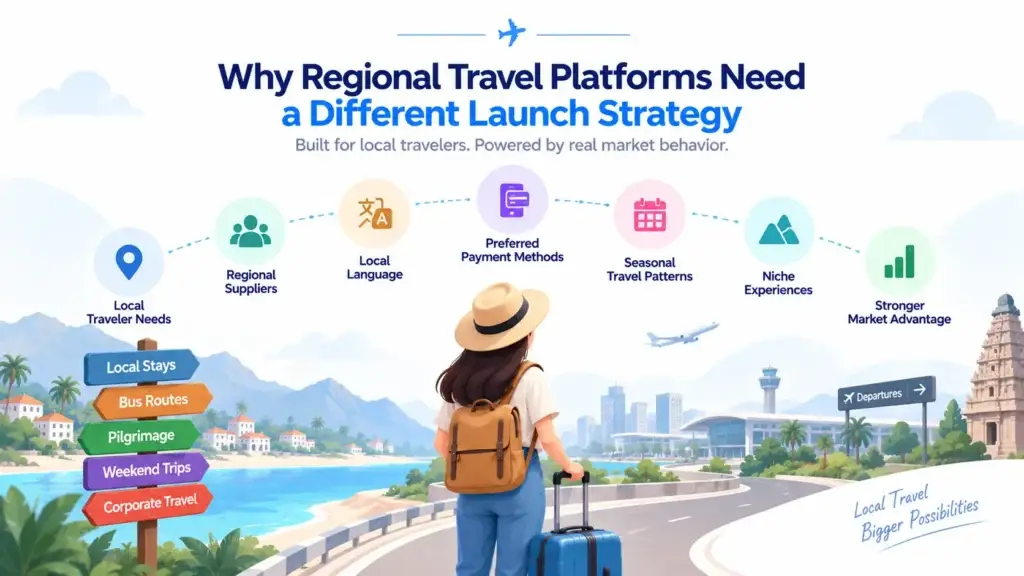
A regional travel booking platform is not just a smaller version of a large travel app. It serves a more specific traveler behavior. Users may search for local stays, bus routes, airport transfers, pilgrimage packages, weekend trips, corporate travel, regional holiday bundles, activity bookings, or travel agents who can help them plan complex trips.
That regional focus can become a strong advantage. A startup can serve local routes, language preferences, payment habits, seasonal travel patterns, local suppliers, and niche experiences better than a broad platform designed for everyone. But that advantage only works when the product is built around real market behavior.
The biggest mistake is assuming that launching a travel booking app means adding a few search filters, connecting inventory, and collecting payments. In reality, every travel booking is a chain of decisions: search accuracy, availability, price validation, payment confirmation, supplier response, booking record creation, notifications, cancellation rules, refund timelines, support visibility, and post-booking trust.
When any one of those steps is weak, the customer does not blame the supplier. The customer blames the platform. That is why a startup should treat the platform as an operating system for travel commerce, not just a mobile app.
Mistake 1: Launching Without a Clear Regional Positioning
Many startups enter travel booking with a broad ambition: flights, hotels, packages, cabs, activities, offers, agents, and everything else. Ambition is good, but unclear positioning creates product confusion. If the platform tries to serve every traveler from day one, it may not serve any traveler deeply enough.
A regional travel booking platform should answer a sharper question: what market do we understand better than a larger booking marketplace? That market could be a city-to-city travel corridor, a state-level tourism segment, a religious travel route, a regional corporate travel audience, a local hotel network, adventure tourism, medical travel, student travel, or weekend holiday packages.
Without this clarity, founders make scattered feature decisions. They add categories because other platforms have them, not because their first users need them. They spend money on broad marketing before knowing which travel use case converts. They onboard suppliers without understanding which inventory creates repeat bookings.
Strong regional positioning helps the founder decide what to launch first, what to delay, which suppliers to prioritize, which payment methods matter, which languages should be supported, and what kind of promotions should appear on the homepage.
Regional Positioning Mistakes and Better Startup Decisions
| Weak Launch Decision | Why It Hurts the Platform | Smarter Regional Decision |
|---|---|---|
| Launching with every travel category at once | The team spreads supplier, support, and marketing effort too thin before proving demand. | Start with the categories your region already books frequently, then expand after usage patterns are clear. |
| Copying a broad travel marketplace layout | The platform may look familiar but fail to highlight regional inventory, local packages, or unique demand drivers. | Design the homepage around regional routes, seasonal trips, local offers, and traveler intent. |
| Ignoring offline travel behavior | Many regional customers may still depend on agents, phone support, or assisted booking for complex trips. | Plan agent workflows, assisted booking, inquiry handling, and customer support from the beginning. |
| Using generic content for all locations | Travelers may not trust thin destination pages or vague package information. | Create useful regional content, clear package details, local policies, and trust-building trip information. |
Mistake 2: Treating Supplier Inventory as a Simple API Problem
Travel platforms depend on inventory. That inventory may come from hotel partners, transport operators, activity providers, package sellers, wholesalers, local agents, or direct supplier integrations. The mistake is assuming that supplier connectivity is only a technical task.
Supplier inventory is both a technical and operational responsibility. The platform must know which supplier has the room, seat, package, or activity slot available. It must show the correct price. It must confirm whether the booking is accepted. It must handle cases where availability changes between search and payment. It must also keep internal teams informed when supplier responses are delayed or inconsistent.
For regional platforms, supplier complexity can be even higher because not every local operator has a clean digital system. Some hotels may prefer dashboard updates. Some tour operators may confirm manually. Some local transport partners may need fixed inventory rules. Some package sellers may work by inquiry rather than instant booking.
Startups should avoid launching with supplier workflows that only work in ideal conditions. Real travel operations include sold-out inventory, seasonal rates, special dates, partial cancellations, refund requests, payout questions, duplicate bookings, and support escalations.
What to Plan Before Supplier Onboarding
- Which supplier categories will be bookable from day one?
- Which suppliers need dashboards and which need API connections?
- How will the platform validate price and availability before payment?
- What happens when a supplier fails to confirm after payment?
- Who approves new suppliers, rooms, packages, routes, and activity listings?
- How will payout records, commissions, and disputes be tracked?
- What supplier performance data should the admin team see?
A founder does not need every supplier integration on day one, but the operating model should be clear. A focused platform with reliable inventory will usually perform better than a broad platform where users cannot trust availability.
For a deeper technical view of how search, supplier APIs, payments, and booking records connect, founders can review Miracuves’ guide on regional travel booking architecture.
Mistake 3: Ignoring Local Payment Behavior and Refund Expectations
Payment is one of the most sensitive moments in travel booking. A traveler may compare for hours, but the final decision depends on whether they trust the checkout. If the payment method they prefer is missing, if the price changes at the last step, or if refund rules are unclear, the booking can be lost immediately.
Regional platforms should not assume one payment flow fits every market. Some users may prefer cards. Others may prefer wallets, net banking, bank transfer, local payment systems, pay-later options, or assisted payment through an agent. A startup should prioritize payment methods based on the region, ticket size, traveler type, and booking category.
Refund expectations also vary by category. A hotel cancellation, activity cancellation, flight change, cab cancellation, holiday package refund, and partial trip cancellation may all follow different rules. If these policies are hidden or handled manually after launch, support load increases and trust decreases.
The platform should make payment and refund logic visible before the user pays. Travelers should know cancellation windows, refund eligibility, payment status, booking status, and support options. Admin teams should be able to track payment references, failed confirmations, refund queues, and dispute records without searching across disconnected tools.
Payment and Refund Questions Startups Should Answer Early
- Will the platform validate price and availability before collecting payment?
- Will booking confirmation happen instantly or after supplier approval?
- How will failed payments, pending payments, and duplicate attempts be handled?
- Which refund rules apply to each travel category?
- Can the support team see payment and booking status in one place?
- Will the platform support wallet credits, promo codes, or loyalty-linked refunds?
Payment reliability is not just a finance issue. It directly affects conversion, repeat bookings, support workload, and brand trust.
Mistake 4: Designing for Search but Not for Booking Confidence
Many travel startups spend heavily on search screens. They add filters, banners, destination cards, price labels, and attractive visuals. These elements matter, but they do not automatically create booking confidence.
Travelers need reassurance at every decision point. They want to know whether the hotel is real, whether the price is final, whether cancellation is possible, whether reviews can be trusted, whether the package includes what it claims, and whether support will respond if something changes.
Regional travel platforms often have an opportunity to outperform broad platforms here because they can add deeper local context. A hotel listing can explain nearby transport access. A package can show day-wise inclusions. An activity listing can show safety notes, language options, pickup points, and local operator information. A bus or cab booking can show boarding details clearly. A holiday package can explain what is included and what is not.
Startups should avoid building a platform that helps users search but leaves them uncertain when it is time to book. The trust layer should be designed into listings, checkout, confirmation, support, reviews, and cancellations.
Founder Decision Signals
Speed
If your team spends months building basic search and checkout from zero, supplier acquisition and marketing may be delayed. A ready-made foundation can help when the launch scope is already clear.
Cost
Travel platform cost is not only development cost. It includes supplier onboarding, API setup, payment testing, support training, refund workflows, and post-launch changes.
Scalability
A regional platform should support category expansion, supplier growth, seasonal spikes, agent workflows, and admin permissions without forcing a full rebuild later.
Market Fit
The first version should match real regional demand. Stronger market fit comes from focused inventory, trusted booking flows, local payments, and clear support.
Mistake 5: Postponing Monetization Until After Launch
A travel platform needs revenue logic before it starts taking bookings. Some founders assume monetization can be added later after the platform gains users. That approach is risky because monetization affects supplier agreements, checkout flow, pricing display, agent commissions, refund rules, package margins, and admin reporting.
A regional travel booking platform may earn through supplier commissions, service fees, package markups, activity margins, featured listings, agent commission splits, corporate travel plans, insurance or visa assistance, local transport add-ons, advertising placements, subscriptions, loyalty programs, or wallet-linked repeat booking incentives.
The right model depends on the region and inventory type. Flight margins may be thinner. Local packages may allow stronger margins. Hotels may work through commission. Activities may work through direct supplier deals. Corporate travel may work through account-based pricing. Agent-led bookings may require commission controls and monthly settlements.
If monetization is not planned early, founders may discover that the platform is generating bookings but not enough contribution margin. They may also struggle to calculate agent commissions, supplier payouts, refunds, taxes, promo-code impact, and category-wise profitability.
Founders who want to map revenue streams more clearly can explore Miracuves’ guide to the travel booking revenue model and use it as a planning reference before finalizing launch scope.
Mistake 6: Launching Without Strong Admin and Operations Control
The traveler-facing app gets the attention, but the admin layer decides whether the business can actually run. A startup may have a beautiful booking interface, but if the operations team cannot manage bookings, suppliers, payouts, refunds, users, support tickets, discounts, homepage content, roles, and reports, the platform becomes difficult to control.
Regional travel platforms especially need practical admin control because market conditions change often. A festival weekend may require different pricing. A local supplier may pause inventory. A route may become unavailable. A hotel may update seasonal rates. A support team may need to prioritize urgent travel cases. A finance user may need to approve a refund without accessing supplier settings.
Admin control is not just about giving the founder a dashboard. It is about creating role-based workflows for everyone involved in the business: operators, support agents, supplier managers, finance teams, marketing teams, and business owners.
Before launch, founders should check whether the platform allows them to manage:
- Booking status and booking history
- Supplier approvals and listing updates
- Category-wise margins and service fees
- Promo codes, banners, offers, and campaigns
- Payment references and refund queues
- Agent commission and settlement records
- User roles, permissions, and activity logs
- Customer support tickets and booking-linked conversations
- Reports for revenue, bookings, cancellations, and supplier performance
If these controls are missing, every small operational change becomes a developer task. That slows the business down at exactly the moment it needs to respond quickly.
Mistake 7: Ignoring Security Until the Platform Starts Growing
Security should not be treated as a post-launch improvement. Travel platforms handle user accounts, personal details, booking history, payment references, supplier data, refund requests, support messages, and admin access. If these layers are weak, trust suffers before the startup gets a chance to scale.
For a regional platform, trust can be a major differentiator. Travelers may be booking with a newer brand, so the platform must reassure them through secure login, clear payment status, transparent policies, verified listings, booking records, refund visibility, and accessible support.
Startups should think about security across the entire booking journey, not only at the payment gateway. The platform should protect authentication, user sessions, payment callbacks, supplier dashboards, admin permissions, customer data, API keys, review systems, promo code abuse, refunds, and payout approvals.
Important security layers include encrypted data transfer, secure payment gateway integration, role-based access control, audit logs, supplier verification, fraud monitoring signals, booking history, refund controls, and permission-based dashboards.
Founders can use this travel booking platform security guide to understand how trust, payments, APIs, and access controls should be planned before launch.
Mistake 8: Building a Regional Platform Without Localized Search and Content
Regional travel search is not only about entering a city and date. Travelers may search by occasion, budget, season, route, event, language, group type, nearby attractions, local transport availability, family suitability, or package inclusions. If the platform only supports generic search behavior, it may fail to capture high-intent regional demand.
Localization should influence filters, destination pages, package descriptions, payment preferences, support language, offer banners, notification tone, and promotional campaigns. A user looking for a weekend trip may need different information than a user booking a business hotel. A family booking a holiday package may need different reassurance than a solo traveler booking a last-minute bus ticket.
The mistake is treating localization as translation only. True localization means the platform understands how people in that region plan, compare, pay, cancel, ask questions, and book again.
Localization Areas Founders Should Not Ignore
- Regional destination pages with useful travel context
- Local payment methods and wallet behavior
- Language support for search, support, and notifications
- Seasonal offers based on regional travel calendars
- Local package types, route preferences, and activity categories
- Supplier-side dashboards that match local operator workflows
- Support scripts for cancellations, delays, and itinerary changes
Good localization can improve both conversion and customer retention because it makes the platform feel built for the traveler’s actual journey.
Mistake 9: Planning Marketing After the Product Is Already Live
Travel booking platforms need supply and demand to grow together. If the startup launches the product first and thinks about marketing later, the platform may go live without enough destination content, supplier offers, search visibility, agent outreach, referral planning, or local campaigns.
Marketing should influence the launch plan from the beginning. A regional platform needs destination pages, package pages, trust-building content, local SEO, supplier stories, social proof, seasonal offers, email capture, referral mechanics, abandoned-search follow-ups, and post-booking retention flows.
Founders should decide what the first 90 days of demand generation will look like before launch. Will the platform acquire customers through local SEO? Travel agents? Influencer campaigns? Corporate accounts? Supplier co-marketing? Paid ads? WhatsApp communities? Regional content? Referral rewards? The acquisition strategy should match the audience and inventory.
A common mistake is launching with a product but no reason for users to return. Travel has natural repeat potential, but repeat booking depends on wallet credits, loyalty reminders, personalized offers, destination suggestions, support quality, and post-trip engagement.
The product and marketing plan should work together. If the platform promotes regional holiday packages, the app should support those package details clearly. If it promotes local hotel deals, the listings should be rich enough to convert. If it promotes agent-assisted travel, agent workflows should already be ready.
Mistake 10: Choosing the Wrong Build Path for the Launch Stage
One of the biggest founder decisions is whether to build from zero, rent a platform, customize an existing foundation, or launch with a ready-made white-label product. There is no single answer for every startup. The right choice depends on budget, timeline, supplier relationships, internal technical capacity, feature depth, ownership needs, and market urgency.
Building from zero may offer maximum flexibility, but it can take longer and require a larger engineering team. Renting can be faster, but founders may have less control over source code, data, margins, customization, or long-term flexibility. A ready-made foundation can be useful when the startup wants to launch faster with core workflows already available and then customize around the regional business model.
The mistake is choosing a build path based only on upfront cost. Travel booking platforms involve booking logic, supplier handling, payment validation, refund workflows, admin controls, dashboards, analytics, security, and support. A low-cost path that cannot support real operations may become more expensive later.
Founders comparing rollout scope, ownership, and budget can review Miracuves’ travel booking platform development cost guide before deciding whether a ready-made, white-label, or custom route fits their launch plan.
Build Path Comparison for Regional Travel Startups
| Build Path | Where It Helps | Risk to Check Before Choosing |
|---|---|---|
| Custom build from zero | Useful when the startup has unique workflows, strong funding, and time for deeper product discovery. | Longer development cycle, higher management effort, and delayed market validation. |
| Rented booking software | Useful for basic online presence or quick testing with limited technical responsibility. | Lower ownership, limited customization, possible margin restrictions, and dependency on provider rules. |
| Ready-made white-label foundation | Useful when founders want faster launch, branded experience, admin control, and core travel workflows already available. | The selected scope must match the business model, supplier needs, and regional rollout plan. |
| Hybrid approach | Useful when the base platform is ready-made but some regional workflows need customization. | Requires clear prioritization so customization does not delay the first launch unnecessarily. |
How Miracuves Helps Startups Avoid Regional Travel Platform Mistakes
Miracuves helps founders, travel agencies, tour operators, and regional travel businesses launch white-label travel booking platforms with branded design, source-code ownership, booking workflows, payment integrations, supplier management, agent workflows, admin dashboards, and customization support.
For founders exploring a ready-made MakeMyTrip Clone foundation, the real advantage is not copying a known app. The stronger advantage is starting with proven travel booking workflows and adapting them to the region, supplier model, payment behavior, and launch strategy that the startup actually needs.
When the ready-made scope matches the rollout requirement, Miracuves can support 6-day solution delivery, helping founders move faster without building every booking, payment, supplier, refund, loyalty, agent, and admin workflow from zero. This matters because speed is useful only when the foundation is operationally ready.
Startups that want a broader travel-commerce foundation can also review Miracuves’ white-label travel portal page to understand how a branded travel portal can support multiple booking categories, local suppliers, and operational control under one business identity.
Startup Checklist Before Launching a Regional Travel Booking Platform
Before going live, founders should not only ask whether the app is developed. They should ask whether the business is operationally ready. A travel booking platform touches real money, real schedules, real suppliers, and real customer expectations. The following checklist helps identify launch gaps early.
Mistakes Founders Should Avoid Before Launch
Launching without supplier reliability checks
Confirm which suppliers are active, how availability updates, how rates are changed, and how failed confirmations are handled before accepting real bookings.
Hiding refund and cancellation rules
Travelers need clear policies before payment. Hidden refund rules may increase support disputes and reduce repeat trust.
Forgetting admin permissions
Support, finance, supplier managers, and business owners should not all have the same access. Role-based control helps protect operations.
Starting marketing too late
Regional demand should be built before launch through destination content, supplier offers, agent outreach, local SEO, and launch campaigns.
Pre-Launch Questions for Founders
- What region, traveler segment, or booking category will the platform own first?
- Which suppliers are confirmed, and how will their inventory be managed?
- Which payment methods are essential for the first market?
- How will the platform handle failed booking confirmation after payment?
- Are refund and cancellation rules visible before checkout?
- Can the admin team manage margins, offers, bookings, users, support, and payouts?
- Does the platform support local content, destination pages, and seasonal campaigns?
- Are agent or corporate workflows required from day one?
- What revenue streams will be active at launch?
- Which metrics will decide whether the first market is working?
Final Thoughts: Avoiding Mistakes Is a Launch Strategy
A regional travel booking platform does not succeed only because it has flights, hotels, packages, or attractive screens. It succeeds when the platform connects real traveler demand with reliable suppliers, trusted payments, clear policies, responsive support, flexible admin control, and a business model that can grow.
The strongest startups do not treat launch as a technical finish line. They treat launch as the beginning of a controlled marketplace. They know which region they are serving, which suppliers matter, how bookings will be confirmed, how refunds will be handled, how support will respond, and how revenue will be earned.
For founders, the goal is not to build the largest travel platform on day one. The goal is to launch a reliable first version that solves a real regional travel problem, earns user trust, and gives the business enough control to expand with confidence.
FAQs
What are the biggest mistakes startups make when launching a regional travel booking platform?
The biggest mistakes include launching without clear regional positioning, depending on unreliable supplier inventory, ignoring local payment behavior, hiding refund rules, weak admin control, poor localization, late marketing, and unclear monetization. These issues can hurt trust, conversion, support efficiency, and long-term growth.
Why is regional positioning important for a travel booking startup?
Regional positioning helps a startup focus on the customers, routes, stays, packages, activities, payment methods, languages, and supplier relationships that matter most in its first market. Without positioning, the platform may become too broad and fail to serve any audience well.
How should startups handle supplier inventory before launch?
Startups should confirm which suppliers are active, how inventory updates, how prices are validated, how bookings are confirmed, how payouts are tracked, and what happens when a supplier fails to confirm. Supplier operations should be tested before accepting live bookings.
What payment mistakes should travel booking platforms avoid?
Travel platforms should avoid missing local payment methods, collecting payment before validating price and availability, unclear refund timelines, weak payment-status tracking, and manual dispute handling. Payment clarity directly affects booking confidence and customer trust.
Should a regional travel booking platform launch with every travel category?
Not always. A focused launch is often safer. Start with the categories your target region needs most and your team can support reliably. More categories can be added after supplier quality, booking conversion, support workflows, and revenue performance are validated.
How can startups monetize a regional travel booking platform?
A regional travel booking platform can earn through supplier commissions, service fees, package margins, activity markups, featured listings, agent commission splits, corporate plans, insurance or visa assistance, local transport add-ons, advertising, subscriptions, and loyalty-driven repeat bookings.
Why is admin control important in a travel booking platform?
Admin control helps the business manage bookings, suppliers, users, payments, refunds, margins, offers, support tickets, roles, permissions, payouts, and reports. Without strong admin control, every operational change may depend on developers, slowing down the business.
Can Miracuves help launch a regional travel booking platform faster?
Yes. Miracuves helps founders launch ready-made and white-label travel booking platforms with branded design, source-code ownership, booking workflows, supplier management, payment integrations, admin dashboards, and customization support. A 6-day solution delivery may apply when the ready-made scope matches the rollout requirement.
Miracuves is an independent software development company. We are not affiliated with, connected to, sponsored by, or endorsed by any company or product named in this article.
Terms such as “X Clone” are used descriptively. It is how the software industry refers to building a platform with functionality comparable to a known service, and how clients search for it.
The entire design and codebase of our products is built by our own team. Our products contain no code, design, graphics, or content originating from any third-party website or applications.
All third-party names and marks referenced in this article are the property of their respective owners, referenced solely to identify the services discussed.



